Nano-Based Water Filtration Market (2026 - 2035)

Nano-Based Water Filtration Market Size, Share & Growth Analysis Report By Product Type (Nanomembrane Filters, Carbon Nanotube Filters, Nanofiber Filters, Nanoparticle-Based Filters, Others), By Application (Municipal Water Treatment, Industrial Wastewater Treatment, Residential Water Purification, Agricultural Water Treatment, Others), By End User (Municipal & Government Bodies, Industrial, Commercial, Residential, Others) and By Regional (North America, Europe, South America, Asia Pacific, Middle East and Africa) – Industry Growth & Forecast to 2035
ID: MRFR/Equip/66590-CR
200 Pages
Garvit Vyas
Last Updated: July 09, 2026
Nano-Based Water Filtration Market
Market Size
Forecast Period2026-2035
CAGR (2026-2035)17.8%
2025 Market SizeUSD 237.454 Billion
2035 Market SizeUSD 910.404 Billion
Key Players
OCSiAl
Cabot Corporation
Arkema
ZEON Corporation
Nanocyl SA
Canatu
Opportunities
  • Rapid Urbanization and Industrial Wastewater Generation

Nano-Based Water Filtration Market Summary

The global nano-based water filtration market was valued at USD 237.454 billion in 2025 and is projected to reach USD 267.622 billion by 2026, ultimately growing to USD 910.404 billion by 2035, registering a CAGR of 14.57% during the forecast period (2026–2035). The market's expansion is being driven primarily by rising global water scarcity and escalating demand for clean, potable water across both developed and emerging economies. According to the United Nations World Water Development Report, over 2 billion people worldwide lack access to safely managed drinking water, creating sustained demand for advanced filtration solutions [1]. Concurrently, government investments in water infrastructure — including multi-billion-dollar national clean water programs in the United States, China, and India — are channeling significant capital into next-generation purification technologies, of which nanofiltration is a central pillar [2].

Due to their demonstrated effectiveness in large-scale municipal and industrial water treatment, nanomembrane filters are the market's leading product segment, accounting for an expected USD 90,233 million in 2025 revenues. Carbon nanotube (CNT) filters, on the other hand, are expected to rise at a compound annual growth rate (CAGR) of roughly 17.8% through 2035 due to advancements in the scalability of graphene nanotube manufacture. OCSiAl made a historic announcement in November 2025 about the opening of its flagship graphene nanotube production plant in Differdange, Luxembourg. This facility will be the largest in the world, drastically lowering unit prices and hastening commercial adoption [3]. The supply chain for multi-walled carbon nanotubes has expanded as a result of Birla Carbon's October 2023 acquisition of Nanocyl SA, strengthening its use in cutting-edge conductivity and filtering applications [4].

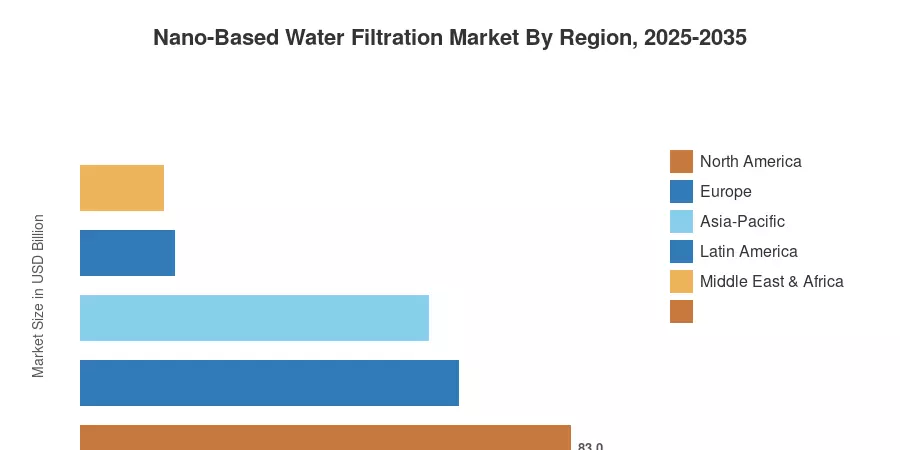
North America continues to be the leading region, accounting for over 35% of worldwide income in 2025 (about USD 83,109 million), thanks to strict EPA water quality regulations, significant municipal investment, and an established industrial base. The fastest-growing region is Asia-Pacific, which is expected to develop at a compound annual growth rate (CAGR) of more than 17% between 2026 and 2035 due to increased industrial wastewater creation, extensive government water initiatives in China and India, and rapid urbanization. Underpinned by EU regulatory mandates on water reuse and circular economy aims, Europe is the second-largest market, contributing around 27% of global revenue. In the future, double-digit growth is anticipated to be sustained through the end of the forecast period due to the convergence of falling nanomaterial manufacturing costs, growing municipal adoption in developing economies, and stricter worldwide water quality laws.


Key Report Takeaways

Segment Dimension Key Metric Notes
Product Type — Dominant Nanomembrane Filters: ~USD 90,233 Mn (2025) Largest share due to municipal and industrial-scale deployment
Product Type — Fastest Growing Carbon Nanotube Filters: ~17.8% CAGR Driven by scalable graphene nanotube production breakthroughs
Application — Dominant Municipal Water Treatment: ~USD 75,985 Mn (2025) Underpinned by government clean water mandates globally
Application — Fastest Growing Industrial Wastewater Treatment: ~16.9% CAGR Rapid industrial expansion in APAC and stricter discharge norms
End User — Dominant Municipal & Government Bodies: ~USD 83,109 Mn (2025) Sustained by federal and state-level water infrastructure spending
End User — Fastest Growing Residential: ~16.2% CAGR Growing consumer awareness and point-of-use nano filter adoption
Region — Dominant North America: ~USD 83,109 Mn (2025) Mature infrastructure, stringent regulatory standards
Region — Fastest Growing Asia-Pacific: ~17.5% CAGR Urbanization, massive government investment and industrial growth
Market Concentration Tier 1 players hold ~43.2% share Moderately consolidated; top firms invest heavily in R&D
Overall Market USD 237.454 Bn (2025) → USD 910.404 Bn (2035) 14.57% CAGR across the forecast horizon


Market Size and Forecast (2019–2035)

Market Research Future (MRFR) derives market sizing using a rigorous bottom-up and top-down approach, triangulating primary interviews with industry executives, publicly filed financial data, regulatory databases, and proprietary demand models. Historical values (2019–2024) are based on verified revenue data, the base year (2025) reflects the most current validated estimates, and the forecast period (2026–2035) applies segment-level growth modeling calibrated against macroeconomic indicators, policy pipelines, and technology adoption curves.
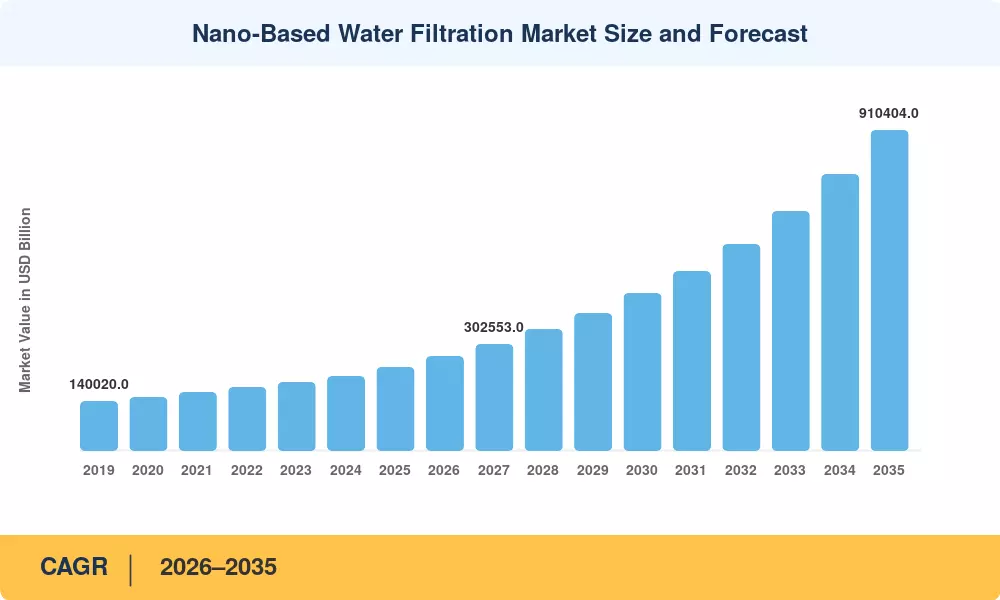
Nano-Based Water Filtration Market Size and Forecast
Our Impact
Enabled $4.3B Revenue Impact for Fortune 500 and Leading Multinationals
Partnering with 2000+ Global Organizations Each Year
30K+ Citations by Top-Tier Firms in the Industry

Driver Impact Analysis

Driver ~% Impact on CAGR Geographic Relevance Impact Timeline
Rising Global Water Scarcity & Demand for Clean Water ~55% Global (strongest in APAC, MEA) Long-term (2026–2035)
Government Investments in Water Infrastructure ~45% North America, APAC, Europe Medium-to-Long-term (2026–2032)


Rising Global Water Scarcity & Demand for Clean Water

The World Health Organization projects that by 2030, almost half of the world's population will reside in regions with significant levels of freshwater stress [5]. Droughts brought on by climate change, depletion of aquifers, and pollution from industrial and agricultural runoff are making the situation worse. Heavy metals, pharmaceutical residues, per- and polyfluoroalkyl substances (PFAS), and other emerging pollutants that conventional filtration is unable to effectively remove are all addressed by nano-based water filtration technologies, especially nanomembranes and nanoparticle-enhanced adsorption systems, which offer superior contaminant removal efficiency at the sub-micron level [7].

In Asia-Pacific and the Middle East and Africa, where population growth, fast urbanization, and a lack of legacy infrastructure generate greenfield demand for cutting-edge treatment solutions, the influence of this factor is particularly noticeable. The Jal Jeevan Mission aims to provide piped water connections to every rural family in India alone, opening up a multibillion-dollar addressable market for point-of-use and community-scale nano-filtration technologies [8]. This long-term, fundamental factor accounts for about 55% of the market's anticipated CAGR.


Government Investments in Water Infrastructure

Governments all across the world are investing previously unheard-of amounts of money in modernizing water infrastructure. Over USD 55 billion is set aside for water and wastewater infrastructure under the US Bipartisan Infrastructure Law, with a sizeable amount designated for cutting-edge treatment technologies [6]. China's 14th Five-Year Plan contains significant measures for improving industrial wastewater treatment and urban water supply. Simultaneously, the European Union's updated Drinking Water Directive requires stricter quality criteria that prioritize solutions possible by nanotechnology [9].

Through subsidies, public-private partnerships, and preferential financing, these initiatives lower adoption barriers and establish direct procurement pipelines for makers of nano-based filtration equipment. With projects approved between 2025 and 2028 translating to equipment demand through 2032 and beyond, the medium-to-long-term effect timeline matches the multi-year capital project cycles characteristic of water infrastructure. About 45% of incremental growth can be attributed to this source.


Restraints Impact Analysis

Restraint ~% Drag on CAGR Geographic Relevance Impact Timeline
High Production & Capital Costs ~100% Global (strongest in developing economies) Short-to-Medium-term (2026–2030)


High Production & Capital Costs

The production of nanomaterials — including carbon nanotubes, graphene nanoplatelets, and nano-silver — requires specialized synthesis processes such as chemical vapor deposition, sol-gel methods, and arc-discharge techniques that entail significant energy consumption and high-purity feedstock requirements [10]. Capital expenditure for nano-filtration manufacturing facilities remains substantially above that for conventional polymer membrane plants, creating a barrier to entry for smaller firms and limiting price competitiveness in cost-sensitive markets. While ongoing R&D investments — such as OCSiAl's flagship production center in Luxembourg — are expected to achieve economies of scale and reduce per-unit costs by an estimated 30–40% by 2030, the near-term cost premium continues to constrain adoption rates, particularly in Latin America, Sub-Saharan Africa, and parts of Southeast Asia where municipal budgets are limited. As production scales and process innovations mature, this restraint is expected to diminish progressively after 2030.


Nano-Based Water Filtration Market Opportunities

Rapid Urbanization and Industrial Wastewater Generation

The rapid urbanization of emerging nations is producing massive amounts of industrial and municipal wastewater; this effluent must undergo improved treatment before being released or reused. According to UN estimates, 60% of the world's population will live in cities by 2030, with the urban population in South Asia and sub-Saharan Africa almost doubling between 2020 and 2050 [12]. Alongside this wave of urbanization comes industrial growth in industries like food processing, electronics manufacturing, textiles, and pharmaceuticals, all of which generate complex effluent streams with microplastics, organic pollutants, and heavy metals that nano-based filtration is uniquely suited to handle [13].

Over the course of the forecast period, the industrial wastewater treatment segment—which was estimated to be worth USD 66,487 million in 2025—is expected to increase at a compound annual growth rate (CAGR) of roughly 16.9%, resulting in a cumulative incremental revenue opportunity of over USD 180 billion. The need for high-efficiency nano-filtration modules that can treat and recover water from difficult industrial waste streams is being further accelerated by zero-liquid-discharge (ZLD) regulations in China, India, and some regions of the EU. Over the next ten years, businesses that invest in scalable, modular nano-filtration systems designed for industrial uses are well-positioned to take a sizable chunk of this market

.


Nano-Based Water Filtration Market Future Outlook

Technology Evolution Trajectory

First-generation nanomembranes will give way to multifunctional nanomaterials that combine filtration, disinfection, and pollutant sensing in integrated modules during the course of the next ten years. Graphene oxide membranes, carbon nanotube-based filters, and photocatalytic nano-TiO₂ composites are all moving from pilot-scale to commercial production. When OCSiAl's Luxembourg plant reaches full capacity, graphene nanotube costs are predicted to drop by more than 30%. It is anticipated that by 2030–2032, improved nanomaterial synthesis and AI-enabled process optimization will converge to produce self-monitoring filtration systems with real-time performance adjustment capabilities, significantly increasing operational efficiency and lowering lifecycle costs.

Competitive Dynamics and Market Structure Evolution

The market's current structure — with Tier 1 players holding approximately 43.2% share, Tier 2 at 32.6%, and Tier 3 at 24.2% — is expected to undergo significant consolidation. Strategic acquisitions, exemplified by Birla Carbon's 2023 acquisition of Nanocyl SA, signal a trend toward vertical integration as chemical conglomerates seek to secure nanomaterial supply chains. By 2030, MRFR anticipates that the top five players will command over 50% market share, with differentiation increasingly driven by proprietary nanomaterial formulations, manufacturing scale, and embedded digital monitoring capabilities rather than basic filtration performance.

Regulatory and Sustainability-Driven Shifts

Adoption of nano-filtration will continue to be fueled by stricter international laws on emerging pollutants, such as PFAS, microplastics, pharmaceutical residues, and heavy metals. China's increasing industrial discharge standards, the EU's zero-pollution goal, and the EPA's upcoming PFAS national primary drinking water regulations all combine to create a regulatory floor that traditional technologies cannot meet, thereby requiring the switch to nano-enabled solutions. The demand for high-selectivity nano-filtration membranes that can recover valuable elements from effluent streams will be driven concurrently by circular economy frameworks that support resource recovery from wastewater and water reuse.


Long-Range Demand Scenario

Under MRFR's base-case scenario, the global nano-based water filtration market reaches USD 910.404 billion by 2035. In an accelerated-adoption scenario — driven by faster regulatory implementation, earlier-than-expected cost parity with conventional systems, and breakthrough nanomaterial performance — the market could reach USD 1.0–1.1 trillion by 2035. Conversely, a constrained scenario involving prolonged production cost challenges and slower regulatory adoption in emerging markets would yield a 2035 value of approximately USD 780–820 billion. Across all scenarios, the structural drivers of water scarcity, population growth, and industrial expansion ensure sustained double-digit growth through the forecast horizon.


Nano-Based Water Filtration Market Segmentation

Dimension Sub-Segments Dominant Segment (2025) Fastest Growing Segment
Product Type Nanomembrane Filters, Carbon Nanotube Filters, Nanofiber Filters, Nanoparticle-Based Filters, Others Nanomembrane Filters Carbon Nanotube Filters (~17.8% CAGR)
Application Municipal Water Treatment, Industrial Wastewater Treatment, Residential Water Purification, Agricultural Water Treatment, Others Municipal Water Treatment Industrial Wastewater Treatment (~16.9% CAGR)
End User Municipal & Government Bodies, Industrial, Commercial, Residential, Others Municipal & Government Bodies Residential (~16.2% CAGR)


By Product Type

Segment 2025 Est. (USD Mn) Primary Demand Driver
Nanomembrane Filters 90,233 Proven municipal/industrial-scale efficacy; regulatory compliance
Carbon Nanotube Filters 56,989 Superior flux rates; graphene nanotube cost reduction
Nanofiber Filters 42,742 Air-water crossover applications; cost-effective media
Nanoparticle-Based Filters 28,495 Heavy metal and PFAS adsorption; point-of-use systems
Others 18,996 Emerging photocatalytic and hybrid nanomaterials


Nanomembrane filters dominate the product type segment, generating approximately USD 90,233 million in 2025 revenues. Their established track record in municipal and industrial applications, combined with the broadest regulatory approval base, ensures continued market leadership. However, carbon nanotube filters are emerging as the fastest-growing product type at approximately 17.8% CAGR, propelled by breakthroughs in scalable production — particularly OCSiAl's Luxembourg facility and Birla Carbon's expanded CNT portfolio following the Nanocyl SA acquisition — which are driving down unit economics and enabling commercial-scale deployment for the first time.

By Application

Segment 2025 Est. (USD Mn) Primary Demand Driver
Municipal Water Treatment 75,985 Government clean water mandates; PFAS regulations
Industrial Wastewater Treatment 66,487 ZLD mandates; industrial expansion in APAC
Residential Water Purification 52,240 Consumer awareness; point-of-use product proliferation
Agricultural Water Treatment 26,120 Irrigation water quality; pesticide/fertilizer remediation
Others 16,622 Marine, mining, and specialty applications


Municipal water treatment is the largest application segment, supported by government mandates worldwide that require advanced contaminant removal capabilities beyond conventional treatment. Industrial wastewater treatment is the fastest-growing application at approximately 16.9% CAGR, reflecting the rapid expansion of manufacturing capacity in Asia-Pacific and the proliferation of stringent zero-liquid-discharge regulations that necessitate high-efficiency nano-filtration solutions.

By End User

Segment 2025 Est. (USD Mn) Primary Demand Driver
Municipal & Government Bodies 83,109 Infrastructure spending programs; regulatory compliance
Industrial 71,236 Process water quality; discharge regulations
Commercial 47,491 Building water quality standards; LEED/green certification
Residential 35,618 Point-of-use adoption; consumer health awareness


Municipal and government bodies constitute the largest end-user segment at USD 83,109 million, reflecting the dominance of public-sector water infrastructure procurement in driving market demand. The residential segment, while currently the smallest, exhibits the highest growth trajectory at approximately 16.2% CAGR, driven by rising consumer awareness of water quality issues and the increasing availability of affordable, compact nano-filtration units for point-of-use applications across both developed and emerging markets.


Regional Market Share Analysis

Region 2025 Market (USD Mn) CAGR (2026–2035) Primary Investment Themes
North America 83,109 12.8% EPA PFAS regulations; municipal infrastructure modernization
Europe 64,113 13.2% EU Drinking Water Directive; industrial water reuse mandates
Asia-Pacific 59,364 17.5% Government clean water missions; industrial wastewater ZLD
Latin America 16,622 14.0% Municipal water access expansion; mining wastewater treatment
Middle East & Africa 14,247 13.8% Desalination pre-treatment; water scarcity mitigation
Total 237,454 14.57%


North America

Country 2025 Est. (USD Mn) Key Driver
United States 66,487 Bipartisan Infrastructure Law; EPA PFAS action plan
Canada 12,472 Federal water quality modernization; Indigenous community water programs
Mexico 4,150 Industrial corridor wastewater treatment expansion


North America leads the global market with an estimated USD 83,109 million in 2025 revenues, driven by the United States' advanced regulatory environment, robust municipal spending, and early adoption of nanotechnology-enabled water treatment. The EPA's aggressive PFAS action plan, which sets enforceable limits on per- and polyfluoroalkyl substances in drinking water, is a significant catalyst for nano-filtration deployment, as conventional activated carbon systems are less effective against short-chain PFAS variants. Canada's commitment to resolving long-term boil water advisories in Indigenous communities has further stimulated demand for compact, high-performance nano-filtration units suitable for remote deployment.

Europe

Country 2025 Est. (USD Mn) Key Driver
Germany 16,670 Industrial water recycling; Industrie 4.0 integration
United Kingdom 11,390 Thames Tideway and water utility capital programs
France 10,260 EU compliance; agricultural runoff remediation
Italy 7,700 Mediterranean water stress; tourism sector standards
Rest of Europe 18,093 Nordic circular economy mandates; Eastern EU convergence funding


Europe represents the second-largest regional market at approximately USD 64,113 million in 2025. The revised EU Drinking Water Directive, which tightened standards for emerging contaminants including microplastics and endocrine disruptors, is driving utilities across the continent to invest in advanced nano-filtration upgrades. Germany leads European adoption through its industrial water recycling mandates and integration of smart nano-filtration monitoring within Industrie 4.0 frameworks, while the UK's multi-billion-pound Thames Tideway programme is catalyzing broader water infrastructure modernization.

Asia-Pacific

Country 2025 Est. (USD Mn) Key Driver
China 23,746 14th Five-Year Plan water infrastructure; industrial ZLD mandates
India 14,247 Jal Jeevan Mission; textile and pharma wastewater treatment
Japan 8,906 Aging infrastructure replacement; advanced membrane R&D
South Korea 5,342 Semiconductor fab water recycling; K-water modernization
Rest of APAC 7,123 ASEAN urbanization; agricultural water treatment


Asia-Pacific is the fastest-growing region with a projected CAGR of approximately 17.5% over 2026–2035, driven by the confluence of rapid urbanization, massive government water infrastructure programs, and accelerating industrial growth. China's urban water infrastructure investment under the 14th Five-Year Plan and India's Jal Jeevan Mission collectively represent over USD 100 billion in committed government spending, creating a substantial addressable market. Japan and South Korea contribute through advanced R&D in next-generation nanomembranes and high-purity water systems for semiconductor manufacturing.

Latin America

Country 2025 Est. (USD Mn) Key Driver
Brazil 8,311 SABESP privatization; urban water access expansion
Mexico 3,325 Industrial corridor development; NAFTA-linked manufacturing
Argentina 1,995 Mining sector wastewater; agricultural remediation
Rest of LATAM 2,991 Regional development bank-funded water programs


Latin America accounts for approximately USD 16,622 million in 2025, with Brazil as the primary market. The region's growth trajectory (14.0% CAGR) is supported by expanding municipal water access programs, mining sector wastewater treatment requirements, and development bank-financed infrastructure projects. The privatization of major utilities such as SABESP in Brazil is expected to accelerate technology adoption as private operators pursue efficiency improvements through advanced filtration.

Middle East & Africa

Country/Sub-region 2025 Est. (USD Mn) Key Driver
GCC Countries 7,124 Desalination pre-treatment; mega-project water infrastructure
South Africa 2,849 Municipal water quality crises; mining remediation
Rest of MEA 4,274 NGO/multilateral funded water access programs


The Middle East & Africa market, valued at approximately USD 14,247 million in 2025, is driven by acute water scarcity and substantial investments in desalination infrastructure, particularly in the GCC states. Nano-filtration technologies are increasingly used as pre-treatment stages in desalination plants, improving membrane longevity and reducing energy consumption. In Sub-Saharan Africa, donor-funded and NGO-supported water access programs are creating demand for low-maintenance, high-efficacy nano-filtration solutions suitable for decentralized deployment.


Nano-Based Water Filtration Market By Region, 2025-2035

Competitive Benchmarking

The global nano-based water filtration market exhibits moderate concentration, with Tier 1 players — defined as companies with estimated annual nano-filtration revenues exceeding USD 5 billion — collectively commanding approximately 43.2% of market share. Tier 2 players (USD 1–5 billion) hold 32.6%, and Tier 3 players (below USD 1 billion) account for the remaining 24.2%. The Herfindahl-Hirschman Index (HHI) is estimated in the 800–1,200 range, indicating a moderately competitive market with no single dominant player. Competition is primarily driven by nanomaterial production capacity, intellectual property portfolios, geographic distribution networks, and the ability to provide integrated filtration-plus-monitoring solutions.

Company Est. Revenue Share Key Offerings Strategic Positioning
OCSiAl ~8.5% Graphene nanotube-enhanced filtration media; TUBALL™ platform Global leader in graphene nanotube production; Luxembourg mega-facility expansion
Cabot Corporation ~7.8% Carbon nanotube and specialty carbon filtration materials Diversified materials leader; strong industrial channel
Arkema ~7.2% Fluoropolymer nanomembranes; Kynar® PVDF water treatment Integrated chemistry platform; European and North American focus
ZEON Corporation ~6.5% Single-wall carbon nanotubes; high-purity filtration components Advanced materials R&D; Asia-Pacific distribution strength
Nanocyl SA (Birla Carbon) ~5.5% Multi-walled carbon nanotube products; conductive additives Integrated into Birla Carbon's global scale, energy and water focus
Canatu ~3.8% Carbon nanobud™ films; flexible filtration substrates Niche premium positioning; Nordic R&D base
Nanografi ~3.2% Graphene and nano-powder filtration media; custom synthesis Cost-competitive Turkish manufacturing; broad product catalog
NoPo Nanotechnologies ~2.8% Functionalized nanoparticle filtration systems Innovation-led; emerging market focus
AdNano Technologies Pvt Ltd ~2.5% Nanoparticle synthesis; custom nano-filtration solutions India-based; positioned for Jal Jeevan Mission procurement
Carbon Solutions, Inc ~2.2% Fullerene and carbon nanomaterial water treatment products Specialty carbon focus; US research partnerships
Other Market Players ~50.0% Diverse regional and specialty nano-filtration providers Fragmented long-tail of niche, regional, and emerging players


Recent News & Developments

OCSiAl (November 2025)


OCSiAl announced the signing of a long-term land lease for the development of its flagship graphene nanotube production center in Differdange, Luxembourg. Upon completion, this deep-tech manufacturing center is planned to become a scalable facility intended to serve as a development hub for European advanced materials. This investment marks a major milestone for the advanced materials sector, specifically targeting the electric vehicle battery, automotive, consumer electronics, and specialized tires markets. The facility's European location positions OCSiAl to meet growing global and regional demand for single-walled carbon nanotubes used to enhance the conductivity, performance, and durability of next-generation polymer matrices and energy storage systems.


Nanocyl SA — Acquisition by Birla Carbon (October 2023):

Nanocyl SA was acquired by Birla Carbon, a global leader in carbon black and specialty carbons, to expand Birla Carbon's presence in the energy systems market, particularly for lithium-ion battery applications. The acquisition integrates Nanocyl's expertise in multi-walled carbon nanotube (MWCNT) production and functionalization into Birla Carbon's extensive global manufacturing and distribution network. This consolidation enhances the availability and competitiveness of advanced carbon conductive additives, creating a comprehensive portfolio aimed at accelerating the electrification of transportation and broadening the potential of these materials across energy storage applications.


Nano-Based Water Filtration Market Report Scope

Parameter Detail
Market Scope Global Nano-Based Water Filtration Market
Study Period 2019–2035
CAGR Window 2026–2035
Base Year 2025
Market Size (2025) USD 237.454 Billion
Market Size (2035) USD 910.404 Billion
Fastest Growing Region Asia-Pacific (~17.5% CAGR)
Dominant Region North America (~35% revenue share, 2025)
Fastest Growing Product Type Carbon Nanotube Filters (~17.8% CAGR)
Fastest Growing Application Industrial Wastewater Treatment (~16.9% CAGR)
Fastest Growing End User Residential (~16.2% CAGR)
Companies Profiled Nanografi, NoPo Nanotechnologies, OCSiAl, AdNano Technologies Pvt Ltd, Cabot Corporation, Arkema, Canatu, Nanocyl SA, Carbon Solutions Inc, ZEON Corporation
Valuation Currency USD (Billion for global headlines; Million for segment/regional tables)
Segments Covered Product Type, Application, End User


FAQs

What is the projected size of the global nano-based water filtration market by 2035?
The global nano-based water filtration market is projected to reach USD 910.404 billion by 2035, growing from USD 237.454 billion in 2025 at a CAGR of 14.57% during the forecast period (2026–2035). This growth is driven by rising water scarcity, government infrastructure investments, and declining nanomaterial production costs.
Which product type segment is expected to grow the fastest?
Carbon nanotube (CNT) filters are the fastest-growing product type segment, projected at approximately 17.8% CAGR through 2035. Key enablers include OCSiAl's new Luxembourg mega-facility, which will dramatically increase global graphene nanotube production capacity and reduce unit costs by an estimated 30–40%.
Why is Asia-Pacific the fastest-growing regional market?
Asia-Pacific is projected to grow at approximately 17.5% CAGR, driven by massive government programs such as China's water infrastructure investments under its 14th Five-Year Plan and India's Jal Jeevan Mission, combined with rapid urbanization and industrial expansion generating large volumes of wastewater requiring advanced treatment.
How is regulatory tightening affecting market growth?
Regulatory developments — including the EPA's PFAS action plan in the United States, the EU's revised Drinking Water Directive, and zero-liquid-discharge mandates in China and India — are creating compliance-driven demand that conventional filtration technologies cannot satisfy, effectively mandating the transition to nano-enabled solutions across municipal and industrial applications.
What is the competitive structure of the market?
The market is moderately concentrated, with Tier 1 players holding approximately 43.2% share, Tier 2 at 32.6%, and Tier 3 at 24.2%. Strategic M&A activity, exemplified by Birla Carbon's acquisition of Nanocyl SA, signals a consolidation trend that is expected to increase top-five player concentration to over 50% by 2030.
What are the main barriers to faster market adoption?
High production and capital costs for nanomaterials remain the primary constraint, particularly in cost-sensitive emerging markets. However, ongoing scale-up investments — such as OCSiAl's production expansion — and process innovations are expected to reduce per-unit costs by 30–40% by 2030, progressively alleviating this barrier and broadening commercial viability.                    
Author
Author
Author Profile
Garvit Vyas LinkedIn
Vice President - Operations
Garvit Vyas is a Research Analyst with experience in working across multiple industry domains in the market research sector. Over the past four years, he has been actively involved in analyzing diverse markets, gathering industry insights, and contributing to the development of comprehensive research reports. His work includes studying market trends, evaluating competitive landscapes, and supporting data-driven business insights. In the early phase of his career, Garvit worked on cross-domain research projects, which helped him build a strong foundation in market analysis, data interpretation, and industry intelligence across various sectors. Later, he transitioned into the Quality Control (QC) function, where he focuses on reviewing and refining research reports and marketing collaterals to ensure accuracy, consistency, and high editorial standards. His responsibilities include validating research data, improving report structure, and maintaining the overall quality of published content. Garvit is committed to maintaining strong research integrity and delivering reliable insights that support informed business decision-making.
Download Free Sample

Kindly complete the form below to receive a free sample of this Report

Download PDF ×

We do not share your information with anyone. However, we may send you emails based on your report interest from time to time. You may contact us at any time to opt-out.