×
Request Free Sample ×

Kindly complete the form below to receive a free sample of this Report

Leading companies partner with us for data-driven Insights

clients tt-cursor
Hero Background

Nanoelectronics Market

ID: MRFR/SEM/4627-HCR
128 Pages
Aarti Dhapte
October 2025

Nanoelectronics Market Research Report By Application (Consumer Electronics, Medical Devices, Telecommunications, Automotive, Aerospace), By Type of Devices (Transistors, Memory Devices, Sensors, Quantum Dots, Nanowires), By Material Used (Carbon Nanotubes, Nanoparticles, Nanocomposites, Graphene, Polymers), By End User (Telecommunication Companies, Healthcare Providers, Automotive Manufacturers, Electronics Manufacturers) and By Regional (North America, Europe, South America, Asia Pacific, Middle East and Africa) – Industry Forecast to 2035

Share:
Download PDF ×

We do not share your information with anyone. However, we may send you emails based on your report interest from time to time. You may contact us at any time to opt-out.

Nanoelectronics Market Infographic
Purchase Options

Nanoelectronics Market Summary

As per MRFR analysis, the Nanoelectronics Market Size was estimated at 17.43 USD Billion in 2024. The Nanoelectronics industry is projected to grow from 18.84 USD Billion in 2025 to 41.09 USD Billion by 2035, exhibiting a compound annual growth rate (CAGR) of 8.11 during the forecast period 2025 - 2035.

Key Market Trends & Highlights

The Nanoelectronics Market is poised for substantial growth driven by technological advancements and increasing demand for miniaturization.

  • North America remains the largest market for nanoelectronics, driven by robust consumer electronics demand.
  • Asia-Pacific is emerging as the fastest-growing region, fueled by rapid advancements in technology and manufacturing capabilities.
  • The consumer electronics segment dominates the market, while the medical devices segment is experiencing the fastest growth due to increasing healthcare needs.
  • Rising demand for miniaturization and increased investment in research and development are key drivers propelling market expansion.

Market Size & Forecast

2024 Market Size 17.43 (USD Billion)
2035 Market Size 41.09 (USD Billion)
CAGR (2025 - 2035) 8.11%

Major Players

Intel Corporation (US), Samsung Electronics (KR), Taiwan Semiconductor Manufacturing Company (TW), Qualcomm Incorporated (US), Texas Instruments Incorporated (US), NVIDIA Corporation (US), Micron Technology, Inc. (US), STMicroelectronics N.V. (NL), Broadcom Inc. (US)

Nanoelectronics Market Trends

The Nanoelectronics Market is currently experiencing a transformative phase, driven by advancements in materials science and miniaturization technologies. This sector encompasses a range of applications, including semiconductors, sensors, and energy storage devices, which are becoming increasingly integral to modern electronics. As the demand for smaller, more efficient devices escalates, innovations in nano-scale components are likely to play a pivotal role in shaping the future of consumer electronics, telecommunications, and healthcare technologies. Furthermore, the integration of nanoelectronics into emerging fields such as artificial intelligence and the Internet of Things suggests a promising trajectory for market growth. In addition to technological advancements, environmental considerations are influencing the Nanoelectronics Market. The push for sustainable practices and energy-efficient solutions is prompting manufacturers to explore eco-friendly materials and processes. This shift not only aligns with The Nanoelectronics Market's appeal to environmentally conscious consumers. As the industry evolves, collaboration between academia and industry stakeholders appears essential for fostering innovation and addressing challenges related to scalability and cost-effectiveness. Overall, the Nanoelectronics Market is poised for substantial growth, driven by both technological innovation and a commitment to sustainability.

Advancements in Material Science

Recent developments in material science are significantly impacting the Nanoelectronics Market. Researchers are exploring new materials that enhance the performance and efficiency of nano-scale devices. These innovations may lead to improved conductivity, reduced energy consumption, and greater durability, thereby expanding the range of applications for nanoelectronics.

Integration with Emerging Technologies

The convergence of nanoelectronics with emerging technologies such as artificial intelligence and the Internet of Things is reshaping the market landscape. This integration could enable smarter devices and systems, enhancing functionality and user experience. As these technologies evolve, the demand for nanoelectronics is likely to increase, driving further innovation.

Focus on Sustainability

Sustainability is becoming a central theme within the Nanoelectronics Market. Manufacturers are increasingly prioritizing eco-friendly materials and processes to meet consumer demand for greener products. This focus on sustainability not only addresses environmental concerns but also positions companies favorably in a market that values corporate responsibility.

Nanoelectronics Market Drivers

Rising Demand for Miniaturization

The Nanoelectronics Market is experiencing a notable surge in demand for miniaturization across various sectors, including consumer electronics, telecommunications, and automotive. As devices become increasingly compact, the need for smaller, more efficient electronic components is paramount. This trend is driven by consumer preferences for lightweight and portable gadgets, which has led to innovations in nano-scale materials and fabrication techniques. According to recent data, the market for miniaturized electronic components is projected to grow at a compound annual growth rate of approximately 10% over the next five years. This growth is indicative of the broader shift towards more integrated and efficient electronic systems, positioning the Nanoelectronics Market as a critical player in the evolution of technology.

Growing Need for Energy Efficiency

Energy efficiency is becoming a critical concern across various industries, and the Nanoelectronics Market is responding to this challenge with innovative solutions. As energy consumption becomes a focal point for both consumers and manufacturers, there is a pressing need for electronic components that minimize power usage while maximizing performance. Nanoelectronics Market, with their ability to operate at lower voltages and reduced power levels, are well-positioned to address these demands. Recent studies indicate that energy-efficient nanoelectronics can reduce power consumption by up to 30% compared to traditional components. This shift towards energy-efficient technologies not only benefits the environment but also enhances the competitiveness of products in the market, thereby driving growth within the Nanoelectronics Market.

Emergence of Internet of Things (IoT)

The proliferation of the Internet of Things (IoT) is significantly influencing the Nanoelectronics Market, as the demand for interconnected devices continues to rise. IoT applications require highly efficient, low-power electronic components that can operate seamlessly in diverse environments. This has led to an increased focus on developing nanoelectronics that can support the vast network of devices, from smart home appliances to industrial sensors. Market analysts project that the IoT sector will contribute to a substantial portion of the nanoelectronics market, with estimates suggesting a growth rate of around 12% annually. Consequently, the Nanoelectronics Market is adapting to meet the unique challenges posed by IoT, driving innovation and expanding its reach.

Advancements in Communication Technologies

The rapid advancements in communication technologies are significantly shaping the Nanoelectronics Market. With the advent of 5G and beyond, there is an increasing demand for high-speed, low-latency electronic components that can support these new standards. Nanoelectronics Market play a crucial role in enabling faster data transmission and improved connectivity, which are essential for modern communication systems. Market forecasts suggest that the demand for nanoelectronics in communication applications will grow at a rate of approximately 14% over the next few years. This growth is driven by the need for enhanced performance in mobile devices, network infrastructure, and data centers. As such, the Nanoelectronics Market is likely to see continued investment and innovation in response to these evolving communication needs.

Increased Investment in Research and Development

Investment in research and development within the Nanoelectronics Market is witnessing a significant uptick, as companies and governments recognize the potential of nano-scale technologies. This influx of funding is aimed at exploring new materials, enhancing fabrication processes, and developing innovative applications. For instance, recent reports indicate that R&D spending in nanoelectronics is expected to reach over 15 billion dollars by 2026. This financial commitment not only accelerates technological advancements but also fosters collaboration between academia and industry, leading to breakthroughs that could redefine electronic capabilities. As a result, the Nanoelectronics Market is poised for substantial growth, driven by a robust pipeline of innovative products and solutions.
Market Segment Insights

Nanoelectronics Market Application Insights

The Nanoelectronics Market encompasses a variety of applications, with the overall market projected to reach a valuation of 16.12 USD Billion in 2023. This growth trajectory reflects the increasing reliance on nanoelectronics across numerous sectors, driven by advancements in technology and the miniaturization of electronic devices. In the realm of Consumer Electronics, this segment is particularly significant, valued at 5.5 USD Billion in 2023, and is poised to double to 11.0 USD Billion by 2032. The prevalence of consumer demand for high-performance devices, smart appliances, and portable electronics contributes to its majority holding in the market.

Additionally, the Medical Devices application plays a crucial role, currently valued at 3.5 USD Billion in 2023 with expectations to reach 7.0 USD Billion in 2032. The integration of nanoelectronics in medical imaging, diagnostics, and therapeutic devices is critical, enhancing the precision and efficiency of healthcare delivery.

Telecommunications is another vital area, with the segment valued at 4.0 USD Billion in 2023 and projected to grow to 8.0 USD Billion by 2032. The industry benefits from the innovation that nanoelectronics brings, particularly in enhancing communication devices and infrastructure, which are vital for the ongoing digital transformation worldwide. The Automotive segment, valued at 2.0 USD Billion in 2023, is set to expand to 4.0 USD Billion by 2032. The adoption of nanoelectronic components in smart vehicles and autonomous driving systems reflects its importance in ensuring safety and enabling advanced functionalities.

Nanoelectronics Market Type of Devices Insights

This segment encompasses a variety of essential components that contribute greatly to advancements in electronic devices. Transistors, known for their foundational role in amplifying and switching signals, remain crucial in driving performance enhancements across technology platforms. Memory Devices are also pivotal, as they enable efficient data storage and processing essential for modern electronic applications.Sensors, with their capability to detect physical phenomena, are increasingly utilized in IoT and automation, driving the demand for smart devices.

The significance of Quantum Dots lies in their ability to enhance display technologies and energy-efficient solutions, while Nanowires present opportunities in flexible electronics and advanced communication systems. The growth in these areas is supported by the increasing demand for high-performance, compact and energy-efficient devices, reflecting broader trends in consumer electronics and industrial applications.The diverse Nanoelectronics Market segments demonstrate the industry's resilience and adaptability in addressing contemporary technological needs.

Nanoelectronics Market Material Used Insights

Among these, Carbon Nanotubes are widely recognized for their exceptional electrical conductivity and strength, making them vital for high-performance electronics. Nanoparticles play a fundamental role in enhancing the properties of materials, offering unique functionalities that are not possible with bulk materials. Nanocomposites, which incorporate nanoparticles into a matrix, have gained traction for their superior mechanical and thermal properties, catering to high-demand applications.Graphene, acclaimed for its remarkable electrical and thermal conductivity, continues to dominate discussions within the industry due to its potential in next-generation electronic components. Additionally, Polymers serve as a key foundation, offering flexibility and versatility in nanoelectronic devices.

The market's growth is driven by the increasing demand for miniaturization in electronic devices and the continuous advancements in material science, although challenges such as production costs and scalability persist. Overall, the Nanoelectronics Market segmentation reveals a diverse material landscape which is pivotal for driving innovations in the industry.

Nanoelectronics Market End User Insights

The End User segmentation reveals significant contributions from industries such as telecommunications, healthcare, automotive, and electronics manufacturing. Telecommunication companies are crucial players, leveraging nanoelectronics for enhanced communication technologies, driving high market growth. In the healthcare sector, providers utilize nanoelectronics for medical devices and diagnostics, thus enhancing patient care and treatment efficacy.Automotive manufacturers are increasingly adopting nanoelectronics, particularly in the development of smart and connected vehicles, contributing to operational efficiency and safety. Furthermore, electronics manufacturers benefit significantly from nanoelectronics as it leads to the production of smaller, more efficient, and powerful devices.

The synergistic relationship between these industries and nanoelectronics illustrates their vital role in shaping future technologies and aligns with the overall upward trajectory of the Nanoelectronics Market revenue, offering a compelling landscape for ongoing investments and innovations.

Nanoelectronics Market Regional Insights

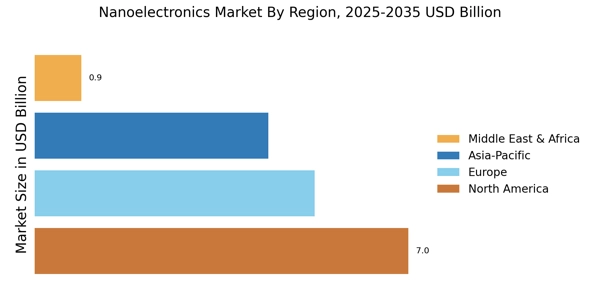
Among the regions, North America dominates the landscape with a valuation of 6.9 USD Billion in 2023, reflecting its strong foothold in technological innovations and research activities. Europe follows, holding a significant share valued at 4.5 USD Billion, supported by robust investments in nanoelectronics manufacturing. APAC, valued at 3.9 USD Billion, is emerging as a critical player, driven by rapid industrialization and technological advancement in countries like China and Japan.South America and MEA contribute with valuations of 0.6 USD Billion and 0.22 USD Billion, respectively, indicating a growing but still limited presence in the nanoelectronics space.

The market growth in these regions is propelled by increasing demands for miniaturized components in electronics, while challenges such as high manufacturing costs and technology accessibility remain. Major opportunities lie in enhanced collaboration among regional players to spur innovation and address market needs effectively, leading to a brighter outlook for the Nanoelectronics Market statistics in the coming years.

Source: Primary Research, Secondary Research, MRFR Database and Analyst Review

Get more detailed insights about Nanoelectronics Market

Regional Insights

North America : Innovation and Leadership Hub

North America is the largest market for nanoelectronics, holding approximately 40% of the global share. The region benefits from strong investments in R&D, a robust technology infrastructure, and a high demand for advanced electronic devices. Regulatory support, particularly from the U.S. government, encourages innovation and commercialization of nanoelectronics technologies, driving growth in this sector. The United States leads the market, with key players like Intel, Qualcomm, and NVIDIA driving advancements in nanoelectronics. The competitive landscape is characterized by significant collaboration between industry and academia, fostering innovation. Canada also plays a vital role, focusing on research and development initiatives that complement the U.S. market, contributing to the overall growth of the region.

Europe : Emerging Technology Landscape

Europe is the second-largest market for nanoelectronics, accounting for approximately 30% of the global share. The region is witnessing a surge in demand for energy-efficient and miniaturized electronic components, driven by stringent environmental regulations and a push for sustainability. The European Union's initiatives to support semiconductor manufacturing and research are pivotal in fostering growth in this sector. Leading countries include Germany, France, and the Netherlands, with significant contributions from companies like STMicroelectronics and ASML. The competitive landscape is marked by a strong emphasis on collaboration between industry and research institutions, enhancing innovation. The presence of various funding programs from the EU further supports the development of nanoelectronics technologies, positioning Europe as a key player in the global market.

Asia-Pacific : Rapid Growth and Adoption

Asia-Pacific is rapidly emerging as a powerhouse in the nanoelectronics market, holding approximately 25% of the global share. The region's growth is driven by increasing demand for consumer electronics, automotive applications, and advancements in telecommunications. Countries like China and South Korea are at the forefront, supported by government initiatives aimed at boosting semiconductor manufacturing and innovation in nanoelectronics. China is the largest market in the region, with significant investments in research and development. South Korea follows closely, with major players like Samsung and Taiwan Semiconductor Manufacturing Company leading the charge. The competitive landscape is characterized by aggressive investments in technology and infrastructure, positioning Asia-Pacific as a critical player in The Nanoelectronics Market.

Middle East and Africa : Emerging Market Potential

The Middle East and Africa (MEA) region is gradually emerging in the nanoelectronics market, currently holding about 5% of the global share. The growth is primarily driven by increasing investments in technology and infrastructure, alongside a rising demand for electronic devices. Governments in the region are focusing on diversifying their economies, which includes fostering the development of the nanoelectronics sector as part of their broader technology strategies. Countries like South Africa and the UAE are leading the charge, with initiatives aimed at enhancing local manufacturing capabilities. The competitive landscape is still developing, with opportunities for both local and international players to establish a foothold. As the region continues to invest in technology, the potential for growth in nanoelectronics is significant, attracting attention from global companies looking to expand their presence.

Nanoelectronics Market Regional Image

Key Players and Competitive Insights

The competitive landscape of the Nanoelectronics Market is characterized by rapid advancements in technology, increasing investments in research and development, and the rising demand for miniaturized electronic components across various industries. This market has gained significant attention due to its potential to revolutionize the electronics sector by enabling the production of smaller, faster and more efficient devices. The competition is intense as key players strive to innovate and introduce cutting-edge nanotechnology solutions that can cater to applications ranging from consumer electronics to healthcare.

As major advancements emerge, companies within the sector are also focusing on strategic partnerships, mergers and acquisitions, and collaborations with universities and research institutions to enhance their technological capabilities and expand their market reach.STMicroelectronics has firmly established itself as a formidable player in the Nanoelectronics Market due to its robust product portfolio and strategic positioning within the highly competitive environment. The company excels in providing a range of innovative nano-electronic solutions that effectively address the needs of industries such as automotive, industrial, and consumer electronics.

With its investment in advanced manufacturing techniques and sustainable technologies, STMicroelectronics has managed to leverage its expertise to create high-performance electronic components that serve as crucial building blocks for future technologies. Its strong commitment to research and development has allowed it to stay ahead of the curve, continuously delivering enhancements in the efficiency and functionality of its products.

Furthermore, the company's global presence and established relationships with key customers have reinforced its leadership position, ensuring a competitive edge in the evolving landscape of nanoelectronics.TSMC, as a leader in semiconductor manufacturing, plays a critical role in the Nanoelectronics Market, driving significant innovations that push the envelope of what is possible in this domain. The company's focus on advanced node technologies and scaling down semiconductor features has positioned it at the forefront of nanoelectronics advancements. TSMC's ability to provide cutting-edge manufacturing services has attracted a diverse clientele across various sectors, allowing it to remain agile and responsive to market demands.

With a strong emphasis on quality, efficiency, and sustainability, TSMC has developed a reputation for excellence, making it a preferred partner for companies seeking to leverage nanoelectronics in their product offerings. Additionally, TSMC's noteworthy investments in RD and state-of-the-art manufacturing facilities equip it to meet the increasing requirements for performance and power savings in nanoelectronic devices, solidifying its pivotal role in shaping the future of this dynamic market.

Key Companies in the Nanoelectronics Market market include

Industry Developments

The Nanoelectronics Market has experienced significant developments recently, with major players like TSMC and Intel continuing to push advancements in semiconductor technology and fabrication processes. STMicroelectronics has been focusing on innovative applications in automotive and industrial electronics, while Qualcomm has announced new partnerships aimed at enhancing connectivity solutions. In parallel, IBM and NVIDIA are advancing quantum computing capabilities, which are expected to revolutionize nanoelectronics by enabling faster processing and more efficient energy use. Infineon Technologies and Texas Instruments are also investing in smart sensor technology to cater to the Internet of Things (IoT) market.

Mergers and acquisitions have been notable, as seen with Broadcom's recent move to acquire VMware to diversify its portfolio and strengthen its position within the computing landscape. Micron Technology continues to grow its market share through strategic expansions in-memory technology, which is critical for high-performance applications. As these companies adapt to changing market demands, they collectively drive innovation and enhance market valuation, which is expected to boost overall growth in the Nanoelectronics Market.

Future Outlook

Nanoelectronics Market Future Outlook

The Nanoelectronics Market is projected to grow at an 8.11% CAGR from 2024 to 2035, driven by advancements in semiconductor technology, increased demand for miniaturization, and enhanced energy efficiency.

New opportunities lie in:

  • Development of advanced quantum dot applications for consumer electronics.
  • Investment in nano-coating technologies for improved device performance.
  • Expansion of nanoelectronics in healthcare diagnostics and wearable devices.

By 2035, the Nanoelectronics Market is expected to achieve substantial growth, solidifying its critical role in technology innovation.

Market Segmentation

Nanoelectronics Market End User Outlook

  • Telecommunication Companies
  • Healthcare Providers
  • Automotive Manufacturers
  • Electronics Manufacturers

Nanoelectronics Market Application Outlook

  • Consumer Electronics
  • Medical Devices
  • Telecommunications
  • Automotive
  • Aerospace

Nanoelectronics Market Material Used Outlook

  • Carbon Nanotubes
  • Nanoparticles
  • Nanocomposites
  • Graphene
  • Polymers

Nanoelectronics Market Type of Devices Outlook

  • Transistors
  • Memory Devices
  • Sensors
  • Quantum Dots
  • Nanowires

Report Scope

MARKET SIZE 2024 17.43(USD Billion)
MARKET SIZE 2025 18.84(USD Billion)
MARKET SIZE 2035 41.09(USD Billion)
COMPOUND ANNUAL GROWTH RATE (CAGR) 8.11% (2024 - 2035)
REPORT COVERAGE Revenue Forecast, Competitive Landscape, Growth Factors, and Trends
BASE YEAR 2024
Market Forecast Period 2025 - 2035
Historical Data 2019 - 2024
Market Forecast Units USD Billion
Key Companies Profiled Market analysis in progress
Segments Covered Market segmentation analysis in progress
Key Market Opportunities Advancements in quantum computing and energy-efficient devices drive growth in the Nanoelectronics Market.
Key Market Dynamics Technological advancements drive competitive forces, reshaping supply chains and consumer preferences in the Nanoelectronics Market.
Countries Covered North America, Europe, APAC, South America, MEA

Market Highlights

Author
Aarti Dhapte
Team Lead - Research

She holds an experience of about 6+ years in Market Research and Business Consulting, working under the spectrum of Information Communication Technology, Telecommunications and Semiconductor domains. Aarti conceptualizes and implements a scalable business strategy and provides strategic leadership to the clients. Her expertise lies in market estimation, competitive intelligence, pipeline analysis, customer assessment, etc.

Leave a Comment

FAQs

What is the current valuation of the Nanoelectronics Market as of 2024?

The Nanoelectronics Market was valued at 17.43 USD Billion in 2024.

What is the projected market size for the Nanoelectronics Market in 2035?

The market is projected to reach 41.09 USD Billion by 2035.

What is the expected CAGR for the Nanoelectronics Market during the forecast period 2025 - 2035?

The expected CAGR for the Nanoelectronics Market during 2025 - 2035 is 8.11%.

Which companies are considered key players in the Nanoelectronics Market?

Key players include Intel Corporation, Samsung Electronics, and Taiwan Semiconductor Manufacturing Company.

What are the main application segments of the Nanoelectronics Market?

Main application segments include Consumer Electronics, Medical Devices, Telecommunications, Automotive, and Aerospace.

How much is the Telecommunications segment expected to grow by 2035?

The Telecommunications segment is projected to grow from 4.0 USD Billion in 2024 to 10.0 USD Billion by 2035.

What types of devices are included in the Nanoelectronics Market?

Types of devices include Transistors, Memory Devices, Sensors, Quantum Dots, and Nanowires.

What is the projected growth for Memory Devices in the Nanoelectronics Market?

Memory Devices are expected to grow from 4.0 USD Billion in 2024 to 10.0 USD Billion by 2035.

Which materials are primarily used in the Nanoelectronics Market?

Primary materials include Carbon Nanotubes, Nanoparticles, Nanocomposites, Graphene, and Polymers.

What is the expected growth for Automotive Manufacturers as end users in the Nanoelectronics Market?

Automotive Manufacturers are projected to grow from 5.0 USD Billion in 2024 to 12.0 USD Billion by 2035.

Download Free Sample

Kindly complete the form below to receive a free sample of this Report

Compare Licence

×
Features License Type
Single User Multiuser License Enterprise User
Price $4,950 $5,950 $7,250
Maximum User Access Limit 1 User Upto 10 Users Unrestricted Access Throughout the Organization
Free Customization
Direct Access to Analyst
Deliverable Format
Platform Access
Discount on Next Purchase 10% 15% 15%
Printable Versions