×
Request Free Sample ×

Kindly complete the form below to receive a free sample of this Report

* Please use a valid business email

Leading companies partner with us for data-driven Insights

clients tt-cursor
Hero Background

Nanomembrane Market

ID: MRFR/CnM/28481-HCR
111 Pages
Chitranshi Jaiswal
October 2025

Nanomembrane Market Research Report By Material (Carbon-Based Nanomembranes, Polymer-Based Nanomembranes, Metal-Based Nanomembranes, Ceramic-Based Nanomembranes, Composite Nanomembranes), By Application (Electronics and Optoelectronics, Sensors and Biosensors, Energy and Environment, Biomedical and Healthcare, Industrial and Packaging), By Fabrication Method (Chemical Vapor Deposition (CVD), Physical Vapor Deposition (PVD), Molecular Beam Epitaxy (MBE), Self-Assembly, Electrospinning) and By Regional (North America, Europe, South America, A... read more

Share:
Download PDF ×

We do not share your information with anyone. However, we may send you emails based on your report interest from time to time. You may contact us at any time to opt-out.

Nanomembrane Market Infographic
Purchase Options

Nanomembrane Market Summary

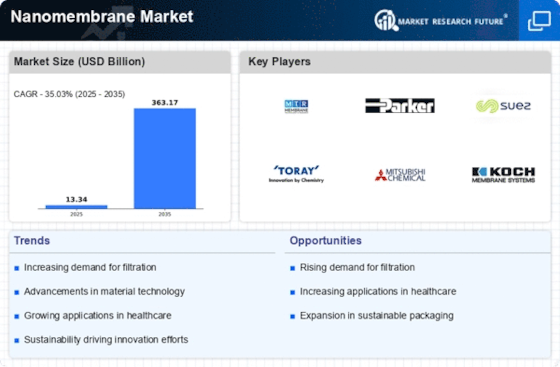
As per MRFR analysis, the Nanomembrane Market Size was estimated at 13.34 USD Billion in 2024. The Nanomembrane industry is projected to grow from 18.02 in 2025 to 363.17 by 2035, exhibiting a compound annual growth rate (CAGR) of 35.03 during the forecast period 2025 - 2035.

Key Market Trends & Highlights

The Nanomembrane Market is poised for substantial growth driven by technological advancements and increasing demand for sustainable solutions.

  • North America remains the largest market for nanomembranes, driven by robust industrial applications and technological innovation.
  • Asia-Pacific is emerging as the fastest-growing region, fueled by rapid urbanization and increasing investments in water purification technologies.
  • Carbon-based nanomembranes dominate the market, while composite nanomembranes are gaining traction due to their enhanced performance characteristics.
  • Rising demand for water purification and advancements in nanotechnology are key drivers propelling market expansion.

Market Size & Forecast

2024 Market Size 13.34 (USD Billion)
2035 Market Size 363.17 (USD Billion)
CAGR (2025 - 2035) 35.03%

Major Players

Membrane Technology and Research Inc (US), Parker Hannifin Corporation (US), SUEZ Water Technologies & Solutions (US), Toray Industries Inc (JP), Mitsubishi Chemical Corporation (JP), Hyflux Ltd (SG), Koch Membrane Systems Inc (US), Asahi Kasei Corporation (JP), GE Water & Process Technologies (US)

Nanomembrane Market Trends

The Nanomembrane Market is currently experiencing a transformative phase, driven by advancements in material science and increasing demand for efficient filtration solutions. This market encompasses a diverse range of applications, including water purification, air filtration, and biomedical uses. The growing awareness of environmental issues and the need for sustainable practices are propelling innovations in nanomembrane technology. As industries seek to enhance performance while minimizing environmental impact, the adoption of nanomembranes is likely to expand significantly. Furthermore, the integration of nanotechnology into traditional filtration systems appears to enhance their effectiveness, leading to a broader acceptance across various sectors. In addition, the Nanomembrane Market is characterized by a dynamic competitive landscape, with numerous players striving to establish their presence. Collaborations between research institutions and industry stakeholders seem to foster the development of novel applications and improve existing technologies. Regulatory frameworks are also evolving, potentially influencing market growth by promoting the use of advanced filtration methods. As the demand for high-performance materials continues to rise, the Nanomembrane Market is poised for substantial growth, reflecting a shift towards more innovative and sustainable solutions in filtration technology.

Sustainable Filtration Solutions

The emphasis on sustainability is reshaping the Nanomembrane Market, as industries increasingly prioritize eco-friendly filtration methods. This trend indicates a shift towards materials and processes that minimize environmental impact while maintaining high efficiency.

Technological Advancements

Ongoing research and development in nanotechnology are driving innovations within the Nanomembrane Market. Enhanced performance characteristics, such as increased permeability and selectivity, suggest that future products will outperform traditional filtration systems.

Collaborative Innovations

Partnerships between academic institutions and industry players are fostering a culture of innovation in the Nanomembrane Market. These collaborations appear to accelerate the development of new applications and improve existing technologies, potentially leading to market expansion.

Nanomembrane Market Drivers

Advancements in Nanotechnology

Technological innovations in nanotechnology are significantly influencing the Nanomembrane Market. The development of new materials and fabrication techniques enhances the performance and efficiency of nanomembranes, making them more attractive for various applications. For instance, the introduction of graphene-based membranes has shown promise in achieving higher permeability and selectivity, which could revolutionize filtration processes. Market analysts suggest that the integration of nanotechnology in membrane design may lead to a compound annual growth rate (CAGR) of over 15% in the coming years. This growth is indicative of the increasing investment in research and development, as companies strive to leverage cutting-edge technologies to meet the evolving demands of industries such as pharmaceuticals, food and beverage, and wastewater treatment.

Growing Environmental Regulations

The imposition of stringent environmental regulations is a key driver for the Nanomembrane Market. Governments worldwide are implementing policies aimed at reducing pollution and promoting sustainable practices, which necessitate the adoption of advanced filtration technologies. As industries face increasing scrutiny regarding their environmental impact, the demand for nanomembranes, known for their efficiency in removing contaminants, is likely to rise. Reports indicate that the market for environmental applications, including air and water filtration, is expected to grow significantly, potentially exceeding several billion dollars by 2027. This trend underscores the importance of compliance with environmental standards, positioning the Nanomembrane Market as a critical player in the transition towards greener technologies.

Expansion of Industrial Applications

The diversification of applications across various industries is a significant driver for the Nanomembrane Market. Industries such as pharmaceuticals, food and beverage, and electronics are increasingly adopting nanomembrane technologies for their superior filtration capabilities. For example, in the pharmaceutical sector, nanomembranes are utilized for drug purification and separation processes, enhancing product quality and safety. Market data indicates that the industrial applications segment is expected to grow at a CAGR of around 10% over the next few years, reflecting the increasing recognition of nanomembranes as essential components in manufacturing processes. This expansion not only broadens the market scope but also encourages innovation within the Nanomembrane Market, as companies strive to meet the specific needs of diverse sectors.

Increased Focus on Energy Efficiency

Energy efficiency is becoming a paramount concern across various sectors, driving the demand for innovative solutions in the Nanomembrane Market. Membrane technologies are recognized for their potential to reduce energy consumption in processes such as desalination and wastewater treatment. The ability of nanomembranes to operate at lower pressures while maintaining high filtration performance presents a compelling case for their adoption. Market forecasts suggest that the energy-efficient membrane segment could witness a growth rate of approximately 12% annually, as industries seek to lower operational costs and minimize their carbon footprint. This focus on sustainability aligns with broader global initiatives aimed at reducing energy consumption, further propelling the Nanomembrane Market into a position of prominence.

Rising Demand for Water Purification

The increasing global concern regarding water quality and scarcity drives the demand for advanced filtration technologies. The Nanomembrane Market is witnessing a surge in applications for water purification, as these membranes offer superior filtration capabilities compared to traditional methods. According to recent estimates, the water treatment segment is projected to account for a substantial share of the market, potentially reaching a valuation of several billion dollars by 2026. This trend is further fueled by regulatory pressures aimed at improving water quality standards, which necessitate the adoption of innovative filtration solutions. As industries and municipalities seek to comply with these regulations, the Nanomembrane Market is likely to experience robust growth, reflecting a shift towards sustainable and efficient water management practices.


Market Segment Insights

By Material: Carbon-Based (Largest) vs. Composite (Fastest-Growing)

The Nanomembrane Market is characterized by a diverse array of materials, with Carbon-Based Nanomembranes taking a prominent share due to their superior mechanical strength and filtration properties. These membranes are widely utilized in various applications, leading to their significant prevalence in the market. Conversely, Composite Nanomembranes are emerging as a dynamic contender, gaining traction with a unique blend of properties that cater to specialized filtration needs, enhancing their appeal in multiple sectors.

Carbon-Based (Dominant) vs. Composite (Emerging)

Carbon-Based Nanomembranes are recognized for their outstanding stability, chemical resistance, and potential for functionalization, making them ideal for applications in water treatment and gas separation. Their dominance is attributed to advancements in production technology, which have increased efficiency and reduced costs. In contrast, Composite Nanomembranes are being rapidly developed, merging the strengths of different materials to achieve enhanced performance. This includes flexibility, affordability, and specialized characteristics tailored to evolving industrial demands. As environmental regulations tighten and technological innovations drive change, the demand for Composite Nanomembranes is expected to surge, highlighting their potential as a significant player in the nanomembrane landscape.

By Application: Electronics and Optoelectronics (Largest) vs. Biomedical and Healthcare (Fastest-Growing)

The application segment of the Nanomembrane Market is notably diverse, with significant contributions from various areas including Electronics and Optoelectronics, Sensors and Biosensors, Energy and Environment, Biomedical and Healthcare, and Industrial and Packaging. Electronics and Optoelectronics holds the largest share within this segment, showcasing its critical role in advancing technology through efficient filtration and protective components. Meanwhile, Biomedical and Healthcare is rapidly gaining traction, driven by advancements in medical technologies and increasing demand for reliable and biocompatible materials.

Electronics and Optoelectronics (Dominant) vs. Biomedical and Healthcare (Emerging)

The Electronics and Optoelectronics segment of the Nanomembrane Market is characterized by its extensive application in producing high-performance components, such as flexible displays and light-emitting devices. This segment remains dominant due to continuous innovations aimed at improving product efficiency and sustainability. Conversely, the Biomedical and Healthcare segment is emerging powerfully, propelled by breakthroughs in nanotechnology that enhance drug delivery systems and diagnostic tools. The increasing focus on healthcare solutions and the integration of nanomaterial in medical devices signify a robust growth potential for this segment in the near future.

By Fabrication Method: Chemical Vapor Deposition (CVD) (Largest) vs. Physical Vapor Deposition (PVD) (Fastest-Growing)

In the Nanomembrane Market, Chemical Vapor Deposition (CVD) remains the largest fabrication method, capturing significant market share due to its ability to produce high-quality membranes with precise control over material properties. In contrast, Physical Vapor Deposition (PVD) is emerging as the fastest-growing segment, driven by increasing demand for lightweight and flexible membranes across various industries. Together, these methods underscore the competitive landscape of nanomembrane fabrication, offering diverse advantages in performance and application. The growth trends in the fabrication method segment are being influenced by advancements in technology and rising applications in healthcare, energy, and filtration. CVD techniques are becoming more efficient, leading to lower costs and improved scalability. Meanwhile, PVD's rapid development is fueled by innovations that enhance material adhesion and durability, making it a preferred choice for innovative nanomembrane applications. This dynamism reflects a shift towards more versatile and efficient fabrication methods in the nanomembrane market.

CVD (Dominant) vs. PVD (Emerging)

Chemical Vapor Deposition (CVD) stands as the dominant technique in the Nanomembrane Market, renowned for its ability to create high-performance membranes with uniform thickness and exceptional material quality. This method excels in the production of sophisticated nanostructures, leading to enhanced functionality in filtration and energy applications. Conversely, Physical Vapor Deposition (PVD) is being recognized as an emerging technology, offering advantages such as low-temperature processing and the potential for large-area coatings. As PVD techniques evolve, they are increasingly utilized for producing lightweight, flexible nanomembranes that cater to the needs of diverse industries, positioning them as key players in the competitive landscape.

Get more detailed insights about Nanomembrane Market

Regional Insights

North America : Innovation and Demand Surge

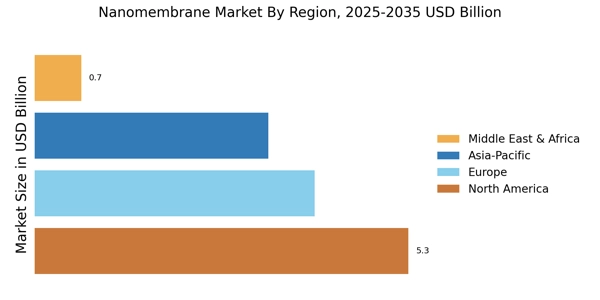
North America is the largest market for nanomembranes, holding approximately 40% of the global share. The region's growth is driven by increasing demand for advanced filtration technologies in water treatment, pharmaceuticals, and food processing. Regulatory support, particularly from the EPA, is fostering innovation and adoption of nanomembrane technologies, enhancing sustainability and efficiency in various sectors. The United States is the primary contributor, with key players like Membrane Technology and Research Inc, Parker Hannifin Corporation, and SUEZ Water Technologies leading the competitive landscape. Canada also plays a significant role, focusing on environmental regulations that promote the use of nanomembranes in industrial applications. The presence of established companies and ongoing R&D investments further solidify North America's position in the market.

Europe : Sustainable Solutions and Growth

Europe is witnessing significant growth in the nanomembrane market, accounting for approximately 30% of the global share. The region's focus on sustainability and stringent environmental regulations are key drivers for the adoption of nanomembrane technologies. Initiatives from the European Union, such as the Green Deal, are catalyzing investments in innovative filtration solutions, particularly in water treatment and energy sectors. Germany and the UK are leading countries in this market, with a strong presence of companies like Toray Industries and Mitsubishi Chemical Corporation. The competitive landscape is characterized by collaborations between industry and academia, fostering innovation. The European market is also seeing increased participation from startups focusing on niche applications, enhancing the overall growth trajectory of the nanomembrane sector.

Asia-Pacific : Rapid Growth and Adoption

Asia-Pacific is rapidly emerging as a significant player in the nanomembrane market, holding around 25% of the global share. The region's growth is fueled by increasing industrialization, urbanization, and a rising demand for clean water solutions. Countries like China and India are investing heavily in water treatment infrastructure, supported by government initiatives aimed at improving environmental standards and public health. China is the largest market in the region, with key players such as Hyflux Ltd and Asahi Kasei Corporation leading the charge. The competitive landscape is marked by a mix of established companies and new entrants focusing on innovative applications of nanomembranes. The region's diverse industrial base, including electronics and pharmaceuticals, further drives the demand for advanced filtration technologies, positioning Asia-Pacific as a key market for future growth.

Middle East and Africa : Resource-Rich and Emerging Market

The Middle East and Africa region is gradually emerging in the nanomembrane market, holding about 5% of the global share. The growth is primarily driven by the need for advanced water purification technologies, especially in arid countries facing water scarcity. Government initiatives aimed at enhancing water security and sustainability are acting as catalysts for market development in this region. Countries like South Africa and the UAE are at the forefront, with increasing investments in water treatment projects. The competitive landscape is characterized by collaborations between local and international firms, focusing on innovative solutions tailored to regional needs. The presence of key players, although limited, is growing, indicating a positive outlook for the nanomembrane market in the Middle East and Africa.

Nanomembrane Market Regional Image

Key Players and Competitive Insights

The Nanomembrane Market is currently characterized by a dynamic competitive landscape, driven by increasing demand for advanced filtration technologies across various sectors, including water treatment, pharmaceuticals, and food processing. Key players such as Membrane Technology and Research Inc (US), Parker Hannifin Corporation (US), and Toray Industries Inc (JP) are strategically positioning themselves through innovation and regional expansion. For instance, Membrane Technology and Research Inc (US) focuses on enhancing its product offerings through continuous research and development, while Parker Hannifin Corporation (US) emphasizes partnerships to bolster its technological capabilities. These strategies collectively contribute to a competitive environment that is increasingly focused on technological advancement and market responsiveness.

In terms of business tactics, companies are localizing manufacturing to reduce costs and optimize supply chains, which is particularly relevant in the context of global supply chain disruptions. The market structure appears moderately fragmented, with several key players exerting influence over specific segments. This fragmentation allows for niche players to thrive, while larger corporations leverage their scale to dominate broader market segments. The collective influence of these key players shapes the competitive dynamics, fostering an environment where innovation and efficiency are paramount.

In August 2025, SUEZ Water Technologies & Solutions (US) announced a strategic partnership with a leading technology firm to develop next-generation nanomembrane solutions aimed at enhancing water purification processes. This collaboration is significant as it not only expands SUEZ's technological capabilities but also positions the company to address the growing global water scarcity challenges. The partnership underscores the importance of innovation in maintaining competitive advantage in the nanomembrane sector.

In September 2025, Toray Industries Inc (JP) launched a new line of nanofiltration membranes designed specifically for industrial wastewater treatment applications. This product introduction is noteworthy as it reflects Toray's commitment to sustainability and environmental responsibility, aligning with global trends towards greener technologies. The launch is expected to enhance Toray's market share in the industrial sector, demonstrating the company's proactive approach to meeting evolving customer needs.

In October 2025, Koch Membrane Systems Inc (US) unveiled a digital platform that integrates AI-driven analytics to optimize membrane performance in real-time. This technological advancement is likely to revolutionize how companies monitor and manage membrane systems, providing a competitive edge through enhanced operational efficiency. The integration of AI into their offerings indicates a shift towards digitalization, which is becoming increasingly critical in the nanomembrane market.

As of October 2025, current competitive trends are heavily influenced by digitalization, sustainability, and the integration of advanced technologies such as AI. Strategic alliances are increasingly shaping the landscape, allowing companies to pool resources and expertise to drive innovation. Looking ahead, competitive differentiation is expected to evolve, with a marked shift from price-based competition to a focus on technological innovation, reliability in supply chains, and sustainable practices. This transition suggests that companies that prioritize these aspects will likely emerge as leaders in the nanomembrane market.

Key Companies in the Nanomembrane Market market include

Industry Developments

The nanomembrane market is projected to grow significantly over the next decade, driven by increasing demand for advanced materials in various industries. In 2023, the market was valued at USD 7.31 billion and is expected to reach USD 109.2 billion by 2032, exhibiting a CAGR of 35.03%. The market growth is attributed to the rising adoption of nanomembranes in electronics, energy storage, and biomedical applications. Recent advancements in nanotechnology have led to the development of novel nanomembranes with enhanced properties, further fueling market expansion.

Key industry players are investing in research and development to improve the performance and cost-effectiveness of nanomembranes. Partnerships and collaborations between industry leaders and research institutions are also contributing to the market's growth.

Future Outlook

Nanomembrane Market Future Outlook

The Nanomembrane Market is projected to grow at a 35.03% CAGR from 2024 to 2035, driven by advancements in filtration technology, increasing demand for clean water, and energy-efficient solutions.

New opportunities lie in:

  • Development of smart nanomembrane systems for real-time monitoring
  • Expansion into emerging markets with tailored filtration solutions
  • Partnerships with renewable energy firms for integrated membrane applications

By 2035, the Nanomembrane Market is expected to achieve substantial growth, solidifying its role in various industries.

Market Segmentation

Nanomembrane Market Material Outlook

  • Carbon-Based Nanomembranes
  • Polymer-Based Nanomembranes
  • Metal-Based Nanomembranes
  • Ceramic-Based Nanomembranes
  • Composite Nanomembranes

Nanomembrane Market Application Outlook

  • Electronics and Optoelectronics
  • Sensors and Biosensors
  • Energy and Environment
  • Biomedical and Healthcare
  • Industrial and Packaging

Nanomembrane Market Fabrication Method Outlook

  • Chemical Vapor Deposition (CVD)
  • Physical Vapor Deposition (PVD)
  • Molecular Beam Epitaxy (MBE)
  • Self-Assembly
  • Electrospinning

Report Scope

MARKET SIZE 202413.34(USD Billion)
MARKET SIZE 202518.02(USD Billion)
MARKET SIZE 2035363.17(USD Billion)
COMPOUND ANNUAL GROWTH RATE (CAGR)35.03% (2024 - 2035)
REPORT COVERAGERevenue Forecast, Competitive Landscape, Growth Factors, and Trends
BASE YEAR2024
Market Forecast Period2025 - 2035
Historical Data2019 - 2024
Market Forecast UnitsUSD Billion
Key Companies ProfiledMarket analysis in progress
Segments CoveredMarket segmentation analysis in progress
Key Market OpportunitiesAdvancements in filtration technologies drive demand for innovative solutions in the Nanomembrane Market.
Key Market DynamicsRising demand for advanced filtration solutions drives innovation and competition in the nanomembrane market.
Countries CoveredNorth America, Europe, APAC, South America, MEA

Leave a Comment

FAQs

What is the current valuation of the Nanomembrane Market as of 2024?

The Nanomembrane Market was valued at 13.34 USD Billion in 2024.

What is the projected market valuation for the Nanomembrane Market in 2035?

The market is projected to reach 363.17 USD Billion by 2035.

What is the expected CAGR for the Nanomembrane Market during the forecast period 2025 - 2035?

The expected CAGR for the Nanomembrane Market during 2025 - 2035 is 35.03%.

Which segment of the Nanomembrane Market is projected to have the highest valuation in 2035?

The Biomedical and Healthcare segment is projected to reach 120.0 USD Billion by 2035.

What are the key materials used in the Nanomembrane Market?

Key materials include Carbon-Based, Polymer-Based, Metal-Based, Ceramic-Based, and Composite Nanomembranes.

Which fabrication method is expected to dominate the Nanomembrane Market by 2035?

Electrospinning is expected to dominate with a projected valuation of 93.17 USD Billion by 2035.

Who are the leading companies in the Nanomembrane Market?

Key players include Membrane Technology and Research Inc, Parker Hannifin Corporation, and SUEZ Water Technologies & Solutions.

What application areas are driving growth in the Nanomembrane Market?

Growth is driven by applications in Electronics and Optoelectronics, Sensors and Biosensors, and Energy and Environment.

How does the valuation of Polymer-Based Nanomembranes compare to other materials?

Polymer-Based Nanomembranes are projected to reach 120.0 USD Billion, making them the highest among all materials.

Download Free Sample

Kindly complete the form below to receive a free sample of this Report

Compare Licence

×
Features License Type
Single User Multiuser License Enterprise User
Price $4,950 $5,950 $7,250
Maximum User Access Limit 1 User Upto 10 Users Unrestricted Access Throughout the Organization
Free Customization
Direct Access to Analyst
Deliverable Format
Platform Access
Discount on Next Purchase 10% 15% 15%
Printable Versions