Download Free Sample
Kindly complete the form below to receive a free sample of this Report
Natural Language Processing in BFSI Market Size, Share and Research Report By Application (Chatbots, Sentiment Analysis, Fraud Detection, Document Processing), By Deployment Type (On-Premises, Cloud-Based), By Component (Software, Services), By End User (Banks, Insurance Companies, Investment Firms) and By Regional (North America, Europe, South America, Asia Pacific, Middle East and Africa) - Industry Forecast Till 2035
As per Market Research Future analysis, the Natural Language Processing in BFSI Market Size was estimated at 4.007 USD Billion in 2024. The Natural Language Processing in BFSI industry is projected to grow from USD 4.6 Billion in 2025 to USD 18.26 Billion by 2035, exhibiting a compound annual growth rate (CAGR) of 14.78% during the forecast period 2025 - 2035
The Natural Language Processing in BFSI Market is poised for substantial growth driven by automation and enhanced customer engagement.
| 2024 Market Size | 4.007 (USD Billion) |
| 2035 Market Size | 18.26 (USD Billion) |
| CAGR (2025 - 2035) | 14.78% |
The Natural Language Processing in BFSI Market is currently experiencing a transformative phase, driven by advancements in artificial intelligence and machine learning technologies. Financial institutions are increasingly adopting these sophisticated tools to enhance customer interactions, streamline operations, and improve decision-making processes. The integration of natural language processing capabilities allows organizations to analyze vast amounts of unstructured data, such as customer feedback and transaction records, thereby enabling them to derive actionable insights. This trend appears to be reshaping the landscape of banking, insurance, and financial services, as firms seek to leverage data-driven strategies to remain competitive in a rapidly evolving environment. Moreover, the emphasis on personalized customer experiences is becoming more pronounced. Institutions are utilizing natural language processing to develop chatbots and virtual assistants that provide real-time support and tailored recommendations. This shift not only enhances customer satisfaction but also optimizes operational efficiency. As the Natural Language Processing in BFSI Market continues to evolve, it is likely that regulatory compliance and risk management will also benefit from these innovations, suggesting a comprehensive impact across various facets of the industry. The future of this market appears promising, with ongoing research and development paving the way for even more sophisticated applications.
Natural Language Processing in BFSI Market is facilitating improved customer engagement through the deployment of chatbots and virtual assistants. These tools enable financial institutions to provide immediate responses to inquiries, thereby enhancing user satisfaction and loyalty.
The integration of natural language processing technologies allows organizations to analyze unstructured data effectively. This capability supports data-driven decision-making, enabling firms to identify trends and insights that inform strategic initiatives.
Natural Language Processing is increasingly being utilized to assist in regulatory compliance and risk management. By automating the analysis of legal documents and transaction records, financial institutions can better navigate complex regulatory landscapes.
The Natural Language Processing in BFSI Market is increasingly leveraged to gain deeper customer insights. By analyzing customer interactions and feedback, financial institutions can better understand client needs and preferences. This capability is particularly valuable in tailoring services and products to meet specific demands. Recent studies indicate that organizations utilizing NLP for sentiment analysis can improve customer retention rates by as much as 25%. The ability to process vast amounts of unstructured data allows institutions to identify trends and patterns that were previously obscured. Consequently, the focus on enhancing customer insights through NLP is likely to drive further investment in these technologies, as firms aim to create more personalized experiences for their clients.
The Natural Language Processing in BFSI Market is recognized for its potential to significantly reduce operational costs. By automating routine tasks such as data entry, customer inquiries, and report generation, financial institutions can allocate resources more efficiently. Studies indicate that the implementation of NLP can lead to a reduction in labor costs by approximately 20%, allowing institutions to reallocate funds towards innovation and growth initiatives. This cost-saving potential is particularly appealing in a competitive market where margins are often tight. As institutions continue to seek ways to enhance profitability, the adoption of NLP technologies for operational efficiency is expected to be a driving force in the BFSI sector.
The Natural Language Processing in BFSI Market is increasingly utilized for fraud detection and prevention. Financial institutions are adopting NLP technologies to analyze transaction data and customer communications for signs of fraudulent activity. By employing machine learning algorithms in conjunction with NLP, institutions can identify anomalies and patterns indicative of fraud. Recent reports suggest that the implementation of NLP in fraud detection can reduce false positives by up to 40%, thereby enhancing the accuracy of fraud prevention measures. As the sophistication of fraudulent schemes evolves, the reliance on advanced NLP solutions is likely to grow, positioning these technologies as essential tools in safeguarding financial assets and maintaining customer trust.
The Natural Language Processing in BFSI Market is experiencing a surge in demand for automation solutions. Financial institutions are increasingly adopting NLP technologies to streamline operations, reduce costs, and enhance efficiency. According to recent data, the automation of customer service processes through NLP can lead to a reduction in operational costs by up to 30%. This trend is driven by the need for faster response times and improved customer satisfaction. As institutions seek to optimize their workflows, the integration of NLP tools for tasks such as document processing and transaction analysis becomes essential. The potential for automation to transform traditional banking practices is substantial, suggesting that the adoption of NLP will continue to grow as institutions strive for operational excellence.
The Natural Language Processing in BFSI Market plays a crucial role in enhancing regulatory compliance efficiency. Financial institutions face increasing scrutiny from regulatory bodies, necessitating robust compliance measures. NLP technologies can assist in automating the monitoring of transactions and communications, ensuring adherence to regulations. For instance, NLP can analyze large volumes of text data to identify potential compliance risks, thereby reducing the likelihood of costly penalties. The market for compliance solutions is projected to grow significantly, with NLP being a key component in achieving compliance objectives. As regulatory requirements continue to evolve, the demand for NLP solutions that facilitate efficient compliance processes is expected to rise, making it a vital driver in the BFSI sector.
In the Natural Language Processing (NLP) in BFSI market, Chatbots command the largest share, owing to their increasing integration in customer service functions across banks and financial institutions. They enhance client engagement by providing immediate assistance and personalized interactions, reshaping the service delivery model in the BFSI sector. Fraud Detection follows as a rapidly expanding segment, driven by the growing emphasis on security and compliance in financial transactions, leading to heightened investments in advanced NLP technologies.
Chatbots (Dominant) vs. Document Processing (Emerging)
Chatbots represent a dominant force in the Natural Language Processing in BFSI market, transforming customer interactions through conversational AI. Their ability to handle high volumes of inquiries effortlessly positions them as essential tools for operational efficiency and customer satisfaction. Conversely, Document Processing is an emerging segment that leverages NLP to automate the extraction and analysis of data from unstructured documents. As regulatory requirements and the need for efficient information management escalate, this segment is gaining traction, driven by innovations in machine learning and natural language understanding, thus augmenting the overall effectiveness of financial operations.
Within the Natural Language Processing in BFSI Market, the cloud-based deployment type has emerged as the largest segment, capturing a significant portion of the market share. Its appeal lies in scalability, flexibility, and reduced infrastructure costs, making it particularly attractive to financial institutions looking to enhance their analytical capabilities with minimal upfront investment. On-premises solutions, while smaller in market share, cater to organizations with stringent data security requirements, thereby holding a specialized niche in the market.
Cloud-Based (Dominant) vs. On-Premises (Emerging)
Cloud-based natural language processing solutions dominate the BFSI market due to their ability to provide scalable and cost-effective solutions that can be rapidly deployed. These solutions offer the advantage of real-time data processing and advanced analytics capabilities, allowing financial institutions to respond quickly to changing market dynamics. In contrast, on-premises deployments, while slower to grow, are becoming increasingly relevant as institutions prioritize data sovereignty and compliance. This deployment model is characterized by higher initial costs but offers enhanced control over sensitive data, making it appealing in highly regulated environments. As security concerns mount, on-premises solutions represent an emerging trend, focusing on tailored solutions that meet specific institutional needs.
The Natural Language Processing (NLP) market in the BFSI sector showcases a clear delineation in market share between software and services. Software remains the largest component, capturing the majority of market demand due to its critical role in powering automated processes and enhancing customer experiences. The rising adoption of AI-driven tools within banking and financial services has solidified the position of software as an essential asset in optimizing operations, risk management, and customer engagement strategies.
Software (Dominant) vs. Services (Emerging)
In the NLP landscape for the BFSI market, software is regarded as the dominant force. It is integral for automating various processes, including transaction validation, fraud detection, and personalized banking services. As institutions increasingly turn to technology for efficiency, software solutions continue to expand their footprint. On the other hand, services represent an emerging segment, driven by a growing need for customization and specialized expertise. With the rise of cloud computing and consultancy services, providers are witnessing increased demand for tailored NLP solutions and support, which is further bolstered by the necessity for ongoing maintenance and optimization of existing systems.
In the Natural Language Processing (NLP) market within the Banking, Financial Services, and Insurance (BFSI) sector, banks represent the dominant end-user, significantly outpacing other segments in terms of adoption and application of NLP technologies. This segment is heavily invested in automating customer service operations, enhancing risk assessment, and improving compliance measures using NLP-driven solutions. Insurance companies, on the other hand, follow closely behind, leveraging NLP to streamline claims processing and enhance customer interaction. The growth trend in the NLP space for the BFSI market is primarily driven by the rising demand for operational efficiency and personalized customer experiences. Insurance companies are experiencing rapid adoption of NLP solutions due to their need for immediate response systems and improved data analytics, which contribute to reliability and customer satisfaction. Investment firms, while significant, are still expanding their NLP applications with a focus on market analysis and sentiment analysis, reflecting a balanced but slower growth rate compared to the burgeoning insurance sector.
Banks (Dominant) vs. Insurance Companies (Emerging)
The banking sector stands as the dominant player in the Natural Language Processing market for BFSI, with extensive utilization in areas such as chatbots, fraud detection, and regulatory compliance. Banks are at the forefront of NLP implementation due to their robust data resources and need for real-time analytics, which streamline operations and enhance security measures. In contrast, insurance companies, currently viewed as the emerging segment, are progressively adopting NLP technologies to revamp their customer engagement strategies. They focus primarily on automating claims processes and utilizing sentiment analysis to tailor their offerings, signifying a crucial shift towards more data-driven decision-making. Although banks showcase immediate and higher adoption, insurance companies are rapidly evolving, indicating a potential shift in market dynamics as they harness NLP for greater efficiency and customer satisfaction.
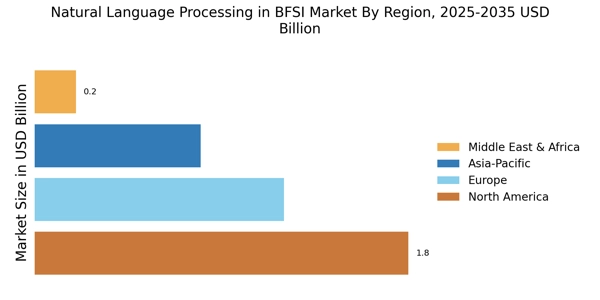
North America leads the Natural Language Processing (NLP) market in the BFSI sector, driven by rapid technological advancements and a strong focus on AI integration. The region holds approximately 45% of the global market share, with the United States being the largest contributor, followed by Canada. Regulatory support for AI technologies and data privacy laws are significant growth catalysts, enhancing the demand for NLP solutions in financial services. The competitive landscape is characterized by the presence of major players such as IBM, Microsoft, and Google, which are continuously innovating to enhance their offerings. The U.S. government’s initiatives to promote AI in financial services further bolster market growth. Additionally, the increasing adoption of chatbots and virtual assistants in banking and insurance sectors is reshaping customer interactions, making NLP a critical component of service delivery.
Europe is witnessing significant growth in the Natural Language Processing (NLP) market within the BFSI sector, driven by stringent regulations and a focus on enhancing customer experience. The region holds approximately 30% of the global market share, with Germany and the UK being the largest markets. The European Union's General Data Protection Regulation (GDPR) has catalyzed the demand for NLP solutions that ensure compliance while improving operational efficiency. Leading countries like Germany and the UK are home to numerous fintech startups and established banks that are increasingly adopting NLP technologies. The competitive landscape includes key players such as SAP and Salesforce, which are investing heavily in AI-driven solutions. The emphasis on data security and customer-centric services is pushing financial institutions to leverage NLP for better insights and decision-making, making it a pivotal area for growth.
Asia-Pacific is rapidly emerging as a significant player in the Natural Language Processing (NLP) market for the BFSI sector, driven by increasing digitalization and a growing tech-savvy population. The region holds approximately 20% of the global market share, with China and India leading the charge. Government initiatives promoting digital finance and smart banking are key drivers of this growth, creating a favorable environment for NLP adoption in financial services. China's fintech landscape is booming, with companies like Alibaba and Tencent leveraging NLP to enhance customer engagement. India is also witnessing a surge in NLP applications, particularly in customer service and fraud detection. The competitive landscape is becoming increasingly crowded, with both established players and startups vying for market share. The focus on improving customer experience and operational efficiency is propelling the demand for NLP solutions across the region.
The Middle East and Africa (MEA) region is gradually embracing Natural Language Processing (NLP) technologies in the BFSI sector, driven by the need for enhanced customer service and operational efficiency. The region holds approximately 5% of the global market share, with South Africa and the UAE being the frontrunners. Government initiatives aimed at digital transformation and financial inclusion are significant catalysts for the adoption of NLP solutions in banking and insurance sectors. In South Africa, banks are increasingly utilizing NLP for customer support and risk management, while the UAE is focusing on smart banking initiatives. The competitive landscape is evolving, with both local and international players entering the market. The emphasis on improving customer interactions and leveraging data analytics is pushing financial institutions to adopt NLP technologies, making it a key area for future growth.
The Natural Language Processing in BFSI Market is rapidly evolving, driven by the increasing need for personalized customer service, operational efficiency, and data analytics within the banking, financial services, and insurance sectors. The competitive landscape of this market is characterized by a diverse range of players that leverage advanced technologies and sophisticated algorithms to create solutions capable of interpreting, analyzing, and responding to human language. As the adoption of these technologies continues to grow, companies are focusing on enhancing their offerings while exploring collaborations and partnerships to expand their market reach.
The dynamic nature of this market requires players to stay attuned to emerging trends, innovative functionalities, and regulatory considerations, which further influence competitive positioning and strategy. Amazon Web Services has established a formidable presence in the Natural Language Processing in BFSI Market by offering comprehensive cloud-based solutions that cater specifically to financial service providers and institutions. The strengths of Amazon Web Services lie in its robust infrastructure, vast suite of machine learning tools, and powerful analytics capabilities that enable organizations to derive actionable insights from unstructured data.
The integration of Amazon Lex and AWS Comprehend allows BFSI companies to build conversational interfaces and enhance customer interactions seamlessly. Furthermore, the scalability of Amazon Web Services facilitates rapid deployment of NLP solutions while ensuring compliance with industry regulations, making it a favored choice for stakeholders seeking technological innovation in their respective domains. Oracle, renowned for its data management and cloud services, plays a significant role in the Natural Language Processing in BFSI Market, leveraging its expertise in analytics and database technology.
With a focus on delivering tailored NLP solutions, Oracle empowers financial institutions to optimize their operations and enhance customer engagement through its Oracle Cloud Infrastructure and AI-driven applications. The strengths of Oracle lie in its ability to offer end-to-end solutions wherein natural language processing capabilities are integrated within a broader ecosystem of enterprise applications. By providing tools for sentiment analysis, chatbots, and automated reporting, Oracle enables these organizations to address customer needs more effectively while generating insights that can influence strategic decision-making. This positions Oracle as a competitive player in the market, catering to the nuanced requirements of BFSI clients.






Recent developments in the Global Natural Language Processing (NLP) in the BFSI market have been notable, with companies such as Amazon Web Services and IBM making strides in AI-driven customer engagement solutions tailored for financial services. Oracle and SAP have introduced advanced NLP capabilities aimed at enhancing fraud detection and compliance processes, while Accenture and Cognizant are focusing on the integration of NLP technology to improve operational efficiencies within banking systems. During this period, Microsoft and Google have expanded their partnerships with financial institutions, emphasizing AI and machine learning for predictive analytics and customer insights.
Additionally, the market has seen growth in valuation due to an increasing demand for automation and improved customer service, and driving investments in NLP solutions. Mergers and acquisitions have also played a crucial role, with companies like Salesforce acquiring niche NLP startups to boost their platform offerings. Reports of collaboration between HCL Technologies and Verint highlight a trend towards leveraging AI-powered analytics for better decision-making in financial sectors. Overall, these trends reflect a significant acceleration in the adoption of NLP technologies within BFSI, reshaping the landscape for financial service providers.
The Natural Language Processing in BFSI Market is projected to grow at a 14.78% CAGR from 2025 to 2035, driven by advancements in AI, customer engagement, and regulatory compliance.
New opportunities lie in:
By 2035, the market is expected to be robust, driven by innovative applications and increased adoption.
| MARKET SIZE 2024 | 4.007(USD Billion) |
| MARKET SIZE 2025 | 4.6(USD Billion) |
| MARKET SIZE 2035 | 18.26(USD Billion) |
| COMPOUND ANNUAL GROWTH RATE (CAGR) | 14.78% (2025 - 2035) |
| REPORT COVERAGE | Revenue Forecast, Competitive Landscape, Growth Factors, and Trends |
| BASE YEAR | 2024 |
| Market Forecast Period | 2025 - 2035 |
| Historical Data | 2019 - 2024 |
| Market Forecast Units | USD Billion |
| Key Companies Profiled | IBM (US), Microsoft (US), Google (US), Amazon (US), Salesforce (US), SAP (DE), Nuance Communications (US), OpenAI (US), C3.ai (US) |
| Segments Covered | Application, Deployment Type, Component, End User, Regional |
| Key Market Opportunities | Integration of advanced Natural Language Processing enhances customer engagement and operational efficiency in the Natural Language Processing in BFSI Market. |
| Key Market Dynamics | Rising demand for automated customer service solutions drives innovation in Natural Language Processing within the BFSI sector. |
| Countries Covered | North America, Europe, APAC, South America, MEA |
The projected market valuation for Natural Language Processing in the BFSI sector is expected to reach 18.26 USD Billion by 2035.
The market valuation for Natural Language Processing in BFSI was 4.007 USD Billion in 2024.
The expected CAGR for the Natural Language Processing in BFSI market during the forecast period 2025 - 2035 is 14.78%.
The Document Processing application segment is projected to reach 7.76 USD Billion by 2035.
Cloud-based deployment types are expected to reach 11.76 USD Billion, surpassing the on-premises valuation of 6.5 USD Billion by 2035.
The key components driving the market include Software, projected to reach 8.88 USD Billion, and Services, expected to reach 9.38 USD Billion by 2035.
The Banks end-user segment is anticipated to dominate the market, projected to reach 7.99 USD Billion by 2035.
Key players in the market include IBM, Microsoft, Google, Amazon, Salesforce, SAP, Nuance Communications, OpenAI, and C3.ai.
The Fraud Detection application segment is projected to grow to 4.1 USD Billion by 2035.
Sentiment Analysis is expected to reach 2.8 USD Billion by 2035, indicating a smaller market share compared to other applications like Document Processing.


Kindly complete the form below to receive a free sample of this Report

“This is really good guys. Excellent work on a tight deadline. I will continue to use you going forward and recommend you to others. Nice job”


“Thanks. It’s been a pleasure working with you, please use me as reference with any other Intel employees.”


“Thanks for sending the report it gives us a good global view of the Betaïne market.”


“Thank you, this will be very helpful for OQS.”


“We found the report very insightful! we found your research firm very helpful. I'm sending this email to secure our future business.”


“I am very pleased with how market segments have been defined in a relevant way for my purposes (such as "Portable Freezers & refrigerators" and "last-mile"). In general the report is well structured. Thanks very much for your efforts.”


“I have been reading the first document or the study, ,the Global HVAC and FP market report 2021 till 2026. Must say, good info! I have not gone in depth at all parts, but got a good indication of the data inside!”


“We got the report in time, we really thank you for your support in this process. I also thank to all of your team as they did a great job.”


“The Automotive 48V ECU Components Procurement Intelligence Study” was a complex project, but the Market Research Future (MRFR) team handled it with quality, agility, and customer-centricity. They delivered all requested data on time and within the agreed scope. The team, including Shubhendra Anand and Rahul Gotadki, was always readily available to clarify questions and swiftly implement necessary adjustments, driving the project to a successful conclusion within a very demanding timeframe.
I would also like to specifically commend Akshay Agarwal for his responsiveness and support at every stage—from our initial inquiry on May 6th through to final delivery on June 18th. His dedication made the entire process seamless.”



