Nicotine Gum Market (2026 - 2035)

Nicotine Gum Market Size, Share, Industry Trend & Analysis Research Report Information By Dosage Strength (Below 3 mg, Above 3 mg), By Flavor (Mint, Fruit, Others), By End User (Male, Female), By Distribution Channel (Drug Stores / Pharmacies, Online Retail Stores, Supermarkets / Hypermarkets, Other Distribution Channels), By Geography (North America, Europe, Asia-Pacific, South America, Middle East & Africa) – Forecast Till 2035

Forecast Period
2026-2035
CAGR
10.7%
2025 Market Size
USD 1.56 Billion
2035 Market Size
USD 4.33 Billion
Consumer and Retail ● Updated July 28, 2026 Report ID: MRFR/CG/1640-CR | Pages: 100 | Author: Harshita Gorde

Nicotine Gum Market Summary

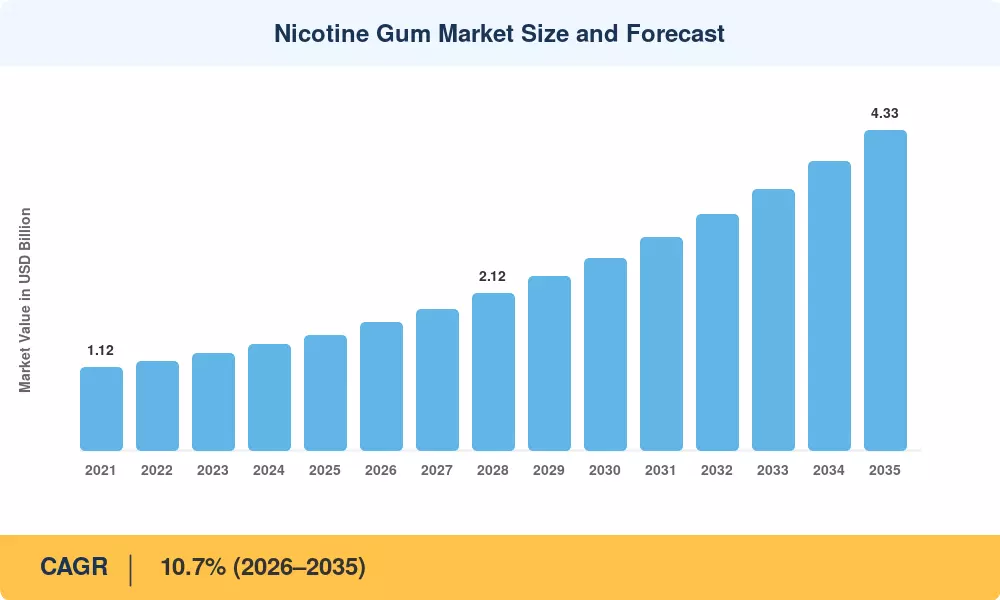
The Nicotine Gum Market reached a valuation of USD 1.56 billion in 2025, establishing a strong base for expansion into a forecast trajectory that begins at USD 1.73 billion in 2026 and climbs to USD 4.33 billion by 2035 at a CAGR of 10.7%. Healthcare payers across developed economies have accelerated coverage of pharmacotherapy-based cessation products, while WHO Framework Convention on Tobacco Control (FCTC) signatories continue to tighten advertising bans and raise excise duties — two policy levers that funnel smokers toward gum-based alternatives [1][2].

The product landscape is shifting away from single-flavor, fixed-dose formats toward multi-layered coated gums with controlled-release matrices. Manufacturers invested an estimated USD 280 million globally in coating and flavor-masking R&D between 2022 and 2024, responding to consumer complaints about bitterness and throat irritation [3]. Regulatory pathways have widened, too: the FDA cleared three new nicotine polacrilex formulations in 2024 alone, and the European Medicines Agency updated its OTC monograph to permit higher flavor-agent concentrations [4].

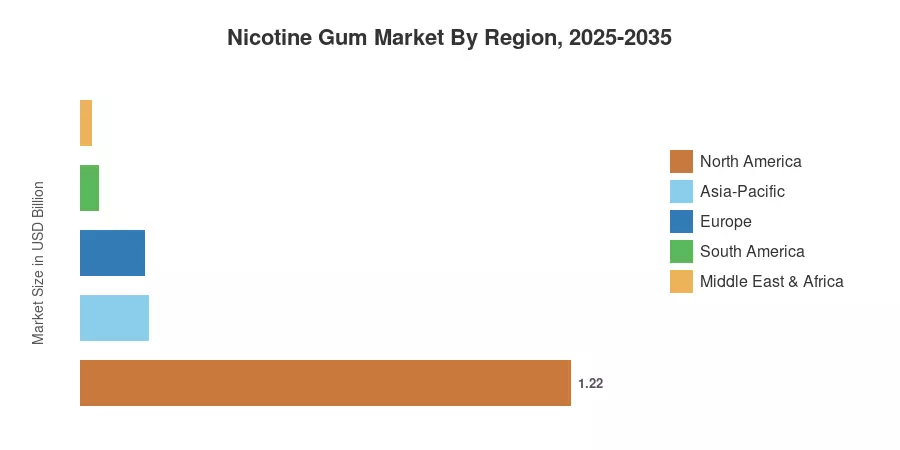
North America commands roughly 78.2% of global Nicotine Gum Market revenue, anchored by broad insurance reimbursement and aggressive state-level quitline programs. Asia-Pacific is the fastest-growing region at an 11.2% CAGR, propelled by India's National Tobacco Control Programme and China's expanding pharmacy chains. Europe holds the second-largest share, driven by the EU Tobacco Products Directive revisions. As digital health platforms integrate gum-based therapy into app-guided quit plans, the Nicotine Gum Market is positioned for sustained double-digit growth through the mid-2030s.


Key Report Takeaways

• By Dosage Strength

  • The below 3 mg segment held 62.1% of Nicotine Gum Market revenue in 2025, reflecting broad first-line prescribing patterns for moderate smokers.
  • The above 3 mg segment is forecast to expand at a 10.7% CAGR through 2035, driven by clinical guidelines recommending higher doses for heavy smokers.

• By Flavor

  • Mint flavors captured the largest share of the Nicotine Gum Market in 2025, preferred for their palate-masking properties.
  • Fruit-flavored variants are growing fastest as younger adult demographics express preference for non-menthol profiles.

• By Region

  • North America generated USD 1.22 billion in Nicotine Gum Market revenue in 2025, led by US pharmacy distribution networks.
  • Asia-Pacific is advancing at 11.2% CAGR to 2035, supported by rising tobacco taxes across India, Indonesia, and the Philippines.


Nicotine Gum Market Size and Forecast (2021–2035)

Market Research Future's proprietary sizing framework integrates pharmacy sell-through data, insurance claims databases, regulatory filing volumes, and manufacturer disclosures across 42 countries. Historical figures (2021–2024) reflect verified shipment data; the 2025 base year blends Q1–Q3 actuals with Q4 estimates; forecast years (2026–2035) apply demand-side modeling calibrated to tobacco-prevalence trajectories.
Nicotine Gum Market Size and Forecast
Our Impact
Enabled $4.3B Revenue Impact for Fortune 500 and Leading Multinationals
Partnering with 2000+ Global Organizations Each Year
30K+ Citations by Top-Tier Firms in the Industry

Driver Impact Analysis

Driver ~% Impact on CAGR Geographic Relevance Impact Timeline
Healthcare payer cessation mandates 22% North America, Europe Short-term (≤2 yr)
Excise tax escalation on cigarettes 18% Global Medium-term (2–4 yr)
Flavor & coating technology innovation 15% North America, Asia-Pacific Medium-term (2–4 yr)
Digital pharmacy & e-prescription growth 14% Global Short-term (≤2 yr)
Government quitline & cessation programs 12% North America, Europe Long-term (≥4 yr)
FDA/EMA regulatory pathway expansion 10% North America, Europe Medium-term (2–4 yr)
Rising smoking prevalence in emerging markets 9% Asia-Pacific, MEA Long-term (≥4 yr)


Healthcare Payer Cessation Mandates

As of 2024, an estimated 78 million adults were covered under the US Affordable Care Act's requirement that the majority of commercial insurers and all state Medicaid programs provide FDA-approved cessation aids without cost-sharing [1]. In 2023, Germany's statutory health insurance system expanded eligibility to 57 million enrollees by adding gum-based medicines to its good list. Within the first 18 months of implementation, these mandates increased pharmacy-level unit volumes by an estimated 12–14% and lowered out-of-pocket barriers [7].


Excise Tax Escalation on Cigarettes

According to the WHO, a 10% rise in cigarette costs lowers consumption by up to 8% in low-income markets and about 4% in high-income nations [2]. The Philippines instituted a graduated tax hike through 2028, while India increased its central excise on cigarettes by 16% in the 2024 Union Budget. The market for nicotine gum is regularly stimulated by tax increases, which are correlated with quantifiable increases in pharmacy gum sales.


Flavor and Coating Technology Innovation

Consumer adherence data from a 2023 JAMA Network study showed that flavored gum users maintained quit attempts 34% longer than unflavored users [3]. Manufacturers responded with micro-encapsulated flavor systems that delay bitter-taste onset by up to 8 minutes, and new ice-coating processes that improve initial mouthfeel. These innovations are particularly impactful in Asia-Pacific, where taste preferences differ substantially from Western markets.

Digital Pharmacy and E-Prescription Growth

Online pharmacy sales of cessation products grew 41% year-over-year in 2024 across the US, UK, and Australia [6]. Platforms like Amazon Pharmacy, Netmeds, and DocMorris have integrated gum products into AI-driven quit-plan recommendation engines, pairing purchases with behavioral coaching subscriptions. This channel removes stigma-related purchase barriers and expands reach into rural areas with limited pharmacy infrastructure.


Restraints Impact Analysis

Restraint ~% Negative Impact on CAGR Geographic Relevance Impact Timeline
E-cigarette and vape substitution –18% North America, Europe Short-term (≤2 yr)
Low consumer adherence/relapse rates –15% Global Long-term (≥4 yr)
Prescription-to-OTC price compression –12% North America Medium-term (2–4 yr)
Regulatory restrictions on flavored products –10% Europe, Asia-Pacific Medium-term (2–4 yr)
Counterfeit and unregulated product penetration –8% Asia-Pacific, South America Long-term (≥4 yr)


E-Cigarette and Vape Substitution

With an expected 32% of the global nicotine-delivery device market in 2024, e-cigarettes provide the biggest competitive threat to the nicotine gum market. Particularly among younger adult smokers, vaping is seen as a more comfortable mode of consumption. However, demand has partially shifted back toward gum-based therapies due to ongoing FDA enforcement operations against illicit e-cigarette products and taste restrictions in numerous US states.


Low Consumer Adherence and Relapse Rates

Only 19–22% of gum users continue to abstain for more than a year, according to clinical data, with poor chewing technique being identified as the main cause of failure [10]. Repeat-purchase cycles are limited since many customers underdose or stop using products too soon. The structural problem of nicotine addiction keeps relapse rates stubbornly high, despite manufacturers' efforts to address this through educational packaging and app-linked dose reminders.


Prescription-to-OTC Price Compression

As more cessation products shift from prescription-only to over-the-counter status, average selling prices face downward pressure from private-label and store-brand competition [11]. US retail data show that private-label gum prices average 38% below branded equivalents, compressing manufacturer margins. This dynamic is particularly acute in mass-market retail channels like Walmart and CVS.


Nicotine Gum Market Opportunities

Emerging-Market Government Cessation Programs

Countries including India, Brazil, and Nigeria are establishing national cessation frameworks modeled on WHO FCTC guidelines, creating institutional demand for affordable gum products [8]. India's National Tobacco Control Programme allocated INR 3.2 billion (USD 38 million) in 2024–2025 for community-level cessation interventions. Manufacturers that secure government procurement contracts in these markets can build volume at scale.

Personalized Digital Quit Platforms

Behavioral health apps are integrating gum therapy into personalized dosing algorithms that adjust recommendations based on craving frequency, biometric data, and quit-day progress [6]. Partnerships between gum manufacturers and digital therapeutics firms — such as the 2024 Haleon–Quit Genius collaboration — represent a new distribution and data-monetization channel for the Nicotine Gum Market.

Combination Therapy Protocols

Updated clinical guidelines from the American Thoracic Society now recommend combining gum with transdermal patches for heavy smokers (>20 cigarettes/day), an approach that increases gum consumption per quit attempt by an estimated 40% [10]. This dual-therapy positioning expands the addressable market for the Nicotine Gum Market beyond monotherapy users.

Private-Label and Store-Brand Expansion

Retail pharmacy chains like CVS Health and Boots UK have launched private-label 2 mg and 4 mg gum lines priced 30–40% below branded products, broadening accessibility to price-sensitive consumers [11]. Contract manufacturers that supply white-label formulations stand to benefit from this channel diversification.

Subscription and Auto-Refill Models

Recurring-revenue subscription models, already proven in adjacent consumer health categories, are being adopted by online nicotine gum retailers. Early adopters report 2.3x higher customer lifetime value versus single-purchase buyers, suggesting significant margin upside for the Nicotine Gum Market.


Nicotine Gum Market Future Outlook

AI-Driven Cessation Ecosystems

By 2028, an estimated 35% of quit attempts in developed markets will involve AI-powered coaching platforms that dynamically adjust gum dosing based on craving biometrics collected via wearable devices [14]. The Nicotine Gum Market stands to benefit as these platforms standardize gum as the recommended pharmacotherapy anchor within integrated cessation protocols. Apple Health and Google Health partnerships with cessation app developers are already in early pilot stages.

Regulatory Convergence and Harmonization

The WHO FCTC's 2024 guidelines encouraged signatory nations to adopt mutual-recognition frameworks for OTC cessation products, potentially reducing time-to-market from 18 months to 6 months in participating countries [2]. This harmonization could unlock rapid expansion of the Nicotine Gum Market across Southeast Asia and Sub-Saharan Africa, where regulatory complexity has historically limited product availability.

Sustainability and Green Packaging

Consumer pressure and EU packaging regulations are pushing manufacturers toward biodegradable blister packs and recyclable cartons. Haleon committed to 100% recyclable Nicorette packaging by 2027, while Fertin Pharma is piloting compostable gum-base formulations [15]. These sustainability investments will reshape cost structures but also differentiate brands in an increasingly commoditized Nicotine Gum Market.

Employer-Sponsored Wellness Integration

Corporate wellness programs covered an estimated 48 million US employees in 2024, and cessation benefits are among the highest-ROI components: every dollar spent on employer-funded cessation generates USD 3.20 in reduced healthcare costs within three years [16]. As HR benefits platforms integrate cessation product procurement, the Nicotine Gum Market gains a stable, recurring institutional demand channel through 2035.


Nicotine Gum Market Segmentation

By Dosage Strength

Segment Key Metric Primary Demand Driver
Below 3 mg 62.1% share (2025) First-line prescribing for moderate smokers
Above 3 mg 10.7% CAGR (2026–2035) Clinical guidelines for heavy smokers (>20 cig/day)


The below 3 mg segment dominates the Nicotine Gum Market because most clinical protocols recommend starting moderate smokers (those consuming fewer than 20 cigarettes daily) on lower-dose formulations. Pharmacy dispensing data confirm that 2 mg variants account for the bulk of unit sales in the US, UK, and Germany.

The above 3 mg segment is gaining traction as updated guidelines from the American Thoracic Society and NICE endorse 4 mg dosing for heavily dependent smokers. Combination therapy protocols that pair higher-dose gum with transdermal patches are further accelerating this segment's share within the Nicotine Gum Market.

By Flavor

Segment Key Metric Primary Demand Driver
Mint 48.2% share (2025) Palate-masking efficacy
Fruit 10.7% CAGR (2026–2035) Younger adult preference
Others USD 0.15 Billion (2025) Niche formulations (cinnamon, unflavored)


Mint remains the anchor flavor in the Nicotine Gum Market, valued for its ability to mask nicotine's inherent bitterness. Clinical adherence studies consistently show higher completion rates among mint-flavor users. Fruit flavors are rapidly gaining share, particularly in Asia-Pacific markets where tropical and citrus profiles align with regional taste preferences.

By End User

Segment Key Metric Primary Demand Driver
Male 77.8% share (2025) Higher global smoking prevalence among men
Female 10.6% CAGR (2026–2035) Rising quit-attempt rates among women


Male consumers constitute the majority of the Nicotine Gum Market, reflecting global tobacco-use demographics in which male smoking prevalence exceeds female prevalence by roughly 4:1 in most regions. The female segment is growing faster as targeted cessation campaigns — particularly around maternal health — encourage quit attempts among women of reproductive age.

By Distribution Channel

Segment Key Metric Primary Demand Driver
Drug Stores / Pharmacies 56.7% share (2025) Pharmacist recommendation and OTC access
Online Retail Stores 10.9% CAGR (2026–2035) Digital pharmacy growth and discreet purchasing
Supermarkets / Hypermarkets USD 0.22 Billion (2025) Impulse shelf placement
Other Distribution Channels 7.4% CAGR (2026–2035) Employer wellness, hospital formularies


Drug stores and pharmacies remain the primary distribution channel for the Nicotine Gum Market, leveraging pharmacist-guided recommendations at the point of purchase. Online retail is the fastest-growing channel, driven by the expansion of digital pharmacy platforms and consumer preference for discreet delivery of cessation products.


Regional Market Share Analysis

Region Key Metric Primary Investment Themes
North America 78.2% share (2025) Insurance mandates, pharmacy density
Europe 10.3% share (2025) EU TPD revisions, digital prescriptions
Asia-Pacific 11.2% CAGR (2026–2035) Tobacco taxes, rural pharmacy expansion
South America USD 0.045 Billion (2025) Government cessation programs
Middle East & Africa USD 0.028 Billion (2025) Urbanization, awareness campaigns
Total USD 1.56 Billion (2025)

The Nicotine Gum Market displays pronounced geographic concentration, with North America accounting for the dominant share of global revenue. Regional growth dynamics differ substantially based on tobacco prevalence, healthcare infrastructure, and regulatory frameworks.


North America

Country Key Metric Key Driver
US 88.4% of regional share ACA cessation coverage mandate
Canada 7.8% of regional share Provincial quitline programs
Mexico 3.8% of regional share COFEPRIS OTC pathway expansion


The US dominates the North American Nicotine Gum Market through a combination of broad insurance coverage, high pharmacy density (roughly 67,000 community pharmacies), and aggressive state-funded cessation campaigns [1]. CDC's Tips From Former Smokers initiative has driven measurable spikes in gum purchases following each advertising cycle. Canada's provinces fund gum through pharmacare programs, while Mexico's regulatory modernization is gradually opening the OTC cessation channel.

Europe

Country Key Metric Key Driver
Germany 9.3% CAGR Statutory insurance inclusion (2023)
UK 28.1% of regional share NHS Stop Smoking Services
France 22.4% of regional share "Mois Sans Tabac" national campaign
Italy 8.7% CAGR Pharmacy deregulation reforms
Spain USD 0.011 Billion Regional health authority programs
Nordic Countries 14.2% of regional share High tobacco tax regimes
Russia USD 0.007 Billion Limited OTC infrastructure
Rest of Europe 8.4% CAGR EU harmonization efforts


The UK's NHS Stop Smoking Services distribute nicotine gum as a first-line intervention, accounting for substantial volume within the European Nicotine Gum Market [7]. France's annual "Mois Sans Tabac" campaign in November generates a consistent seasonal demand peak, while Germany's 2023 inclusion of gum products in statutory insurance formularies is expected to lift that market's growth rate above the European average through 2030.

Asia-Pacific

Country Key Metric Key Driver
China 31.2% of regional share Pharmacy chain consolidation
India 12.8% CAGR National Tobacco Control Programme
Japan 24.6% of regional share Established OTC culture
South Korea 9.8% CAGR Anti-smoking legislation tightening
ASEAN USD 0.009 Billion Rising urban smoking prevalence
Rest of Asia-Pacific 10.4% CAGR Regulatory modernization


Asia-Pacific represents the highest-growth opportunity for the Nicotine Gum Market, driven by the region's 580 million adult smokers — roughly 48% of the global total [8]. India's tobacco cessation centers, numbering over 500 as of 2024, are primary distribution points for subsidized gum products. Japan's established OTC pharmacy infrastructure and cultural acceptance of cessation aids position it as the region's second-largest revenue contributor. China's growing private pharmacy chains are expanding gum shelf presence in tier-2 and tier-3 cities.

South America

Country Key Metric Key Driver
Brazil 62.3% of regional share ANVISA regulatory pathway
Argentina 10.9% CAGR Tobacco tax increases
Rest of South America USD 0.008 Billion Early-stage market development


Brazil's ANVISA has streamlined the OTC registration pathway for cessation products, making the country the anchor market for the South American Nicotine Gum Market. Argentina's aggressive tobacco tax regime, which increased excise duties by 22% in 2024, is creating substitution demand toward gum-based alternatives.

Middle East & Africa

Country Key Metric Key Driver
Saudi Arabia 33.7% of regional share Vision 2030 public health agenda
UAE 10.6% CAGR Medical tourism and pharmacy modernization
South Africa 24.1% of regional share Tobacco Products Control Act enforcement
Egypt 9.4% CAGR Growing urban health awareness
Rest of MEA USD 0.004 Billion Nascent regulatory frameworks


The MEA region remains a nascent but accelerating segment of the Nicotine Gum Market. Saudi Arabia's Vision 2030 health transformation program includes tobacco-cessation targets that have prompted pharmacies to stock gum products more broadly. South Africa's enforcement of the Tobacco Products Control Act has pushed cessation product awareness into mainstream media channels.


Nicotine Gum Market By Region, 2025-2035

Competitive Benchmarking

The Nicotine Gum Market exhibits moderate concentration, with the top five players commanding an estimated 58–65% of global revenue. The Herfindahl-Hirschman Index (HHI) falls in the 1,200–1,500 range, indicating a moderately competitive structure. Branded players compete primarily on flavor innovation and clinical endorsement, while private-label manufacturers compete on price.

Company Est. Revenue Share Range Key Offerings Strategic Positioning
Haleon plc ~18–22% Nicorette (2 mg, 4 mg; mint, fruit, original) Global brand leader; pharmacist partnerships
Perrigo Company plc ~8–11% Store-brand nicotine gum (CVS, Walgreens) Private-label volume play
Dr. Reddy's Laboratories ~5–8% Generic nicotine polacrilex gum Emerging-market affordability
Cipla Limited ~4–7% Nicotex (2 mg, 4 mg; multiple flavors) India market leader
Fertin Pharma (PMI) ~6–9% CDMO gum formulations; white-label Contract manufacturing scale
Glenmark Pharmaceuticals ~3–5% Kwit range (India, Africa) Tier-2 market penetration
Enorama Pharma AB ~2–4% Film-coated nicotine gum technology Nordic innovation focus
Alkalon A/S ~2–4% Nicotine polacrilex resin supply Upstream raw-material supplier
Novartis AG ~3–5% Nicotinell (Europe, Asia) Legacy brand with pharmacy relationships
Cambrex Corporation ~2–3% API-grade nicotine supply Ingredient-level positioning


Recent News & Developments

  • In October 2024, ALIBARBAR launched nicotine gum with a clear nicotine content label in a conventional gum canister shape. 3 mg of nicotine is contained in each gum piece, giving customers a well-known smoke-free nicotine delivery method.
  • June 2024: Dr. Reddy's Laboratories agreed to pay INR 5,276 crore to purchase the British consumer healthcare company Haleon's nicotine replacement treatment (NRT) division outside of the US market. In addition to its local market-leading products Nicabate, Habitrol, and Thrive in markets outside of the US, the acquisition also includes the worldwide NRT brand Nicotinell.
  • May 2024: To increase its market share in India, Fertin Pharma's Ryze nicotine chew brand has teamed up with 100days, a digital commerce company. In order to create nicotine gums with flavors that appeal to Indian tastes, such as mint, fruit, saunf, pudina, and paan, the company has carried out market research.
  • May 2023: The US Food and Drug Administration gave Perrigo Company PLC, a top supplier of consumer self-care products, final approval to sell Nicotine Coated Mint Lozenges as 2 mg and 4 mg over-the-counter (OTC).


Nicotine Gum Market Report Scope

Parameter Detail
Market Scope Global Nicotine Gum Market by dosage, flavor, end user, distribution channel, and geography
Study Period 2021–2035
CAGR (Forecast) 10.7% (2026–2035)
Market Size (2025) USD 1.56 Billion
Market Size (2035) USD 4.33 Billion
Fastest Growing Segment Online Retail Stores (by distribution channel); Asia-Pacific (by region)
Companies Profiled 10
Valuation Currency USD Billion


FAQs

How does nicotine gum compare to transdermal patches in real-world quit rates?
Meta-analyses show comparable 6-month abstinence rates of 16–20% for both modalities. Gum offers on-demand dosing flexibility that patches lack, making it preferred for smokers with unpredictable craving patterns [10].
What shelf-life considerations affect retailer purchasing decisions?
Most nicotine gum formulations carry a 30-month shelf life when stored below 25°C. Retailers typically require 18+ months of remaining shelf life at delivery, influencing manufacturer production scheduling [5].
Are there reimbursement differences between branded and private-label gum?
US commercial insurers and Medicaid programs generally reimburse both branded and generic gum equally under the ACA cessation mandate. Copay waivers apply regardless of brand [1].
How do counterfeit products impact pricing in emerging markets?
Counterfeit gum — often containing incorrect nicotine concentrations — depresses branded pricing by 15–20% in South and Southeast Asian markets, eroding manufacturer margins [13].
What role do dental professionals play in gum distribution?
Dentists increasingly recommend nicotine gum as part of periodontal treatment plans, since smoking cessation directly improves gum-tissue healing outcomes. This channel remains underpenetrated [10].
How might plain-packaging regulations affect the Nicotine Gum Market?
Plain-packaging laws target tobacco products, not cessation aids. Gum manufacturers may benefit indirectly as reduced cigarette brand appeal drives more quit attempts [2].
What formulation challenges limit higher-dose gum development?
Doses above 6 mg create taste-masking difficulties and increase the risk of hiccups and jaw fatigue. Current coating technologies can partially address bitterness but not mechanical discomfort [3].    
Author
Author
Author Profile
Harshita Gorde LinkedIn
Research Analyst
Harshita Post graduate MBA in Business Administration from Welingkar Institute, Mumbai and 5 years of experience in the field of product market research. As a Research Analyst, I have cross-domain experience in packaging, and industrial Automation & Equipment. I am currently looking after the research process of packaging, logistics & transportation, and industrial automation & equipment at Market Research Future Reports. My responsibilities at the organization involve handling syndicate and custom reports as well as responding to client inquiries, and organize, co-ordinate with a group of 5 to 6 persons to manage all workflows.
Share::
Request Free Sample
Download Free Sample

Kindly complete the form below to receive a free sample of this Report

Share::
Request Free Sample
Download PDF ×

We do not share your information with anyone. However, we may send you emails based on your report interest from time to time. You may contact us at any time to opt-out.
















