×
Hero Background
English
Chinese
French
Japanese
Korean
German
Spanish

Non-Ionic Surfactants Market Share

ID: MRFR/CnM/2549-HCR
145 Pages
Priya Nagrale
October 2025

Non-Ionic Surfactants Market Research Report Information by Type (Alcohol Ethoxylates, Fatty Alkanolamides, Amine Derivatives, Glycerol Derivatives, Alkoxylates, and Others), Application (Cleaners, Emulsifiers, Foaming Agents, Wetting Agents, Additives, and Others), End-Use Industry (Paints & Coatings, Personal Care & Cosmetics, Textiles, Agrochemicals, Household Cleaners, Food & Beverage, Oil & Gas, and Others), and Region (North America, Europe, Asia-Pacific, and Rest Of The World) – Market Forecast Till 2035

Share:
Download PDF ×

We do not share your information with anyone. However, we may send you emails based on your report interest from time to time. You may contact us at any time to opt-out.

Non-Ionic Surfactants Market Infographic
Purchase Options

Market Share

Non-Ionic Surfactants Market Share Analysis

In the Non-Ionic Surfactants Market, companies employ diverse strategies to carve out their niche and gain a competitive edge in the industry. One prevalent strategy is differentiation, where companies focus on offering unique features or benefits that set their products apart from competitors. This could involve developing Non-Ionic Surfactants with specific functionalities such as improved environmental sustainability, enhanced performance in certain applications, or compatibility with particular formulations. By differentiating their products, companies can appeal to specific customer segments and command higher prices, thus increasing market share.

Cost leadership is another common strategy employed in the Non-Ionic Surfactants Market. Companies strive to become the lowest-cost producers by optimizing their production processes, sourcing raw materials efficiently, and reducing operational expenses. By offering competitive prices, firms can attract price-sensitive customers and gain market share, especially in price-driven segments of the market. Cost leadership also enables companies to withstand price competition from rivals and maintain profitability while capturing a larger portion of the market.

Moreover, companies may adopt a focus strategy, concentrating their efforts on serving a particular niche within the Non-Ionic Surfactants Market. This involves identifying underserved customer segments with specific needs or preferences and tailoring products or services to address those requirements effectively. By focusing on a niche, companies can develop specialized expertise, build strong relationships with customers, and establish themselves as leaders in that segment. This targeted approach allows firms to defend against competitors and maintain market share in their chosen niche.

Innovation plays a crucial role in market share positioning within the Non-Ionic Surfactants Market. Companies that invest in research and development to introduce new formulations, technologies, or applications of Non-Ionic Surfactants can gain a competitive advantage. Innovative products that offer improved performance, sustainability, or cost-effectiveness are often well-received by customers and can drive market share growth. Additionally, innovation helps companies stay ahead of evolving customer needs and market trends, ensuring continued relevance and competitiveness in the industry.

Strategic partnerships and collaborations are also important for market share positioning in the Non-Ionic Surfactants Market. By forming alliances with suppliers, distributors, or other industry players, companies can expand their reach, access new markets, and leverage complementary capabilities. Strategic partnerships enable firms to combine resources, share risks, and capitalize on synergies to strengthen their position in the market. Collaborations with research institutions or technology providers can also facilitate innovation and product development, further enhancing market share growth.

Effective marketing and branding strategies are essential for companies looking to increase their market share in the Non-Ionic Surfactants Market. Building a strong brand identity, communicating product benefits clearly, and engaging with customers through various channels can help create awareness and preference for Non-Ionic Surfactants products. By establishing a compelling brand presence, companies can differentiate themselves from competitors and influence purchasing decisions, ultimately driving market share growth.

Geographical expansion is another strategy for capturing market share in the Non-Ionic Surfactants Market. Companies can enter new regions or countries to access untapped markets, diversify their customer base, and mitigate risks associated with reliance on specific regions or economies. This expansion may involve establishing local production facilities, distribution networks, and adapting products to meet regional preferences and regulations. Through strategic geographic expansion, firms can strengthen their position in the market and capitalize on growth opportunities in different regions.

Customer-centricity is paramount for sustaining and growing market share in the Non-Ionic Surfactants Market. By prioritizing customer satisfaction, addressing feedback, and delivering excellent service, companies can build loyalty and advocacy among customers. A loyal customer base not only ensures repeat business but also attracts new customers through positive word-of-mouth and referrals, driving market share expansion.
Author
Priya Nagrale
Senior Research Analyst

With an experience of over five years in market research industry (Chemicals & Materials domain), I gather and analyze market data from diverse sources to produce results, which are then presented back to a client. Also, provide recommendations based on the findings. As a Senior Research Analyst, I perform quality checks (QC) for market estimations, QC for reports, and handle queries and work extensively on client customizations. Also, handle the responsibilities of client proposals, report planning, report finalization, and execution

Leave a Comment

FAQs

In 2018, what was the valuation of the Non-Ionic Surfactants Market?

USD 24300 million was the Non-ionic surfactants market value.

What might be the CAGR of the non-ionic surfactants market during the figure time frame (2024-2035)?

Non-ionic surfactants market CAGR would be 4.50% during the estimated time frame.

What locale would rule the worldwide non-ionic surfactants market result?

The Asia Pacific district would rule the non-ionic surfactants market.

What are end-clients referenced in the non-ionic surfactants market report?

The end-clients remembered for the non-ionic surfactants market report are paints and coatings, individual consideration and beauty care products, materials, agrochemicals, family cleaners, food and drink, oil and gas, and others.

What are the applications referenced in the non-ionic surfactants market report?

The non-ionic surfactants market applications are cleaners, emulsifiers, frothing specialists, wetting specialists, added substances, and others.

Market Summary

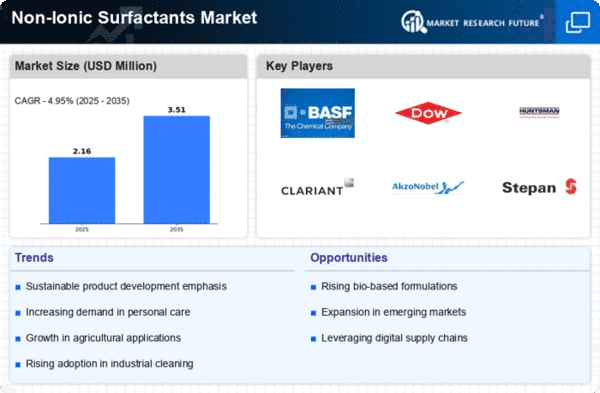
As per MRFR analysis, the Non-Ionic Surfactants Market Size was estimated at 2.06 USD Million in 2024. The Non-Ionic Surfactants industry is projected to grow from 2.17 in 2025 to 3.51 by 2035, exhibiting a compound annual growth rate (CAGR) of 4.95 during the forecast period 2025 - 2035.

Key Market Trends & Highlights

The Non-Ionic Surfactants Market is poised for robust growth driven by sustainability and innovation.

  • The market is witnessing a pronounced shift towards sustainability, influencing product formulations and consumer preferences.
  • Technological advancements are enhancing the efficiency and effectiveness of non-ionic surfactants across various applications.
  • North America remains the largest market, while the Asia-Pacific region is emerging as the fastest-growing area for non-ionic surfactants.
  • Rising demand in personal care products and household cleaning applications is driving market growth, alongside innovation in product formulations.

Market Size & Forecast

2024 Market Size 2.06 (USD Million)
2035 Market Size 3.51 (USD Million)
CAGR (2025 - 2035) 4.95%
Largest Regional Market Share in 2024 Asia-Pacific

Major Players

<p>BASF SE (DE), Dow Inc. (US), Huntsman Corporation (US), Clariant AG (CH), AkzoNobel N.V. (NL), Solvay S.A. (BE), Stepan Company (US), Evonik Industries AG (DE), Croda International Plc (GB)</p>

Market Trends

The Non-Ionic Surfactants Market is currently experiencing a notable transformation, driven by evolving consumer preferences and increasing environmental awareness. As industries seek sustainable alternatives, non-ionic surfactants are gaining traction due to their mildness and effectiveness in various applications, including personal care, household cleaning, and industrial processes. This shift towards eco-friendly products appears to be influencing manufacturers to innovate and develop formulations that align with sustainability goals. Furthermore, the versatility of non-ionic surfactants in emulsifying, wetting, and dispersing agents enhances their appeal across diverse sectors, suggesting a robust growth trajectory in the foreseeable future. In addition to sustainability, the Non-Ionic Surfactants Market is witnessing advancements in technology that facilitate the production of high-performance surfactants. These innovations may lead to improved efficiency and cost-effectiveness, thereby attracting a broader range of applications. Moreover, the increasing demand for biodegradable and non-toxic surfactants is likely to shape the competitive landscape, as companies strive to meet regulatory standards and consumer expectations. Overall, the Non-Ionic Surfactants Market appears poised for growth, driven by a combination of environmental considerations and technological progress.

Sustainability Focus

The emphasis on sustainability is reshaping the Non-Ionic Surfactants Market. Manufacturers are increasingly prioritizing eco-friendly formulations that minimize environmental impact. This trend reflects a broader societal shift towards greener products, influencing consumer choices and driving demand for sustainable surfactants.

Technological Advancements

Innovations in production technologies are enhancing the performance of non-ionic surfactants. These advancements may lead to more efficient manufacturing processes and improved product characteristics, potentially expanding their applications across various industries.

Regulatory Compliance

As environmental regulations become more stringent, the Non-Ionic Surfactants Market is adapting to comply with new standards. This trend encourages the development of biodegradable and non-toxic surfactants, aligning with both regulatory requirements and consumer preferences.

Non-Ionic Surfactants Market Market Drivers

Market Growth Projections

The Global Non-Ionic Surfactants Market Industry is projected to experience substantial growth over the coming years. With an expected market value of 19.6 USD Billion in 2024, the industry is on a trajectory to reach 30.3 USD Billion by 2035. This growth reflects a compound annual growth rate of 4.05% from 2025 to 2035, driven by various factors including increased demand in personal care, household products, and industrial applications. The market's expansion is indicative of the broader trends towards sustainability and innovation, as manufacturers seek to meet evolving consumer expectations and regulatory standards.

Growth in Personal Care Sector

The Global Non-Ionic Surfactants Market Industry is significantly influenced by the expanding personal care sector. Non-ionic surfactants are integral in formulating shampoos, conditioners, and skin care products due to their ability to enhance texture and stability. As the global population becomes increasingly aware of personal grooming and hygiene, the demand for high-quality personal care products rises. This trend is likely to propel the market forward, with projections suggesting that the industry could reach 30.3 USD Billion by 2035. The continuous innovation in product formulations further supports this growth, as brands seek to differentiate themselves in a competitive landscape.

Rising Demand in Household Products

The Global Non-Ionic Surfactants Market Industry experiences a notable surge in demand driven by the increasing use of non-ionic surfactants in household cleaning products. These surfactants are favored for their mildness and effectiveness in removing dirt and grease without harsh effects on surfaces or skin. As consumers become more environmentally conscious, manufacturers are reformulating products to include biodegradable non-ionic surfactants, aligning with sustainability trends. This shift is projected to contribute to the market's growth, with the industry expected to reach 19.6 USD Billion in 2024, indicating a robust consumer preference for safer cleaning solutions.

Emerging Markets and Economic Growth

The Global Non-Ionic Surfactants Market Industry is poised for expansion in emerging markets, where economic growth and urbanization drive increased consumption of consumer goods. As disposable incomes rise, consumers in these regions are more inclined to purchase personal care and household products that contain non-ionic surfactants. This trend is particularly evident in Asia-Pacific and Latin America, where the demand for quality products is escalating. The growing middle class in these regions indicates a potential for market growth, as the industry adapts to local preferences and needs, further solidifying its global presence.

Industrial Applications and Versatility

The versatility of non-ionic surfactants in various industrial applications contributes to the growth of the Global Non-Ionic Surfactants Market Industry. These surfactants are utilized in sectors such as textiles, agriculture, and oil recovery, where their emulsifying and wetting properties are essential. For instance, in the textile industry, non-ionic surfactants facilitate dyeing processes, improving color uptake and consistency. As industries seek to enhance efficiency and product quality, the demand for non-ionic surfactants is likely to increase. This trend suggests a steady growth trajectory, with a projected CAGR of 4.05% from 2025 to 2035, reflecting the ongoing reliance on these surfactants across diverse applications.

Regulatory Support for Eco-Friendly Products

The Global Non-Ionic Surfactants Market Industry benefits from increasing regulatory support aimed at promoting eco-friendly and sustainable products. Governments worldwide are implementing stringent regulations to limit the use of harmful chemicals in consumer products, thereby encouraging manufacturers to adopt non-ionic surfactants that are less toxic and more biodegradable. This regulatory landscape fosters innovation and investment in the development of sustainable surfactant alternatives. As a result, the market is likely to witness accelerated growth, as companies align their product offerings with regulatory expectations and consumer preferences for environmentally responsible solutions.

Market Segment Insights

By Application: Household Cleaning (Largest) vs. Personal Care (Fastest-Growing)

<p>In the Non-Ionic Surfactants Market, the application segment is primarily driven by Household Cleaning, which maintains the largest market share. This segment benefits from increasing demand for effective and eco-friendly cleaning solutions in residential settings. Following closely, Personal Care represents a rapidly growing segment, fueled by rising consumer awareness and preference for personal hygiene products that utilize non-ionic surfactants for their mildness and efficacy.</p>

<p>Household Cleaning (Dominant) vs. Agriculture (Emerging)</p>

<p>Household Cleaning remains the dominant application within the Non-Ionic Surfactants Market, characterized by a robust demand for versatile cleaning products suitable for various surfaces and purposes. This segment is resilient, with continual innovation in product formulations focused on sustainability and efficacy. Conversely, Agriculture is emerging as a significant segment, driven by the need for effective adjuvants that enhance pesticide efficacy and optimize agricultural processes. This growth is propelled by the increasing focus on sustainable agricultural practices and the need for environmentally friendly solutions.</p>

By End Use: Detergents (Largest) vs. Cosmetics (Fastest-Growing)

<p>The Non-Ionic Surfactants Market showcases varied distribution among its end-use segments, with detergents taking the lead as the largest segment. This dominance reflects the ongoing demand for effective cleaning solutions in both household and industrial applications. Cosmetics are emerging rapidly, driven by increased consumer awareness regarding personal care products and their formulations, leading to a notable shift in market dynamics. Growth trends indicate that while detergents continue to dominate, the cosmetics segment is witnessing the fastest growth due to rising disposable incomes and a burgeoning beauty industry. Additionally, innovations in surfactant formulations are pushing the boundaries of effectiveness and safety, particularly in cosmetics, which further enhances their market appeal and adoption across various demographics.</p>

<p>Detergents: Dominant vs. Cosmetics: Emerging</p>

<p>Detergents are positioned as the dominant segment in the Non-Ionic Surfactants Market, primarily due to their widespread application in household cleaning products, industrial cleaning agents, and laundry applications. Their consistent effectiveness in removing dirt and stains makes them essential in both consumer and commercial markets. On the other hand, cosmetics represent an emerging segment, reflecting changing consumer behaviors that favor gentle yet effective ingredients in personal care products. The focus on natural and safe formulations has led to significant innovation in this area, allowing cosmetic companies to leverage non-ionic surfactants for improved product performance while adhering to consumer demand for sustainability and safety. As such, the dynamics between these segments reflect broader trends in consumer preferences and industry adaptations.</p>

By Chemical Structure: Alcohol Ethoxylates (Largest) vs. Alkyl Polyglucosides (Fastest-Growing)

<p>In the Non-Ionic Surfactants Market, the segment of Alcohol Ethoxylates holds a significant share, solidifying its position as the largest category. These surfactants are widely utilized in personal care, household cleaning, and industrial applications, due to their effectiveness and versatility. Following closely are Alkyl Polyglucosides, praised for their biodegradable properties and mildness, contributing to their rapid growth trajectory within this market segment. This indicates a strong shift towards environmentally friendly options in surfactant applications. Fatty Acid Ethoxylates and Sorbitan Esters also play vital roles, catering to specific applications in both industrial and consumer products, yet they lag in market share compared to Alcohol Ethoxylates. Glycerol Esters, while currently smaller in share, are witnessing increasing interest driven by the rising demand for green chemistry solutions, which focuses on sustainable production methods. This trend highlights the industry's overall movement toward eco-friendly surfactant options, shaping the future landscape of non-ionic surfactants.</p>

<p>Alcohol Ethoxylates (Dominant) vs. Glycerol Esters (Emerging)</p>

<p>Alcohol Ethoxylates are renowned in the Non-Ionic Surfactants Market for their exceptional cleaning capabilities and compatibility with a wide range of formulations. As a dominant player, they are extensively used in formulations requiring effective degreasing and wetting properties across various industries. They are manufactured through the ethoxylation of alcohols, leading to molecules with excellent surfactant properties. On the other hand, Glycerol Esters represent an emerging segment characterized by their eco-friendly and biodegradable nature, appealing to consumers and manufacturers alike focusing on sustainability. Although their market presence is currently smaller compared to Alcohol Ethoxylates, their growth potential is underscored by an increasing consumer preference for natural ingredients in formulations, paving the way for their expansion and utilization in diverse applications.</p>

By Formulation Type: Liquid (Largest) vs. Powder (Fastest-Growing)

<p>In the Non-Ionic Surfactants Market, the formulation types are widely varied, with liquid formulations taking the lead as the largest segment. This dominance is attributed to their versatility and ease of integration in various applications, such as household cleaning products and industrial formulations. Conversely, powder formulations, while currently smaller in market share, are gaining traction due to their cost-effectiveness and convenience for transport and storage, particularly in remote locations where water supply may be limited.</p>

<p>Liquid (Dominant) vs. Powder (Emerging)</p>

<p>Liquid non-ionic surfactants dominate the market thanks to their extensive applicability and effectiveness across various industries. Their ability to easily mix with other ingredients makes them highly sought after in cleaning, personal care, and agricultural products. Meanwhile, powder formulations are emerging as an attractive alternative, especially in sectors looking for sustainable and transport-friendly solutions. They typically offer a longer shelf life and reduced shipping costs, providing manufacturers with a compelling reason to reconsider their formulation types. As these segments continue to develop, the balance of power may shift, driven by evolving consumer preferences and technological innovations.</p>

By Functionality: Emulsifiers (Largest) vs. Stabilizers (Fastest-Growing)

<p>In the Non-Ionic Surfactants Market, the functionality segment is diverse, with key players including emulsifiers, wetting agents, foaming agents, dispersants, and stabilizers. Emulsifiers capture the largest market share, driven by their extensive application in cosmetics, pharmaceuticals, and food industries. They provide critical functions such as binding water and oil-based ingredients, which are essential in product formulation. In contrast, stabilizers, while smaller in share, are showing rapid growth due to increasing demand in personal care and home care products, where formulation stability is key to product efficacy.</p>

<p>Emulsifiers (Dominant) vs. Stabilizers (Emerging)</p>

<p>Emulsifiers play a dominant role in the Non-Ionic Surfactants Market as essential components for numerous formulations, enabling the mixing of immiscible liquids, such as oil and water. Their widespread uses across various sectors, including food, cosmetics, and pharmaceuticals, underscore their importance. Emulsifiers enhance texture, extend shelf life, and improve the sensory attributes of products. On the other hand, stabilizers are emerging as a pivotal segment, driven by the rising need for long-lasting product performance in applications. They prevent the separation of components and enhance the overall stability of formulations, especially in industries focusing on sustainability and natural ingredient solutions.</p>

Get more detailed insights about Non-Ionic Surfactants Market Research Report - Global Forecast till 2035

Regional Insights

North America : Established Market with Growth Potential

The North American non-ionic surfactants market is projected to grow significantly, driven by increasing demand in personal care and household products. With a market size of $0.62 billion, the region benefits from stringent regulations promoting eco-friendly products, which are boosting the adoption of non-ionic surfactants. The trend towards sustainable formulations is a key growth driver, as consumers increasingly prefer biodegradable and non-toxic ingredients. Leading countries like the US and Canada are home to major players such as Dow Inc. and BASF SE, which are investing in innovative product development. The competitive landscape is characterized by a mix of established companies and emerging players, all vying for market share. The presence of advanced manufacturing facilities and R&D centers further enhances the region's position in the global market.

Europe : Innovation and Sustainability Focus

Europe's non-ionic surfactants market, valued at $0.52 billion, is characterized by a strong emphasis on sustainability and innovation. Regulatory frameworks such as REACH are driving manufacturers to develop eco-friendly surfactants, aligning with consumer preferences for sustainable products. The region's commitment to reducing environmental impact is a significant catalyst for market growth, as companies adapt to stringent regulations and consumer demands for greener alternatives. Germany, France, and the UK are leading markets, with key players like Clariant AG and AkzoNobel N.V. spearheading innovation. The competitive landscape is robust, with companies focusing on R&D to create high-performance, sustainable surfactants. This focus on innovation, combined with regulatory support, positions Europe as a leader in the non-ionic surfactants market.

Asia-Pacific : Rapid Growth and Market Leadership

Asia-Pacific is the largest market for non-ionic surfactants, with a market size of $1.0 billion, driven by rapid industrialization and urbanization. The region's growth is fueled by increasing demand in sectors such as personal care, agriculture, and textiles. The rising middle class and changing consumer preferences towards high-quality products are significant factors contributing to this growth. Additionally, favorable government policies supporting manufacturing and exports are enhancing market dynamics. China and India are the leading countries in this region, with major players like BASF SE and Huntsman Corporation expanding their operations. The competitive landscape is marked by a mix of local and international companies, all striving to capture market share. The presence of a large consumer base and growing industrial activities further solidifies Asia-Pacific's position as a dominant player in the non-ionic surfactants market.

Middle East and Africa : Emerging Market with Growth Opportunities

The Middle East and Africa (MEA) non-ionic surfactants market, valued at $0.02 billion, is in its nascent stages but shows potential for growth. Factors such as increasing urbanization, rising disposable incomes, and a growing demand for personal care products are driving market expansion. The region's diverse industrial base, including oil and gas, is also contributing to the demand for non-ionic surfactants, particularly in cleaning and formulation applications. Countries like South Africa and the UAE are leading the market, with opportunities for both local and international players. The competitive landscape is evolving, with companies exploring partnerships and collaborations to enhance their market presence. As the region continues to develop, the demand for non-ionic surfactants is expected to rise, presenting significant opportunities for growth.

Key Players and Competitive Insights

The Non-Ionic Surfactants Market is characterized by a competitive landscape that is increasingly shaped by innovation, sustainability, and strategic partnerships. Key players such as BASF SE (DE), Dow Inc. (US), and Clariant AG (CH) are actively pursuing strategies that emphasize product development and market expansion. BASF SE (DE) has focused on enhancing its portfolio with bio-based surfactants, which aligns with the growing demand for sustainable products. Meanwhile, Dow Inc. (US) is leveraging its technological capabilities to optimize formulations, thereby improving performance and reducing environmental impact. Clariant AG (CH) appears to be concentrating on strategic collaborations to enhance its market presence, particularly in emerging economies, which collectively influences the competitive dynamics of the market.

The market structure is moderately fragmented, with several players vying for market share through localized manufacturing and supply chain optimization. Companies are increasingly localizing their production to reduce lead times and enhance responsiveness to regional demands. This tactic not only improves operational efficiency but also allows for better alignment with local regulatory requirements. The collective influence of these key players fosters a competitive environment where innovation and customer-centric strategies are paramount.

In November 2025, BASF SE (DE) announced the launch of a new line of biodegradable non-ionic surfactants aimed at the personal care sector. This strategic move is significant as it not only addresses the rising consumer demand for eco-friendly products but also positions BASF as a leader in sustainable surfactant solutions. The introduction of these products is likely to enhance their market share and reinforce their commitment to sustainability.

In October 2025, Dow Inc. (US) unveiled a new digital platform designed to streamline the formulation process for non-ionic surfactants. This initiative is crucial as it integrates advanced data analytics and AI, enabling customers to optimize their product formulations more efficiently. By investing in digital transformation, Dow is not only enhancing customer engagement but also solidifying its competitive edge in a rapidly evolving market.

In September 2025, Clariant AG (CH) entered into a strategic partnership with a leading biotechnology firm to develop innovative surfactant solutions derived from renewable resources. This collaboration is indicative of Clariant's commitment to sustainability and innovation, potentially allowing them to capture a larger share of the market focused on green chemistry. Such partnerships are likely to enhance their product offerings and appeal to environmentally conscious consumers.

As of December 2025, the competitive trends in the Non-Ionic Surfactants Market are increasingly defined by digitalization, sustainability, and the integration of AI technologies. Strategic alliances are becoming more prevalent, as companies recognize the value of collaboration in driving innovation and expanding market reach. Looking ahead, competitive differentiation is expected to evolve, with a notable shift from price-based competition to a focus on innovation, technological advancements, and supply chain reliability. This transition underscores the importance of adapting to market demands while maintaining a commitment to sustainability and operational excellence.

Key Companies in the Non-Ionic Surfactants Market market include

Industry Developments

    • A biosurfactant named Rhamnolipid which is renewable and biodegradable by nature was launched as a result of a partnership between Unilever and Evonik in December 2019. The distinctive quality of Rhamnolipid is that it is ultra soft for the skin. The dishwasher brand of Unilever in Chile named Quix used this surfactant initially.
    • July 2021 – a technology-driven firm manufacturing next-generation biopolymers, Integrity BioChem (IBC), disclosed the launch of a renewable line of water-based bio-based surfactants, TegraSurf. TegraSurf is developed for water treatment, agricultural, mining, energy, and other industrial applications. Developed using sustainable vegetative materials, TegraSurf enhances the carbon footprint of manufacturing, devoid of compromising product performance. The latest product works as efficiently as a synthetic surfactant and is easy to manufacture and cost-effective if produced at large scales. TegraSurf is used in the operations to decrease or substitute prominent non-ionic surfactants, such as alcohol ethoxylates and nonylphenols. The product marks a Renewable Carbon Index (RCI) of more than 90% and is licensed as a Readily Biodegradable by OECD 301B protocol. It does not remain in the atmosphere after 90 days, enabling healthier and safer conditions for nearby communities and allowing formulators to meet industry sustainability standards.The Director of Supply Chain at Liberty Oilfield Services said that TegaSurf is a product that tests a lot of boxes for the company’s sustainability efforts. They are happy to partner with IBC.
    • Logos Technologies LLC’s business Natsurfact was acquired by Stephan in March 2020, which gave birth to many Rhamnolipid-based surfactants that were derived from renewable sources.
    • Solvay introduced two new products without nonylphenol ethoxylate in its Rhodapex BR APE surfactants category in October 2019. This helped the company meet and compete in the demand for water-based emulsion & polymerized paints, textiles, and adhesives in South America, Brazil, and many other countries.
    • In October 2019, BASF SE chose to twofold the limit of alkyl polyglucoside (APG), a surfactant utilized in the individual consideration section, at Jinshan, China.

Future Outlook

Non-Ionic Surfactants Market Future Outlook

<p>The Non-Ionic Surfactants Market is projected to grow at a 4.95% CAGR from 2024 to 2035, driven by increasing demand in personal care, agriculture, and industrial applications.</p>

New opportunities lie in:

  • <p>Development of biodegradable non-ionic surfactants for eco-friendly products.</p>
  • <p>Expansion into emerging markets with tailored formulations.</p>
  • <p>Investment in R&D for innovative applications in pharmaceuticals.</p>

<p>By 2035, the Non-Ionic Surfactants Market is expected to achieve robust growth and diversification.</p>

Market Segmentation

Non-Ionic Surfactants Market End Use Outlook

  • Detergents
  • Cosmetics
  • Textiles
  • Pharmaceuticals
  • Paints and Coatings

Non-Ionic Surfactants Market Application Outlook

  • Household Cleaning
  • Personal Care
  • Industrial Cleaning
  • Agriculture
  • Food Processing

Non-Ionic Surfactants Market Functionality Outlook

  • Emulsifiers
  • Wetting Agents
  • Foaming Agents
  • Dispersants
  • Stabilizers

Non-Ionic Surfactants Market Formulation Type Outlook

  • Liquid
  • Powder
  • Granular
  • Emulsifiable Concentrate
  • Aerosol

Non-Ionic Surfactants Market Chemical Structure Outlook

  • Alcohol Ethoxylates
  • Fatty Acid Ethoxylates
  • Sorbitan Esters
  • Alkyl Polyglucosides
  • Glycerol Esters

Report Scope

MARKET SIZE 20242.06(USD Million)
MARKET SIZE 20252.17(USD Million)
MARKET SIZE 20353.51(USD Million)
COMPOUND ANNUAL GROWTH RATE (CAGR)4.95% (2024 - 2035)
REPORT COVERAGERevenue Forecast, Competitive Landscape, Growth Factors, and Trends
BASE YEAR2024
Market Forecast Period2025 - 2035
Historical Data2019 - 2024
Market Forecast UnitsUSD Million
Key Companies ProfiledBASF SE (DE), Dow Inc. (US), Huntsman Corporation (US), Clariant AG (CH), AkzoNobel N.V. (NL), Solvay S.A. (BE), Stepan Company (US), Evonik Industries AG (DE), Croda International Plc (GB)
Segments CoveredApplication, End Use, Chemical Structure, Formulation Type, Functionality
Key Market OpportunitiesGrowing demand for eco-friendly formulations drives innovation in the Non-Ionic Surfactants Market.
Key Market DynamicsRising demand for eco-friendly formulations drives innovation and competition in the Non-Ionic Surfactants Market.
Countries CoveredNorth America, Europe, APAC, South America, MEA

FAQs

In 2018, what was the valuation of the Non-Ionic Surfactants Market?

USD 24300 million was the Non-ionic surfactants market value.

What might be the CAGR of the non-ionic surfactants market during the figure time frame (2024-2035)?

Non-ionic surfactants market CAGR would be 4.50% during the estimated time frame.

What locale would rule the worldwide non-ionic surfactants market result?

The Asia Pacific district would rule the non-ionic surfactants market.

What are end-clients referenced in the non-ionic surfactants market report?

The end-clients remembered for the non-ionic surfactants market report are paints and coatings, individual consideration and beauty care products, materials, agrochemicals, family cleaners, food and drink, oil and gas, and others.

What are the applications referenced in the non-ionic surfactants market report?

The non-ionic surfactants market applications are cleaners, emulsifiers, frothing specialists, wetting specialists, added substances, and others.

  1. Executive Summary
  2. Scope of the Report
    1. Market Definition
    2. Scope of the Study
      1. Research Objectives
      2. Assumptions & Limitations
    3. Market Structure
  3. Market Research
    1. Methodology
    2. Research Process
    3. Secondary Research
    4. Primary
    5. Research
    6. Forecast Model
  4. Market Landscape
    1. Supply Chain Analysis
      1. Raw Material Suppliers
      2. Manufacturers/Producers
      3. Distributors/Retailers/Wholesalers/E-Commerce
      4. End Users
    2. Porter’s Five Forces Analysis
      1. Threat
      2. Bargaining Power of Buyers
      3. Bargaining Power
      4. Threat of Substitutes
      5. Intensity of Competitive
    3. of New Entrants
    4. of Suppliers
    5. Rivalry
  5. Market Dynamics of the Global Non-Ionic Surfactants Market
    1. Introduction
    2. Drivers
    3. Restraints
    4. Opportunities
    5. Challenges
    6. Trends/Strategies
  6. Global Non-Ionic Surfactants Market,
    1. by Type
    2. Introduction
    3. Alcohol Ethoxylates
      1. Market Estimates
      2. Market Estimates & Forecast, by Region,
    4. & Forecast, 2022–2030
    5. Fatty Alkanolamides
      1. Market Estimates & Forecast,
      2. Market Estimates & Forecast, by Region, 2022–2030
    6. Amine Derivatives
      1. Market Estimates & Forecast, 2022–2030
      2. Market Estimates & Forecast, by Region, 2022–2030
    7. Glycerol
      1. Market Estimates & Forecast, 2022–2030
    8. Derivatives
  7. Market Estimates & Forecast, by Region, 2022–2030
    1. Alkoxylates
      1. Market Estimates & Forecast, 2022–2030
      2. Market Estimates
    2. & Forecast, by Region, 2022–2030
    3. Others
      1. Market Estimates
      2. Market Estimates & Forecast, by Region,
    4. & Forecast, 2022–2030
  8. Global Non-Ionic Surfactants Market, by Application
    1. Introduction
    2. Cleaners
      1. Market Estimates & Forecast, 2022–2030
      2. Market Estimates & Forecast, by Region, 2022–2030
    3. Emulsifiers
      1. Market Estimates & Forecast, 2022–2030
      2. Market Estimates
    4. & Forecast, by Region, 2022–2030
    5. Foaming Agents
      1. Market
      2. Market Estimates & Forecast,
    6. Estimates & Forecast, 2022–2030
    7. by Region, 2022–2030
    8. Wetting Agents
      1. Market Estimates &
      2. Market Estimates & Forecast, by Region,
    9. Forecast, 2022–2030
    10. Additives
      1. Market Estimates & Forecast, 2022–2030
      2. Market Estimates & Forecast, by Region, 2022–2030
    11. Others
      1. Market Estimates & Forecast, 2022–2030
      2. Market Estimates
    12. & Forecast, by Region, 2022–2030
  9. Global Non-Ionic Surfactants
  10. Market, by End-Use Industry
    1. Introduction
    2. Paints & Coatings
      1. Market Estimates & Forecast, 2022–2030
      2. Market Estimates
    3. & Forecast, by Region, 2022–2030
    4. Personal Care & Cosmetics
      1. Market Estimates & Forecast, 2022–2030
      2. Market Estimates
    5. & Forecast, by Region, 2022–2030
    6. Textiles
      1. Market Estimates
      2. Market Estimates & Forecast, by Region,
    7. & Forecast, 2022–2030
    8. Agrochemicals
      1. Market Estimates & Forecast,
      2. Market Estimates & Forecast, by Region, 2022–2030
    9. Household Cleaners
      1. Market Estimates & Forecast, 2022–2030
      2. Market Estimates & Forecast, by Region, 2022–2030
    10. Food
      1. Market Estimates & Forecast, 2022–2030
    11. & Beverage
  11. Market Estimates & Forecast, by Region, 2022–2030
    1. Oil & Gas
      1. Market Estimates & Forecast, 2022–2030
      2. Market Estimates
    2. & Forecast, by Region, 2022–2030
    3. Others
      1. Market Estimates
      2. Market Estimates & Forecast, by Region,
    4. & Forecast, 2022–2030
  12. Global Non-Ionic Surfactants Market, by Region
    1. Introduction
    2. North America
      1. Market Estimates & Forecast,
      2. Market Estimates & Forecast, by Type, 2022–2030
      3. Market Estimates & Forecast, by Application, 2022–2030
  13. Market Estimates & Forecast, by End-Use Industry, 2022–2030
    1. US
    2. Estimates & Forecast, by Type, 2022–2030
    3. & Forecast, by Application, 2022–2030
    4. Forecast, by End-Use Industry, 2022–2030
    5. Estimates & Forecast, 2022–2030
    6. by Type, 2022–2030
    7. Estimates & Forecast, by Application, 2022–2030
    8. & Forecast, by End-Use Industry, 2022–2030
    9. Market Estimates & Forecast, 2022–2030
    10. Forecast, by Type, 2022–2030
    11. by Application, 2022–2030
    12. End-Use Industry, 2022–2030
    13. & Forecast, 2022–2030
    14. Type, 2022–2030
  14. Market Estimates & Forecast, 2022–2030
  15. Market
  16. Market Estimates
  17. Market Estimates &
  18. Canada
  19. Market
  20. Market Estimates & Forecast,
  21. Market Estimates & Forecast, by Application,
  22. Market Estimates & Forecast, by End-Use Industry,
    1. Europe
      1. Market Estimates & Forecast, 2022–2030
      2. Market Estimates & Forecast, by Type, 2022–2030
      3. Market
      4. Market Estimates
      5. Germany
      6. France
      7. Italy
  23. Market Estimates & Forecast, by Application, 2022–2030
    1. Estimates & Forecast, by End-Use Industry, 2022–2030
    2. & Forecast, by Type, 2022–2030
    3. by Application, 2022–2030
    4. End-Use Industry, 2022–2030
    5. Forecast, 2022–2030
  24. Market
  25. Spain
  26. Market Estimates & Forecast, 2022–2030
  27. Market Estimates
  28. Market Estimates & Forecast,
  29. Market Estimates & Forecast, by
  30. UK
  31. Market Estimates &
  32. Market Estimates & Forecast, by Type,
  33. Market Estimates & Forecast, by Application, 2022–2030
  34. Market Estimates & Forecast, by End-Use Industry, 2022–2030
  35. Russia
  36. Market Estimates & Forecast, 2022–2030
  37. Market Estimates & Forecast, by Type, 2022–2030
  38. Market Estimates & Forecast, by Application, 2022–2030
    1. Estimates & Forecast, by End-Use Industry, 2022–2030
    2. Estimates & Forecast, by Type, 2022–2030
    3. & Forecast, by Application, 2022–2030
    4. Forecast, by End-Use Industry, 2022–2030
    5. Market Estimates & Forecast, 2022–2030
    6. & Forecast, by Type, 2022–2030
    7. by Application, 2022–2030
    8. End-Use Industry, 2022–2030
    9. & Forecast, 2022–2030
  39. Market
  40. Poland
  41. Market Estimates & Forecast, 2022–2030
  42. Market
  43. Market Estimates
  44. Market Estimates &
  45. Rest of Europe
  46. Market Estimates
  47. Market Estimates & Forecast,
  48. Market Estimates & Forecast, by
    1. Asia-Pacific
      1. Market Estimates
      2. Market Estimates & Forecast, by Type,
      3. Market Estimates & Forecast, by Application, 2022–2030
      4. Market Estimates & Forecast, by End-Use Industry, 2022–2030
      5. China
  49. Market Estimates & Forecast, by Type, 2022–2030
    1. & Forecast, by Application, 2022–2030
    2. Forecast, by End-Use Industry, 2022–2030
    3. Estimates & Forecast, 2022–2030
    4. by Type, 2022–2030
  50. Market Estimates
  51. Market Estimates &
  52. India
  53. Market
  54. Market Estimates & Forecast,
  55. Market Estimates & Forecast, by Application,
  56. Market Estimates & Forecast, by End-Use Industry,
  57. Japan
  58. Market Estimates & Forecast, 2022–2030
  59. Market Estimates & Forecast, by Type, 2022–2030
  60. Market Estimates & Forecast, by Application, 2022–2030
    1. Estimates & Forecast, by End-Use Industry, 2022–2030
    2. & New Zealand
  61. Market
  62. Australia
  63. Market Estimates & Forecast, 2022–2030
  64. Market Estimates & Forecast, by Type, 2022–2030
  65. Market Estimates & Forecast, by Application, 2022–2030
    1. Estimates & Forecast, by End-Use Industry, 2022–2030
    2. & South Korea
  66. Market
  67. Indonesia
  68. Market Estimates & Forecast, 2022–2030
  69. Market Estimates & Forecast, by Type, 2022–2030
  70. Market Estimates & Forecast, by Application, 2022–2030
    1. Estimates & Forecast, by End-Use Industry, 2022–2030
    2. of Asia-Pacific
  71. Market
  72. Rest
  73. Market Estimates & Forecast, 2022–2030
  74. Market Estimates & Forecast, by Type, 2022–2030
  75. Market Estimates & Forecast, by Application, 2022–2030
    1. Estimates & Forecast, by End-Use Industry, 2022–2030
    2. & Africa
  76. Market
    1. Middle East
      1. Market Estimates & Forecast, 2022–2030
  77. Market Estimates & Forecast, by Type, 2022–2030
    1. & Forecast, by Application, 2022–2030
    2. Forecast, by End-Use Industry, 2022–2030
    3. Estimates & Forecast, 2022–2030
    4. by Type, 2022–2030
  78. Market Estimates
  79. Market Estimates &
  80. GCC
  81. Market
  82. Market Estimates & Forecast,
  83. Market Estimates & Forecast, by Application,
  84. Market Estimates & Forecast, by End-Use Industry,
  85. Israel
  86. Market Estimates & Forecast,
  87. Market Estimates & Forecast, by Type, 2022–2030
  88. Market Estimates & Forecast, by Application, 2022–2030
  89. Market Estimates & Forecast, by End-Use Industry, 2022–2030
    1. North Africa
  90. Market Estimates & Forecast, 2022–2030
  91. Market Estimates & Forecast, by Type, 2022–2030
    1. & Forecast, by Application, 2022–2030
    2. Forecast, by End-Use Industry, 2022–2030
    3. Estimates & Forecast, 2022–2030
    4. by Type, 2022–2030
    5. Estimates & Forecast, 2022–2030
    6. by Type, 2022–2030
  92. Market Estimates
  93. Market Estimates &
  94. Turkey
  95. Market
  96. Market Estimates & Forecast,
  97. Market Estimates & Forecast, by Application,
  98. Market Estimates & Forecast, by End-Use Industry,
  99. Rest of Middle East & Africa
  100. Market
  101. Market Estimates & Forecast,
  102. Market Estimates & Forecast, by Application,
  103. Market Estimates & Forecast, by End-Use Industry,
    1. Latin America
      1. Market Estimates & Forecast,
      2. Market Estimates & Forecast, by Type, 2022–2030
      3. Market Estimates & Forecast, by Application, 2022–2030
  104. Market Estimates & Forecast, by End-Use Industry, 2022–2030
    1. Brazil
  105. Market Estimates & Forecast, 2022–2030
  106. Market Estimates & Forecast, by Type, 2022–2030
    1. & Forecast, by Application, 2022–2030
    2. Forecast, by End-Use Industry, 2022–2030
    3. Estimates & Forecast, 2022–2030
    4. by Type, 2022–2030
  107. Market Estimates
  108. Market Estimates &
  109. Mexico
  110. Market
  111. Market Estimates & Forecast,
  112. Market Estimates & Forecast, by Application,
  113. Market Estimates & Forecast, by End-Use Industry,
  114. Argentina
  115. Market Estimates & Forecast,
  116. Market Estimates & Forecast, by Type, 2022–2030
  117. Market Estimates & Forecast, by Application, 2022–2030
  118. Market Estimates & Forecast, by End-Use Industry, 2022–2030
    1. Rest of Latin America
  119. Market Estimates & Forecast, 2022–2030
  120. Market Estimates & Forecast, by Type, 2022–2030
  121. Market Estimates & Forecast, by Application, 2022–2030
    1. Estimates & Forecast, by End-Use Industry, 2022–2030
  122. Market
  123. Company
    1. Landscape
    2. Introduction
    3. Market Key Strategies
    4. Key Development
    5. Analysis
    6. (Expansions/Mergers & Acquisitions/Joint Ventures/New Application
    7. Developments/Agreements/Investments)
  124. Company Profiles
    1. 3M
      1. Financial Updates
      2. Application/Business
      3. Key Strategies
      4. Key Developments
    2. Company Overview
    3. Segment Overview
    4. SWOT Analysis
    5. SABIC
      1. Company Overview
      2. Financial
      3. Application/Business Segment Overview
      4. Key Strategies
      5. Key Developments
      6. SWOT Analysis
    6. Updates
    7. Akzo Nobel N.V.
      1. Company Overview
      2. Financial Updates
      3. Application/Business
      4. Key Strategies
      5. Key Developments
    8. Segment Overview
    9. SWOT Analysis
    10. Arkema
      1. Company Overview
      2. Financial
      3. Application/Business Segment Overview
      4. Key Strategies
      5. Key Developments
      6. SWOT Analysis
    11. Updates
    12. BASF SE
      1. Financial Updates
      2. Application/Business
      3. Key Strategies
      4. Key Developments
    13. Company Overview
    14. Segment Overview
    15. SWOT Analysis
    16. Clariant
      1. Company Overview
      2. Financial
      3. Application/Business Segment Overview
      4. Key Strategies
      5. Key Developments
      6. SWOT Analysis
    17. Updates
    18. Dow
      1. Company
      2. Financial Updates
      3. Application/Business Segment
      4. Key Strategies
      5. Key Developments
      6. SWOT
    19. Overview
    20. Overview
    21. Analysis
    22. Elementis plc
      1. Company Overview
      2. Financial
      3. Application/Business Segment Overview
      4. Key Strategies
      5. Key Developments
      6. SWOT Analysis
    23. Updates
    24. Evonik Industries
      1. Company Overview
      2. Financial Updates
      3. Application/Business
      4. Key Strategies
      5. Key Developments
    25. AG
    26. Segment Overview
    27. SWOT Analysis
    28. Huntsman International LLC
      1. Company Overview
      2. Financial Updates
      3. Application/Business Segment Overview
      4. Key Strategies
      5. Key Developments
      6. SWOT Analysis
    29. Kao Corporation
      1. Company Overview
      2. Financial Updates
      3. Application/Business Segment Overview
      4. Key Strategies
      5. SWOT Analysis
    30. Key Developments
    31. Stepan Company
      1. Financial Updates
      2. Application/Business
      3. Key Strategies
      4. Key Developments
    32. Company Overview
    33. Segment Overview
    34. SWOT Analysis
  125. Conclusion
  126. LIST OF TABLES
  127. Global
  128. Non-Ionic Surfactants Market, by Region, 2022–2030
  129. North America:
  130. Non-Ionic Surfactants Market, by Country, 2022–2030
  131. Europe: Non-Ionic
  132. Surfactants Market, by Country, 2022–2030
  133. Asia-Pacific: Non-Ionic
  134. Surfactants Market, by Country, 2022–2030
  135. Middle East & Africa:
  136. Non-Ionic Surfactants Market, by Country, 2022–2030
  137. Latin America:
  138. Non-Ionic Surfactants Market, by Country, 2022–2030
  139. Global Non-Ionic
  140. Surfactants Type Market, by Region, 2022–2030
  141. North America:
  142. Non-Ionic Surfactants Type Market, by Country, 2022–2030
  143. Europe:
  144. Non-Ionic Surfactants Type Market, by Country, 2022–2030
    1. Table10 Asia-Pacific:
  145. Non-Ionic Surfactants Type Market, by Country, 2022–2030
    1. Table11 Middle
  146. East & Africa: Non-Ionic Surfactants Type Market, by Country, 2022–2030
  147. Table13 Latin America: Non-Ionic Surfactants Type Market, by Country, 2022–2030
  148. Table13 Global Non-Ionic Surfactants Application Market, by Region, 2022–2030
  149. Table14 North America: Non-Ionic Surfactants Application Market, by Country, 2022–2030
  150. Table15 Europe: Non-Ionic Surfactants Application Market, by Country, 2022–2030
  151. Table16 Asia-Pacific: Non-Ionic Surfactants Application Market, by Country, 2022–2030
    1. Table17 Middle East & Africa: Non-Ionic Surfactants Application Market, by
    2. Country, 2022–2030
    3. Table18 Latin America: Non-Ionic Surfactants Application
  152. Market, by Country, 2022–2030
    1. Table19 Global Non-Ionic Surfactants End-Use
  153. Industry Market, by Region, 2022–2030
    1. Table20 North America: Non-Ionic
  154. Surfactants End-Use Industry Market, by Country, 2022–2030
    1. Table21 Europe:
  155. Non-Ionic Surfactants End-Use Industry Market, by Country, 2022–2030
    1. Table22
  156. Asia-Pacific: Non-Ionic Surfactants End-Use Industry Market, by Country, 2022–2030
    1. Table23 Middle East & Africa: Non-Ionic Surfactants End-Use Industry Market,
    2. by Country, 2022–2030
    3. Table24 Latin America: Non-Ionic Surfactants End-Use
  157. Industry Market, by Country, 2022–2030
    1. Table25 Global Type Market, by
    2. Region, 2022–2030
  158. Table26 Global Application Market, by Region, 2022–2030
  159. Table27 Global End-Use Industry Market, by Region, 2022–2030
    1. Table28
  160. North America: Non-Ionic Surfactants Market, by Country
    1. Table29 North America:
  161. Non-Ionic Surfactants Market, by Type
    1. Table30 North America: Non-Ionic Surfactants
  162. Market, by Application
    1. Table31 North America: Non-Ionic Surfactants Market,
    2. by End-Use Industry
  163. Table32 Europe: Non-Ionic Surfactants Market, by Country
  164. Table33 Europe: Non-Ionic Surfactants Market, by Type
    1. Table34 Europe: Non-Ionic
  165. Surfactants Market, by Application
    1. Table35 Europe: Non-Ionic Surfactants Market,
    2. by End-Use Industry
    3. Table36 Asia-Pacific: Non-Ionic Surfactants Market, by
    4. Country
  166. Table37 Asia-Pacific: Non-Ionic Surfactants Market, by Type
    1. Table38
  167. Asia-Pacific: Non-Ionic Surfactants Market, by Application
    1. Table39 Asia-Pacific:
  168. Non-Ionic Surfactants Market, by End-Use Industry
    1. Table40 Middle East &
  169. Africa: Non-Ionic Surfactants Market, by Country
    1. Table41 Middle East &
  170. Africa Non-Ionic Surfactants Market, by Type
    1. Table42 Middle East & Africa
  171. Non-Ionic Surfactants Market, by Application
    1. Table43 Middle East & Africa:
  172. Non-Ionic Surfactants Market, by End-Use Industry
    1. Table44 Latin America: Non-Ionic
  173. Surfactants Market, by Country
    1. Table45 Latin America Non-Ionic Surfactants
  174. Market, by Type
  175. Table46 Latin America Non-Ionic Surfactants Market, by Application
  176. Table47 Latin America: Non-Ionic Surfactants Market, by End-Use Industry
    1. LIST
  177. OF FIGURES
  178. Global Non-Ionic Surfactants Market Segmentation
    1. FIGURE
  179. Forecast Research Methodology
  180. Porter’s Five Forces Analysis
    1. of the Global Non-Ionic Surfactants Market
  181. Value Chain of the Global
    1. Non-Ionic Surfactants Market
  182. Share of the Global Non-Ionic Surfactants
  183. Market in 2022, by Country (%)
  184. Global Non-Ionic Surfactants Market,
  185. Global Non-Ionic Surfactants Market Size by Types,
  186. Share of the Global Non-Ionic Surfactants Market, by Type, 2022–2030
  187. Global Non-Ionic Surfactants Market Size, by Application, 2022
    1. FIGURE
  188. Share of the Global Non-Ionic Surfactants Market, by Application, 2022–2030
  189. Global Non-Ionic Surfactants Market Size, by End-Use Industry, 2022
  190. Share of the Global Non-Ionic Surfactants Market, by End-Use Industry,

Non-Ionic Surfactants Market Segmentation

Market Segmentation Overview

  • Detailed segmentation data will be available in the full report
  • Comprehensive analysis by multiple parameters
  • Regional and country-level breakdowns
  • Market size forecasts by segment
Infographic

Free Sample Request

Kindly complete the form below to receive a free sample of this Report

Get Free Sample

Customer Strories

Compare Licence

×
Features License Type
Single User Multiuser License Enterprise User
Price $4,950 $5,950 $7,250
Maximum User Access Limit 1 User Upto 10 Users Unrestricted Access Throughout the Organization
Free Customization
Direct Access to Analyst
Deliverable Format
Platform Access
Discount on Next Purchase 10% 15% 15%
Printable Versions