×
Request Free Sample ×

Kindly complete the form below to receive a free sample of this Report

Leading companies partner with us for data-driven Insights

clients tt-cursor
Hero Background

North America M2M Communication Market

ID: MRFR/ICT/60658-HCR
200 Pages
Aarti Dhapte
October 2025

North America M2M Communication Market Research Report By Application (Telematics, Smart Grids, Healthcare, Industrial Automation, Smart Cities), By Connectivity Technology (Cellular, Satellite, Wi-Fi, Bluetooth, LPWAN), By Type (Hardware, Software, Connectivity Services), By End Use (Automotive, Healthcare, Manufacturing, Utilities, Retail) and By Regional (US, Canada)- Forecast to 2035

Share:
Download PDF ×

We do not share your information with anyone. However, we may send you emails based on your report interest from time to time. You may contact us at any time to opt-out.

North America M2M Communication Market Infographic
Purchase Options

North America M2M Communication Market Summary

As per MRFR analysis, the North America m2m communication market size was estimated at 23.5 USD Billion in 2024. The North America m2m communication market is projected to grow from 24.79 USD Billion in 2025 to 42.26 USD Billion by 2035, exhibiting a compound annual growth rate (CAGR) of 5.48% during the forecast period 2025 - 2035.

Key Market Trends & Highlights

The North America m2m communication market is poised for substantial growth driven by technological advancements and increasing demand for connectivity.

  • The US remains the largest market for m2m communication, while Canada is emerging as the fastest-growing region.
  • There is a notable increase in the adoption of IoT solutions across various industries, enhancing operational efficiency.
  • A strong focus on security and compliance is shaping the development of m2m communication technologies.
  • The expansion of 5G networks and rising demand for automation are key drivers propelling market growth.

Market Size & Forecast

2024 Market Size 23.5 (USD Billion)
2035 Market Size 42.26 (USD Billion)

Major Players

AT&T (US), Verizon (US), Vodafone (GB), Telefónica (ES), Deutsche Telekom (DE), Orange (FR), T-Mobile (US), China Mobile (CN), China Telecom (CN)

North America M2M Communication Market Trends

The m2m communication market in North America is currently experiencing a transformative phase, driven by advancements in technology and increasing demand for connectivity. The proliferation of IoT devices has led to a surge in applications across various sectors, including healthcare, transportation, and agriculture. This trend indicates a growing reliance on automated systems that enhance operational efficiency and data management. Furthermore, the integration of artificial intelligence and machine learning into m2m communication systems appears to be reshaping how businesses interact with their environments, potentially leading to smarter decision-making processes. In addition, regulatory frameworks and government initiatives are likely to play a crucial role in shaping the future landscape of the m2m communication market. Policies aimed at promoting innovation and ensuring cybersecurity are becoming increasingly relevant. As organizations seek to leverage the benefits of m2m communication, collaboration between public and private sectors may foster an ecosystem conducive to growth. Overall, the m2m communication market is poised for significant evolution, with various factors contributing to its expansion and adaptation to emerging technologies.

Increased Adoption of IoT Solutions

The m2m communication market is witnessing a notable rise in the adoption of IoT solutions across diverse industries. This trend is driven by the need for real-time data collection and analysis, which enhances operational efficiency. Organizations are increasingly integrating IoT devices into their processes, leading to improved decision-making and resource management.

Focus on Security and Compliance

As the m2m communication market expands, there is a heightened emphasis on security and compliance measures. Organizations are prioritizing the protection of sensitive data and ensuring adherence to regulatory standards. This focus on security is essential for building trust and fostering long-term relationships with customers.

Emergence of Smart Cities

The development of smart cities is significantly influencing the m2m communication market. Urban areas are increasingly implementing connected technologies to improve infrastructure and services. This trend suggests a shift towards more sustainable and efficient urban living, with m2m communication playing a pivotal role in facilitating these advancements.

North America M2M Communication Market Drivers

Expansion of 5G Networks

The ongoing expansion of 5G networks in North America is a pivotal driver for the m2m communication market. With enhanced data speeds and reduced latency, 5G technology facilitates seamless connectivity for a multitude of devices. This advancement is expected to bolster the deployment of m2m applications across various sectors, including healthcare, automotive, and manufacturing. As of 2025, it is projected that 5G will account for approximately 30% of all mobile connections in the region, significantly impacting the m2m communication market. The ability to support a higher density of devices per square kilometer enhances the potential for innovative m2m solutions, thereby driving market growth.

Emergence of Edge Computing

The emergence of edge computing is transforming the landscape of the m2m communication market. By processing data closer to the source, edge computing reduces latency and bandwidth usage, which is particularly beneficial for real-time applications. This technology is gaining traction in sectors such as manufacturing and transportation, where timely data processing is critical. As of 2025, it is anticipated that edge computing will account for nearly 25% of all data processed in North America, thereby enhancing the capabilities of m2m communication solutions. The integration of edge computing with m2m technologies is likely to drive innovation and efficiency within the market.

Rising Demand for Automation

The increasing demand for automation across industries is significantly influencing the m2m communication market. Businesses are increasingly adopting automated systems to enhance operational efficiency and reduce costs. In sectors such as manufacturing and logistics, m2m communication enables real-time monitoring and control of equipment and processes. This trend is reflected in a projected growth rate of 15% annually for automation technologies in North America, which directly correlates with the expansion of the m2m communication market. As organizations seek to optimize their operations, the integration of m2m solutions becomes essential, further propelling market dynamics.

Increased Focus on Data Analytics

The growing emphasis on data analytics is reshaping the m2m communication market. Organizations are increasingly leveraging data generated from m2m devices to gain insights into operational performance and customer behavior. This trend is particularly evident in sectors such as retail and healthcare, where data-driven decision-making is becoming the norm. The m2m communication market is likely to benefit from this shift, as the demand for advanced analytics tools and platforms rises. It is estimated that the market for data analytics in North America will reach $200 billion by 2027, further driving the adoption of m2m technologies.

Government Initiatives and Funding

Government initiatives aimed at promoting technological advancements are playing a crucial role in the m2m communication market. In North America, various federal and state programs are designed to support the development and implementation of smart technologies. For instance, funding for smart grid projects and transportation infrastructure improvements is expected to exceed $10 billion by 2026. Such investments not only enhance connectivity but also stimulate the m2m communication market by encouraging private sector participation. The alignment of public policy with technological innovation fosters an environment conducive to the growth of m2m solutions.
Market Segment Insights

By Application: Telematics (Largest) vs. Smart Grids (Fastest-Growing)

In the North America m2m communication market, the application segment displays diverse distribution with telematics holding the largest share. This segment is fueled by the increasing demand for vehicle connectivity and fleet management solutions. Meanwhile, smart grids have emerged as a vital area of growth, appealing to utilities in their quest for enhanced efficiency and renewable energy integration. Growth trends indicate a significant rise in the adoption of smart cities and healthcare applications, focusing on enhancing urban infrastructure and patient monitoring systems. The push towards automation and data-driven decision-making is propelling the industrial automation sector, while the telematics domain continues to benefit from advancements in IoT and communication technologies, further solidifying its market prominence.

Telematics: Dominant vs. Smart Grids: Emerging

Telematics has established itself as the dominant application within the North America m2m communication market, primarily driven by its role in real-time vehicle tracking and management solutions. The use of telematics in providing data analytics and enhancing operational efficiencies for logistics and transportation sectors showcases its market significance. In contrast, smart grids are recognized as an emerging application, gaining traction due to the increasing focus on sustainable energy management and improved grid reliability. The integration of renewable energy sources and smart meter deployments within smart grids present an exciting opportunity for growth, indicating a shift towards a more intelligent energy landscape that benefits both consumers and service providers.

By Connectivity Technology: Cellular (Largest) vs. LPWAN (Fastest-Growing)

The connectivity technology segment in the m2m communication market showcases a diverse distribution among several key technologies. Cellular technology commands the largest share, benefiting from established infrastructures and extensive coverage, making it the preferred choice for many applications. In contrast, LPWAN has emerged as a significant player, appealing to sectors that prioritize low power consumption and long-range communication capabilities. As the demand for IoT applications surges, growth trends are increasingly favoring LPWAN due to its efficiency and cost-effectiveness. Factors driving growth include the rising number of connected devices and the need for seamless connectivity in smart cities and industrial automation. With advancements in cellular technology also paving the way for enhanced performance, the competition between these technologies is expected to intensify over the coming years.

Cellular (Dominant) vs. LPWAN (Emerging)

Cellular technology remains dominant in the connectivity landscape due to its reliable performance and widespread adoption across various sectors. It is characterized by high data transmission rates and robust security features, making it suitable for critical applications in healthcare, automotive, and smart cities. Conversely, LPWAN is recognized as an emerging technology that focuses on low power consumption and long-range connectivity. This makes LPWAN particularly attractive for use cases involving sensor networks and remote monitoring where battery life is crucial. The growing number of applications leveraging LPWAN, including smart metering and asset tracking, positions it as a compelling choice for enterprises looking to optimize resource usage while ensuring reliable connectivity.

By Type: Hardware (Largest) vs. Software (Fastest-Growing)

In the North America m2m communication market, the distribution of market share among Hardware, Software, and Connectivity Services reveals a significant dominance of Hardware, which accounts for a considerable portion of the overall market. Software is emerging as the fastest-growing segment, reflecting a shift towards more sophisticated and integrated solutions. Connectivity Services, while crucial, remains a smaller share in comparison to Hardware and Software. The growth trends in this segment are primarily driven by the increasing demand for smart devices and automation solutions across various industries. The rapid advancements in IoT technologies have prompted organizations to invest heavily in Software solutions for improved functionality and efficiency. Additionally, the need for robust Connectivity Services is also rising, supporting the overall development and integration of m2m communication systems, thus collectively enhancing market dynamics.

Hardware (Dominant) vs. Software (Emerging)

Hardware, encompassing various devices and sensors, holds a dominant position in the m2m communication landscape due to its essential role in facilitating communication between devices. Its reliability and performance are paramount for sectors like automotive, healthcare, and manufacturing. On the other hand, Software is an emerging segment that is experiencing rapid growth driven by increased demand for analytics and data management tools. The integration capabilities of Software with existing Hardware solutions allow for greater efficiency and smarter operations. As industries evolve, Software is increasingly recognized for enhancing the capabilities of traditional Hardware, making it a vital component for future innovations in m2m communication.

By End Use: Automotive (Largest) vs. Healthcare (Fastest-Growing)

The m2m communication market is witnessing a diverse array of end use segments, with the automotive sector holding the largest share due to the increasing integration of connected vehicles and autonomous driving technologies. Healthcare follows closely, benefiting from the rise of telemedicine and remote patient monitoring systems, leading to significant advancements in personalized healthcare services. The manufacturing, utilities, and retail sectors are also emerging as vital contributors, driven by automation and smart technologies that enhance operational efficiency. Growth trends in the m2m communication market are characterized by significant advancements across various end use sectors. Automotive stands out with its rapid adoption of intelligent transportation systems, while healthcare is experiencing the fastest growth fueled by the demand for remote patient management and connected health devices. Additionally, the manufacturing sector is increasingly leveraging m2m solutions for smart factory initiatives, further driving market expansion. The utilities and retail sectors are also harnessing these communications to optimize resource management and customer engagement, respectively.

Automotive: Dominant vs. Healthcare: Emerging

The automotive segment remains dominant in the m2m communication landscape, primarily due to its early adoption of connected technologies and a robust infrastructure that supports vehicle-to-everything (V2X) communications. This segment is characterized by substantial investments in R&D aimed at enhancing safety features, efficiency, and user experience. On the other hand, the healthcare sector is emerging rapidly, driven by innovations in telehealth services and remote monitoring solutions. The growth in healthcare is supported by an increasing focus on patient-centered care models and the necessity for real-time data analysis. While automotive enjoys a stable market share, healthcare's dynamic expansion highlights the shift towards integrated health solutions in a post-pandemic world.

Get more detailed insights about North America M2M Communication Market

Regional Insights

US : Leading Market with Robust Growth

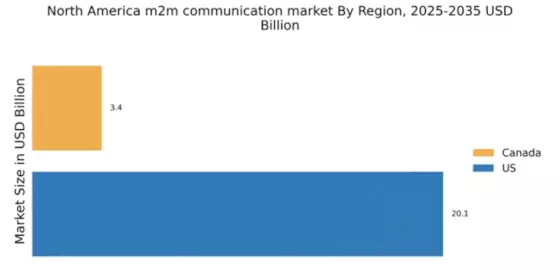
The US m2m communication market holds a significant share of 20.1%, reflecting its value-driven growth. Key drivers include the rapid adoption of IoT technologies, increased demand for smart devices, and supportive government initiatives promoting digital infrastructure. Regulatory policies, such as the FCC's efforts to enhance broadband access, further stimulate market expansion. The industrial sector is also evolving, with investments in 5G technology enhancing connectivity and operational efficiency.

Canada : Growth Potential in Diverse Sectors

Canada's m2m communication market, with a share of 3.4%, is poised for growth driven by advancements in smart city initiatives and increased demand for connected devices. Government policies, such as the Innovation and Skills Plan, aim to foster technological development and enhance connectivity. The market is characterized by a growing focus on sustainability and energy efficiency, aligning with global trends in environmental responsibility.

North America M2M Communication Market Regional Image

Key Players and Competitive Insights

The m2m communication market in North America is characterized by a dynamic competitive landscape, driven by rapid technological advancements and increasing demand for connectivity across various sectors. Key players such as AT&T (US), Verizon (US), and T-Mobile (US) are at the forefront, focusing on innovation and strategic partnerships to enhance their service offerings. These companies are actively investing in the development of IoT solutions, which are pivotal in driving growth within the market. Their collective strategies, which include regional expansion and digital transformation initiatives, are shaping a competitive environment that emphasizes not only connectivity but also the integration of advanced technologies.

In terms of business tactics, companies are increasingly localizing manufacturing and optimizing supply chains to enhance operational efficiency. The market structure appears moderately fragmented, with several players vying for market share. However, the influence of major companies like Verizon (US) and AT&T (US) remains substantial, as they leverage their extensive networks and resources to maintain a competitive edge. This competitive structure fosters an environment where innovation and customer-centric solutions are paramount.

In October 2025, Verizon (US) announced a strategic partnership with a leading cloud service provider to enhance its m2m communication capabilities. This collaboration aims to integrate advanced analytics and AI-driven solutions into their existing infrastructure, thereby improving service delivery and operational efficiency. The strategic importance of this move lies in Verizon's commitment to staying ahead in the rapidly evolving m2m landscape, positioning itself as a leader in providing comprehensive IoT solutions.

Similarly, in September 2025, AT&T (US) launched a new suite of IoT services designed specifically for the healthcare sector. This initiative focuses on improving patient monitoring and data management through enhanced connectivity solutions. The strategic significance of this launch is evident in AT&T's aim to capitalize on the growing demand for telehealth services, thereby expanding its market reach and reinforcing its position in the m2m communication space.

In August 2025, T-Mobile (US) unveiled its 5G IoT platform, which is designed to support a wide range of applications, from smart cities to industrial automation. This strategic move underscores T-Mobile's focus on leveraging next-generation technology to enhance its service offerings. The introduction of this platform is likely to attract new customers and drive further adoption of m2m solutions across various industries.

As of November 2025, current trends in the m2m communication market are heavily influenced by digitalization, sustainability, and the integration of AI technologies. Strategic alliances among key players are shaping the competitive landscape, fostering innovation and collaboration. Looking ahead, it appears that competitive differentiation will increasingly hinge on technological advancements and supply chain reliability, rather than solely on price. This shift suggests a future where companies that prioritize innovation and customer-centric solutions will likely emerge as leaders in the m2m communication market.

Key Companies in the North America M2M Communication Market market include

Industry Developments

The North America M2M Communication Market has seen significant recent developments, especially in sectors like smart logistics, healthcare, and industrial automation. In September 2023, Honeywell announced the launch of a new IoT platform aimed at optimizing operations in various industries, reflecting the growing demand for M2M solutions. Cisco Systems has also expanded its cloud-based M2M offerings, focusing on enhanced security features, catering to increasing cyber threats in connected devices. In August 2023, Verizon Communications revealed a partnership with Amazon Web Services to streamline M2M connectivity solutions, further solidifying its foothold in the market. 

Major growth is noted in companies like AT&T and IBM, both of which are investing heavily in next-gen M2M communication technologies. Moreover, in July 2023, Oracle completed its acquisition of a smaller tech firm to enhance its M2M capabilities, a move that signified the increasing consolidation trends within the sector. The market valuation is expected to see a significant uptick due to robust investments in Research and Development from key players like Siemens and Microsoft, indicating a flourishing landscape for M2M communications across North America.

Future Outlook

North America M2M Communication Market Future Outlook

The M2M Communication Market is projected to grow at a 5.48% CAGR from 2024 to 2035, driven by advancements in IoT, increased automation, and enhanced connectivity solutions.

New opportunities lie in:

  • Development of smart agriculture solutions leveraging m2m technology.
  • Expansion of telehealth services utilizing remote monitoring devices.
  • Integration of m2m communication in smart city infrastructure projects.

By 2035, the m2m communication market is expected to be robust, driven by innovative applications and increased adoption.

Market Segmentation

North America M2M Communication Market Type Outlook

  • Hardware
  • Software
  • Connectivity Services

North America M2M Communication Market End Use Outlook

  • Automotive
  • Healthcare
  • Manufacturing
  • Utilities
  • Retail

North America M2M Communication Market Application Outlook

  • Telematics
  • Smart Grids
  • Healthcare
  • Industrial Automation
  • Smart Cities

North America M2M Communication Market Connectivity Technology Outlook

  • Cellular
  • Satellite
  • Wi-Fi
  • Bluetooth
  • LPWAN

Report Scope

MARKET SIZE 202423.5(USD Billion)
MARKET SIZE 202524.79(USD Billion)
MARKET SIZE 203542.26(USD Billion)
COMPOUND ANNUAL GROWTH RATE (CAGR)5.48% (2024 - 2035)
REPORT COVERAGERevenue Forecast, Competitive Landscape, Growth Factors, and Trends
BASE YEAR2024
Market Forecast Period2025 - 2035
Historical Data2019 - 2024
Market Forecast UnitsUSD Billion
Key Companies Profiled["AT&T (US)", "Verizon (US)", "Vodafone (GB)", "Telefónica (ES)", "Deutsche Telekom (DE)", "Orange (FR)", "T-Mobile (US)", "China Mobile (CN)", "China Telecom (CN)"]
Segments CoveredApplication, Connectivity Technology, Type, End Use
Key Market OpportunitiesIntegration of advanced IoT solutions enhances efficiency in the m2m communication market.
Key Market DynamicsRising demand for smart devices drives innovation and competition in the M2M communication market.
Countries CoveredUS, Canada

Leave a Comment

FAQs

What is the expected market size of the North America M2M Communication Market in 2024?

The North America M2M Communication Market is expected to be valued at 23.0 billion USD in 2024.

What is the projected market value for the North America M2M Communication Market by 2035?

By 2035, the North America M2M Communication Market is anticipated to reach a value of 42.2 billion USD.

What is the expected compound annual growth rate (CAGR) for the North America M2M Communication Market?

The expected CAGR for the North America M2M Communication Market from 2025 to 2035 is 5.673%.

Which application segment holds the largest share in the North America M2M Communication Market?

The Telematics application segment is anticipated to dominate the market, valued at 8.5 billion USD in 2024.

How is the M2M Communication Market expected to grow in the US compared to Canada?

In 2024, the M2M Communication Market is expected to be valued at 15.0 billion USD in the US and 8.0 billion USD in Canada.

What is the market size for the Smart Grids application in the M2M Communication Market by 2035?

The Smart Grids application segment is projected to be valued at 9.2 billion USD by 2035.

Who are the major players in the North America M2M Communication Market?

Key players in the market include Honeywell, Cisco Systems, Oracle, and Verizon Communications among others.

What market value is expected for the Healthcare application segment by 2035?

The Healthcare application segment is expected to reach a value of 7.6 billion USD by 2035.

What are the anticipated challenges in the North America M2M Communication Market?

Challenges may include technological integration and ensuring data security within the market.

What is the expected value for the Industrial Automation application segment in 2024?

The Industrial Automation application segment is expected to be valued at 3.0 billion USD in 2024.

Download Free Sample

Kindly complete the form below to receive a free sample of this Report

Compare Licence

×
Features License Type
Single User Multiuser License Enterprise User
Price $4,950 $5,950 $7,250
Maximum User Access Limit 1 User Upto 10 Users Unrestricted Access Throughout the Organization
Free Customization
Direct Access to Analyst
Deliverable Format
Platform Access
Discount on Next Purchase 10% 15% 15%
Printable Versions