×
Request Free Sample ×

Kindly complete the form below to receive a free sample of this Report

* Please use a valid business email

Leading companies partner with us for data-driven Insights

clients tt-cursor
Hero Background

North America Metal Forging Market

ID: MRFR/CnM/47519-HCR
111 Pages
Chitranshi Jaiswal
October 2025

North America Metal Forging Market Research Report: By Raw Material (Steel, Aluminum, Magnesium, Nickel-Based Alloys, Titanium, Other), By Type (Closed-die Forging, Open-die Forging, Others), By End-use (Automotive, Aerospace & Defense, Aircraft Engine, Others, Power, Building & Construction, Oil & Gas, Metalworking) and By Regional (US, Canada) - Forecast to 2035.

Share:
Download PDF ×

We do not share your information with anyone. However, we may send you emails based on your report interest from time to time. You may contact us at any time to opt-out.

North America Metal Forging Market Infographic
Purchase Options

North America Metal Forging Market Summary

As per MRFR analysis, the North America metal forging market Size was estimated at 18.1 USD Billion in 2024. The North America metal forging market is projected to grow from 19.56 USD Billion in 2025 to 42.5 USD Billion by 2035, exhibiting a compound annual growth rate (CAGR) of 8.07% during the forecast period 2025 - 2035.

Key Market Trends & Highlights

The North America metal forging market is poised for growth driven by technological advancements and increasing demand from key industries.

  • Technological advancements are reshaping the metal forging landscape, enhancing efficiency and product quality.
  • Sustainability initiatives are gaining traction, prompting manufacturers to adopt eco-friendly practices in forging processes.
  • The US remains the largest market, while Canada is emerging as the fastest-growing region in the metal forging sector.
  • Rising automotive production and infrastructure development initiatives are key drivers propelling market expansion.

Market Size & Forecast

2024 Market Size 18.1 (USD Billion)
2035 Market Size 42.5 (USD Billion)
CAGR (2025 - 2035) 8.07%

Major Players

Thyssenkrupp AG (DE), Alcoa Corporation (US), Precision Castparts Corp (US), Aubert & Duval (FR), Forged Solutions Group (GB), Fletcher International (AU), Bharat Forge Limited (IN), Nippon Steel Corporation (JP), Shaanxi Blower (CN)

North America Metal Forging Market Trends

The metal forging market in North America is currently experiencing a dynamic phase characterized by evolving technologies and increasing demand across various sectors. The automotive and aerospace industries are particularly influential, as they require high-strength components that can withstand extreme conditions. This demand is likely to drive innovation in forging techniques, leading to enhanced efficiency and reduced waste. Furthermore, the emphasis on lightweight materials is prompting manufacturers to explore advanced alloys and composites, which may reshape production processes. In addition, sustainability is becoming a focal point within the metal forging market. Companies are increasingly adopting eco-friendly practices, such as recycling scrap metal and utilizing energy-efficient machinery. This shift not only aligns with regulatory requirements but also appeals to environmentally conscious consumers. As the market continues to evolve, collaboration between manufacturers and technology providers appears essential for fostering growth and maintaining competitiveness. Overall, the landscape of the metal forging market is poised for transformation, driven by technological advancements and a commitment to sustainability.

Technological Advancements

The metal forging market is witnessing rapid technological advancements that enhance production efficiency and product quality. Innovations such as computer numerical control (CNC) machining and automation are streamlining operations, reducing labor costs, and minimizing errors. These technologies enable manufacturers to produce complex geometries with precision, catering to the specific needs of various industries.

Sustainability Initiatives

Sustainability initiatives are gaining traction within the metal forging market, as companies strive to reduce their environmental footprint. Efforts include the adoption of energy-efficient processes, waste reduction strategies, and the use of recycled materials. This trend not only meets regulatory standards but also resonates with consumers who prioritize eco-friendly practices.

Increased Demand from Key Industries

The demand for forged components is increasing in key industries such as automotive and aerospace. These sectors require high-performance materials that can withstand rigorous conditions. As manufacturers seek to enhance product durability and performance, the metal forging market is likely to experience sustained growth driven by these industries.

North America Metal Forging Market Drivers

Energy Sector Growth

The energy sector, particularly renewable energy, is emerging as a vital driver for the metal forging market in North America. With the increasing focus on sustainable energy sources, the demand for forged components in wind turbines, solar panels, and other renewable technologies is likely to grow. In 2025, investments in renewable energy infrastructure are expected to exceed $200 billion, creating a substantial market for forged products. The metal forging market is positioned to capitalize on this trend, as forged components are essential for the structural integrity and efficiency of energy systems. Additionally, the transition towards cleaner energy solutions may prompt innovations in forging processes, further enhancing the market's potential. As such, the growth of the energy sector is anticipated to significantly impact the demand for forged materials.

Aerospace Industry Expansion

The aerospace sector is a significant contributor to the metal forging market in North America. As air travel continues to recover and expand, the demand for aircraft components is expected to rise. In 2025, the North American aerospace industry is projected to generate revenues exceeding $300 billion, with a considerable portion attributed to the procurement of forged parts. The metal forging market is likely to benefit from this growth, as forged components are critical for ensuring the safety and performance of aircraft. Furthermore, advancements in aerospace technology may lead to the development of new alloys and forging techniques, enhancing the capabilities of forged products. This expansion in the aerospace sector is anticipated to create opportunities for manufacturers to innovate and meet the evolving needs of the industry.

Rising Automotive Production

The automotive sector is a primary driver for the metal forging market in North America. With the increasing production of vehicles, the demand for forged components is expected to rise. In 2025, the automotive industry is projected to contribute approximately $1 trillion to the North American economy, with a significant portion allocated to manufacturing processes that utilize metal forging. This trend is likely to enhance the need for high-strength, lightweight materials, which are essential for improving fuel efficiency and performance. As automakers focus on innovation and sustainability, the metal forging market is poised to benefit from the shift towards electric vehicles, which require specialized forged parts. Consequently, the growth in automotive production is anticipated to stimulate investments in forging technologies, thereby expanding the market's capacity and capabilities.

Infrastructure Development Initiatives

Infrastructure development is a crucial factor influencing the metal forging market in North America. With government initiatives aimed at enhancing transportation networks, energy systems, and public facilities, the demand for forged metal components is likely to surge. In 2025, infrastructure spending in the U.S. is expected to reach $1.5 trillion, creating a substantial market for forged products used in construction and maintenance. The metal forging market stands to gain from this trend, as forged components are essential for structural integrity and durability in infrastructure projects. Additionally, the push for modernization and resilience in infrastructure systems may lead to increased adoption of advanced forging techniques, further driving market growth. As such, the ongoing infrastructure development initiatives are anticipated to create a robust demand for high-quality forged materials.

Technological Innovations in Manufacturing

Technological advancements in manufacturing processes are playing a pivotal role in shaping the metal forging market in North America. The adoption of automation, artificial intelligence, and advanced materials is likely to enhance production efficiency and product quality. In 2025, the market for smart manufacturing technologies is projected to reach $500 billion, indicating a strong trend towards modernization in the manufacturing sector. The metal forging market stands to benefit from these innovations, as they enable manufacturers to produce complex geometries and improve material properties. Furthermore, the integration of Industry 4.0 principles may lead to more sustainable practices within the forging process, aligning with broader industry goals. As technological innovations continue to evolve, they are expected to drive growth and competitiveness in the metal forging market.
Market Segment Insights

By Raw Material: Steel (Largest) vs. Aluminum (Fastest-Growing)

In the North America metal forging market, the share distribution among raw materials showcases Steel as the largest segment, dominating the market due to its wide applications in automotive and construction industries. Aluminum follows as a significant player, increasingly utilized for its lightweight properties, particularly in aerospace and automotive sectors. Other raw materials like Magnesium, Nickel-Based Alloys, and Titanium hold notable positions, driven by specialized applications where weight reduction and corrosion resistance are critical. The growth trends for raw materials reflect a substantial shift towards lightweight and high-performance alternatives. Aluminum is emerging as the fastest-growing segment, propelled by rising demand for energy-efficient and lightweight components across various industries. As manufacturers prioritize sustainability and efficiency, the focus on advanced materials such as titanium and nickel-based alloys is also expected to grow, supported by technological advancements and innovative forging techniques.

Steel (Dominant) vs. Aluminum (Emerging)

Steel, recognized for its robustness and versatility, maintains a dominant position in the metal forging sector, catering to industries such as automotive, construction, and machinery. Its inherent strength makes it suitable for a wide array of applications, focusing on durability and load-bearing capabilities. Aluminum, conversely, presents itself as an emerging contender due to its lightweight nature, which is increasingly favored in high-tech industries, especially aerospace and automotive. The transition towards lighter materials is driven by stringent regulations on fuel efficiency and environmental concerns, positioning aluminum as a preferred choice for innovative designs. While steel remains essential for strength, aluminum's adoption is rapidly increasing, reflecting shifting industry priorities.

By Type: Closed-die Forging (Largest) vs. Open-die Forging (Fastest-Growing)

In the North America metal forging market, Closed-die Forging holds the largest market share due to its efficiency in producing high-volume, complex shapes with dimensional accuracy. This method is widely adopted across various industries, such as automotive and aerospace, where precision and repeatability are critical. In contrast, Open-die Forging, while smaller in market share, is gaining traction for its versatility and capability to produce larger components that are not possible with Closed-die methods. The growth trends in this segment are driven by advancements in technology and increasing demand for lightweight materials in manufacturing. Open-die Forging is witnessing robust growth owing to its adaptability to custom specifications and low initial setup costs. Factors such as rising investments in manufacturing infrastructure and a shift towards automation are also propelling the evolution of these forging methods, enabling them to cater to the changing market needs.

Closed-die Forging (Dominant) vs. Open-die Forging (Emerging)

Closed-die Forging is characterized by its capability to produce intricate shapes which makes it the dominant force in the North America metal forging market. This method utilizes two dies to enclose the metal, offering exceptional surface finish, and reducing waste significantly. In contrast, Open-die Forging, while emerging, provides unique advantages such as producing larger components and greater flexibility in design. The latter is particularly appealing to industries requiring bespoke products. Both segments are vital, with Closed-die forging leading in high-volume production, whereas Open-die forging is favored for low-volume specialized applications.

By End-use Industry: Automotive (Largest) vs. Aerospace & Defense (Fastest-Growing)

The market share distribution among the end-use industries in the metal forging market showcases Automotive as the largest segment, dominating with a significant part of the overall market. Automotive relies heavily on forged components for critical parts, stemming from the ongoing demand for lightweight materials that offer strength and durability. Following closely, Aerospace & Defense emerges steadily, driven by increasing investments in military and defense technologies, highlighting its vital role in shaping industry dynamics. Growth trends within this segment reveal that while Automotive remains dominant, Aerospace & Defense is identified as the fastest-growing segment. The push for advanced materials and innovations in aerospace engineering, coupled with environmental regulations favoring lightweight solutions, escalates its market demand. Additionally, the Building & Construction and Oil & Gas sectors are also contributing positively to growth as they expand their use of forged products to enhance structural integrity and efficiency.

Automotive (Dominant) vs. Aerospace & Defense (Emerging)

The Automotive sector stands out as the dominant player in metal forging, characterized by its vast requirements for high-strength components that cater to both traditional and electric vehicles. As vehicle manufacturers seek to enhance fuel efficiency and performance, the demand for forged metals is expected to stay robust. Conversely, Aerospace & Defense is an emerging segment, rapidly evolving due to technological advancements and increased focus on innovative military and civilian applications. This segment witnesses a growing shift towards advanced forging techniques that enable the production of lightweight yet sturdy components vital for aircraft and spacecraft, aligning with industry shifts towards more sustainable practices.

Get more detailed insights about North America Metal Forging Market

Regional Insights

US : Leading Market with Robust Growth

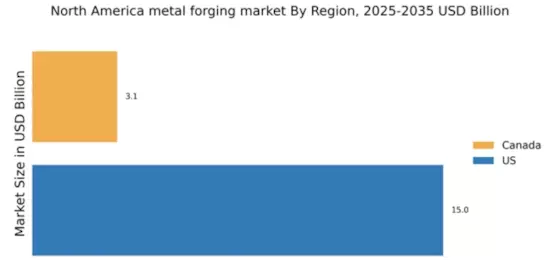
The US metal forging market holds a significant share of 15.0% in North America, driven by a strong industrial base and increasing demand from sectors like automotive and aerospace. Key growth drivers include advancements in manufacturing technologies, government initiatives promoting infrastructure development, and a focus on sustainable practices. Regulatory policies are increasingly supportive, fostering innovation and investment in the sector, while robust infrastructure facilitates efficient production and distribution.

Canada : Growth Opportunities in Metal Forging

Canada's metal forging market, with a share of 3.1%, is characterized by its potential for growth, particularly in provinces like Ontario and Alberta. The demand is driven by the energy sector and automotive industries, with increasing investments in renewable energy projects. The competitive landscape features key players like Alcoa Corporation and Precision Castparts Corp, which are expanding their operations. Local market dynamics are influenced by government policies aimed at enhancing manufacturing capabilities and fostering innovation in the forging sector.

North America Metal Forging Market Regional Image

Key Players and Competitive Insights

The North American metal forging market is characterized by a competitive landscape that is increasingly shaped by innovation, strategic partnerships, and a focus on sustainability. Key players such as Alcoa Corporation (US), Precision Castparts Corp (US), and Thyssenkrupp AG (DE) are actively pursuing strategies that enhance their operational efficiencies and market reach. Alcoa Corporation (US) has been particularly focused on advancing its aluminum forging capabilities, which aligns with the growing demand for lightweight materials in the automotive and aerospace sectors. Meanwhile, Precision Castparts Corp (US) emphasizes its commitment to high-quality manufacturing processes, which positions it favorably in the defense and aerospace industries. Thyssenkrupp AG (DE) is leveraging digital transformation initiatives to optimize its production processes, thereby enhancing its competitive edge in the market.

In terms of business tactics, companies are increasingly localizing manufacturing to reduce lead times and enhance supply chain resilience. This trend is particularly evident in the context of a moderately fragmented market structure, where the collective influence of major players is significant. The strategic focus on supply chain optimization and localized production is likely to foster a more agile market environment, enabling companies to respond swiftly to changing customer demands.

In October 2025, Alcoa Corporation (US) announced a partnership with a leading automotive manufacturer to develop advanced aluminum forging techniques aimed at reducing vehicle weight and improving fuel efficiency. This collaboration underscores Alcoa's commitment to innovation and positions it as a key player in the transition towards more sustainable automotive solutions. The strategic importance of this partnership lies in its potential to enhance Alcoa's market share in the automotive sector, which is increasingly prioritizing lightweight materials.

In September 2025, Precision Castparts Corp (US) expanded its manufacturing capabilities by acquiring a state-of-the-art forging facility in the Midwest. This acquisition is expected to bolster its production capacity and improve its service offerings to the aerospace sector. The strategic move reflects Precision Castparts' focus on enhancing operational efficiencies and meeting the growing demand for high-performance components in aerospace applications.

In August 2025, Thyssenkrupp AG (DE) launched a new digital platform aimed at streamlining its forging operations and improving customer engagement. This initiative is indicative of the company's broader strategy to integrate digital technologies into its manufacturing processes. The launch of this platform is likely to enhance Thyssenkrupp's operational efficiency and customer responsiveness, thereby solidifying its competitive position in the market.

As of November 2025, the competitive trends in the metal forging market are increasingly defined by digitalization, sustainability, and the integration of artificial intelligence. Strategic alliances are playing a crucial role in shaping the current landscape, as companies seek to leverage complementary strengths to drive innovation. Looking ahead, it appears that competitive differentiation will evolve from traditional price-based competition towards a focus on technological advancements, supply chain reliability, and sustainable practices. This shift may redefine the parameters of competition, compelling companies to innovate continuously to maintain their market positions.

Key Companies in the North America Metal Forging Market market include

Industry Developments

Recent developments in the North America Metal Forging Market indicate a growing trend in capacity expansion and strategic partnerships. Companies like Alcoa Corporation and Nucor Corporation are ramping up production to meet rising demand in the automotive and aerospace sectors, contributing to a stronger market valuation.

In addition, Wheatland Tube Company is focusing on sustainable practices, aligning with increasing environmental regulations and customer expectations. Notably, Alcoa Corporation announced its intention to acquire a smaller player in the titanium forging space in August 2023, a move aimed at bolstering its position in high-performance applications.

Furthermore, in January 2023, Timken Steel Corporation expanded its manufacturing footprint by investing in advanced forging technologies to enhance efficiency and product quality. The market has also seen strong investments in Research and Development, particularly in lightweight and high-strength materials, fostering innovation among companies like General Motors Company and Toyota Tsusho Corporation.

Additionally, there has been a noticeable impact of geopolitical shifts and supply chain adjustments, affecting raw material availability and global price fluctuations, which are relevant factors for manufacturers in ongoing production and operational strategies.

Future Outlook

North America Metal Forging Market Future Outlook

The metal forging market is projected to grow at an 8.07% CAGR from 2024 to 2035, driven by advancements in technology, increasing demand in automotive, and aerospace sectors.

New opportunities lie in:

  • Investment in automated forging technologies to enhance production efficiency.
  • Development of lightweight forged components for electric vehicles.
  • Expansion into renewable energy sector with specialized forging solutions.

By 2035, the metal forging market is expected to achieve robust growth and innovation.

Market Segmentation

North America Metal Forging Market Type Outlook

  • Closed-die Forging
  • Open-die Forging
  • Others

North America Metal Forging Market Raw Material Outlook

  • Steel
  • Aluminum
  • Magnesium
  • Nickel-Based Alloys
  • Titanium
  • Others

North America Metal Forging Market End-use Industry Outlook

  • Automotive
  • Aerospace & Defense
  • Power
  • Building & Construction
  • Oil & Gas
  • Metalworking
  • Others

Report Scope

MARKET SIZE 202418.1(USD Billion)
MARKET SIZE 202519.56(USD Billion)
MARKET SIZE 203542.5(USD Billion)
COMPOUND ANNUAL GROWTH RATE (CAGR)8.07% (2024 - 2035)
REPORT COVERAGERevenue Forecast, Competitive Landscape, Growth Factors, and Trends
BASE YEAR2024
Market Forecast Period2025 - 2035
Historical Data2019 - 2024
Market Forecast UnitsUSD Billion
Key Companies Profiled["Thyssenkrupp AG (DE)", "Alcoa Corporation (US)", "Precision Castparts Corp (US)", "Aubert & Duval (FR)", "Forged Solutions Group (GB)", "Fletcher International (AU)", "Bharat Forge Limited (IN)", "Nippon Steel Corporation (JP)", "Shaanxi Blower (CN)"]
Segments CoveredRaw Material, Type, End-use Industry
Key Market OpportunitiesAdoption of advanced automation technologies enhances efficiency in the metal forging market.

Key Market DynamicsTechnological advancements and regulatory changes drive innovation and competition in the North American metal forging market.

Countries CoveredUS, Canada

Leave a Comment

FAQs

What is the expected market size of the North America Metal Forging Market in 2024?

The North America Metal Forging Market is expected to be valued at 18.0 billion USD in 2024.

What is the projected market size of the North America Metal Forging Market by 2035?

By 2035, the overall market is expected to reach a valuation of 40.17 billion USD.

What is the expected CAGR for the North America Metal Forging Market from 2025 to 2035?

The market is anticipated to grow at a CAGR of 7.571% during the period from 2025 to 2035.

Which region holds the largest market share in the North America Metal Forging Market?

The United States holds the largest market share, projected to be valued at 10.5 billion USD in 2024.

What is the market size of the North America Metal Forging Market in Canada in 2024?

In 2024, the Canadian segment of the North America Metal Forging Market is valued at 7.5 billion USD.

Who are the key players in the North America Metal Forging Market?

Major players include Wheatland Tube Company, Timken Steel Corporation, and Alcoa Corporation, among others.

What is the forecasted market size for steel in the North America Metal Forging Market in 2024?

The market size for steel in the North America Metal Forging Market is valued at 7.5 billion USD in 2024.

What are the growth prospects for aluminum in the market by 2035?

The aluminum segment is expected to grow to 9.0 billion USD by 2035.

What challenges are currently impacting the North America Metal Forging Market?

Challenges include fluctuating raw material costs and changing regulations affecting production.

What is the expected market size for nickel-based alloys in 2035?

The market for nickel-based alloys is projected to reach 4.0 billion USD by 2035.

Download Free Sample

Kindly complete the form below to receive a free sample of this Report

Compare Licence

×
Features License Type
Single User Multiuser License Enterprise User
Price $4,950 $ $7,250
Maximum User Access Limit 1 User Upto 10 Users Unrestricted Access Throughout the Organization
Free Customization
Direct Access to Analyst
Deliverable Format
Platform Access
Discount on Next Purchase 10% 15% 15%
Printable Versions