×
Request Free Sample ×

Kindly complete the form below to receive a free sample of this Report

* Please use a valid business email

Leading companies partner with us for data-driven Insights

clients tt-cursor
Hero Background

Oil Field Chemicals Market

ID: MRFR/CnM/1223-CR
208 Pages
Priya Nagrale
October 2019

Oilfield Chemicals Market Research Report Information By Chemical Type (Demulsifiers, Corrosion Inhibitors, Water Clarifiers, Biocides, Scale Inhibitors, Paraffin Inhibitors, Hydrogen Sulfide Scavengers, Gas Well Foamers, and Others), By Application (Drilling, Cement, Stimulation, and Production), And By Region (North America, Europe, Asia-Pacific, And Rest Of The World) – Market Forecast Till 2035.

Share:
Download PDF ×

We do not share your information with anyone. However, we may send you emails based on your report interest from time to time. You may contact us at any time to opt-out.

Oil Field Chemicals Market Infographic
Purchase Options

Oil Field Chemicals Market Summary

As per MRFR analysis, the Oil Field Chemicals Market Size was estimated at 19.5 USD Billion in 2024. The Oil Field Chemicals industry is projected to grow from 20.41 USD Billion in 2025 to 32.13 USD Billion by 2035, exhibiting a compound annual growth rate (CAGR) of 4.64 during the forecast period 2025 - 2035.

Key Market Trends & Highlights

The Oil Field Chemicals Market is poised for growth driven by sustainability and technological advancements.

  • North America remains the largest market for oil field chemicals, primarily due to its extensive oil and gas infrastructure.
  • The Asia-Pacific region is emerging as the fastest-growing market, fueled by increasing exploration activities and demand for energy.
  • Drilling fluids continue to dominate the market, while enhanced oil recovery chemicals are experiencing rapid growth.
  • Key market drivers include the rising demand for enhanced oil recovery and the expansion of oil and gas exploration activities.

Market Size & Forecast

2024 Market Size 19.5 (USD Billion)
2035 Market Size 32.13 (USD Billion)
CAGR (2025 - 2035) 4.64%

Major Players

Baker Hughes (US), Halliburton (US), Schlumberger (US), BASF (DE), Clariant (CH), Ecolab (US), Nalco Champion (US), Weatherford International (IE), Newpark Resources (US)

Oil Field Chemicals Market Trends

The Oil Field Chemicals Market is currently experiencing a dynamic evolution, driven by various factors that influence the demand for specialized chemicals used in oil extraction and production processes. The increasing complexity of oil recovery techniques necessitates the use of advanced chemical solutions, which enhance efficiency and optimize production yields. Furthermore, the growing emphasis on environmentally friendly practices is prompting companies to seek sustainable alternatives, thereby reshaping the landscape of chemical formulations utilized in the industry. As a result, the market is witnessing a shift towards innovative products that not only meet operational requirements but also adhere to stringent environmental regulations. In addition, The Oil Field Chemicals. Companies are exploring new technologies and methodologies to improve the performance of oil field chemicals while minimizing their ecological footprint. This trend indicates a potential for growth in the sector, as stakeholders adapt to changing market dynamics and consumer preferences. Overall, the Oil Field Chemicals Market appears poised for continued development, with a focus on innovation, sustainability, and efficiency in chemical applications across the oil and gas industry.

Sustainability Initiatives

The Oil Field Chemicals Market is increasingly influenced by sustainability initiatives, as companies strive to reduce their environmental impact. This trend involves the development of eco-friendly chemical solutions that comply with regulatory standards while maintaining operational efficiency. Stakeholders are likely to invest in research and development to create biodegradable and less toxic alternatives, reflecting a broader commitment to sustainable practices.

Technological Advancements

Technological advancements play a crucial role in shaping the Oil Field Chemicals Market. Innovations in chemical formulations and application techniques are enhancing the effectiveness of oil recovery processes. Companies are adopting advanced technologies, such as digital monitoring and automation, to optimize chemical usage, thereby improving overall productivity and reducing costs.

Regulatory Compliance

Regulatory compliance remains a significant driver in the Oil Field Chemicals Market. As governments implement stricter environmental regulations, companies are compelled to adapt their chemical offerings to meet these requirements. This trend may lead to increased investment in compliance strategies and the development of products that align with evolving legal frameworks.

Oil Field Chemicals Market Drivers

Rising Demand for Energy

The Global Oilfield Chemicals Market Industry experiences a notable surge in demand driven by the increasing global energy requirements. As economies expand, the need for oil and gas escalates, prompting exploration and production activities. In 2024, the market is projected to reach 19.5 USD Billion, reflecting a robust growth trajectory. This demand is further fueled by the transition towards cleaner energy sources, necessitating advanced oilfield chemicals that enhance extraction efficiency and reduce environmental impact. Consequently, the industry is likely to witness innovations in chemical formulations that cater to both traditional and renewable energy sectors.

Market Segment Insights

By Application: Drilling Fluids (Largest) vs. Enhanced Oil Recovery (Fastest-Growing)

In the Oil Field Chemicals Market, the application segment showcases a diverse array of products aimed at enhancing operational efficiency in oil extraction. Drilling Fluids dominate this sector, serving as the largest application with broad utility across various drilling operations. Production Chemicals and Completion Fluids also hold significant shares, vital for ensuring the smooth execution of production processes and well completion, respectively. Enhanced Oil Recovery is steadily rising, indicative of a shift towards advanced extraction methods. The growth trends in this segment are influenced by increasing global energy demands and the push for more efficient extraction methods. Enhanced Oil Recovery is gaining traction due to its ability to maximize the output of existing reservoirs, driven by technological advancements and a focus on sustainability. As oil companies seek to improve yield while reducing costs, the adoption of innovative production chemicals is expected to expand, further shaping the market landscape.

Drilling Fluids (Dominant) vs. Well Stimulation (Emerging)

Drilling Fluids serve as the cornerstone of the Oil Field Chemicals Market, characterized by their critical role in cooling, lubricating, and stabilizing drilling operations. They enhance the efficiency of drilling while minimizing environmental impacts, solidifying their dominant market position. In contrast, Well Stimulation represents an emerging area that is gaining prominence, focusing on techniques such as hydraulic fracturing and acidizing to enhance hydrocarbon flow rates from producing formations. This segment is characterized by high energy and resource efficiency, often utilizing advanced chemical formulations tailored to specific geological conditions. The rising demand for unconventional resources and the need for cost-efficient recovery methods are driving the growth of both segments, highlighting their complementary roles in modern oil recovery strategies.

By End Use: Onshore (Largest) vs. Offshore (Fastest-Growing)

The Oil Field Chemicals Market is prominently driven by the onshore segment, which holds the largest share due to its extensive applications in traditional drilling and production processes. This segment benefits from established infrastructure and widespread operational activities. In contrast, the offshore segment is gaining traction, representing the fastest-growing area as companies invest in offshore drilling technologies propelled by rising global energy demands and the need for enhanced recovery methods.

Onshore (Dominant) vs. Offshore (Emerging)

The onshore segment of the Oil Field Chemicals Market remains dominant, characterized by robust usage in a variety of chemical applications such as drilling fluids, production aids, and enhanced oil recovery agents. Its stronghold stems from established practices and a supportive regulatory environment. Conversely, the offshore segment is emerging rapidly, driven by significant investments in deep-water exploration and production, emphasizing innovative chemical solutions designed for harsh marine environments. The growth in offshore activities is largely attributable to the increasing necessity for advanced technologies that ensure efficient drilling and production in challenging locations.

By Chemical Type: Surfactants (Largest) vs. Biocides (Fastest-Growing)

In the Oil Field Chemicals Market, surfactants hold the largest share, playing a pivotal role in enhancing oil recovery and improving the efficiency of drilling operations. Other chemical types like corrosion inhibitors, scale inhibitors, foamers, and biocides also contribute to the market but with varying levels of market penetration and functionality. Surfactants account for a significant portion of the overall market, indicating their foundational importance in various processes including emulsification and dispersion, essential for optimizing oil extraction. On the growth front, biocides have emerged as the fastest-growing segment, driven by increasing regulatory scrutiny on environmental impacts and the proliferation of microbial threats in oil fields. Corrosion inhibitors and scale inhibitors continue to grow steadily, fueled by the necessity to protect infrastructure and optimize production efficiency in an increasingly competitive market. The growing emphasis on sustainable and eco-friendly chemicals also supports the expansion of biocides as they offer significant advantages in managing microbial activities without environmental compromise.

Corrosion Inhibitors (Dominant) vs. Foamers (Emerging)

Corrosion inhibitors are considered the dominant players within the Oil Field Chemicals Market, critical for extending the lifespan of drilling equipment and pipelines by preventing rust and deterioration. They are widely used in various formulations, showcasing their essential role in maintaining operational efficiency in oil extraction activities. Conversely, foamers represent an emerging segment, gaining traction due to their effectiveness in enhancing the separation process in oil recovery. As operators increasingly seek cost-effective solutions to manage water production and optimize oil recovery rates, foamers are expected to gain customer preference. The innovative applications of foamers in reducing surface tension and creating stable foam for improved oil extraction make them attractive for future investments, marking a notable shift in oil field chemical strategies.

By Functionality: Fluid Loss Control (Largest) vs. Viscosity Control (Fastest-Growing)

The Oil Field Chemicals Market displays a variety of functionalities, with Fluid Loss Control commanding the largest share due to its critical role in maintaining downhole pressure and enhancing performance. Other functionalities such as Viscosity Control, pH Control, Emulsification, and Wettability Alteration also play significant roles, but Fluid Loss Control remains paramount in applications across various regions due to its consistent demand and essential nature in drilling operations. Viscosity Control, on the other hand, is experiencing rapid growth as advancements in chemical formulations and techniques to optimize flow rates become more prevalent. Additionally, pH Control and Emulsification are vital for the stability of drilling fluids, contributing to an efficient and effective drilling process, although they hold smaller market shares.

Fluid Loss Control (Dominant) vs. Viscosity Control (Emerging)

Fluid Loss Control stands out as the dominant functionality in the Oil Field Chemicals Market, delivering essential performance enhancements that prevent loss of valuable drilling fluid into permeable formations. This characteristic leads to cost-efficiency and improved drilling speed, making it indispensable in various operations. Viscosity Control, emerging rapidly due to heightened focus on optimizing wellbore stability and maximizing hydrocarbon recovery, plays a crucial role in maintaining the flow characteristics of drilling muds. Its ability to adapt to varying subsurface conditions makes it a favored choice among operators seeking enhanced performance metrics. While Fluid Loss Control maintains dominance, Viscosity Control is poised for substantial growth, driven by evolving industry demands and increased technological advancements.

By Formulation Type: Water-Based (Largest) vs. Foam-Based (Fastest-Growing)

The Oil Field Chemicals Market has a diverse range of formulation types, with water-based formulations holding the largest market share. This is primarily due to their wide applicability and lower environmental impact compared to other formulations. Oil-based formulations follow closely, favored for their effectiveness in specific applications, although their market share has been gradually declining as demand shifts towards more sustainable solutions. Emulsion and microemulsion types hold moderate shares, catering to specialized needs in oil recovery and production processes. In terms of growth trends, foam-based formulations are emerging as the fastest-growing segment within the market. The increasing demands for enhanced oil recovery methods and the advancements in formulation technologies contribute significantly to this growth. Additionally, the stringent environmental regulations are pushing the industry towards greener alternatives, thus benefiting water-based and foam-based formulations explicitly. The shift in preferences towards more effective and eco-friendly solutions indicates a bright future for these segments.

Water-Based (Dominant) vs. Foam-Based (Emerging)

Water-based formulations are considered dominant in the Oil Field Chemicals Market due to their versatility and lower toxicity, making them appealing for various applications such as drilling and well completion. These formulations maintain a significant edge due to their environmental compliance and cost-effectiveness. Conversely, foam-based formulations are emerging as key players, especially in enhanced oil recovery solutions. They are valued for their efficiency in managing gas influx and reducing water usage during extraction processes. The growth of foam-based solutions is fueled by technological advancements and the industry's need for high-performance chemicals, marking them as a crucial segment to watch in the future.

Get more detailed insights about Oil Field Chemicals Market

Regional Insights

North America : Market Leader in Oil Chemicals

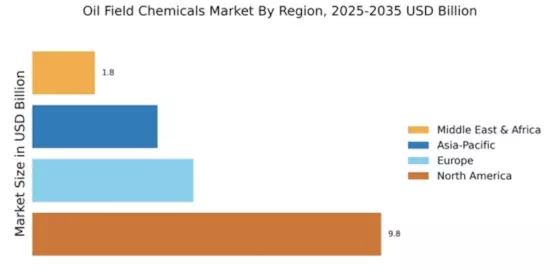
North America continues to lead the Oil Field Chemicals market, holding a significant share of 9.75 in 2024. The region's growth is driven by increasing oil production, technological advancements, and stringent environmental regulations that promote the use of efficient chemicals. The demand for enhanced oil recovery (EOR) techniques is also a key factor, as operators seek to maximize output from existing fields. The competitive landscape is robust, with major players like Baker Hughes, Halliburton, and Schlumberger dominating the market. These companies are investing heavily in R&D to innovate and improve chemical formulations. The U.S. remains the largest market, supported by a well-established oil and gas infrastructure, while Canada and Mexico also contribute significantly to regional growth.

Europe : Emerging Market Dynamics

Europe's Oil Field Chemicals market is projected to grow, with a market size of 4.5 by 2025. The region is witnessing increased investments in oil exploration and production, driven by the need for energy security and sustainability. Regulatory frameworks are evolving, encouraging the adoption of eco-friendly chemicals, which is expected to boost market demand. The shift towards renewable energy sources is also influencing the market, as companies seek to balance traditional oil production with sustainable practices. Leading countries in this region include Germany, the UK, and Norway, where major players like BASF and Clariant are actively involved. The competitive landscape is characterized by collaborations and partnerships aimed at enhancing product offerings. The presence of established companies ensures a steady supply of innovative solutions tailored to meet the specific needs of the European market.

Asia-Pacific : Rapidly Growing Market Potential

The Asia-Pacific region is emerging as a significant player in the Oil Field Chemicals market, with a size of 3.5 by 2025. The growth is fueled by increasing energy demands, particularly in countries like China and India, where oil consumption is on the rise. Additionally, government initiatives to enhance domestic production and reduce dependency on imports are driving investments in oil field chemicals. Regulatory support for cleaner technologies is also a catalyst for market expansion. China and India are the leading countries in this region, with a growing presence of international players like Ecolab and Weatherford. The competitive landscape is evolving, with local companies also entering the market to meet rising demand. The focus on innovation and cost-effective solutions is shaping the strategies of key players, ensuring they remain competitive in this dynamic market.

Middle East and Africa : Resource-Rich Market Opportunities

The Middle East and Africa (MEA) region, with a market size of 1.75, presents unique opportunities in the Oil Field Chemicals market. The region is rich in oil reserves, and the demand for chemicals is driven by ongoing exploration and production activities. Regulatory frameworks are gradually improving, encouraging the use of advanced chemicals that enhance oil recovery and minimize environmental impact. The focus on sustainability is becoming increasingly important, influencing market dynamics. Leading countries include Saudi Arabia, the UAE, and South Africa, where major players like Nalco Champion and Newpark Resources are active. The competitive landscape is characterized by partnerships and joint ventures aimed at leveraging local expertise. As the region continues to develop its oil and gas sector, the demand for innovative chemical solutions is expected to rise significantly.

Key Players and Competitive Insights

The Oil Field Chemicals Market is characterized by a dynamic competitive landscape, driven by the increasing demand for enhanced oil recovery and the need for environmentally sustainable solutions. Key players such as Baker Hughes (US), Halliburton (US), and Schlumberger (US) are at the forefront, leveraging innovation and strategic partnerships to maintain their market positions. Baker Hughes (US) focuses on digital transformation and advanced chemical solutions, while Halliburton (US) emphasizes operational efficiency through technology integration. Schlumberger (US) appears to be enhancing its service offerings through strategic acquisitions, thereby shaping a competitive environment that prioritizes technological advancement and sustainability.

In terms of business tactics, companies are increasingly localizing manufacturing to reduce costs and optimize supply chains. The market structure is moderately fragmented, with a mix of large multinational corporations and smaller regional players. This fragmentation allows for diverse strategies, yet the collective influence of major players like BASF (DE) and Ecolab (US) is significant, as they drive innovation and set industry standards.

In November 2025, Baker Hughes (US) announced a partnership with a leading renewable energy firm to develop bio-based oil field chemicals. This strategic move not only aligns with the growing trend towards sustainability but also positions Baker Hughes (US) as a pioneer in eco-friendly solutions, potentially enhancing its market share in a competitive landscape increasingly focused on environmental responsibility.

In October 2025, Halliburton (US) launched a new line of chemical products designed to improve the efficiency of hydraulic fracturing operations. This initiative reflects Halliburton's (US) commitment to innovation and operational excellence, suggesting that the company is keen on maintaining its competitive edge by offering advanced solutions that meet the evolving needs of its clients.

In September 2025, Schlumberger (US) completed the acquisition of a specialty chemical company, which is expected to bolster its product portfolio and enhance its service capabilities. This acquisition indicates a strategic focus on expanding its chemical offerings, thereby allowing Schlumberger (US) to provide more comprehensive solutions to its customers and strengthen its position in the market.

As of December 2025, current competitive trends in the Oil Field Chemicals Market include a pronounced shift towards digitalization, sustainability, and the integration of AI technologies. Strategic alliances are increasingly shaping the landscape, as companies recognize the value of collaboration in driving innovation. The competitive differentiation is likely to evolve from traditional price-based competition to a focus on technological advancements, supply chain reliability, and sustainable practices, indicating a transformative phase in the market.

Key Companies in the Oil Field Chemicals Market market include

Industry Developments

  • Q2 2024: BASF launches new biodegradable scale inhibitor for oilfield applications BASF announced the launch of a new biodegradable scale inhibitor designed for oilfield applications, aiming to help operators meet stricter environmental regulations while maintaining production efficiency.
  • Q2 2024: Clariant opens new oilfield chemicals laboratory in Houston Clariant inaugurated a new state-of-the-art oilfield chemicals laboratory in Houston, Texas, to enhance its R&D capabilities and better serve North American oil and gas customers.
  • Q3 2024: Baker Hughes and ADNOC sign agreement to develop sustainable oilfield chemical solutions Baker Hughes signed a strategic agreement with ADNOC to co-develop and deploy sustainable oilfield chemical solutions for enhanced oil recovery and production optimization in the UAE.
  • Q3 2024: ChampionX announces new production chemicals facility in Saudi Arabia ChampionX announced the opening of a new production chemicals manufacturing facility in Saudi Arabia to support growing demand in the Middle East oilfield sector.
  • Q4 2024: Halliburton acquires specialty oilfield chemicals firm ChemSolv Halliburton completed the acquisition of ChemSolv, a specialty oilfield chemicals company, to expand its portfolio of advanced chemical solutions for upstream oil and gas operations.
  • Q4 2024: Chevron Phillips Chemical launches new friction reducer for unconventional oilfields Chevron Phillips Chemical introduced a new high-performance friction reducer designed for use in unconventional oilfield operations, targeting improved efficiency in hydraulic fracturing.
  • Q1 2025: Dow Chemical announces $200 million investment in Texas oilfield chemicals plant Dow Chemical revealed plans to invest $200 million in expanding its oilfield chemicals manufacturing plant in Texas, aiming to increase capacity and support innovation in drilling and production chemicals.
  • Q1 2025: Huntsman launches new corrosion inhibitor for offshore oilfields Huntsman Corporation launched a new corrosion inhibitor specifically formulated for offshore oilfield environments, addressing the need for enhanced asset protection in harsh conditions.
  • Q2 2025: Kemira signs multi-year supply contract with Petrobras for oilfield chemicals Kemira secured a multi-year contract to supply oilfield chemicals to Petrobras, supporting the Brazilian company's offshore and onshore production operations.
  • Q2 2025: BASF opens new oilfield chemicals technical center in Abu Dhabi BASF opened a new technical center in Abu Dhabi dedicated to oilfield chemicals, aiming to provide technical support and product development for customers in the Middle East.
  • Q3 2025: Stepan Company acquires oilfield chemicals business from Solvay Stepan Company completed the acquisition of Solvay's oilfield chemicals business, expanding its product offerings and market presence in the global oil and gas sector.
  • Q3 2025: Halliburton unveils new demulsifier for enhanced oil recovery Halliburton introduced a new demulsifier product designed to improve oil-water separation and boost recovery rates in mature oilfields.

Future Outlook

Oil Field Chemicals Market Future Outlook

The Oil Field Chemicals Market is projected to grow at a 4.64% CAGR from 2024 to 2035, driven by increasing drilling activities, technological advancements, and environmental regulations.

New opportunities lie in:

  • Development of biodegradable chemical solutions for enhanced environmental compliance.
  • Investment in advanced data analytics for optimized chemical usage in operations.
  • Expansion of supply chain networks to improve distribution efficiency and reduce costs.

By 2035, the Oil Field Chemicals Market is expected to achieve robust growth, driven by innovation and strategic investments.

Market Segmentation

Oil Field Chemicals Market End Use Outlook

  • Onshore
  • Offshore
  • Oil Sands
  • Shale Gas
  • Coal Bed Methane

Oil Field Chemicals Market Application Outlook

  • Drilling Fluids
  • Production Chemicals
  • Enhanced Oil Recovery
  • Well Stimulation
  • Completion Fluids

Oil Field Chemicals Market Chemical Type Outlook

  • Surfactants
  • Corrosion Inhibitors
  • Biocides
  • Scale Inhibitors
  • Foamers

Oil Field Chemicals Market Functionality Outlook

  • Fluid Loss Control
  • Viscosity Control
  • pH Control
  • Emulsification
  • Wettability Alteration

Oil Field Chemicals Market Formulation Type Outlook

  • Water-Based
  • Oil-Based
  • Emulsion-Based
  • Microemulsion
  • Foam-Based

Report Scope

MARKET SIZE 202419.5(USD Billion)
MARKET SIZE 202520.41(USD Billion)
MARKET SIZE 203532.13(USD Billion)
COMPOUND ANNUAL GROWTH RATE (CAGR)4.64% (2024 - 2035)
REPORT COVERAGERevenue Forecast, Competitive Landscape, Growth Factors, and Trends
BASE YEAR2024
Market Forecast Period2025 - 2035
Historical Data2019 - 2024
Market Forecast UnitsUSD Billion
Key Companies ProfiledBaker Hughes (US), Halliburton (US), Schlumberger (US), BASF (DE), Clariant (CH), Ecolab (US), Nalco Champion (US), Weatherford International (IE), Newpark Resources (US)
Segments CoveredApplication, End Use, Chemical Type, Functionality, Formulation Type
Key Market OpportunitiesAdoption of environmentally friendly chemicals enhances sustainability in the Oil Field Chemicals Market.
Key Market DynamicsRising demand for environmentally friendly oil field chemicals drives innovation and regulatory compliance across the industry.
Countries CoveredNorth America, Europe, APAC, South America, MEA

Market Highlights

Author
Priya Nagrale
Senior Research Analyst

With an experience of over five years in market research industry (Chemicals & Materials domain), I gather and analyze market data from diverse sources to produce results, which are then presented back to a client. Also, provide recommendations based on the findings. As a Senior Research Analyst, I perform quality checks (QC) for market estimations, QC for reports, and handle queries and work extensively on client customizations. Also, handle the responsibilities of client proposals, report planning, report finalization, and execution

Leave a Comment

FAQs

How much is the Oilfield Chemicals market?

The Oilfield Chemicals Market size was valued at USD 19.50 Billion in 2024.

What is the growth rate of the Oilfield Chemicals market?

Oil Field Chemicals Market is projected to grow at a CAGR of 4.64% during the forecast period, 2025-2035

Which region held the largest market share in the Oilfield Chemicals market?

North America had the largest share of the Oilfield Chemicals Market.

Who are the key players in the Oilfield Chemicals market?

The key players in the market are Schlumberger Limited (US), Baker Hughes, a GE Company LLC (UK), Ideal Energy Solutions, LLC (US), Royal Dutch Shell PLC (The Netherlands), BASF SE (Germany), Solvay (Belgium), Halliburton (US), Clariant (US), Kemira (Finland), Albemarle Corporation (US), Stepan Company (US), Nalco Champion (US), Croda International PLC (UK), Huntsman International LLC (US), Ashland (US), The Lubrizol Corporation (US)

Which chemical type led the Oilfield Chemicals market?

The demulsifiers categories dominated the market in 2024.

Which Application led the Oilfield Chemicals market?

The drilling had the largest share in the global market for Oilfield Chemicals.

Download Free Sample

Kindly complete the form below to receive a free sample of this Report

Compare Licence

×
Features License Type
Single User Multiuser License Enterprise User
Price $4,950 $5,950 $7,250
Maximum User Access Limit 1 User Upto 10 Users Unrestricted Access Throughout the Organization
Free Customization
Direct Access to Analyst
Deliverable Format
Platform Access
Discount on Next Purchase 10% 15% 15%
Printable Versions