×
Request Free Sample ×

Kindly complete the form below to receive a free sample of this Report

* Please use a valid business email

Leading companies partner with us for data-driven Insights

clients tt-cursor
Hero Background

Oil & Gas Pipeline Leak Detection Market

ID: MRFR/EnP/8705-HCR
111 Pages
Priya Nagrale
October 2025

Oil Gas Pipeline Leak Detection Market Research Report By Detection Technology (Acoustic Sensing, Fiber Optic Sensing, Infrared Imaging, Gas Detection, Chemical Sensing), By Application (Onshore Pipelines, Offshore Pipelines, Gathering Systems, Transmission Lines, Distribution Networks), By Pipeline Type (Oil Pipelines, Gas Pipelines, Water Pipelines, Slurry Pipelines), By Component (Sensors, Transmitters, Data Acquisition Systems, Software, Services) and By Regional (North America, Europe, South America, Asia Pacific, Middle East and Africa... read more

Share:
Download PDF ×

We do not share your information with anyone. However, we may send you emails based on your report interest from time to time. You may contact us at any time to opt-out.

Oil & Gas Pipeline Leak Detection Market Infographic
Purchase Options

Oil & Gas Pipeline Leak Detection Market Summary

As per MRFR analysis, the Oil & Gas Pipeline Leak Detection Market Size was estimated at 8.94 USD Billion in 2024. The Oil & Gas Pipeline Leak Detection industry is projected to grow from 9.78 USD Billion in 2025 to 24.12 USD Billion by 2035, exhibiting a compound annual growth rate (CAGR) of 9.44 during the forecast period 2025 - 2035.

Key Market Trends & Highlights

The Oil and Gas Pipeline Leak Detection Market is experiencing robust growth driven by technological advancements and regulatory pressures.

  • Technological advancements in detection systems are enhancing the accuracy and efficiency of leak detection processes.
  • North America remains the largest market, while Asia-Pacific is emerging as the fastest-growing region in pipeline leak detection.
  • Leak detection systems dominate the market, whereas monitoring systems are witnessing the fastest growth due to increasing safety concerns.
  • Key market drivers include technological innovations in leak detection and regulatory pressures aimed at environmental protection.

Market Size & Forecast

2024 Market Size 8.94 (USD Billion)
2035 Market Size 24.12 (USD Billion)
CAGR (2025 - 2035) 9.44%

Major Players

Honeywell (US), Emerson Electric (US), Siemens (DE), Schneider Electric (FR), Baker Hughes (US), KROHNE (DE), Endress+Hauser (CH), Mistras Group (US), Perma-Pipe (US)

Oil & Gas Pipeline Leak Detection Market Trends

The Oil & Gas Pipeline Leak Detection Market is currently experiencing a transformative phase, driven by advancements in technology and increasing regulatory pressures. The demand for effective leak detection solutions is rising as companies seek to minimize environmental impact and enhance operational efficiency. Innovations in sensor technology, data analytics, and machine learning are reshaping the landscape, enabling more accurate and timely detection of leaks. Furthermore, the integration of these technologies into existing infrastructure is becoming more feasible, allowing operators to monitor pipelines in real-time and respond swiftly to potential issues. In addition to technological advancements, the Oil & Gas Pipeline Leak Detection Market is influenced by growing public awareness regarding environmental sustainability. Stakeholders are increasingly prioritizing safety and compliance, leading to a shift towards more sophisticated detection systems. The market appears poised for growth as companies invest in solutions that not only meet regulatory requirements but also align with broader sustainability goals. As the industry evolves, the focus on proactive leak detection strategies is likely to intensify, fostering a culture of safety and responsibility within the sector.

Technological Advancements in Detection Systems

The Oil & Gas Pipeline Leak Detection Market is witnessing a surge in the adoption of advanced technologies. Innovations such as fiber optic sensors, drones, and satellite monitoring are enhancing the accuracy and reliability of leak detection. These technologies enable operators to identify leaks more efficiently, reducing response times and minimizing potential damage.

Regulatory Compliance and Environmental Concerns

Increasing regulatory scrutiny surrounding environmental protection is shaping the Oil & Gas Pipeline Leak Detection Market. Companies are compelled to adopt more stringent leak detection measures to comply with regulations. This trend reflects a broader commitment to environmental stewardship and the need to mitigate the risks associated with pipeline operations.

Integration of Data Analytics and Machine Learning

The integration of data analytics and machine learning into leak detection systems is transforming the Oil & Gas Pipeline Leak Detection Market. These technologies facilitate the analysis of vast amounts of data, enabling predictive maintenance and enhancing the overall effectiveness of detection systems. This trend suggests a move towards more intelligent and automated solutions in the industry.

Oil & Gas Pipeline Leak Detection Market Drivers

Market Growth Projections

The Global Oil Gas Pipeline Leak Detection Market Industry is poised for substantial growth, with projections indicating a market size of 24.1 USD Billion by 2035. This growth is underpinned by a compound annual growth rate (CAGR) of 9.44% from 2025 to 2035. The increasing emphasis on safety, regulatory compliance, and technological advancements are key factors contributing to this upward trajectory. As the industry evolves, stakeholders are likely to explore innovative solutions to enhance leak detection capabilities, ensuring the integrity of pipeline operations in a rapidly changing energy landscape.

Increasing Regulatory Compliance

The Global Oil Gas Pipeline Leak Detection Market Industry is experiencing a surge in demand due to stringent regulatory frameworks aimed at environmental protection. Governments worldwide are enforcing regulations that mandate the implementation of advanced leak detection systems to minimize environmental risks. For instance, the U.S. Pipeline and Hazardous Materials Safety Administration has set forth regulations that require operators to adopt technologies that can detect leaks promptly. This regulatory pressure is expected to drive the market's growth, as companies seek to comply with these standards and avoid hefty fines. As a result, the market is projected to reach 8.94 USD Billion in 2024.

Focus on Environmental Sustainability

The Global Oil Gas Pipeline Leak Detection Market Industry is increasingly shaped by a growing focus on environmental sustainability. As public awareness of environmental issues rises, companies are under pressure to adopt practices that minimize their ecological footprint. Effective leak detection systems are crucial in preventing spills that can lead to environmental disasters. This trend is prompting investments in advanced technologies that not only comply with regulations but also demonstrate corporate responsibility. The commitment to sustainability is expected to drive market growth, as companies recognize the long-term benefits of investing in leak detection solutions.

Investment in Infrastructure Development

The Global Oil Gas Pipeline Leak Detection Market Industry is benefiting from substantial investments in infrastructure development. Governments and private entities are allocating significant resources to upgrade and expand pipeline networks, particularly in emerging economies. This investment is often accompanied by the implementation of modern leak detection technologies to ensure safety and reliability. As these infrastructure projects progress, the demand for effective leak detection systems is likely to increase, contributing to the market's expansion. By 2035, the market is anticipated to reach 24.1 USD Billion, reflecting the critical role of infrastructure in driving technological adoption.

Rising Demand for Energy and Oil Products

The Global Oil Gas Pipeline Leak Detection Market Industry is also driven by the increasing demand for energy and oil products. As global populations grow and economies expand, the need for reliable energy sources intensifies. This demand necessitates the expansion of pipeline networks, which in turn raises the stakes for effective leak detection systems. The market is projected to grow at a CAGR of 9.44% from 2025 to 2035, reflecting the urgency for enhanced safety measures in pipeline operations. Companies are investing in leak detection technologies to ensure the integrity of their pipelines and to meet the rising energy demands.

Technological Advancements in Detection Systems

The Global Oil Gas Pipeline Leak Detection Market Industry is significantly influenced by rapid technological advancements. Innovations such as fiber optic sensors, acoustic monitoring, and drone surveillance are enhancing the accuracy and efficiency of leak detection systems. These technologies allow for real-time monitoring and data analysis, which can lead to quicker response times in the event of a leak. For example, the integration of artificial intelligence in monitoring systems is proving to be a game-changer. As these technologies continue to evolve, they are likely to attract investments, further propelling the market's growth trajectory.

Market Segment Insights

By Application: Leak Detection (Largest) vs. Monitoring Systems (Fastest-Growing)

In the Oil & Gas Pipeline Leak Detection Market, the application segments are distinctly varied, with Leak Detection holding the largest share. This dominant segment captures the attention of stakeholders due to its critical role in preventing environmental damage and safeguarding operational efficiency. Monitoring Systems follow closely, showcasing significant growth as they offer real-time surveillance capabilities essential for early leak detection and environmental safety. Growth trends in the Oil & Gas Pipeline Leak Detection Market are primarily driven by increasing regulatory pressures and the rising demand for enhanced safety measures. Additionally, advancements in technology, such as AI and machine learning, enhance leak detection accuracy and reliability. As the sector shifts towards more preventative measures, the focus on Monitoring Systems is expanding rapidly, marking them as a key area for investment in the coming years.

Leak Detection (Dominant) vs. Emergency Response (Emerging)

The Leak Detection segment in the Oil & Gas Pipeline Leak Detection Market stands as a dominant force, driven by the necessity for strict compliance with environmental regulations and safety standards. Its vast application covers various technological solutions that focus on early identification of leaks, thus minimizing potential hazards and financial losses. Meanwhile, Emergency Response is emerging as a critical segment, characterized by its capability to address accidents rapidly post-incident. While Leak Detection is primarily preventive in nature and remains entrenched in traditional methods, Emergency Response leverages innovative solutions such as mobile response units and rapid deployment technologies, positioning it as an important companion to preventive systems, ultimately leading to a more comprehensive safety net for oil and gas operations.

By Technology: Acoustic Sensors (Largest) vs. Fiber Optic Technology (Fastest-Growing)

In the Oil & Gas Pipeline Leak Detection Market, Acoustic Sensors hold the largest market share, leveraging their ability to detect leaks through sound waves. Their widespread adoption stems from proven reliability and robustness in various environmental conditions. Following closely are Optical Sensors and Pressure Sensors, which, while having considerable shares, do not match the dominance of Acoustic Sensors. Fiber Optic Technology, however, is gaining traction due to its advanced capabilities in long-distance detection and minimal maintenance, positioning itself as a key player in future developments of leak detection technology.

Technology: Acoustic Sensors (Dominant) vs. Fiber Optic Technology (Emerging)

Acoustic Sensors are established as the dominant technology in the Oil & Gas Pipeline Leak Detection Market, primarily due to their efficacy in identifying leaks quickly and accurately. These sensors utilize sound wave analysis to detect leaks, making them reliable for various pipeline environments. Meanwhile, Fiber Optic Technology is emerging as a significant contender, known for its ability to monitor pipelines over long distances with exceptional sensitivity and reduced false alarms. This technology allows for continuous monitoring and real-time data transmission, factors that are appealing in minimizing environmental risks and operational downtimes. As regulations tighten and the demand for enhanced safety measures increases, Fiber Optic Technology is poised for rapid growth, complementing the established dominance of Acoustic Sensors.

By End Use: Oil Transportation (Largest) vs. Gas Transportation (Fastest-Growing)

The Oil & Gas Pipeline Leak Detection Market displays distinct market share distribution across various end-use categories. Oil Transportation stands out as the largest segment, representing a significant portion of the overall market due to the vital need for effective leak detection in extensive oil transport networks. In contrast, Gas Transportation, while smaller in share, is rapidly gaining momentum, reflecting the increasing focus on natural gas as a cleaner energy source and the necessity of maintaining its integrity during transportation.

Oil Transportation (Dominant) vs. Gas Transportation (Emerging)

Oil Transportation has established itself as the dominant force in the Oil & Gas Pipeline Leak Detection Market, driven by extensive global infrastructure dedicated to oil transport. The segment is characterized by stringent regulatory requirements and advanced leak detection technologies necessary to mitigate environmental risks. Conversely, Gas Transportation is emerging as a key player, fueled by the rapid adoption of natural gas for energy needs and innovation in pipeline monitoring systems. This segment is witnessing a surge in investments aimed at enhancing leak detection capabilities, ensuring safety, and meeting environmental standards, thereby positioning itself as a crucial growth area in the market.

By Component: Hardware (Largest) vs. Software (Fastest-Growing)

In the Oil & Gas Pipeline Leak Detection Market, the component segment is predominantly driven by hardware solutions, which hold the largest market share. This includes advanced sensors and monitoring devices that provide real-time data to operators for effective leak detection. Software solutions, while currently having a smaller share, are rapidly gaining traction as more companies look to integrate digital solutions for data analysis and management, which is essential for predictive maintenance and optimizing operations. The growth in the software segment is particularly notable, fueled by the increasing adoption of IoT and AI technologies within the oil and gas sector. As organizations prioritize digital transformation and invest in smarter leak detection systems, software is becoming a critical component due to its ability to process large volumes of data and improve decision-making capabilities. This trend is expected to accelerate, positioning software as a key growth driver in the market.

Hardware: Sensors (Dominant) vs. Software: Data Analytics (Emerging)

In the component segment of the Oil & Gas Pipeline Leak Detection Market, hardware solutions, especially sensors, play a dominant role due to their foundational importance in detecting leaks. These sensors utilize various technologies to ensure real-time monitoring and immediate response to potential leaks, thereby minimizing environmental risks and economic losses. On the other hand, software solutions, particularly in data analytics, are emerging as an essential counterpart, enabling companies to analyze sensor data efficiently. As analytics tools evolve, they assist in predictive maintenance, identifying trends, and enhancing overall safety measures. The combination of robust hardware with sophisticated software analytics is defining a new era in pipeline integrity management, making the solutions more comprehensive and effective.

Get more detailed insights about Oil & Gas Pipeline Leak Detection Market

Regional Insights

North America : Market Leader in Innovation

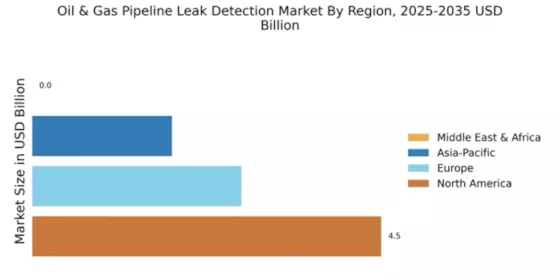
North America is poised to maintain its leadership in the Oil & Gas Pipeline Leak Detection Market, holding a significant market share of 4.47 in 2024. The region's growth is driven by stringent regulatory frameworks, increasing investments in pipeline infrastructure, and a rising focus on environmental safety. The demand for advanced leak detection technologies is further fueled by the need to minimize operational risks and enhance efficiency in oil and gas operations. The competitive landscape in North America is robust, featuring key players such as Honeywell, Emerson Electric, and Baker Hughes. These companies are at the forefront of technological advancements, offering innovative solutions that cater to the evolving needs of the industry. The presence of established firms and a strong emphasis on R&D contribute to the region's dominance, ensuring that North America remains a critical hub for leak detection technologies.

Europe : Regulatory Frameworks Drive Growth

Europe, with a market size of 2.68, is witnessing significant growth in the Oil & Gas Pipeline Leak Detection Market, driven by stringent environmental regulations and a commitment to sustainability. The European Union's directives on pipeline safety and environmental protection are key catalysts for the adoption of advanced leak detection technologies. As countries strive to meet these regulations, the demand for reliable and efficient detection systems is on the rise. Leading countries in this region include Germany, France, and the UK, where major players like Siemens and Schneider Electric are actively involved. The competitive landscape is characterized by a mix of established firms and innovative startups, all vying to provide cutting-edge solutions. The focus on reducing environmental impact and enhancing safety standards positions Europe as a vital market for leak detection technologies.

Asia-Pacific : Rapidly Growing Market Potential

Asia-Pacific is emerging as a significant player in the Oil & Gas Pipeline Leak Detection Market, with a market size of 1.79. The region's growth is fueled by increasing energy demands, rapid industrialization, and a growing focus on safety and environmental regulations. Countries like China and India are investing heavily in pipeline infrastructure, which is expected to drive the demand for advanced leak detection technologies in the coming years. The competitive landscape in Asia-Pacific is evolving, with both local and international players vying for market share. Companies such as KROHNE and Endress+Hauser are expanding their presence, offering innovative solutions tailored to the region's unique challenges. As the market matures, the emphasis on technology adoption and regulatory compliance will shape the future of leak detection in this dynamic region.

Middle East and Africa : Untapped Market Opportunities

The Middle East & Africa region currently shows a market size of 0.0 in the Oil & Gas Pipeline Leak Detection Market, indicating significant untapped potential. The growth in this region is expected to be driven by increasing investments in oil and gas infrastructure, coupled with a rising awareness of environmental safety. As countries in this region seek to modernize their pipeline systems, the demand for effective leak detection technologies is anticipated to grow. Leading countries in the Middle East, such as Saudi Arabia and the UAE, are beginning to recognize the importance of advanced leak detection systems. The competitive landscape is still developing, with opportunities for both local and international players to establish a foothold. As regulatory frameworks evolve, the region is poised for growth in the leak detection market, making it an attractive area for investment and innovation.

Key Players and Competitive Insights

The Oil & Gas Pipeline Leak Detection Market is characterized by a competitive landscape that is increasingly shaped by technological advancements and regulatory pressures. Key growth drivers include the rising demand for safety and environmental protection, alongside the need for efficient monitoring systems. Major players such as Honeywell (US), Emerson Electric (US), and Siemens (DE) are strategically positioned to leverage innovation and digital transformation. These companies focus on enhancing their product offerings through advanced sensor technologies and data analytics, which collectively foster a more robust competitive environment.

In terms of business tactics, companies are increasingly localizing manufacturing and optimizing supply chains to enhance operational efficiency. The market appears moderately fragmented, with a mix of established players and emerging firms. The collective influence of key players is significant, as they drive technological advancements and set industry standards, thereby shaping the overall market structure.

In November 2025, Honeywell (US) announced the launch of its latest leak detection system, which integrates AI-driven analytics to improve response times and accuracy. This strategic move underscores Honeywell's commitment to innovation and positions it as a leader in the market. The integration of AI not only enhances operational efficiency but also aligns with the growing trend towards digitalization in the industry.

In October 2025, Emerson Electric (US) expanded its partnership with a leading oil and gas company to implement advanced leak detection technologies across multiple sites. This collaboration is indicative of Emerson's strategy to strengthen its market presence through strategic alliances. By leveraging its technological expertise, Emerson aims to enhance safety measures and operational reliability, which are critical in today’s regulatory environment.

In September 2025, Siemens (DE) unveiled a new suite of digital solutions aimed at improving pipeline monitoring and leak detection capabilities. This initiative reflects Siemens' focus on sustainability and digital transformation, as it seeks to provide comprehensive solutions that address both operational efficiency and environmental concerns. The introduction of these solutions is likely to enhance Siemens' competitive edge in a market that increasingly values sustainability.

As of December 2025, current competitive trends indicate a strong emphasis on digitalization, sustainability, and AI integration. Strategic alliances are becoming more prevalent, as companies recognize the need to collaborate in order to innovate and meet regulatory demands. The competitive differentiation is shifting from price-based competition to a focus on technology, innovation, and supply chain reliability. This evolution suggests that companies that prioritize these aspects will likely emerge as leaders in the Oil & Gas Pipeline Leak Detection Market.

Key Companies in the Oil & Gas Pipeline Leak Detection Market market include

Industry Developments

Recent news and current affairs in the Oil Gas Pipeline Leak Detection Market highlight the increasing adoption of advanced technologies like AI and IoT for enhanced leak detection capabilities. Strategic partnerships and collaborations among industry players are driving innovation and expanding market reach. For instance, in 2023, Siemens partnered with ePIPE to integrate AI-based leak detection solutions into its pipeline monitoring systems. Moreover, governments worldwide are implementing stringent regulations and promoting the adoption of advanced leak detection technologies to ensure pipeline safety and environmental protection.

As a result of these factors, the Oil Gas Pipeline Leak Detection Market is projected to grow significantly over the forecast period, reaching an estimated valuation of USD 22.04 billion by 2034 with a CAGR of 9.44% from 2025 to 2034.

Future Outlook

Oil & Gas Pipeline Leak Detection Market Future Outlook

The Oil & Gas Pipeline Leak Detection Market is projected to grow at a 9.44% CAGR from 2024 to 2035, driven by technological advancements, regulatory pressures, and increasing environmental concerns.

New opportunities lie in:

  • Integration of AI-driven analytics for predictive maintenance solutions.
  • Development of advanced sensor technologies for real-time monitoring.
  • Expansion of service contracts for pipeline integrity management.

By 2035, the market is expected to be robust, driven by innovation and regulatory compliance.

Market Segmentation

Oil & Gas Pipeline Leak Detection Market End Use Outlook

  • Oil Transportation
  • Gas Transportation
  • Refinery Operations
  • Storage Facilities

Oil & Gas Pipeline Leak Detection Market Component Outlook

  • Hardware
  • Software
  • Services
  • Installation

Oil & Gas Pipeline Leak Detection Market Technology Outlook

  • Acoustic Sensors
  • Optical Sensors
  • Pressure Sensors
  • Fiber Optic Technology

Oil & Gas Pipeline Leak Detection Market Application Outlook

  • Leak Detection
  • Monitoring Systems
  • Data Analysis
  • Emergency Response

Report Scope

MARKET SIZE 20248.94(USD Billion)
MARKET SIZE 20259.78(USD Billion)
MARKET SIZE 203524.12(USD Billion)
COMPOUND ANNUAL GROWTH RATE (CAGR)9.44% (2024 - 2035)
REPORT COVERAGERevenue Forecast, Competitive Landscape, Growth Factors, and Trends
BASE YEAR2024
Market Forecast Period2025 - 2035
Historical Data2019 - 2024
Market Forecast UnitsUSD Billion
Key Companies ProfiledHoneywell (US), Emerson Electric (US), Siemens (DE), Schneider Electric (FR), Baker Hughes (US), KROHNE (DE), Endress+Hauser (CH), Mistras Group (US), Perma-Pipe (US)
Segments CoveredApplication, Technology, End Use, Component
Key Market OpportunitiesIntegration of advanced sensor technologies enhances real-time monitoring in the Oil & Gas Pipeline Leak Detection Market.
Key Market DynamicsTechnological advancements and regulatory pressures drive innovation in oil and gas pipeline leak detection solutions.
Countries CoveredNorth America, Europe, APAC, South America, MEA

Leave a Comment

FAQs

What is the projected market size of the Oil Gas Pipeline Leak Detection Market in 2024?

The Oil Gas Pipeline Leak Detection Market is expected to reach an estimated value of 8.94 Billion USD in 2024.

What is the projected CAGR of the Oil Gas Pipeline Leak Detection Market from 2025 to 2034?

Oil & Gas Pipeline Leak Detection Market is expected to grow with a CAGR of 9.44% in the period 2025-2035

Which region is expected to hold the largest market share in the Oil Gas Pipeline Leak Detection Market in 2024?

North America is expected to hold the largest market share in the Oil Gas Pipeline Leak Detection Market in 2024.

Which application segment is expected to hold the largest market share in the Oil Gas Pipeline Leak Detection Market in 2024?

The Onshore segment is expected to hold the largest market share in the Oil Gas Pipeline Leak Detection Market in 2024.

Who are the key competitors in the Oil Gas Pipeline Leak Detection Market?

Some of the key competitors in the Oil Gas Pipeline Leak Detection Market include Honeywell International Inc., Emerson Electric Co., General Electric Company, Siemens AG, and Schneider Electric SE.

What are the major factors driving the growth of the Oil Gas Pipeline Leak Detection Market?

The major factors driving the growth of the Oil Gas Pipeline Leak Detection Market include increasing demand for oil and gas, rising concerns about environmental safety, and growing investments in pipeline infrastructure.

What are the major challenges faced by the Oil Gas Pipeline Leak Detection Market?

The major challenges faced by the Oil Gas Pipeline Leak Detection Market include high installation and maintenance costs, lack of skilled workforce, and technological limitations.

What are the emerging trends in the Oil Gas Pipeline Leak Detection Market?

Some of the emerging trends in the Oil Gas Pipeline Leak Detection Market include the adoption of advanced technologies such as AI and IoT, increasing focus on predictive maintenance, and growing demand for remote monitoring solutions.

Which region is expected to witness the highest growth rate in the Oil Gas Pipeline Leak Detection Market from 2025 to 2034?

The Asia-Pacific region is expected to witness the highest growth rate in the Oil Gas Pipeline Leak Detection Market from 2025 to 2034.

Download Free Sample

Kindly complete the form below to receive a free sample of this Report

Compare Licence

×
Features License Type
Single User Multiuser License Enterprise User
Price $4,950 $5,950 $7,250
Maximum User Access Limit 1 User Upto 10 Users Unrestricted Access Throughout the Organization
Free Customization
Direct Access to Analyst
Deliverable Format
Platform Access
Discount on Next Purchase 10% 15% 15%
Printable Versions