×
Request Free Sample ×

Kindly complete the form below to receive a free sample of this Report

* Please use a valid business email

Leading companies partner with us for data-driven Insights

clients tt-cursor
Hero Background

On-Board Diagnostics Device Market

ID: MRFR/SEM/31890-HCR
100 Pages
Aarti Dhapte
October 2025

On-Board Diagnostics Device Market Research Report By Application (Passenger Vehicle, Commercial Vehicle, Motorcycle, Heavy-Duty Vehicles), By Technology (On-Board Diagnostics II, On-Board Diagnostics III, Unified Diagnostic Services), By End Use (Automotive Repair Shops, DIY Users, Fleet Management), By Connectivity (Wireless, Wired) and By Regional (North America, Europe, South America, Asia Pacific, Middle East and Africa) - Forecast to 2035

Share:
Download PDF ×

We do not share your information with anyone. However, we may send you emails based on your report interest from time to time. You may contact us at any time to opt-out.

On-Board Diagnostics Device Market Infographic
Purchase Options

On-Board Diagnostics Device Market Summary

As per MRFR analysis, the On-Board Diagnostics Device Market Size was estimated at 44.4 USD Billion in 2024. The On-Board Diagnostics Device industry is projected to grow from 46.89 USD Billion in 2025 to 81.02 USD Billion by 2035, exhibiting a compound annual growth rate (CAGR) of 5.62 during the forecast period 2025 - 2035.

Key Market Trends & Highlights

The On-Board Diagnostics Device Market is poised for substantial growth driven by technological advancements and evolving vehicle standards.

  • The integration of advanced technologies is transforming diagnostic capabilities in vehicles, enhancing efficiency and accuracy.
  • North America remains the largest market, while Asia-Pacific is emerging as the fastest-growing region for on-board diagnostics.
  • Passenger vehicles dominate the market, yet commercial vehicles are witnessing the most rapid growth in diagnostics adoption.
  • Increasing vehicle complexity and regulatory compliance are key drivers propelling the demand for advanced on-board diagnostics solutions.

Market Size & Forecast

2024 Market Size 44.4 (USD Billion)
2035 Market Size 81.02 (USD Billion)
CAGR (2025 - 2035) 5.62%

Major Players

Bosch (DE), Denso (JP), Delphi Technologies (GB), Snap-on (US), Hella (DE), Autel (CN), Launch Tech (CN), Actron (US), Innova Electronics (US)

On-Board Diagnostics Device Market Trends

The On-Board Diagnostics Device Market is currently experiencing a transformative phase, driven by advancements in automotive technology and increasing regulatory requirements for vehicle emissions. As vehicles become more complex, the demand for sophisticated diagnostic tools that can monitor and report on vehicle performance is rising. This trend is further fueled by the growing emphasis on environmental sustainability, prompting manufacturers to integrate more efficient diagnostic systems. The market appears to be shifting towards devices that not only diagnose issues but also provide real-time data analytics, enhancing the overall driving experience and vehicle maintenance. Moreover, the proliferation of electric and hybrid vehicles is likely to reshape the On-Board Diagnostics Device Market. These vehicles require specialized diagnostic tools that can cater to their unique systems and components. As the automotive industry evolves, the integration of artificial intelligence and machine learning into diagnostic devices may offer unprecedented capabilities, allowing for predictive maintenance and improved vehicle safety. This evolution suggests a promising future for the On-Board Diagnostics Device Market, as stakeholders adapt to the changing landscape and consumer expectations.

Integration of Advanced Technologies

The On-Board Diagnostics Device Market is witnessing a trend towards the incorporation of advanced technologies such as artificial intelligence and machine learning. These innovations enable devices to not only identify issues but also predict potential failures, thereby enhancing vehicle reliability and safety.

Focus on Environmental Compliance

There is a growing emphasis on environmental regulations, which is influencing the On-Board Diagnostics Device Market. Manufacturers are increasingly developing devices that ensure compliance with stringent emissions standards, reflecting a broader commitment to sustainability within the automotive sector.

Rise of Electric and Hybrid Vehicles

The emergence of electric and hybrid vehicles is reshaping the On-Board Diagnostics Device Market. These vehicles necessitate specialized diagnostic tools that can effectively monitor their unique systems, leading to a demand for tailored solutions that address the complexities of modern automotive technology.

On-Board Diagnostics Device Market Drivers

Rise of Connected Vehicles

The On-Board Diagnostics Device Market is significantly impacted by the rise of connected vehicles. As vehicles become increasingly integrated with internet connectivity and smart technologies, the demand for on-board diagnostics devices that can communicate with these systems is growing. Connected vehicles require advanced diagnostic solutions to monitor performance, detect faults, and provide real-time data to both drivers and manufacturers. This trend is likely to drive innovation within the market, as manufacturers develop devices that can seamlessly integrate with connected vehicle platforms. The market is projected to expand as the automotive industry embraces connectivity as a standard feature.

Increasing Vehicle Complexity

The On-Board Diagnostics Device Market is experiencing growth due to the increasing complexity of modern vehicles. As vehicles incorporate advanced technologies such as electronic control units and sophisticated sensors, the need for effective diagnostic tools becomes paramount. This complexity necessitates the use of on-board diagnostics devices to monitor vehicle performance and ensure compliance with regulatory standards. The market is projected to expand as manufacturers and consumers alike recognize the importance of these devices in maintaining vehicle efficiency and safety. In 2025, the market is expected to reach a valuation of approximately USD 5 billion, driven by the demand for enhanced vehicle diagnostics.

Regulatory Compliance and Standards

The On-Board Diagnostics Device Market is significantly influenced by stringent regulatory requirements aimed at reducing vehicle emissions and enhancing safety. Governments worldwide are implementing regulations that mandate the use of on-board diagnostics systems in vehicles. These regulations not only promote environmental sustainability but also ensure that vehicles meet safety standards. As a result, manufacturers are increasingly investing in advanced diagnostic technologies to comply with these regulations. The market is likely to see a surge in demand as compliance becomes a critical factor for vehicle manufacturers, with projections indicating a compound annual growth rate of 7% over the next five years.

Growing Awareness of Vehicle Maintenance

The On-Board Diagnostics Device Market is benefiting from a growing awareness among consumers regarding the importance of regular vehicle maintenance. As vehicle owners become more informed about the implications of neglecting maintenance, the demand for on-board diagnostics devices is likely to increase. These devices provide real-time data on vehicle health, enabling owners to address issues proactively. This trend is particularly evident in regions where vehicle ownership is rising, leading to an increased focus on maintenance solutions. The market is expected to grow as consumers seek tools that enhance their understanding of vehicle performance and longevity.

Technological Advancements in Diagnostics

The On-Board Diagnostics Device Market is propelled by rapid technological advancements in diagnostic tools. Innovations such as wireless connectivity, mobile applications, and artificial intelligence are transforming the way diagnostics are conducted. These advancements allow for more accurate and efficient monitoring of vehicle systems, thereby enhancing the overall user experience. As technology continues to evolve, the market is likely to witness the introduction of more sophisticated diagnostic devices that cater to the needs of both consumers and automotive professionals. This trend is expected to drive market growth, with an anticipated increase in device adoption rates.


Market Segment Insights

By Application: Passenger Vehicle (Largest) vs. Commercial Vehicle (Fastest-Growing)

The On-Board Diagnostics Device Market is predominantly driven by the passenger vehicle segment, which holds the largest market share. This segment benefits significantly from the increasing adoption of OBD systems in personal vehicles. Moreover, stringent regulatory norms for emissions monitoring and vehicle health have further bolstered the demand for advanced diagnostic devices within this category. In contrast, the commercial vehicle segment is rapidly gaining momentum, fueled by the growing emphasis on fleet management and maintenance optimization. The widespread integration of technology in transportation and logistics is catalyzing the growth of diagnostic systems tailored for commercial applications.

Passenger Vehicle (Dominant) vs. Heavy-Duty Vehicles (Emerging)

The passenger vehicle segment is well-established in the On-Board Diagnostics Device Market, dominating due to its extensive integration in consumer cars for monitoring vehicle performance and emissions. This segment is characterized by a broad variety of OBD solutions tailored to meet consumer needs, enabling quick diagnostics and repairs. On the other hand, heavy-duty vehicles are emerging rapidly within the OBD space, driven by the need for enhanced compliance and operational efficiency in logistics. Heavy-duty diagnostics focus on engine performance, emissions control, and preventive maintenance, catering to transport companies that aim to reduce costs and adhere to environmental regulations. The evolving technology landscape is essential for both segments, propelling innovation in vehicle health management.

By Technology: On-Board Diagnostics II (Largest) vs. Unified Diagnostic Services (Fastest-Growing)

The On-Board Diagnostics Device Market exhibits a diverse distribution among its key segments, predominantly favoring On-Board Diagnostics II, which captures the largest market share. This dominance can be attributed to its widespread adoption in vehicles for monitoring performance and emissions, ensuring compliance with regulatory standards. Unified Diagnostic Services, although currently smaller in share, is rapidly gaining traction as automakers seek to integrate advanced diagnostics solutions into their systems, prompted by increasing consumer demand for enhanced vehicle intelligence.

Technology: On-Board Diagnostics II (Dominant) vs. Unified Diagnostic Services (Emerging)

On-Board Diagnostics II stands out as the dominant technology within the On-Board Diagnostics Device Market, characterized by its effective monitoring capabilities of vehicle performance and adherence to emissions regulations. This technology's extensive usage in both passenger and commercial vehicles underscores its vitality in the automotive landscape. In contrast, Unified Diagnostic Services is emerging as a key player, driven by advancements in vehicle connectivity and the growing trend of digital vehicle ecosystems. As automotive technology evolves, Unified Diagnostic Services promises to deliver new functionalities, enabling comprehensive diagnostic and data-sharing capabilities that appeal to manufacturers and consumers looking for smarter vehicle solutions.

By End Use: Automotive Repair Shops (Largest) vs. DIY Users (Fastest-Growing)

In the On-Board Diagnostics Device Market, the segment of Automotive Repair Shops holds the largest share due to their reliance on advanced diagnostic tools for vehicle maintenance and repair. This sector has established a strong base, integrating OBD devices into their daily operations, which ensures regular uptake and utilization. In contrast, the DIY Users segment is rapidly gaining attention, appealing to a growing base of vehicle owners who prefer to diagnose and fix issues independently. Their increasing interest in vehicle maintenance is driven by access to information and technology, leading to a more hands-on approach to car management.

Automotive Repair Shops (Dominant) vs. Fleet Management (Emerging)

Automotive Repair Shops represent the dominant segment in the On-Board Diagnostics Device Market, leveraging their deep expertise and integration of sophisticated diagnostic tools into their services. These shops cater to a wide range of vehicles, utilizing OBD devices to provide accurate and timely diagnostics. In contrast, Fleet Management is emerging as a significant segment, as businesses increasingly recognize the importance of efficient vehicle maintenance. Fleet management solutions utilize OBD devices to monitor vehicle performance, ensuring reduced downtime and optimized operation. This segment is characterized by a shift towards data-driven decision-making, where businesses are investing in technology to enhance productivity and cut costs.

By Connectivity: Wireless (Largest) vs. Wired (Fastest-Growing)

In the On-Board Diagnostics Device Market, the connectivity segment showcases a distinct distribution, where wireless technology holds the largest market share. This segment has become increasingly essential due to the growing demand for convenience and the ease of data transmission without physical connections. Conversely, wired solutions, while historically significant, are witnessing a surge in popularity, especially in specific applications where reliability and direct connections are paramount. Together, these two connectivity types cater to diverse user needs and preferences.

Connectivity: Wireless (Dominant) vs. Wired (Emerging)

Wireless connectivity in the On-Board Diagnostics Device Market stands out as the dominant solution, offering users unparalleled convenience and flexibility. This technology enables real-time data transmission and remote vehicle diagnostics, appealing to tech-savvy consumers and fleet operators alike. On the other hand, wired connectivity is labeled as an emerging choice, reinforcing stability and robustness in environments where wireless signals may falter. Its resurgence can be attributed to industries requiring stringent data accuracy and reliability, signaling a balanced coexistence in market preferences. Both variants contribute to a comprehensive diagnostic experience, catering to a wide range of automotive applications.

Get more detailed insights about On-Board Diagnostics Device Market

Regional Insights

North America : Market Leader in Diagnostics

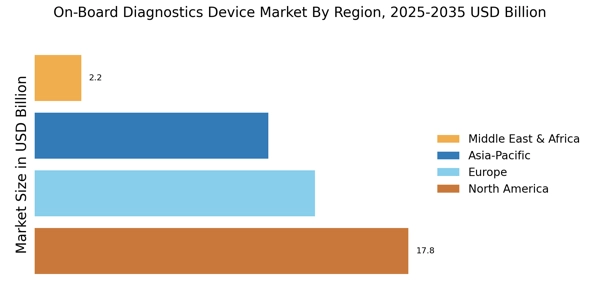
North America is the largest market for On-Board Diagnostics (OBD) devices, holding approximately 40% of the global market share. The growth is driven by stringent emissions regulations and increasing vehicle electrification. The U.S. leads in demand, supported by a robust automotive sector and technological advancements in diagnostics. Canada follows as the second-largest market, contributing around 15% to the overall share, with a focus on environmental compliance and vehicle safety standards. The competitive landscape in North America is characterized by the presence of key players such as Bosch, Snap-on, and Delphi Technologies. These companies are investing in innovative technologies to enhance diagnostic capabilities. The market is also witnessing a rise in startups focusing on software-based diagnostic solutions, further intensifying competition. The regulatory environment, particularly in the U.S., mandates regular vehicle inspections, boosting the demand for advanced OBD devices.

Europe : Regulatory-Driven Market Growth

Europe is a significant player in the On-Board Diagnostics market, accounting for approximately 30% of the global share. The region's growth is primarily driven by stringent EU regulations aimed at reducing vehicle emissions and enhancing road safety. Countries like Germany and France are at the forefront, with Germany holding the largest market share in Europe at around 12%. The increasing adoption of electric vehicles (EVs) is also contributing to the demand for advanced diagnostic systems. Leading countries in Europe include Germany, France, and the UK, with a competitive landscape featuring major players like Bosch and Hella. The market is characterized by a strong emphasis on innovation, with companies investing in R&D to develop next-generation diagnostic tools. The European market is also witnessing collaborations between automotive manufacturers and technology firms to enhance diagnostic capabilities, ensuring compliance with evolving regulations.

Asia-Pacific : Emerging Market Potential

Asia-Pacific is emerging as a powerhouse in the On-Board Diagnostics market, holding approximately 25% of the global share. The region's growth is fueled by increasing vehicle production, rising disposable incomes, and a growing focus on vehicle safety and emissions standards. China is the largest market in the region, contributing around 15% to the global share, followed by Japan and India, which are also witnessing significant growth in OBD device adoption. The competitive landscape in Asia-Pacific is marked by the presence of both established players like Denso and emerging companies such as Autel and Launch Tech. The region is experiencing a surge in demand for advanced diagnostic tools, driven by the rapid expansion of the automotive sector and increasing consumer awareness regarding vehicle maintenance. Government initiatives promoting vehicle safety and environmental standards are further propelling market growth.

Middle East and Africa : Untapped Market Opportunities

The Middle East and Africa region is gradually emerging in the On-Board Diagnostics market, holding about 5% of the global share. The growth is primarily driven by increasing vehicle ownership and a rising awareness of vehicle maintenance. Countries like South Africa and the UAE are leading the market, with South Africa accounting for a significant portion due to its expanding automotive sector and regulatory initiatives aimed at improving vehicle safety and emissions standards. The competitive landscape in this region is still developing, with a mix of local and international players. Companies are increasingly focusing on establishing distribution networks to cater to the growing demand for OBD devices. The market is also witnessing collaborations between automotive manufacturers and diagnostic tool providers to enhance service offerings and meet regulatory requirements, indicating a positive outlook for future growth.

On-Board Diagnostics Device Market Regional Image

Key Players and Competitive Insights

The On-Board Diagnostics Device Market is characterized by a rapidly evolving technological landscape and rising consumer demand for advanced vehicle monitoring systems. This market is primarily shaped by the increasing need for emission control, higher vehicle performance, and comprehensive data collection from automotive systems. Companies competing in this space are focusing on innovative solutions and enhanced functionality of on-board diagnostics (OBD) devices. 

Key players are also leveraging partnerships and technological advancements to improve their product offerings and meet regulatory requirements, which are becoming progressively stringent worldwide. The competition is not just about the sophistication of the devices themselves but also hinges on how well these devices can integrate with existing vehicle technologies and provide real-time data analysis for better decision-making by both consumers and service providers.

Within the On-Board Diagnostics Device Market, Toyota holds a strong market presence, largely due to its commitment to quality, reliability, and innovation. The company has been at the forefront of integrating OBD systems into its vehicles, ensuring compliance with stringent emission standards. Toyota's devices are known for their robust performance and user-friendly interface, which enhance vehicle maintenance and provide drivers with critical information on their vehicle's health. The manufacturer’s extensive research and development efforts have led to the introduction of more sophisticated diagnostic tools, enabling real-time monitoring of vehicle systems and thorough fault detection.

Additionally, Toyota's strong brand reputation and substantial investment in vehicle technology give it a competitive edge in the OBD market, allowing efficient interactions between the diagnostic devices and the broader vehicle platforms.

General Motors also presents a significant presence in the On-Board Diagnostics Device Market, leveraging its extensive experience and technological capabilities. The company has incorporated advanced OBD systems in its wide range of vehicles, focusing on enhancing operational efficiency and vehicle safety. General Motors is proficient in utilizing data analytics and software development to improve the functionality of its diagnostic devices, thereby offering drivers and service providers enhanced insights into vehicle performance. 

Their commitment to innovation is evident through their investment in next-generation OBD solutions that not only ensure compliance with international standards but also provide predictive maintenance capabilities. By actively pursuing partnerships and collaborations, General Motors continues to strengthen its position in the diagnostic device market, catering to the evolving needs of automotive technology and consumer expectations.

Key Companies in the On-Board Diagnostics Device Market market include

Industry Developments

The On-Board Diagnostics Device Market has seen significant developments recently, with a focus on advancements in technology and partnerships among key players. Toyota and General Motors have been actively enhancing their OBD systems to improve vehicle diagnostics, thereby driving efficiency and compliance with environmental regulations. Furthermore, companies like Bosch and Denso have introduced innovative solutions aimed at real-time data analysis and enhanced connectivity for vehicles. Autel and Snapon are also expanding their product lines to cater to the increasing demand for advanced automotive diagnostic tools.

Additionally, Volkswagen has entered discussions regarding potential collaborations to integrate AI technologies into their diagnostic processes. 

In the realm of mergers and acquisitions, Honeywell has announced its acquisition of a small tech firm specializing in connected vehicle solutions, aiming to bolster its position in the OBD market. Likewise, Delphi Technologies completed a strategic partnership with Launch Tech, enhancing both companies' diagnostic capabilities. These developments reflect a growing market valuation as demand for enhanced vehicle diagnostics rises, with companies actively adjusting their strategies to capture larger market shares and increase technological prowess.

Future Outlook

On-Board Diagnostics Device Market Future Outlook

The On-Board Diagnostics Device Market is projected to grow at a 5.62% CAGR from 2024 to 2035, driven by technological advancements, regulatory changes, and increasing vehicle complexity.

New opportunities lie in:

  • Integration of AI-driven diagnostics for predictive maintenance
  • Development of mobile diagnostic applications for consumer use
  • Expansion into emerging markets with tailored solutions

By 2035, the market is expected to be robust, driven by innovation and increased adoption across various sectors.

Market Segmentation

On-Board Diagnostics Device Market End Use Outlook

  • Automotive Repair Shops
  • DIY Users
  • Fleet Management

On-Board Diagnostics Device Market Technology Outlook

  • On-Board Diagnostics II
  • On-Board Diagnostics III
  • Unified Diagnostic Services

On-Board Diagnostics Device Market Application Outlook

  • Passenger Vehicle
  • Commercial Vehicle
  • Motorcycle
  • Heavy-Duty Vehicles

On-Board Diagnostics Device Market Connectivity Outlook

  • Wireless
  • Wired

Report Scope

MARKET SIZE 2024 44.4(USD Billion)
MARKET SIZE 2025 46.89(USD Billion)
MARKET SIZE 2035 81.02(USD Billion)
COMPOUND ANNUAL GROWTH RATE (CAGR) 5.62% (2024 - 2035)
REPORT COVERAGE Revenue Forecast, Competitive Landscape, Growth Factors, and Trends
BASE YEAR 2024
Market Forecast Period 2025 - 2035
Historical Data 2019 - 2024
Market Forecast Units USD Billion
Key Companies Profiled Market analysis in progress
Segments Covered Market segmentation analysis in progress
Key Market Opportunities Integration of advanced telematics and artificial intelligence in On-Board Diagnostics Device Market enhances vehicle diagnostics and maintenance.
Key Market Dynamics Rising demand for advanced diagnostics tools drives innovation and competition among On-Board Diagnostics Device manufacturers.
Countries Covered North America, Europe, APAC, South America, MEA

Leave a Comment

FAQs

What is the projected market valuation of the On-Board Diagnostics Device Market by 2035?

The On-Board Diagnostics Device Market is projected to reach a valuation of 81.02 USD Billion by 2035.

What was the market valuation of the On-Board Diagnostics Device Market in 2024?

In 2024, the On-Board Diagnostics Device Market was valued at 44.4 USD Billion.

What is the expected CAGR for the On-Board Diagnostics Device Market during the forecast period 2025 - 2035?

The expected CAGR for the On-Board Diagnostics Device Market during the forecast period 2025 - 2035 is 5.62%.

Which companies are considered key players in the On-Board Diagnostics Device Market?

Key players in the On-Board Diagnostics Device Market include Bosch, Denso, Delphi Technologies, Snap-on, Hella, Autel, Launch Tech, Actron, and Innova Electronics.

What are the projected valuations for the Passenger Vehicle segment by 2035?

The Passenger Vehicle segment is projected to grow from 20.0 USD Billion to 37.0 USD Billion by 2035.

How does the Heavy-Duty Vehicles segment perform in terms of market valuation?

The Heavy-Duty Vehicles segment is expected to increase from 9.4 USD Billion to 16.02 USD Billion by 2035.

What is the market outlook for Wireless connectivity in the On-Board Diagnostics Device Market?

The Wireless connectivity segment is anticipated to grow from 20.0 USD Billion to 38.0 USD Billion by 2035.

What are the future projections for the Automotive Repair Shops segment?

The Automotive Repair Shops segment is projected to rise from 20.0 USD Billion to 36.0 USD Billion by 2035.

What is the expected growth for On-Board Diagnostics II technology by 2035?

On-Board Diagnostics II technology is expected to grow from 15.0 USD Billion to 27.0 USD Billion by 2035.

How does the DIY Users segment compare to Fleet Management in terms of market size?

The DIY Users segment is projected to grow from 10.0 USD Billion to 18.0 USD Billion, whereas Fleet Management is expected to increase from 14.4 USD Billion to 27.02 USD Billion by 2035.

Download Free Sample

Kindly complete the form below to receive a free sample of this Report

Compare Licence

×
Features License Type
Single User Multiuser License Enterprise User
Price $4,950 $5,950 $7,250
Maximum User Access Limit 1 User Upto 10 Users Unrestricted Access Throughout the Organization
Free Customization
Direct Access to Analyst
Deliverable Format
Platform Access
Discount on Next Purchase 10% 15% 15%
Printable Versions