Download Free Sample
Kindly complete the form below to receive a free sample of this Report
Online Professional Development Courses Market Research Report By Duration (Short Courses, Medium-Term Courses, Long-Term Courses, Workshops, Bootcamps), By Course Type (Technical Skills, Soft Skills, Leadership Development, Compliance Training, Industry-Specific Training), By Delivery Method (Self-Paced Learning, Live Virtual Classes, Blended Learning, Mobile Learning, Microlearning), By Target Audience (Corporate Professionals, Students, Job Seekers, Freelancers, Entrepreneurs), By Certification Type (Professional Certification, Continuing Education Units, Diploma Programs, Micro-Credentials, Skill Badges) And By Region (North America, Europe, Asia-Pacific, And Rest Of The World) – Market Forecast Till 2035.
As per MRFR analysis, the Online Professional Development Courses Market was estimated at 55.5 USD Billion in 2024. The Online Professional Development Courses industry is projected to grow from 59.53 USD Billion in 2025 to 120.0 USD Billion by 2035, exhibiting a compound annual growth rate (CAGR) of 7.26% during the forecast period 2025 - 2035.
The Online Professional Development Courses Market is experiencing dynamic growth driven by evolving learner needs and technological advancements.
| 2024 Market Size | 55.5 (USD Billion) |
| 2035 Market Size | 120.0 (USD Billion) |
| CAGR (2025 - 2035) | 7.26% |
Coursera (US), edX (US), Udacity (US), LinkedIn Learning (US), Skillshare (US), Pluralsight (US), FutureLearn (GB), Khan Academy (US), Alison (IE)
Our Impact
Enabled $4.3B Revenue Impact for Fortune 500 and Leading Multinationals
Partnering with 2000+ Global Organizations Each Year
30K+ Citations by Top-Tier Firms in the Industry
The Online Professional Development Courses Market is currently experiencing a notable transformation, driven by the increasing demand for flexible learning solutions. Professionals across various sectors are seeking opportunities to enhance their skills and knowledge without the constraints of traditional education. This shift is largely influenced by technological advancements, which facilitate access to a wide array of courses tailored to meet diverse needs. As organizations recognize the importance of continuous learning, they are increasingly investing in online training programs to foster employee growth and adaptability. Moreover, the market appears to be evolving in response to changing workforce dynamics. The rise of remote work has prompted individuals to pursue online courses that can be completed at their own pace, allowing for a more personalized learning experience. This trend suggests that the Online Professional Development Courses Market is not only expanding but also diversifying, with a growing emphasis on specialized skills that align with industry demands. As the landscape continues to develop, it is likely that new technologies and innovative teaching methods will further shape the future of professional development in the online realm.
There is a growing emphasis on soft skills within the Online Professional Development Courses Market. As employers recognize the value of interpersonal abilities, courses that enhance communication, teamwork, and emotional intelligence are gaining traction. This trend indicates a shift towards holistic professional development, where technical skills are complemented by essential soft skills.
The integration of artificial intelligence into online learning platforms is becoming increasingly prevalent. AI-driven tools are being utilized to personalize learning experiences, providing tailored content and assessments based on individual progress. This trend suggests that the Online Professional Development Courses Market is leveraging technology to enhance engagement and effectiveness.
Micro-credentials are emerging as a popular alternative to traditional degrees in the Online Professional Development Courses Market. These short, focused courses allow professionals to gain specific skills quickly, catering to the fast-paced nature of modern industries. This trend reflects a broader shift towards competency-based education, where the emphasis is placed on practical skills rather than lengthy programs.
The Online Professional Development Courses Market is experiencing a shift towards a lifelong learning mindset among professionals. This cultural change emphasizes the importance of continuous education and skill enhancement throughout one's career. Recent surveys indicate that over 60 percent of workers believe that ongoing learning is essential for career advancement. As a result, there is a growing inclination to enroll in online courses that facilitate skill development and knowledge acquisition. This trend is particularly evident in industries undergoing rapid transformation, where staying updated with the latest trends and technologies is crucial. The shift towards lifelong learning not only benefits individuals by enhancing their employability but also supports organizations in cultivating a more skilled workforce. This evolving mindset is likely to sustain the demand for online professional development courses in the foreseeable future.
The Online Professional Development Courses Market experiences a notable surge in demand for flexible learning solutions. Professionals increasingly seek courses that accommodate their busy schedules, allowing them to balance work and personal commitments. This trend is evidenced by a significant increase in enrollment numbers, with many platforms reporting a rise of over 30 percent in course registrations in recent years. The convenience of online learning enables individuals to access high-quality educational resources from anywhere, fostering a culture of continuous learning. As organizations recognize the importance of upskilling their workforce, they are more likely to invest in online professional development courses, further propelling market growth. This shift towards flexibility not only enhances learner engagement but also aligns with the evolving needs of the modern workforce.
Technological advancements play a pivotal role in shaping the Online Professional Development Courses Market. The integration of cutting-edge technologies such as virtual reality, augmented reality, and artificial intelligence enhances the learning experience, making it more interactive and engaging. For instance, platforms utilizing AI-driven analytics can tailor course content to individual learning styles, thereby improving retention rates. Recent data indicates that e-learning technologies are expected to grow at a compound annual growth rate of 20 percent over the next five years. This rapid evolution of technology not only attracts learners but also encourages institutions to innovate their course offerings, ensuring they remain competitive in a crowded marketplace. As a result, the market is likely to witness an influx of new and improved online courses that cater to diverse professional development needs.
The Online Professional Development Courses Market is significantly influenced by the increased corporate investment in employee training. Organizations are recognizing the value of continuous professional development as a means to enhance employee performance and retention. Recent statistics suggest that companies are allocating upwards of 10 percent of their annual budgets to training and development initiatives. This trend is particularly pronounced in sectors such as technology and healthcare, where rapid advancements necessitate ongoing education. As businesses seek to maintain a competitive edge, they are more inclined to partner with online course providers to deliver tailored training solutions. This growing investment not only fuels the demand for online courses but also fosters a culture of lifelong learning within organizations, ultimately benefiting both employees and employers.
The Online Professional Development Courses Market is witnessing a rising importance of certifications and credentials among professionals. As the job market becomes increasingly competitive, individuals are seeking ways to differentiate themselves through recognized qualifications. Data indicates that nearly 70 percent of employers consider certifications as a key factor in hiring decisions. This trend has led to a proliferation of online courses that offer micro-credentials and specialized certifications, catering to the needs of various industries. The ability to earn credentials online provides professionals with the flexibility to enhance their qualifications without disrupting their careers. Consequently, this demand for recognized certifications is likely to drive growth in the online professional development sector, as more individuals pursue courses that align with their career aspirations.
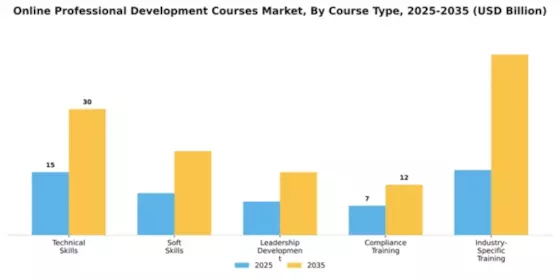
In the Online Professional Development Courses Market, the distribution of market share among the various course types reveals a dominant position for Technical Skills courses, which have firmly established themselves as the preferred choice for professionals seeking to enhance their job-specific capabilities. Conversely, Soft Skills training is emerging as a significant contender, capturing attention for its essential role in workplace effectiveness. As organizations continue to prioritize employee development, the disparity in preferences among these course types reflects broader trends in workforce training and innovation. Growth trends indicate that both Technical Skills and Soft Skills are on upward trajectories, driven by the increasing demand for a versatile workforce equipped with both hard and soft skills. The drive for continuous learning, fueled by technological advancements and changing work environments, is propelling both segments forward. Companies are now focusing on creating a well-rounded skill set that not only emphasizes technical expertise but also fosters interpersonal skills, leadership, and adaptability among employees.
Technical Skills (Dominant) vs. Leadership Development (Emerging)
Technical Skills courses continue to dominate the Online Professional Development Courses Market, catering to professionals aiming to acquire specific technical expertise required in their respective fields. These courses are characterized by their practical applications, ensuring that participants gain hands-on experience directly related to their career paths. In contrast, Leadership Development programs are emerging as a vital component in the professional training landscape, focusing on cultivating managerial capabilities, strategic thinking, and effective communication among aspiring leaders. While Technical Skills courses emphasize technical knowledge and competencies, Leadership Development seeks to prepare individuals for governance and organizational responsibilities, highlighting the growing importance of strong leadership in today’s complex business environment.
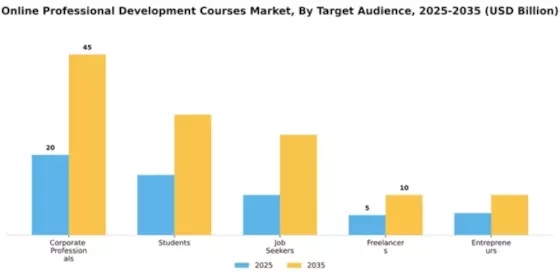
In the Online Professional Development Courses Market, the distribution of the target audience reveals that corporate professionals hold the largest share, significantly driving the demand for courses tailored to enhance their skills and productivity. This segment benefits from organizational support, as companies increasingly invest in employee development to remain competitive in a fast-paced environment. Conversely, job seekers, while smaller in size, are emerging rapidly as a major segment as they pursue opportunities to upskill and make themselves more marketable in a challenging job market. Growth trends highlight that corporate professionals are motivated by the need for continuous learning and career advancement, leading to a steady increase in course enrollments in specialized areas. In contrast, job seekers are leveraging online courses to quickly acquire in-demand skills, propelling this segment's growth as they adapt to the evolving job landscape. Online platforms are catering to both segments, offering flexible options to meet their unique learning requirements.
Corporate Professionals: Dominant vs. Job Seekers: Emerging
Corporate professionals represent the dominant category in the Online Professional Development Courses Market, characterized by their structured learning approach and alignment with organizational goals. They seek courses that enhance their competencies and contribute to career progression, often supported by employer funding. Meanwhile, job seekers are an emerging group that expresses a growing interest in upskilling through online platforms, reflecting a shift in demand towards practical and industry-relevant courses. As job seekers aim to enhance their employability, they prioritize courses that offer certifications and skills directly applicable to available job opportunities. The contrasting profiles of these segments reflect varying motivations and learning needs in the professional development landscape.
In the Online Professional Development Courses Market, Self-Paced Learning constitutes the largest segment, appealing to a broad audience seeking flexibility and autonomy in their learning journeys. Live Virtual Classes, while not as dominant in terms of market share, represent the fastest-growing segment, catering to those who desire real-time interaction and engagement with instructors and peers. The distribution highlights the diverse preferences of learners in today’s digital landscape, with Self-Paced Learning accommodating individual schedules while Live Virtual Classes provide a structured and collaborative environment. The growth of these segments is driven by an increasing demand for personalized learning experiences and the rise of digital learning technologies. Self-Paced Learning benefits from the convenience of 24/7 access, allowing professionals to balance training with their work commitments. Live Virtual Classes are gaining traction as they foster interactivity and networking opportunities, appealing to organizations focused on team-building and enhanced communication skills. The blend of convenience and engagement is reshaping the market dynamics, as learners gravitate toward offerings that best fit their lifestyles and learning preferences.
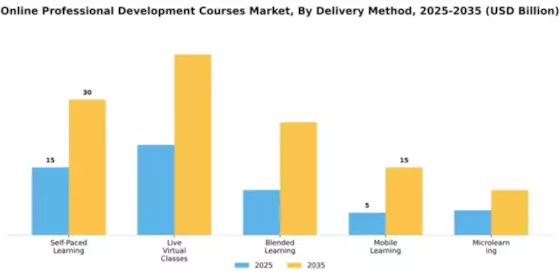
Self-Paced Learning (Dominant) vs. Blended Learning (Emerging)
Self-Paced Learning stands as the dominant approach in the Online Professional Development Courses Market, characterized by its flexibility and adaptability to learners’ schedules. It allows individuals to progress at their own pace, making it ideal for those juggling professional responsibilities with educational goals. In contrast, Blended Learning is emerging as a significant contender, combining online digital media with traditional face-to-face classroom methods. This hybrid model caters to learners who benefit from both independent study and direct interaction with instructors. As organizations increasingly recognize the value of diverse learning styles, Blended Learning is gaining traction for its ability to enhance engagement and retention, offering a pathway that aligns well with modern professional development needs.
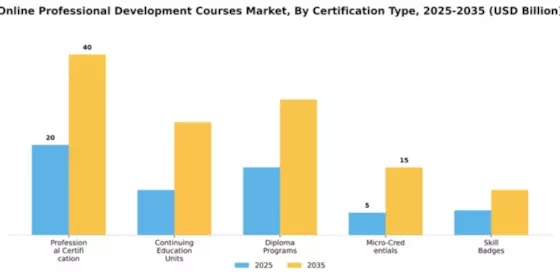
In the Online Professional Development Courses Market, the distribution of certification types is quite varied. Professional Certification holds the largest market share, appealing to professionals seeking specialized knowledge and credibility within their fields. Following this, Continuing Education Units and Diploma Programs attract significant attention as they offer foundational and advanced knowledge necessary for career progression. Micro-Credentials and Skill Badges, while smaller in share, are gaining traction and are noticeably popular among learners aiming for quick skill acquisition and recognition.
Professional Certification (Dominant) vs. Micro-Credentials (Emerging)
Professional Certification represents a critical cornerstone in the Online Professional Development Courses Market, providing individuals with recognized credentials that enhance their employment prospects significantly. This segment targets working professionals across various industries, ensuring they meet the evolving standards required for career advancement. Conversely, Micro-Credentials have emerged as an agile alternative for learners who value flexibility and rapid skill development. These bite-sized credentials are often highly focused on specific skills or competencies, allowing professionals to quickly adapt to industry changes. As organizations increasingly recognize the value of micro-learning, this segment is set to experience substantial growth, driven by the demand for targeted skills in fast-paced job markets.
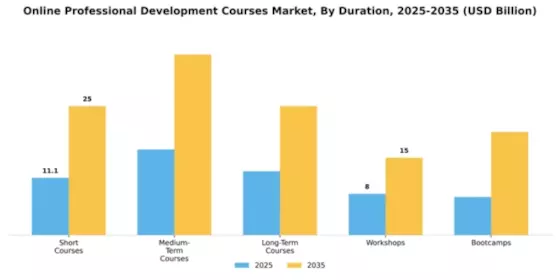
The Online Professional Development Courses Market shows a diverse range of duration-based offerings, with Short Courses currently leading the market share. These programs appeal to professionals seeking quick skill enhancements, allowing flexibility in learning and immediate application. Medium-Term Courses and Workshops follow as robust contenders, addressing more comprehensive topics and skill sets, while Long-Term Courses provide in-depth knowledge for career advancement. The growth trends indicate a rapid increase in the popularity of Bootcamps, driven by workforce demands for rapid skill acquisition in specific areas. As industries evolve, learners are gravitating towards programs that offer quick turnarounds on employable skills. This trend is further supported by partnerships between educational institutions and industry players focusing on real-world applications of knowledge.
Short Courses (Dominant) vs. Bootcamps (Emerging)
Short Courses represent the dominant segment within the Online Professional Development Courses Market, widely favored for their concise and targeted curriculum. These courses cater to professionals looking to upskill quickly, often focusing on specific competencies that enhance employability. In contrast, Bootcamps are emerging as a significant trend, designed for those seeking intensive training in areas like coding, data science, and digital marketing. Bootcamps typically offer immersive experiences that lead to rapid skill development and are tailormade to meet the immediate demands of the job market. As technology evolves, both Short Courses and Bootcamps are adjusting their offerings, although each continues to appeal to different segments of the workforce.
Get more detailed insights about Online Professional Development Courses Market Request Free Sample
North America continues to lead the Online Professional Development Courses Market, holding a significant market share of 30.0 in 2024. The growth is driven by increasing demand for flexible learning options, technological advancements, and a strong emphasis on upskilling in the workforce. Regulatory support for online education further catalyzes this growth, as institutions adapt to the evolving educational landscape. The competitive landscape is robust, with key players such as Coursera, edX, and LinkedIn Learning dominating the market. The U.S. is the primary contributor, leveraging its technological infrastructure and educational institutions. The presence of diverse platforms catering to various professional needs enhances the market's appeal, ensuring a steady influx of learners seeking to enhance their skills and career prospects.
Europe is witnessing a significant transformation in the Online Professional Development Courses Market, with a market size of 15.0 in 2024. The region's growth is fueled by increasing digital literacy, government initiatives promoting lifelong learning, and a shift towards remote work. Regulatory frameworks are evolving to support online education, making it more accessible to a broader audience. Leading countries like Germany, the UK, and France are at the forefront, with numerous platforms such as FutureLearn and Alison gaining traction. The competitive landscape is characterized by a mix of local and international players, fostering innovation and diverse course offerings. This dynamic environment is attracting learners eager to enhance their skills in a rapidly changing job market.
The Asia-Pacific region is emerging as a rapidly growing market for Online Professional Development Courses, with a market size of 8.0 in 2024. The growth is driven by rising internet penetration, increasing smartphone usage, and a growing emphasis on skill development among the workforce. Governments are also implementing policies to promote online education, enhancing accessibility and affordability for learners across the region. Countries like China, India, and Australia are leading the charge, with platforms such as Udacity and Skillshare gaining popularity. The competitive landscape is diverse, featuring both established players and new entrants, which fosters innovation and a wide range of course offerings. This vibrant market is attracting a large number of learners seeking to upskill and adapt to the evolving job market.
The Middle East and Africa region is gradually emerging as a new frontier in the Online Professional Development Courses Market, with a market size of 2.5 in 2024. The growth is driven by increasing internet access, a young population eager for education, and government initiatives aimed at enhancing digital skills. Regulatory support is also becoming more pronounced, encouraging the adoption of online learning platforms across the region. Countries like South Africa, UAE, and Kenya are leading the way, with various local and international platforms entering the market. The competitive landscape is evolving, with a mix of established players and startups offering diverse courses tailored to regional needs. This growth presents significant opportunities for learners seeking to enhance their skills in a rapidly changing economic environment.
The Online Professional Development Courses Market is characterized by a dynamic competitive landscape, driven by the increasing demand for flexible learning solutions and the rapid evolution of technology. Major players such as Coursera (US), edX (US), and LinkedIn Learning (US) are strategically positioned to leverage their extensive course offerings and partnerships with leading universities and organizations. These companies focus on innovation and digital transformation, enhancing user experience through personalized learning paths and advanced analytics. Their collective strategies contribute to a moderately fragmented market, where competition is fierce yet collaborative, as companies often engage in partnerships to expand their reach and improve course quality.Key business tactics employed by these companies include localized content development and strategic partnerships with educational institutions. The market structure appears to be moderately fragmented, with a mix of established players and emerging startups. This fragmentation allows for diverse offerings, catering to various learner needs and preferences. The influence of key players is substantial, as they set industry standards and drive technological advancements that shape the overall market dynamics.In November Coursera (US) announced a partnership with a leading tech company to integrate AI-driven learning tools into its platform. This strategic move is likely to enhance the personalization of learning experiences, allowing users to receive tailored course recommendations based on their individual learning styles and progress. Such innovations may position Coursera as a frontrunner in the competitive landscape, appealing to a broader audience seeking customized educational solutions.In October edX (US) launched a new initiative aimed at expanding its course offerings in emerging technologies, particularly in AI and machine learning. This initiative reflects edX's commitment to staying ahead of industry trends and meeting the evolving needs of professionals. By focusing on high-demand skills, edX may strengthen its market position and attract learners eager to enhance their employability in a rapidly changing job market.In September LinkedIn Learning (US) introduced a subscription model that allows users to access a wider range of courses at a reduced rate. This strategic decision appears to be a response to increasing competition and aims to enhance user retention by providing more value. By making professional development more accessible, LinkedIn Learning could potentially increase its user base and solidify its standing in the market.As of December current trends in the Online Professional Development Courses Market include a pronounced emphasis on digitalization, sustainability, and the integration of AI technologies. Strategic alliances among key players are shaping the competitive landscape, fostering innovation and collaboration. The shift from price-based competition to a focus on technological advancement and supply chain reliability is evident, suggesting that future differentiation will hinge on the ability to innovate and deliver high-quality, relevant educational content.






The Online Professional Development Courses Market is projected to grow at a 7.26% CAGR from 2025 to 2035, driven by technological advancements, increasing demand for upskilling, and flexible learning options.
New opportunities lie in:
By 2035, the market is expected to be robust, reflecting substantial growth and innovation.
| MARKET SIZE 2024 | 55.5(USD Billion) |
| MARKET SIZE 2025 | 59.53(USD Billion) |
| MARKET SIZE 2035 | 120.0(USD Billion) |
| COMPOUND ANNUAL GROWTH RATE (CAGR) | 7.26% (2025 - 2035) |
| REPORT COVERAGE | Revenue Forecast, Competitive Landscape, Growth Factors, and Trends |
| BASE YEAR | 2024 |
| Market Forecast Period | 2025 - 2035 |
| Historical Data | 2019 - 2024 |
| Market Forecast Units | USD Billion |
| Key Companies Profiled | Coursera (US), edX (US), Udacity (US), LinkedIn Learning (US), Skillshare (US), Pluralsight (US), FutureLearn (GB), Khan Academy (US), Alison (IE) |
| Segments Covered | Course Type, Target Audience, Delivery Method, Certification Type, Duration |
| Key Market Opportunities | Integration of artificial intelligence enhances personalized learning experiences in the Online Professional Development Courses Market. |
| Key Market Dynamics | Rising demand for flexible learning options drives innovation and competition in the Online Professional Development Courses Market. |
| Countries Covered | North America, Europe, APAC, South America, MEA |
The market valuation was 55.5 USD Billion in 2024.
The market is projected to reach 120.0 USD Billion by 2035.
The expected CAGR during the forecast period 2025 - 2035 is 7.26%.
Key players include Coursera, edX, Udacity, LinkedIn Learning, Skillshare, Pluralsight, FutureLearn, Khan Academy, and Alison.
The primary segments include Technical Skills, Soft Skills, Leadership Development, Compliance Training, and Industry-Specific Training.
Technical Skills courses were valued at 15.0 to 30.0 USD Billion, whereas Soft Skills courses ranged from 10.0 to 20.0 USD Billion.
The market segments by target audience include Corporate Professionals, Students, Job Seekers, Freelancers, and Entrepreneurs.
Delivery methods include Self-Paced Learning, Live Virtual Classes, Blended Learning, Mobile Learning, and Microlearning.
Available certifications include Professional Certification, Continuing Education Units, Diploma Programs, Micro-Credentials, and Skill Badges.
Course durations vary from Short Courses, Medium-Term Courses, Long-Term Courses, Workshops, to Bootcamps.


Kindly complete the form below to receive a free sample of this Report

“This is really good guys. Excellent work on a tight deadline. I will continue to use you going forward and recommend you to others. Nice job”


“Thanks. It’s been a pleasure working with you, please use me as reference with any other Intel employees.”


“Thanks for sending the report it gives us a good global view of the Betaïne market.”


“Thank you, this will be very helpful for OQS.”


“We found the report very insightful! we found your research firm very helpful. I'm sending this email to secure our future business.”


“I am very pleased with how market segments have been defined in a relevant way for my purposes (such as "Portable Freezers & refrigerators" and "last-mile"). In general the report is well structured. Thanks very much for your efforts.”


“I have been reading the first document or the study, ,the Global HVAC and FP market report 2021 till 2026. Must say, good info! I have not gone in depth at all parts, but got a good indication of the data inside!”


“We got the report in time, we really thank you for your support in this process. I also thank to all of your team as they did a great job.”


“The Automotive 48V ECU Components Procurement Intelligence Study” was a complex project, but the Market Research Future (MRFR) team handled it with quality, agility, and customer-centricity. They delivered all requested data on time and within the agreed scope. The team, including Shubhendra Anand and Rahul Gotadki, was always readily available to clarify questions and swiftly implement necessary adjustments, driving the project to a successful conclusion within a very demanding timeframe.
I would also like to specifically commend Akshay Agarwal for his responsiveness and support at every stage—from our initial inquiry on May 6th through to final delivery on June 18th. His dedication made the entire process seamless.”



