Open Database Connectivity Market
Open Database Connectivity Market Summary
As per Market Research Future analysis, the Open Database Connectivity Market (ODBC) Market Size was estimated at 1.7 USD Billion in 2024. The ODBC industry is projected to grow from 2.032 USD Billion in 2025 to 12.07 USD Billion by 2035, exhibiting a compound annual growth rate (CAGR) of 19.5% during the forecast period 2025 - 2035
Key Market Trends & Highlights
The Open Database Connectivity Market (ODBC) Market is experiencing robust growth driven by technological advancements and evolving data management needs.
- North America remains the largest market for ODBC solutions, reflecting a strong demand for data integration.
- Asia-Pacific is emerging as the fastest-growing region, fueled by rapid digital transformation initiatives.
- The Windows segment continues to dominate the market, while the Linux segment is witnessing the fastest growth due to increasing open-source adoption.
- Key market drivers include the rising demand for data integration solutions and the expansion of business intelligence applications.
Market Size & Forecast
| 2024 Market Size | 1.7 (USD Billion) |
| 2035 Market Size | 12.07 (USD Billion) |
| CAGR (2025 - 2035) | 19.5% |
Major Players
Microsoft (US), Oracle (US), IBM (US), SAP (DE), Progress Software (US), Intersystems (US), Actian (US), DataDirect Technologies (US), CData Software (US)
Open Database Connectivity Market Trends
The Open Database Connectivity Market (ODBC) Market is currently experiencing a notable evolution, driven by the increasing demand for seamless data integration across diverse platforms. Organizations are recognizing the necessity of connecting various data sources to enhance operational efficiency and decision-making processes. This trend is further fueled by the growing reliance on cloud-based solutions, which necessitate robust connectivity options. As businesses strive to leverage data analytics, the ODBC framework appears to be a pivotal component in facilitating access to disparate databases, thereby promoting a more unified data ecosystem. Moreover, the Open Database Connectivity Market (ODBC) Market is likely to witness advancements in technology that enhance performance and security. The emergence of new standards and protocols may lead to improved interoperability among different database systems. Additionally, as data privacy regulations become more stringent, the demand for secure data access solutions is expected to rise. This evolving landscape suggests that the ODBC Market will continue to adapt, providing innovative solutions that meet the changing needs of organizations in a data-driven world.
Increased Cloud Adoption
The shift towards cloud computing is significantly influencing the Open Database Connectivity Market (ODBC) Market. As more organizations migrate their operations to the cloud, the need for reliable and efficient data connectivity solutions becomes paramount. ODBC serves as a crucial bridge, enabling seamless access to cloud-based databases and applications.
Focus on Data Security
With the rise in data breaches and privacy concerns, there is a heightened emphasis on security within the Open Database Connectivity Market (ODBC) Market. Organizations are increasingly seeking ODBC solutions that incorporate advanced security features, ensuring that data access remains protected against unauthorized threats.
Integration with Emerging Technologies
The Open Database Connectivity Market (ODBC) Market is likely to see greater integration with emerging technologies such as artificial intelligence and machine learning. This trend suggests that ODBC can enhance data processing capabilities, allowing organizations to derive deeper insights and improve overall data management.
Open Database Connectivity Market Drivers
Adoption of Big Data Technologies
The Open Database Connectivity Market (ODBC) Market is poised for growth due to the increasing adoption of big data technologies. Organizations are leveraging big data analytics to extract valuable insights from vast amounts of data generated daily. ODBC serves as a vital component in this ecosystem, allowing seamless connectivity between big data platforms and traditional databases. As the big data market is projected to exceed USD 100 billion by 2027, the demand for ODBC drivers is likely to rise correspondingly. This trend indicates a shift towards more sophisticated data management solutions, where ODBC facilitates the integration of diverse data sources, thereby enhancing analytical capabilities.
Emergence of Hybrid IT Environments
The Open Database Connectivity Market (ODBC) Market is witnessing a shift towards hybrid IT environments, where organizations blend on-premises and cloud-based solutions. This transition necessitates reliable connectivity options to ensure seamless data flow between different systems. ODBC serves as a critical enabler in these hybrid setups, allowing organizations to connect various databases regardless of their location. As more businesses adopt hybrid strategies, the demand for ODBC drivers is likely to increase. This trend indicates a broader movement towards flexible IT architectures, where ODBC plays a pivotal role in facilitating data integration and accessibility across diverse environments.
Growing Emphasis on Data Governance
The Open Database Connectivity Market (ODBC) Market is increasingly shaped by the growing emphasis on data governance. Organizations are recognizing the importance of managing data quality, security, and compliance, which necessitates robust connectivity solutions. ODBC provides a standardized method for accessing and managing data across various platforms, thereby supporting governance initiatives. As regulatory requirements become more stringent, the demand for ODBC-compliant solutions is expected to rise. This trend suggests that organizations are prioritizing data integrity and compliance, which could drive further adoption of ODBC technologies in the coming years.
Rising Demand for Data Integration Solutions
The Open Database Connectivity Market (ODBC) Market is experiencing a notable surge in demand for data integration solutions. Organizations are increasingly seeking to unify disparate data sources to enhance decision-making processes. This trend is driven by the need for real-time data access and analytics, which are critical for maintaining competitive advantage. According to recent estimates, the data integration market is projected to grow at a compound annual growth rate of approximately 12% over the next five years. This growth is likely to propel the ODBC market as businesses adopt ODBC drivers to facilitate seamless connectivity between various databases and applications, thereby streamlining operations and improving data accessibility.
Expansion of Business Intelligence Applications
The Open Database Connectivity Market (ODBC) Market is significantly influenced by the expansion of business intelligence (BI) applications. As organizations increasingly rely on data-driven insights, the demand for robust BI tools has escalated. ODBC plays a crucial role in enabling these applications to connect with multiple data sources, thereby enhancing their functionality. Market analysis indicates that the BI market is expected to reach USD 40 billion by 2026, which could further stimulate the ODBC market as more companies integrate ODBC-compliant solutions to harness the power of their data. This trend suggests a growing recognition of the importance of data accessibility and integration in driving business success.
Market Segment Insights
By Operating System: Windows (Largest) vs. Linux (Fastest-Growing)
The Open Database Connectivity Market (ODBC) market exhibits a diverse distribution of operating systems, with Windows holding the largest share. Its widespread adoption in enterprise environments continues to bolster its position, serving as a preferred choice for integration with various databases. In contrast, Linux is gaining traction due to its open-source nature, appealing to businesses seeking cost-effective solutions. Other operating systems, such as macOS, hold a smaller share, primarily catering to niche markets.
Windows (Dominant) vs. Linux (Emerging)
Windows remains the dominant force in the ODBC market, benefiting from its legacy systems and extensive support for various database platforms. It is characterized by its user-friendly interface, extensive software support, and robust security features, making it a reliable choice for businesses of all sizes. On the other hand, Linux is emerging rapidly in the ODBC ecosystem, driven by its agility, customization options, and lower overhead costs. Its adoption is particularly prevalent among tech-savvy organizations and startups, seeking flexibility and scalability in database management. As these trends continue, Linux is expected to expand its footprint in the market, challenging Windows' long-standing dominance.
By Driver Type: Multi-Tier ODBC Driver (Largest) vs. Single-Tier ODBC Driver (Fastest-Growing)
In the Open Database Connectivity Market (ODBC) market, the Multi-Tier ODBC Driver holds a significant majority share due to its versatility and robust features, making it the preferred choice for enterprises with complex database interactions. Conversely, the Single-Tier ODBC Driver, while smaller in market share, is witnessing rapid adoption as businesses seek simplicity and cost-efficiency in their database connectivity solutions.
Driver Type: Multi-Tier ODBC Driver (Dominant) vs. Single-Tier ODBC Driver (Emerging)
The Multi-Tier ODBC Driver stands as the dominant force in the market, offering a high level of scalability and security, which is crucial for large organizations needing to handle multiple data sources. Its capacity to support various protocols and interaction models allows it to serve a diverse set of applications effectively. In contrast, the Single-Tier ODBC Driver has emerged as a rapid growth segment, particularly appealing to small and medium enterprises. It provides a straightforward and cost-effective solution that fulfills basic database connectivity requirements without the complexities of multi-tier architectures. This driver type is increasingly favored for simpler applications and quick deployment, reflecting the ongoing trend towards more agile database solutions.
By Deployment: Cloud (Largest) vs. On-Premise (Fastest-Growing)
In the Open Database Connectivity Market (ODBC) Market, the cloud deployment segment has emerged as the largest, characterized by its flexibility, scalability, and ease of integration with various applications. This segment significantly benefits from the shift toward remote work and the increasing reliance on cloud-based services, which has led to a substantial uptake among enterprises. On the other hand, the on-premise deployment segment, while smaller by market share, is rapidly gaining traction as organizations seek more direct control over their data, particularly in industries with stringent compliance regulations.
Deployment: Cloud (Dominant) vs. On-Premise (Emerging)
Cloud deployment in the ODBC market is recognized as the dominant choice due to its ability to offer robust data management solutions with minimal infrastructure costs. This option allows for real-time data access and collaborative work environments, making it ideal for businesses looking to leverage big data. In contrast, on-premise deployment is becoming an emerging choice as it addresses specific needs for data security and control. Organizations in heavily regulated sectors are increasingly opting for on-premise solutions to ensure data integrity and compliance, driving growth in this segment as companies invest in building internal capabilities to manage their databases effectively.
By End-User: Healthcare (Largest) vs. BFSI (Fastest-Growing)
The Open Database Connectivity Market (ODBC) market exhibits a diverse distribution of end-user sectors, with the healthcare segment holding a significant share. As a core area for ODBC applications, healthcare relies on data consistency and interoperability across various systems, driving its dominant position. Following healthcare, the BFSI sector is emerging as a substantial player, highlighting the necessity for robust data management solutions as organizations increasingly embrace digital transformation.
Healthcare: Dominant vs. BFSI: Emerging
The healthcare sector is at the forefront of the ODBC market, leveraging its extensive databases for improved patient management, research, and administrative processes. This segment's use of ODBC allows for seamless integration with electronic health records and cloud-based solutions, making it a powerhouse in data connectivity. Conversely, the BFSI sector is witnessing rapid growth as financial institutions adopt ODBC for real-time data access and enhanced decision-making capabilities. This emerging segment is characterized by increased investments in data analytics and a shift towards more reliable data management practices, positioning it as a key area to watch in the coming years.
Regional Insights
North America : Technology Leadership and Innovation
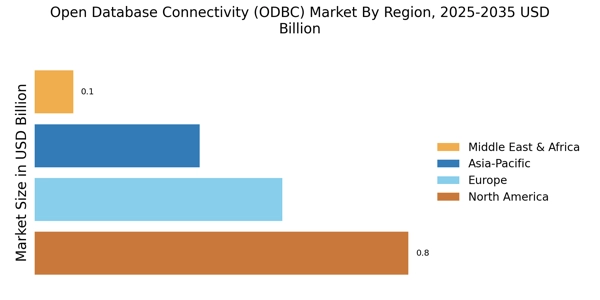
North America is the largest market for Open Database Connectivity Market (ODBC), accounting for approximately 45% of the global market share. The region's growth is driven by the increasing demand for data integration solutions, cloud computing, and the rise of big data analytics. Regulatory support for data interoperability and security standards further catalyzes market expansion, making it a hub for technological innovation. The competitive landscape in North America is characterized by the presence of major players such as Microsoft, Oracle, and IBM. These companies are continuously innovating to enhance their ODBC offerings, ensuring compatibility with various data sources. The U.S. leads the market, followed by Canada, which is also witnessing significant growth due to its expanding tech ecosystem and investment in data management solutions.
Europe : Emerging Data Integration Hub
Europe is the second-largest market for Open Database Connectivity Market (ODBC), holding around 30% of the global market share. The region's growth is fueled by the increasing need for seamless data access across various platforms and the adoption of cloud-based solutions. Regulatory frameworks such as the General Data Protection Regulation (GDPR) are also influencing the market, promoting secure data handling practices and interoperability among systems. Leading countries in Europe include Germany, the UK, and France, where the demand for ODBC solutions is on the rise. The competitive landscape features key players like SAP and Progress Software, who are focusing on enhancing their product offerings to meet the diverse needs of businesses. The region is witnessing a surge in partnerships and collaborations aimed at improving data connectivity and integration capabilities.
Asia-Pacific : Rapidly Growing Tech Ecosystem
Asia-Pacific is emerging as a significant player in the Open Database Connectivity Market (ODBC) market, accounting for approximately 20% of the global share. The region's growth is driven by rapid digital transformation, increasing investments in IT infrastructure, and a growing emphasis on data analytics. Countries like China and India are leading this growth, supported by favorable government initiatives and a burgeoning startup ecosystem focused on technology solutions. The competitive landscape in Asia-Pacific is diverse, with both local and international players vying for market share. Key companies such as Intersystems and Actian are expanding their presence, while new entrants are innovating to cater to the unique needs of the region. The demand for ODBC solutions is expected to rise as businesses seek to enhance their data management capabilities and improve operational efficiency.
Middle East and Africa : Emerging Market Potential
The Middle East and Africa (MEA) region is gradually emerging in the Open Database Connectivity Market (ODBC) market, holding about 5% of the global share. The growth is primarily driven by increasing digitalization efforts, investments in smart technologies, and the need for efficient data management solutions. Governments in the region are promoting initiatives to enhance data accessibility and integration, which is expected to further boost market growth. Leading countries in the MEA region include South Africa and the UAE, where there is a growing demand for ODBC solutions among enterprises. The competitive landscape is evolving, with both The Open Database Connectivity Market (ODBC). Companies are focusing on developing tailored solutions to meet the specific needs of local businesses, thereby enhancing their market presence and driving adoption of ODBC technologies.
Key Players and Competitive Insights
Key Companies in the Open Database Connectivity Market include
Industry Developments
April 2023: Amazon DocumentDB (with MongoDB compatibility) is a scalable, incredibly durable, fully managed database service for running mission-critical MongoDB workloads. Amazon DocumentDB recently disclosed a new ODBC connection that allows Microsoft Excel and PowerBI to connect to Amazon DocumentDB clusters. With the ODBC connector, anyone may now query and view data stored in DocumentDB from programs that allow ODBC access.
February 2021: The open-source data networking technology called Apache Arrow Flight, which Dremio co-developed and which dramatically increases data transmission rates, will now be supported by Dremio, a pioneer in the field of data lake transformation. Using over ten-year-old technologies like Java Database Connectivity (JDBC) and Open Database Connectivity Market (ODBC), client applications can now communicate with Dremio's data lake service more swiftly than they could previously.
Future Outlook
Open Database Connectivity Market Future Outlook
The Open Database Connectivity Market (ODBC) Market is projected to grow at a 19.5% CAGR from 2025 to 2035, driven by increasing data integration needs and cloud adoption.
New opportunities lie in:
- Development of advanced ODBC drivers for cloud-based databases. Integration of AI-driven analytics tools with ODBC solutions. Expansion into emerging markets with tailored ODBC solutions.
By 2035, the ODBC market is expected to be robust, reflecting substantial growth and innovation.
Market Segmentation
Open Database Connectivity Market End-User Outlook
- Manufacturing
- BFSI
- Government
- IT and Telecommunication
- Electronics
- Healthcare
- Automotive
- Others
Open Database Connectivity Market Deployment Outlook
- Cloud
- On-Premise
Open Database Connectivity Market Driver Type Outlook
- Multi-Tier ODBC Driver
- Single-Tier ODBC Driver
Open Database Connectivity Market Operating System Outlook
- Windows
- macOS
- Linux
- Others
Report Scope
| MARKET SIZE 2024 | 1.7(USD Billion) |
| MARKET SIZE 2025 | 2.032(USD Billion) |
| MARKET SIZE 2035 | 12.07(USD Billion) |
| COMPOUND ANNUAL GROWTH RATE (CAGR) | 19.5% (2025 - 2035) |
| REPORT COVERAGE | Revenue Forecast, Competitive Landscape, Growth Factors, and Trends |
| BASE YEAR | 2024 |
| Market Forecast Period | 2025 - 2035 |
| Historical Data | 2019 - 2024 |
| Market Forecast Units | USD Billion |
| Key Companies Profiled | Microsoft (US), Oracle (US), IBM (US), SAP (DE), Progress Software (US), Intersystems (US), Actian (US), DataDirect Technologies (US), CData Software (US) |
| Segments Covered | Operating System, Driver Type, Deployment, End-User, Region |
| Key Market Opportunities | Integration of artificial intelligence in Open Database Connectivity (ODBC) Market enhances data accessibility and analytics. |
| Key Market Dynamics | Rising demand for seamless data integration drives innovation and competition in the Open Database Connectivity market. |
| Countries Covered | North America, Europe, APAC, South America, MEA |
FAQs
What is the projected market valuation of the Open Database Connectivity (ODBC) Market by 2035?
The projected market valuation for the Open Database Connectivity (ODBC) Market is expected to reach 12.07 USD Billion by 2035.
What was the market valuation of the ODBC Market in 2024?
The overall market valuation of the Open Database Connectivity (ODBC) Market was 1.7 USD Billion in 2024.
What is the expected CAGR for the ODBC Market during the forecast period 2025 - 2035?
The expected CAGR for the Open Database Connectivity (ODBC) Market during the forecast period 2025 - 2035 is 19.5%.
Which operating system segment had the highest valuation in 2024?
In 2024, the Windows operating system segment had the highest valuation at 5.9 USD Billion.
What are the two types of ODBC drivers and their respective market valuations in 2024?
In 2024, the Single-Tier ODBC Driver was valued at 6.27 USD Billion, while the Multi-Tier ODBC Driver was valued at 5.8 USD Billion.
How does the On-Premise deployment segment compare to the Cloud segment in 2024?
In 2024, the On-Premise deployment segment was valued at 6.57 USD Billion, surpassing the Cloud segment, which was valued at 5.5 USD Billion.
Which end-user segment contributed the most to the ODBC Market in 2024?
Who are the key players in the Open Database Connectivity (ODBC) Market?
What was the valuation of the Healthcare end-user segment in 2024?
What is the potential growth outlook for the ODBC Market in the coming years?
Kindly complete the form below to receive a free sample of this Report
Customer Stories
“This is really good guys. Excellent work on a tight deadline. I will continue to use you going forward and recommend you to others. Nice job”
“Thanks. It’s been a pleasure working with you, please use me as reference with any other Intel employees.”
“Thanks for sending the report it gives us a good global view of the Betaïne market.”
“Thank you, this will be very helpful for OQS.”
“We found the report very insightful! we found your research firm very helpful. I'm sending this email to secure our future business.”
“I am very pleased with how market segments have been defined in a relevant way for my purposes (such as "Portable Freezers & refrigerators" and "last-mile"). In general the report is well structured. Thanks very much for your efforts.”
“I have been reading the first document or the study, ,the Global HVAC and FP market report 2021 till 2026. Must say, good info! I have not gone in depth at all parts, but got a good indication of the data inside!”
“We got the report in time, we really thank you for your support in this process. I also thank to all of your team as they did a great job.”