×
Request Free Sample ×

Kindly complete the form below to receive a free sample of this Report

* Please use a valid business email

Leading companies partner with us for data-driven Insights

clients tt-cursor
Hero Background

Organic Eggs Market

ID: MRFR/FnB/10386-HCR
128 Pages
Snehal Singh
October 2025

Organic Eggs Market Research Report Information By Application (Retail, Food Processing, Food Service, and Others), By Distribution Channel (Supermarket and Hypermarket, E Commerce, Convenience stores, Bulk Suppliers, and Others), By Size (Extra Large and Jumbo, Medium and Large, and Small), and By Region (North America, Europe, Asia-Pacific, and Rest Of The World) – Market Forecast Till 2032

Share:
Download PDF ×

We do not share your information with anyone. However, we may send you emails based on your report interest from time to time. You may contact us at any time to opt-out.

Organic Eggs Market Infographic
Purchase Options

Organic Eggs Market Summary

As per MRFR analysis, the Organic Eggs Market Size was estimated at 2730.48 USD Million in 2024. The Organic Eggs industry is projected to grow from 3113.18 in 2025 to 10384.35 by 2035, exhibiting a compound annual growth rate (CAGR) of 12.87 during the forecast period 2025 - 2035.

Key Market Trends & Highlights

The Organic Eggs Market is experiencing robust growth driven by health consciousness and sustainability.

  • North America remains the largest market for organic eggs, reflecting a strong consumer preference for health-oriented products.
  • The Asia-Pacific region is emerging as the fastest-growing market, driven by increasing urbanization and changing dietary habits.
  • Supermarkets continue to dominate the organic eggs segment, while online retail is rapidly gaining traction among consumers seeking convenience.
  • Rising demand for organic products and an increased focus on animal welfare are key drivers propelling market expansion.

Market Size & Forecast

2024 Market Size 2730.48 (USD Million)
2035 Market Size 10384.35 (USD Million)
CAGR (2025 - 2035) 12.87%

Major Players

Cal-Maine Foods (US), Nestle S.A. (CH), Organic Valley (US), Vital Farms (US), Happy Egg Co. (GB), Eggland's Best (US), Farmhouse Eggs (US), Blue Sky Family Farms (US), Nutritional Foods (US)

Organic Eggs Market Trends

The Organic Eggs Market is currently experiencing a notable transformation, driven by a growing consumer preference for healthier and more sustainable food options. This shift is largely influenced by increased awareness regarding the benefits of organic farming practices, which emphasize animal welfare and environmental sustainability. As consumers become more discerning about their food choices, the demand for organic eggs is likely to rise, reflecting a broader trend towards clean eating and transparency in food sourcing. Retailers and producers are responding to this trend by enhancing their product offerings and marketing strategies to highlight the organic credentials of their eggs, thereby appealing to health-conscious consumers. Moreover, the Organic Eggs Market appears to be benefiting from a surge in interest from various demographic segments, including millennials and families seeking nutritious alternatives. This demographic shift suggests that the market may continue to expand as more individuals prioritize organic products in their diets. Additionally, the rise of e-commerce platforms is facilitating easier access to organic eggs, allowing consumers to purchase these products conveniently. As the market evolves, it is essential for stakeholders to remain attuned to consumer preferences and adapt their strategies accordingly, ensuring they meet the demands of an increasingly health-oriented populace.

Rising Health Consciousness

There is a growing trend among consumers towards health and wellness, which is driving the demand for organic eggs. Individuals are increasingly seeking nutritious food options that align with their health goals, leading to a preference for organic products.

Sustainability Focus

The Organic Eggs Market is witnessing a heightened emphasis on sustainability. Consumers are becoming more aware of the environmental impact of their food choices, prompting them to opt for organic eggs that are produced through environmentally friendly practices.

E-commerce Growth

The expansion of e-commerce platforms is significantly influencing the Organic Eggs Market. Online shopping provides consumers with greater access to organic products, making it easier for them to incorporate organic eggs into their diets.

Organic Eggs Market Drivers

Market Growth Projections

The Global Organic Eggs Industry is poised for substantial growth, with projections indicating a market value of 4.2 USD Billion in 2024 and an anticipated increase to 15.2 USD Billion by 2035. This growth trajectory suggests a compound annual growth rate of 12.43% from 2025 to 2035, reflecting the increasing consumer demand for organic products. Factors such as rising health consciousness, sustainability trends, and regulatory support for organic farming are likely to drive this expansion. As the market evolves, it is expected to attract new entrants and foster innovation, further enhancing the competitive landscape and providing consumers with a wider array of organic egg options.

Rising Health Consciousness

The Global Organic Eggs Industry is experiencing a notable surge in demand, driven by an increasing awareness of health and wellness among consumers. As individuals become more conscious of their dietary choices, organic eggs, known for their higher nutritional value and absence of synthetic additives, are gaining traction. This trend is reflected in the projected market value of 4.2 USD Billion in 2024, indicating a robust consumer preference for organic products. The emphasis on organic farming practices, which prioritize animal welfare and environmental sustainability, further enhances the appeal of organic eggs, positioning them as a preferred choice for health-conscious consumers.

Innovative Product Offerings

Innovation within the Global Organic Eggs Industry is driving consumer interest and expanding market opportunities. Producers are increasingly introducing a variety of organic egg products, including enriched eggs that contain higher levels of omega-3 fatty acids and other nutrients. These innovative offerings cater to diverse consumer preferences and dietary needs, enhancing the appeal of organic eggs. Additionally, value-added products such as organic egg-based snacks and ready-to-eat meals are emerging, further diversifying the market. This innovation not only attracts health-conscious consumers but also contributes to the overall growth of the market, as it adapts to changing consumer demands.

Sustainable Farming Practices

Sustainability plays a pivotal role in shaping the Global Organic Eggs Industry. The increasing adoption of sustainable farming practices, which prioritize ecological balance and animal welfare, is influencing consumer preferences. Organic egg production typically involves free-range systems that allow hens to roam outdoors, thereby enhancing their quality of life. This commitment to sustainability resonates with environmentally conscious consumers, who are willing to pay a premium for products that align with their values. As a result, the market is expected to grow significantly, with projections indicating a rise to 15.2 USD Billion by 2035, reflecting the long-term viability of sustainable organic farming.

Growing Urbanization and Convenience Trends

Urbanization is significantly impacting the Global Organic Eggs Industry, as more consumers in urban areas seek convenient and healthy food options. The fast-paced lifestyle of urban dwellers often leads to a preference for ready-to-cook or ready-to-eat organic egg products. This trend is further supported by the increasing availability of organic eggs in supermarkets and online platforms, making them more accessible to consumers. As urban populations continue to grow, the demand for convenient organic food options is likely to rise, contributing to the overall expansion of the market. The convenience factor, combined with health benefits, positions organic eggs as a favorable choice for busy urban consumers.

Regulatory Support for Organic Certification

The Global Organic Eggs Industry benefits from robust regulatory frameworks that support organic certification. Governments worldwide are implementing stringent standards for organic farming, ensuring that consumers receive high-quality products. This regulatory support not only enhances consumer trust but also encourages producers to transition to organic practices. As more farms obtain organic certification, the supply of organic eggs is likely to increase, meeting the growing demand. This trend is indicative of a broader shift towards organic agriculture, which is projected to expand significantly, with a compound annual growth rate of 12.43% from 2025 to 2035, further solidifying the market's growth trajectory.
Market Segment Insights

By Distribution Channel: Supermarket (Largest) vs. Online Retail (Fastest-Growing)

In the Organic Eggs Market, the distribution channel landscape reveals that supermarkets hold the largest share. They have established trust and reliability, attracting consumers seeking convenience. Following closely, online retail has seen significant growth as more consumers turn to e-commerce for their grocery needs, especially post-pandemic. Specialty stores and farmers markets, while important, account for a smaller portion of overall market share, appealing primarily to niche consumer segments. Growth trends indicate a shift towards online retail, driven by the increasing adoption of digital shopping platforms and the desire for convenience. This segment is experiencing rapid advancements in logistics and delivery services, making organic egg products more accessible. Moreover, environmentally conscious consumers are increasingly favoring farmers markets and specialty stores, further diversifying the distribution landscape.

Supermarket (Dominant) vs. Farmers Market (Emerging)

Supermarkets dominate the organic eggs distribution channel, benefiting from their extensive reach and customer base, allowing them to offer a wide variety of organic egg products at competitive prices. Their strategic partnerships with farms ensure a steady supply while focusing on quality assurance, which is paramount for organic certifications. On the other hand, farmers markets, while smaller in size, represent an emerging distribution channel, appealing to health-conscious consumers looking for locally sourced, fresh products. They emphasize the farm-to-table experience, creating a personal connection between consumers and producers. This trend highlights a growing awareness of sustainable farming practices, which resonates well with the values of organic eggs, driving the popularity of this channel.

By Product Type: Free Range Organic Eggs (Largest) vs. Pasture Raised Organic Eggs (Fastest-Growing)

In the Organic Eggs Market, Free Range Organic Eggs hold the largest market share, reflecting the consumer preference for products that ensure animal welfare and natural living conditions. This category appeals strongly to health-conscious consumers, contributing to its dominance. Meanwhile, Pasture Raised Organic Eggs are emerging rapidly, capturing the interest of environmentally aware buyers who are willing to pay a premium for higher welfare standards. As awareness increases, this segment is gaining traction, positioning itself as a significant player in the market.

Free Range Organic Eggs (Dominant) vs. Pasture Raised Organic Eggs (Emerging)

Free Range Organic Eggs are characterized by hens that are given outdoor access and raised in more humane conditions compared to conventional systems. This segment dominates due to its established consumer base and strong marketing favoring ethical farming practices. On the other hand, Pasture Raised Organic Eggs represent an innovative and rapidly growing segment, focusing on the highest standards of animal welfare. The hens are allowed ample space to roam and forage, thus appealing deeply to the emerging trends of sustainability and health, making this segment attractive to newer, environmentally-conscious consumers.

By Packaging Type: Carton (Largest) vs. Eco-Friendly Packaging (Fastest-Growing)

In the Organic Eggs Market, the packaging type segment showcases a diverse distribution among various packaging formats. The carton packaging remains the largest segment, primarily used to enhance the shelf life of organic eggs while providing a convenient method for consumers. Tray packaging follows closely behind, favored for its ability to showcase premium products visually. Meanwhile, bulk packaging serves distributors and retailers, making it an essential option for businesses aiming to reduce costs in supply chain operations.

Carton (Dominant) vs. Eco-Friendly Packaging (Emerging)

Carton packaging is the dominant choice in the organic eggs segment, recognized for its functionality in protecting eggs while offering branding opportunities for organic labels. The sturdy nature of cartons not only preserves the integrity of the eggs but also appeals to consumers seeking convenience. On the other hand, eco-friendly packaging is rapidly emerging as a trendy option amongst environmentally conscious consumers. It encompasses biodegradable materials and minimalistic designs, addressing consumer demand for sustainable products. As such, both carton and eco-friendly packaging continue to play pivotal roles, with carton being a staple in conventional markets and eco-friendly options appealing to a growing base of sustainable-minded customers.

By End User: Household (Largest) vs. Food Service (Fastest-Growing)

The Organic Eggs Market is primarily driven by the Household segment, which holds the largest share due to increasing consumer preference for healthy and organic food options. This segment has seen consistent growth, as more households prioritize the consumption of organic products, reflecting a shift in consumer behavior towards better nutrition and quality. Food Service, while smaller in market share, is quickly becoming a significant player as restaurants and cafes recognize the demand for organic egg options to satisfy health-conscious consumers.

Household (Dominant) vs. Food Service (Emerging)

The Household segment dominates the Organic Eggs Market, characterized by consumers seeking quality, health benefits, and sustainability in their food choices. This segment's growth is fueled by heightened awareness of the nutritional advantages of organic eggs, leading to increased purchasing frequency. On the other hand, the Food Service segment is emerging rapidly, driven by restaurants and food establishments looking to cater to the growing consumer trend toward organic and health-oriented menus. As dining preferences evolve, food service providers are adapting, which creates an opportunity for organic egg suppliers, making this segment one of the fastest-growing within the market.

Get more detailed insights about Organic Eggs Market

Regional Insights

North America : Market Leader in Organic Eggs

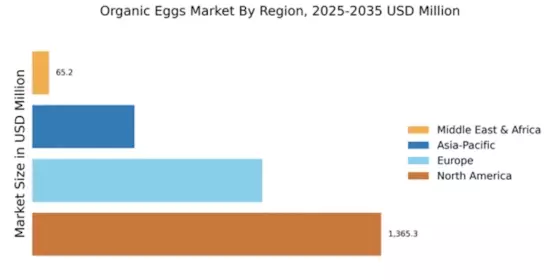
North America continues to lead the organic eggs market, holding a significant share of 1365.29 million. The growth is driven by increasing consumer awareness regarding health benefits and a rising demand for organic products. Regulatory support, including USDA organic certification, has further catalyzed market expansion. The trend towards sustainable farming practices is also influencing consumer choices, pushing organic egg sales higher. The United States is the primary market player, with key companies like Cal-Maine Foods and Organic Valley dominating the landscape. The competitive environment is characterized by innovation in product offerings and marketing strategies aimed at health-conscious consumers. As the market matures, companies are focusing on enhancing supply chain efficiencies and expanding distribution channels to meet growing demand.

Europe : Emerging Market for Organic Eggs

Europe's organic eggs market is on the rise, with a market size of 819.14 million. The growth is fueled by increasing health consciousness among consumers and stringent EU regulations promoting organic farming. The European Union's Common Agricultural Policy supports organic farming initiatives, which is a significant driver for market expansion. Additionally, the demand for ethically sourced products is pushing consumers towards organic options. Leading countries in this region include Germany, France, and the UK, where companies like Happy Egg Co. and Nestle S.A. are making significant inroads. The competitive landscape is marked by a mix of large corporations and smaller organic farms, all vying for market share. The focus on quality and sustainability is shaping product offerings, making the European market a dynamic space for organic eggs.

Asia-Pacific : Growing Demand for Organic Products

The Asia-Pacific region is witnessing a burgeoning interest in organic eggs, with a market size of 486.1 million. This growth is driven by rising disposable incomes, urbanization, and a shift towards healthier eating habits. Regulatory frameworks are gradually evolving to support organic farming, although they are not as established as in North America or Europe. The increasing awareness of food safety and quality is also propelling demand for organic products in this region. Countries like Australia and Japan are leading the charge, with local players and international brands competing for market share. The competitive landscape is characterized by a mix of established companies and new entrants focusing on organic offerings. As consumer preferences shift, the market is expected to grow, with companies investing in marketing and distribution to capture the emerging demand.

Middle East and Africa : Niche Market for Organic Eggs

The Middle East and Africa region represents a niche market for organic eggs, with a market size of 60.95 million. The growth is slow due to limited consumer awareness and lower disposable incomes in many areas. However, there is a gradual shift towards organic products as health awareness increases. Regulatory frameworks are still developing, which poses challenges for market expansion. The demand for organic eggs is expected to grow as more consumers seek healthier options. Countries like South Africa and the UAE are showing potential for growth, with local producers beginning to enter the organic market. The competitive landscape is still in its infancy, with few established players. However, as consumer preferences evolve, there is an opportunity for growth, particularly in urban areas where health trends are gaining traction.

Key Players and Competitive Insights

The Organic Eggs Market is currently characterized by a dynamic competitive landscape, driven by increasing consumer demand for organic products and heightened awareness of animal welfare. Major players such as Cal-Maine Foods (US), Organic Valley (US), and Vital Farms (US) are strategically positioned to capitalize on these trends. Cal-Maine Foods (US) has focused on expanding its product line to include organic offerings, thereby enhancing its market share. Meanwhile, Organic Valley (US) emphasizes cooperative farming practices, which not only bolster its brand image but also ensure a steady supply of high-quality organic eggs. Vital Farms (US) has adopted a direct-to-consumer model, leveraging digital platforms to reach a broader audience, which reflects a significant shift in consumer purchasing behavior. Collectively, these strategies contribute to a competitive environment that is increasingly focused on sustainability and consumer engagement.

In terms of business tactics, companies are localizing manufacturing and optimizing supply chains to enhance efficiency and reduce costs. The market structure appears moderately fragmented, with several key players vying for dominance. This fragmentation allows for niche players to thrive, while larger companies leverage economies of scale to maintain competitive pricing. The collective influence of these key players shapes market dynamics, as they continuously innovate to meet evolving consumer preferences.

In November 2025, Vital Farms (US) announced a partnership with a leading e-commerce platform to enhance its online sales capabilities. This strategic move is likely to bolster its market presence, particularly among younger consumers who prefer online shopping. By streamlining its distribution channels, Vital Farms (US) positions itself to capture a larger share of the growing e-commerce segment, which is crucial in today’s digital-first environment.

In October 2025, Organic Valley (US) launched a new marketing campaign aimed at educating consumers about the benefits of organic farming practices. This initiative not only reinforces the brand's commitment to sustainability but also seeks to differentiate its products in a crowded marketplace. By focusing on consumer education, Organic Valley (US) may enhance brand loyalty and drive sales, particularly among health-conscious consumers.

In September 2025, Cal-Maine Foods (US) expanded its organic egg production facilities in response to rising demand. This expansion is indicative of the company's commitment to meeting consumer needs while also enhancing its operational capacity. By increasing production capabilities, Cal-Maine Foods (US) is likely to strengthen its competitive position and respond effectively to market fluctuations.

As of December 2025, current competitive trends in the Organic Eggs Market include a pronounced shift towards digitalization, sustainability, and the integration of AI technologies in production processes. Strategic alliances are increasingly shaping the landscape, as companies collaborate to enhance their supply chain reliability and innovate product offerings. Looking ahead, competitive differentiation is expected to evolve, with a notable shift from price-based competition to a focus on innovation, technology, and sustainable practices. This transition underscores the importance of adaptability in a rapidly changing market.

Key Companies in the Organic Eggs Market market include

Industry Developments

July 2021: St Ewe's, a Cornish egg producer, has introduced a line of bottled egg whites in Morrisons supermarkets all throughout the country. The Super Egg Whites, according to the manufacturer, are 100 percent pasteurised free-range egg whites with 11 grammes of protein per 100 millilitres, 0 grammes of fat, and no gluten or cholesterol.

Future Outlook

Organic Eggs Market Future Outlook

The Organic Eggs Market is projected to grow at a 12.87% CAGR from 2024 to 2035, driven by rising health consciousness, sustainable farming practices, and increasing consumer demand for organic products.

New opportunities lie in:

  • Expansion of online sales platforms for organic eggs
  • Development of premium organic egg product lines
  • Partnerships with health-focused restaurants and cafes

By 2035, the Organic Eggs Market is expected to achieve substantial growth and market penetration.

Market Segmentation

Organic Eggs Market End User Outlook

  • Household
  • Food Service
  • Retailers
  • Food Manufacturers

Organic Eggs Market Product Type Outlook

  • Conventional Organic Eggs
  • Free Range Organic Eggs
  • Pasture Raised Organic Eggs
  • Omega-3 Enriched Organic Eggs

Organic Eggs Market Packaging Type Outlook

  • Carton
  • Tray
  • Bulk Packaging
  • Eco-Friendly Packaging

Organic Eggs Market Distribution Channel Outlook

  • Supermarket
  • Online Retail
  • Specialty Store
  • Farmers Market

Report Scope

MARKET SIZE 20242730.48(USD Million)
MARKET SIZE 20253113.18(USD Million)
MARKET SIZE 203510384.35(USD Million)
COMPOUND ANNUAL GROWTH RATE (CAGR)12.87% (2024 - 2035)
REPORT COVERAGERevenue Forecast, Competitive Landscape, Growth Factors, and Trends
BASE YEAR2024
Market Forecast Period2025 - 2035
Historical Data2019 - 2024
Market Forecast UnitsUSD Million
Key Companies ProfiledCal-Maine Foods (US), Nestle S.A. (CH), Organic Valley (US), Vital Farms (US), Happy Egg Co. (GB), Eggland's Best (US), Farmhouse Eggs (US), Blue Sky Family Farms (US), Nutritional Foods (US)
Segments CoveredDistribution Channel, Product Type, Packaging Type, End User
Key Market OpportunitiesGrowing consumer demand for sustainable and ethically produced products drives expansion in the Organic Eggs Market.
Key Market DynamicsRising consumer demand for sustainable food options drives growth in the organic eggs market, influencing supply chain dynamics.
Countries CoveredNorth America, Europe, APAC, South America, MEA

Market Highlights

Author
Snehal Singh
Assistant Manager - Research

High acumen in analyzing complex macro & micro markets with more than 6 years of work experience in the field of market research. By implementing her analytical skills in forecasting and estimation into market research reports, she has expertise in Packaging, Construction, and Equipment domains. She handles a team size of 20-25 resources and ensures smooth running of the projects, associated marketing activities, and client servicing.

Leave a Comment

FAQs

How much is the Organic Eggs market?

The Organic Eggs Market size was valued at USD 3.7 Billion in 2023.

What is the growth rate of the Organic Eggs market?

The global market is projected to grow at a CAGR of 12.50% during the forecast period, 2024-2032.

Which region held the largest market share in the Organic Eggs market?

North America had the largest share in the global market

Who are the key players in the Organic Eggs market?

The key players in the market Cal-Maine Foods Inc., Michael Foods Inc., LDC, Hickman’s Egg Ranch, Trillium Farm Holdings LLC, Plukon Food Group, Sisters Food Group, SUN DAILY, DQY Ecological, and thehappyhensfarm.com

Which Application led the Organic Eggs market?

The Retail Application dominated the market in 2023.

Which Distribution Channel had the largest market share in the Organic Eggs market?

The Supermarket and Hypermarket Distribution Channel had the largest share in the global market.

Download Free Sample

Kindly complete the form below to receive a free sample of this Report

Compare Licence

×
Features License Type
Single User Multiuser License Enterprise User
Price $4,950 $5,950 $7,250
Maximum User Access Limit 1 User Upto 10 Users Unrestricted Access Throughout the Organization
Free Customization
Direct Access to Analyst
Deliverable Format
Platform Access
Discount on Next Purchase 10% 15% 15%
Printable Versions