×
Request Free Sample ×

Kindly complete the form below to receive a free sample of this Report

* Please use a valid business email

Leading companies partner with us for data-driven Insights

clients tt-cursor
Hero Background

Organic Food Flavor Market

ID: MRFR/FnB/38565-HCR
100 Pages
Harshita Gorade
October 2025

Organic Food Flavor Market Research Report By Flavor Type (Fruit Flavors, Vegetable Flavors, Herb Flavors, Spice Flavors, Nut Flavors), By Application (Food and Beverages, Cosmetics and Personal Care, Pharmaceuticals, Nutraceuticals), By Formulation Type (Liquid Flavorings, Powder Flavorings, Concentrated Flavorings), By Certification (USDA Organic, European Union Organic, Non-GMO Project Verified), By Target Consumer (Health-Conscious Consumers, Eco-Friendly Consumers, Gourmet Food Enthusiasts) and By Regional (North America, Europe, South... read more

Share:
Download PDF ×

We do not share your information with anyone. However, we may send you emails based on your report interest from time to time. You may contact us at any time to opt-out.

Organic Food Flavor Market Infographic
Purchase Options

Organic Food Flavor Market Summary

As per MRFR analysis, the Organic Food Flavor Market Size was estimated at 3.444 USD Billion in 2024. The Organic Food Flavor industry is projected to grow from 3.617 USD Billion in 2025 to 5.897 USD Billion by 2035, exhibiting a compound annual growth rate (CAGR) of 5.01 during the forecast period 2025 - 2035.

Key Market Trends & Highlights

The Organic Food Flavor Market is experiencing robust growth driven by consumer preferences for natural and clean label products.

  • North America remains the largest market for organic food flavors, driven by increasing health consciousness among consumers.
  • The Asia-Pacific region is emerging as the fastest-growing market, reflecting a rising demand for innovative flavor profiles.
  • Fruit flavors dominate the market, while herb flavors are witnessing rapid growth due to evolving consumer tastes.
  • Key market drivers include the growing popularity of plant-based diets and consumer preference for natural ingredients.

Market Size & Forecast

2024 Market Size 3.444 (USD Billion)
2035 Market Size 5.897 (USD Billion)
CAGR (2025 - 2035) 5.01%

Major Players

Givaudan (CH), Firmenich (CH), Symrise (DE), International Flavors & Fragrances (US), T. Hasegawa (JP), Sensient Technologies (US), Kerry Group (IE), Mane (FR), Robertet (FR)

Organic Food Flavor Market Trends

The Organic Food Flavor Market is currently experiencing a notable transformation, driven by a growing consumer preference for natural ingredients and clean-label products. This shift reflects a broader trend towards health-conscious eating, where individuals increasingly seek flavors derived from organic sources. As awareness of the benefits associated with organic consumption rises, manufacturers are adapting their offerings to align with these evolving consumer demands. The market appears to be expanding as more brands introduce innovative flavor profiles that cater to diverse culinary applications, from beverages to snacks and beyond. Moreover, the Organic Food Flavor Market is likely to witness a surge in product development, as companies invest in research and development to create unique and appealing flavors. This focus on innovation may lead to the emergence of new flavor combinations that resonate with consumers' desire for authenticity and quality. Additionally, the increasing availability of organic ingredients is expected to facilitate market growth, as suppliers respond to the rising demand for natural flavoring options. Overall, the Organic Food Flavor Market seems poised for continued expansion, driven by a confluence of consumer preferences and industry advancements.

Rising Demand for Clean Label Products

Consumers are increasingly gravitating towards products that feature transparent ingredient lists. This trend indicates a preference for organic flavors that are free from artificial additives, aligning with the broader clean label movement.

Innovation in Flavor Profiles

The market is witnessing a wave of creativity as brands experiment with unique flavor combinations. This innovation caters to adventurous consumers seeking new taste experiences, thereby enhancing product appeal.

Sustainability and Ethical Sourcing

There is a growing emphasis on sustainability within the Organic Food Flavor Market. Brands are prioritizing ethically sourced ingredients, which resonates with environmentally conscious consumers and supports responsible production practices.

Organic Food Flavor Market Drivers

Innovation in Flavor Technology

Technological advancements in flavor extraction and formulation are playing a crucial role in shaping the Organic Food Flavor Market. Innovations such as cold-press extraction and advanced distillation techniques allow for the creation of more concentrated and authentic organic flavors. These technologies enable manufacturers to produce flavors that are not only more potent but also retain the integrity of the original ingredients. Market analysis suggests that the flavor technology sector is experiencing rapid growth, with investments in research and development increasing significantly. This focus on innovation is essential for meeting the evolving tastes and preferences of consumers, particularly in a market that is becoming increasingly competitive. As companies strive to differentiate their products, the integration of cutting-edge flavor technology is likely to enhance the overall quality and appeal of organic flavors, thereby propelling the Organic Food Flavor Market forward.

Health Consciousness Among Consumers

The increasing awareness regarding health and wellness among consumers appears to be a pivotal driver for the Organic Food Flavor Market. As individuals become more informed about the adverse effects of artificial additives and preservatives, there is a marked shift towards organic alternatives. This trend is reflected in market data, which indicates that the organic food sector has experienced a compound annual growth rate of approximately 10% over the past few years. Consumers are actively seeking products that not only taste good but also contribute positively to their health. Consequently, manufacturers are compelled to innovate and expand their offerings in the organic food flavor segment, aligning with the growing demand for clean label products. This heightened health consciousness is likely to continue influencing purchasing decisions, thereby propelling the growth of the Organic Food Flavor Market.

Growing Popularity of Plant-Based Diets

The rising trend of plant-based diets is significantly influencing the Organic Food Flavor Market. As more consumers adopt vegetarian and vegan lifestyles, there is an increasing demand for flavors that complement plant-based foods. Market Research Future indicates that the plant-based food sector is projected to grow at a rate of 11% annually, which in turn drives the need for organic flavors that enhance the taste of these products. This shift towards plant-based eating is not merely a fad; it reflects a broader movement towards sustainability and ethical consumption. Consequently, manufacturers are focusing on developing innovative organic flavors that cater to this demographic, thereby expanding their product lines. The intersection of plant-based diets and organic flavors is likely to create new opportunities within the Organic Food Flavor Market.

Regulatory Support for Organic Products

Regulatory frameworks that promote organic farming and food production are increasingly shaping the Organic Food Flavor Market. Governments in various regions are implementing policies that support organic agriculture, which includes financial incentives for farmers and stringent regulations on synthetic additives. Such measures are designed to enhance consumer trust and ensure the integrity of organic products. For instance, the introduction of certification programs has made it easier for consumers to identify genuine organic flavors. This regulatory support not only fosters a favorable environment for organic producers but also encourages consumers to opt for organic flavors over conventional options. As a result, the Organic Food Flavor Market is likely to benefit from these initiatives, which may lead to an expansion in market share and consumer base.

Consumer Preference for Natural Ingredients

The preference for natural ingredients over synthetic alternatives is a defining characteristic of the Organic Food Flavor Market. As consumers become more discerning about the contents of their food, there is a growing inclination towards products that are perceived as pure and unadulterated. This trend is supported by market data, which shows that nearly 70% of consumers are willing to pay a premium for organic products. This willingness to invest in quality reflects a broader cultural shift towards valuing authenticity and transparency in food sourcing. Manufacturers are responding to this demand by reformulating their products to include organic flavors derived from natural sources. This focus on natural ingredients not only enhances the appeal of products but also aligns with the ethical considerations that many consumers prioritize today, thereby driving growth in the Organic Food Flavor Market.
Market Segment Insights

By Type: Fruit Flavors (Largest) vs. Herb Flavors (Fastest-Growing)

In the Organic Food Flavor Market, the distribution among the segment values reveals Fruit Flavors as the predominant category, characterized by a diverse range of naturally derived flavor options that appeal to health-conscious consumers. Vegetable Flavors and Spice Flavors also maintain significant shares, providing culinary versatility, whereas Nut Flavors have carved a niche market primarily focused on allergen-free products. Overall, consumers are gravitating towards flavors that align with organic and natural dietary preferences. As the market evolves, Herb Flavors are emerging as the fastest-growing segment, driven by the increasing popularity of herbal ingredients in food products made from organic or local sources. The demand for clean label products and innovative combinations of flavors is pushing manufacturers to focus on expanding their herb offerings, capitalizing on trends related to health benefits and sustainable practices in food preparation.

Fruit Flavors (Dominant) vs. Spice Flavors (Emerging)

Fruit Flavors are recognized as the dominant category in the Organic Food Flavor Market, capitalizing on their versatility and appeal across various food applications, from beverages to baked goods. These flavors not only evoke freshness and sweetness but also cater to a wide demographic, including children and health-conscious adults seeking natural alternatives to synthetic ingredients. In contrast, Spice Flavors are emerging as an exciting trend, spurred on by the increasing interest in ethnic cuisines and culinary experimentation. As consumers seek unique and adventurous taste profiles, Spice Flavors are gaining traction, appealing to gourmet enthusiasts and home cooks alike. This segment is witnessing a shift towards organic and sustainably sourced spices, further enhancing their position in the market.

By Application: Food and Beverages (Largest) vs. Nutraceuticals (Fastest-Growing)

The organic food flavor market is increasingly dominated by the food and beverages segment, which holds a significant portion of the overall market share. This segment encompasses a variety of products, including snacks, beverages, and processed foods, all of which are increasingly utilizing organic flavors to enhance taste and appeal to health-conscious consumers. Meanwhile, the cosmetics and personal care segment, although smaller, is also carving a niche for organic flavors, driven by consumer demand for natural and skin-friendly products.

Food and Beverages: Dominant vs. Nutraceuticals: Emerging

The food and beverages segment remains the cornerstone of the organic food flavor market, characterized by its expansive range of applications and prevalent demand. This dominance is fueled by consumers' shift towards natural ingredients and clean label preferences, leading manufacturers to adopt organic flavors to attract health-conscious buyers. In contrast, the nutraceuticals segment is emerging rapidly, driven by the increasing focus on health and wellness. As consumers seek supplements offering health benefits, the incorporation of organic flavors into these products makes them more appealing, thus propelling market growth in this category. This segment is witnessing innovation as brands strive to differentiate their offerings and meet the evolving consumer preferences centered around wellness.

By Formulation Type: Liquid Flavorings (Largest) vs. Powder Flavorings (Fastest-Growing)

In the Organic Food Flavor Market, liquid flavorings have established themselves as the largest segment, capturing a significant share of consumer preferences due to their versatile application in various culinary processes. These liquid flavorings have become essential in both home and commercial kitchens, serving a wide array of products from marinades to beverages. On the other hand, powder flavorings, while smaller in comparison, are gaining momentum rapidly, driven by their convenience and longer shelf life, making them increasingly popular among health-conscious consumers seeking natural and organic options.

Liquid Flavorings (Dominant) vs. Powder Flavorings (Emerging)

Liquid flavorings play a dominant role in the Organic Food Flavor Market, known for their ease of use and ability to blend seamlessly into dishes, beverages, and sauces. This formulation type caters to a diverse range of culinary applications, offering a robust selection of organic flavors that appeal to both chefs and home cooks. Conversely, powder flavorings are emerging as a noteworthy category, favored for their portability and extended shelf life. The growing trend toward convenience in food preparation and the rising demand for clean-label products have positioned powder flavorings as a popular choice among consumers. Both formulation types are integral to the market, driven by a shift towards organic and natural food solutions.

By Certification: USDA Organic (Largest) vs. European Union Organic (Fastest-Growing)

In the Organic Food Flavor Market, the certification landscape is primarily dominated by USDA Organic, which holds the largest market share. This certification is highly recognized among consumers in the United States, reflecting a commitment to organic farming practices and offering assurance of product quality. European Union Organic follows closely, gaining a significant share as it appeals to consumers seeking EU-certified products. The Non-GMO Project Verified segment also plays a pivotal role, particularly among health-conscious and environmentally aware consumers. This market distribution underscores the competitive nature of organic certifications and reflects consumer preferences driven by authenticity and agricultural integrity. As consumer awareness of health and sustainability continues to rise, growth trends within the Organic Food Flavor Market show positive momentum for the European Union Organic certification. This certification is becoming increasingly popular, especially in regions where organic practices are heavily promoted. The adoption of organic farming and the push for cleaner labels are key growth drivers, alongside the Non-GMO Project Verified certification gaining traction. Consumers are more willing to pay a premium for certified products, which further supports the expanding market for organic flavors. The increasing global reach of organic products provides a strong foundation for these certification segments to flourish.

USDA Organic (Dominant) vs. Non-GMO Project Verified (Emerging)

The USDA Organic certification remains the dominant player in the Organic Food Flavor Market, symbolizing high standards for organic farming and production. It conveys a strong message of authenticity to majority of consumers who value quality and transparency. This certification not only ensures compliance with strict regulations but also enhances product credibility, making USDA Organic products a preferred choice for many. Conversely, the Non-GMO Project Verified certification is emerging as a significant contender, catering to a niche but growing market segment that prioritizes GMO-free products. This certification resonates deeply with a segment of consumers who are notably health-conscious and concerned about the ecological impacts of genetically modified organisms. As awareness around GMO issues increases, the relevance and demand for Non-GMO Project Verified products are expected to rise.

By Target Consumer: Health-Conscious Consumers (Largest) vs. Eco-Friendly Consumers (Fastest-Growing)

In the Organic Food Flavor Market, Health-Conscious Consumers hold the largest market share owing to their increasing awareness of health benefits associated with organic food. This segment prioritizes products free from harmful additives and synthetic ingredients, driving consistent demand. Meanwhile, Eco-Friendly Consumers represent the fastest-growing segment as more individuals seek sustainable and environmentally-friendly food options. Their values align with ethical sourcing and reduced carbon footprints, which enhances the market’s expansion.

Health-Conscious Consumers (Dominant) vs. Eco-Friendly Consumers (Emerging)

Health-Conscious Consumers dominate the Organic Food Flavor Market, characterized by their unwavering commitment to health and wellness. They actively seek products that are organic, natural, and devoid of artificial additives. This segment greatly influences product formulations and marketing approaches, pushing brands to emphasize health benefits and transparency in ingredient sourcing. Conversely, Eco-Friendly Consumers are emerging rapidly, driven by the desire for sustainability and ecological responsibility. Their preferences shape the market towards environmentally-friendly practices, encouraging brands to adopt sustainable sourcing and packaging. As these consumers grow in number, their impact on product innovation and brand loyalty is significant.

Get more detailed insights about Organic Food Flavor Market

Regional Insights

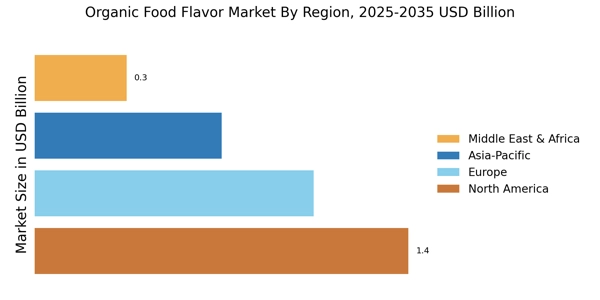
The Organic Food Flavor Market was valued at 3.28 USD Billion in 2023, with significant contributions from various regions. North America currently held a major share, valued at 1.22 USD Billion in 2023, reflecting its strong consumer preference for organic products and a mature food industry. Europe follows closely, valued at 1.05 USD Billion, where health consciousness and regulatory support drive market growth.

The Asia-Pacific region, valued at 0.75 USD Billion, is experiencing rapid growth, fueled by rising disposable incomes and changing dietary preferences.South America, while smaller at 0.2 USD Billion, shows potential due to increasing awareness of organic food benefits. The Middle East and Africa represent the lowest valuation at 0.06 USD Billion, indicating a nascent market phase but offering opportunities for growth as awareness rises.

Overall, the Organic Food Flavor Market segmentation reflects varying regional dynamics, with North America and Europe dominating, while emerging regions like Asia-Pacific are expected to witness accelerated growth in the coming years due to changing consumer behaviors and market trends.

Organic Food Flavor Market Regional Image

Key Players and Competitive Insights

The Organic Food Flavor Market is witnessing significant growth driven by increasing consumer demand for natural and organic products. As consumers become more health conscious and aware of the ingredients in their food, the market for organic flavors has expanded considerably. This evolution has led to an increase in competition among key players who are striving to innovate and offer more diverse organic flavor choices. Companies are exploring unique flavor profiles, sustainable sourcing, and plant-based alternatives to meet the changing preferences of consumers. 

The competitive landscape is characterized by a mix of established manufacturers and emerging players who are focusing on research and development to enhance product offerings and capture a larger market share. The dynamics of the market indicate a shift toward clean labeling and transparency, which are critical factors for companies seeking to maintain a competitive edge. Flavor Producers LLC has established a notable presence in the Organic Food Flavor Market through its commitment to quality and innovation.

The company is recognized for its expertise in developing a wide array of organic flavors that cater to various sectors, including beverage, bakery, and dairy products. With a robust distribution network, Flavor Producers LLC effectively reaches a diverse clientele, providing tailored solutions that meet specific customer needs. The company's strength lies in its continuous investment in cutting-edge technology and research, enabling it to create flavors that not only conform to organic standards but also enhance the sensory experience of food products.

Furthermore, their emphasis on sustainable practices and sourcing contributes to their reputation and reliability in the burgeoning market for organic food flavors, setting them apart from competitors.Givaudan SA is another significant player in the Organic Food Flavor Market, renowned for its extensive portfolio and innovative approaches to flavor development. 

As a leader in the industry, Givaudan SA offers a comprehensive range of organic flavors that meet the increasing demand for clean-label products. The company leverages its deep understanding of consumer preferences to develop flavors that resonate with market trends and cultural tastes. Their strength lies in a global network of researchers and flavorists who collaborate to create unique flavor solutions that are both appealing and authentic. Givaudan SA also focuses on sustainability initiatives in sourcing natural ingredients, ensuring that their offerings align with the values of environmentally-conscious consumers.

By positioning itself at the forefront of flavor innovation and sustainability, Givaudan SA continues to solidify its reputation as a leader in the Organic Food Flavor Market, catering effectively to the evolving demands of food and beverage manufacturers worldwide.

Key Companies in the Organic Food Flavor Market market include

Industry Developments

Recent developments in the Organic Food Flavor Market indicate a growing consumer preference for natural and organic ingredients, driven by increasing health consciousness and the desire for clean-label products. Food manufacturers are responding to this trend by reformulating their offerings to include organic flavors, which are perceived as safer and more sustainable. The rise of plant-based diets and the expansion of organic food sections in retail outlets are further bolstering market growth. Additionally, innovations in extraction and enhancement technologies are improving the quality and availability of organic flavors.

Recent partnerships between flavor companies and food producers aim to develop unique organic flavor profiles that cater to evolving consumer tastes. Regulatory changes promoting organic farming practices are also playing a pivotal role in shaping the market landscape. Overall, while challenges such as supply chain disruptions and the fluctuating costs of raw materials persist, the long-term outlook remains positive, with significant investments directed toward sustainable and organic flavor solutions. These dynamics underscore the market's robust expansion trajectory, anticipating substantial growth opportunities through 2032 as consumer demand continues to evolve.

Future Outlook

Organic Food Flavor Market Future Outlook

The Organic Food Flavor Market is projected to grow at a 5.01% CAGR from 2024 to 2035, driven by increasing consumer demand for natural ingredients and health-conscious choices.

New opportunities lie in:

  • Expansion into plant-based flavor solutions
  • Development of customized flavor profiles for niche markets
  • Investment in sustainable sourcing and production practices

By 2035, the market is expected to solidify its position as a leader in natural flavor solutions.

Market Segmentation

Organic Food Flavor Market Type Outlook

  • Fruit Flavors
  • Vegetable Flavors
  • Herb Flavors
  • Spice Flavors
  • Nut Flavors

Organic Food Flavor Market Application Outlook

  • Food and Beverages
  • Cosmetics and Personal Care
  • Pharmaceuticals
  • Nutraceuticals

Organic Food Flavor Market Certification Outlook

  • USDA Organic
  • European Union Organic
  • Non-GMO Project Verified

Organic Food Flavor Market Target Consumer Outlook

  • Health-Conscious Consumers
  • Eco-Friendly Consumers
  • Gourmet Food Enthusiasts

Organic Food Flavor Market Formulation Type Outlook

  • Liquid Flavorings
  • Powder Flavorings
  • Concentrated Flavorings

Report Scope

MARKET SIZE 20243.444(USD Billion)
MARKET SIZE 20253.617(USD Billion)
MARKET SIZE 20355.897(USD Billion)
COMPOUND ANNUAL GROWTH RATE (CAGR)5.01% (2024 - 2035)
REPORT COVERAGERevenue Forecast, Competitive Landscape, Growth Factors, and Trends
BASE YEAR2024
Market Forecast Period2025 - 2035
Historical Data2019 - 2024
Market Forecast UnitsUSD Billion
Key Companies ProfiledMarket analysis in progress
Segments CoveredMarket segmentation analysis in progress
Key Market OpportunitiesGrowing consumer demand for natural ingredients drives innovation in the Organic Food Flavor Market.

Key Market DynamicsRising consumer demand for natural ingredients drives innovation and competition in the Organic Food Flavor Market.

Countries CoveredNorth America, Europe, APAC, South America, MEA

Leave a Comment

FAQs

What is the projected market valuation of the Organic Food Flavor Market by 2035?

The Organic Food Flavor Market is projected to reach a valuation of 5.897 USD Billion by 2035.

What was the market valuation of the Organic Food Flavor Market in 2024?

In 2024, the Organic Food Flavor Market had a valuation of 3.444 USD Billion.

What is the expected CAGR for the Organic Food Flavor Market during the forecast period 2025 - 2035?

The expected CAGR for the Organic Food Flavor Market during the forecast period 2025 - 2035 is 5.01%.

Which segment is expected to show the highest growth in the Organic Food Flavor Market?

The Food and Beverages segment is anticipated to grow from 1.5 USD Billion in 2024 to 2.5 USD Billion by 2035.

Who are the key players in the Organic Food Flavor Market?

Key players in the Organic Food Flavor Market include Givaudan, Firmenich, Symrise, and International Flavors & Fragrances.

What are the projected values for fruit flavors in the Organic Food Flavor Market by 2035?

Fruit flavors are projected to increase from 0.8 USD Billion in 2024 to 1.3 USD Billion by 2035.

How do health-conscious consumers impact the Organic Food Flavor Market?

Health-conscious consumers are expected to drive the market from 1.5 USD Billion in 2024 to 2.5 USD Billion by 2035.

Download Free Sample

Kindly complete the form below to receive a free sample of this Report

Compare Licence

×
Features License Type
Single User Multiuser License Enterprise User
Price $4,950 $5,950 $7,250
Maximum User Access Limit 1 User Upto 10 Users Unrestricted Access Throughout the Organization
Free Customization
Direct Access to Analyst
Deliverable Format
Platform Access
Discount on Next Purchase 10% 15% 15%
Printable Versions