Outdoor Lighting Market (2025 - 2035)

Outdoor Lighting Market Size, Share and Research Report By Lighting Type (LED Lights, Plasma Lamps, High-Intensity Discharge Lamps, and Fluorescent Lights), By Distribution Channel (Retail and Commercial), By Application (Street Lighting, Highways, Stadiums, Parking Lots, Tunnel Lights, Parks, and Others) And By Region (North America, Europe, Asia-Pacific, And Rest Of The World) – Industry Forecast Till 2035
ID: MRFR/SEM/6868-HCR
111 Pages
Ankit Gupta, Shubham Munde
Last Updated: June 30, 2026
Outdoor Lighting Market
Market Size
Forecast Period2025-2035
CAGR (2025-2035)7.1%
2025 Market SizeUSD 17.10 Billion
2035 Market SizeUSD 33.84 Billion
Key Players
Signify N.V.
Acuity Brands
ams-OSRAM
Hubbell Incorporated
Eaton Corporation
Current Lighting
Opportunities
  • Solar-Hybrid Streetlight Systems for Off-Grid Communities
  • Lighting-as-a-Service (LaaS) Business Models
  • Data Monetization Through Smart Poles

Outdoor Lighting Market Summary

The Outdoor Lighting Market reached an estimated USD 17.10 billion in 2025 and is projected to grow from USD 18.25 Billion in 2026 to USD 33.84 billion by 2035, expanding at a CAGR of 7.1% during the forecast period. This trajectory is anchored in aggressive municipal LED retrofit mandates and national infrastructure spending programs — the U.S. Bipartisan Infrastructure Law alone allocated over USD 65 billion for power and grid modernization, a portion of which directly funds street and highway lighting upgrades [1]. Across Europe, the European Green Deal's renovation wave targets a 55% reduction in building-related emissions by 2030, pulling exterior lighting systems into the scope of compliance spending [2].

The outdoor lighting market's technological narrative is simple: LED-based luminaires with wireless connectivity, dimming controls, and integrated sensors are replacing traditional high-pressure sodium and metal halide lamps. The speed at which municipalities are transforming passive street lights into networked infrastructure nodes is demonstrated by Signify's projection that by late 2024, there were over 113 million connected light points worldwide [3]. Compared to traditional fixtures, these networked solutions reduce energy consumption by 50–70% while enabling traffic-responsive dimming and real-time defect monitoring.

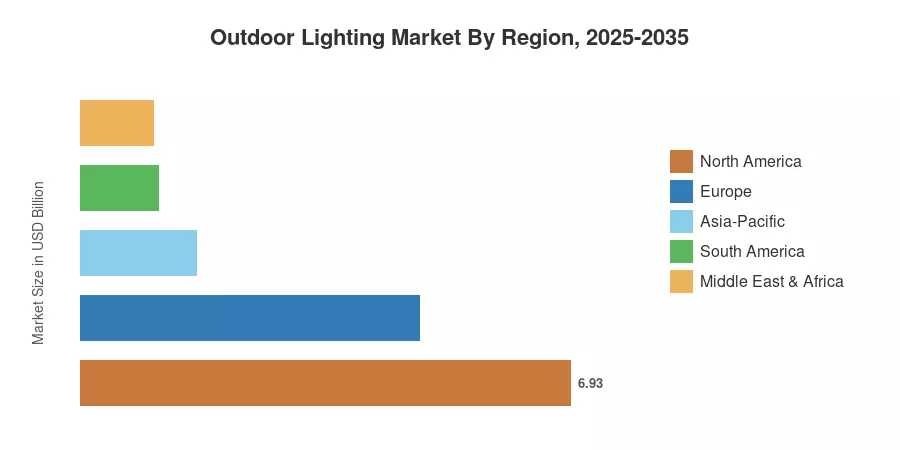
Driven by federally financed highway lighting initiatives and smart-city pilot deployments across more than 200 U.S. municipalities, North America has the greatest share of the outdoor lighting market, accounting for around 40.5% of 2025 revenue [4]. With a predicted CAGR of 9.6%, Asia-Pacific is the fastest-growing area due to the rapid urbanization of China, India, and ASEAN countries. With a share of about 28%, Europe continues to hold the second-largest position because to strict energy-performance regulations. Outdoor lighting will change over the next ten years from a category of commodity infrastructure to a platform for reporting on sustainability and urban intelligence.

Key Report Takeaways

• By Product Type

  • Decorative lighting commanded a 41.5% revenue share of the Outdoor Lighting Market in 2025, reflecting sustained demand for architectural and landscape aesthetics in commercial districts and residential communities.
  • Deck and patio lighting is the fastest-growing product category in the Outdoor Lighting Market, projected at a 9.1% CAGR through 2035.
  • Light Source
  • LED technology accounted for approximately 73% of all outdoor lighting shipments by value in 2025, cementing its dominance over fluorescent, halogen, and incandescent alternatives.
  • Deck and patio lighting is the fastest-growing product category in the Outdoor Lighting Market, projected at a 9.1% CAGR through 2035.

• By Application & Distribution

  • Commercial applications represented roughly 70% of the Outdoor Lighting Market in 2025, spanning highways, parking structures, stadiums, and retail complexes.
  • Online and direct-to-consumer distribution channels are expanding at a 10.0% CAGR, the highest growth rate across all channels.

• By Geography

  • North America led the Outdoor Lighting Market with a 40.5% share in 2025, with the United States accounting for the bulk of regional demand.
  • Asia-Pacific is projected to grow at a 9.6% CAGR from 2026 to 2035, outpacing all other regions.

Market Size and Forecast (2021–2035)

Market Research Future's estimates for the Outdoor Lighting Market draw on a combination of primary interviews with luminaire manufacturers, municipal procurement officers, and distribution-channel executives, supplemented by secondary analysis of trade association data, customs records, and corporate filings. Historical figures reflect actual shipment and installation volumes; forecast values apply the calibrated CAGR with adjustments for anticipated policy shifts and technology adoption curves.
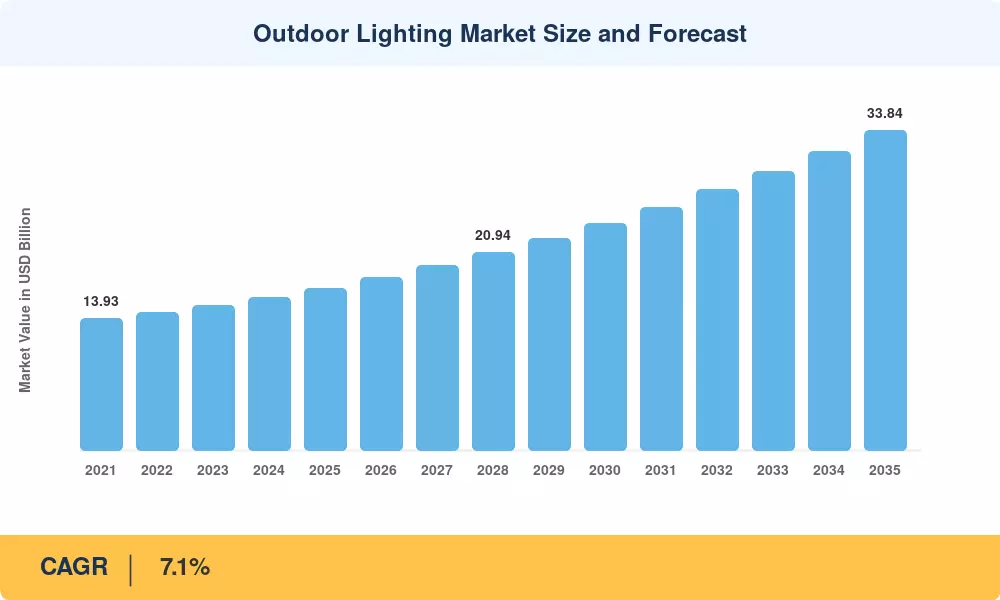
Outdoor Lighting Market Size and Forecast
Our Impact
Enabled $4.3B Revenue Impact for Fortune 500 and Leading Multinationals
Partnering with 2000+ Global Organizations Each Year
30K+ Citations by Top-Tier Firms in the Industry

Driver Impact Analysis

Driver ~% Impact on CAGR Geographic Relevance Impact Timeline
Government LED retrofit mandates ~18% Global Short-term (≤2 yr)
Urban smart-city infrastructure programs ~22% North America, Europe, Asia-Pacific Medium-term (2–4 yr)
Rising commercial construction activity ~15% Asia-Pacific, Middle East Medium-term (2–4 yr)
IoT-connected lighting adoption ~14% North America, Europe Medium-term (2–4 yr)
Residential outdoor aesthetics trend ~10% North America, Europe Short-term (≤2 yr)
Highway and public infrastructure expansion ~12% Asia-Pacific, South America Long-term (≥4 yr)
Carbon-reduction and ESG compliance pressure ~9% Europe, North America Long-term (≥4 yr)

Government LED Retrofit Mandates

Municipalities worldwide are under fiscal and regulatory pressure to replace legacy outdoor fixtures with energy-efficient LED systems. The U.S. Department of Energy estimates that converting all U.S. outdoor stationary lighting to LED would save approximately 44 TWh of electricity annually — equivalent to the output of six mid-size power plants [1]. Cities like Los Angeles, which completed a 215,000-streetlight LED conversion, saving USD 9 million per year in energy costs, have become blueprints for similar programs across Latin America, Southeast Asia, and Eastern Europe [5]. These mandates create a predictable, publicly funded demand pipeline for the Outdoor Lighting Market over the next three to five years.

Urban Smart-City Infrastructure Programs

Cities worldwide are deploying integrated roadmaps that position street lighting as critical network infrastructure. Singapore’s Smart Nation Sensor Platform trial successfully utilized localized clusters of its nationwide grid of 110,000 lampposts to mount multi-functional environmental sensors and cameras. These strategic smart-city upgrades accelerate procurement cycles by transforming standard municipal poles into responsive data-collection endpoints.

Rising Commercial Construction Activity

Infrastructure developments in the Asia-Pacific region continue to drive substantial exterior lighting investments. India’s Ministry of Housing and Urban Affairs officially recorded a total Union Budget allocation of 47,652 crore rupees for its Smart Cities Mission. This foundational urban investment program completed over 7,500 local infrastructure projects, injecting vast procurement volume into regional area-lighting markets.

IoT-Connected Lighting Adoption

The shift from standalone luminaires to networked lighting management systems is reshaping procurement specifications. Connected outdoor lighting platforms — integrating motion sensors, ambient-light detectors, and cellular or LoRaWAN communication modules — reduce maintenance costs by 30–40% through predictive failure alerts [3]. Signify's Interact City platform and Itron's intelligent streetlight controllers are among the solutions driving this transition, turning each light pole into a managed network endpoint for the Outdoor Lighting Market.

Restraints Impact Analysis

Restraint ~% Drag on CAGR Geographic Relevance Impact Timeline
High upfront capital costs for LED retrofits ~–6% Emerging markets Short-term (≤2 yr)
Vandalism and extreme-weather damage ~–4% Global Ongoing
Supply-chain bottlenecks for specialty components ~–3% Global Short-term (≤2 yr)
Fragmented municipal procurement processes ~–3% South America, Africa Medium-term (2–4 yr)
Light-pollution regulations limiting deployment ~–2% Europe, North America Long-term (≥4 yr)


High Upfront Capital Costs

While LED luminaires deliver lower total cost of ownership over a 10–15-year lifecycle, the initial purchase and installation expense remains two to three times higher than conventional fixtures [16]. For municipalities in developing economies operating under constrained budgets, this upfront barrier delays conversion timelines. The World Bank has noted that Sub-Saharan African cities often lack the creditworthiness to access green-bond financing for street-lighting upgrades, stalling projects that would otherwise expand the Outdoor Lighting Market in high-growth urban corridors [18].

Vandalism and Extreme-Weather Damage

Public lighting infrastructure remains intensely vulnerable to systemic physical damage and targeted theft. Official South African state documentation indicates that coordinated metal and cable theft drains over seven billion Rand annually from wider electrical grids. These severe disruptions compromise grid functionality, compress operational margins, and deter crucial private sector investment in municipal utility lighting concessions.

Supply-Chain Bottlenecks

Critical luminaire components remain highly concentrated within limited regional manufacturing hubs, exposing infrastructure projects to severe vulnerabilities. The International Energy Agency notes that geographic component concentration leaves electronic supply networks highly exposed to structural disruptions. These upstream vulnerabilities trigger extensive project delays, highlighting the ongoing risks of incomplete raw material sourcing diversification.

Outdoor Lighting Market Opportunities

Solar-Hybrid Streetlight Systems for Off-Grid Communities

Widespread regional electrification gaps continue to accelerate the demand for autonomous public lighting systems. The African Development Bank's Desert-to-Power initiative actively aims to mobilize twenty billion dollars to develop ten gigawatts of solar capacity across the Sahel region by 2030. These targeted, multi-country renewable energy investments establish a secure, long-term procurement pipeline for off-grid municipal outdoor illumination installations.

Lighting-as-a-Service (LaaS) Business Models

Innovative performance-based utility contracting models are rapidly gaining traction across diverse municipal landscapes. According to the United Nations Environment Programme, service-driven procurement paradigms allow financially constrained municipalities to bypass steep upfront capital hurdles by spreading equipment costs across predictable, multi-year operational budgets. This structural shift shifts hardware depreciation risks directly to qualified private contractors.

Data Monetization Through Smart Poles

Modern connected street poles are evolving rapidly from standard municipal liabilities into integrated network infrastructure assets. The World Economic Forum highlights that smart city poles can cleanly integrate localized environmental sensors, public communication networks, and traffic safety arrays. This multi-functional capability allows municipalities to coordinate urban data processing, improving regional municipal asset utilization and procurement cycles.

Emerging Horticultural and Architectural Lighting Applications

Global urbanization trends continue to stimulate substantial secondary demand for specialized, high-efficiency exterior architectural lighting systems. Data published by the United Nations indicates that rapid urban growth across emerging regions necessitates substantial commercial building investments. These extensive construction expansions create a highly continuous, incremental requirement for customizable, weather-resistant outdoor aesthetic luminaires.

Carbon-Credit Alignment and ESG Reporting

As corporate ESG disclosures become mandatory under the EU Corporate Sustainability Reporting Directive and SEC climate-risk rules, commercial property owners are seeking measurable energy-reduction projects to strengthen their filings [2]. Outdoor LED lighting retrofits offer a quantifiable, short-payback pathway to documented carbon savings, positioning the Outdoor Lighting Market as a compliance enabler.

Outdoor Lighting Market Future Outlook

AI-Driven Adaptive Lighting Networks

Artificial intelligence continues to transform public outdoor lighting systems from rigid, scheduled dimming configurations into responsive networks. The International Energy Agency emphasizes that deploying intelligent digital control systems alongside advanced automation platforms can comprehensively maximize energy efficiency across global building and municipal infrastructure. These system-level optimization upgrades significantly expand long-term procurement opportunities throughout the digital outdoor illumination sector.

Platform Economics and Multi-Service Smart Poles

The Outdoor Lighting Market is evolving toward a platform model where the luminaire pole serves as a mounting point for 5G small cells, EV chargers, environmental sensors, and digital signage. Cities that adopt this multi-service architecture can amortize pole infrastructure costs across three to five revenue streams, fundamentally altering the economic case for outdoor lighting investment [14]. Telecom operators and urban-infrastructure funds are already co-investing in smart-pole deployments across the U.S., South Korea, and the Netherlands.

Electrification and Renewable Integration

Global clean energy transitions are actively integrating public outdoor lighting networks with decentralized power systems to support grid resilience. According to the International Renewable Energy Agency, grid-edge flexibility resources are vital for managing high shares of variable renewable generation. Modern connected luminaires can actively participate in localized demand-response programs, optimizing regional municipal power networks.

ESG Reporting as a Procurement Catalyst

Mandatory sustainability disclosures under the EU CSRD, the ISSB standards, and proposed SEC climate rules will compel commercial property owners to document energy reduction across their portfolios. Outdoor lighting retrofits deliver measurable, third-party-verifiable carbon savings within 12–18 months of installation — faster than most building-envelope or HVAC upgrades [2]. This reporting imperative will convert discretionary lighting projects into compliance-driven spending, reinforcing the Outdoor Lighting Market growth trajectory through 2035.


Outdoor Lighting Market Segmentation

By Product Type

Segment Key Metric Primary Demand Driver
Decorative 41.5% share (2025) Commercial facades and hospitality landscaping
Post USD 1.88 Billion (2025) Highway and arterial road installations
Wall 6.9% CAGR Residential and commercial perimeter security
Path and Step USD 0.95 Billion (2025) Pedestrian-safety regulations
Deck and Patio 9.1% CAGR Residential outdoor-living lifestyle trend
Garden USD 0.78 Billion (2025) Landscape architecture and hospitality
Security 7.5% CAGR Crime-deterrence and insurance incentives
Flood and Spot USD 1.12 Billion (2025) Stadium, arena, and industrial facilities
Bollard 6.5% CAGR Urban-pedestrian zone and park design
Others USD 0.62 Billion (2025) Specialty and custom applications


Decorative lighting remains the largest product segment within the Outdoor Lighting Market, driven by commercial property owners seeking to differentiate retail, hospitality, and mixed-use environments through architectural illumination. The category benefits from rising specification of tunable-white and color-changing LED fixtures that enable dynamic programming for seasonal events and branding. Deck and patio lighting is the fastest-growing category, expanding at a 9.1% CAGR as homeowners across North America and Europe invest in outdoor-living spaces — a behavioral shift accelerated by the post-pandemic emphasis on residential amenity [15].

By Light Source

Segment Key Metric Primary Demand Driver
LED 73% share (2025) Energy mandates and total-cost-of-ownership advantage
Fluorescent USD 1.37 Billion (2025) Legacy installed base in developing markets
Incandescent 2.1% share (2025) Decorative and heritage applications
Halogen 3.8% CAGR Declining; limited to specialty flood lighting
Others 7.9% CAGR Emerging OLED and laser-phosphor technologies


LED dominance in the Outdoor Lighting Market is effectively irreversible. Luminous efficacy improvements — now exceeding 200 lumens per watt in premium fixtures — continue to widen the performance gap with incumbent technologies [7]. The "Others" category, which includes organic LED panels and laser-activated phosphor sources, is posting the highest growth rate as niche applications in architectural signage and decorative installations adopt these next-generation light sources.

By Installation Type

Segment Key Metric Primary Demand Driver
New Installation 71% share (2025) Greenfield construction in Asia-Pacific and MEA
Retrofit and Replacement 8.8% CAGR LED conversion mandates and energy-savings targets


New installations dominate the Outdoor Lighting Market by volume, reflecting the global construction pipeline for highways, commercial campuses, and residential developments. Retrofit activity is growing faster, however, as municipalities and commercial property owners replace aging high-pressure sodium and metal-halide fixtures with LED systems to capture immediate energy and maintenance savings.

By Application

Segment Key Metric Primary Demand Driver
Commercial 70% share (2025) Highways, parking, stadiums, retail, hospitality
Residential 7.6% CAGR Outdoor-living spaces and home-security demand


Commercial applications account for the majority of the Outdoor Lighting Market owing to the sheer scale of highway, parking, and public-space installations managed by government agencies and private operators. Residential is growing faster as homeowners invest in landscape, security, and deck lighting systems — increasingly purchased through online channels that offer design tools and smart-home integration.

By Distribution Channel

Segment Key Metric Primary Demand Driver
Direct B2B 66% share (2025) Municipal and commercial procurement contracts
Online and D2C 10.0% CAGR Homeowner and small-contractor purchasing
Distributors USD 3.25 Billion (2025) Regional electrical-supply chain networks


Direct B2B channels dominate the Outdoor Lighting Market because large-scale municipal and commercial projects are awarded through competitive tenders that flow directly from manufacturer to buyer. Online and direct-to-consumer channels are the fastest-growing distribution path, reflecting the residential segment's shift toward e-commerce platforms where consumers compare specifications, read reviews, and access smart-home compatibility information before purchasing [15].


Regional Market Share Analysis

Region Key Metric Primary Investment Themes
North America 40.5% share (2025) Smart-city retrofits, highway modernization
Europe 28.0% share (2025) Energy-efficiency directives, urban renewal
Asia-Pacific 9.6% CAGR (2026–2035) Urbanization, new-build infrastructure
South America USD 1.11 Billion (2025) Municipal LED conversion programs
Middle East & Africa USD 1.03 Billion (2025) Mega-projects, solar-hybrid deployments
Total USD 17.10 Billion (2025)

The Outdoor Lighting Market exhibits distinct regional demand profiles shaped by urbanization rates, energy policy frameworks, and infrastructure investment cycles. North America and Europe account for the majority of current revenue, while Asia-Pacific and the Middle East are the primary sources of incremental growth.


North America

Country Key Metric Key Driver
United States 78% of regional share Federal infrastructure spending, smart-city mandates
Canada 7.2% CAGR Provincial carbon-pricing incentives
Mexico USD 0.49 Billion (2025) Tourism corridor and highway expansion


The United States drives the vast majority of North American spending on the Outdoor Lighting Market, with state DOTs and municipal utilities collectively procuring over 15 million LED streetlights between 2020 and 2025 [1]. Canada's federal carbon-pricing framework has made lighting retrofits among the fastest-payback decarbonization investments for municipalities in Ontario and British Columbia. Mexico's growing tourism infrastructure along the Riviera Maya and Baja corridors is generating incremental demand for decorative and security outdoor lighting [5].

Europe

Country Key Metric Key Driver
Germany 22% of the regional share Energiewende street-lighting upgrades
United Kingdom 7.4% CAGR National Highways LED conversion program
France USD 0.68 Billion (2025) Grand Paris Express transit infrastructure
Italy 15% of regional share PNRR-funded urban-renewal projects
Spain 6.8% CAGR Tourism and coastal resort development
Nordic Countries USD 0.41 Billion (2025) Arctic-grade intelligent lighting systems
Russia 5.2% CAGR Federal highway modernization program
Rest of Europe USD 0.52 Billion (2025) EU cohesion fund infrastructure projects


Europe's Outdoor Lighting Market benefits from the continent's regulatory commitment to energy efficiency. The EU's Ecodesign for Sustainable Products Regulation, effective from 2025, sets minimum luminous efficacy standards that effectively mandate LED adoption for all new outdoor installations [2]. The UK's National Highways agency has committed GBP 500 million to convert motorway and trunk-road lighting to LED by 2030, while France's Grand Paris Express will require over 100,000 new exterior luminaires across 68 stations and connecting corridors [8].

Asia-Pacific

Country Key Metric Key Driver
China 38% of regional share National new-type urbanization plan
India 10.8% CAGR Smart Cities Mission Phase 2
Japan USD 0.47 Billion (2025) Aging infrastructure replacement cycle
South Korea 8.5% CAGR Green New Deal public-lighting targets
ASEAN USD 0.39 Billion (2025) Urban expansion in Vietnam, the Philippines and Indonesia
Rest of Asia-Pacific 7.9% CAGR Australia and New Zealand smart-highway programs


Asia-Pacific represents the fastest-growing opportunity for the Outdoor Lighting Market, driven by the convergence of rapid urbanization, government digitalization agendas, and declining LED component costs. China alone installed an estimated 32 million LED streetlights between 2020 and 2024 under its "Double Carbon" policy framework [9]. India's Street Lighting National Programme (SLNP) has converted over 13 million conventional streetlights to LED through the Energy Efficiency Services Limited (EESL) model, with Phase 2 targeting an additional 10 million units by 2028 [9].

South America

Country Key Metric Key Driver
Brazil 55% of regional share PPP-funded LED street-lighting concessions
Argentina 6.3% CAGR Provincial highway lighting expansion
Rest of South America USD 0.22 Billion (2025) Inter-American Development Bank financing


Brazil's public-private partnership model for street-lighting concessions has attracted international operators — including Enel X and Engie — to manage and modernize municipal networks in São Paulo, Belo Horizonte, and Recife [18]. The Outdoor Lighting Market in South America is constrained by currency volatility and fragmented procurement, but IDB-financed programs are establishing standardized bidding frameworks that lower barriers for smaller cities.

Middle East & Africa

Country Key Metric Key Driver
Saudi Arabia 30% of regional share Vision 2030 mega-project pipeline
UAE 8.9% CAGR Smart Dubai and Abu Dhabi urban programs
South Africa USD 0.18 Billion (2025) Municipal LED conversion and anti-vandalism design
Egypt 7.5% CAGR New Administrative Capital infrastructure
Rest of MEA USD 0.21 Billion (2025) African Development Bank solar-lighting programs


The Middle East and Africa present a dual-track Outdoor Lighting Market. Gulf states are specifying premium connected luminaires for flagship developments like NEOM, The Line, and Masdar City, while Sub-Saharan African nations are deploying cost-optimized solar-LED streetlights to address chronic grid deficits [10]. South Africa's Eskom load-shedding crisis has accelerated interest in off-grid and hybrid outdoor lighting solutions.


Outdoor Lighting Market By Region, 2025-2035

Competitive Benchmarking

The Outdoor Lighting Market exhibits medium concentration with an estimated top-five share of 35–42% and a Herfindahl-Hirschman Index in the 600–900 range. The landscape blends global lighting conglomerates with regional specialists and emerging connected-technology entrants. Competition centers on luminous efficacy, smart-controls interoperability, total cost of ownership, and sustainability credentials.

Company Est. Revenue Share Range Key Offerings for the Outdoor Lighting Market Strategic Positioning
Signify N.V. ~8–11% Interact City platform, Philips RoadFlair LED Global connected-lighting leader with the largest installed base
Acuity Brands ~6–9% Atrius IoT platform, Holophane roadway luminaires North America-focused smart-controls integrator
ams-OSRAM ~5–8% OSRAM LED street-light modules, Traxon architectural European technology leader in LED components and systems
Hubbell Incorporated ~4–7% Kim Lighting, Sterner Lighting, roadway solutions Utility and industrial outdoor-lighting specialist
Eaton Corporation ~4–6% Lumark, McGraw-Edison area and flood lighting Diversified electrical with a strong municipal channel
Current Lighting (GE) ~3–5% Evolve LED roadway, Daintree wireless controls U.S. municipal and highway focus, IoT integration
Zumtobel Group ~2–4% Thorn outdoor range, smart-pole partnerships Premium European architectural and urban lighting
Cree Lighting (IDEAL) ~2–4% RSW and OSQ series area lights High-efficacy LED specialist for commercial and area lighting
Havells India ~2–3% Outdoor LED street and flood lights Price-competitive leader in South Asian markets
RAB Lighting ~1–3% Commercial flood, wall-pack, and bollard fixtures Value-oriented, distributor-driven North American presence

Recent News & Developments

Signify-- (January 2026)-- The company expanded its professional outdoor lighting portfolio by acquiring Intelligent Lighting Controls, Inc., strengthening its position with wired control systems for North America.

Los Angeles Municipal Council-- (March 2026)-- The city approved a massive infrastructure initiative deploying solar roadway and area lights to combat rampant wire theft and maintenance backlogs.

Signify-- (June 2026)-- Announced a strategic brand transition consolidating its global outdoor specification sports, road, solar, tunnel, and flood luminaires under the primary Signify brand.

Outdoor Lighting Market Report Scope

Parameter Detail
Market Scope Global Outdoor Lighting Market covering product types, light sources, installation types, applications, distribution channels, and five geographic regions
Study Period 2021–2035
Historical Period 2021–2024
Base Year 2025
Forecast Period 2026–2035
CAGR (2026–2035) 7.1%
Market Size — 2025 USD 17.10 Billion
Market Size — 2035 USD 33.84 Billion
Fastest Growing Region Asia-Pacific (9.6% CAGR)
Fastest Growing Product Segment Deck and Patio Lighting (9.1% CAGR)
Companies Profiled 10 (Signify, Acuity Brands, ams-OSRAM, Hubbell, Eaton, Current Lighting, Zumtobel, Cree Lighting, Havells, RAB Lighting)
Valuation Currency USD Billion


FAQs

What payback period should municipalities expect from an LED outdoor lighting retrofit?
Most municipal LED retrofits achieve full payback within 3–5 years through energy and maintenance savings, depending on local utility rates and fixture density [1]. Financing via ESCO or LaaS models can eliminate upfront capital requirements entirely.
How do light-pollution ordinances affect product specification for outdoor fixtures?
Dark-sky ordinances — adopted in over 190 U.S. jurisdictions — require shielded, downward-directed luminaires with warm-white color temperatures below 3000K [19]. Manufacturers now offer IDA-compliant models as standard catalog options.
What cybersecurity risks exist for connected outdoor lighting networks?
Networked luminaires using unencrypted protocols are vulnerable to denial-of-service attacks and unauthorized dimming or shutdown. Leading platforms now embed TLS 1.3 encryption and certificate-based device authentication to mitigate these risks [14].
How does the Outdoor Lighting Market differ between public-sector and private-sector procurement?
Public procurement typically follows multi-year competitive-tender cycles with performance guarantees, while private buyers prioritize faster deployment and design flexibility [23]. Contract structures and warranty expectations differ substantially between the two channels.
What role does color-tunable LED technology play in the Outdoor Lighting Market?
Tunable-white and RGBW fixtures enable dynamic color-temperature shifts for circadian-friendly street lighting and event-driven architectural displays [7]. Adoption is highest in hospitality, retail, and premium residential applications.
Are there standardized interoperability protocols for smart outdoor luminaires?
The Zhaga-D4i standard and TALQ Smart City Protocol are the two dominant frameworks ensuring sensor and controller interoperability across manufacturers [22]. Specifying these standards protects municipalities from vendor lock-in.
How does the Outdoor Lighting Market address end-of-life recycling for LED fixtures?
EU WEEE Directive requirements mandate manufacturer take-back and recycling for luminaire electronics and housings [2]. Circular-design initiatives are increasing use of recyclable aluminum and modular driver assemblies to simplify disassembly.    
Author
Author
Author Profile
Ankit Gupta LinkedIn
Team Lead - Research
Ankit Gupta is a seasoned market intelligence and strategic research professional with over six plus years of experience in the ICT and Semiconductor industries. With academic roots in Telecom, Marketing, and Electronics, he blends technical insight with business strategy. Ankit has led 200+ projects, including work for Fortune 500 clients like Microsoft and Rio Tinto, covering market sizing, tech forecasting, and go-to-market strategies. Known for bridging engineering and enterprise decision-making, his insights support growth, innovation, and investment planning across diverse technology markets.
Co-Author
Co-Author Profile
Shubham Munde LinkedIn
Team Lead - Research
Shubham brings over 7 years of expertise in Market Intelligence and Strategic Consulting, with a strong focus on the Automotive, Aerospace, and Defense sectors. Backed by a solid foundation in semiconductors, electronics, and software, he has successfully delivered high-impact syndicated and custom research on a global scale. His core strengths include market sizing, forecasting, competitive intelligence, consumer insights, and supply chain mapping. Widely recognized for developing scalable growth strategies, Shubham empowers clients to navigate complex markets and achieve a lasting competitive edge. Trusted by start-ups and Fortune 500 companies alike, he consistently converts challenges into strategic opportunities that drive sustainable growth.

Research Approach


Secondary Research

The secondary research process involved comprehensive analysis of regulatory databases, industry publications, technical standards, and authoritative energy & lighting organizations. Key sources included the US Department of Energy (DOE) Office of Energy Efficiency & Renewable Energy, International Energy Agency (IEA), Illuminating Engineering Society (IES), International Electrotechnical Commission (IEC), American National Standards Institute (ANSI), European Committee for Electrotechnical Standardization (CENELEC), International Dark-Sky Association (IDA), US Environmental Protection Agency (EPA) ENERGY STAR Program, EU Ecodesign Directive & Energy Labeling Regulations, China National Institute of Standardization (CNIS), Bureau of Indian Standards (BIS), Japan Electrical Manufacturers' Association (JEMA), National Electrical Manufacturers Association (NEMA), Lighting Research Center (LRC) at Rensselaer Polytechnic Institute, International Association of Lighting Designers (IALD), and national energy ministry reports from key markets. These sources were used to collect energy consumption statistics, regulatory compliance data, efficacy standards, smart city infrastructure trends, and market landscape analysis for LED lighting, plasma lamps, high-intensity discharge lamps, and fluorescent lighting technologies.


Primary Research

Qualitative and quantitative insights were obtained by interviewing supply-side and demand-side stakeholders during the primary research process. The supply-side sources consist of CEOs, VPs of Product Development, R&D chiefs, and commercial directors from outdoor lighting manufacturers, component suppliers, and smart lighting solution providers. In addition to procurement leads from infrastructure development authorities, demand-side sources included municipal illumination engineers, urban planners, facility managers from commercial and industrial sectors, and contractors from highway, stadium, and public space projects. Primary research verified market segmentation, verified the timelines for the adoption of smart lighting, and collected information on the impact of energy efficiency regulations, pricing strategies, and technology migration patterns.

Primary Respondent Breakdown:

By Designation: C-level Primaries (28%), Director Level (32%), Others (40%)

By Region: North America (32%), Europe (30%), Asia-Pacific (33%), Rest of World (5%)


Market Size Estimation

Global market valuation was derived through revenue mapping and installation volume analysis. The methodology included:

The identification of over 50 key manufacturers in North America, Europe, Asia-Pacific, and Latin America

Product mapping across LED lights, plasma lamps, high-intensity discharge lamps, and fluorescent light categories

Analysis of reported and modeled annual revenues specific to outdoor lighting portfolios

Coverage of manufacturers representing 75-80% of global market share in 2024

Extrapolation using bottom-up (installation volume × ASP by country/region) and top-down (manufacturer revenue validation) approaches to derive segment-specific valuations across street lighting, highways, stadiums, parking lots, tunnel lights, parks, and other applications

Download Free Sample

Kindly complete the form below to receive a free sample of this Report

Download PDF ×

We do not share your information with anyone. However, we may send you emails based on your report interest from time to time. You may contact us at any time to opt-out.
















