×
Request Free Sample ×

Kindly complete the form below to receive a free sample of this Report

* Please use a valid business email

Leading companies partner with us for data-driven Insights

clients tt-cursor
Hero Background

Outdoor Sound Barriers Market

ID: MRFR/PCM/6792-HCR
110 Pages
Snehal Singh
October 2025

Outdoor Sound Barriers Market Research Report Information By Material (Concrete, Metal, Wood), By Application (Highways, Aviation, Demolition, Utilities & Railroad, Building Construction), And By Region (North America, Europe, Asia-Pacific, And Rest Of The World) –Market Forecast Till 2035

Share:
Download PDF ×

We do not share your information with anyone. However, we may send you emails based on your report interest from time to time. You may contact us at any time to opt-out.

Outdoor Sound Barriers Market Infographic
Purchase Options

Outdoor Sound Barriers Market Summary

As per MRFR analysis, the Outdoor Sound Barriers Market Size was estimated at 1244.58 USD Million in 2024. The Outdoor Sound Barriers industry is projected to grow from 1296.87 in 2025 to 1957.31 by 2035, exhibiting a compound annual growth rate (CAGR) of 4.2 during the forecast period 2025 - 2035.

Key Market Trends & Highlights

The Outdoor Sound Barriers Market is experiencing a dynamic shift towards sustainability and technological innovation.

  • North America remains the largest market for outdoor sound barriers, driven by urbanization and infrastructure development.
  • The Asia-Pacific region is emerging as the fastest-growing market, fueled by increasing awareness of noise pollution and regulatory influences.
  • The noise reduction segment dominates the market, while the sound insulation segment is witnessing rapid growth due to evolving consumer preferences.
  • Key market drivers include rising urbanization and stringent environmental regulations, which are shaping the demand for effective sound barrier solutions.

Market Size & Forecast

2024 Market Size 1244.58 (USD Million)
2035 Market Size 1957.31 (USD Million)
CAGR (2025 - 2035) 4.2%

Major Players

Acoustiblok (US), Sound Barrier Solutions (US), Noise Barriers Inc. (US), Auralex Acoustics (US), Trelleborg (SE), Hush City (AU), Ecovative Design (US), Barriers and Soundproofing (US)

Outdoor Sound Barriers Market Trends

The Outdoor Sound Barriers Market is currently experiencing a notable evolution, driven by increasing urbanization and the growing awareness of noise pollution's adverse effects on health and well-being. As cities expand, the demand for effective noise mitigation solutions becomes more pronounced. This market encompasses a variety of products designed to reduce sound transmission, including walls, fences, and other structures made from diverse materials. The emphasis on sustainability and eco-friendly materials is also gaining traction, as consumers and businesses alike seek solutions that align with environmental considerations. In addition, advancements in technology are influencing the Outdoor Sound Barriers Market, with innovations in material science leading to the development of more efficient and aesthetically pleasing barriers. These modern solutions not only serve their primary function of noise reduction but also enhance the visual appeal of urban landscapes. Furthermore, regulatory frameworks aimed at controlling noise levels in residential and commercial areas are likely to bolster market growth. As awareness of the importance of sound management continues to rise, the Outdoor Sound Barriers Market appears poised for further expansion, reflecting a broader commitment to improving quality of life in densely populated regions.

Sustainability Focus

There is a growing trend towards the use of eco-friendly materials in the construction of outdoor sound barriers. This shift reflects a broader societal commitment to sustainability, as consumers increasingly prefer products that minimize environmental impact. Manufacturers are responding by developing barriers made from recycled or renewable resources, which not only reduce noise but also align with green building practices.

Technological Advancements

Innovations in material science are significantly shaping the Outdoor Sound Barriers Market. New materials are being engineered to enhance sound absorption and durability, while also being lightweight and easy to install. These advancements allow for more versatile designs that can be integrated into various environments, catering to both functional and aesthetic needs.

Regulatory Influence

Government regulations aimed at controlling noise pollution are becoming more stringent, thereby driving demand for outdoor sound barriers. As urban areas grow and noise levels rise, municipalities are implementing policies that require effective noise mitigation solutions. This regulatory environment is likely to create opportunities for market expansion, as compliance becomes essential for new developments.

Outdoor Sound Barriers Market Drivers

Increasing Urbanization

The Global Outdoor Sound Barriers Market Industry is experiencing growth driven by rapid urbanization. As cities expand, noise pollution becomes a pressing concern for residents and local governments. Urban areas are projected to grow significantly, with the United Nations estimating that by 2024, over 55% of the global population will reside in urban settings. This urban expansion necessitates effective sound management solutions, including outdoor sound barriers, to mitigate noise from traffic and construction. Consequently, the demand for these barriers is likely to rise, contributing to the market's projected value of 1.24 USD Billion in 2024.

Market Growth Projections

The Global Outdoor Sound Barriers Market Industry is projected to grow steadily, with anticipated values reaching 1.24 USD Billion in 2024 and 1.39 USD Billion by 2035. The compound annual growth rate (CAGR) is estimated at 1.02% from 2025 to 2035, indicating a gradual but consistent increase in demand. This growth trajectory reflects the ongoing need for effective noise mitigation solutions across various sectors, including residential, commercial, and industrial applications. The market's expansion is likely to be influenced by factors such as urbanization, regulatory frameworks, and technological advancements.

Rising Awareness of Health Impacts

The growing recognition of the health impacts associated with noise pollution is driving demand within the Global Outdoor Sound Barriers Market Industry. Research indicates that prolonged exposure to high noise levels can lead to various health issues, including stress, sleep disturbances, and cardiovascular problems. As public awareness of these health risks increases, communities are more likely to advocate for sound mitigation measures, including the installation of outdoor sound barriers. This trend is expected to bolster market growth, as stakeholders prioritize public health and well-being in urban planning and development initiatives.

Expansion of Infrastructure Projects

The expansion of infrastructure projects globally is a significant driver for the Global Outdoor Sound Barriers Market Industry. Governments and private entities are investing heavily in transportation networks, including highways, railways, and airports, which often generate substantial noise pollution. As these projects progress, the need for effective noise mitigation solutions becomes paramount. The installation of outdoor sound barriers is increasingly seen as a necessary component of infrastructure development, ensuring compliance with noise regulations and enhancing community acceptance. This trend is likely to sustain market growth, as infrastructure investments continue to rise.

Regulatory Support for Noise Control

Government regulations aimed at controlling noise pollution are pivotal in shaping the Global Outdoor Sound Barriers Market Industry. Various countries have implemented stringent noise control policies, particularly in residential and commercial zones. For instance, the Environmental Protection Agency in the United States has established guidelines for acceptable noise levels, prompting municipalities to adopt sound barriers as a mitigation strategy. This regulatory framework not only encourages the installation of outdoor sound barriers but also enhances public awareness regarding noise pollution. As a result, the market is expected to see sustained growth, with a projected value of 1.39 USD Billion by 2035.

Technological Advancements in Materials

Innovations in materials science are significantly influencing the Global Outdoor Sound Barriers Market Industry. The development of advanced composites and sound-absorbing materials enhances the effectiveness of sound barriers while reducing costs. For example, the introduction of recycled materials in barrier construction not only addresses environmental concerns but also improves acoustic performance. These advancements may lead to increased adoption rates among municipalities and private developers, as they seek cost-effective solutions to noise pollution. As the market evolves, the integration of such technologies could contribute to a compound annual growth rate of 1.02% from 2025 to 2035.
Market Segment Insights

By Application: Noise Reduction (Largest) vs. Sound Insulation (Fastest-Growing)

The Outdoor Sound Barriers Market is characterized by a diverse range of applications, with Noise Reduction being the largest segment due to its essential role in minimizing sound pollution in urban areas. This application is crucial for environments near roads, railways, and industrial facilities. Sound Insulation follows as the fastest-growing segment, driven by increasing urbanization and the demand for quieter residential and commercial spaces. As noise pollution regulations become stricter, the need for sound insulation solutions in outdoor settings gains traction, positioning it for substantial growth in the coming years.

Noise Reduction (Dominant) vs. Environmental Protection (Emerging)

Noise Reduction serves as the dominant application within the Outdoor Sound Barriers Market, effectively addressing urban sound pollution and enhancing the quality of life for residents in noisier locales. It employs materials specifically designed to absorb sound energy and reduce transmission. On the other hand, Environmental Protection is an emerging segment, focusing on the dual purpose of noise mitigation while preserving local ecosystems. As sustainability becomes a core concern, sound barriers are increasingly being developed with eco-friendly materials, combining aesthetic value with environmental benefits. This trend is expected to shape the market landscape significantly, with growth opportunities arising from innovations in green engineering and sustainable construction practices.

By Material Type: Concrete (Largest) vs. Wood (Fastest-Growing)

In the Outdoor Sound Barriers Market, the material type segment is primarily dominated by concrete, which holds the largest market share due to its durability and effectiveness in noise reduction. Concrete barriers are extensively used in urban areas to mitigate traffic noise and enhance the quality of life for residents. Following concrete, wood sound barriers are gaining traction as an eco-friendly and aesthetic option, appealing to both residential and commercial sectors. Moreover, the adoption of innovative designs is promoting their acceptance in various applications.

Wood (Dominant) vs. Plastic (Emerging)

The wood segment is considered dominant in the Outdoor Sound Barriers Market due to its favorable sound absorption properties and natural appearance, making it an attractive choice for residential applications and parks. This segment is characterized by varying wood species, which offer a range of acoustic performance and aesthetic appeal. On the other hand, plastic sound barriers are emerging, primarily driven by advancements in material technology that enhance their noise-reduction capabilities. Plastic barriers are lightweight, resistant to weather elements, and easy to install, which positions them as a competitive alternative to traditional materials for cost-sensitive projects. As manufacturers innovate and expand their offerings, both wood and plastic barriers are expected to grow in prominence.

By End Use: Residential (Largest) vs. Commercial (Fastest-Growing)

In the Outdoor Sound Barriers Market, the distribution of market share among various end-use segments reveals the dominance of the residential sector, which plays a crucial role in noise reduction for urban areas and residential communities. Following closely is the commercial segment, which is increasingly gaining traction due to the rising awareness of noise pollution and its implications on employee productivity and customer satisfaction. Industrial and transportation sectors also contribute to the market, but they account for a smaller percentage of the overall share.

Residential: Dominant vs. Commercial: Emerging

The residential segment of the Outdoor Sound Barriers Market is characterized by its focus on enhancing living conditions through effective noise reduction solutions. As urbanization increases, homeowners are investing in sound barriers to shield their living spaces from external noise, thereby affirming its position as a dominant segment. On the other hand, the commercial sector is emerging rapidly due to heightened awareness of noise control measures for businesses. Companies are increasingly recognizing the impact of acoustic comfort on employee well-being and customer experience, leading to substantial investments in sound barrier technologies. This trend underscores the commercial sector’s significant potential for growth in the coming years.

By Installation Type: Permanent (Largest) vs. Temporary (Fastest-Growing)

The Outdoor Sound Barriers Market showcases a dynamic segmentation based on installation type, primarily including Permanent, Temporary, and Modular barriers. Permanent installations dominate the market due to their durability and long-term efficiency in noise reduction, appealing to consumers seeking lasting solutions. Conversely, Temporary barriers are gaining traction, driven by the increasing demand for flexible and short-term installations in urban development projects and events, capturing a significant share of consumer interest. Growth trends indicate that while Permanent installations continue to hold the largest market share, Temporary barriers are emerging as the fastest-growing segment. This growth can be attributed to heightened urbanization, regulatory pressures, and an increased focus on sustainable practices. Additionally, advancements in materials technology are enhancing the performance of Temporary solutions, positioning them favorably in a competitive landscape, and attracting clients who need cost-effective, quick-install options for noise mitigation.

Installation Type: Permanent (Dominant) vs. Temporary (Emerging)

Permanent sound barriers represent the most established segment in the Outdoor Sound Barriers Market, characterized by their robust construction and long-lasting effectiveness. These barriers are ideal for residential and industrial applications, where noise pollution is a persistent concern. Their solid build allows for efficient sound attenuation, making them a preferred choice for urban planners and developers investing in long-term infrastructure. In contrast, Temporary sound barriers are rapidly emerging, appealing to sectors that require adaptable noise control solutions. These barriers are particularly favored for construction sites and temporary events, offering significant mobility and ease of installation. They present a viable alternative for projects with limited timelines or budgets, thus expanding their market reach and adoption among varying consumer segments.

By Design Type: Standard (Largest) vs. Custom (Fastest-Growing)

In the Outdoor Sound Barriers Market, the design type segment showcases a diverse landscape dominated by standard sound barriers. These barriers are widely preferred due to their cost-effectiveness and ease of installation, providing significant market share among consumers seeking basic solutions. Conversely, the custom design type, though smaller in market share, is driven by increasing demand for tailored solutions that cater to specific acoustic needs, showing a remarkable growth trajectory in recent years.

Design Type: Standard (Dominant) vs. Custom (Emerging)

Standard outdoor sound barriers are recognized for their practicality, as they offer a feasible and reliable solution for noise control in various environments. Their wide acceptance is fueled by the straightforward manufacturing process, leading to lower costs and increased availability. Meanwhile, the custom design sector represents an emerging niche that is gaining traction among consumers looking for aesthetically pleasing and highly effective noise reduction solutions. This segment appeals to developers and homeowners alike, presenting tailored options that address unique geographical and acoustic considerations, positioning itself as a robust competitor with considerable growth potential.

Get more detailed insights about Outdoor Sound Barriers Market

Regional Insights

North America : Market Leader in Sound Barriers

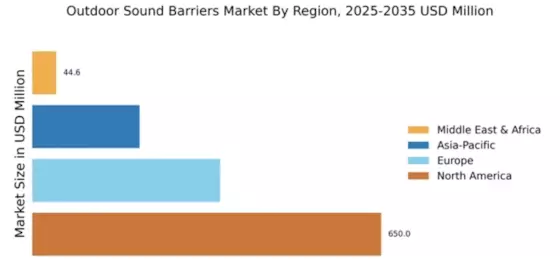
North America is poised to maintain its leadership in the Outdoor Sound Barriers Market, holding a significant market share of $650.0M as of 2024. The region's growth is driven by increasing urbanization, stringent noise regulations, and a rising demand for effective noise mitigation solutions. Government initiatives aimed at enhancing public health and environmental quality further catalyze market expansion. The focus on sustainable materials and innovative technologies is also shaping demand trends, making the region a hub for advancements in sound barrier solutions. The competitive landscape in North America is robust, featuring key players such as Acoustiblok, Sound Barrier Solutions, and Noise Barriers Inc. These companies are leveraging advanced technologies and strategic partnerships to enhance their market presence. The U.S. is the leading country, supported by a strong regulatory framework that encourages noise reduction initiatives. The presence of established manufacturers and a growing emphasis on eco-friendly products are expected to drive further growth in this sector.

Europe : Emerging Market with Regulations

Europe is witnessing a growing demand for outdoor sound barriers, with a market size of $350.0M. The region's growth is fueled by increasing environmental awareness and stringent regulations aimed at reducing noise pollution. Countries are implementing policies that mandate noise control measures in urban planning, which is driving the adoption of sound barriers. The European Union's commitment to sustainability and public health is also a significant catalyst for market growth, encouraging investments in innovative soundproofing technologies. Leading countries in this market include Germany, France, and the UK, where the presence of key players like Trelleborg and Hush City is notable. The competitive landscape is characterized by a mix of established companies and emerging startups focusing on sustainable solutions. The market is expected to grow as governments continue to enforce regulations that promote noise reduction, creating opportunities for innovation and collaboration among industry stakeholders.

Asia-Pacific : Rapid Growth in Emerging Markets

The Asia-Pacific region is experiencing rapid growth in the Outdoor Sound Barriers Market, with a market size of $200.0M. This growth is driven by urbanization, industrialization, and increasing awareness of noise pollution's impact on health. Countries like China and India are investing heavily in infrastructure projects, which necessitate effective noise control solutions. Government initiatives aimed at improving urban living conditions are also contributing to the rising demand for sound barriers, making this region a focal point for market expansion. China is the leading country in this market, supported by a growing number of manufacturers and suppliers. The competitive landscape is evolving, with both local and international players vying for market share. Companies are focusing on innovative materials and technologies to meet the diverse needs of urban environments. As the region continues to develop, the demand for outdoor sound barriers is expected to rise significantly, driven by both regulatory and consumer pressures for noise reduction solutions.

Middle East and Africa : Niche Market with Growth Potential

The Middle East and Africa (MEA) region represents a niche market for outdoor sound barriers, with a market size of $44.58M. The growth in this region is primarily driven by urban development and increasing awareness of noise pollution issues. Governments are beginning to recognize the importance of noise control in urban planning, leading to a gradual increase in demand for sound barriers. The region's unique challenges, such as rapid urbanization and infrastructural development, are creating opportunities for innovative soundproofing solutions. Countries like South Africa and the UAE are at the forefront of this market, with a growing number of projects focusing on noise mitigation. The competitive landscape is characterized by a mix of local and international players, with companies exploring partnerships to enhance their market presence. As awareness of environmental issues grows, the demand for outdoor sound barriers in the MEA region is expected to increase, driven by both regulatory frameworks and market needs.

Key Players and Competitive Insights

The Outdoor Sound Barriers Market is currently characterized by a dynamic competitive landscape, driven by increasing urbanization and heightened awareness of noise pollution. Key players such as Acoustiblok (US), Trelleborg (SE), and Noise Barriers Inc. (US) are actively shaping the market through innovative product offerings and strategic partnerships. Acoustiblok (US) has positioned itself as a leader in soundproofing technology, focusing on the development of high-performance materials that cater to both residential and commercial applications. Trelleborg (SE), on the other hand, emphasizes sustainability in its operations, integrating eco-friendly materials into its sound barrier solutions, which resonates well with the growing demand for environmentally responsible products. Noise Barriers Inc. (US) has adopted a strategy of regional expansion, targeting urban areas with high noise levels, thereby enhancing its market presence and customer base.

The business tactics employed by these companies reflect a concerted effort to optimize supply chains and localize manufacturing processes. The market appears moderately fragmented, with several players vying for market share, yet the influence of major companies is palpable. Their collective strategies not only enhance operational efficiencies but also foster competitive differentiation, allowing them to respond adeptly to market demands.

In November 2025, Acoustiblok (US) announced a partnership with a leading construction firm to integrate its sound barrier solutions into new urban development projects. This collaboration is strategically significant as it positions Acoustiblok (US) at the forefront of urban noise mitigation efforts, potentially increasing its market share in the construction sector. Furthermore, this partnership underscores the importance of aligning product offerings with the needs of urban planners and developers.

In October 2025, Trelleborg (SE) launched a new line of biodegradable sound barriers, marking a pivotal shift towards sustainability in the industry. This initiative not only enhances Trelleborg's (SE) product portfolio but also aligns with global trends favoring eco-friendly solutions. The introduction of biodegradable materials could attract environmentally conscious consumers and set a new standard for competitors in the market.

In September 2025, Noise Barriers Inc. (US) expanded its operations into the European market, establishing a manufacturing facility in Germany. This strategic move is indicative of the company's ambition to tap into the growing demand for sound barriers in Europe, where stringent noise regulations are in place. By localizing production, Noise Barriers Inc. (US) can reduce shipping costs and improve delivery times, thereby enhancing its competitive edge.

As of December 2025, the Outdoor Sound Barriers Market is witnessing trends such as digitalization, sustainability, and the integration of AI technologies. These trends are reshaping competitive dynamics, with companies increasingly forming strategic alliances to leverage shared resources and expertise. The focus appears to be shifting from price-based competition to innovation and reliability in supply chains. As the market evolves, differentiation through advanced technology and sustainable practices will likely become paramount, positioning companies that adapt swiftly to these changes as leaders in the Outdoor Sound Barriers Market.

Key Companies in the Outdoor Sound Barriers Market market include

Industry Developments

April 2021: Noise Barriers, LLC, a leading provider of outdoor sound barrier solutions, announced a collaboration with a prominent construction company to develop and install customized good barrier systems along major highways in a specific region. The partnership aimed to reduce noise and improve residents' overall quality of life near busy roadways.

June 2021: Acoustic Sciences Corporation (ASC), a renowned manufacturer of acoustic products, partnered with an infrastructure development firm to implement sound barrier solutions for a large-scale transportation project. The collaboration focused on creating innovative and effective rugged barrier designs that met the project's specific requirements and contributed to noise mitigation efforts in densely populated areas.

Future Outlook

Outdoor Sound Barriers Market Future Outlook

The Outdoor Sound Barriers Market is projected to grow at a 4.2% CAGR from 2024 to 2035, driven by urbanization, regulatory support, and technological advancements.

New opportunities lie in:

  • Expansion into eco-friendly materials for sound barriers
  • Development of modular sound barrier systems for easy installation
  • Integration of smart technology for real-time noise monitoring

By 2035, the market is expected to achieve robust growth, driven by innovation and sustainability.

Market Segmentation

Outdoor Sound Barriers Market End Use Outlook

  • Residential
  • Commercial
  • Industrial
  • Transportation

Outdoor Sound Barriers Market Application Outlook

  • Noise Reduction
  • Sound Insulation
  • Environmental Protection
  • Aesthetic Enhancement

Outdoor Sound Barriers Market Design Type Outlook

  • Standard
  • Custom
  • Acoustic

Outdoor Sound Barriers Market Material Type Outlook

  • Concrete
  • Wood
  • Plastic
  • Metal

Outdoor Sound Barriers Market Installation Type Outlook

  • Permanent
  • Temporary
  • Modular

Report Scope

MARKET SIZE 20241244.58(USD Million)
MARKET SIZE 20251296.87(USD Million)
MARKET SIZE 20351957.31(USD Million)
COMPOUND ANNUAL GROWTH RATE (CAGR)4.2% (2024 - 2035)
REPORT COVERAGERevenue Forecast, Competitive Landscape, Growth Factors, and Trends
BASE YEAR2024
Market Forecast Period2025 - 2035
Historical Data2019 - 2024
Market Forecast UnitsUSD Million
Key Companies ProfiledAcoustiblok (US), Sound Barrier Solutions (US), Noise Barriers Inc. (US), Auralex Acoustics (US), Trelleborg (SE), Hush City (AU), Ecovative Design (US), Barriers and Soundproofing (US)
Segments CoveredApplication, Material Type, End Use, Installation Type, Design Type
Key Market OpportunitiesIntegration of sustainable materials and smart technology in the Outdoor Sound Barriers Market presents growth opportunities.
Key Market DynamicsRising demand for noise reduction solutions drives innovation and competition in the Outdoor Sound Barriers Market.
Countries CoveredNorth America, Europe, APAC, South America, MEA

Market Highlights

Author
Snehal Singh
Assistant Manager - Research

High acumen in analyzing complex macro & micro markets with more than 6 years of work experience in the field of market research. By implementing her analytical skills in forecasting and estimation into market research reports, she has expertise in Packaging, Construction, and Equipment domains. She handles a team size of 20-25 resources and ensures smooth running of the projects, associated marketing activities, and client servicing.

Leave a Comment

FAQs

How much is the Outdoor Sound Barriers Market?

The Outdoor Sound Barriers market size was valued at USD 1.24 Billion in 2024.

What is the growth rate of the Outdoor Sound Barriers market?

Outdoor Sound Barriers Market is projected to register a CAGR of 4.2% from 2025-2035

Which Region held the largest market share in the Outdoor Sound Barriers market?

North America had the largest share of the Outdoor Sound Barriers Market.

Who are the key players in the Outdoor Sound Barriers market?

The key players in the Outdoor Sound Barriers Market are miller group (US), Armtec Infrastructure (Canada), Hoover Treated Wood Products (US), Dynamic Precast Company (US), Coastal Precast Systems (US), Cretex Companies (US), AcoustiGaurd (Canada), ZAK Acoustic Pvt Ltd (India), Amcon Block & Precast (US), and Evonik Industries (Germany).

Which Material led the Outdoor Sound Barriers market?

The Concrete Outdoor Sound Barriers category dominated the Outdoor Sound Barriers Market in 2024.

Which Application had the largest market share in the Outdoor Sound Barriers market?

Building Construction had the largest share of the Outdoor Sound Barriers Market.

Download Free Sample

Kindly complete the form below to receive a free sample of this Report

Compare Licence

×
Features License Type
Single User Multiuser License Enterprise User
Price $4,950 $5,950 $7,250
Maximum User Access Limit 1 User Upto 10 Users Unrestricted Access Throughout the Organization
Free Customization
Direct Access to Analyst
Deliverable Format
Platform Access
Discount on Next Purchase 10% 15% 15%
Printable Versions