Download Free Sample
Kindly complete the form below to receive a free sample of this Report
Outsourced Logistics Services Market Research Report By Service Type (Transportation Services, Warehousing Services, Freight Forwarding Services, Value-Added Services), By Customer Size (Small Enterprises, Medium Enterprises, Large Enterprises), By Logistics Model (Third-Party Logistics, Fourth-Party Logistics, Integrated Logistics), By End Use Industry (Retail, Manufacturing, Healthcare, Automotive), By Technology Utilization (Automation, Internet Of Things, Artificial Intelligence, Blockchain) And By Region (North America, Europe, Asia-Pacific, And Rest Of The World) – Market Forecast Till 2035.
As per MRFR analysis, the Outsourced Logistics Services Market Size was estimated at 150.0 USD Billion in 2024. The Outsourced Logistics Services industry is projected to grow from 157.13 USD Billion in 2025 to 250.0 USD Billion by 2035, exhibiting a compound annual growth rate (CAGR) of 4.75% during the forecast period 2025 - 2035.
The Outsourced Logistics Services Market is experiencing robust growth driven by technological advancements and evolving consumer demands.
| 2024 Market Size | 150.0 (USD Billion) |
| 2035 Market Size | 250.0 (USD Billion) |
| CAGR (2025 - 2035) | 4.75% |
DHL (DE), FedEx (US), UPS (US), XPO Logistics (US), Kuehne + Nagel (CH), DB Schenker (DE), C.H. Robinson (US), Nippon Express (JP), Geodis (FR), Sinotrans (CN)
Our Impact
Enabled $4.3B Revenue Impact for Fortune 500 and Leading Multinationals
Partnering with 2000+ Global Organizations Each Year
30K+ Citations by Top-Tier Firms in the Industry
The Outsourced Logistics Services Market is currently experiencing a transformative phase, driven by evolving consumer expectations and technological advancements. Companies are increasingly recognizing the value of outsourcing logistics functions to enhance operational efficiency and focus on core competencies. This shift appears to be influenced by the growing complexity of supply chains, which necessitates specialized expertise in logistics management. As businesses seek to optimize their distribution networks, the demand for outsourced services is likely to expand, fostering innovation and collaboration among service providers. Moreover, sustainability considerations are becoming integral to logistics strategies. Organizations are increasingly prioritizing eco-friendly practices, which may lead to the adoption of green logistics solutions. This trend suggests a potential shift towards more sustainable transportation methods and waste reduction initiatives. As the Outsourced Logistics Services Market evolves, it seems poised to adapt to these changing dynamics, offering solutions that align with both operational goals and environmental responsibilities.
The integration of advanced technologies such as artificial intelligence and automation is reshaping the Outsourced Logistics Services Market. These innovations enhance efficiency, reduce operational costs, and improve service delivery. Companies are leveraging data analytics to optimize routes and manage inventory more effectively, indicating a trend towards smarter logistics solutions.
Sustainability is emerging as a critical focus within the Outsourced Logistics Services Market. Organizations are increasingly adopting eco-friendly practices, such as utilizing alternative fuels and optimizing packaging. This trend reflects a broader commitment to reducing carbon footprints and enhancing corporate social responsibility.
There is a growing demand for tailored logistics solutions in the Outsourced Logistics Services Market. Businesses are seeking providers that can offer customized services to meet specific needs, such as specialized handling or unique delivery requirements. This trend highlights the importance of flexibility and responsiveness in logistics partnerships.
Cost efficiency remains a crucial driver for the Outsourced Logistics Services Market. Companies are increasingly recognizing the financial benefits of outsourcing logistics functions rather than managing them in-house. By leveraging the expertise of third-party providers, businesses can reduce operational costs, optimize resource allocation, and focus on core competencies. In 2025, it is estimated that companies can save up to 20% on logistics costs by outsourcing. This trend is particularly evident in industries with tight margins, where every dollar counts. The Outsourced Logistics Services Market thus thrives as organizations seek to enhance profitability while maintaining service quality. Furthermore, the competitive landscape encourages logistics providers to innovate and offer cost-effective solutions, further driving market growth.
The rise of e-commerce has been a pivotal driver for the Outsourced Logistics Services Market. As online shopping continues to expand, businesses increasingly rely on third-party logistics providers to manage their supply chains efficiently. In 2025, e-commerce sales are projected to reach approximately 6 trillion USD, necessitating robust logistics solutions. This trend compels companies to outsource logistics to enhance delivery speed and customer satisfaction. The Outsourced Logistics Services Market is thus experiencing heightened demand as retailers seek to streamline operations and reduce costs associated with warehousing and transportation. The integration of advanced technologies in logistics further supports this growth, allowing for real-time tracking and improved inventory management.
Consumer expectations are evolving rapidly, driving changes in the Outsourced Logistics Services Market. Today's consumers demand faster delivery times, greater transparency, and enhanced service quality. In 2025, studies indicate that 80% of consumers prioritize delivery speed when making online purchases, compelling retailers to invest in efficient logistics solutions. This shift in consumer behavior encourages businesses to partner with third-party logistics providers that can meet these heightened expectations. The Outsourced Logistics Services Market is thus positioned to grow as companies seek to enhance their logistics capabilities and improve customer satisfaction. Furthermore, the emphasis on sustainability and ethical practices is influencing consumer choices, prompting logistics providers to adopt greener practices to align with consumer values.
The evolving dynamics of The Outsourced Logistics Services Industry. As trade agreements and tariffs fluctuate, companies are compelled to adapt their logistics strategies to navigate these complexities. In 2025, the value of international trade is projected to exceed 25 trillion USD, creating opportunities for logistics providers to offer tailored solutions that address specific regional challenges. The Outsourced Logistics Services Market benefits from this trend as businesses seek to optimize their supply chains and mitigate risks associated with global sourcing. Additionally, the rise of emerging markets presents new avenues for growth, prompting logistics companies to expand their services and capabilities to meet diverse customer needs.
Technological advancements are transforming the Outsourced Logistics Services Market, enabling providers to offer more efficient and effective solutions. Innovations such as artificial intelligence, machine learning, and automation are streamlining logistics operations, enhancing accuracy, and reducing lead times. In 2025, the adoption of these technologies is expected to increase significantly, with logistics companies investing heavily in digital transformation. This shift allows for improved data analytics, predictive modeling, and enhanced customer service capabilities. As businesses seek to remain competitive, the demand for technologically advanced logistics solutions is likely to surge, propelling the growth of the Outsourced Logistics Services Market. The integration of technology not only improves operational efficiency but also enhances the overall customer experience.
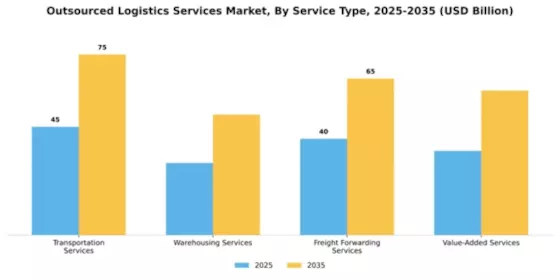
The Outsourced Logistics Services Market is primarily characterized by its diverse service types, with Transportation Services currently holding the largest market share. This segment encompasses various transportation modes, including road, rail, air, and sea, essential for efficient goods movement. Following closely, Warehousing Services offers critical storage solutions that support the broader logistics framework, while Freight Forwarding Services emerges as a key player thanks to the globalization of trade, enabling seamless international shipping processes. Overall, these segments represent a balanced distribution of market share, catering to varied logistics needs across different industries. In terms of growth trends, Freight Forwarding Services is gaining rapid momentum, driven by increasing e-commerce activities and the need for rapid delivery solutions. The rise in international trade regulations and the demand for integrated logistics solutions further accentuate this trend. Additionally, Value-Added Services, including packaging, labeling, and customs clearance, are becoming increasingly crucial as companies seek differentiation in service offerings. As technology continues to evolve, these segments are expected to witness significant growth, adapting to changing consumer demands and market conditions.
Transportation Services (Dominant) vs. Value-Added Services (Emerging)
Transportation Services dominate the Outsourced Logistics Services Market by providing essential logistics solutions that facilitate the movement of goods across various channels. This segment is critical for connecting manufacturers with consumers, ensuring timely deliveries. It encompasses a broad range of services, from trucking to air freight, thus providing flexibility and scalability for businesses. On the other hand, Value-Added Services represent an emerging trend within this market, focusing on providing additional capabilities beyond standard logistics offerings. These services cater to specific customer requirements, such as customs brokerage, returns management, and inventory handling, making them increasingly vital for businesses seeking to enhance their logistics operations. As competition intensifies, companies are increasingly integrating these value-added offerings into their logistics strategies, driving innovation and efficiency.
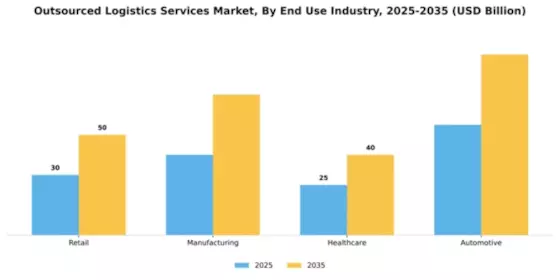
The outsourced logistics services market showcases a diverse distribution among its end use industries, with retail taking the lead as the largest segment. This dominance can be attributed to the increasing demand for efficient supply chain management and the growing trend of e-commerce, which necessitates robust logistics support. Healthcare follows closely as a significant sector, reflecting the need for specialized logistics services that cater to the unique requirements of medical and pharmaceutical products, ensuring timely and safe delivery.
Healthcare (Emerging) vs. Automotive (Dominant)
In the context of outsourced logistics services, the healthcare sector is emerging strongly, driven by the need for precision in the transport of medical supplies and pharmaceuticals. This segment is characterized by compliance with strict regulations, necessitating providers who can ensure temperature control and timely deliveries. Conversely, the automotive industry is considered a dominant player in logistics services, given its established supply chains and the critical nature of timely parts delivery. This segment relies heavily on just-in-time logistics to enhance production efficiency, leading to a well-optimized and responsive logistics operation.
In the Outsourced Logistics Services Market, Third-Party Logistics (3PL) holds the largest market share, benefiting from established operations and a wide range of services that include warehousing, distribution, and transportation. This segment continues to dominate due to its ability to provide cost-effective solutions for companies seeking efficiency in their supply chain management. Meanwhile, Fourth-Party Logistics (4PL) is gaining traction as businesses look for integrated solutions that go beyond traditional logistics. With a focus on supply chain optimization, 4PL is rapidly capturing the interest of organizations aiming for extensive logistics management.
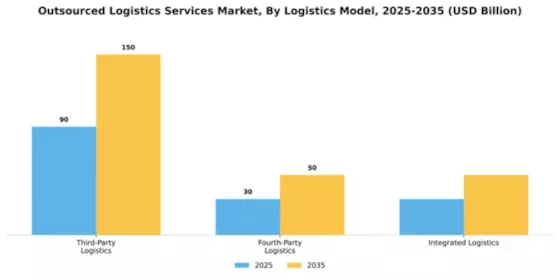
Third-Party Logistics: Dominant vs. Fourth-Party Logistics: Emerging
Third-Party Logistics (3PL) is marked by its comprehensive service offerings, including freight forwarding, warehousing, and transportation management, which cater to a wide array of industries. Firms leveraging 3PL services benefit from reduced operational costs and enhanced flexibility, making it the dominant force in the logistics model segment. On the other hand, Fourth-Party Logistics (4PL) is an emerging segment characterized by its advanced integration of technology and management services. 4PL providers often integrate multiple supply chain functions, bringing in innovative solutions that help businesses manage their logistics needs holistically. As organizations seek more streamlined operations, 4PL is positioned for significant growth, driven by the demand for sophisticated logistics strategies.
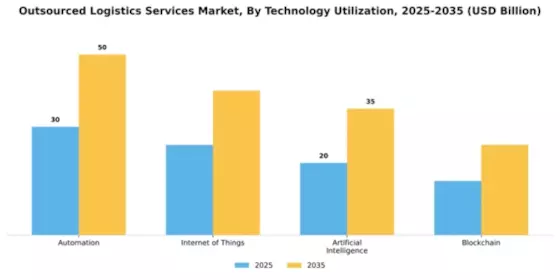
In the Outsourced Logistics Services Market, Automation leads the segment with significant market share, driving efficiency and reducing operational costs for logistics providers. It has become an essential element for streamlining processes and improving service delivery, allowing companies to maximize output while minimizing human error. Meanwhile, Artificial Intelligence, although smaller by share, is rapidly gaining traction as logistics companies increasingly rely on predictive analytics and machine learning to enhance decision-making and optimize supply chain operations. The growth of these technologies is driven by the need for enhanced efficiency and accuracy in logistics operations. With the rapid adoption of digital solutions and the demand for real-time data, Automation continues to dominate. In contrast, Artificial Intelligence is recognized as the fastest-growing segment, propelled by advancements in data processing capabilities and the urgent need for businesses to adapt to changing consumer behaviors and expectations. Companies are investing in AI to automate complex tasks and drive innovation in their logistics practices.
Automation (Dominant) vs. Blockchain (Emerging)
Automation has established itself as the dominant technology in the Outsourced Logistics Services Market by enhancing process efficiencies and transforming the way logistics operations are managed. By minimizing human intervention, it streamlines workflows, reduces errors, and improves overall service delivery. Key players are investing in automated systems to increase capacity without the proportional increase in cost. Conversely, Blockchain represents an emerging technology with the potential to revolutionize the industry by providing secure, transparent, and immutable transaction records. Although still in the early stages, its ability to enhance traceability and trust within supply chains positions it as a critical tool for future logistics strategies. The synergy between Automation and Blockchain could define a new era of efficiency and security in logistics.
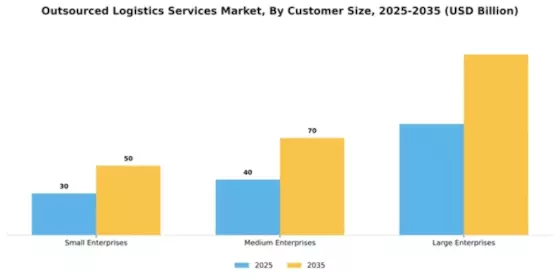
In the Outsourced Logistics Services Market, customer size plays a pivotal role in shaping market dynamics. Large enterprises continue to hold the largest share, as they leverage extensive supply chains and complex logistics needs, ensuring a steady demand for outsourced services. Small enterprises, conversely, represent a rapidly growing segment, driven by their need for cost-effective and flexible supply chain solutions that allow them to compete in a broader marketplace. The growth trends in this segment highlight the increasing reliance of small enterprises on outsourced logistics services for scalability and efficiency. The current market environment encourages small businesses to adapt to technological advancements and e-commerce growth, thereby supporting their rapid expansion. Additionally, large enterprises are focusing on optimizing their logistics networks, further reinforcing the differentiation in growth dynamics between these customer sizes.
Large Enterprises: Dominant vs. Small Enterprises: Emerging
Large enterprises dominate the Outsourced Logistics Services Market due to their established relationships with logistics providers and significant volume of shipments, necessitating comprehensive logistics solutions. These companies often prioritize reliability and integration with their extensive networks, driving them to adopt advanced logistics technologies and automated processes. In contrast, small enterprises are emerging as a vital segment, seeking affordable logistics options to enhance their operational flexibility. They typically prefer services that provide an ability to scale quickly, enabling them to respond to market fluctuations efficiently. As e-commerce continues to expand, small businesses are increasingly recognizing the importance of responsive logistics, creating a crucial shift towards outsourcing to specialized providers.
Get more detailed insights about Outsourced Logistics Services Market Request Free Sample
North America dominates the outsourced logistics services market, holding a significant 60.0% share as of 2024. The region's growth is driven by increasing e-commerce activities, technological advancements, and a robust supply chain infrastructure. Regulatory support for trade and logistics further enhances market dynamics, fostering innovation and efficiency in service delivery. The demand for integrated logistics solutions is on the rise, reflecting a shift towards more streamlined operations. The competitive landscape in North America is characterized by major players such as FedEx, UPS, and DHL, which are continuously innovating to meet customer demands. The U.S. leads the market, supported by a strong economy and advanced logistics networks. Companies are investing in automation and digital solutions to enhance service offerings, ensuring they remain competitive in a rapidly evolving market. The presence of key players ensures a diverse range of services, catering to various industries and customer needs.
Europe's outsourced logistics services market is robust, accounting for 40.0% of the global share. The region benefits from a well-established infrastructure, regulatory frameworks promoting trade, and a growing demand for sustainable logistics solutions. The rise of e-commerce and cross-border trade is driving the need for efficient logistics services, prompting companies to adopt innovative technologies and practices to enhance operational efficiency. Leading countries in Europe include Germany, France, and the UK, where major players like DHL and DB Schenker are prominent. The competitive landscape is marked by a mix of global and regional players, each striving to capture market share through strategic partnerships and technological advancements. The European market is also witnessing a shift towards green logistics, with companies increasingly focusing on sustainability to meet regulatory requirements and consumer expectations.
The Asia-Pacific region is witnessing significant growth in outsourced logistics services, holding a 35.0% market share. This growth is fueled by increasing urbanization, rising consumer demand, and the expansion of e-commerce platforms. Governments in the region are also implementing favorable policies to enhance logistics infrastructure, which is crucial for supporting trade and economic development. The demand for efficient supply chain solutions is driving innovation and investment in logistics technologies. Countries like China, Japan, and India are leading the charge in this dynamic market. Key players such as Nippon Express and Sinotrans are expanding their operations to meet the growing demand. The competitive landscape is characterized by a mix of local and international firms, all vying for market share. As the region continues to develop, the focus on technology and sustainability will play a pivotal role in shaping the future of logistics services.
The Middle East and Africa region represents a growing market for outsourced logistics services, with a 15.0% share. The region's growth is driven by increasing trade activities, investments in infrastructure, and a rising demand for efficient logistics solutions. Governments are prioritizing logistics as a key sector for economic diversification, leading to enhanced regulatory frameworks and support for logistics companies. The demand for integrated logistics services is on the rise, reflecting the region's evolving economic landscape. Leading countries in this region include the UAE and South Africa, where logistics companies are expanding their capabilities to cater to growing market needs. The competitive landscape features both local and international players, with companies focusing on innovation and service diversification. As the region continues to develop, the emphasis on technology and sustainability will be crucial for capturing growth opportunities in the logistics sector.
The Outsourced Logistics Services Market is currently characterized by a dynamic competitive landscape, driven by factors such as globalization, e-commerce growth, and technological advancements. Major players like DHL (DE), FedEx (US), and UPS (US) are strategically positioned to leverage these trends. DHL (DE) focuses on sustainability and digital transformation, aiming to reduce carbon emissions while enhancing operational efficiency. FedEx (US) emphasizes innovation through technology integration, particularly in automation and data analytics, to streamline logistics processes. UPS (US) is enhancing its service offerings through strategic partnerships and regional expansions, thereby solidifying its market presence. Collectively, these strategies contribute to a competitive environment that is increasingly focused on efficiency, sustainability, and technological integration.Key business tactics within the market include localizing manufacturing and optimizing supply chains to enhance responsiveness to customer demands. The competitive structure appears moderately fragmented, with several key players exerting significant influence. This fragmentation allows for a diverse range of service offerings, catering to various customer needs while fostering competition that drives innovation and service quality.In November DHL (DE) announced a partnership with a leading technology firm to develop AI-driven logistics solutions aimed at improving delivery efficiency. This strategic move is likely to enhance DHL's operational capabilities, allowing for more precise demand forecasting and inventory management, which could lead to reduced operational costs and improved customer satisfaction.In October FedEx (US) unveiled its new automated sorting facility in Memphis, which is expected to increase sorting capacity by 30%. This facility represents a significant investment in automation technology, positioning FedEx to better handle the growing volume of e-commerce shipments and improve delivery times, thereby enhancing its competitive edge in the market.In September UPS (US) expanded its partnership with a major e-commerce platform to offer integrated logistics solutions tailored for small and medium-sized enterprises. This initiative not only broadens UPS's customer base but also aligns with the growing trend of e-commerce, allowing UPS to capture a larger share of the market by providing customized solutions that meet the specific needs of these businesses.As of December current competitive trends in the Outsourced Logistics Services Market are heavily influenced by digitalization, sustainability initiatives, and the integration of AI technologies. Strategic alliances are increasingly shaping the landscape, enabling companies to pool resources and expertise to enhance service offerings. Looking ahead, competitive differentiation is likely to evolve from traditional price-based competition to a focus on innovation, technology adoption, and supply chain reliability, as companies strive to meet the ever-changing demands of the market.



The Outsourced Logistics Services Market is projected to grow at a 4.75% CAGR from 2025 to 2035, driven by technological advancements, increasing e-commerce demand, and globalization.
New opportunities lie in:
By 2035, the market is expected to be robust, reflecting substantial growth and innovation.
| MARKET SIZE 2024 | 150.0(USD Billion) |
| MARKET SIZE 2025 | 157.13(USD Billion) |
| MARKET SIZE 2035 | 250.0(USD Billion) |
| COMPOUND ANNUAL GROWTH RATE (CAGR) | 4.75% (2025 - 2035) |
| REPORT COVERAGE | Revenue Forecast, Competitive Landscape, Growth Factors, and Trends |
| BASE YEAR | 2024 |
| Market Forecast Period | 2025 - 2035 |
| Historical Data | 2019 - 2024 |
| Market Forecast Units | USD Billion |
| Key Companies Profiled | DHL (DE), FedEx (US), UPS (US), XPO Logistics (US), Kuehne + Nagel (CH), DB Schenker (DE), C.H. Robinson (US), Nippon Express (JP), Geodis (FR), Sinotrans (CN) |
| Segments Covered | Service Type, End Use Industry, Logistics Model, Technology Utilization, Customer Size |
| Key Market Opportunities | Integration of advanced technologies enhances efficiency in the Outsourced Logistics Services Market. |
| Key Market Dynamics | Rising demand for efficient supply chain solutions drives growth in outsourced logistics services amid technological advancements. |
| Countries Covered | North America, Europe, APAC, South America, MEA |
The projected market valuation for the Outsourced Logistics Services Market in 2035 is 250.0 USD Billion.
The market valuation of the Outsourced Logistics Services Market in 2024 was 150.0 USD Billion.
The expected CAGR for the Outsourced Logistics Services Market during the forecast period 2025 - 2035 is 4.75%.
Key players in the Outsourced Logistics Services Market include DHL, FedEx, UPS, XPO Logistics, and Kuehne + Nagel.
Main service types include Transportation Services valued at 75.0 USD Billion, Warehousing Services at 50.0 USD Billion, and Freight Forwarding Services at 65.0 USD Billion.
The Automotive sector is projected to reach a valuation of 90.0 USD Billion by 2035.
The valuation range for Third-Party Logistics is between 90.0 and 150.0 USD Billion.
Technologies such as Automation, Internet of Things, and Artificial Intelligence are projected to have valuations ranging from 20.0 to 50.0 USD Billion.
The market size for Large Enterprises is expected to range from 80.0 to 130.0 USD Billion.
The Manufacturing sector is expected to have the highest valuation, projected to reach between 40.0 and 70.0 USD Billion.


Kindly complete the form below to receive a free sample of this Report

“This is really good guys. Excellent work on a tight deadline. I will continue to use you going forward and recommend you to others. Nice job”


“Thanks. It’s been a pleasure working with you, please use me as reference with any other Intel employees.”


“Thanks for sending the report it gives us a good global view of the Betaïne market.”


“Thank you, this will be very helpful for OQS.”


“We found the report very insightful! we found your research firm very helpful. I'm sending this email to secure our future business.”


“I am very pleased with how market segments have been defined in a relevant way for my purposes (such as "Portable Freezers & refrigerators" and "last-mile"). In general the report is well structured. Thanks very much for your efforts.”


“I have been reading the first document or the study, ,the Global HVAC and FP market report 2021 till 2026. Must say, good info! I have not gone in depth at all parts, but got a good indication of the data inside!”


“We got the report in time, we really thank you for your support in this process. I also thank to all of your team as they did a great job.”


“The Automotive 48V ECU Components Procurement Intelligence Study” was a complex project, but the Market Research Future (MRFR) team handled it with quality, agility, and customer-centricity. They delivered all requested data on time and within the agreed scope. The team, including Shubhendra Anand and Rahul Gotadki, was always readily available to clarify questions and swiftly implement necessary adjustments, driving the project to a successful conclusion within a very demanding timeframe.
I would also like to specifically commend Akshay Agarwal for his responsiveness and support at every stage—from our initial inquiry on May 6th through to final delivery on June 18th. His dedication made the entire process seamless.”



