×
Request Free Sample ×

Kindly complete the form below to receive a free sample of this Report

Leading companies partner with us for data-driven Insights

clients tt-cursor
Hero Background

Oviposition Deterring Pheromone Market

ID: MRFR/CnM/35918-HCR
100 Pages
Chitranshi Jaiswal
October 2025

Oviposition Deterring Pheromone Market Research Report By Application (Agriculture, Horticulture, Forestry, Public Health), By Formulation Type (Liquid, Gel, Solid, Emulsifiable Concentrates), By End Use (Crop Protection, Pest Control, Fisheries Management, Livestock Protection), By Distribution Channel (Online Retail, Offline Retail, Direct Sales) and By Regional (North America, Europe, South America, Asia-Pacific, Middle East and Africa) - Forecast to 2035

Share:
Download PDF ×

We do not share your information with anyone. However, we may send you emails based on your report interest from time to time. You may contact us at any time to opt-out.

Oviposition Deterring Pheromone Market  Infographic
Purchase Options

Oviposition Deterring Pheromone Market Summary

As per MRFR analysis, the Oviposition Deterring Pheromone Market Size was estimated at 1.261 USD Billion in 2024. The Oviposition Deterring Pheromone industry is projected to grow from 1.391 in 2025 to 3.705 by 2035, exhibiting a compound annual growth rate (CAGR) of 10.29 during the forecast period 2025 - 2035.

Key Market Trends & Highlights

The Oviposition Deterring Pheromone Market is poised for growth driven by sustainability and technological advancements.

  • The market experiences rising demand for sustainable solutions, particularly in North America, which remains the largest market.
  • Technological advancements in pheromone applications are enhancing efficacy and adoption across various agricultural practices.
  • Integration with pest management strategies is becoming increasingly prevalent, especially in the agriculture segment, which is the largest.
  • Key market drivers include increasing awareness of environmental impact and rising agricultural productivity needs, particularly in the Asia-Pacific region.

Market Size & Forecast

2024 Market Size 1.261 (USD Billion)
2035 Market Size 3.705 (USD Billion)
CAGR (2025 - 2035) 10.29%

Major Players

Koppert Biological Systems (NL), Syngenta AG (CH), BASF SE (DE), FMC Corporation (US), Certis USA LLC (US), Biobest Group NV (BE), AgBiTech Pty Ltd (AU), Suterra LLC (US), Pheromone Sciences (US)

Oviposition Deterring Pheromone Market Trends

The Oviposition Deterring Pheromone Market is currently experiencing notable growth, driven by increasing awareness of sustainable agricultural practices and the need for effective pest management solutions. As farmers and agricultural stakeholders seek alternatives to chemical pesticides, the demand for natural and environmentally friendly options is on the rise. This market appears to be influenced by a growing emphasis on integrated pest management strategies, which prioritize the use of biological control methods. Consequently, the adoption of oviposition deterring pheromones is likely to expand, as they offer a viable solution for reducing pest populations while minimizing ecological impact. Moreover, advancements in research and development are contributing to the evolution of the Oviposition Deterring Pheromone Market. Innovations in pheromone synthesis and application techniques are enhancing the effectiveness of these products, making them more appealing to end-users. The potential for these pheromones to be utilized in various crops and settings suggests a broadening of their application scope. As the agricultural sector continues to evolve, the Oviposition Deterring Pheromone Market is poised to play a crucial role in promoting sustainable practices and ensuring food security in the future.

Rising Demand for Sustainable Solutions

The Oviposition Deterring Pheromone Market is witnessing an increasing preference for sustainable agricultural practices. Stakeholders are actively seeking alternatives to traditional chemical pesticides, leading to a heightened interest in natural pest management solutions.

Technological Advancements in Pheromone Applications

Innovations in the synthesis and application of oviposition deterring pheromones are enhancing their effectiveness. These advancements are likely to attract more users, as they provide improved pest control options across various agricultural settings.

Integration with Pest Management Strategies

The integration of oviposition deterring pheromones into broader pest management strategies is becoming more common. This trend indicates a shift towards holistic approaches that combine biological control methods with traditional practices.

Oviposition Deterring Pheromone Market Drivers

Regulatory Support for Biopesticides

The Oviposition Deterring Pheromone Market benefits from increasing regulatory support for biopesticides. Governments worldwide are recognizing the need to reduce reliance on chemical pesticides due to their environmental and health impacts. This regulatory shift encourages the development and commercialization of biopesticides, including oviposition deterring pheromones. Recent policy changes have streamlined the approval process for biopesticide products, making it easier for manufacturers to bring their innovations to market. As a result, the Oviposition Deterring Pheromone Market is likely to see accelerated growth, with projections indicating a potential market size increase of 25% by 2027. This supportive regulatory environment fosters a favorable landscape for the adoption of pheromone-based solutions in pest management.

Rising Agricultural Productivity Needs

The Oviposition Deterring Pheromone Market is significantly influenced by the increasing demand for agricultural productivity. As the global population continues to rise, the pressure on farmers to produce more food efficiently intensifies. Pheromones serve as a crucial tool in integrated pest management, helping to protect crops from pests without the adverse effects associated with chemical pesticides. The market data indicates that the adoption of oviposition deterring pheromones can lead to yield increases of up to 20% in certain crops. This potential for enhanced productivity is likely to drive investments in pheromone technologies, thereby expanding the Oviposition Deterring Pheromone Market. Farmers are increasingly recognizing the value of these solutions in achieving sustainable agricultural practices while meeting the growing food demand.

Integration with Organic Farming Practices

The Oviposition Deterring Pheromone Market is increasingly aligned with the growth of organic farming practices. As consumers demand organic produce, farmers are seeking pest control methods that comply with organic standards. Pheromones, being naturally derived, fit well within these parameters, offering a viable alternative to synthetic pesticides. The organic farming sector has been expanding at a rate of approximately 10% annually, which bodes well for the Oviposition Deterring Pheromone Market. This integration not only supports the growth of organic agriculture but also enhances the market's appeal to environmentally conscious consumers. The synergy between organic farming and pheromone use is likely to foster further innovation and investment in this sector.

Increasing Awareness of Environmental Impact

The Oviposition Deterring Pheromone Market is experiencing a surge in demand as consumers and agricultural stakeholders become increasingly aware of the environmental consequences of traditional pest control methods. This heightened awareness drives the adoption of pheromone-based solutions, which are perceived as more sustainable and less harmful to non-target species. As regulatory bodies impose stricter guidelines on chemical pesticides, the market for oviposition deterring pheromones is likely to expand. In 2025, the market is projected to grow at a compound annual growth rate (CAGR) of approximately 8%, reflecting a shift towards eco-friendly agricultural practices. This trend suggests that the Oviposition Deterring Pheromone Market will continue to thrive as more stakeholders prioritize sustainability in their pest management strategies.

Technological Innovations in Pheromone Delivery Systems

The Oviposition Deterring Pheromone Market is poised for growth due to ongoing technological innovations in pheromone delivery systems. Advances in formulation and application techniques enhance the effectiveness and longevity of pheromone products, making them more appealing to farmers. For instance, the development of slow-release formulations allows for prolonged pest control, reducing the frequency of applications. Market analysis suggests that these innovations could lead to a 15% increase in market penetration by 2026. As farmers seek more efficient and effective pest management solutions, the Oviposition Deterring Pheromone Market stands to benefit from these technological advancements, which may also lower overall costs associated with pest control.
Market Segment Insights

By Application: Agriculture (Largest) vs. Horticulture (Fastest-Growing)

In the Oviposition Deterring Pheromone Market, Agriculture holds the largest share, driven by the increasing demand for sustainable practices to protect crops from pests. This segment predominantly utilizes pheromones to deter oviposition, contributing significantly to crop protection and yields. Horticulture, on the other hand, is emerging rapidly as a key segment, leveraging pheromones to safeguard ornamental plants and enhance fruit production. This dual approach is vital as growers seek environmentally friendly solutions to pest management. The growth trends in these segments indicate a shift towards more eco-conscious agricultural practices. Agriculture continues to expand, supported by government initiatives promoting sustainable agricultural methods. Meanwhile, Horticulture is developing swiftly due to rising consumer demand for organic and aesthetically pleasing plants, driving innovation in pheromone-based solutions. The intersection of these needs fosters a fertile ground for market expansion and investment in research and development to enhance product efficacy.

Agriculture: Dominant vs. Horticulture: Emerging

The Agriculture segment of the Oviposition Deterring Pheromone Market is characterized by widespread adoption among farmers who prioritize sustainable pest and crop management strategies. This segment's dominance stems from the significant need for effective pest control in large-scale agricultural production where crop yield is paramount. It encompasses various applications, including row crops and field crops, ensuring the availability of safe food products. Conversely, Horticulture represents an emerging sector fueled by the growing trend toward organic gardening and landscaping. This segment is marked by its focus on ornamental plants, fruits, and vegetables, appealing to environmentally conscious consumers. Horticultural applications are increasingly characterized by innovative pheromone products tailored for specific pest challenges, allowing for precision targeting and reduced environmental impact.

By Formulation Type: Liquid (Largest) vs. Gel (Fastest-Growing)

In the Oviposition Deterring Pheromone Market, the formulation types exhibit varying market share distributions. The liquid formulation type leads the segment, accounting for a significant proportion of market share due to its versatility and ease of application. Gel formulations are emerging rapidly in popularity, capturing attention for their unique benefits in controlled application scenarios. These market dynamics create opportunities for growth and innovation in the industry as companies strive to meet diverse consumer needs.

Liquid (Dominant) vs. Gel (Emerging)

The liquid formulation remains the dominant player in the Oviposition Deterring Pheromone Market, favored for its ease of use and effective delivery mechanism. It is ideal for widespread application in various agricultural settings, keeping pests at bay efficiently. Meanwhile, gel formulations are emerging, offering enhanced control and longer-lasting effects. Their increasing adoption is fueled by a growing demand for targeted applications and reduced environmental impact. These formulations represent a shift in consumer preferences towards more sustainable and efficient pest management solutions, positioning them well for future growth.

By End Use: Crop Protection (Largest) vs. Pest Control (Fastest-Growing)

The Oviposition Deterring Pheromone Market displays a diverse landscape of end use applications, with crop protection taking the lead as the largest segment. This sector harnesses the power of pheromones to create a sustainable solution for mitigating crop loss due to pest infestation, thereby ensuring food security and improving agricultural yields. Conversely, pest control is capturing attention as the fastest-growing segment, driven by an increasing demand for integrated pest management solutions that are both environmentally friendly and effective, assisting farmers and pest control professionals alike. As the market evolves, the growth trends for these segments are shaped by rising awareness of sustainable practices and regulatory support geared towards minimizing chemical pesticide usage. The demand for crop protection is sustained by ongoing agricultural innovations and the necessity for resilient farming practices, while the burgeoning pest control segment is witnessing robust advancements in detection technologies and formulation strategies, appealing to a broader base of users seeking efficient pest management alternatives.

Crop Protection (Dominant) vs. Fisheries Management (Emerging)

Crop protection remains a dominant force in the Oviposition Deterring Pheromone Market due to its extensive application in safeguarding agricultural produce. This segment capitalizes on the urgent need for sustainable practices, utilizing natural pheromones to deter pests without the harmful side effects of synthetic chemicals. In parallel, fisheries management is emerging as a significant segment, focusing on the balance of aquatic ecosystems. As the awareness about the ecological impact of overfishing grows, fisheries management is progressively integrating pheromone applications to enhance fish breeding and mitigate pest issues, positioning itself as a key player in conservation efforts.

By Distribution Channel: Online Retail (Largest) vs. Offline Retail (Fastest-Growing)

In the Oviposition Deterring Pheromone Market, the distribution channel is critical for reaching potential customers. Online Retail commands the largest share due to its accessibility and convenience for consumers seeking pest control solutions. This channel has gained substantial traction as more users turn to e-commerce for purchasing specialized products. Conversely, Offline Retail is emerging as the fastest-growing segment, with an increasing number of consumers preferring to see and purchase products in physical stores, driven by the immediate accessibility of solutions. Growth trends in this segment suggest a convergence between online and offline channels. Online Retail continues to thrive, bolstered by effective digital marketing strategies and targeted promotions. However, the Offline Retail segment is also experiencing a resurgence, driven by a renewed interest in local shopping experiences and the ability to consult knowledgeable staff. Brands that recognize and adapt to these evolving preferences are likely to capture a larger market share in the upcoming years.

Online Retail (Dominant) vs. Direct Sales (Emerging)

Online Retail in the Oviposition Deterring Pheromone Market stands out as the dominant segment, characterized by its extensive reach and the convenience it provides to consumers. This channel allows for a wide variety of products to be displayed and easily accessed, fostering a growing community of online shoppers who prioritize convenience. Brands benefit from utilizing e-commerce platforms and targeted advertisements to drive sales. In contrast, Direct Sales is recognized as an emerging segment, focusing on personalized customer interactions and direct engagement strategies. This approach may involve representatives or experts in pest control directly communicating with consumers. While it currently holds a smaller market presence, the potential for growth is significant, as consumers increasingly seek tailored solutions and advice to combat pest issues.

Get more detailed insights about Oviposition Deterring Pheromone Market

Regional Insights

North America : Innovation and Sustainability Focus

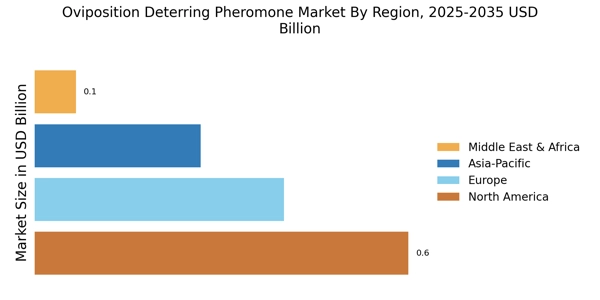
North America is the largest market for oviposition deterring pheromones, holding approximately 45% of the global market share. The region's growth is driven by increasing demand for sustainable agricultural practices and stringent regulations promoting eco-friendly pest control solutions. The U.S. and Canada are the primary contributors, with a growing emphasis on integrated pest management (IPM) strategies that utilize pheromones to reduce chemical pesticide use. The competitive landscape in North America is characterized by the presence of key players such as Syngenta AG, BASF SE, and FMC Corporation. These companies are actively investing in research and development to enhance product efficacy and expand their market reach. The collaboration between agricultural stakeholders and regulatory bodies further supports innovation in pheromone technology, ensuring compliance with environmental standards.

Europe : Regulatory-Driven Market Growth

Europe is the second-largest market for oviposition deterring pheromones, accounting for approximately 30% of the global market share. The region's growth is significantly influenced by the European Union's stringent regulations on pesticide use, which encourage the adoption of biological pest control methods. Countries like Germany and France are leading the charge, with increasing investments in sustainable agriculture and pest management solutions that align with the EU's Green Deal objectives. The competitive landscape in Europe features key players such as BASF SE and Koppert Biological Systems, who are at the forefront of developing innovative pheromone products. The presence of strong regulatory frameworks fosters collaboration between industry and research institutions, driving advancements in pheromone technology. This synergy is crucial for meeting the growing demand for environmentally friendly agricultural practices across the continent.

Asia-Pacific : Emerging Market Potential

Asia-Pacific is witnessing rapid growth in the oviposition deterring pheromone market, holding approximately 20% of the global market share. The region's agricultural sector is expanding due to increasing population demands and the need for sustainable farming practices. Countries like China and India are leading this growth, driven by government initiatives promoting organic farming and integrated pest management strategies that utilize pheromones to enhance crop yields while minimizing chemical inputs. The competitive landscape in Asia-Pacific is evolving, with both local and international players entering the market. Companies such as AgBiTech Pty Ltd and Suterra LLC are establishing a presence, focusing on innovative solutions tailored to regional agricultural needs. The collaboration between governments and agricultural stakeholders is crucial for fostering awareness and adoption of pheromone technologies, ensuring a sustainable future for the region's agriculture.

Middle East and Africa : Resource-Rich Agricultural Landscape

The Middle East and Africa region is gradually emerging in the oviposition deterring pheromone market, accounting for approximately 5% of the global market share. The growth is driven by increasing agricultural activities and a rising awareness of sustainable pest management practices. Countries like South Africa and Kenya are at the forefront, with initiatives aimed at improving agricultural productivity through eco-friendly solutions, including pheromones that deter pests without harming beneficial insects. The competitive landscape in this region is characterized by a mix of local and international players, with companies exploring partnerships to enhance their market presence. The focus on sustainable agriculture is gaining traction, supported by government policies that encourage the adoption of biological pest control methods. This shift is crucial for addressing food security challenges while promoting environmental sustainability in the region.

Oviposition Deterring Pheromone Market  Regional Image

Key Players and Competitive Insights

The Oviposition Deterring Pheromone Market is an evolving sector that plays a crucial role in agricultural pest management, providing innovative solutions for farmers to protect their crops from harmful pests while minimizing the use of chemical pesticides. The competitive landscape of this market is characterized by a range of companies that offer various formulations and services to enhance crop protection through the application of pheromones. These companies are constantly engaged in research and development to deliver more effective and sustainable products.

The landscape is marked by strategic partnerships, mergers, and acquisitions, leading to a stronger market presence for those committed to advancing pest control technology. As the demand for sustainable agricultural practices increases, companies in this space must remain agile and responsive to market needs, regulatory changes, and technological advancements to maintain their competitive edge.FMC Corporation stands out in the Oviposition Deterring Pheromone Market due to its strong commitment to innovation and sustainability. The company's extensive research and development efforts are aimed at formulating advanced pheromone solutions that effectively deter pests and minimize crop damage.

FMC Corporation has built a robust product portfolio that resonates with environmentally-conscious growers looking for sustainable options. The organization has established a significant market presence through its comprehensive distribution channels and collaborations with agricultural stakeholders. FMC Corporation leverages its expertise in pest management and its strong customer relationships to gain insights into market trends, enabling it to adapt quickly and efficiently to the evolving needs of the agriculture industry.

The company's strategic focus on developing products with low environmental impact positions it favorably in a marketplace increasingly driven by sustainability.Bayer has made a notable impact in the Oviposition Deterring Pheromone Market, recognized for its commitment to effective agricultural solutions that integrate technology with environmental stewardship. The company's continuous investment in research and development has led to the creation of cutting-edge pheromone products that deter pests while promoting a healthier ecosystem. Bayer's global presence is enhanced by its established distribution networks and partnerships that facilitate product accessibility to farmers worldwide.

The company emphasizes sustainable agricultural practices and provides comprehensive support and education to growers on the benefits of using pheromones in pest management. Bayer's reputation for quality and reliability contributes to its strong positioning within the market, allowing it to compete against both emerging and established players effectively. Its innovative approach and dedication to advancing agricultural technology are key factors that support its leadership in the prevailing competitive landscape.

Key Companies in the Oviposition Deterring Pheromone Market market include

Industry Developments

Recent developments in the Oviposition Deterring Pheromone Market have seen a notable increase in demand as awareness grows regarding sustainable agricultural practices. Companies like FMC Corporation and Bayer are expanding their portfolios to include innovative pheromone solutions that cater to pest management, ensuring they are in line with environmental regulatory standards. Syngenta and BioPhero are also pushing boundaries in research and development to improve their offerings, signaling a healthy competitive landscape. In terms of mergers and acquisitions, notable changes include strategic partnerships forming within the sector to enhance technological capabilities, though no specific recent mergers have been publicly announced.

Additionally, the market is witnessing increased investments, pushing companies such as BASF and Suterra to innovate and optimize their production processes. With a growing market valuation, these companies are focusing on expanding their geographical reach and enhancing their market presence by targeting emerging economies, ultimately leading to a transformative shift in pest control methodologies. Growth in market valuation points towards a robust investor interest in environmentally friendly solutions, reinforcing the potential of pheromones as a key component in integrated pest management programs across various agricultural sectors.

Future Outlook

Oviposition Deterring Pheromone Market Future Outlook

The Oviposition Deterring Pheromone Market is projected to grow at a 10.29% CAGR from 2024 to 2035, driven by increasing agricultural demand and pest management innovations.

New opportunities lie in:

  • Development of targeted pheromone release systems for precision agriculture.
  • Partnerships with biotech firms for enhanced pheromone formulations.
  • Expansion into emerging markets with tailored pest control solutions.

By 2035, the market is expected to achieve robust growth, solidifying its role in sustainable agriculture.

Market Segmentation

Oviposition Deterring Pheromone Market End Use Outlook

  • Crop Protection
  • Pest Control
  • Fisheries Management
  • Livestock Protection

Oviposition Deterring Pheromone Market Application Outlook

  • Agriculture
  • Horticulture
  • Forestry
  • Public Health

Oviposition Deterring Pheromone Market Formulation Type Outlook

  • Liquid
  • Gel
  • Solid
  • Emulsifiable Concentrates

Oviposition Deterring Pheromone Market Distribution Channel Outlook

  • Online Retail
  • Offline Retail
  • Direct Sales

Report Scope

MARKET SIZE 20241.261(USD Billion)
MARKET SIZE 20251.391(USD Billion)
MARKET SIZE 20353.705(USD Billion)
COMPOUND ANNUAL GROWTH RATE (CAGR)10.29% (2024 - 2035)
REPORT COVERAGERevenue Forecast, Competitive Landscape, Growth Factors, and Trends
BASE YEAR2024
Market Forecast Period2025 - 2035
Historical Data2019 - 2024
Market Forecast UnitsUSD Billion
Key Companies ProfiledMarket analysis in progress
Segments CoveredMarket segmentation analysis in progress
Key Market OpportunitiesAdvancements in sustainable agriculture practices drive demand for Oviposition Deterring Pheromone Market solutions.
Key Market DynamicsRising demand for sustainable agriculture drives innovation in oviposition deterring pheromone applications and formulations.
Countries CoveredNorth America, Europe, APAC, South America, MEA

Leave a Comment

FAQs

What is the current valuation of the Oviposition Deterring Pheromone Market?

The Oviposition Deterring Pheromone Market was valued at 1.261 USD Billion in 2024.

What is the projected market size for the Oviposition Deterring Pheromone Market by 2035?

The market is projected to reach 3.705 USD Billion by 2035.

What is the expected CAGR for the Oviposition Deterring Pheromone Market during the forecast period?

The expected CAGR for the market from 2025 to 2035 is 10.29%.

Which companies are considered key players in the Oviposition Deterring Pheromone Market?

Key players include Koppert Biological Systems, Syngenta AG, BASF SE, and FMC Corporation.

What are the main application segments of the Oviposition Deterring Pheromone Market?

The main application segments include Agriculture, Horticulture, Forestry, and Public Health.

How does the Agriculture segment perform in terms of market valuation?

The Agriculture segment is projected to grow from 0.5 to 1.5 USD Billion during the forecast period.

What formulation types are available in the Oviposition Deterring Pheromone Market?

Available formulation types include Liquid, Gel, Solid, and Emulsifiable Concentrates.

What is the market valuation for the Gel formulation type?

The Gel formulation type is expected to grow from 0.2523 to 0.7353 USD Billion.

What distribution channels are utilized in the Oviposition Deterring Pheromone Market?

Distribution channels include Online Retail, Offline Retail, and Direct Sales.

Download Free Sample

Kindly complete the form below to receive a free sample of this Report

Compare Licence

×
Features License Type
Single User Multiuser License Enterprise User
Price $4,950 $5,950 $7,250
Maximum User Access Limit 1 User Upto 10 Users Unrestricted Access Throughout the Organization
Free Customization
Direct Access to Analyst
Deliverable Format
Platform Access
Discount on Next Purchase 10% 15% 15%
Printable Versions