Paints Coatings Market

Key Players: Sherwin-Williams, AkzoNobel, PPG Industries, Nippon Paint Holdings, RPM International, Asian Paints, BASF Coatings, Axalta Coating Systems

Paints Coatings Market

Paints and Coatings Market Research Report By Product Type (Water-Based Coatings, Solvent-Based Coatings, Powder Coatings, Specialty Coatings), By Application (Architectural, Industrial, Decorative, Automotive), By End Use (Residential, Commercial, Industrial, Automotive), By Formulation (Acrylic, Alkyd, Epoxy, Polyurethane) and By Regional (North America, Europe, South America, Asia Pacific, Middle East and Africa) - Forecast to 2035
ID: MRFR/CnM/0355-CR
111 Pages
Chitranshi Jaiswal
Last Updated: June 12, 2026
 

Paints Coatings Market Summary

The Paints and Coatings Market reached an estimated USD 198.42 billion in 2025 and is projected to climb from USD 206.15 billion in 2026 to USD 289.67 billion by 2035, registering a CAGR of 3.87% during 2026–2035. Aggressive infrastructure spending — highlighted by India's INR 11.1 lakh crore capital expenditure allocation in FY 2024–25 [2] and the U.S. Infrastructure Investment and Jobs Act channeling USD 550 billion into bridges, roads, and water systems [3] — continues to anchor demand for protective coating materials and architectural paints across both emerging and developed economies.

A sweeping technology shift is reshaping how the Paints and Coatings Market  operates. Legacy solvent-borne formulations are losing ground to waterborne coatings, which already represent the dominant technology platform. The European Union's Directive 2004/42/EC and subsequent Decopaint Directive amendments have progressively capped VOC limits, pushing manufacturers toward low-emission chemistries [4]. Concurrently, powder coatings are gaining traction in industrial applications where zero-VOC performance and recyclability command premium positioning. Global capital expenditure on waterborne and UV-cured production lines exceeded USD 4.2 billion in 2024 alone [5].

Asia-Pacific commands the largest revenue share in the Paints and Coatings Market at approximately 49.3%, driven by rapid urbanization in China, India, and Southeast Asia. The region is simultaneously the fastest-growing, posting a projected CAGR of 5.28% through 2035. Europe holds roughly 22.4% of global revenue, underpinned by stringent sustainability mandates that accelerate the shift toward specialty paint solutions and bio-based resins As digital color-matching tools and automated plant scheduling become standard, the next decade will reward producers who marry formulation innovation with supply-chain agility.

Key Report Takeaways

• By Resin

  • Acrylics led the Paints and Coatings Market with a 38.2% share in 2025, driven by versatility across decorative paints and industrial coatings applications
  • Polyurethane-based systems are projected to grow at a 4.45% CAGR through 2035, fueled by rising demand for corrosion-resistant coatings in heavy infrastructure
  • Epoxy resins remain essential for protective coating materials in marine, oil-and-gas, and flooring end uses

• By Technology

  • Waterborne coatings accounted for 54.1% of the Paints and Coatings Market in 2025, reflecting regulatory momentum and consumer preference for low-VOC products
  • Powder coatings are expanding at a 4.68% CAGR, gaining share in automotive coatings and appliance finishing

• By End-User Industry

  • Architectural paints commanded the largest end-user segment, contributing USD 103.24 billion in 2025 revenue across residential and commercial construction
  • Automotive coatings represent the fastest-growing end-user vertical in the Paints and Coatings Market, driven by electric-vehicle production ramps and lightweighting trends

• By Region

  • Asia-Pacific dominated the Paints and Coatings Market with a 49.3% revenue share in 2025
  • North America is projected to reach USD 52.78 billion by 2035, supported by the reshoring of manufacturing and federal infrastructure programs

Market Size and Forecast (2021–2035)

MRFR's sizing model combines top-down trade-flow analysis with bottom-up manufacturer revenue aggregation, cross-referenced against customs data, industry association reporting, and proprietary channel checks across 42 countries. Historical values (2021–2024) reflect audited trade statistics; the base year (2025) integrates preliminary full-year shipment data; and the forecast period (2026–2035) applies a compound trajectory calibrated to macroeconomic indicators, raw-material price indices, and regulatory phase-in schedules.
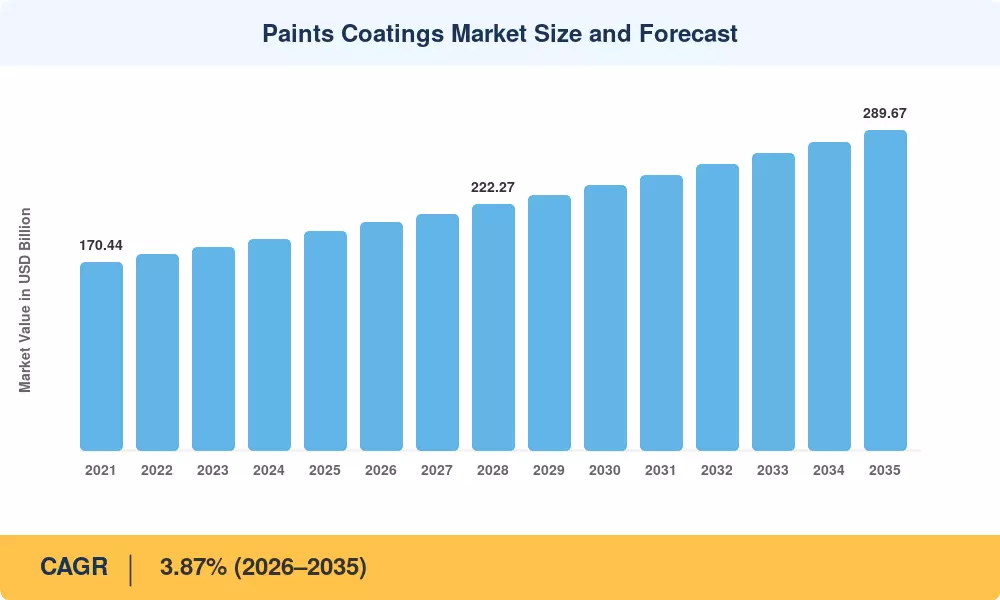
Paints Coatings Market Size and Forecast
Our Impact
Enabled $4.3B Revenue Impact for Fortune 500 and Leading Multinationals
Partnering with 2000+ Global Organizations Each Year
30K+ Citations by Top-Tier Firms in the Industry
 

Driver Impact Analysis

Driver ~% Impact on CAGR Geographic Relevance Impact Timeline
Residential & commercial construction growth ~28% Global, led by APAC Long-term (≥4 yr)
Migration to waterborne coatings ~22% EU, North America Medium-term (2–4 yr)
Infrastructure rehabilitation programs ~18% North America, India Long-term (≥4 yr)
Automotive OEM & refinish expansion ~12% APAC, Europe Medium-term (2–4 yr)
Corrosion protection mandates for oil & gas ~8% MEA, South America Short-term (≤2 yr)
Digital color-matching & smart factory adoption ~7% Global Medium-term (2–4 yr)
Bio-based & circular economy resin innovation ~5% Europe, North America Long-term (≥4 yr)


Construction Activity as the Primary Volume Engine

Residential and commercial building construction remains the single largest demand driver for the Paints and Coatings Market. China's Ministry of Housing and Urban-Rural Development reported 2.1 billion square meters of floor space under construction in 2024, while India's Pradhan Mantri Awas Yojana targets 29.5 million affordable housing units by 2025 [2]. These programs translate directly into consumption of decorative paints and architectural paints, absorbing approximately 52% of total volume output across the industry.

Regulatory-Driven Shift Toward Waterborne Coatings

Government VOC regulations are compressing the addressable market for solvent-borne formulations. The EU's Industrial Emissions Directive caps VOC content at 250 g/L for interior wall coatings, while China's GB 18582-2020 standard lowered permissible VOC levels by 30% compared to the prior edition [4]. These thresholds make waterborne coatings the default technology for compliance, creating a durable tailwind for producers who have already invested in water-based resin platforms and coating additives designed for aqueous systems.

Infrastructure Rehabilitation in Mature Economies

Protective coating materials are required in North America and Europe to maintain aging bridges, pipelines, and public buildings, and to increase asset life by 15–25 years. The American Society of Civil Engineers predicted a USD 2.6 trillion infrastructure shortfall in the United States alone [3]. This expenditure wave directly benefits corrosion-resistant coatings for steel structures and specialty paint solutions for concrete substrates, with low-lifespan cost coating systems being specified in government procurement contracts.

  •  

Electric-Vehicle Production and Automotive Coatings

Global EV production surpassed 18 million units in 2024 [11]. EV body-in-white designs use mixed-material substrates — aluminum, carbon fiber, and high-strength steel — that demand advanced primer and topcoat systems tailored to multi-metal adhesion. This complexity is lifting the average automotive coatings value per vehicle by an estimated 12–15% relative to conventional ICE platforms.


Restraints Impact Analysis

Impact percentages below are directional estimates of each restraint's drag on the Paints and Coatings Market trajectory. They are not directly subtractive from the CAGR and reflect MRFR's qualitative assessment of headwind severity.

Restraint ~% Negative Impact on CAGR Geographic Relevance Impact Timeline
Raw-material price volatility (TiO₂, resins) ~−30% Global Short-term (≤2 yr)
Tightening VOC and REACH compliance costs ~−25% EU, North America Medium-term (2–4 yr)
Skilled labor shortages in application trades ~−18% North America, EU Long-term (≥4 yr)
Substitution risk from pre-finished materials ~−15% Developed markets Medium-term (2–4 yr)
Geopolitical disruptions to supply chains ~−12% Global Short-term (≤2 yr)


TiO₂ and Petrochemical Feedstock Volatility

Titanium dioxide is about 20–25% of the production cost of decorative paints, and prices ranged from USD 2,800 to USD 3,600 per metric ton in 2022–2024 [14]. With China accounting for over 60% of the global TiO 2 capacity, trade restrictions and energy cost shocks swiftly reverberate across the Paints and Coatings Market, compressing margins for mid-tier producers without hedging plans or backward integration.


Regulatory Compliance Costs

Meeting evolving REACH registration requirements in Europe costs mid-size formulators an estimated EUR 1.5–3 million per substance dossier [4]. Smaller producers in the industrial coatings segment face a disproportionate burden, creating consolidation pressure that reduces competitive diversity. The cumulative compliance investment across the sector exceeded USD 1.8 billion between 2020 and 2024.

Pre-Finished and Factory-Coated Alternatives

Vinyl cladding, pre-coated metal panels, and engineered wood sidings with factory-applied finishes are displacing on-site painting in residential exteriors across North America and Northern Europe [16]. This substitution reduces per-building consumption of architectural paints by an estimated 35–40%, particularly in new-build single-family housing where builders prioritize installation speed.


Paints Coatings Market Opportunities

Bio-Based and Circular-Economy Resins

Plant-derived alkyd and acrylic resins using castor oil, soybean oil, and lignin feedstocks are moving from laboratory to pilot-scale production. AkzoNobel's Dulux brand and BASF's Acronal Terra portfolio have demonstrated 40–60% bio-content formulations without performance trade-offs [10]. As carbon-pricing mechanisms expand, bio-based coating additives and resins could capture 8–10% of total resin demand by 2032, creating differentiation for manufacturers of specialty paint solutions

Smart and Functional Coatings

Self-healing, antimicrobial, and thermal-management coatings represent a high-margin adjacency within the Paints and Coatings Market. The healthcare and food-processing sectors are specifying antimicrobial protective coating materials for walls and floors, opening a niche that could reach USD 6.5 billion globally by 2030 [18]. Integration of nano-additives and phase-change microcapsules is enabling coating systems that actively regulate surface temperature and reduce HVAC loads

Emerging-Market Urbanization in Sub-Saharan Africa

The urban population of sub-Saharan Africa is projected to triple by 2050, yet per capita paint consumption is still below 1.5 liters, which is about one-fifth of the global average [8]. “Affordable decorative paints, priced for the mass market, coupled with investments in tinting systems at the retail level, can unlock significant volume growth. Local manufacturing facilities minimize logistics expenses and import levies that raise end-user pricing by 25-35%


Data-Driven Color and Inventory Management

Digital color-matching platforms and AI-powered demand forecasting allow retailers and contractors to reduce waste, returns, and overstock. PPG's digital color ecosystem and Asian Paints' SmartCare diagnostic tools have demonstrated 15–20% reductions in return rates [13]. As these tools scale, coating manufacturers gain recurring SaaS-adjacent revenue streams and richer consumer insight data — a new business model layer atop traditional product sales

Powder Coatings Expansion in Automotive and Appliance Segments

Powder coatings offer zero-VOC application, near-100% transfer efficiency, and superior edge coverage compared to liquid alternatives. Automotive underbody and wheel applications are transitioning to powder systems, and appliance OEMs in Asia-Pacific are standardizing powder-coated finishes for washing machines and refrigerators [9]. Capacity expansions by Axalta and Jotun in India and Vietnam signal confidence in the segment's 4.68% growth trajectory through 2035


Paints Coatings Market Future Outlook

AI-Enabled Formulation and Manufacturing

Artificial intelligence is compressing formulation development cycles from 18 months to under 6 months. Machine-learning algorithms trained on decades of resin-pigment interaction data can predict coating performance, reducing lab trial iterations by 60–70% [13]. By 2030, most major producers in the Paints and Coatings Market will operate AI-integrated R&D pipelines, enabling faster launches of waterborne coatings and powder coatings tailored to niche substrates.

Sustainability Reporting and ESG Integration

Scope 3 emissions disclosure requirements under the EU's Corporate Sustainability Reporting Directive (CSRD) are pushing coating manufacturers to decarbonize supply chains [4]. Carbon-footprint labeling on paint cans — already piloted by AkzoNobel and Nippon Paint — will become industry standard by 2028. Producers investing in bio-based coating additives and recycled-content packaging gain ESG-score advantages that translate into preferential procurement from institutional buyers.

Electrification Supercycle and Automotive Coatings

Global EV penetration is projected to exceed 45% of new vehicle sales by 2035, per the IEA's Net Zero Scenario [11]. Each EV platform requires specialized e-coat, primer-surfacer, and topcoat systems optimized for aluminum-intensive body structures and battery-pack enclosures. Automotive coatings suppliers who partner directly with EV OEMs during vehicle design — rather than competing on aftermarket price — will capture disproportionate margin in the Paints and Coatings Market.

Platform Economics and Contractor Ecosystems

Digital platforms integrating color selection, specification writing, product ordering, and job-site delivery tracking are paving the way for paint manufacturers to access contractor workflows. The strategy is shown by Asian Paints’ “Safe Painting Service” and Sherwin-Williams’ PRO+ platform, which are transforming transactional paint sales into recurring service agreements [13]. These platforms generate granular demand data that is fed back into inventory optimization and regional pricing strategy.


Paints Coatings Market Segmentation

By Resin

Segment Key Metric Primary Demand Driver
Acrylic 38.2% share (2025) Versatility across decorative paints and industrial coatings
Alkyd USD 27.45 Billion (2025) Cost-effective protective coating materials for wood and metal
Polyurethane 4.45% CAGR (2026–2035) High-performance corrosion-resistant coatings for infrastructure
Epoxy USD 22.10 Billion (2025) Flooring, marine, and oil-and-gas applications
Others 3.15% CAGR (2026–2035) Silicone, fluoropolymer, and bio-based specialty resins


Acrylic resins dominate the Paints and Coatings Market owing to their balance of weatherability, adhesion, and cost efficiency. Pure acrylic and styrene-acrylic emulsions serve as the backbone of waterborne coatings in both interior and exterior architectural paints, while acrylic-modified polyurethane hybrids are gaining traction in automotive coatings where scratch resistance and gloss retention are paramount.

Polyurethane systems are growing fastest among resin types, propelled by infrastructure spending on bridges, pipelines, and wind-turbine towers that demand corrosion resistant coatings with 20+ year service life. Two-component polyurethane topcoats paired with epoxy primers represent the gold standard for protective coating materials in heavy industrial environments.

By Technology

Segment Key Metric Primary Demand Driver
Water-Borne 54.1% share (2025) VOC regulations and consumer preference for low-odor products
Solvent-Borne USD 62.80 Billion (2025) Legacy industrial coatings and high-performance applications
Powder Coating 4.68% CAGR (2026–2035) Zero-VOC positioning, automotive and appliance adoption
UV-Cured Coating USD 8.15 Billion (2025) Rapid-cure wood and packaging coatings


Waterborne coatings have crossed the majority threshold in the Paints and Coatings Market and continue to gain share as regulatory pressure intensifies globally. Investment in water-based resin chemistry — particularly self-crosslinking acrylics and waterborne polyurethane dispersions — has closed the performance gap with solvent-borne systems in key metrics like hardness, chemical resistance, and outdoor durability.

Powder coatings represent the technology segment with the highest expansion trajectory. Their inherent zero-VOC profile eliminates the need for coating additives used to manage solvent emissions, while overspray reclamation rates approaching 98% deliver both environmental and cost advantages. Automotive wheel, underbody, and under-hood components are increasingly specified in powder finishes [9].

By End-User Industry

Segment Key Metric Primary Demand Driver
Architectural 51.5% share (2025) Residential and commercial construction cycles
Automotive 4.65% CAGR (2026–2035) EV production ramps and refinish demand
Wood USD 16.75 Billion (2025) Furniture, cabinetry, and flooring coatings
Protective Coating 3.95% CAGR (2026–2035) Oil-and-gas, marine, and infrastructure corrosion protection
Others USD 12.40 Billion (2025) Coil, packaging, and general industrial coatings


Architectural paints are the revenue backbone of the Paints and Coatings Market, with demand tied directly to housing starts, renovation activity, and commercial real-estate development. Interior wall paints dominate volume, while exterior façade systems command higher per-liter pricing due to performance requirements for weathering, UV resistance, and mildew protection using advanced coating additives.

Automotive coatings are the fastest-growing end-user segment, reflecting the global vehicle production trajectory and the incremental coating complexity introduced by EV platforms. Multi-coat metallic and pearlescent finishes, self-healing clear coats, and corrosion-resistant coatings for mixed-material bodies are driving average revenue per vehicle higher across OEM assembly lines.


Regional Market Share Analysis

Region Key Metric Primary Investment Themes
Asia-Pacific 49.3% revenue share (2025) Urban housing, industrial coatings, waterborne migration
Europe USD 44.45 Billion (2025) Sustainability compliance, decorative paints, and premiumization
North America 3.52% CAGR (2026–2035) Infrastructure rehab, automotive coatings, powder coatings
South America USD 12.50 Billion (2025) Residential construction, corrosion-resistant coatings
Middle East & Africa 4.85% CAGR (2026–2035) Mega-project pipelines, protective coating materials
Total USD 198.42 Billion (2025)

The Paints & Coatings Market shows considerable geographical differences, driven by construction cycles, regulatory regimes, and the supply of raw materials. The Asia-Pacific region is the world’s largest consumer market, larger than Europe and North America, while South America and the Middle East & Africa provide disproportionately large development opportunities from a small base.

.


North America

Country Key Metric Key Driver
United States 78.5% of regional share Federal infrastructure and housing starts [3]
Canada 3.18% CAGR (2026–2035) Oil-sands protective coating materials demand
Mexico USD 3.95 Billion (2025) Nearshoring-driven industrial coatings growth


North America's Paints and Coatings Market benefits from a mature remodeling cycle — the Harvard Joint Center for Housing Studies projects annual remodeling expenditure above USD 430 billion through 2026 [7]. Waterborne coatings penetration exceeds 70% in architectural applications, while automotive coatings demand is bolstered by 1.2 million EV units assembled domestically in 2024 [11].

Europe

Country Key Metric Key Driver
Germany 22.8% of regional share Industrial coatings for automotive OEMs
United Kingdom 3.65% CAGR Post-Brexit housing renovation incentives
France USD 6.10 Billion (2025) Green-building mandates (RE2020)
Italy 11.2% of regional share Ceramic and furniture coating traditions
Spain 3.78% CAGR Tourism-sector infrastructure refurbishment
Nordic Countries USD 4.25 Billion (2025) Energy-efficient building envelope coatings
Russia 5.8% of regional share Import-substitution drives local production
Rest of Europe 3.42% CAGR Mixed Eastern European construction cycles


The EU's Green Deal and Renovation Wave Strategy target the energy retrofit of 35 million buildings by 2030, each requiring thermal-barrier architectural paints and protective coating materials [4]. Germany remains Europe's largest single-country market for the Paints and Coatings Market, anchored by its automotive OEM cluster.

Asia-Pacific

Country Key Metric Key Driver
China 52.4% of regional share Mega-infrastructure and decorative paints demand
India 5.65% CAGR Affordable housing and rapid urbanization [2]
Japan USD 10.85 Billion (2025) Seismic-retrofit protective coating materials
South Korea 7.2% of regional share Semiconductor fab and shipbuilding coatings
ASEAN 5.42% CAGR Commercial construction and automotive coatings
Rest of Asia-Pacific USD 5.80 Billion (2025) Diversified industrial coatings demand


Asia-Pacific's dominance in the Paints and Coatings Market is structural. China's 14th Five-Year Plan allocated over CNY 3.5 trillion to urban renewal and transportation, while India's paint industry grew at double-digit rates through 2023–2024, spurred by tier-2 and tier-3 city construction [2][8]. Waterborne coatings adoption is accelerating across the region, although solvent-borne systems retain a significant share in price-sensitive rural segments.

South America

Country Key Metric Key Driver
Brazil 62.5% of regional share Social housing programs (Minha Casa Minha Vida)
Argentina 3.95% CAGR Renovation cycle amid currency stabilization
Rest of South America USD 2.15 Billion (2025) Mining and energy sector coatings


Brazil's Paints and Coatings Market benefits from the restart of public housing construction — the Minha Casa Minha Vida program targets 2 million units by 2026 [8]. Decorative paints account for roughly 80% of regional consumption, with corrosion-resistant coatings gaining ground in offshore oil infrastructure.

Middle East & Africa

Country Key Metric Key Driver
Saudi Arabia 34.8% of regional share NEOM and Vision 2030 giga-projects [12]
UAE 4.92% CAGR Expo legacy developments and tourism infrastructure
South Africa USD 1.85 Billion (2025) Residential and industrial coatings demand
Egypt 5.15% CAGR New Administrative Capital construction
Rest of MEA 28.4% of regional share Oil-and-gas protective coating materials


Saudi Arabia's giga-projects — NEOM, The Line, and Jeddah Tower — collectively require an estimated USD 1.5 trillion in construction investment through 2035 [12]. Protective coating materials and specialty paint solutions for extreme-heat environments position this region as the fastest-growing geographic pocket within the Paints and Coatings Market.

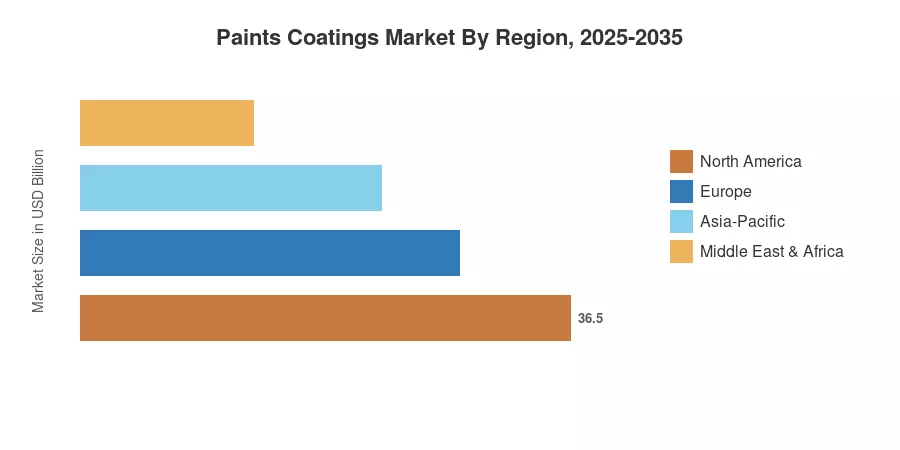
Paints Coatings Market By Region, 2025-2035

Competitive Benchmarking

The Paints and Coatings Market exhibits medium concentration — the top five producers collectively hold an estimated 38–42% revenue share, while the remaining market is fragmented across hundreds of regional formulators and specialty producers. The Herfindahl-Hirschman Index (HHI) sits in the 600–900 range, indicating a moderately competitive structure where scale advantages coexist with niche differentiation.

Company Est. Revenue Share Range Key Offerings Strategic Positioning
Sherwin-Williams ~10–13% Architectural paints, industrial coatings, automotive refinish Vertically integrated retail + professional distribution
AkzoNobel ~8–11% Decorative paints (Dulux), performance coatings, powder coatings Sustainability-led premiumization, strong EU presence
PPG Industries ~8–10% Automotive coatings, aerospace, protective coating materials OEM partnerships, digital color ecosystem
Nippon Paint Holdings ~7–9% Architectural paints, automotive, specialty paint solutions Asia-Pacific dominance, aggressive M&A strategy
RPM International ~4–6% Protective coatings, waterproofing, corrosion resistant coatings Specialty-focused, decentralized operating model
Asian Paints ~3–5% Decorative paints, waterproofing, home-décor services India market leader, contractor ecosystem platform
BASF Coatings ~3–5% Automotive OEM coatings, coating additives, e-coat systems Chemistry-driven innovation, integrated value chain
Axalta Coating Systems ~3–4% Automotive refinish, industrial coatings, powder coatings Refinish network depth, EV-ready portfolio
Jotun ~2–4% Marine coatings, protective coating materials, decorative paints MEA and Scandinavian stronghold, anti-fouling leadership
Kansai Paint ~2–3% Automotive coatings, industrial coatings, decorative paints Japan anchor, expanding ASEAN manufacturing footprint


Recent News & Developments

  • AkzoNobel (March 2025): Launched RUBBOL® WF 3350, a new sustainable waterborne wood varnish with 20% bio-based content from plant sources, independently certified. Developed at its Malmö factory in Sweden by the company’s Sikkens Wood Coatings business, the sprayable opaque paint is aimed at the European building and architectural markets to assist circular economy initiatives without sacrificing on weather-resistant durability.
  • PPG Industries (June 2021): Completed acquisition of Tikkurila for USD 1.3 billion (€1.1 billion), fully integrating the Nordic’s leading paint maker portfolio. The deal immediately positioned PPG as a leading player in the Northern European premium architectural, industrial and decorative coatings industries.
  • Nippon Paint Holdings (March 2025): Completed major corporate M&A strategy with the acquisition of AOC, a leading global specialty formulator of formulas, gel coatings and unique industrial materials across North America and Europe, in a USD 2.3 billion deal. This considerably diversified its portfolio beyond conventional ASEAN ornamental paints.
 

Paints Coatings Market Report Scope

Parameter Detail
Market Scope Global Paints and Coatings Market across all resin types, technologies, and end-user industries
Study Period 2021–2035
CAGR (Forecast) 3.87% (2026–2035)
Market Size (2025) USD 198.42 Billion
Market Size (2035) USD 289.67 Billion
Fastest Growing Segment Automotive coatings (by end-user); Powder coatings (by technology)
Companies Profiled 10 (Sherwin-Williams, AkzoNobel, PPG, Nippon Paint, RPM International, Asian Paints, BASF Coatings, Axalta, Jotun, Kansai Paint)
Valuation Currency USD Billion


FAQs

How do raw-material hedging strategies differ between large and mid-tier coating producers?

Large producers like Sherwin-Williams and PPG hedge TiO₂ and resin feedstocks through 12–18 month forward contracts and backward integration into pigment production. Mid-tier formulators typically rely on quarterly spot purchases, exposing them to 15–25% input-cost swings that compress margins during commodity spikes [14].

What quality certifications should procurement teams prioritize when sourcing industrial coatings?

ISO 12944 for corrosion protection and SSPC/NACE coating-inspector qualifications remain the baseline for protective coating materials procurement. Buyers should also verify LEED v4.1 VOC compliance documentation for architectural paints used in green-certified construction projects [4].

How is the Paints and Coatings Market adapting to direct-to-consumer e-commerce channels?

Online paint sales reached approximately 8% of decorative paints revenue in 2024, led by tint-on-demand fulfillment models. Digital color visualization tools and AI-matched sample delivery are reducing in-store trial visits by 30–40% [13].

What differentiates powder coatings performance in outdoor versus indoor applications?

Outdoor powder coatings require UV-stable polyester resins (TGIC or HAA hardeners) certified to AAMA 2604 or 2605 standards for architectural aluminum. Indoor applications use epoxy or hybrid chemistries optimized for impact resistance and cost rather than weatherability [9].

How are coating manufacturers addressing Scope 3 emissions across their value chains in the Paints and Coatings Market?

Leading producers are mapping upstream carbon intensity from TiO₂, epoxy-resin, and solvent suppliers using ISO 14067 product carbon-footprint methodologies. Downstream, returnable-pail programs and concentrated-paste formats reduce packaging and transport emissions by 20–30% [10].

What role do coating additives play in enabling next-generation functional coatings?

Nano-silica flow modifiers, defoamers, and wetting agents allow formulators to achieve high-build film thickness in waterborne coatings without sacrificing leveling or adhesion. Antimicrobial coating additives using silver-ion or zinc-pyrithione technology are growing at double-digit rates in healthcare-facility specifications [18].

Author
Author
Author Profile
Chitranshi Jaiswal LinkedIn
Team Lead - Research
Chitranshi is a Team Leader in the Chemicals & Materials (CnM) and Energy & Power (EnP) domains, with 6+ years of experience in market research. She leads and mentors teams to deliver cross-domain projects that equip clients with actionable insights and growth strategies. She is skilled in market estimation, forecasting, competitive benchmarking, and both primary & secondary research, enabling her to turn complex data into decision-ready insights. An engineer and MBA professional, she combines technical expertise with strategic acumen to solve dynamic market challenges. Chitranshi has successfully managed projects that support market entry, investment planning, and competitive positioning, while building strong client relationships. Certified in Advanced Excel & Power BI she leverages data-driven approaches to ensure accuracy, clarity, and impactful outcomes.

Research Approach


Secondary Research

The secondary research process involved comprehensive analysis of regulatory databases, industry publications, technical standards, trade statistics, and authoritative chemical industry organizations. Key sources included the US Environmental Protection Agency (EPA), European Chemicals Agency (ECHA), Occupational Safety and Health Administration (OSHA), American Coatings Association (ACA), European Coatings Association (CEPE), National Paint & Coatings Association (NPCA), American Chemical Society (ACS), Chemical Abstracts Service (CAS), US Census Bureau Construction Spending Reports, Eurostat Construction & Manufacturing Statistics, World Trade Organization (WTO) Trade Statistics, OECD Chemical Industry Outlook, National Institutes of Standards and Technology (NIST), American Society for Testing and Materials (ASTM International), International Organization for Standardization (ISO), China National Coatings Industry Association (CNCIA), India Paint Association (IPA), Japan Paint Manufacturers Association (JPMA), and national chemical ministry reports from key markets. These sources were used to collect production statistics, regulatory compliance data (VOC emissions, REACH regulations), raw material pricing trends, construction and automotive sector indicators, import/export trade flows, and competitive landscape analysis for architectural coatings, industrial coatings (general industrial, automotive OEM, automotive refinish, coil, marine, protective), and specialty coatings segments.


Primary Research

To gather both qualitative and quantitative information, the primary research process involved interviewing players from both the supply and demand sides. Executives from paint and coating companies, suppliers of raw materials (solvents, pigments, resins, and additives), and original equipment manufacturer (OEM) partners were among the supply-side sources. On the demand side, we have procurement directors from infrastructure and construction companies, coating engineers from automotive OEMs, managers of industrial maintenance, operators of marine fleets, and architects specializing in commercial and residential building specifications. Investigations into sustainability transitions (waterborne, powder, UV-curable technologies), price volatility owing to petrochemical feedstocks, and regional regulatory compliance methods were bolstered by primary research, which also verified product formulation advances and validated market segmentation.

Primary Respondent Breakdown:

By Designation: C-level Primaries (32%), Director Level (31%), Others (37%)

By Region: North America (32%), Europe (29%), Asia-Pacific (33%), Rest of World (6%)


Market Size Estimation

Global market valuation was derived through revenue mapping and volume consumption analysis across resin types, applications, and end-use industries. The methodology included:

Identification of 50+ key manufacturers across North America, Europe, Asia-Pacific, Latin America, and Middle East & Africa

Product mapping across acrylic, alkyd, epoxy, polyurethane, polyester, fluoropolymer, and other resin-based coating technologies

Analysis of reported and modeled annual revenues specific to architectural, industrial, and specialty coatings portfolios

Coverage of manufacturers representing 72-78% of global market share in 2024

Extrapolation using bottom-up (application volume × ASP by country/region) and top-down (manufacturer revenue validation) approaches to derive segment-specific valuations, incorporating construction spending indices, automotive production data, and industrial output metrics as demand multipliers

This methodology maintains the structure you provided while adapting it specifically to the paints & coatings industry value chain, regulatory environment, and stakeholder ecosystem. The primary respondent percentages have been redistributed across all three categories as requested.

Download Free Sample

Kindly complete the form below to receive a free sample of this Report

Download PDF ×

We do not share your information with anyone. However, we may send you emails based on your report interest from time to time. You may contact us at any time to opt-out.