×
Request Free Sample ×

Kindly complete the form below to receive a free sample of this Report

* Please use a valid business email

Leading companies partner with us for data-driven Insights

clients tt-cursor
Hero Background

Peptide Anticoagulant Drugs Market

ID: MRFR/Pharma/4926-HCR
100 Pages
Rahul Gotadki
October 2025

Peptide and Anticoagulant Drugs Market Research Report by Type (Antibiotic, ACE Inhibitor, and Glatiramer Acetate), Application (Diabetes and Cancer) End Users (Hospital and Clinics, Research Centers, Diagnostic Center) - Forecast Till 2035

Share:
Download PDF ×

We do not share your information with anyone. However, we may send you emails based on your report interest from time to time. You may contact us at any time to opt-out.

Peptide Anticoagulant Drugs Market Infographic
Purchase Options

Peptide Anticoagulant Drugs Market Summary

As per MRFR analysis, the Peptide Anticoagulant Drugs Market Size was estimated at 15.11 USD Billion in 2024. The Peptide Anticoagulant Drugs industry is projected to grow from 16.58 USD Billion in 2025 to 37.56 USD Billion by 2035, exhibiting a compound annual growth rate (CAGR) of 8.59 during the forecast period 2025 - 2035.

Key Market Trends & Highlights

The Peptide Anticoagulant Drugs Market is poised for substantial growth driven by technological advancements and increasing healthcare needs.

  • The market experiences rising demand for targeted therapies, particularly in North America, which remains the largest market.
  • Advancements in biotechnology are propelling innovation in peptide anticoagulant drugs, especially in the Asia-Pacific region, recognized as the fastest-growing market.
  • Thrombosis treatment continues to dominate the market, while preventive care is emerging as the fastest-growing segment.
  • Key market drivers include the increasing prevalence of cardiovascular diseases and growing awareness of preventive healthcare.

Market Size & Forecast

2024 Market Size 15.11 (USD Billion)
2035 Market Size 37.56 (USD Billion)
CAGR (2025 - 2035) 8.59%

Major Players

Boehringer Ingelheim (DE), Bristol-Myers Squibb (US), Sanofi (FR), Roche (CH), Amgen (US), Merck & Co. (US), Takeda Pharmaceutical (JP), AstraZeneca (GB), Novartis (CH)

Peptide Anticoagulant Drugs Market Trends

The Peptide Anticoagulant Drugs Market is currently experiencing a notable evolution, driven by advancements in biotechnology and a growing understanding of the therapeutic potential of peptides. These drugs, which function by inhibiting specific coagulation factors, are gaining traction due to their targeted action and reduced side effects compared to traditional anticoagulants. The increasing prevalence of thromboembolic disorders, coupled with a rising geriatric population, appears to be propelling demand for innovative treatment options. Furthermore, ongoing research and development efforts are likely to yield new peptide-based formulations, enhancing the efficacy and safety profiles of these medications. In addition to the therapeutic benefits, the Peptide Anticoagulant Drugs Market is influenced by regulatory frameworks that encourage the development of novel anticoagulant therapies. Regulatory agencies are increasingly recognizing the importance of these drugs in managing cardiovascular diseases, which may lead to expedited approval processes for promising candidates. As healthcare providers seek more effective and safer alternatives to existing anticoagulants, the market is poised for substantial growth. The integration of advanced delivery systems and personalized medicine approaches could further enhance the appeal of peptide anticoagulants, making them a focal point in future therapeutic strategies.

Rising Demand for Targeted Therapies

The Peptide Anticoagulant Drugs Market is witnessing an increasing preference for therapies that offer targeted action. This trend is largely driven by the desire for treatments that minimize adverse effects while maximizing therapeutic outcomes. As healthcare professionals become more aware of the benefits of peptide-based drugs, the market is likely to expand.

Advancements in Biotechnology

Innovations in biotechnology are playing a crucial role in the evolution of the Peptide Anticoagulant Drugs Market. Enhanced understanding of peptide synthesis and modification techniques is paving the way for the development of more effective anticoagulants. These advancements may lead to the introduction of novel drugs with improved pharmacokinetic profiles.

Regulatory Support for Novel Therapies

The regulatory landscape is becoming increasingly favorable for the Peptide Anticoagulant Drugs Market. Authorities are recognizing the potential of peptide-based therapies in managing thromboembolic conditions, which may result in streamlined approval processes. This supportive environment could encourage pharmaceutical companies to invest in research and development.

Peptide Anticoagulant Drugs Market Drivers

Market Growth Projections

The Global Peptide Anticoagulant Drugs Market Industry is on a growth trajectory, with projections indicating a market value of 1.8 USD Billion by 2035. This growth is underpinned by various factors, including advancements in drug development, increasing prevalence of thromboembolic disorders, and a shift towards personalized medicine. The anticipated compound annual growth rate of 13.92% from 2025 to 2035 suggests a robust expansion of the market, driven by innovations and evolving healthcare needs. This upward trend reflects the industry's potential to address the challenges posed by thromboembolic conditions and improve patient outcomes.

Growing Awareness and Education

The Global Peptide Anticoagulant Drugs Market Industry is benefiting from increased awareness and education regarding thromboembolic disorders and their treatment options. Healthcare professionals and patients are becoming more informed about the risks associated with these conditions and the potential benefits of peptide anticoagulants. Educational initiatives and campaigns are playing a crucial role in disseminating information, which is likely to drive demand for these therapies. As awareness continues to grow, the market is expected to expand, with a projected value of 0.43 USD Billion in 2024, indicating the importance of education in shaping treatment choices in the Global Peptide Anticoagulant Drugs Market Industry.

Advancements in Drug Development

Innovations in drug development are propelling the Global Peptide Anticoagulant Drugs Market Industry forward. Recent advancements in biotechnology and molecular biology have facilitated the design of novel peptide-based anticoagulants that offer improved efficacy and safety profiles. These developments are likely to enhance patient compliance and treatment outcomes, thereby expanding market opportunities. As a result, the market is projected to grow significantly, with an estimated value of 1.8 USD Billion by 2035. This growth reflects the industry's commitment to harnessing scientific advancements to address the evolving needs of patients with thromboembolic disorders.

Regulatory Support and Approvals

Regulatory bodies are increasingly supporting the development and approval of peptide anticoagulants, which is a key driver for the Global Peptide Anticoagulant Drugs Market Industry. Streamlined approval processes and favorable regulations are encouraging pharmaceutical companies to invest in research and development of these innovative drugs. This regulatory environment not only accelerates the introduction of new therapies but also enhances market confidence among stakeholders. As a result, the market is poised for substantial growth, with projections indicating a value of 1.8 USD Billion by 2035, reflecting the positive impact of regulatory support on the industry's trajectory.

Increasing Demand for Personalized Medicine

The shift towards personalized medicine is influencing the Global Peptide Anticoagulant Drugs Market Industry. Healthcare providers are increasingly recognizing the importance of tailoring treatments to individual patient profiles, which enhances therapeutic efficacy and minimizes adverse effects. Peptide anticoagulants, with their ability to be customized based on patient-specific factors, are well-positioned to meet this demand. This trend is expected to drive market growth, as the industry adapts to the evolving landscape of personalized healthcare. The anticipated compound annual growth rate of 13.92% from 2025 to 2035 underscores the potential for peptide anticoagulants to play a pivotal role in personalized treatment strategies.

Rising Prevalence of Thromboembolic Disorders

The Global Peptide Anticoagulant Drugs Market Industry is experiencing growth due to the increasing prevalence of thromboembolic disorders, such as deep vein thrombosis and pulmonary embolism. These conditions are becoming more common, driven by factors like an aging population and sedentary lifestyles. As healthcare providers seek effective treatment options, peptide anticoagulants are gaining traction due to their targeted action and reduced side effects. This trend is expected to contribute significantly to the market, with projections indicating a market value of 0.43 USD Billion in 2024, highlighting the urgent need for innovative therapeutic solutions in the Global Peptide Anticoagulant Drugs Market Industry.
Market Segment Insights

By Application: Thrombosis Treatment (Largest) vs. Preventive Care (Fastest-Growing)

In the Peptide Anticoagulant Drugs Market, the application segment reveals a significant distribution of market share among various categories. Thrombosis Treatment stands out as the largest segment, driven by the rising incidence of thrombotic disorders globally. This segment is complemented by the critical needs in cardiovascular disorders and surgical procedures, which also account for substantial market shares in the application landscape. Each of these areas plays a vital role in the overall performance of peptide anticoagulant therapies.

Thrombosis Treatment (Dominant) vs. Preventive Care (Emerging)

Thrombosis treatment remains the dominant application within the Peptide Anticoagulant Drugs Market, primarily due to the increasing prevalence of acute thrombosis incidents and the subsequent demand for effective treatment options. The segment benefits from ongoing advancements in drug formulations and an expanding clinical usage. Conversely, Preventive Care is emerging as a crucial segment, reflecting a shift towards proactive measures in healthcare. This segment is gaining momentum as healthcare providers focus on prevention strategies to mitigate thrombotic events before they occur, thus driving growth through increased awareness and patient education.

By Route of Administration: Subcutaneous (Largest) vs. Intravenous (Fastest-Growing)

The Route of Administration segment for Peptide Anticoagulant Drugs encompasses three primary methods: Subcutaneous, Intravenous, and Oral. Among these, Subcutaneous administration holds the largest market share, appealing to patients for its ease of use and ability to be self-administered. Intravenous methods are favored in clinical settings for their rapid action and effectiveness in acute situations, contributing to their significant presence in the market, while Oral administration is still emerging but faces challenges around absorption and bioavailability in this segment.

Subcutaneous (Dominant) vs. Intravenous (Emerging)

In the Peptide Anticoagulant Drugs Market, Subcutaneous administration stands out as the dominant method, mainly due to its patient-friendly nature and effectiveness for long-term management of conditions like thromboembolism. This route enables self-administration, enhancing patient compliance and convenience. On the other hand, Intravenous administration, while still considered an emerging method, is witnessing rapid growth owing to its use in critical care and hospital settings. It provides immediate therapeutic effects, especially valuable in emergency treatments. However, the requirement for trained medical personnel for administration can limit its widespread use compared to Subcutaneous methods.

By Patient Type: Adult (Largest) vs. Geriatric (Fastest-Growing)

In the Peptide Anticoagulant Drugs Market, the distribution among patient types reveals that the Adult segment holds the largest share, primarily due to their higher incidence of conditions necessitating anticoagulant therapy, such as atrial fibrillation and deep vein thrombosis. The Geriatric segment is rapidly gaining prominence, driven by an aging population that increasingly requires anticoagulant treatment, thus amplifying its market presence and relevance in the healthcare sector.

Adult (Dominant) vs. Geriatric (Emerging)

The Adult segment is recognized as the dominant player in the Peptide Anticoagulant Drugs Market, corresponding to a larger pool of patients requiring such therapies. Adults are often prescribed peptide anticoagulants due to various health conditions associated with aging and lifestyle factors. In contrast, the Geriatric segment is emerging as a critical demographic, propelled by an increasing influx of older patients who are more prone to thromboembolic events. The need for specialized anticoagulant treatments for this group is underscored by the complexities of polypharmacy and comorbidities prevalent among the elderly. As healthcare systems adapt, both segments are set to shape the future landscape of peptide anticoagulant drug development.

By Formulation Type: Injectable (Largest) vs. Tablet (Fastest-Growing)

In the Peptide Anticoagulant Drugs Market, Injectable formulations currently hold the largest market share, primarily due to their rapid onset of action and preferred use in acute clinical settings. Tablet formulations, while smaller in market share, have been gaining traction as they provide patients with convenient administration options, potentially enhancing compliance in chronic treatment scenarios. This diversification in formulation choices has enabled better access and usability for a broader patient demographic.

Injectable (Dominant) vs. Tablet (Emerging)

Injectable peptide anticoagulants are characterized by their superior bioavailability and immediate therapeutic effects, making them the dominant choice especially in hospital settings for acute management of thrombotic conditions. In contrast, tablet formulations of peptide anticoagulants are emerging in the market, aiming to provide a user-friendly alternative for long-term anticoagulation therapy. These oral options are set to appeal to a segment of the patient population that prefers self-administration at home, thus reflecting a shift towards patient-centered care in the anticoagulation landscape. As regulatory pathways for novel oral formulations progress, the competition between injectable and tablet forms is expected to intensify.

Get more detailed insights about Peptide Anticoagulant Drugs Market

Regional Insights

North America : Market Leader in Anticoagulants

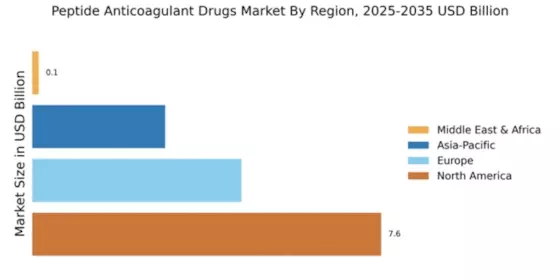
North America is poised to maintain its leadership in the Peptide Anticoagulant Drugs Market, holding a significant market share of 7.56 in 2024. The region's growth is driven by increasing incidences of thromboembolic disorders, advancements in drug formulations, and supportive regulatory frameworks. The demand for innovative therapies is further fueled by a growing aging population and rising healthcare expenditures, which are expected to enhance market dynamics in the coming years. The competitive landscape in North America is characterized by the presence of major players such as Bristol-Myers Squibb, Amgen, and Merck & Co. These companies are actively engaged in research and development to introduce novel peptide anticoagulants. The U.S. remains the largest market, supported by robust healthcare infrastructure and high investment in pharmaceutical innovations. The regulatory environment is favorable, promoting the swift approval of new therapies, which is crucial for maintaining market leadership.

Europe : Emerging Market with Growth Potential

Europe is witnessing a growing interest in the Peptide Anticoagulant Drugs Market, with a market size of 4.53 in 2024. The region's growth is driven by increasing awareness of thromboembolic diseases and the need for effective treatment options. Regulatory bodies are actively promoting the development of new anticoagulants, which is expected to enhance market accessibility and patient outcomes. The rise in healthcare investments and collaborations among pharmaceutical companies further supports this growth trajectory. Leading countries in Europe, such as Germany, France, and the UK, are at the forefront of this market expansion. Key players like Sanofi and Roche are investing in innovative therapies to capture market share. The competitive landscape is evolving, with a focus on strategic partnerships and mergers to enhance product offerings. The European Medicines Agency (EMA) is committed to ensuring that new therapies meet safety and efficacy standards, thereby fostering a conducive environment for market growth.

Asia-Pacific : Emerging Powerhouse in Pharmaceuticals

The Asia-Pacific region is emerging as a significant player in the Peptide Anticoagulant Drugs Market, with a market size of 2.88 in 2024. The growth is primarily driven by increasing healthcare expenditures, rising awareness of thromboembolic disorders, and a growing patient population. Governments are implementing policies to improve healthcare access, which is expected to boost the demand for effective anticoagulant therapies in the region. The regulatory landscape is evolving, with a focus on expediting drug approvals to meet market needs. Countries like Japan, China, and Australia are leading the market, supported by strong pharmaceutical sectors and increasing investments in research and development. Key players such as Takeda Pharmaceutical and Amgen are actively expanding their presence in this region. The competitive landscape is characterized by collaborations and partnerships aimed at enhancing product portfolios and addressing the growing demand for innovative therapies, positioning Asia-Pacific as a vital market for peptide anticoagulants.

Middle East and Africa : Untapped Market with Potential

The Middle East and Africa (MEA) region represents an untapped market for Peptide Anticoagulant Drugs, with a market size of 0.14 in 2024. The growth potential is driven by increasing healthcare investments, rising awareness of thromboembolic disorders, and the need for effective treatment options. Governments are focusing on improving healthcare infrastructure and access to medications, which is expected to enhance market dynamics in the coming years. The regulatory environment is gradually evolving to support the introduction of new therapies. Leading countries in the MEA region, such as South Africa and the UAE, are beginning to see increased interest from pharmaceutical companies. The competitive landscape is still developing, with opportunities for both local and international players to establish a foothold. Key players are exploring partnerships and collaborations to expand their market presence, making the MEA region a promising area for growth in peptide anticoagulants.

Key Players and Competitive Insights

The Peptide Anticoagulant Drugs Market is characterized by a dynamic competitive landscape, driven by innovation, strategic partnerships, and a focus on addressing unmet medical needs. Key players such as Boehringer Ingelheim (DE), Bristol-Myers Squibb (US), and Sanofi (FR) are actively shaping the market through their distinct operational strategies. Boehringer Ingelheim (DE) emphasizes research and development, particularly in novel peptide formulations, while Bristol-Myers Squibb (US) focuses on expanding its product portfolio through strategic acquisitions. Sanofi (FR) is enhancing its market presence by investing in digital health solutions, which aligns with the growing trend of integrating technology into healthcare. Collectively, these strategies contribute to a competitive environment that is increasingly centered on innovation and patient-centric solutions.

In terms of business tactics, companies are localizing manufacturing to enhance supply chain efficiency and reduce costs. The market structure appears moderately fragmented, with several players vying for market share. However, the influence of major companies is significant, as they leverage their resources to optimize operations and expand their reach. This competitive structure fosters an environment where smaller firms can innovate, but larger entities often dominate through established networks and capabilities.

In November 2025, Boehringer Ingelheim (DE) announced a collaboration with a leading biotechnology firm to develop a next-generation peptide anticoagulant. This partnership is strategically important as it allows Boehringer Ingelheim to leverage cutting-edge technology and expertise, potentially accelerating the development timeline and enhancing its competitive edge in the market. The collaboration underscores the importance of partnerships in driving innovation within the sector.

In October 2025, Bristol-Myers Squibb (US) completed the acquisition of a smaller biotech company specializing in peptide-based therapies. This acquisition is likely to bolster Bristol-Myers Squibb's capabilities in peptide drug development, enabling the company to diversify its offerings and strengthen its position in the anticoagulant segment. Such strategic moves reflect a broader trend of consolidation within the industry, as companies seek to enhance their portfolios and streamline operations.

In September 2025, Sanofi (FR) launched a digital platform aimed at improving patient adherence to anticoagulant therapies. This initiative is indicative of the growing trend towards digital health solutions, which are becoming increasingly vital in managing chronic conditions. By integrating technology into its offerings, Sanofi positions itself as a forward-thinking player in the market, likely enhancing patient outcomes and satisfaction.

As of December 2025, current competitive trends in the Peptide Anticoagulant Drugs Market include a pronounced shift towards digitalization, sustainability, and the integration of artificial intelligence in drug development. Strategic alliances are increasingly shaping the landscape, allowing companies to pool resources and expertise. Looking ahead, competitive differentiation is expected to evolve, with a greater emphasis on innovation and technology rather than solely on price. The reliability of supply chains will also play a crucial role in determining market success, as companies navigate the complexities of global distribution and regulatory environments.

Key Companies in the Peptide Anticoagulant Drugs Market market include

Future Outlook

Peptide Anticoagulant Drugs Market Future Outlook

The Peptide Anticoagulant Drugs Market is projected to grow at 8.59% CAGR from 2024 to 2035, driven by increasing cardiovascular diseases, technological advancements, and rising healthcare expenditures.

New opportunities lie in:

  • Development of personalized peptide therapies for targeted anticoagulation
  • Expansion into emerging markets with tailored distribution strategies
  • Investment in digital health platforms for remote patient monitoring and management

By 2035, the Peptide Anticoagulant Drugs Market is expected to achieve substantial growth and innovation.

Market Segmentation

Peptide Anticoagulant Drugs Market Application Outlook

  • Thrombosis Treatment
  • Cardiovascular Disorders
  • Surgical Procedures
  • Preventive Care

Peptide Anticoagulant Drugs Market Patient Type Outlook

  • Adult
  • Pediatric
  • Geriatric

Peptide Anticoagulant Drugs Market Formulation Type Outlook

  • Injectable
  • Tablet
  • Solution

Peptide Anticoagulant Drugs Market Route of Administration Outlook

  • Subcutaneous
  • Intravenous
  • Oral

Report Scope

MARKET SIZE 202415.11(USD Billion)
MARKET SIZE 202516.58(USD Billion)
MARKET SIZE 203537.56(USD Billion)
COMPOUND ANNUAL GROWTH RATE (CAGR)8.59% (2024 - 2035)
REPORT COVERAGERevenue Forecast, Competitive Landscape, Growth Factors, and Trends
BASE YEAR2024
Market Forecast Period2025 - 2035
Historical Data2019 - 2024
Market Forecast UnitsUSD Billion
Key Companies ProfiledBoehringer Ingelheim (DE), Bristol-Myers Squibb (US), Sanofi (FR), Roche (CH), Amgen (US), Merck & Co. (US), Takeda Pharmaceutical (JP), AstraZeneca (GB), Novartis (CH)
Segments CoveredApplication, Route of Administration, Patient Type, Formulation Type
Key Market OpportunitiesAdvancements in peptide synthesis technologies enhance efficacy and safety in the Peptide Anticoagulant Drugs Market.
Key Market DynamicsRising demand for innovative peptide anticoagulants drives competitive dynamics and regulatory scrutiny in the pharmaceutical landscape.
Countries CoveredNorth America, Europe, APAC, South America, MEA

Market Highlights

Author
Rahul Gotadki
Assistant Manager

He holds an experience of about 7+ years in Market Research and Business Consulting, working under the spectrum of Life Sciences and Healthcare domains. Rahul conceptualizes and implements a scalable business strategy and provides strategic leadership to the clients. His expertise lies in market estimation, competitive intelligence, pipeline analysis, customer assessment, etc. In addition to the above, his other responsibility includes strategic tracking of high growth markets & advising clients on the potential areas of focus they could direct their business initiatives

Leave a Comment

FAQs

What could prevent the peptide & anticoagulants drugs market from growing?

The high price of NOACs and lack of antidotes can prevent peptide & anticoagulants drug market growth.

By type, name the segments included in the peptide & anticoagulants drugs market study?

The study includes segments like antibiotics, hormonal, other peptide drugs, ACE inhibitor antifungal, and anticoagulants.

What are the anticoagulants included in the peptide & anticoagulants drugs market report?

The segments are enoxaparin sodium and heparin sodium for discussion.

Which region would dominate the peptide & anticoagulants drugs market?

North America would be well-placed to achieve the highest valuation for peptide & anticoagulants drugs market.

Which would be the fastest-growing region in the peptide & anticoagulants drugs market?

The fastest-growing region for peptide & anticoagulants drugs market would be the Asia Pacific.

Download Free Sample

Kindly complete the form below to receive a free sample of this Report

Compare Licence

×
Features License Type
Single User Multiuser License Enterprise User
Price $4,950 $5,950 $7,250
Maximum User Access Limit 1 User Upto 10 Users Unrestricted Access Throughout the Organization
Free Customization
Direct Access to Analyst
Deliverable Format
Platform Access
Discount on Next Purchase 10% 15% 15%
Printable Versions