Personal Finance Software Market
Personal Finance Software Market Summary
As per Market Research Future analysis, the Personal Finance Software Market Size was estimated at 3.192 USD Billion in 2024. The Personal Finance Software industry is projected to grow from 3.506 USD Billion in 2025 to 8.947 USD Billion by 2035, exhibiting a compound annual growth rate (CAGR) of 9.82% during the forecast period 2025 - 2035
Key Market Trends & Highlights
The Personal Finance Software Market is experiencing robust growth driven by technological advancements and increasing consumer demand for financial literacy tools.
- The demand for financial literacy tools is surging, particularly in North America, as consumers seek to enhance their financial management skills.
- Integration of AI and automation is transforming user experiences, making personal finance software more intuitive and efficient.
- Mobile applications are rapidly gaining traction, reflecting a shift towards greater accessibility and user engagement in the Asia-Pacific region.
- Rising consumer awareness of financial management and technological advancements in software development are key drivers propelling market growth.
Market Size & Forecast
| 2024 Market Size | 3.192 (USD Billion) |
| 2035 Market Size | 8.947 (USD Billion) |
| CAGR (2025 - 2035) | 9.82% |
Major Players
Intuit (US), Mint (US), YNAB (US), Personal Capital (US), Quicken (US), Tiller Money (US), PocketGuard (US), GoodBudget (US), Wally (US)
Personal Finance Software Market Trends
The Personal Finance Software Market is currently experiencing a dynamic evolution, driven by the increasing need for individuals to manage their finances effectively. As consumers become more aware of the importance of financial literacy, there is a growing demand for tools that facilitate budgeting, expense tracking, and investment management. The adoption of comprehensive household financial management software has become a cornerstone for families looking to consolidate debt, save for major milestones, and gain a 360-degree view of their economic health. This market appears to be influenced by technological advancements, with software solutions becoming more user-friendly and accessible. Furthermore, the integration of artificial intelligence and machine learning into these platforms suggests a shift towards more personalized financial advice and automated management, enhancing user experience and engagement. A prominent example of personal finance software currently leading the market is Intuit’s Quicken, which combines deep historical data tracking with modern cloud-based accessibility to cater to high-net-worth individuals.
In addition, the rise of mobile applications has transformed how users interact with their finances. The convenience of managing personal finances on-the-go is appealing to a broad demographic, particularly younger generations who prefer digital solutions. This trend indicates a potential for further growth as developers continue to innovate and adapt to changing consumer preferences. Overall, the Personal Finance Software Market seems poised for continued expansion, with various factors contributing to its evolution and relevance in today's financial landscape.
Increased Demand for Financial Literacy Tools
There is a noticeable rise in the demand for software that enhances financial literacy among users. As individuals seek to understand their financial situations better, tools that provide educational resources and insights are becoming essential.
Integration of AI and Automation
The incorporation of artificial intelligence and automation into personal finance software is transforming user experiences. These technologies enable personalized recommendations and streamline financial management processes, making them more efficient.
Mobile Accessibility and User Engagement
The shift towards mobile applications is reshaping the Personal Finance Software Market. Users increasingly prefer managing their finances through mobile devices, leading to higher engagement and the need for responsive, intuitive designs. As developers prioritize high-performance interfaces, the availability of robust finance software personal tools ensures that users can maintain financial discipline regardless of their location.
Personal Finance Software Market Drivers
Increased Focus on Data Security and Privacy
In the Personal Finance Software Market, the heightened focus on data security and privacy is becoming increasingly critical. With the rise of cyber threats, consumers are more cautious about sharing their financial information. Software providers are responding by implementing robust security measures, such as encryption and two-factor authentication, to protect user data. According to recent surveys, nearly 70% of users prioritize security features when selecting personal finance software. This emphasis on data protection not only builds consumer trust but also drives the demand for software that prioritizes user privacy, thereby influencing the competitive landscape of the Personal Finance Software Market.
Growing Popularity of Subscription-Based Models
The Personal Finance Software Market is witnessing a shift towards subscription-based models, which are becoming increasingly popular among consumers. This model allows users to access premium features and updates without a significant upfront investment. Recent statistics suggest that subscription services account for over 40% of the market share in personal finance software. This trend is appealing to users who prefer flexibility and continuous access to the latest tools and resources. As more companies adopt this model, it is likely to reshape the pricing strategies within the Personal Finance Software Market, making it more accessible to a wider audience.
Rising Consumer Awareness of Financial Management
The Personal Finance Software Market is experiencing a notable surge in consumer awareness regarding financial management. As individuals increasingly recognize the importance of budgeting, saving, and investing, the demand for personal finance software has escalated. Recent data indicates that approximately 60% of consumers actively seek tools to enhance their financial literacy. This trend is likely to drive the adoption of personal finance software, as users look for solutions that provide insights into their spending habits and investment opportunities. Furthermore, the emphasis on financial education in schools and communities is fostering a culture of proactive financial management, which could further propel the growth of the Personal Finance Software Market.
Technological Advancements in Software Development
Technological advancements are playing a pivotal role in shaping the Personal Finance Software Market. Innovations in software development, particularly in areas such as artificial intelligence and machine learning, are enhancing the functionality and user experience of personal finance applications. For instance, predictive analytics can now offer users tailored financial advice based on their spending patterns. The market is projected to grow at a compound annual growth rate of 10% over the next five years, driven by these technological improvements. As software becomes more sophisticated, it is likely to attract a broader audience, including those who may have previously been hesitant to engage with personal finance tools.
Integration of Financial Services within Software Platforms
The integration of financial services within personal finance software platforms is emerging as a key driver in the Personal Finance Software Market. Users are increasingly seeking comprehensive solutions that not only help with budgeting but also facilitate investment management, tax preparation, and retirement planning. This trend is reflected in the growing number of software that offers all-in-one financial solutions. Market analysis indicates that platforms providing integrated services are likely to capture a larger share of the market, as they meet the diverse needs of consumers. This holistic approach to personal finance could significantly influence user engagement and retention in the Personal Finance Software Market.
Market Segment Insights
By Type: Desktop Applications (Largest) vs. Mobile Applications (Fastest-Growing)
In the Personal Finance Software Market, Desktop Applications hold the largest market share, benefiting from their extensive functionalities and robust features that cater to users seeking comprehensive financial management solutions. Mobile Applications, while smaller in market share, are the fastest-growing segment as more users embrace the convenience of managing finances on-the-go. This shift towards mobile solutions reflects the increasing reliance on smartphones for everyday tasks and the growing demand for accessibility in personal finance management. Growth trends in this segment are primarily driven by technological advancements and changing consumer preferences. The rise of digital banking and e-commerce has fueled the popularity of both Desktop and Mobile Applications, but especially for the latter, which allows users to track expenses, view budgets, and make transactions swiftly and securely. As the market continues to evolve, Mobile Applications are expected to gain an even more significant share, driven by innovative features and user-friendly interfaces that appeal to a tech-savvy customer base.
Desktop Applications (Dominant) vs. Mobile Applications (Emerging)
Desktop Applications dominate the Personal Finance Software Market because they provide advanced functionalities that cater to both individual users and small businesses. Typically installed on personal computers, they offer extensive features like in-depth reporting, visual analytics, and integrated tax preparation tools. Their robust interface is preferred by users who require detailed financial analysis and business management tools. Conversely, Mobile Applications are emerging rapidly, motivated by consumer demand for flexibility and convenience. These applications enable users to access their financial accounts anywhere, facilitating immediate transaction tracking and budget management. The ease of use, combined with features like biometric security and real-time updates, positions Mobile Applications as a prominent player in shaping the future of personal finance management.
By Deployment Model: Cloud-Based (Largest) vs. On-Premises (Fastest-Growing)
In the Personal Finance Software Market, the deployment model is primarily dominated by the cloud-based segment, which is highly preferred due to its convenience and accessibility. Users have increasingly shifted towards cloud solutions, appreciating the ease of access across multiple devices and automatic updates. On-premises solutions, while still relevant, occupy a smaller share of the market as they often require significant investment in infrastructure and maintenance, deterring many small to medium-sized enterprises from adopting them.
Deployment Model: Cloud-Based (Dominant) vs. On-Premises (Emerging)
The cloud-based deployment model stands as the dominant choice in the Personal Finance Software Market, thanks to its scalability and low upfront costs, making it attractive to a wide range of consumers. This model facilitates easier updates and real-time access to financial data from any internet-enabled device. The rapid adoption of cloud personal finance software allows users to synchronize their bank feeds and investment portfolios seamlessly across multiple platforms while ensuring high-level data encryption. On the other hand, the on-premises model, while slower in growth, is emerging among businesses that prioritize data security and control over their financial assets. Its growth is bolstered by companies that favor in-house management of software and data, avoiding dependencies on internet connectivity and external providers.
By Target User: Individuals (Largest) vs. Small Businesses (Fastest-Growing)
In the Personal Finance Software Market, the target user segment is characterized by a diverse distribution among individuals, freelancers, small businesses, and corporates. Individuals dominate this space, accounting for the largest market share due to the growing awareness of personal finance management and the ease of access provided by software solutions. Following closely, small businesses are carving out a significant presence, driven by their need for efficient financial tracking and budgeting tools to optimize operations and improve financial health. As technology evolves, growth trends indicate a notable shift towards small businesses as the fastest-growing segment in the Personal Finance Software Market. This is largely driven by an increase in entrepreneurial ventures and the growing reliance on digital tools for managing finances. Freelancers are also gaining traction, albeit at a slower rate, due to the rise of gig economies, while corporates remain a smaller market owing to their existing frameworks and requirements for sophisticated solutions.

Individuals: Dominant vs. Small Businesses: Emerging
Individuals represent the dominant user segment in the Personal Finance Software Market, characterized by their need for user-friendly interfaces and basic financial tracking features. They often seek solutions that assist in budgeting, expense tracking, and savings management, benefiting from software’s accessibility and convenience. On the other hand, small businesses, classified as an emerging segment, are increasingly realizing the importance of finance software to manage cash flow, payroll, and expenses effectively. These businesses require more tailored solutions that cater to their specific financial needs as they scale. The transition of small businesses towards such software is spurred by their desire for efficiency and financial insight, positioning themselves for greater competition and growth.
By Key Features: Budgeting and Forecasting (Largest) vs. Expense Tracking (Fastest-Growing)
In the Personal Finance Software Market, Budgeting and Forecasting holds the largest share among key features, serving as the fundamental tool for users aiming to manage their financial future. Following closely is Expense Tracking, which has emerged as the fastest-growing segment as consumers increasingly seek real-time insights into spending habits and financial management. This rise is indicative of a shift towards more proactive financial planning among individuals and households, emphasizing the importance of awareness in spending patterns.
Budgeting and Forecasting (Dominant) vs. Expense Tracking (Emerging)
Budgeting and Forecasting is characterized by its robust tools that help users envision their financial future while setting realistic goals. These features allow for detailed analysis and forecasting of future income and expenditures, making it essential for users who prioritize long-term financial stability. Conversely, Expense Tracking has become an emerging choice, particularly among younger demographics who demand seamless integration with banking apps and intuitive interfaces. This feature enables real-time monitoring of expenses, fostering better spending habits and providing insights that can lead to healthier financial decisions. Together, these features reflect the evolving needs of consumers in the personal finance landscape.
By Subscription Model: Subscription-Based (Largest) vs. Free (Fastest-Growing)
In the Personal Finance Software Market, the distribution of market share among subscription models reveals a notable trend. Subscription-Based services currently dominate the market, driven by their ability to provide continuous updates and customer support. Meanwhile, Free models are gaining traction, appealing to a budget-conscious demographic seeking effective tools without additional costs. This shift indicates a broader acceptance of these models among diverse consumer segments.
Subscription-Based (Dominant) vs. Free (Emerging)
The Subscription-Based model stands out as the dominant player in the Personal Finance Software Market, primarily due to its comprehensive features and consistent revenue generation. Users benefit from regular updates, enhanced functionalities, and ongoing customer support, making it a preferred choice for many. On the other hand, the Free model is emerging rapidly, attracting users who initially hesitate to invest in premium options. This model typically offers limited features, but its accessibility is key, as it allows users to experience the software before committing financially. As consumers become more financially literate, both models are evolving to meet varying needs.
Regional Insights
North America : Market Leader in Innovation
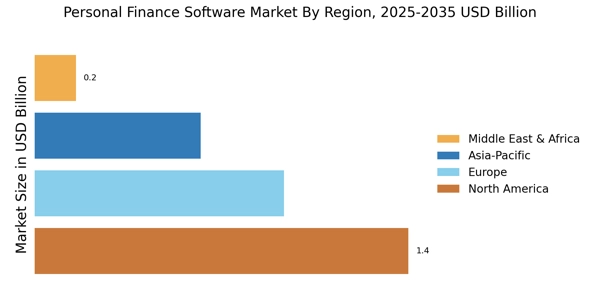
North America is the largest market for personal finance software, holding approximately 45% of the global market share. The region's growth is driven by increasing consumer awareness of financial management, the rise of digital banking, and favorable regulatory frameworks that encourage innovation. The demand for user-friendly and secure financial tools is also on the rise, further propelling market growth. The United States is the leading country in this region, with key players like Intuit, Mint, and YNAB dominating the landscape. The competitive environment is characterized by continuous innovation and the introduction of new features to enhance user experience. Canada also plays a significant role, contributing to the market with its growing adoption of personal finance solutions. The presence of established companies ensures a robust competitive landscape.
Europe : Emerging Market with Potential
Europe is witnessing a significant rise in the adoption of personal finance software, holding around 30% of the global market share. The growth is fueled by increasing financial literacy among consumers, regulatory support for digital finance, and a shift towards cashless transactions. Countries like Germany and the UK are leading this trend, with a growing demand for innovative financial solutions that cater to diverse consumer needs. Germany stands out as a key player in the European market, with a strong presence of local and international software providers. The competitive landscape is marked by a mix of established companies and startups, fostering innovation and enhancing user experience. The UK also plays a crucial role, with a high penetration of personal finance tools among consumers. The region's regulatory environment supports the growth of fintech, further driving market expansion.
Asia-Pacific : Rapid Growth and Adoption
Asia-Pacific is rapidly emerging as a significant market for personal finance software, accounting for approximately 20% of the global market share. The region's growth is driven by increasing smartphone penetration, rising disposable incomes, and a growing awareness of financial management among consumers. Countries like China and India are at the forefront, with a surge in demand for digital financial solutions that cater to the tech-savvy population. China leads the market in this region, with numerous local players offering innovative personal finance solutions. The competitive landscape is vibrant, with both established companies and new entrants vying for market share. India is also witnessing a boom in personal finance software adoption, driven by a young population eager to manage their finances digitally. The presence of key players and a supportive regulatory environment are crucial for the region's growth.
Middle East and Africa : Untapped Market Potential
The Middle East and Africa region is an emerging market for personal finance software, holding about 5% of the global market share. The growth is primarily driven by increasing smartphone usage, a young population, and a rising interest in financial literacy. Countries like South Africa and the UAE are leading the charge, with a growing demand for accessible financial management tools that cater to diverse consumer needs. South Africa is a key player in this region, with a mix of local and international software providers entering the market. The competitive landscape is evolving, with startups and established companies focusing on user-friendly solutions. The UAE is also witnessing a surge in personal finance software adoption, supported by government initiatives aimed at enhancing financial literacy. The region presents significant growth opportunities for personal finance software providers.
Key Players and Competitive Insights
Key Companies in the Personal Finance Software Market include
Industry Developments
Recent developments in the Personal Finance Software Market indicate a strong upward trajectory driven by increasing consumer demand for digital financial management solutions. The rising adoption of mobile applications and a focus on user-friendly interfaces have significantly contributed to market growth. In various regions, emerging fintech companies are innovating to provide advanced features such as AI-driven budgeting tools and automated expense tracking, enhancing user experience. The market is also witnessing strategic partnerships between traditional financial institutions and technology providers, allowing for improved integration of services.
Moreover, rising financial literacy among consumers, coupled with a growing inclination toward personalized financial products, is expected to drive further interest in personal finance software. Additionally, regulatory changes and increasing data security concerns are prompting software developers to prioritize compliance and user privacy, reshaping product offerings. The shift towards cloud-based solutions is also notable, enabling users to access their financial data anywhere and anytime, thereby enhancing the appeal of these platforms. Overall, the landscape of personal finance software continues to evolve rapidly, reflecting broader trends in technology and consumer behavior.
Future Outlook
Personal Finance Software Market Future Outlook
The Personal Finance Software Market is projected to grow at a 9.82% CAGR from 2025 to 2035, driven by increasing digitalization, consumer demand for financial literacy, and innovative technology solutions.
New opportunities lie in:
- Integration of AI-driven budgeting tools for personalized financial advice. Expansion into emerging markets with localized financial solutions. Development of subscription-based models for premium features and services.
By 2035, the Personal Finance Software Market is expected to be robust, reflecting substantial growth and innovation.
Market Segmentation
Personal Finance Software Market Type Outlook
- Desktop Applications
- Mobile Applications
- Web-Based Solutions
Personal Finance Software Market Target User Outlook
- Individuals
- Freelancers
- Small Businesses
- Corporates
Personal Finance Software Market Key Features Outlook
- Budgeting and Forecasting
- Expense Tracking
- Investment Management
- Tax Management
Personal Finance Software Market Deployment Model Outlook
- Cloud-Based
- On-Premises
Personal Finance Software Market Subscription Model Outlook
- Free
- One-Time Purchase
- Subscription-Based
Report Scope
| MARKET SIZE 2024 | 3.192(USD Billion) |
| MARKET SIZE 2025 | 3.506(USD Billion) |
| MARKET SIZE 2035 | 8.947(USD Billion) |
| COMPOUND ANNUAL GROWTH RATE (CAGR) | 9.82% (2025 - 2035) |
| REPORT COVERAGE | Revenue Forecast, Competitive Landscape, Growth Factors, and Trends |
| BASE YEAR | 2024 |
| Market Forecast Period | 2025 - 2035 |
| Historical Data | 2019 - 2024 |
| Market Forecast Units | USD Billion |
| Key Companies Profiled | Intuit (US), Mint (US), YNAB (US), Personal Capital (US), Quicken (US), Tiller Money (US), PocketGuard (US), GoodBudget (US), Wally (US) |
| Segments Covered | Software Type, Deployment Model, Target User, Key Features, Subscription Model, Regional |
| Key Market Opportunities | Integration of artificial intelligence for personalized financial planning in the Personal Finance Software Market. |

| Key Market Dynamics | Rising consumer demand for intuitive personal finance software drives innovation and competition among leading market players. |
| Countries Covered | North America, Europe, APAC, South America, MEA |
FAQs
What is the projected market valuation of the Personal Finance Software Market by 2035?
The Personal Finance Software Market is projected to reach approximately 8.947 USD Billion by 2035.
What was the market valuation of the Personal Finance Software Market in 2024?
In 2024, the market valuation stood at 3.192 USD Billion.
What is the expected CAGR for the Personal Finance Software Market during the forecast period 2025 - 2035?
The expected CAGR for the Personal Finance Software Market during the forecast period 2025 - 2035 is 9.82%.
Which segment is anticipated to have the highest growth in the Personal Finance Software Market?
The Web-Based Solutions segment is expected to grow significantly, with a projected valuation increase from 1.5952 USD Billion to 4.695 USD Billion.
What are the key features driving the Personal Finance Software Market?
How do subscription models impact the Personal Finance Software Market?
Subscription-Based models are likely to dominate, with projections indicating growth from 1.492 USD Billion to 5.247 USD Billion.
What types of deployment models are prevalent in the Personal Finance Software Market?
Who are the key players in the Personal Finance Software Market?
What target user segments are driving demand in the Personal Finance Software Market?
Demand is driven by Individuals, Freelancers, Small Businesses, and Corporates, with Individuals projected to grow from 1.2 USD Billion to 3.2 USD Billion.
What is the growth outlook for mobile applications in the Personal Finance Software Market?
Mobile Applications are expected to grow from 0.6392 USD Billion to 1.6885 USD Billion, indicating a rising trend in mobile finance management.
Research Approach
Secondary Research
The secondary research process involved comprehensive analysis of regulatory databases, fintech industry publications, peer-reviewed technology journals, software development reports, and authoritative financial organizations. Key sources included the US Securities and Exchange Commission (SEC), Consumer Financial Protection Bureau (CFPB), Financial Industry Regulatory Authority (FINRA), European Banking Authority (EBA), International Organization of Securities Commissions (IOSCO), Financial Conduct Authority (FCA), National Institute of Standards and Technology (NIST), International Telecommunication Union (ITU), Organization for Economic Co-operation and Development (OECD) Digital Economy Outlook, World Bank Global Financial Inclusion Database, International Monetary Fund (IMF) Financial Access Survey, Bureau of Economic Analysis (BEA), Federal Reserve Economic Data (FRED), Eurostat Digital Economy and Society Statistics, and national fintech regulatory reports from key markets. These sources were used to collect software adoption statistics, regulatory compliance data, cybersecurity frameworks, digital banking trends, and market landscape analysis for desktop applications, mobile applications, web-based solutions, cloud deployment models, and subscription-based pricing strategies.
Primary Research
In order to gather both qualitative and quantitative insights, supply-side and demand-side stakeholders were interviewed during the primary research process. CEOs, CTOs, VPs of Product Development, Chief Information Security Officers, and heads of fintech innovation from SaaS platform providers, financial technology OEMs, and personal finance software developers were examples of supply-side sources. Certified financial planners, wealth management advisors, small business owners, independent financial consultants, procurement leads from banks, credit unions, fintech accelerators, and enterprise IT decision-makers from corporations implementing financial management solutions were examples of demand-side sources. Market segmentation, product roadmap timelines, user adoption trends, pricing elasticity, API integration preferences, and data privacy compliance requirements were all confirmed by primary research.
Primary Respondent Breakdown:
By Designation: C-level Primaries (32%), Director Level (30%), Others (38%)
By Region: North America (38%), Europe (25%), Asia-Pacific (28%), Rest of World (9%)
Market Size Estimation
Global market valuation was derived through revenue mapping and user subscription analysis. The methodology included:
Identification of 50+ key software vendors across North America, Europe, Asia-Pacific, and Latin America
Product mapping across desktop applications, mobile applications, web-based solutions, cloud-based deployment, and on-premises installations
Analysis of reported and modeled annual revenues specific to personal finance software portfolios
Coverage of vendors representing 75-80% of global market share in 2024
Extrapolation using bottom-up (active user count × ARPU by country) and top-down (vendor revenue validation) approaches to derive segment-specific valuations for budgeting and forecasting, expense tracking, investment management, and tax management feature categories
Kindly complete the form below to receive a free sample of this Report
Customer Stories
“This is really good guys. Excellent work on a tight deadline. I will continue to use you going forward and recommend you to others. Nice job”
“Thanks. It’s been a pleasure working with you, please use me as reference with any other Intel employees.”
“Thanks for sending the report it gives us a good global view of the Betaïne market.”
“Thank you, this will be very helpful for OQS.”
“We found the report very insightful! we found your research firm very helpful. I'm sending this email to secure our future business.”
“I am very pleased with how market segments have been defined in a relevant way for my purposes (such as "Portable Freezers & refrigerators" and "last-mile"). In general the report is well structured. Thanks very much for your efforts.”
“I have been reading the first document or the study, ,the Global HVAC and FP market report 2021 till 2026. Must say, good info! I have not gone in depth at all parts, but got a good indication of the data inside!”
“We got the report in time, we really thank you for your support in this process. I also thank to all of your team as they did a great job.”