Phototherapy Market
Phototherapy Market Summary
As per Market Research Future analysis, The Global Phototherapy Market Size was estimated at 0.62 USD Billion in 2024. The phototherapy industry is projected to grow from USD 0.6517 Billion in 2025 to USD 1.074 Billion by 2035, exhibiting a compound annual growth rate (CAGR) of 5.12% during the forecast period 2025 - 2035
Key Market Trends & Highlights
The Global Phototherapy Market is experiencing robust growth driven by technological advancements and increasing awareness of treatment benefits.
- North America remains the largest market for phototherapy, driven by high healthcare expenditure and advanced medical infrastructure.
- The Asia-Pacific region is emerging as the fastest-growing market, fueled by rising healthcare access and increasing prevalence of skin disorders.
- LED phototherapy equipment dominates the market, while fiberoptic phototherapy equipment is witnessing rapid growth due to its innovative applications.
- Key market drivers include the increasing incidence of skin disorders and the rising demand for home-based treatment options.
Market Size & Forecast
| 2024 Market Size | 0.62 (USD Billion) |
| 2035 Market Size | 1.074 (USD Billion) |
| CAGR (2025 - 2035) | 5.12% |
Major Players
Philips (NL), GE Healthcare (US), Natus Medical Incorporated (US), Daavlin (US), Hill-Rom Holdings, Inc. (US), Bio-Therapeutics, Inc. (US), Sunlight Medical (US), Waldmann (DE), Lumenis (IL)
Phototherapy Market Trends
The Global Phototherapy Market is currently experiencing a notable evolution, driven by advancements in technology and an increasing awareness of the therapeutic benefits of light-based treatments. This market encompasses a variety of applications, including dermatological conditions, neonatal jaundice, and mood disorders, among others. As healthcare providers and patients alike recognize the efficacy of phototherapy, the demand for innovative devices and treatment protocols appears to be on the rise. Furthermore, the integration of phototherapy into standard treatment regimens suggests a shift towards more holistic approaches in patient care. In addition to technological advancements, regulatory support and clinical validation are likely to play crucial roles in shaping the future of The Global Phototherapy Market. Governments and health organizations are increasingly endorsing light therapy as a viable treatment option, which may enhance its acceptance among healthcare professionals. Moreover, ongoing research into the mechanisms of action and potential new applications for phototherapy could further expand its market reach. As the landscape evolves, stakeholders must remain vigilant to emerging trends and adapt their strategies accordingly to capitalize on the opportunities presented by this dynamic sector.
Technological Advancements
Recent innovations in phototherapy devices are enhancing treatment efficacy and patient comfort. Newer models incorporate features such as adjustable wavelengths and improved energy efficiency, which may lead to better outcomes and increased patient satisfaction.
Growing Awareness and Acceptance
There is a rising recognition of the benefits of phototherapy among both healthcare providers and patients. This growing awareness is likely to drive demand for light-based treatments, as more individuals seek non-invasive alternatives for various health conditions.
Regulatory Support and Clinical Validation
Support from regulatory bodies is becoming increasingly important in legitimizing phototherapy as a treatment option. Clinical studies validating its effectiveness could pave the way for broader adoption and integration into standard healthcare practices.
Phototherapy Market Drivers
Supportive Regulatory Framework
A supportive regulatory framework is fostering growth in The Global Phototherapy Industry. Regulatory bodies are increasingly recognizing the efficacy of phototherapy, leading to streamlined approval processes for new devices and treatments. This regulatory support not only encourages innovation but also instills confidence among manufacturers and healthcare providers. As of October 2025, several new phototherapy devices have received expedited approvals, facilitating their entry into the market. This trend is expected to continue, with regulatory agencies likely to prioritize the review of phototherapy technologies, thereby enhancing market dynamics and encouraging further investment in research and development.
Increasing Incidence of Skin Disorders
The rising prevalence of skin disorders, such as psoriasis, eczema, and acne, is a primary driver for The Global Phototherapy Industry. According to recent estimates, skin disorders affect millions of individuals worldwide, leading to a growing demand for effective treatment options. Phototherapy Market has emerged as a preferred choice due to its non-invasive nature and proven efficacy. The market is projected to witness substantial growth, with a compound annual growth rate (CAGR) of approximately 7% over the next few years. This trend indicates a robust market potential, as healthcare providers increasingly recommend phototherapy as a viable treatment option for various skin conditions.
Growing Awareness of Phototherapy Benefits
The rising awareness of the benefits of phototherapy is a crucial driver for The Global Phototherapy Industry. Educational campaigns and increased information dissemination regarding the effectiveness of phototherapy in treating various skin conditions have led to greater acceptance among both healthcare professionals and patients. As of 2025, surveys indicate that approximately 60% of dermatologists recommend phototherapy as a first-line treatment for certain skin disorders. This growing endorsement is likely to enhance patient confidence in phototherapy, thereby driving market growth. Furthermore, the increasing visibility of successful treatment outcomes in media and patient testimonials contributes to this heightened awareness.
Rising Demand for Home-Based Treatment Options
The increasing preference for home-based treatment options is reshaping The Global Phototherapy Industry. Patients are increasingly seeking convenient and effective solutions that can be administered in the comfort of their homes. This trend is driven by the desire for privacy, cost-effectiveness, and ease of use. As a result, manufacturers are developing user-friendly phototherapy devices designed for home use. The market for home phototherapy devices is projected to grow at a CAGR of around 8% in the coming years, indicating a shift towards more accessible treatment modalities. This evolution reflects a broader trend in healthcare, where patients are empowered to take control of their treatment.
Technological Innovations in Phototherapy Devices
Technological advancements in phototherapy devices are significantly influencing The Global Phototherapy Industry. Innovations such as LED-based systems and portable devices have enhanced treatment efficacy and patient convenience. The introduction of smart phototherapy devices, which allow for remote monitoring and personalized treatment plans, is expected to further propel market growth. As of 2025, the market for advanced phototherapy devices is anticipated to reach a valuation of over USD 1 billion, reflecting a growing preference for cutting-edge technology in dermatological treatments. These innovations not only improve patient outcomes but also expand the accessibility of phototherapy treatments.
Market Segment Insights
By Product: LED Phototherapy Equipment (Largest) vs. Fiberoptic Phototherapy Equipment (Fastest-Growing)
In The Global Phototherapy, the distribution among various product segments showcases LED Phototherapy Equipment as the most substantial player, dominating market shares across different regions due to its efficiency and effectiveness. Conventional Phototherapy Equipment follows closely, benefitting from long-standing clinical usage, while Germicidal Lamps and Accessories constitute significant portions of sales, particularly in healthcare settings. Fiberoptic Phototherapy Equipment, although smaller in comparison, remains notable for its innovative design and specific application in neonatal care. Over recent years, the phototherapy segment has witnessed significant growth, primarily driven by the rising incidence of skin disorders and the increasing awareness of the benefits of light therapy. Advancements in technology have bolstered the appeal of LED and Fiberoptic Phototherapy, leading to their rapid adoption in hospitals and clinics. Furthermore, healthcare professionals are increasingly recognizing the healing potential of germicidal lamps, propelling their use in infection control management in medical facilities.
Technology: LED Phototherapy Equipment (Dominant) vs. Fiberoptic Phototherapy Equipment (Emerging)
LED Phototherapy Equipment stands as a dominant force in the market, offering energy-efficient and versatile treatment options for various skin conditions, including psoriasis and eczema. Its ability to produce specific wavelengths of light has made it a preferred choice among dermatologists and consumers alike. Meanwhile, Fiberoptic Phototherapy Equipment emerges as an innovative solution particularly beneficial for treating neonatal hyperbilirubinemia, ensuring effective treatment with minimal discomfort. While the LED segment enjoys robust demand, Fiberoptic technology is expanding its market presence due to an increasing focus on advanced therapies in pediatric care. This contrast epitomizes the broader dynamism within the phototherapy landscape, where established technologies coexist and compete with novel innovations to meet evolving healthcare needs.
By Radiation: Ultraviolet B (UVB) (Largest) vs. Psoralen Ultraviolet A (PUVA) (Fastest-Growing)
In The Global Phototherapy Market, the Ultraviolet B (UVB) segment has established itself as the largest contributor, dominating market share due to its effectiveness in treating various skin conditions, particularly psoriasis and eczema. This method entails the use of specific wavelengths that have been widely embraced by dermatologists. In contrast, the Psoralen Ultraviolet A (PUVA) segment, while smaller in market share, is catching up due to its unique ability to treat more severe dermatological disorders, making it a key player in the growth strategy for phototherapy providers.
Ultraviolet B (Dominant) vs. Psoralen Ultraviolet A (Emerging)
The Ultraviolet B (UVB) segment is characterized by its established techniques and broad acceptance in clinical settings, primarily focusing on skin disorders. Its dominance stems from well-documented efficacy and a favorable safety profile. Conversely, the Psoralen Ultraviolet A (PUVA) segment is emerging rapidly, distinguished by its effectiveness against more challenging skin conditions, including cutaneous lymphoma. Growing awareness and acceptance of PUVA treatments, along with technological advancements enhancing safety and convenience, drive this segment's expansion. As patients seek more diverse therapies, both segments present vital options in the phototherapy landscape.
By Application: Skin Disease Treatment (Largest) vs. Neonatal Jaundice Management (Fastest-Growing)
The Global Phototherapy Market is characterized by a diverse application landscape, with Skin Disease Treatment commanding the largest market share. This segment is pivotal, driven by the increasing prevalence of skin disorders such as psoriasis and eczema, which rely heavily on effective phototherapy solutions. In parallel, Neonatal Jaundice Management has emerged as the fastest-growing segment, thanks to rising awareness about newborn health and advancements in phototherapy technologies that enhance treatment efficacy. Overall, there is a significant opportunity for continued growth across these applications as healthcare professionals increasingly adopt phototherapy for various conditions.
Skin Disease Treatment (Dominant) vs. Neonatal Jaundice Management (Emerging)
In The Global Phototherapy Market, Skin Disease Treatment remains the dominant application, utilized primarily for alleviating symptoms associated with chronic conditions. This segment focuses on light-based therapies, which are widely accepted for their efficacy in treating psoriasis, acne, and other dermatoses. In contrast, Neonatal Jaundice Management is an emerging segment that capitalizes on the growing emphasis on neonatal healthcare. The use of phototherapy for treating jaundice in newborns involves bright light exposure to reduce bilirubin levels, and innovations in technology have improved the safety and effectiveness of such treatments. Both segments highlight the critical role of light-based therapies in improving patient outcomes.
By End User: Clinics (Largest) vs. Home Care (Fastest-Growing)
In The Global Phototherapy Market, Clinics hold the largest share as they are the primary location for phototherapy treatments. They provide specialized services and personalized care, making them the go-to choice for patients seeking therapeutic light treatments. Following Clinics, Hospitals and Dermatology Centers also play significant roles, particularly in advanced treatment and research, but the growth of the home healthcare sector is rapidly changing the landscape.
Home Care: Emerging vs. Clinics: Dominant
Clinics remain the dominant players in the phototherapy market due to their established infrastructures, experienced professionals, and a broad range of treatment options. However, the emergence of Home Care is a notable trend, driven by increased patient preference for convenience and the ability to manage treatments in their own environments. Patients benefit from cost-effectiveness and flexibility, with technologies developing to facilitate effective at-home treatment solutions. This shift reflects a broader transformation in healthcare delivery, integrating traditional clinical services with innovative home care approaches.
Regional Insights
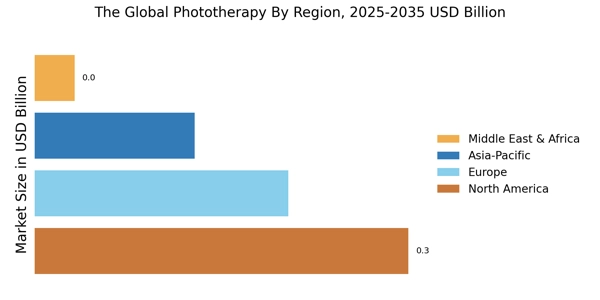
By region, the study provides market insights into North America, Europe, Asia-Pacific and the Rest of the World. The North American Phototherapy Market accounted for USD 0.2 billion in 2022 and is expected to exhibit a significant CAGR growth during the study period. The United States has been dominating the market landscape and has played an important role in influencing the overall market. The major reason for the outstanding performance of this Region is the high demand for phototherapy solutions for skin treatments.
Further, the major countries studied in the market report are The U.S., Canada, Germany, France, the U.K., Italy, Spain, China, Japan, India, Australia, South Korea, and Brazil.
Europe's market of phototherapy accounts for the second-largest share owing to technological advancements and various financial aids, encouraging opting for this treatment. In 2020, the market was valued at approximately USD 56 Billion, while the French were valued at USD 34 Billion. One of the big opportunities for medical device manufacturers is the creation and expansion of 40 major hospitals across England by 2030, according to HospeTrack UK hospital intelligence.
At this point, another eight items may be added to the pipeline. The government's strong interest in improving its healthcare system is expected to boost the development of phototherapy treatments. Further, the Germany market of phototherapy held the largest market share, and the UK market of phototherapy was the fastest-growing market in the region.

The Asia Pacific Phototherapy Market is expected to grow at the fastest CAGR from 2022 to 2030. An increasing number of premature births and an increasing number of people suffering from skin diseases can be attributed to the high growth rate. For example, according to The Lancet, approximately 85% of preterm births occur late preterm, and 80% of these occur in Asia and South Asia.
Moreover, according to the Narayan Health Organization, India alone accounts for one-fifth of the 15 billion preterm births worldwide. Moreover, people in the Asia Pacific are prone to acne, which is expected to drive phototherapy use further. Further, the India market of phototherapy held the largest market share, and the China market of phototherapy was the fastest-growing in the region.
Key Players and Competitive Insights
Key Companies in the Phototherapy Market include
Industry Developments
- Q2 2024: Philips launches next-generation BlueControl wearable phototherapy device for psoriasis Philips announced the launch of its new BlueControl wearable phototherapy device, designed to provide targeted blue LED light therapy for patients with mild to moderate plaque psoriasis. The device is CE-marked and aims to improve patient convenience and adherence to treatment.
- Q1 2024: Biofrontera Inc. Announces FDA Approval of Ameluz® PDT Lamp for Expanded Indication Biofrontera Inc. received FDA approval for its Ameluz® photodynamic therapy lamp to treat actinic keratosis on the extremities and trunk, expanding its previous indication limited to the face and scalp.
- Q2 2024: Soligenix Announces Positive Results from Phase 3 FLASH Study of HyBryte™ in Cutaneous T-Cell Lymphoma Soligenix reported positive topline results from its Phase 3 FLASH study evaluating HyBryte™, a synthetic hypericin photodynamic therapy, for the treatment of cutaneous T-cell lymphoma, supporting a future regulatory submission.
- Q3 2024: Ra Medical Systems Completes Merger with Catheter Precision, Inc. Ra Medical Systems completed its merger with Catheter Precision, Inc., combining their expertise in medical device development, including phototherapy and ablation technologies, to expand their therapeutic offerings.
- Q2 2024: Dermal Photonics Corporation Raises $15 Million Series B to Advance At-Home Phototherapy Market Platform Dermal Photonics Corporation closed a $15 million Series B funding round to accelerate the development and commercialization of its at-home phototherapy platform for dermatological conditions.
- Q1 2025: Lumenis Announces Strategic Partnership with MedSkin Solutions for Advanced Phototherapy Market Applications Lumenis entered into a strategic partnership with MedSkin Solutions to co-develop advanced phototherapy solutions targeting chronic wound care and skin regeneration.
- Q2 2025: TheraLight Opens New Manufacturing Facility in Texas to Meet Growing Demand for Light Therapy Devices TheraLight inaugurated a new manufacturing facility in Texas to increase production capacity for its full-body phototherapy devices, addressing rising demand in clinical and wellness markets.
- Q1 2024: Vielight Receives Health Canada Approval for Neuro Alpha Photobiomodulation Device Vielight received regulatory approval from Health Canada for its Neuro Alpha photobiomodulation device, enabling commercial distribution for cognitive health applications.
- Q3 2024: PhotoMedex Appoints Dr. Lisa Grant as Chief Medical Officer PhotoMedex announced the appointment of Dr. Lisa Grant as Chief Medical Officer to lead clinical strategy and oversee regulatory initiatives for its phototherapy product portfolio.
- Q2 2025: BioLitec AG Receives CE Mark for New LEONARDO® Mini Dual Phototherapy Market Laser System BioLitec AG obtained CE Mark approval for its LEONARDO® Mini Dual, a compact phototherapy laser system designed for minimally invasive dermatological and vascular treatments.
- Q1 2025: Strata Skin Sciences Announces Distribution Agreement with Medline Industries for XTRAC® Laser System Strata Skin Sciences entered into a distribution agreement with Medline Industries to expand the reach of its XTRAC® excimer laser phototherapy system for psoriasis and vitiligo treatment in the U.S.
- Q2 2024: Theralase Technologies Receives FDA Breakthrough Device Designation for Anti-Cancer Photodynamic Therapy Theralase Technologies was granted FDA Breakthrough Device Designation for its photodynamic therapy platform targeting non-muscle invasive bladder cancer, expediting regulatory review and development.
Future Outlook
Phototherapy Market Future Outlook
The Global Phototherapy Market is projected to grow at a 5.12% CAGR from 2025 to 2035, driven by technological advancements, increasing skin disorders, and rising awareness of phototherapy benefits.
New opportunities lie in:
- Development of portable phototherapy devices for home use. Expansion into emerging markets with tailored phototherapy solutions. Partnerships with dermatology clinics for integrated treatment programs.
By 2035, the market is expected to achieve substantial growth, solidifying its position as a key therapeutic option.
Market Segmentation
Phototherapy Market Product Outlook
- Conventional Phototherapy Equipment
- LED Phototherapy Equipment
- Fiberoptic Phototherapy Equipment
- Germicidal Lamps
- Accessories
Phototherapy Market End User Outlook
- Clinics
- Hospitals
- Dermatology Centers
- Home Care
Phototherapy Market Radiation Outlook
- Ultraviolet B (UVB)
- Psoralen Ultraviolet A (PUVA)
Phototherapy Market Application Outlook
- Skin Disease Treatment
- Neonatal Jaundice Management
- Sterilization
Report Scope
| MARKET SIZE 2024 | 0.62(USD Billion) |
| MARKET SIZE 2025 | 0.6517(USD Billion) |
| MARKET SIZE 2035 | 1.074(USD Billion) |
| COMPOUND ANNUAL GROWTH RATE (CAGR) | 5.12% (2025 - 2035) |
| REPORT COVERAGE | Revenue Forecast, Competitive Landscape, Growth Factors, and Trends |
| BASE YEAR | 2024 |
| Market Forecast Period | 2025 - 2035 |
| Historical Data | 2019 - 2024 |
| Market Forecast Units | USD Billion |
| Key Companies Profiled | Philips (NL), GE Healthcare (US), Natus Medical Incorporated (US), Daavlin (US), Hill-Rom Holdings, Inc. (US), Bio-Therapeutics, Inc. (US), Sunlight Medical (US), Waldmann (DE), Lumenis (IL) |
| Segments Covered | Product |
| Key Market Opportunities | Advancements in light-emitting diode technology enhance treatment efficacy in The Global Phototherapy. |
| Key Market Dynamics | Rising demand for non-invasive treatments drives innovation and competition in the phototherapy market. |
| Countries Covered | North America, Europe, APAC, South America, MEA |
Market Highlights
FAQs
What is the projected market valuation of The Global Phototherapy by 2035?
The projected market valuation of The Global Phototherapy is expected to reach 1.074 USD Billion by 2035.
What was the market valuation of The Global Phototherapy in 2024?
The overall market valuation of The Global Phototherapy was 0.62 USD Billion in 2024.
What is the expected CAGR for The Global Phototherapy during the forecast period 2025 - 2035?
The expected CAGR for The Global Phototherapy during the forecast period 2025 - 2035 is 5.12%.
Which companies are considered key players in The Global Phototherapy?
Key players in The Global Phototherapy include Philips, GE Healthcare, Natus Medical Incorporated, and Daavlin.
What are the main product segments in The Global Phototherapy?
The main product segments in The Global Phototherapy include Conventional Phototherapy Equipment, LED Phototherapy Equipment, and Fiberoptic Phototherapy Equipment.
How much was the valuation for Ultraviolet B (UVB) radiation segment in 2024?
The valuation for the Ultraviolet B (UVB) radiation segment was 0.25 USD Billion in 2024.
What applications are driving growth in The Global Phototherapy?
What is the projected valuation for the LED Phototherapy Equipment segment by 2035?
Which end-user segments are prominent in The Global Phototherapy?
What was the valuation for Neonatal Jaundice Management in 2024?
Kindly complete the form below to receive a free sample of this Report
Customer Stories
“This is really good guys. Excellent work on a tight deadline. I will continue to use you going forward and recommend you to others. Nice job”
“Thanks. It’s been a pleasure working with you, please use me as reference with any other Intel employees.”
“Thanks for sending the report it gives us a good global view of the Betaïne market.”
“Thank you, this will be very helpful for OQS.”
“We found the report very insightful! we found your research firm very helpful. I'm sending this email to secure our future business.”
“I am very pleased with how market segments have been defined in a relevant way for my purposes (such as "Portable Freezers & refrigerators" and "last-mile"). In general the report is well structured. Thanks very much for your efforts.”
“I have been reading the first document or the study, ,the Global HVAC and FP market report 2021 till 2026. Must say, good info! I have not gone in depth at all parts, but got a good indication of the data inside!”
“We got the report in time, we really thank you for your support in this process. I also thank to all of your team as they did a great job.”