×
Request Free Sample ×

Kindly complete the form below to receive a free sample of this Report

* Please use a valid business email

Leading companies partner with us for data-driven Insights

clients tt-cursor
Hero Background

Pipeline Integrity Market

ID: MRFR/EnP/6595-CR
155 Pages
Chitranshi Jaiswal
May 2021

Pipeline Integrity Market Research Report Information By Service (Testing, Monitoring, Inspection, and Software Service), By Product (Oil, Gas, and Refined Product), By Application (Onshore and Offshore), And By Region (North America, Europe, Asia-Pacific, And Rest Of The World) – Market Forecast Till 2035

Share:
Download PDF ×

We do not share your information with anyone. However, we may send you emails based on your report interest from time to time. You may contact us at any time to opt-out.

Pipeline Integrity Market Infographic
Purchase Options

Pipeline Integrity Market Summary

As per MRFR analysis, the Pipeline Integrity Market Size was estimated at 2215.2 USD Million in 2024. The Pipeline Integrity industry is projected to grow from 2311.38 USD Million in 2025 to 3535.61 USD Million by 2035, exhibiting a compound annual growth rate (CAGR) of 4.34 during the forecast period 2025 - 2035.

Key Market Trends & Highlights

The Pipeline Integrity Market is experiencing robust growth driven by technological advancements and increasing regulatory demands.

  • The adoption of smart technologies is transforming pipeline monitoring and management practices.
  • Regulatory compliance and safety standards are becoming increasingly stringent, particularly in North America.
  • Sustainability initiatives are gaining traction, influencing investment decisions across the sector.
  • The growing demand for energy and advancements in monitoring technologies are key drivers propelling the market forward.

Market Size & Forecast

2024 Market Size 2215.2 (USD Million)
2035 Market Size 3535.61 (USD Million)
CAGR (2025 - 2035) 4.34%

Major Players

Baker Hughes (US), Schlumberger (US), Halliburton (US), Emerson Electric (US), Siemens (DE), Honeywell (US), National Oilwell Varco (US), Aker Solutions (NO), T.D. Williamson (US)

Pipeline Integrity Market Trends

The Pipeline Integrity Market is currently experiencing a transformative phase, driven by the increasing emphasis on safety and environmental sustainability. As industries recognize the critical importance of maintaining pipeline systems, investments in advanced monitoring technologies and inspection methodologies are on the rise. This shift is largely influenced by regulatory frameworks that mandate stringent compliance measures, compelling organizations to adopt proactive strategies for risk management. Furthermore, the integration of digital solutions, such as artificial intelligence and machine learning, is enhancing the ability to predict potential failures and optimize maintenance schedules. In addition to technological advancements, the Pipeline Integrity Market is witnessing a growing trend towards collaboration among stakeholders. Companies are forming strategic partnerships to share knowledge and resources, thereby improving overall operational efficiency. This collaborative approach not only fosters innovation but also helps in addressing the complexities associated with pipeline management. As the market evolves, the focus on sustainability and resilience is likely to shape future developments, ensuring that pipeline systems can withstand emerging challenges while meeting the demands of a changing energy landscape.

Adoption of Smart Technologies

The Pipeline Integrity Market is increasingly embracing smart technologies, which enhance monitoring and inspection processes. These innovations enable real-time data collection and analysis, allowing for timely decision-making and improved risk assessment.

Regulatory Compliance and Safety Standards

Heightened regulatory scrutiny is driving organizations to prioritize compliance with safety standards. This trend compels companies to invest in advanced integrity management systems to mitigate risks and ensure operational safety.

Sustainability Initiatives

There is a growing emphasis on sustainability within the Pipeline Integrity Market. Companies are adopting eco-friendly practices and technologies to minimize environmental impact, aligning with global efforts to promote sustainable energy solutions.

Pipeline Integrity Market Drivers

Increasing Demand for Energy Security

The Global Pipeline Integrity Market Industry is experiencing heightened demand for energy security, driven by the need to ensure reliable and safe transportation of oil and gas. As geopolitical tensions and supply chain vulnerabilities persist, countries are investing in infrastructure to bolster energy independence. This trend is reflected in the projected market value of 2.22 USD Billion in 2024, as stakeholders prioritize the integrity of pipelines to prevent leaks and failures. Enhanced monitoring technologies and maintenance practices are being adopted to mitigate risks, thereby fostering a more resilient energy supply chain globally.

Aging Infrastructure and Maintenance Needs

The aging infrastructure of pipeline systems presents a critical challenge and opportunity within the Global Pipeline Integrity Market Industry. Many pipelines, particularly in developed regions, are reaching the end of their operational lifespan, necessitating urgent maintenance and upgrades. This situation is prompting investments in integrity management programs to assess and rehabilitate aging assets. The market's growth trajectory is influenced by the need for proactive maintenance strategies that can extend the life of these infrastructures. As companies address these challenges, the demand for integrity solutions is expected to rise, contributing to the overall market expansion.

Technological Advancements in Monitoring Systems

Technological advancements are revolutionizing the Global Pipeline Integrity Market Industry, particularly in monitoring systems. Innovations such as real-time data analytics, artificial intelligence, and machine learning are enabling operators to detect anomalies and predict failures before they occur. These technologies enhance the overall safety and efficiency of pipeline operations, reducing downtime and maintenance costs. As the industry embraces these advancements, the market is projected to grow at a CAGR of 4.33% from 2025 to 2035. The integration of these cutting-edge solutions is likely to transform traditional pipeline management practices, ensuring greater integrity and reliability.

Regulatory Compliance and Environmental Standards

Stringent regulatory frameworks and environmental standards are propelling the Global Pipeline Integrity Market Industry forward. Governments worldwide are implementing policies that mandate regular inspections and maintenance of pipeline systems to minimize environmental impacts. Compliance with these regulations not only ensures safety but also enhances public trust in energy companies. As a result, the market is expected to grow, reaching 3.54 USD Billion by 2035. Companies are increasingly investing in advanced technologies such as smart sensors and data analytics to meet these compliance requirements, thereby driving innovation and efficiency in pipeline management.

Growing Investment in Renewable Energy Infrastructure

The transition towards renewable energy sources is influencing the Global Pipeline Integrity Market Industry. As countries invest in renewable energy infrastructure, the need for efficient and secure transportation of biofuels and hydrogen is emerging. This shift not only diversifies energy portfolios but also necessitates the implementation of robust pipeline integrity measures to ensure safety and reliability. The market is likely to see increased investments in technologies that support the integrity of these new pipeline systems. This evolving landscape presents both challenges and opportunities for stakeholders, as they adapt to the changing energy paradigm.
Market Segment Insights

By Application: Leak Detection (Largest) vs. Corrosion Management (Fastest-Growing)

In the Pipeline Integrity Market, several application segments showcase varied market share distributions. Leak Detection currently stands out as the largest segment, driven by an increasing focus on safety and compliance regulations across industries reliant on pipelines. Corrosion Management also commands a significant share, attributed to the growing need for infrastructure maintenance and the increasing aging of pipeline systems worldwide. The growth trends in this market are shaped by technological advancements and heightened awareness around environmental concerns. As industries adopt more sophisticated monitoring systems, the Integrity Assessment and Monitoring Systems segments are also gaining traction, while Data Management is expected to see emerging opportunities as companies strive for better analytics and decision-making capabilities. Overall, a shift towards preventive solutions will continue to drive growth across these application segments.

Leak Detection (Dominant) vs. Data Management (Emerging)

Leak Detection remains the dominant application in the Pipeline Integrity Market due to its critical role in ensuring pipeline safety and reducing risks associated with environmental hazards. This segment leverages advanced technologies like acoustic, infrared, and fiber-optic sensing to provide real-time monitoring and immediate response capabilities. On the other hand, Data Management is emerging as a pivotal segment, driven by the need for efficient data analysis and reporting. As industries collect vast amounts of data, the ability to manage and interpret this information is becoming essential. Companies are increasingly investing in Data Management solutions to enhance decision-making processes and enhance the overall integrity of pipeline systems, allowing for proactive measures that can prevent issues before they arise. The interplay between these two segments highlights the necessity for both immediate leak detection and long-term data strategies in maintaining pipeline integrity.

By End Use: Oil and Gas (Largest) vs. Water and Wastewater (Fastest-Growing)

In the Pipeline Integrity Market, the Oil and Gas sector commands a substantial share, significantly influencing market dynamics due to its extensive pipeline networks and critical need for integrity management. As an established player, this sector's demand for advanced monitoring and maintenance solutions drives a sizeable portion of the market, showcasing its dominance in both revenue and technological advancements. Conversely, the Water and Wastewater segment is emerging as the fastest-growing area within the market. With increasing concerns over freshwater scarcity and the imperative for efficient wastewater management, investments in innovative pipeline integrity solutions are surging, indicating a robust growth trajectory. This shift towards sustainable practices in water management further advocates for the rising relevance of this segment in the overall Pipeline Integrity landscape.

Oil and Gas: Dominant vs. Water and Wastewater: Emerging

The Oil and Gas sector remains the dominant force in the Pipeline Integrity Market, characterized by its significant investments in technology to ensure the safety and reliability of extensive, high-pressure pipeline systems. This segment continually seeks cutting-edge solutions to mitigate corrosion, leaks, and other integrity risks due to the high stakes involved in transporting hydrocarbons. In contrast, the Water and Wastewater segment, while traditionally smaller, is rapidly gaining ground as emerging players adopt advanced integrity management technologies to address regulatory pressures and sustainability goals. The increasing prevalence of smart monitoring systems and automated solutions within this segment positions it for a bright future as municipalities and private entities invest heavily in maintaining water quality and system reliability.

By Technology: Ultrasonic Testing (Largest) vs. Smart Pigs (Fastest-Growing)

In the Pipeline Integrity Market, Ultrasonic Testing holds the largest share, leveraging its precise measuring capabilities and ability to detect various flaws in pipelines. This technology dominates due to its effectiveness in a wide range of applications and environments, making it a preferred choice for many industries. Meanwhile, Smart Pigs, equipped with advanced technologies, are witnessing rapid growth thanks to increased demand for efficiency and safety in pipeline inspection. These devices provide real-time data, thus enhancing the scope of pipeline maintenance and monitoring.

Technology: Ultrasonic Testing (Dominant) vs. Smart Pigs (Emerging)

Ultrasonic Testing is widely recognized as the dominant technology in the Pipeline Integrity Market. Its capability to provide detailed and accurate evaluation of wall thickness and flaw detection makes it indispensable in maintaining the safety and reliability of pipelines. The established nature of this technology ensures its continued adoption across the industry. On the other hand, Smart Pigs represent an emerging technology, combining advanced sensing capabilities with mobility to inspect pipelines autonomously. Their ability to collect extensive data while traversing the pipeline systems positions them as a crucial innovation in pipeline integrity, responding to the growing need for automated and data-driven inspection methods.

By Service Type: Inspection Services (Largest) vs. Maintenance Services (Fastest-Growing)

In the Pipeline Integrity Market, Inspection Services currently command the largest share among the various service types. This segment focuses primarily on the assessment and evaluation of pipeline systems to guarantee their integrity and performance. It plays a critical role in identifying potential issues before they escalate into major problems, contributing to overall safety and efficiency in operations. Furthermore, Maintenance Services are rapidly gaining traction, attributed to the increasing emphasis on regular maintenance practices to extend the life span of pipeline assets. These services encompass a wide range of activities aimed at sustaining the operational capabilities of pipeline systems.

Inspection Services: Dominant vs. Maintenance Services: Emerging

Inspection Services represent the dominant segment in the Pipeline Integrity Market, offering comprehensive evaluations and analysis to ensure pipeline safety and compliance. They involve various techniques, such as non-destructive testing and visual inspections, crucial for early detection of faults and preserving asset integrity. Meanwhile, Maintenance Services are recognized as an emerging category, driven by the growing need for proactive management of pipeline infrastructures. These services include repairs, routine check-ups, and technology-enhanced monitoring solutions, aimed at minimizing downtime and optimizing operational efficiency. With increasing investment in pipeline infrastructure and regulatory requirements, both segments are poised for growth, albeit at different paces.

By Material Type: Steel (Largest) vs. Plastic (Fastest-Growing)

In the Pipeline Integrity Market, the material type segment is dominated by steel, holding the largest market share due to its strength, durability, and widespread acceptance in traditional pipeline applications. Steel pipes are favored for their resistance to wear and tear, making them the preferred choice for high-pressure applications. Following steel, plastic is rapidly gaining traction, thanks to advancements in manufacturing technologies and their lightweight, corrosion-resistant properties that appeal to modern infrastructure needs.

Steel (Dominant) vs. Plastic (Emerging)

Steel remains the dominant material in the Pipeline Integrity Market, renowned for its robustness and ability to withstand extreme conditions. It plays a critical role in the transportation of oil and gas, where safety and reliability are paramount. Alternatively, plastic is emerging as a vital player, especially in non-corrosive environments where its lightweight nature and cost-effectiveness offer significant advantages. As regulations favor environmentally friendly materials and technologies evolve, plastic is expected to carve out a larger market share, appealing particularly to new installations.

Get more detailed insights about Pipeline Integrity Market

Regional Insights

North America : Market Leader in Pipeline Integrity

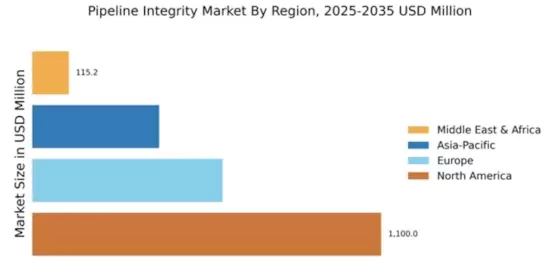
North America continues to lead the Pipeline Integrity Market, holding a significant share of 1100.0M in 2024. The region's growth is driven by stringent regulatory frameworks, increasing investments in infrastructure, and a rising focus on safety and environmental standards. The demand for advanced monitoring technologies and integrity management solutions is also on the rise, fueled by the need to prevent leaks and ensure compliance with regulations. The United States is the primary contributor to this market, with key players like Baker Hughes, Schlumberger, and Halliburton driving innovation and competition. The presence of established companies enhances the competitive landscape, ensuring a robust supply of advanced technologies. As the market evolves, the focus on digital solutions and predictive maintenance is expected to further strengthen North America's position in The Pipeline Integrity.

Europe : Emerging Regulatory Frameworks

Europe's Pipeline Integrity Market is projected to grow significantly, with a market size of 600.0M. The region is witnessing a surge in demand for pipeline integrity solutions, driven by new regulations aimed at enhancing safety and environmental protection. The European Union's commitment to reducing carbon emissions and improving energy efficiency is catalyzing investments in pipeline infrastructure and integrity management systems. Leading countries such as Germany, the UK, and France are at the forefront of this growth, supported by key players like Siemens and Honeywell. The competitive landscape is characterized by a mix of established firms and innovative startups, all vying to meet the increasing demand for advanced pipeline monitoring technologies. As regulatory frameworks evolve, the market is expected to adapt, fostering further innovation and investment in pipeline integrity solutions.

Asia-Pacific : Rapid Growth in Emerging Markets

The Asia-Pacific region is experiencing rapid growth in the Pipeline Integrity Market, with a market size of 400.0M. This growth is primarily driven by increasing industrialization, urbanization, and the expansion of energy infrastructure. Countries like China and India are investing heavily in pipeline projects, necessitating advanced integrity management solutions to ensure safety and compliance with emerging regulations. China is leading the charge, supported by significant investments from both domestic and international players. The competitive landscape features a mix of global giants and local firms, all striving to capture market share. As the region continues to develop, the demand for innovative technologies and services in pipeline integrity is expected to rise, further solidifying Asia-Pacific's role in the global market.

Middle East and Africa : Resource-Rich Market Potential

The Middle East and Africa region, with a market size of 115.2M, presents significant potential for growth in the Pipeline Integrity Market. The region's rich natural resources and ongoing investments in oil and gas infrastructure are driving demand for effective pipeline integrity solutions. Regulatory bodies are increasingly focusing on safety and environmental standards, which is catalyzing the adoption of advanced monitoring technologies. Countries like Saudi Arabia and South Africa are leading the way, with key players such as Aker Solutions and T.D. Williamson actively participating in the market. The competitive landscape is evolving, with both established companies and new entrants seeking to address the unique challenges of pipeline integrity in this diverse region. As investments continue, the market is poised for substantial growth in the coming years.

Key Players and Competitive Insights

The Pipeline Integrity Market is characterized by a dynamic competitive landscape, driven by the increasing demand for safe and efficient pipeline operations. Key players are focusing on innovation, digital transformation, and strategic partnerships to enhance their market positioning. Companies such as Baker Hughes (US), Schlumberger (US), and Halliburton (US) are at the forefront, leveraging advanced technologies and data analytics to optimize pipeline integrity solutions. Their collective strategies not only enhance operational efficiency but also contribute to a more sustainable approach in pipeline management, thereby shaping the competitive environment.

In terms of business tactics, companies are increasingly localizing manufacturing and optimizing supply chains to respond swiftly to market demands. The competitive structure of the Pipeline Integrity Market appears moderately fragmented, with several key players exerting influence. This fragmentation allows for a diverse range of solutions and innovations, fostering a competitive atmosphere where companies must continuously adapt to maintain their market share.

In November 2025, Baker Hughes (US) announced a strategic partnership with a leading technology firm to develop AI-driven predictive maintenance solutions for pipeline integrity. This initiative is poised to enhance operational reliability and reduce downtime, reflecting the company's commitment to integrating cutting-edge technology into its service offerings. Such advancements may significantly improve the efficiency of pipeline monitoring and maintenance, positioning Baker Hughes as a leader in the digital transformation of the industry.

In October 2025, Schlumberger (US) launched a new suite of digital tools aimed at enhancing pipeline inspection and monitoring capabilities. This launch underscores the company's focus on innovation and its intent to leverage digital technologies to provide real-time insights into pipeline conditions. By enhancing its service portfolio, Schlumberger is likely to strengthen its competitive edge and attract clients seeking advanced solutions for pipeline integrity management.

In September 2025, Halliburton (US) expanded its operations in Europe by acquiring a regional pipeline integrity service provider. This acquisition not only broadens Halliburton's geographical footprint but also enhances its service capabilities in a key market. The strategic move indicates Halliburton's commitment to growth through consolidation, allowing it to offer a more comprehensive range of services to its clients.

As of December 2025, the Pipeline Integrity Market is witnessing trends such as digitalization, sustainability, and AI integration, which are redefining competitive dynamics. Strategic alliances are becoming increasingly vital, enabling companies to pool resources and expertise to innovate more effectively. Looking ahead, competitive differentiation is expected to evolve, with a pronounced shift from price-based competition to a focus on innovation, technology, and supply chain reliability. This transition may ultimately lead to a more resilient and adaptive market landscape.

Key Companies in the Pipeline Integrity Market market include

Industry Developments

May 2023: ADNOC and Baker Hughes announced a deal to accelerate the development of technical solutions for low-carbon, environmentally friendly hydrogen, and graphene. ADNOC will cooperate as a strategic partner with Baker Hughes to investigate and test the use of cutting-edge technologies from Baker Hughes' hydrogen portfolio, according to the contract stipulations, followed by a strategic technological collaboration agreement signed by the two companies in November 2022.

January 2023: Wolftank Group and EnerMech have agreed to a distribution agreement. The cooperation will roll out hydrogen refueling stations across Australia and New Zealand’s industrial sectors as companies work to reduce their dependency on fossil fuels in their transportation fleets to fulfill net zero emission targets.  

Future Outlook

Pipeline Integrity Market Future Outlook

The Pipeline Integrity Market is projected to grow at a 4.34% CAGR from 2024 to 2035, driven by technological advancements, regulatory compliance, and increasing infrastructure investments.

New opportunities lie in:

  • Development of advanced monitoring technologies for real-time data analysis.
  • Expansion of predictive maintenance services to reduce operational downtime.
  • Integration of AI-driven analytics for enhanced decision-making in pipeline management.

By 2035, the Pipeline Integrity Market is expected to achieve robust growth, reflecting evolving industry demands.

Market Segmentation

Pipeline Integrity Market End Use Outlook

  • Oil and Gas
  • Water and Wastewater
  • Chemical
  • Power Generation
  • Mining

Pipeline Integrity Market Technology Outlook

  • Ultrasonic Testing
  • Magnetic Flux Leakage
  • Smart Pigs
  • Visual Inspection
  • Electromagnetic Testing

Pipeline Integrity Market Application Outlook

  • Leak Detection
  • Corrosion Management
  • Integrity Assessment
  • Monitoring Systems
  • Data Management

Pipeline Integrity Market Service Type Outlook

  • Consulting Services
  • Inspection Services
  • Maintenance Services
  • Training Services
  • Software Solutions

Pipeline Integrity Market Material Type Outlook

  • Steel
  • Plastic
  • Composite
  • Concrete
  • Copper

Report Scope

MARKET SIZE 20242215.2(USD Million)
MARKET SIZE 20252311.38(USD Million)
MARKET SIZE 20353535.61(USD Million)
COMPOUND ANNUAL GROWTH RATE (CAGR)4.34% (2024 - 2035)
REPORT COVERAGERevenue Forecast, Competitive Landscape, Growth Factors, and Trends
BASE YEAR2024
Market Forecast Period2025 - 2035
Historical Data2019 - 2024
Market Forecast UnitsUSD Million
Key Companies ProfiledBaker Hughes (US), Schlumberger (US), Halliburton (US), Emerson Electric (US), Siemens (DE), Honeywell (US), National Oilwell Varco (US), Aker Solutions (NO), T.D. Williamson (US)
Segments CoveredApplication, End Use, Technology, Service Type, Material Type
Key Market OpportunitiesIntegration of advanced monitoring technologies enhances safety and compliance in the Pipeline Integrity Market.
Key Market DynamicsRising regulatory pressures and technological advancements drive innovation in pipeline integrity management solutions.
Countries CoveredNorth America, Europe, APAC, South America, MEA

Market Highlights

Author
Chitranshi Jaiswal
Research Analyst Level I

In her 3 years of experience in the market research field, she has handled critical cross-domain projects. She has an in-depth knowledge of market estimation & analysis, problem-solving, primary as well as secondary research, and team management.She holds an engineering degree and is an MBA professional from a well-known university, capable of evaluating the market and competitive conditions. An exceptional strategist with excellent communication skills and a passion for delivering cutting-edge & practical insights for the market. Proficient in multi-tasking, and can successfully deal with competing demands, while maintaining complete confidentiality. Generated business through active client and project development, networking, and high-quality responses. Her knowledge and skills have helped in making solid business decisions, securing funding from investors, and avoiding business failures.

Leave a Comment

FAQs

How much is the pipeline integrity market?

The pipeline integrity market size was valued at USD 2.22 Billion in 2024.

What is the growth rate of the pipeline integrity market?

The market is projected to grow at a CAGR of 4.34% during the forecast period, 2025-2034.

Which region held the largest market share in the pipeline integrity market?

North America had the largest share of the market.

Who are the key players in the pipeline integrity market?

The key players in the market are ROSEN Group (Switzerland), Baker Hughes (US), NDT Gmbh & Co. Kg. (UAE), Emerson Electric Co. (US), Applus (Spain), Intertek Group Plc (UK), and EnerMech (UK), Schneider Electric (Japan), T.D WilliAMSON Inc. (US), and Altus Intervention (Norway).

Which product type led the pipeline integrity market?

The gas type category dominated the market in 2022.

Which application had the largest market share in the pipeline integrity market?

The onshore had the largest share of the market.

Download Free Sample

Kindly complete the form below to receive a free sample of this Report

Compare Licence

×
Features License Type
Single User Multiuser License Enterprise User
Price $4,950 $5,950 $7,250
Maximum User Access Limit 1 User Upto 10 Users Unrestricted Access Throughout the Organization
Free Customization
Direct Access to Analyst
Deliverable Format
Platform Access
Discount on Next Purchase 10% 15% 15%
Printable Versions