Pipeline & Process Services Market
Pipeline & Process Services Market Summary
As per Market Research Future analysis, the Pipeline and Process Services Market was estimated at 3.91 USD Billion in 2024. The Pipeline and Process Services industry is projected to grow from 4.121 USD Billion in 2025 to 6.973 USD Billion by 2035, exhibiting a compound annual growth rate (CAGR) of 5.4% during the forecast period 2025 - 2035
Key Market Trends & Highlights
The Pipeline and Process Services Market is experiencing a dynamic shift towards technological integration and sustainability.
- Technological integration is reshaping the Pipeline and Process Services Market, enhancing efficiency and monitoring capabilities.
- Sustainability initiatives are becoming increasingly central, driving companies to adopt eco-friendly practices and technologies.
- Collaborative ecosystems are emerging, fostering partnerships that enhance service delivery and innovation across the sector.
- The expansion of oil and gas exploration activities, coupled with regulatory compliance and safety standards, is propelling demand for pipeline inspection and maintenance services.
Market Size & Forecast
| 2024 Market Size | 3.91 (USD Billion) |
| 2035 Market Size | 6.973 (USD Billion) |
| CAGR (2025 - 2035) | 5.4% |
Major Players
Baker Hughes (US), Schlumberger (US), Halliburton (US), TechnipFMC (GB), Saipem (IT), KBR (US), Fluor Corporation (US), Wood Group (GB), Aker Solutions (NO)
Pipeline & Process Services Market Trends
The Pipeline and Process Services Market is currently experiencing a transformative phase, driven by advancements in technology and increasing demand for efficient operations. Companies are increasingly focusing on optimizing their processes to enhance productivity and reduce operational costs. This shift is evident in the growing adoption of automation and digital solutions, which streamline workflows and improve overall efficiency. Furthermore, the emphasis on sustainability is reshaping the market landscape, as organizations seek to minimize their environmental impact while maintaining profitability. As a result, service providers are innovating their offerings to align with these evolving needs, indicating a dynamic and competitive environment. In addition, the Pipeline and Process Services Market is witnessing a surge in collaboration between various stakeholders, including technology providers, service companies, and end-users. This collaborative approach fosters the development of integrated solutions that address complex challenges faced by industries. Moreover, the increasing focus on safety and regulatory compliance is prompting service providers to enhance their capabilities, ensuring that they meet stringent industry standards. Overall, the Pipeline and Process Services Market appears poised for continued growth, driven by technological advancements and a commitment to sustainable practices.
Technological Integration
The integration of advanced technologies is reshaping the Pipeline and Process Services Market. Companies are increasingly adopting automation, artificial intelligence, and data analytics to enhance operational efficiency. This trend suggests a shift towards more intelligent systems that can predict maintenance needs and optimize resource allocation.
Sustainability Initiatives
There is a growing emphasis on sustainability within the Pipeline and Process Services Market. Organizations are actively seeking to reduce their carbon footprint and implement eco-friendly practices. This trend indicates a broader commitment to environmental stewardship, influencing service offerings and operational strategies.
Collaborative Ecosystems
The formation of collaborative ecosystems is becoming prevalent in the Pipeline and Process Services Market. Stakeholders are joining forces to develop integrated solutions that address complex industry challenges. This trend highlights the importance of partnerships in driving innovation and enhancing service delivery.
Pipeline & Process Services Market Drivers
Increasing Demand for Energy
The Pipeline and Process Services Market is experiencing a notable surge in demand for energy, driven by the growing global population and industrialization. As countries strive to meet energy needs, investments in pipeline infrastructure are escalating. According to recent data, the energy sector is projected to require an additional 30% in pipeline capacity by 2030. This demand is not only for oil and gas but also for renewable energy sources, which necessitate advanced pipeline solutions. Consequently, service providers in the Pipeline and Process Services Market are likely to expand their offerings to accommodate this increasing demand, ensuring efficient and safe transportation of energy resources.
Focus on Environmental Sustainability
The Pipeline and Process Services Market is witnessing a growing emphasis on environmental sustainability. Companies are increasingly adopting practices that minimize environmental impact, driven by both regulatory pressures and consumer demand for greener solutions. The market for sustainable pipeline services is projected to expand as organizations seek to reduce their carbon footprint. This shift is likely to result in the development of eco-friendly materials and processes, which could reshape service offerings within the Pipeline and Process Services Market. As sustainability becomes a core focus, service providers may need to innovate to align with these environmental goals.
Regulatory Compliance and Safety Standards
The Pipeline and Process Services Market is significantly influenced by stringent regulatory compliance and safety standards. Governments and regulatory bodies are implementing more rigorous safety protocols to mitigate risks associated with pipeline operations. This trend is evident in the rise of safety audits and inspections, which have increased by approximately 25% in recent years. Companies are compelled to invest in advanced technologies and services that ensure adherence to these regulations. As a result, the Pipeline and Process Services Market is likely to see a boost in demand for specialized services that focus on compliance and safety, thereby enhancing operational reliability.
Expansion of Oil and Gas Exploration Activities
The Pipeline and Process Services Market is poised for growth due to the expansion of oil and gas exploration activities. As new reserves are discovered, there is an increasing need for efficient pipeline solutions to transport these resources. Recent estimates indicate that exploration activities could increase by 20% in the next five years, necessitating enhanced pipeline infrastructure. This trend suggests that service providers will need to scale their operations and invest in advanced technologies to support the burgeoning exploration sector. Consequently, the Pipeline and Process Services Market is likely to benefit from this expansion, as demand for related services rises.
Technological Advancements in Pipeline Monitoring
Technological advancements are reshaping the Pipeline and Process Services Market, particularly in the realm of pipeline monitoring and maintenance. Innovations such as smart sensors and data analytics are enabling real-time monitoring of pipeline conditions, which enhances operational efficiency and reduces downtime. The market for pipeline monitoring technologies is expected to grow by over 15% annually, reflecting the increasing reliance on technology for maintenance and safety. This trend suggests that service providers in the Pipeline and Process Services Market will need to adopt these technologies to remain competitive and meet the evolving needs of their clients.
Market Segment Insights
By Service Type: Pipeline Inspection Services (Largest) vs. Pipeline Maintenance Services (Fastest-Growing)
The Pipeline and Process Services Market showcases a variety of service types, with Pipeline Inspection Services commanding the largest market share. This segment has established itself as a cornerstone of operational efficiency, contributing significantly to project timelines and safety measures across industries. Meanwhile, Pipeline Maintenance Services is on a robust growth trajectory, driven by increasing infrastructure investments and the need for regular maintenance due to aging pipelines.
Pipeline Inspection Services (Dominant) vs. Pipeline Maintenance Services (Emerging)
Pipeline Inspection Services have established themselves as the dominant force in the market, essential for ensuring pipeline integrity and compliance with safety standards. With advanced technologies being employed to enhance inspection processes—such as drone and robotic inspections—this segment continues to lead the way in innovation and reliability. Conversely, Pipeline Maintenance Services are emerging rapidly, fueled by the escalating requirement for pipeline upkeep, especially in regions with aging infrastructures. This service type focuses on preventive measures to avoid leaks and catastrophic failures, aligning with regulatory pressures and sustainability goals, positioning itself as a vital aspect of modern pipeline management.
By End Use Industry: Oil and Gas (Largest) vs. Water and Wastewater (Fastest-Growing)
In the Pipeline and Process Services Market, the distribution of market share among various end-use industries reveals that Oil and Gas remains the largest segment, reflecting strong demand for services linked to exploration, extraction, and distribution. Meanwhile, the Water and Wastewater sector is catching up, driven by increasing investments in infrastructure and environmental regulations aimed at enhancing water treatment and management. This shift highlights the evolving priorities of various industries in the context of both resource management and sustainability.
Oil and Gas (Dominant) vs. Water and Wastewater (Emerging)
The Oil and Gas sector holds a dominant position in the Pipeline and Process Services Market, characterized by extensive service requirements for drilling, pipeline construction, and maintenance. Companies in this segment are focused on innovation to optimize processes and reduce costs in response to fluctuating oil prices. In contrast, the Water and Wastewater segment is emerging as a key player due to increasing global awareness of water scarcity and pollution. This industry focuses on efficient wastewater treatment solutions and the implementation of sustainable practices, thereby positioning itself for rapid growth in a market that demands innovative approaches to resource management.
By Pipeline Material: Steel (Largest) vs. Plastic (Fastest-Growing)
In the Pipeline and Process Services Market, the market share distribution among different pipeline materials reveals that steel currently dominates due to its strength and durability, making it a preferred choice in high-pressure applications. Meanwhile, plastic is rapidly gaining traction, especially in residential and low-pressure scenarios, attributed to its cost-effectiveness and lightweight nature. Other materials like copper, composite, and concrete hold smaller portions of the market but serve specific niche applications. The growth trends within this segment are driven by innovations in materials and increasing demand for sustainable solutions. Plastic's rise can be linked to advancements in manufacturing processes and increasing applications in energy-efficient piping. Conversely, steel remains a staple due to ongoing infrastructure projects and the need for reliable materials in heavy industries. Market dynamics suggest continued competition among materials as technology evolves.
Steel (Dominant) vs. Composite (Emerging)
Steel is characterized by its exceptional strength and reliability, making it the dominant material in the Pipeline and Process Services Market. It is widely used in oil, gas, and water transportation, where high pressure and temperature stability are critical. However, composite materials are emerging as viable alternatives, known for their corrosion resistance and lightweight properties. Composites offer the potential for reduced installation costs and longer service life, appealing to sectors looking to improve efficiency and reduce environmental impacts. Their development is also spurred by growing regulations favoring low-weight and corrosive-resistant solutions. As industries evolve, the competition between steel and composite materials will likely intensify, forcing ongoing innovations and adaptations in pipeline technology.
By Application: Storage (Largest) vs. Transport (Fastest-Growing)
The Pipeline and Process Services Market is primarily distributed among three key application segments: transport, storage, and distribution. Among these, storage holds the largest market share, driven by the need for efficient and secure holding of raw materials and finished products in various industries. Meanwhile, the transport application is gaining traction as companies focus on optimizing their logistics and reducing transit times, reflecting a notable share in the overall market.
Storage (Dominant) vs. Transport (Emerging)
Storage services are a crucial element of the Pipeline and Process Services Market due to their essential role in ensuring smooth operations within industries such as oil and gas, chemicals, and food processing. They encompass facilities and technologies that safeguard products, maintain quality and compliance, and facilitate inventory management. On the other hand, the transport segment is emerging vigorously, characterized by increasing investments in logistics infrastructure and innovative transport solutions. This growth is propelled by the rising demand for faster delivery systems and efficient supply chain management, making transport a significant focus for companies looking to enhance their service offerings.
Regional Insights
North America : Market Leader in Services
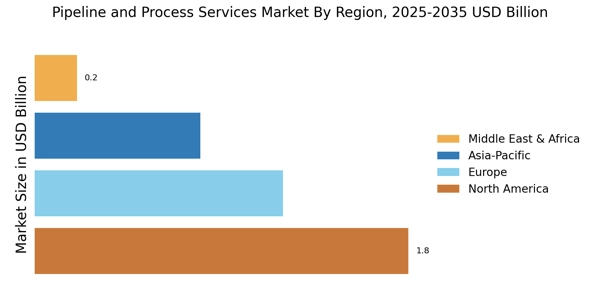
North America is the largest market for pipeline and process services, holding approximately 45% of the global market share. The region's growth is driven by increasing investments in infrastructure, stringent safety regulations, and a shift towards sustainable energy solutions. The demand for efficient and reliable pipeline services is further fueled by the expansion of oil and gas exploration activities, particularly in the U.S. and Canada. The competitive landscape in North America is characterized by the presence of major players such as Baker Hughes, Schlumberger, and Halliburton. These companies leverage advanced technologies and innovative solutions to enhance operational efficiency. The U.S. remains the leading country in this sector, followed by Canada, which also contributes significantly to the market with its rich natural resources and ongoing projects.
Europe : Emerging Regulatory Framework
Europe is witnessing a significant transformation in the pipeline and process services market, driven by regulatory frameworks aimed at enhancing safety and environmental sustainability. The region holds approximately 30% of the global market share, with countries like Germany and the UK leading the charge. The European Union's commitment to reducing carbon emissions and promoting renewable energy sources is catalyzing investments in pipeline infrastructure and technology. Key players in Europe include TechnipFMC, Saipem, and Wood Group, which are actively involved in various projects across the continent. The competitive landscape is evolving, with a focus on innovation and compliance with stringent regulations. The UK, in particular, is a hub for technological advancements in pipeline services, supported by government initiatives to foster growth in the energy sector.
Asia-Pacific : Rapid Growth and Demand
Asia-Pacific is rapidly emerging as a significant player in the pipeline and process services market, accounting for approximately 20% of the global market share. The region's growth is driven by increasing energy demands, urbanization, and government initiatives to enhance infrastructure. Countries like China and India are at the forefront, investing heavily in pipeline projects to support their growing economies and energy needs. The competitive landscape in Asia-Pacific is marked by the presence of both local and international players, including KBR and Aker Solutions. The region is witnessing a surge in partnerships and collaborations aimed at leveraging technological advancements. China, in particular, is leading the way with its ambitious energy projects, while India is focusing on expanding its pipeline network to meet rising demand.
Middle East and Africa : Resource-Rich Opportunities
The Middle East and Africa region is characterized by its vast natural resources, making it a crucial market for pipeline and process services, holding about 5% of the global market share. The region's growth is primarily driven by oil and gas exploration activities, coupled with increasing investments in infrastructure development. Countries like Saudi Arabia and Nigeria are leading the market, focusing on enhancing their pipeline networks to support energy exports and domestic consumption. The competitive landscape is shaped by key players such as Fluor Corporation and Halliburton, which are actively involved in various projects across the region. The presence of abundant resources and ongoing government initiatives to improve energy infrastructure are expected to drive further growth. Saudi Arabia, in particular, is investing heavily in pipeline projects to diversify its economy and reduce dependence on oil revenues.
Key Players and Competitive Insights
Key Companies in the Pipeline & Process Services Market include
Industry Developments
The Pipeline and Process Services Market has seen notable recent developments, particularly with major players expanding their capacities and services. KBR and Halliburton continue to enhance their positions in technology-driven solutions, focusing on sustainable energy initiatives. Meanwhile, Veolia and Baker Hughes are exploring collaborations aimed at improving waste management and efficiency in pipeline operations. Current affairs reveal ongoing trends towards digital transformation, with Schneider Electric and Emerson Electric investing significantly in automation and IoT technologies to optimize pipeline processes. Additionally, Jacobs Engineering Group and Wood Group have been actively engaged in large-scale projects that solidify their market presence.
Mergers and acquisitions remain a focal point, with Halliburton eyeing growth through strategic partnerships while KBR pursues innovative alliances. Market valuations for companies such as TechnipFMC and Tetra Tech have shown substantial growth, driven by increased demand for energy infrastructure and sustainable practices. Fluor Corporation has also reported advancements in its project pipeline, reflecting a healthy outlook in the industry. These dynamics indicate a robust and evolving landscape in the Pipeline and Process Services Market, with companies adapting to changes and seeking new growth avenues.
Future Outlook
Pipeline & Process Services Market Future Outlook
The Pipeline and Process Services Market is projected to grow at a 5.4% CAGR from 2025 to 2035, driven by technological advancements, increasing demand for energy, and regulatory compliance.
New opportunities lie in:
- Expansion of digital monitoring solutions for pipeline integrity management.
- Development of eco-friendly pipeline cleaning technologies.
- Implementation of predictive maintenance services to reduce operational downtime.
By 2035, the market is expected to achieve robust growth, positioning itself as a leader in innovative pipeline solutions.
Market Segmentation
Pipeline Process Services Market Application Outlook
- Transport
- Storage
- Distribution
Pipeline Process Services Market Service Type Outlook
- Pipeline Inspection Services
- Pipeline Testing Services
- Pipeline Maintenance Services
- Pipeline Construction Services
- Process Services
Pipeline Process Services Market End Use Industry Outlook
- Oil and Gas
- Chemical
- Water and Wastewater
- Power Generation
- Food and Beverage
Pipeline Process Services Market Pipeline Material Outlook
- Steel
- Plastic
- Copper
- Composite
- Concrete
Report Scope
| MARKET SIZE 2024 | 3.91(USD Billion) |
| MARKET SIZE 2025 | 4.121(USD Billion) |
| MARKET SIZE 2035 | 6.973(USD Billion) |
| COMPOUND ANNUAL GROWTH RATE (CAGR) | 5.4% (2025 - 2035) |
| REPORT COVERAGE | Revenue Forecast, Competitive Landscape, Growth Factors, and Trends |
| BASE YEAR | 2024 |
| Market Forecast Period | 2025 - 2035 |
| Historical Data | 2019 - 2024 |
| Market Forecast Units | USD Billion |
| Key Companies Profiled | Baker Hughes (US), Schlumberger (US), Halliburton (US), TechnipFMC (GB), Saipem (IT), KBR (US), Fluor Corporation (US), Wood Group (GB), Aker Solutions (NO) |
| Segments Covered | Service Type, End Use Industry, Pipeline Material, Application, Regional |
| Key Market Opportunities | Integration of advanced digital technologies enhances efficiency in the Pipeline and Process Services Market. |
| Key Market Dynamics | Rising demand for sustainable practices drives innovation and competition in the Pipeline and Process Services Market. |
| Countries Covered | North America, Europe, APAC, South America, MEA |
Market Highlights
FAQs
What is the projected market valuation for the Pipeline and Process Services Market in 2035?
The projected market valuation for the Pipeline and Process Services Market in 2035 is 6.973 USD Billion.
What was the overall market valuation for the Pipeline and Process Services Market in 2024?
The overall market valuation for the Pipeline and Process Services Market in 2024 was 3.91 USD Billion.
What is the expected CAGR for the Pipeline and Process Services Market during the forecast period 2025 - 2035?
The expected CAGR for the Pipeline and Process Services Market during the forecast period 2025 - 2035 is 5.4%.
Which service type segment is projected to experience the highest growth by 2035?
The Pipeline Maintenance Services segment is projected to grow from 1.2 USD Billion in 2024 to 2.0 USD Billion by 2035.
How do the projected valuations for Pipeline Inspection Services compare between 2024 and 2035?
Pipeline Inspection Services are expected to increase from 0.78 USD Billion in 2024 to 1.35 USD Billion by 2035.
What are the key players in the Pipeline and Process Services Market?
Key players in the Pipeline and Process Services Market include Baker Hughes, Schlumberger, Halliburton, and TechnipFMC.
Which end-use industry is anticipated to have the largest market share by 2035?
The Oil and Gas end-use industry is anticipated to grow from 1.5 USD Billion in 2024 to 2.7 USD Billion by 2035.
What is the expected growth for the Pipeline Construction Services segment from 2024 to 2035?
The Pipeline Construction Services segment is expected to grow from 0.9 USD Billion in 2024 to 1.5 USD Billion by 2035.
How does the market for Pipeline Maintenance Services compare to other service types by 2035?
By 2035, Pipeline Maintenance Services are projected to be the largest service type, reaching 2.0 USD Billion.
What is the projected growth for the Water and Wastewater end-use industry by 2035?
The Water and Wastewater end-use industry is projected to grow from 0.6 USD Billion in 2024 to 1.1 USD Billion by 2035.
Kindly complete the form below to receive a free sample of this Report
Customer Stories
“This is really good guys. Excellent work on a tight deadline. I will continue to use you going forward and recommend you to others. Nice job”
“Thanks. It’s been a pleasure working with you, please use me as reference with any other Intel employees.”
“Thanks for sending the report it gives us a good global view of the Betaïne market.”
“Thank you, this will be very helpful for OQS.”
“We found the report very insightful! we found your research firm very helpful. I'm sending this email to secure our future business.”
“I am very pleased with how market segments have been defined in a relevant way for my purposes (such as "Portable Freezers & refrigerators" and "last-mile"). In general the report is well structured. Thanks very much for your efforts.”
“I have been reading the first document or the study, ,the Global HVAC and FP market report 2021 till 2026. Must say, good info! I have not gone in depth at all parts, but got a good indication of the data inside!”
“We got the report in time, we really thank you for your support in this process. I also thank to all of your team as they did a great job.”