Plant Asset Management Market (2026 - 2035)

Plant Asset Management Market Size, Share and Research Report: By Deployment Type (On-Premise, Cloud-Based, Hybrid), By Solution Type (Software, Services), By Application (Manufacturing, Oil and Gas, Utilities, Mining, Transportation), By Asset Type (Physical Assets, Digital Assets, Production Assets) and By Regional (North America, Europe, South America, Asia Pacific, Middle East and Africa) - Industry Forecast to 2035
ID: MRFR/ICT/1256-HCR
110 Pages
Aarti Dhapte
Last Updated: July 03, 2026
Plant Asset Management Market
Market Size
Forecast Period2026-2035
CAGR (2026-2035)11.18%
2025 Market SizeUSD 10.40 Billion
2035 Market SizeUSD 30.55 Billion
Key Players
Honeywell International
Emerson Electric
ABB Ltd.
Siemens AG
Schneider Electric
Aspen Technology
Opportunities
  • Emerging Market Greenfield Instrumentation
  • Data Monetization and Outcome-Based Contracts
  • SME-Targeted Subscription Platforms

Plant Asset Management Market Summary

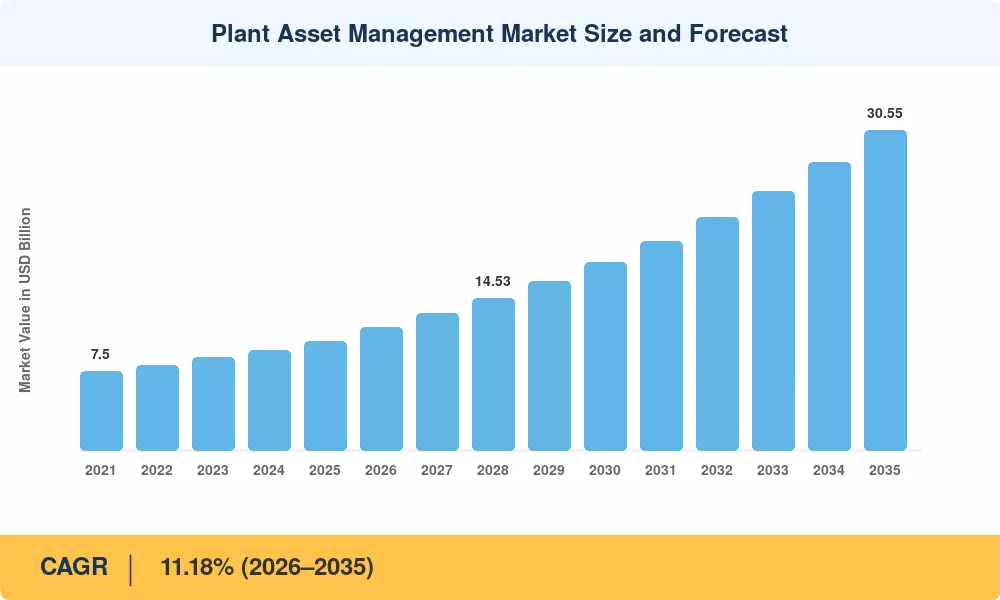
The Plant Asset Management Market stood at USD 10.40 billion in 2025 and is projected to open the forecast window at USD 11.75 billion in 2026, climbing to USD 30.55 billion by 2035. Industrial operators are accelerating digitalization budgets to comply with tightening safety and emissions reporting mandates, and that regulatory pressure is doing as much to lift demand as any single technology rollout. Utilities and process manufacturers alike are treating asset visibility as a compliance line item now, not a discretionary upgrade.

Connected sensor networks and analytics layers are replacing legacy condition-monitoring technologies, such as manual rounds and isolated SCADA tags, that can identify bearing wear or corrosion weeks before breakdown. Utilities are using pilot programs that leverage private 5G and low-power wireless mesh networks to extend this visibility to substations and remote pump stations that were previously unmonitored. Several utility-led trials are reporting capital allocations in the tens of millions of dollars for plant-wide instrumentation refreshes. The Plant Asset Management Market is seeing a revolution in procurement cycles as the move from reactive to predictive maintenance models takes hold.


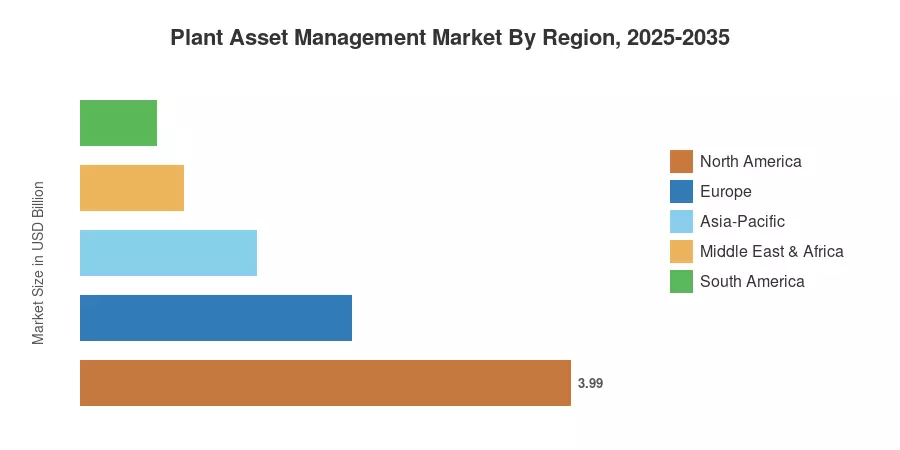
North America has the highest share of the Plant Asset Management Market at around 38.40%, owing to its established instrumentation infrastructure and strict environmental enforcement. The fastest growing region is Asia Pacific, which is rising at close to 13.78% CAGR as manufacturing expansion and government-backed digital factory efforts converge across China, India and South Korea. Europe ranks second, owing to industrial decarbonization requirements under the EU’s larger energy efficiency directives. Over the next 10 years, cloud-delivered platforms should begin to minimize these geographical differences by lowering the entrance barrier for mid-sized companies.


Key Report Takeaways

• By Technology

  • Software solutions led the Plant Asset Management Market with a 47.20% revenue share in 2025.
  • Cloud deployment models are expanding at a 14.09% CAGR through 2035, outpacing on-premise growth.
  • Electrical assets accounted for 46.20% of total asset-type revenue in 2025.

• By Sector

  • Oil and gas remained the leading end-user vertical in the Plant Asset Management Market with a 22.17% share in 2025.
  • Mining and metals is the fastest-rising end-user segment, growing at a 13.08% CAGR.
  • Large enterprises generated 68.21% of 2025 revenue, while smaller operators are catching up quickly.

• By Geography

  • North America captured 38.40% of global revenue in 2025.
  • Asia-Pacific is forecast to grow at 13.78% CAGR through 2035, the fastest of any region.
  • Europe contributed an estimated USD 2.21 billion in 2025 revenue.

Market Size and Forecast (2021–2035)

Figures below represent a blend of primary interviews with plant reliability managers, secondary data from regulatory filings, and triangulation versus publicly announced vendor revenue. The historical years represent the actual reported spend, and the prospective years are modeled based on capital expenditure cycles and digitalization mandates tracked across the Plant Asset Management Market.
Plant Asset Management Market Size and Forecast
Our Impact
Enabled $4.3B Revenue Impact for Fortune 500 and Leading Multinationals
Partnering with 2000+ Global Organizations Each Year
30K+ Citations by Top-Tier Firms in the Industry

Driver Impact Analysis

Driver ~% Impact on CAGR Geographic Relevance Impact Timeline
Predictive maintenance adoption 3.1% Global Medium-term (2–4 yr)
Aging electrical infrastructure replacement 2.4% North America, Europe Long-term (≥4 yr)
Stricter safety and emissions reporting 2.0% Global Short-term (≤2 yr)
Private wireless/5G plant connectivity 1.6% APAC, North America Medium-term (2–4 yr)
Manufacturing digital factory programs 1.5% APAC Long-term (≥4 yr)
Skilled reliability engineer scarcity 1.1% Global Short-term (≤2 yr)
Hybrid cloud analytics deployment 0.9% Global Medium-term (2–4 yr)


Predictive Maintenance Adoption

Process manufacturers are reallocating reliability budgets away from time-based inspection schedules toward condition-based triggers. A 2024 industry survey found that operators running predictive programs reported maintenance cost reductions of roughly 18–22%, a margin large enough to justify sensor retrofits even on older rotating equipment fleets.

Aging Electrical Infrastructure Replacement

Utilities across North America and parts of Western Europe are working through transformer and switchgear fleets that are decades past their design life. Several regional grid operators have disclosed multi-year capital programs exceeding USD 1 billion specifically earmarked for substation monitoring and asset-health analytics.

Private Wireless and 5G Plant Connectivity

Trials like Korea Electric Power Corporation's wireless IoT substation monitoring network demonstrate how ultra-low-latency connectivity shortens the gap between anomaly detection and field intervention [1]. As private 5G equipment costs fall, expect broader adoption across refineries and mining operations within the Plant Asset Management Market.

Manufacturing Digital Factory Programs

Government-backed smart manufacturing initiatives across China, India, and South Korea are tying subsidy eligibility to plant-level digital instrumentation. This policy linkage is pulling forward equipment purchases that might otherwise have waited for a full retrofit cycle.

Restraints Impact Analysis

Restraint percentages reflect relative drag on CAGR and are directional rather than additive.

Restraint ~% Impact on CAGR Geographic Relevance Impact Timeline
High upfront sensor retrofit cost -1.8% Emerging markets Short-term (≤2 yr)
Legacy OT-IT integration complexity -1.4% Global Medium-term (2–4 yr)
Data security concerns in cloud deployment -1.1% Europe, North America Medium-term (2–4 yr)
Fragmented vendor interoperability standards -0.9% Global Long-term (≥4 yr)
Budget constraints among small operators -0.7% Emerging markets Short-term (≤2 yr)


Legacy OT-IT Integration Complexity

Plants running control systems installed before 2010 often lack standardized data tagging, forcing integrators to build custom middleware before analytics tools can ingest a single sensor feed. Industry estimates put the integration line item at 25–30% of total project cost on brownfield sites.

Data Security Concerns in Cloud Deployment

Operators in regulated sectors remain cautious about routing operational telemetry through public cloud infrastructure, citing data-sovereignty rules under frameworks comparable to the EU's NIS2 directive. This caution is one reason on-premise deployment still commands roughly half of current spend.

Plant Asset Management Market Opportunities

Emerging Market Greenfield Instrumentation

Greenfield industrial projects across Southeast Asia and the Gulf region offer vendors a chance to specify modern asset-management architecture from day one, bypassing the brownfield integration costs described in.

Data Monetization and Outcome-Based Contracts

Vendors are beginning to package analytics as outcome-based service contracts tied to uptime guarantees rather than flat software licenses. This model could reshape pricing across the Plant Asset Management Market over the next decade.

SME-Targeted Subscription Platforms

Cloud-native, low-code asset monitoring tools are lowering the entry threshold for small and mid-sized operators that previously could not justify dedicated reliability-engineering headcount.

AI-Driven Failure Prediction

Machine-learning models trained on vibration, thermal, and acoustic data are improving failure-prediction accuracy beyond traditional threshold-based alarms, opening a premium analytics tier for vendors willing to invest in model development.

Cross-Industry Standardization

Efforts to harmonize asset data tagging standards across oil and gas, power generation, and manufacturing could meaningfully cut integration costs, addressing one of the sector's most persistent restraints.

Plant Asset Management Market Future Outlook

AI and Autonomous Operations

Autonomous inspection drones and robotic crawlers are increasingly paired with asset-management software to reduce manual rounds in hazardous plant zones, a trend reinforced by workforce-safety guidance from bodies such as OSHA.

Platform Economics

Vendors are consolidating point solutions into unified platforms, mirroring broader enterprise software trends toward fewer, deeper vendor relationships rather than best-of-breed point tools.

Electrification Supercycle

The International Energy Agency has flagged grid investment needs exceeding USD 600 billion annually through 2030 to support electrification targets, a trend that directly expands the addressable base for electrical-asset monitoring.

ESG and Sustainability Reporting

Expanding ESG disclosure requirements are pushing plant operators to instrument energy and emissions data at the asset level, turning what was once a maintenance tool into a compliance reporting backbone.

Plant Asset Management Market Segmentation

By Offering

Segment Metric Primary Demand Driver
Software 47.20% share (2025) Predictive analytics adoption
Services 13.63% CAGR Integration and consulting demand
Hardware USD 1.85 billion (2025) Sensor retrofit programs


Software retains the largest share as operators prioritize analytics layers over standalone sensors, while services growth reflects the integration complexity discussed in. Hardware spend remains steady as legacy sensor networks are gradually replaced.

By Deployment

Segment Metric Primary Demand Driver
On-Premise 50.00% share (2025) Data-sovereignty preference
Cloud 14.09% CAGR Lower entry cost for SMEs
Hybrid USD 1.95 billion (2025) Phased migration strategy


On-premise deployment still edges out cloud due to security concerns noted earlier, but cloud's growth rate signals a structural shift as hybrid architectures ease data-sovereignty objections.

By Asset Type

Segment Metric Primary Demand Driver
Electrical Assets 46.20% share (2025) Grid modernization spend
Rotating Equipment 11.70% CAGR Predictive vibration monitoring
Fixed Equipment USD 1.62 billion (2025) Corrosion and integrity monitoring


Electrical assets dominate given utility-scale instrumentation programs, while rotating equipment growth reflects rising demand for vibration-based diagnostics across rotating machinery fleets.

By End User

Segment Metric Primary Demand Driver
Oil and Gas 22.17% share (2025) Refinery reliability programs
Mining and Metals 13.08% CAGR Asset reliability management priorities
Power Generation USD 1.95 billion (2025) Grid asset monitoring
Chemicals USD 1.10 billion (2025) Process safety mandates


Oil and gas remains the anchor vertical, while mining and metals operators are scaling fastest as commodity producers invest in plant operations monitoring to reduce unplanned downtime.

By Organization Size

Segment Metric Primary Demand Driver
Large Enterprises 68.21% share (2025) Existing reliability infrastructure
SMEs 13.93% CAGR Subscription platform accessibility


Regional Market Share Analysis

Region Metric Primary Investment Themes
North America 38.40% share (2025) Grid modernization, safety compliance
Europe USD 2.21 billion (2025) Decarbonization mandates, OT security
Asia-Pacific 13.78% CAGR (2026–2035) Smart factory subsidies, manufacturing expansion
South America USD 0.62 billion (2025) Mining sector digitalization
Middle East & Africa USD 0.84 billion (2025) Oil and gas infrastructure refresh
Total USD 10.40 billion (2025) Global digitalization wave


North America

Country Metric Key Driver
US 82.50% of regional revenue Grid resilience funding
Canada 12.10% of regional revenue Mining sector retrofits
Mexico 5.40% of regional revenue Manufacturing nearshoring


The United States continues to anchor regional demand through federal grid-modernization funding programs that condition disbursement on installed monitoring infrastructure, while Mexican manufacturers are adopting asset-management platforms in step with nearshoring-driven plant expansions.

Europe

Country Metric Key Driver
Germany USD 0.61 billion Industrial decarbonization
UK USD 0.38 billion North Sea asset refurbishment
France USD 0.31 billion Nuclear plant monitoring upgrades
Italy USD 0.22 billion Manufacturing efficiency mandates
Spain USD 0.19 billion Renewable integration
Nordic Countries USD 0.21 billion District energy digitalization
Russia USD 0.14 billion Legacy infrastructure constraints
Rest of Europe USD 0.15 billion Fragmented regulatory uptake


Germany leads regional spend as manufacturers respond to tightening EU energy-efficiency reporting rules, while UK operators are prioritizing offshore asset refurbishment ahead of looming decommissioning deadlines.

Asia-Pacific

Country Metric Key Driver
China 41.20% of regional revenue Smart factory subsidy programs
India 18.60% of regional revenue Industrial corridor expansion
Japan 16.30% of regional revenue Aging plant workforce automation
South Korea 11.40% of regional revenue Private 5G plant trials
ASEAN 8.20% of regional revenue Foreign direct investment inflows
Rest of Asia-Pacific 4.30% of regional revenue Early-stage digitalization


China's share reflects sustained government backing for digital factory pilots, while South Korea's utilities are among the most aggressive adopters of private wireless asset-monitoring networks globally.

South America

Country Metric Key Driver
Brazil 58.40% of regional revenue Mining and energy sector capex
Argentina 21.10% of regional revenue Shale gas infrastructure
Rest of South America 20.50% of regional revenue Gradual modernization


Brazil's mining and energy operators dominate regional demand, supported by capital programs tied to export-driven commodity production.

Middle East & Africa

Country Metric Key Driver
Saudi Arabia 36.80% of regional revenue Oil and gas digital transformation
UAE 24.50% of regional revenue Refinery modernization
South Africa 16.20% of regional revenue Mining sector adoption
Egypt 12.10% of regional revenue Energy infrastructure investment
Rest of MEA 10.40% of regional revenue Early-stage uptake


Saudi Arabia's national digitalization agenda continues to push asset-management adoption across its downstream oil and gas facilities.

Plant Asset Management Market By Region, 2025-2035

Competitive Benchmarking

The Plant Asset Management Market is Moderately Concentrated, with an estimated Top Five Revenue Share of 35-42% and an HHI consistent with a moderately fragmented industry where regional integrators are competing with multinational automation conglomerates.

Company Est. Revenue Share Range Key Offerings for Plant Asset Management Market Strategic Positioning
Honeywell International ~9–12% Predictive maintenance suites, process safety systems Broad industrial automation portfolio
Emerson Electric ~8–11% AMS asset management software, instrumentation Deep installed-base relationships
ABB Ltd. ~7–10% Asset health monitoring, electrification platforms Strong electrical-asset focus
Siemens AG ~7–9% Digital twin and analytics platforms Manufacturing digitalization leadership
Schneider Electric ~6–8% EcoStruxure asset performance management Energy and sustainability integration
Aspen Technology ~5–7% Asset performance management software Process industry specialization
Rockwell Automation ~5–7% Plant-wide condition monitoring Strong North American presence
GE Vernova ~4–6% Bently Nevada condition monitoring hardware Rotating equipment expertise
Yokogawa Electric ~4–6% Plant asset management and DCS integration Strong APAC distribution
IBM Corporation ~3–5% Maximo asset management platform Enterprise software integration


Recent News & Developments

  • Emerson Electric (March 2025): Expanded its AMS Asset Monitor portfolio with cloud-native diagnostics, broadening reach into mid-sized plants [18].
  • ABB Ltd. (November 2024): Announced a partnership to integrate AI-based anomaly detection into substation monitoring offerings [19].


  • Siemens AG (February 2025): Opened a new digital twin development center focused on rotating equipment diagnostics [21].


  • Rockwell Automation (January 2025): Introduced an updated condition-monitoring sensor line aimed at SME manufacturers [24].
  • GE Vernova (April 2025): Expanded Bently Nevada vibration monitoring hardware production capacity to meet rising demand [25].

Plant Asset Management Market Report Scope

Item Detail
Market Scope Global Plant Asset Management Market across offering, deployment, asset type, end user, and organization size
Study Period 2021–2035
CAGR 11.18% (2026–2035)
Market Size Checkpoints 2025: USD 10.40 billion; 2026: USD 11.75 billion; 2035: USD 30.55 billion
Fastest Growing Segments Cloud deployment, SMEs, Mining and Metals end user
Companies Profiled 10
Valuation Currency USD billion


FAQs

What should buyers weigh when comparing on-premise versus cloud asset management platforms?
Buyers should weigh data-sovereignty requirements against scalability needs. On-premise suits regulated sites; cloud suits multi-plant rollouts needing faster deployment. Total cost of ownership often favors cloud after year three [12].
How does vendor lock-in affect procurement decisions in this market?
Proprietary data formats can trap operators with a single vendor for years. Buyers in the Plant Asset Management Market increasingly demand open APIs before signing multi-year contracts [16].
What integration challenges arise when connecting legacy OT systems to modern analytics platforms?
Legacy controllers often lack standardized data tagging, requiring custom middleware. This raises brownfield project costs significantly compared to greenfield deployments within the Plant Asset Management Market [14].
Are outcome-based service contracts gaining traction among plant operators?
Yes. Some vendors now tie pricing to uptime guarantees rather than flat licensing. This model is still niche but expanding across oil and gas and mining accounts [9].
What regulatory nuances affect cross-border data handling for monitoring platforms?
Operators with European facilities face stricter cross-border data transfer rules under frameworks like NIS2. This pushes many toward hybrid architectures, keeping sensitive telemetry on local servers [15].
How are smaller manufacturers entering the Plant Asset Management Market without large IT teams?
Low-code, subscription-based platforms now let SMEs deploy monitoring without dedicated reliability engineers. Vendors bundle onboarding support to offset the skills gap [17].
What emerging use cases are extending demand beyond traditional rotating equipment monitoring?
Operators are applying asset-management platforms to building systems, water infrastructure, and renewable energy assets. This expansion broadens the addressable base for vendors in the Plant Asset Management Market [10].  
Author
Author
Author Profile
Aarti Dhapte LinkedIn
AVP - Research
A consulting professional focused on helping businesses navigate complex markets through structured research and strategic insights. I partner with clients to solve high-impact business problems across market entry strategy, competitive intelligence, and opportunity assessment. Over the course of my experience, I have led and contributed to 100+ market research and consulting engagements, delivering insights across multiple industries and geographies, and supporting strategic decisions linked to $500M+ market opportunities. My core expertise lies in building robust market sizing, forecasting, and commercial models (top-down and bottom-up), alongside deep-dive competitive and industry analysis. I have played a key role in shaping go-to-market strategies, investment cases, and growth roadmaps, enabling clients to make confident, data-backed decisions in dynamic markets.

Research Approach


Secondary Research

The secondary research process involved comprehensive analysis of industrial automation databases, peer-reviewed engineering journals, technology publications, and authoritative industrial organizations. Key sources included the International Society of Automation (ISA), Institute of Electrical and Electronics Engineers (IEEE), International Electrotechnical Commission (IEC), International Organization for Standardization (ISO), US Department of Energy (DOE) Office of Energy Efficiency & Renewable Energy, US Bureau of Labor Statistics (BLS), European Committee for Standardization (CEN), German Electrical and Electronic Manufacturers' Association (ZVEI), Japan Industrial Standards Committee (JISC), National Institute of Standards and Technology (NIST), Occupational Safety and Health Administration (OSHA), International Labour Organization (ILO) STAT, United Nations Industrial Development Organization (UNIDO) Statistics, World Economic Forum (WEF) Advanced Manufacturing Data, OECD Digital Economy Outlook, and national statistics bureaus from key manufacturing markets.

Industrial automation adoption statistics, regulatory compliance data, maintenance technology studies, Industry 4.0 transition trends, and competitive landscape analysis for software platforms, predictive maintenance systems, IoT-enabled asset monitoring, and other PAM technologies were gathered from these sources.


Primary Research

In order to gather both qualitative and quantitative insights, supply-side and demand-side stakeholders were interviewed during the primary research process. CEOs, CTOs, VPs of Industrial Software, heads of product development, and digital transformation officers from software vendors, system integrators, and industrial automation firms were examples of supply-side suppliers. Plant managers, maintenance directors, reliability engineers, operations technology (OT) leads, and procurement heads from discrete manufacturing (automotive, aerospace, electronics), heavy asset industries (mining, metals, pulp & paper), and process industries (oil & gas, chemicals, power generation) made up demand-side sources. Market segmentation, product development roadmaps, Industry 4.0 adoption trends, SaaS vs. on-premise deployment preferences, and cybersecurity concerns in asset management were all corroborated by primary research.

Primary Respondent Breakdown:

By Designation: C-level Primaries (28%), Director Level (34%), Others (38%)

By Region: North America (32%), Europe (29%), Asia-Pacific (34%), Rest of World (5%)


Market Size Estimation

Revenue mapping and deployment volume analysis were used to determine the global market valuation. The methodology comprised:

Finding more than fifty major solution providers in North America, Europe, Asia-Pacific, the Middle East, and Africa

Product mapping between predictive maintenance platforms, condition monitoring devices, asset performance management software, and integration services

Analysis of annual revenues for plant asset management portfolios, both reported and modeled

Coverage of software providers and manufacturers accounting for 72–78% of the world market in 2024

Extrapolation of segment-specific valuations for software, services, cloud-based and on-premise deployments, production assets, and automation assets across process and discrete industry verticals using top-down (vendor revenue validation) and bottom-up (licensed installation base × ARPU by deployment type) approaches

Download Free Sample

Kindly complete the form below to receive a free sample of this Report

Download PDF ×

We do not share your information with anyone. However, we may send you emails based on your report interest from time to time. You may contact us at any time to opt-out.