Download Free Sample
Kindly complete the form below to receive a free sample of this Report
Plastic Tableware Market Size, Share, Industry Trend & Analysis Research Report Information By Type (Plates, Bowls, Cutlery, Cups & Glasses and Others), Distribution Channel (Store-Based {Supermarkets & Hypermarkets, Convenience Stores and Others} and Non-Store-Based) and Region (North America, Europe, Asia-Pacific and Rest of the World) - Forecast till 2030
As per MRFR analysis, the Plastic Tableware Market Size was estimated at 4240.0 USD Billion in 2024. The Plastic Tableware industry is projected to grow from 4460.0 in 2025 to 6580.0 by 2035, exhibiting a compound annual growth rate (CAGR) of 4.0% during the forecast period 2025 - 2035.
The Plastic Tableware Market is experiencing a dynamic shift towards sustainability and convenience, driven by evolving consumer preferences.
| 2024 Market Size | 4240.0 (USD Billion) |
| 2035 Market Size | 6580.0 (USD Billion) |
| CAGR (2025 - 2035) | 4.0% |
The Plastic Tableware Market is currently experiencing a notable transformation, driven by evolving consumer preferences and increasing environmental awareness. As sustainability becomes a focal point for many, manufacturers are exploring innovative materials and production methods that minimize ecological impact. This shift is not merely a trend but appears to be a fundamental change in how tableware is produced and consumed. The demand for biodegradable and compostable options is rising, suggesting that consumers are increasingly seeking products that align with their values regarding environmental stewardship.\n\nMoreover, the market is witnessing a diversification of product offerings, catering to various occasions and consumer segments. From casual dining to formal events, the range of plastic tableware is expanding to meet diverse needs. This evolution indicates a potential for growth in niche markets, where specialized products can thrive. Additionally, the influence of social media and online platforms is reshaping how consumers discover and purchase tableware, leading to a more dynamic and competitive landscape. As the Plastic Tableware Market continues to evolve, it is likely that these trends will shape its future trajectory, emphasizing sustainability and innovation in design and functionality.
The Global Plastic Tableware Industry experiences a notable surge in demand for convenience products, driven by the fast-paced lifestyle of consumers. As people increasingly seek quick and easy meal solutions, plastic tableware offers a practical alternative to traditional dinnerware. This trend is particularly evident in urban areas where busy schedules necessitate disposable options. The market is projected to reach 25 USD Billion in 2024, reflecting the growing preference for lightweight and portable tableware. This shift towards convenience is likely to sustain the industry's growth, as consumers prioritize efficiency without compromising on aesthetics.
In the Plastic Tableware Market, the application segment is primarily dominated by the Food Service category, which captures a significant market share due to its widespread use in restaurants, cafes, and other dining establishments. Catering is also an important player, experiencing rapid growth as events and gatherings continue to increase in number. Both segments cater to a variety of consumer needs, leading to diverse product offerings and heightened competition among suppliers. Growth trends in the Plastic Tableware Market are strongly influenced by evolving consumer preferences and sustainability concerns. With an increased focus on convenience and disposable products, the Food Service segment remains steady, while the Catering segment is gaining traction due to the rising demand for outdoor events and corporate functions. Innovations in design and materials are also supporting growth, alongside a push for eco-friendly solutions within catering services.
Food Service (Dominant) vs. Catering (Emerging)
The Food Service segment is characterized by its extensive use of plastic tableware in restaurants and food outlets, catering to a wide range of culinary needs. This segment has solidified its position due to the high demand for practicality and cost-efficiency, making disposable options preferable for high-traffic settings. In contrast, the Catering segment is quickly emerging as event-hosting companies seek versatile and aesthetically pleasing tableware that enhances the dining experience at gatherings. Catering has embraced innovative designs and sustainable materials, making it attractive to environmentally-conscious consumers, thereby driving its growth. With these distinct characteristics, the two segments exemplify the diversity and dynamism in the Plastic Tableware Market.
In the Plastic Tableware Market, Polypropylene holds the largest share due to its excellent versatility, durability, and cost-effectiveness, which makes it a preferred choice among consumers for disposable tableware. Polystyrene and PVC also account for significant market shares, but Polypropylene's properties grant it a more substantial foothold in various applications, including restaurants, catering, and outdoor events. Furthermore, the rise in sustainability awareness is shifting consumer preferences towards alternatives like biodegradable plastics, which, while currently smaller in market size, are rapidly gaining traction. The market is witnessing a growing trend towards environmentally friendly options, causing Biodegradable Plastics to become the fastest-growing segment. Factors propelling this growth include increasing government regulations on single-use plastics and heightened consumer demand for sustainable products. As awareness of environmental issues continues to rise, manufacturers are innovating to include materials that not only meet functional requirements but also appeal to eco-conscious consumers, leading to a gradual shift in market dynamics.
Polypropylene (Dominant) vs. Biodegradable Plastics (Emerging)
Polypropylene is the dominant material in the Plastic Tableware Market, recognized for its strength, flexibility, and microwave-safe properties. It is widely used for various tableware applications, providing a balance between functionality and affordability. In contrast, Biodegradable Plastics, although currently an emerging segment, are gaining momentum among environmentally conscious consumers. These materials are designed to decompose more quickly than traditional plastics, responding to the growing consumer demand for sustainable and eco-friendly products. Brands are increasingly adopting biodegradable options to differentiate themselves in a competitive landscape, pushing innovation and consumer education as high priorities. This evolution indicates a significant shift towards sustainability while still accommodating traditional preferences.
In the Plastic Tableware Market, the segment values are dominated by Plates, which account for a significant share owing to their widespread use in various settings, including households and events. Cups also represent a substantial portion of the market, particularly with the growing trend towards single-use products in gatherings and fast-food environments. Other segments like Cutlery, Bowls, and Trays play crucial roles but have not achieved the same level of market penetration as Plates and Cups. The growth trends for Plastic Tableware are influenced by consumer preferences shifting towards convenience and affordability. Cups are currently the fastest-growing segment, driven by a rise in on-the-go consumption patterns and increasing demand for disposable drinkware. Additionally, sustainability concerns are pushing manufacturers to innovate in biodegradable materials for cutlery, bowls, and trays, further expanding their market opportunities.
Plates (Dominant) vs. Cutlery (Emerging)
Plates have established themselves as the dominant product type in the Plastic Tableware Market, characterized by their versatility and frequent use in diverse occasions, including parties, picnics, and restaurants. Their strong presence is backed by consumer preference for durability and design variety. In contrast, cutlery is emerging as a significant segment, buoyed by changing lifestyles that favor disposable or biodegradable options over traditional metal or ceramic alternatives. This shift is largely driven by the food delivery sector, which emphasizes ease of use and convenience. As consumers become more eco-conscious, manufacturers are focusing on developing cutlery that meets both safety standards and sustainability goals, positioning themselves to capitalize on the growing demand for eco-friendly dining solutions.
The Plastic Tableware Market showcases a diverse distribution across various end-use sectors, with the residential segment leading in market share. Households increasingly prefer disposable tableware for convenience, especially in outdoor and event settings. Following the residential sector, the commercial segment is gaining momentum, driven by a rising number of foodservice establishments and the growing trend of takeout and delivery services.
End Use: Residential (Dominant) vs. Commercial (Emerging)
The residential segment dominates the Plastic Tableware Market, characterized by an increase in consumer demand for convenience and sustainability. Households require tableware for a variety of occasions, from daily meals to celebrations, which boosts consumption rates. In contrast, the commercial segment is rapidly emerging, fueled by the expansion of the food service industry and an increased focus on efficiency and hygiene, especially post-pandemic. Restaurants, catering services, and event planners are incorporating plastic tableware into their operations for both practical and economic benefits, making it a vital player in market dynamics.
In the Plastic Tableware Market, the distribution channel landscape is predominantly shaped by Online Retail, which commands a significant market share. Consumers increasingly prefer the convenience of shopping online, leading to a substantial portion of sales occurring through this channel. Supermarkets also play a vital role, capturing a considerable share as physical retail remains essential for immediate purchases and customer accessibility. convenience stores and Wholesale account for smaller segments but still contribute to the overall distribution ecosystem.
Online Retail (Dominant) vs. Wholesale (Emerging)
Online Retail stands out as the dominant force in the Plastic Tableware Market, driven by consumer preference for convenience, a wide range of product availability, and time-saving benefits. This channel offers a platform for various brands to reach a broader audience and leverage digital marketing strategies effectively. In contrast, Wholesale is emerging as a significant player, targeting bulk purchasers such as restaurants and event organizers. wholesalers benefit from competitive pricing and the ability to meet large order requirements efficiently, making them an essential part of the distribution network as they cater to specific segments of the market.
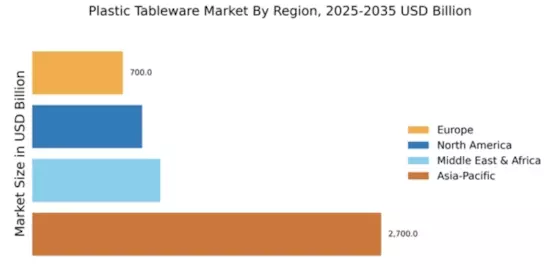
The Asia-Pacific region dominates the plastic tableware market with a staggering valuation of $2700.0M, driven by rapid urbanization and changing consumer lifestyles. The growing foodservice industry, particularly in countries like China and India, is a significant growth driver, as disposable tableware becomes increasingly popular for convenience. Additionally, rising disposable incomes and a shift towards online food delivery services are further propelling market demand in this region. China, Japan, and India are the leading countries in this market, with a competitive landscape featuring major players such as Genpak LLC and Pactiv Evergreen Inc. The presence of numerous local manufacturers also intensifies competition, leading to price wars and innovation in product offerings. As the market continues to expand, companies are focusing on enhancing their distribution networks and product variety to capture a larger share of the growing consumer base.
The Middle East and Africa plastic tableware market, valued at $990.0M, is experiencing growth fueled by urbanization and changing consumer habits. The increasing demand for convenience in foodservice and catering sectors is driving the adoption of plastic tableware. Additionally, government initiatives aimed at promoting local manufacturing are enhancing market dynamics, encouraging investment in the production of disposable tableware to meet rising consumer needs. Countries like South Africa and the UAE are at the forefront of this market, with a competitive landscape that includes both local and international players. Companies are focusing on product innovation and sustainability to cater to the diverse needs of consumers in this region. As the market evolves, the emphasis on quality and affordability will play a crucial role in shaping the competitive environment.
The Plastic Tableware Market is currently characterized by a dynamic competitive landscape, driven by increasing consumer demand for convenience and sustainability. Major players are actively engaging in strategic initiatives to enhance their market positioning. For instance, Dart Container Corporation (US) has focused on innovation in biodegradable materials, aiming to capture the growing segment of environmentally conscious consumers. Similarly, Berry Global Inc. (US) has been investing in advanced manufacturing technologies to improve efficiency and reduce waste, thereby reinforcing its competitive edge. These strategies collectively contribute to a market that is moderately fragmented, with key players vying for dominance through differentiation and operational excellence.In terms of business tactics, companies are increasingly localizing manufacturing to mitigate supply chain disruptions and enhance responsiveness to regional market demands. This approach not only optimizes logistics but also aligns with sustainability goals by reducing transportation emissions. The competitive structure of the market remains moderately fragmented, with several key players influencing overall dynamics through their strategic initiatives and operational capabilities.
In November Huhtamaki Group (FI) announced a partnership with a leading food service provider to develop a new line of compostable tableware. This collaboration is significant as it underscores Huhtamaki's commitment to sustainability and positions the company to meet the rising demand for eco-friendly products. The partnership is expected to enhance Huhtamaki's market share while reinforcing its reputation as a leader in sustainable packaging solutions.
In October Pactiv Evergreen Inc. (US) launched a new product line featuring enhanced durability and design aesthetics aimed at the premium segment of the market. This strategic move is indicative of Pactiv's focus on innovation and quality, which may attract a broader customer base seeking high-end disposable tableware. By diversifying its product offerings, Pactiv Evergreen is likely to strengthen its competitive position in a market that increasingly values both functionality and style.
In September Genpak LLC (US) expanded its production capabilities by investing in a state-of-the-art facility in the Midwest. This expansion is crucial as it not only increases Genpak's production capacity but also enhances its ability to serve regional markets more effectively. The investment reflects a strategic focus on operational efficiency and responsiveness, which are vital in a competitive landscape where speed to market can be a differentiator.
As of December the Plastic Tableware Market is witnessing trends that emphasize digitalization, sustainability, and the integration of AI technologies. Companies are increasingly forming strategic alliances to leverage shared resources and expertise, thereby enhancing their competitive positioning. The shift from price-based competition to a focus on innovation, technology, and supply chain reliability is becoming more pronounced. This evolution suggests that future competitive differentiation will hinge on the ability to adapt to changing consumer preferences and technological advancements.



Report Overview
The report's overview shows the development of the Plastic tableware market across the world. The effective role of key market drivers and the widespread marketing opportunities is propelling the market's growth rate. The key players check the other growth hampering factors to run the business smoothly. The awareness of plastic pollution and a plastic-free environment affected the Plastic tableware market. But the replacement of biodegradable plastics further lifted the market to regain its growth rate. The COVID-19 challenging situation was a tough period for the Plastic tableware market, but the strategies implemented by the key players helped the market restore its growth rate.
The various segments of the market reach the highest CAGR because of the largest share value in the market. The regional report shows the development of the Plastic tableware market Forecast in various regions with the key growth drivers of the regions. If its growth consistency continues, the market is estimated to witness a good CAGR during the review period.
The Plastic Tableware Market is projected to grow at a 4.0% CAGR from 2025 to 2035, driven by increasing consumer demand for convenience and sustainability.
New opportunities lie in:
By 2035, the market is expected to solidify its position as a leader in convenience-oriented dining solutions.
| MARKET SIZE 2024 | 4240.0(USD Billion) |
| MARKET SIZE 2025 | 4460.0(USD Billion) |
| MARKET SIZE 2035 | 6580.0(USD Billion) |
| COMPOUND ANNUAL GROWTH RATE (CAGR) | 4.0% (2025 - 2035) |
| REPORT COVERAGE | Revenue Forecast, Competitive Landscape, Growth Factors, and Trends |
| BASE YEAR | 2024 |
| Market Forecast Period | 2025 - 2035 |
| Historical Data | 2019 - 2024 |
| Market Forecast Units | USD Billion |
| Key Companies Profiled | Dart Container Corporation (US), Solo Cup Company (US), Plastico (BR), Genpak LLC (US), Pactiv Evergreen Inc. (US), Berry Global Inc. (US), Clearwater Paper Corporation (US), Huhtamaki Group (FI) |
| Segments Covered | Application, Material Type, Product Type, End Use, Distribution Channel |
| Key Market Opportunities | Growing demand for sustainable and biodegradable options in the Plastic Tableware Market presents significant opportunities. |
| Key Market Dynamics | Rising consumer preference for sustainable materials drives innovation and competition in the plastic tableware market. |
| Countries Covered | North America, Europe, APAC, South America, MEA |
The overall market valuation of the Plastic Tableware Market was 4240.0 USD Billion in 2024.
The projected valuation for the Plastic Tableware Market in 2035 is 6580.0 USD Billion.
The expected CAGR for the Plastic Tableware Market during the forecast period 2025 - 2035 is 4.0%.
Key players in the Plastic Tableware Market include Dart Container Corporation, Solo Cup Company, and Huhtamaki Group.



Kindly complete the form below to receive a free sample of this Report

“This is really good guys. Excellent work on a tight deadline. I will continue to use you going forward and recommend you to others. Nice job”


“Thanks. It’s been a pleasure working with you, please use me as reference with any other Intel employees.”


“Thanks for sending the report it gives us a good global view of the Betaïne market.”


“Thank you, this will be very helpful for OQS.”


“We found the report very insightful! we found your research firm very helpful. I'm sending this email to secure our future business.”


“I am very pleased with how market segments have been defined in a relevant way for my purposes (such as "Portable Freezers & refrigerators" and "last-mile"). In general the report is well structured. Thanks very much for your efforts.”


“I have been reading the first document or the study, ,the Global HVAC and FP market report 2021 till 2026. Must say, good info! I have not gone in depth at all parts, but got a good indication of the data inside!”


“We got the report in time, we really thank you for your support in this process. I also thank to all of your team as they did a great job.”


“The Automotive 48V ECU Components Procurement Intelligence Study” was a complex project, but the Market Research Future (MRFR) team handled it with quality, agility, and customer-centricity. They delivered all requested data on time and within the agreed scope. The team, including Shubhendra Anand and Rahul Gotadki, was always readily available to clarify questions and swiftly implement necessary adjustments, driving the project to a successful conclusion within a very demanding timeframe.
I would also like to specifically commend Akshay Agarwal for his responsiveness and support at every stage—from our initial inquiry on May 6th through to final delivery on June 18th. His dedication made the entire process seamless.”



