×
Request Free Sample ×

Kindly complete the form below to receive a free sample of this Report

* Please use a valid business email

Leading companies partner with us for data-driven Insights

clients tt-cursor
Hero Background

Plating on Plastics Market

ID: MRFR/CnM/6831-HCR
111 Pages
Priya Nagrale
October 2025

Plating on Plastics (POP) Market Research Report By Plating (Chromium, Copper, Nickel, Others), By Plastics (ABS, Polypropylene, Polyetherimide, Polyethylene terephthalate, Others) and By Application (Automotive, Electrical & Electronics, Sanitary Fittings, Others) – Forecast to 2035

Share:
Download PDF ×

We do not share your information with anyone. However, we may send you emails based on your report interest from time to time. You may contact us at any time to opt-out.

Plating on Plastics Market Infographic
Purchase Options

Plating on Plastics Market Summary

As per MRFR analysis, the Plating on Plastics Market Size was estimated at 3.7 USD Million in 2024. The Plating on Plastics industry is projected to grow from 3.9 in 2025 to 6.6 by 2035, exhibiting a compound annual growth rate (CAGR) of 5.39 during the forecast period 2025 - 2035.

Key Market Trends & Highlights

The Plating on Plastics Market is poised for growth driven by sustainability and technological advancements.

  • North America remains the largest market for plating on plastics, driven by robust demand in the automotive sector.
  • Asia-Pacific is emerging as the fastest-growing region, fueled by increasing applications in consumer electronics.
  • The automotive segment leads in market share, while the functional plating segment is witnessing rapid growth due to customization trends.
  • Key market drivers include rising demand for lightweight materials and regulatory support for sustainable practices.

Market Size & Forecast

2024 Market Size 3.7 (USD Million)
2035 Market Size 6.6 (USD Million)
CAGR (2025 - 2035) 5.39%

Major Players

Atotech (DE), Coventya (FR), MacDermid Alpha Electronics Solutions (US), BASF (DE), DOW (US), Heraeus (DE), KISCO (KR), Nippon Paint (JP), Praxair (US), SABIC (SA)

Plating on Plastics Market Trends

The Plating on Plastics Market is currently experiencing a notable transformation, driven by advancements in technology and increasing demand across various industries. This market encompasses the application of metallic coatings on plastic substrates, enhancing both aesthetic appeal and functional properties. Industries such as automotive, electronics, and consumer goods are increasingly adopting plating techniques to improve product durability and performance. The integration of eco-friendly processes and materials is also gaining traction, as manufacturers seek to align with sustainability goals while meeting consumer expectations for environmentally responsible products. In December 2025, the Plating on Plastics Market appears poised for further growth, as innovations in plating technologies continue to emerge. The shift towards lightweight materials in automotive and aerospace applications is likely to bolster demand for plastic substrates that can be effectively plated. Additionally, the rise of smart electronics and the need for advanced surface finishes may further drive the adoption of plating on plastics. As the market evolves, stakeholders must remain vigilant to emerging trends and consumer preferences, ensuring that they adapt their strategies accordingly.

Sustainability Initiatives

The Plating on Plastics Market is witnessing a growing emphasis on sustainable practices. Manufacturers are increasingly adopting eco-friendly materials and processes to minimize environmental impact. This trend reflects a broader industry shift towards sustainability, as companies strive to meet regulatory requirements and consumer demand for greener products.

Technological Advancements

Innovations in plating technologies are reshaping the Plating on Plastics Market. New methods, such as electroless plating and vacuum metallization, are enhancing the efficiency and quality of coatings. These advancements not only improve the performance of plated products but also expand the range of applications across various sectors.

Customization and Aesthetic Appeal

There is a rising trend towards customization in the Plating on Plastics Market. Consumers increasingly seek unique designs and finishes for their products. This demand for aesthetic appeal drives manufacturers to offer a wider variety of plating options, allowing for greater personalization and differentiation in the marketplace.

Plating on Plastics Market Drivers

Growing Automotive Sector

The Global Plating on Plastics Market (POP) Market Industry is significantly influenced by the growth of the automotive sector. As automotive manufacturers increasingly incorporate plastic components for aesthetic and functional purposes, the demand for plating on these materials rises. This trend is particularly evident in the production of interior and exterior parts, where plated plastics enhance visual appeal and performance. The automotive industry is expected to be a key contributor to the market's expansion, with a projected compound annual growth rate of 5.3% from 2025 to 2035. This growth trajectory underscores the importance of plating technologies in meeting the evolving needs of automotive design and manufacturing.

Market Growth Projections

The Global Plating on Plastics Market (POP) Market Industry is poised for substantial growth, with projections indicating a market size of 469.2 USD Million in 2024 and an anticipated increase to 827.8 USD Million by 2035. This growth trajectory suggests a compound annual growth rate of 5.3% from 2025 to 2035, reflecting the industry's resilience and adaptability to emerging trends. Factors such as technological advancements, rising demand for lightweight materials, and increasing focus on aesthetics contribute to this positive outlook. The market's expansion underscores the importance of plating technologies in various applications, from automotive to consumer electronics, highlighting its integral role in modern manufacturing.

Rising Demand for Lightweight Materials

The Global Plating on Plastics Market (POP) Market Industry experiences a notable surge in demand for lightweight materials across various sectors, particularly in automotive and aerospace. As manufacturers strive to enhance fuel efficiency and reduce emissions, the adoption of lightweight components becomes increasingly critical. For instance, the automotive sector is projected to witness a significant shift towards plastic substrates that can be effectively plated, thereby reducing overall vehicle weight. This trend is expected to contribute to the market's growth, with the industry valued at 469.2 USD Million in 2024, indicating a robust trajectory as companies seek innovative solutions to meet regulatory standards.

Increasing Focus on Aesthetics and Customization

A growing emphasis on aesthetics and customization within various industries is driving the Global Plating on Plastics Market (POP) Market Industry. Consumers increasingly seek personalized products that reflect their individual styles, prompting manufacturers to explore innovative plating options. This trend is particularly pronounced in consumer electronics, where plated plastics are used to enhance the visual appeal of devices. As companies strive to differentiate their offerings in a competitive market, the demand for high-quality plating solutions is likely to rise. This shift towards customization may further propel the market, aligning with the broader trend of personalization across consumer goods.

Technological Advancements in Plating Techniques

Technological advancements play a pivotal role in shaping the Global Plating on Plastics Market (POP) Market Industry. Innovations in electroplating and vacuum metallization techniques are enhancing the efficiency and quality of plating processes. These advancements not only improve adhesion and durability but also expand the range of applications for plated plastics. For example, the introduction of environmentally friendly plating methods aligns with global sustainability goals, appealing to eco-conscious consumers. As these technologies evolve, they are likely to drive market growth, with projections indicating a market size of 827.8 USD Million by 2035, reflecting the industry's adaptability to changing consumer preferences.

Environmental Regulations and Sustainability Initiatives

The Global Plating on Plastics Market (POP) Market Industry is increasingly shaped by stringent environmental regulations and sustainability initiatives. Governments worldwide are implementing policies aimed at reducing the environmental impact of manufacturing processes, which includes the use of eco-friendly plating techniques. Companies are compelled to adopt sustainable practices, such as utilizing non-toxic materials and minimizing waste during production. This shift not only aligns with regulatory requirements but also resonates with environmentally conscious consumers. As a result, the market is expected to witness growth driven by the demand for sustainable plating solutions, reflecting a broader commitment to environmental stewardship.
Market Segment Insights

By Application: Automotive (Largest) vs. Consumer Electronics (Fastest-Growing)

The Plating on Plastics Market is witnessing a dynamic shift in its application segments, with 'Automotive' holding the largest share. This sector leverages plating on plastics extensively to enhance aesthetic appeal and performance characteristics of automotive components. On the other hand, 'Consumer Electronics' is emerging rapidly, driven by increasing demand for lightweight materials and advanced design features in devices, making it one of the fastest-growing segments.

Automotive: Dominant vs. Consumer Electronics: Emerging

The automotive sector remains the dominant player within the Plating on Plastics Market, widely utilizing plating for parts such as trims, emblems, and controls. By combining strength and weight efficiency, plated plastics are properties highly sought after in automotive designs. In contrast, the consumer electronics segment is considered emerging and is quickly gaining traction due to evolving consumer preferences for sleek and stylish devices. This segment benefits from innovations in plating technology that allow for better fidelity in finishing and durability of products, creating a competitive edge over traditional materials.

By End Use: Decorative Plating (Largest) vs. Functional Plating (Fastest-Growing)

The 'End Use' segment of the Plating on Plastics Market consists of key segments such as Decorative Plating and Functional Plating. Decorative Plating holds the largest market share, as it serves the aesthetic needs of various applications including automotive and consumer goods. Functional Plating, which enhances functional properties such as conductivity and corrosion resistance, is rapidly gaining traction and emerging as a vital segment due to its increasing adoption in electronics and other high-tech industries. In terms of growth trends, the increasing demand for aesthetically pleasing products is a significant driver for the Decorative Plating segment. However, the Functional Plating subsidiary is expanding rapidly, fueled by technological advancements and the need for improved performance in various applications. The focus on sustainability and eco-friendly practices is also contributing to the growth of these segments, as manufacturers adopt plating methods that align with industry standards for environmental responsibility.

Decorative Plating (Dominant) vs. Functional Plating (Emerging)

Decorative Plating is characterized by its aesthetic benefits, often utilized in automotive trims and consumer electronics, making it a dominant player in the Plating on Plastics Market. With a focus on visual appeal, this segment relies on various metals to enhance the finish and attractiveness of plastic parts. Conversely, Functional Plating is seen as an emerging segment that enables enhanced electrical conductivity, thermal conductivity, and corrosion resistance. As industries strive for improved material performance, Functional Plating’s importance is growing, making it a critical focus for innovations. While Decorative Plating continues to thrive in traditional markets, Functional Plating is gaining ground in high-tech applications, positioning itself as a significant driver of future growth.

By Material Type: Polycarbonate (Largest) vs. Polypropylene (Fastest-Growing)

The material type segment in the plating on plastics market showcases a diverse distribution among various plastics. Polycarbonate emerges as the largest segment as it is widely adopted for its durability, optical clarity, and compatibility with various plating processes. Following closely are Polypropylene and Acrylic, which are valued for their lightweight nature and processability in different applications. Polyethylene Terephthalate and Polyvinyl Chloride also contribute to the portfolio, serving specialized needs across numerous industries. Together, these materials represent a balanced market share, catering to both conventional and innovative demands in plating on plastics. Growth in this segment is driven by several factors, including technological advancements in plating processes and a growing demand for lightweight, corrosion-resistant materials across industries such as automotive, electronics, and consumer goods. Polycarbonate's established presence continues to capitalize on its attributes, while Polypropylene is quickly gaining traction thanks to its cost-effectiveness and ease of processing, making it the fastest-growing material in recent years. Rising environmental concerns also promote the use of lighter materials, further supporting this segment's expansion.

Polycarbonate (Dominant) vs. Polypropylene (Emerging)

Polycarbonate stands out as the dominant material in the plating on plastics market, primarily due to its mechanical strength and resilience against environmental stressors, making it suitable for a wide range of applications, from automotive components to electronic devices. This material exhibits excellent adhesion properties when coated, providing aesthetic appeal and functional protection. On the other hand, Polypropylene is carving out its niche as an emerging material due to its unrivaled flexibility, chemical resistance, and affordability. As manufacturers seek more sustainable options, Polypropylene offers a compelling balance of properties and cost-effectiveness, thus attracting interest for innovative applications. Both materials are pivotal in shaping future trends within the plating on plastics market.

By Technology: Electroplating (Largest) vs. Electroless Plating (Fastest-Growing)

The plating on plastics market is notably segmented by technology, with electroplating holding the largest share among its counterparts. Electroplating dominates due to its well-established applications in industries like automotive and electronics, where durability and aesthetic appeal are essential. In contrast, electroless plating has garnered significant attention as the fastest-growing segment, appreciated for its ability to coat complex geometries and offering uniform thickness without requiring sophisticated equipment. As industries evolve, the demand for lightweight materials and innovative applications fuels the growth of electroless plating. Additionally, advancements in technology and processes related to environmental sustainability contribute to the increasing adoption. Other technologies, like vacuum metallizing, chemical plating, and plasma spraying, also contribute but lack the same growth trajectory as the leading segments in this evolving market.

Technology: Electroplating (Dominant) vs. Electroless Plating (Emerging)

Electroplating, being the dominant technology in the plating on plastics market, is best known for its capabilities in providing a thick and lustrous metal finish that enhances both the durability and aesthetics of plastic components. Its widespread use across automotive, consumer electronics, and decorative applications underscores its importance. On the other hand, electroless plating emerges as a significant technology for its ability to offer uniform coatings without the need for electrical currents. Its advancements in precision, as well as its versatility in coating difficult shapes, position it effectively in high-growth sectors, particularly in industries demanding robust and lightweight materials, driving its rise as a valuable alternative.

By Process Type: Batch Processing (Largest) vs. Fully Automatic Processing (Fastest-Growing)

In the Plating on Plastics Market, the market share among process types indicates a significant predominance of batch processing, appealing to a wide range of applications due to its versatility and cost-effectiveness. On the other hand, fully automatic processing is emerging rapidly, capturing the interest of industries seeking efficiency and consistent output. This duality reflects the diverse needs and operational capacities of manufacturers in the sector. The growth trends in this market segment are influenced by factors such as increased demand for high-quality finishing and the need for processing solutions that reduce labor costs. As industries transition towards automation, fully automatic processing grows in prominence, often seen as essential in high-demand production settings. This segment is expected to continue its upward trajectory, driven by technological advancements and a push for more sustainable manufacturing processes.

Batch Processing: Dominant vs. Fully Automatic Processing: Emerging

Batch processing has established itself as the dominant method in the Plating on Plastics Market, thanks to its ability to handle varied batch sizes and its flexibility that suits different production needs. It is especially favored in applications requiring customization and lower volume. In contrast, fully automatic processing is recognized as an emerging force, as it significantly enhances production efficiency and ensures uniformity in outcomes. This method is particularly attractive for industries focused on scalability and consistency, leading to a stronger shift toward automation across many production lines. Together, these process types represent the spectrum of operational capabilities, catering to distinct market requirements.

Get more detailed insights about Plating on Plastics Market

Regional Insights

North America : Market Leader in Plating

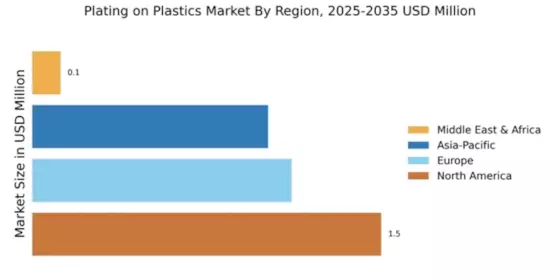
North America is poised to maintain its leadership in the Plating on Plastics market, holding a significant market share of 1.48 in 2024. The region's growth is driven by increasing demand in automotive and electronics sectors, alongside stringent regulations promoting sustainable practices. The adoption of advanced technologies and innovative materials further fuels market expansion, making it a hub for industry advancements. The competitive landscape in North America is characterized by the presence of key players such as MacDermid Alpha Electronics Solutions and DOW. The U.S. stands out as the leading country, supported by a robust manufacturing base and a focus on R&D. Companies are investing in eco-friendly solutions to meet regulatory requirements, enhancing their market position and driving growth in the region.

Europe : Emerging Market Dynamics

Europe's Plating on Plastics market is evolving, with a market size of 1.1 in 2024. The region benefits from a strong automotive industry and increasing demand for lightweight materials. Regulatory frameworks, such as REACH, are driving innovation and sustainability in manufacturing processes, encouraging companies to adopt eco-friendly practices. This regulatory support is crucial for market growth and competitiveness. Leading countries in Europe include Germany and France, where companies like BASF and Coventya are making significant strides. The competitive landscape is marked by a focus on technological advancements and partnerships to enhance product offerings. The presence of established players and a growing emphasis on sustainability are key factors shaping the market dynamics in this region.

Asia-Pacific : Rapid Growth and Innovation

The Asia-Pacific region is witnessing rapid growth in the Plating on Plastics market, with a market size of 1.0 in 2024. Key drivers include the booming electronics and automotive sectors, alongside increasing urbanization and consumer demand for high-quality products. Governments are also implementing supportive policies to boost manufacturing capabilities, further enhancing market potential. Countries like Japan and South Korea are at the forefront, with companies such as Nippon Paint and KISCO leading the charge. The competitive landscape is characterized by a mix of local and international players, all vying for market share. The focus on innovation and technology adoption is crucial for maintaining competitiveness in this dynamic market.

Middle East and Africa : Emerging Opportunities Ahead

The Middle East and Africa (MEA) region, with a market size of 0.12 in 2024, presents emerging opportunities in the Plating on Plastics market. The growth is driven by increasing industrialization and a rising demand for consumer electronics. Governments are investing in infrastructure and manufacturing capabilities, which are expected to catalyze market growth in the coming years. Leading countries in this region include South Africa and Saudi Arabia, where local players are beginning to establish a foothold. The competitive landscape is still developing, with opportunities for international companies to enter the market. As the region continues to evolve, the focus on innovation and sustainability will be key to capturing market share and driving growth.

Key Players and Competitive Insights

The Plating on Plastics Market is characterized by a dynamic competitive landscape, driven by increasing demand for lightweight materials in automotive and electronics applications. Key players are actively pursuing strategies that emphasize innovation, sustainability, and regional expansion. For instance, Atotech (DE) has focused on enhancing its product portfolio through technological advancements, while BASF (DE) has been investing in sustainable solutions to meet the growing environmental regulations. These strategies collectively contribute to a competitive environment that is increasingly shaped by the need for advanced materials and eco-friendly processes.

In terms of business tactics, companies are localizing manufacturing to reduce lead times and optimize supply chains. The market structure appears moderately fragmented, with several players vying for market share. However, the influence of major companies like DOW (US) and Heraeus (DE) is significant, as they leverage their extensive resources and technological capabilities to maintain competitive advantages.

In November 2025, DOW (US) announced a strategic partnership with a leading automotive manufacturer to develop advanced plating solutions aimed at enhancing the durability and aesthetic appeal of automotive components. This collaboration is likely to bolster DOW's position in the market by aligning its innovative capabilities with the specific needs of the automotive sector, thereby enhancing customer satisfaction and loyalty.

In October 2025, Heraeus (DE) launched a new line of eco-friendly plating solutions that utilize less hazardous materials, reflecting a growing trend towards sustainability in manufacturing. This initiative not only positions Heraeus as a leader in environmentally responsible practices but also caters to the increasing regulatory pressures faced by manufacturers globally, potentially expanding its market reach.

In September 2025, MacDermid Alpha Electronics Solutions (US) expanded its operations in Asia by establishing a new manufacturing facility in South Korea. This move is indicative of the company's strategy to tap into the rapidly growing electronics market in the region, allowing for localized production and quicker response times to customer demands. Such expansions are crucial for maintaining competitiveness in a market that is increasingly reliant on regional supply chains.

As of December 2025, the competitive trends in the Plating on Plastics Market are heavily influenced by digitalization, sustainability, and the integration of AI technologies. Strategic alliances are becoming more prevalent, as companies recognize the need to collaborate to enhance their technological capabilities and market reach. The shift from price-based competition to a focus on innovation, technology, and supply chain reliability is evident, suggesting that future competitive differentiation will hinge on the ability to deliver advanced, sustainable solutions that meet evolving customer expectations.

Key Companies in the Plating on Plastics Market market include

Industry Developments

In February 2019, SRG Global Inc, who is a manufacturer of chrome-plated plastic parts for the automotive industry, produced a new polymer for the plating of parts for automobiles.

On April 29, 2024, Cybershield Inc., a U.S. producer of metalized plastic components announced that it is collaborating with SABIC, a global leader in the chemical industry to promote the use of plated ULTEM resins in aerospace. This collaboration will be showcased at NPE2024 and the 2024 Aircraft Interiors Expo (AIX). In this respect, SABIC’s team had imparted to Cybershield their extensive knowledge on injection molding of high-heat ULTEM resins. These are high-performance thermoplastics having excellent mechanical properties, thermal stability, and resistance to harsh environments.

Further benefits can be achieved by metallizing these resins with improved durability against electromagnetic interference shielding (EMI).

Atotech has launched the Atotech CMA Closed-Loop System for alkaline zinc nickel plating on July 28th, 2023. It is certified by TÜV Rheinland and facilitates virtually wastewater-free operations while reducing waste generation to minimize carbon footprinting. The closed-loop system allows all-inclusive functions under such solution covering every aspect of alkaline zinc nickel plating including rinsing process requirements. Implementing this closed-loop water system significantly reduces or eliminates wastewater discharges during plating operations making it an eco-friendly process.

As a result, cleaner and more sustainable operations are realized due to optimizing the plating process by CMA systems which reduces the amount of waste produced. It helps improve overall carbon footprints of the plating process aligning with worldwide sustainability targets.

GROHE AG, world's biggest producer of sanitary fittings continues expanding succeeding in investing in its facility located in Lahr Germany. The development of an electroplating facility allowing chrome-plating plastic parts like showerheads increased plastics chrome-plating capacity at site by up to seventy percent.

Market overview

This global Plating on plastics market outlook report is based on the qualitative and quantitative analysis of the Plating on plastics market outlook. This report highlights the Plating on plastics market outlook on the market overviews, covid-19 analysis, market dynamics, and Plating on plastics market analysis. This plating on the plastics (POP) market also gives an idea about the regional analysis, competitive landscape, and recent development of the market.

Segmental table

By Type

    • Nickel
    • Chrome
    • Others

By Application

    • Automotive
    • Electrical & Electronics
    • Construction & Building
    • Others

By region

    • North America
    • Europe
    • Asia Pacific
    • middle east and Africa
    • Latin America

Future Outlook

Plating on Plastics Market Future Outlook

The Plating on Plastics Market is projected to grow at a 5.39% CAGR from 2024 to 2035, driven by technological advancements, increasing demand in automotive applications, and sustainability initiatives.

New opportunities lie in:

  • Expansion into electric vehicle components with advanced plating techniques.
  • Development of eco-friendly plating solutions to meet regulatory demands.
  • Strategic partnerships with automotive manufacturers for customized plating services.

By 2035, the Plating on Plastics Market is expected to achieve robust growth and innovation.

Market Segmentation

Plating on Plastics Market End Use Outlook

  • Decorative Plating
  • Functional Plating
  • Corrosion Resistance
  • Electrical Conductivity
  • Thermal Conductivity

Plating on Plastics Market Technology Outlook

  • Electroplating
  • Electroless Plating
  • Vacuum Metalizing
  • Chemical Plating
  • Plasma Spraying

Plating on Plastics Market Application Outlook

  • Automotive
  • Consumer Electronics
  • Aerospace
  • Medical Devices
  • Industrial Equipment

Plating on Plastics Market Process Type Outlook

  • Batch Processing
  • Continuous Processing
  • Semi-Automatic Processing
  • Fully Automatic Processing
  • Manual Processing

Plating on Plastics Market Material Type Outlook

  • Polycarbonate
  • Polypropylene
  • Acrylic
  • Polyethylene Terephthalate
  • Polyvinyl Chloride

Report Scope

MARKET SIZE 20243.7(USD Million)
MARKET SIZE 20253.9(USD Million)
MARKET SIZE 20356.6(USD Million)
COMPOUND ANNUAL GROWTH RATE (CAGR)5.39% (2024 - 2035)
REPORT COVERAGERevenue Forecast, Competitive Landscape, Growth Factors, and Trends
BASE YEAR2024
Market Forecast Period2025 - 2035
Historical Data2019 - 2024
Market Forecast UnitsUSD Million
Key Companies ProfiledAtotech (DE), Coventya (FR), MacDermid Alpha Electronics Solutions (US), BASF (DE), DOW (US), Heraeus (DE), KISCO (KR), Nippon Paint (JP), Praxair (US), SABIC (SA)
Segments CoveredApplication, End Use, Material Type, Technology, Process Type
Key Market OpportunitiesAdvancements in eco-friendly plating technologies drive growth in the Plating on Plastics Market.
Key Market DynamicsRising demand for lightweight materials drives innovation in plating on plastics technologies and applications.
Countries CoveredNorth America, Europe, APAC, South America, MEA

Market Highlights

Author
Priya Nagrale
Senior Research Analyst

With an experience of over five years in market research industry (Chemicals & Materials domain), I gather and analyze market data from diverse sources to produce results, which are then presented back to a client. Also, provide recommendations based on the findings. As a Senior Research Analyst, I perform quality checks (QC) for market estimations, QC for reports, and handle queries and work extensively on client customizations. Also, handle the responsibilities of client proposals, report planning, report finalization, and execution

Leave a Comment

FAQs

What is the market’s valuation?

plating on plastics market is expected to rise to a valuation of USD 654.79 million by 2035.

What is the CAGR of the market?

The market is expected to exhibit a strong 4.8% CAGR over the forecast period from 2025-2035.

What are the major drivers in the Plating on plastics market?

The application of Plating on Plastics in automotive and construction are the drivers of the Plating on plastics market.

Which is the leading regional market?

North America holds the largest share in the plating on plastics market.

What are the leading market players?

Leading players in the plating on plastics market include Atotech, SRG Global, and Plamingo, among others.

Download Free Sample

Kindly complete the form below to receive a free sample of this Report

Compare Licence

×
Features License Type
Single User Multiuser License Enterprise User
Price $4,950 $5,950 $7,250
Maximum User Access Limit 1 User Upto 10 Users Unrestricted Access Throughout the Organization
Free Customization
Direct Access to Analyst
Deliverable Format
Platform Access
Discount on Next Purchase 10% 15% 15%
Printable Versions