×
Request Free Sample ×

Kindly complete the form below to receive a free sample of this Report

* Please use a valid business email

Leading companies partner with us for data-driven Insights

clients tt-cursor
Hero Background

Polycaprolactone Polyol Market

ID: MRFR/CnM/2723-CR
107 Pages
Priya Nagrale
July 2017

Polycaprolactone Polyol Market Research Report Information- By Application (Foam, Adhesives, Coating Elastomer and Others), By End-Use (Resin, Footwear, Automotive, Pharmaceutical, Printing, Commodity, Other) - Global Forecast to 2035

Share:
Download PDF ×

We do not share your information with anyone. However, we may send you emails based on your report interest from time to time. You may contact us at any time to opt-out.

Polycaprolactone Polyol Market Infographic
Purchase Options

Polycaprolactone Polyol Market Summary

As per MRFR analysis, the Polycaprolactone Polyol Market Size was estimated at 0.42 USD Million in 2024. The Polycaprolactone Polyol industry is projected to grow from 0.496 in 2025 to 2.64 by 2035, exhibiting a compound annual growth rate (CAGR) of 18.2 during the forecast period 2025 - 2035.

Key Market Trends & Highlights

The Polycaprolactone Polyol Market is experiencing a robust growth trajectory driven by sustainability and innovation.

  • The market is increasingly oriented towards sustainability, with a notable emphasis on biodegradable materials.
  • Technological advancements are enhancing production processes, thereby improving efficiency and product quality.
  • North America remains the largest market, while Asia-Pacific is recognized as the fastest-growing region in this sector.
  • Rising demand for biodegradable materials and regulatory support for eco-friendly products are key drivers propelling market expansion.

Market Size & Forecast

2024 Market Size 0.42 (USD Million)
2035 Market Size 2.64 (USD Million)
CAGR (2025 - 2035) 18.2%

Major Players

BASF SE (DE), Covestro AG (DE), Mitsui Chemicals, Inc. (JP), Perstorp Holding AB (SE), Repsol S.A. (ES), Huntsman Corporation (US), Kraton Corporation (US), LG Chem Ltd. (KR), Eastman Chemical Company (US)

Polycaprolactone Polyol Market Trends

The Polycaprolactone Polyol Market is currently experiencing a notable transformation, driven by increasing demand for sustainable materials across various industries. This market is characterized by its versatility, as polycaprolactone polyol is utilized in applications ranging from coatings and adhesives to flexible foams and elastomers. The growing emphasis on eco-friendly products is prompting manufacturers to explore innovative formulations that incorporate bio-based components, thereby enhancing the appeal of polycaprolactone polyol in the marketplace. Furthermore, advancements in production technologies are likely to improve efficiency and reduce costs, making these materials more accessible to a broader range of applications. In addition to sustainability, the Polycaprolactone Polyol Market is influenced by evolving consumer preferences and regulatory frameworks that favor low-emission and non-toxic alternatives. As industries such as automotive, construction, and consumer goods increasingly prioritize environmental responsibility, the demand for polycaprolactone polyol is expected to rise. This trend suggests a shift towards more responsible manufacturing practices, where the lifecycle impact of materials is carefully considered. Overall, the Polycaprolactone Polyol Market appears poised for growth, driven by innovation, sustainability, and changing market dynamics.

Sustainability Focus

The emphasis on sustainable materials is reshaping the Polycaprolactone Polyol Market. Manufacturers are increasingly adopting eco-friendly practices, leading to the development of bio-based polyols that align with environmental goals.

Technological Advancements

Innovations in production techniques are enhancing the efficiency of polycaprolactone polyol manufacturing. These advancements may lead to reduced costs and improved product quality, making polyols more competitive.

Regulatory Influence

Evolving regulations favoring low-emission and non-toxic materials are impacting the Polycaprolactone Polyol Market. Compliance with these standards is driving demand for safer alternatives in various applications.

Polycaprolactone Polyol Market Drivers

Market Growth Projections

The Global Polycaprolactone Polyol Market Industry is poised for substantial growth, with projections indicating a market size of 700 USD Million in 2024. This growth trajectory is expected to accelerate, with estimates suggesting a market value of 2268.2 USD Million by 2035. The compound annual growth rate of 11.28% from 2025 to 2035 reflects the increasing adoption of polycaprolactone polyol across various sectors, including automotive, packaging, and medical applications. The anticipated expansion underscores the material's versatility and the growing demand for sustainable alternatives in the global market.

Advancements in Polymer Technology

Technological advancements in polymer science significantly influence the Global Polycaprolactone Polyol Market Industry. Innovations in production techniques and formulations enhance the performance characteristics of polycaprolactone polyol, making it suitable for a wider range of applications. For instance, improvements in its mechanical properties and thermal stability allow for its use in high-performance coatings and adhesives. These advancements not only increase the versatility of polycaprolactone polyol but also attract investments in research and development. As a result, the market is expected to grow at a compound annual growth rate of 11.28% from 2025 to 2035, reflecting the industry's commitment to continuous improvement and innovation.

Rising Demand for Biodegradable Materials

The Global Polycaprolactone Polyol Market Industry experiences a surge in demand for biodegradable materials, driven by increasing environmental awareness. As industries seek sustainable alternatives to conventional plastics, polycaprolactone polyol emerges as a viable option due to its biodegradability and eco-friendliness. This trend is particularly evident in packaging, automotive, and consumer goods sectors, where companies are actively pursuing greener solutions. The market is projected to reach 700 USD Million in 2024, reflecting a growing commitment to sustainability. Furthermore, the anticipated growth trajectory suggests that by 2035, the market could expand to 2268.2 USD Million, indicating a robust shift towards environmentally responsible materials.

Growing Applications in the Medical Sector

The Global Polycaprolactone Polyol Market Industry benefits from expanding applications in the medical field, where its biocompatibility and biodegradability are highly valued. Polycaprolactone polyol is increasingly utilized in the production of drug delivery systems, sutures, and tissue engineering scaffolds. These applications are driven by the need for materials that can safely interact with biological systems while minimizing environmental impact. The medical sector's growing reliance on such materials is indicative of a broader trend towards sustainable healthcare solutions. As the market evolves, it is poised for significant growth, with projections indicating a potential market size of 2268.2 USD Million by 2035.

Regulatory Support for Sustainable Practices

Regulatory frameworks promoting sustainable practices significantly impact the Global Polycaprolactone Polyol Market Industry. Governments worldwide are increasingly implementing policies that encourage the use of biodegradable materials in various sectors, including packaging and construction. Such regulations not only create a favorable environment for polycaprolactone polyol but also stimulate demand across industries seeking compliance with environmental standards. This regulatory support is expected to drive market growth, with projections indicating a market size of 700 USD Million in 2024. As sustainability becomes a priority for policymakers, the market is likely to expand further, with potential growth reaching 2268.2 USD Million by 2035.

Increased Investment in Research and Development

Investment in research and development plays a crucial role in shaping the Global Polycaprolactone Polyol Market Industry. Companies are increasingly allocating resources to explore new applications and improve existing formulations of polycaprolactone polyol. This focus on R&D not only enhances product performance but also fosters innovation in sustainable practices. For example, research initiatives aimed at optimizing production processes can lead to cost reductions and improved environmental outcomes. As a result, the market is likely to witness a steady growth trajectory, with an expected compound annual growth rate of 11.28% from 2025 to 2035, reflecting the industry's commitment to advancing polycaprolactone polyol technologies.
Market Segment Insights

By Application: Adhesives (Largest) vs. Foams (Fastest-Growing)

In the Polycaprolactone Polyol Market, the application segment is notably diverse, with adhesives currently holding the largest market share among various applications. This dominance is attributed to the rising demand for adhesive products across multiple industries, including automotive, construction, and consumer goods. Moreover, coatings and elastomers follow closely, showcasing significant engagement within the manufacturing sector, while sealants and foams also present valuable contributions to market dynamics.

Adhesives (Dominant) vs. Foams (Emerging)

Adhesives serve as the foundational application in the Polycaprolactone Polyol Market, owing to their essential role in bonding processes across various industries. They are characterized by outstanding flexibility and durability, making them ideal for use in construction and automotive applications. Conversely, foams represent an emerging and rapidly growing segment, driven by increasing demands for comfort and energy efficiency in insulation applications. Their unique properties of lightweight structure and thermal insulation capability make them highly sought after in consumer goods, furniture, and automotive sectors.

By End Use Industry: Automotive (Largest) vs. Medical (Fastest-Growing)

In the Polycaprolactone Polyol Market, the automotive industry emerges as the largest end-use sector, primarily driven by the increasing adoption of bio-based materials in automotive applications. This segment accounts for a substantial portion of the market share, as manufacturers seek to improve the sustainability of their products while maintaining performance standards. Conversely, the medical industry is witnessing rapid growth, fueled by the rising demand for biocompatible materials in medical devices and drug delivery systems. As advancements in technology and material science continue, the adoption of polycaprolactone polyols in the medical field is set to expand significantly. The growth trends in the Polycaprolactone Polyol Market are indicative of shifting consumer preferences towards sustainable and innovative solutions. The automotive sector benefits from regulatory pressures and a shift towards lighter materials, which enhances fuel efficiency. On the other hand, the medical industry’s growth is attributed to increasing healthcare needs and a focus on patient-centered solutions. These trends suggest a robust future for both segments as they adapt to meet evolving market demands.

Automotive: Dominant vs. Medical: Emerging

The automotive segment is recognized as the dominant force within the Polycaprolactone Polyol Market, characterized by its extensive application in the production of flexible foams, coatings, and adhesives. This segment benefits from robust technological advancements and a growing emphasis on reducing environmental impact through the use of bio-degradable materials. In contrast, the medical segment, while currently emerging, displays significant growth potential due to its unique application in developing drug delivery systems and implantable devices. The characteristics of polycaprolactone, including its biocompatibility and bio-degradability, make it an ideal choice for medical uses. As research progresses, the demand for polycaprolactone polyol in medical applications is likely to increase, driven by innovation and an evolving focus on health solutions.

By Formulation Type: Rigid Polyol (Largest) vs. Flexible Polyol (Fastest-Growing)

In the Polycaprolactone Polyol Market, the formulation type segment is diversified into four key categories: Flexible Polyol, Rigid Polyol, Thermoplastic Polyol, and Thermosetting Polyol. Among these, Rigid Polyol holds the largest market share due to its widespread use in applications requiring durability and thermal stability. Flexible Polyol follows closely, appealing to sectors demanding elasticity, but its share is rapidly increasing due to rising demand for flexible materials in various end-use applications.

Rigid Polyol (Dominant) vs. Flexible Polyol (Emerging)

Rigid Polyol is recognized for its strength and reliability, making it the go-to choice for industries needing sturdy materials, such as construction and automotive. It offers a significant advantage in structural applications, providing superior thermal and mechanical properties. On the other hand, Flexible Polyol is emerging quickly, driven by innovations in consumer goods and packaging applications. Its inherent flexibility and lightweight characteristics make it ideal for products that require adaptability and comfort. The shift towards lightweight solutions in various industries is propelling the growth of Flexible Polyol.

By Production Method: Batch Process (Largest) vs. Continuous Process (Fastest-Growing)

In the Polycaprolactone Polyol Market, the distribution of the production method segment reveals that the batch process holds the largest share due to its widespread adoption in specialty chemical production. This method allows for greater customization and control over the polymerization process. Meanwhile, the continuous process is emerging as the fastest-growing segment, driven by technological advancements and increasing demand for efficiency in polyol production. Growth trends within this segment are heavily influenced by the rising preference for sustainable and environmentally friendly production methods. The continuous process is gaining traction as manufacturers seek to maximize production efficiency and reduce operational costs. Furthermore, advancements in equipment and process controls are making this method more appealing for large-scale polyol production, thereby accelerating its market growth.

Production Method: Batch Process (Dominant) vs. Continuous Process (Emerging)

The batch process remains the dominant production method in the Polycaprolactone Polyol Market, characterized by its flexibility and ability to accommodate smaller production runs. It allows manufacturers to experiment with formulations and adjust production parameters based on specific customer requirements. Conversely, the continuous process is positioned as an emerging contender, offering higher efficiency and reduced cycle times. This method involves a constant feed of raw materials and results in a steady output of polyol, which aligns well with the growing demand for consistent quality and reduced lead times. Both methods have their advantages; however, the trend towards automation and process optimization in the polyethylene supply chain indicates that the continuous process may capture a larger market share in the coming years.

By Physical State: Liquid (Largest) vs. Gel (Fastest-Growing)

In the Polycaprolactone Polyol Market, the physical state segments of liquid, solid, and gel exhibit distinct market share distributions. The liquid segment holds the largest share, driven by its versatile applications in various industries, including adhesives, coatings, and flexible foams. The solid segment, while significant, does not match the liquid's widespread adoption. Gel formulations are gaining traction due to their unique properties, positioning them effectively to capture market interest, especially in specialty applications.

Liquid (Dominant) vs. Gel (Emerging)

The liquid segment of the Polycaprolactone Polyol Market is dominant due to its extensive use in various end-user industries, providing excellent flexibility and compatibility with different formulations. It is particularly favored for applications requiring low viscosity and high processability. In contrast, the gel segment is emerging rapidly, attracting attention for its unique attributes, including enhanced thermal stability and shape retention. While currently smaller in market share, gels are being increasingly adopted for their performance benefits in specific applications like sealants and medical devices. As a result, they represent an exciting area of growth within the market.

Get more detailed insights about Polycaprolactone Polyol Market

Regional Insights

North America : Market Leader in Polyol

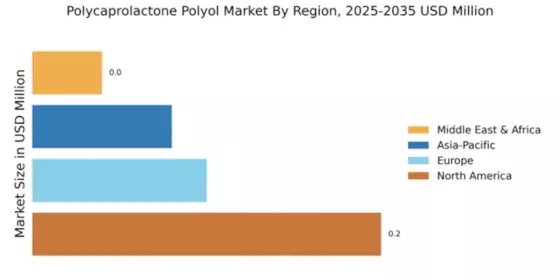
North America is poised to maintain its leadership in the Polycaprolactone Polyol market, holding a significant market share of 20% in 2024. The region's growth is driven by increasing demand in automotive and consumer goods sectors, alongside supportive regulatory frameworks promoting sustainable materials. The focus on eco-friendly products is further catalyzing market expansion, with innovations in production processes enhancing efficiency and reducing environmental impact. The United States stands as the primary market, with key players like BASF SE, Huntsman Corporation, and Kraton Corporation leading the charge. The competitive landscape is characterized by strategic partnerships and investments in R&D, aimed at developing advanced polyol formulations. This dynamic environment is expected to foster continued growth, positioning North America as a hub for polyol innovation and production.

Europe : Emerging Market Dynamics

Europe is witnessing a burgeoning interest in Polycaprolactone Polyol, with a market share of 10% in 2024. The region's growth is fueled by stringent environmental regulations and a shift towards sustainable materials in various industries, including packaging and construction. The European Union's Green Deal is a significant regulatory catalyst, promoting the use of bio-based and biodegradable products, which aligns with the increasing consumer demand for eco-friendly solutions. Germany and France are leading the charge in this market, with major players like Covestro AG and Perstorp Holding AB actively investing in sustainable technologies. The competitive landscape is marked by innovation and collaboration among companies to enhance product offerings. This focus on sustainability is expected to drive further growth in the European Polycaprolactone Polyol market, making it a key player in the global arena.

Asia-Pacific : Emerging Powerhouse in Polyol

Asia-Pacific is emerging as a significant player in the Polycaprolactone Polyol market, with a market share of 8% in 2024. The region's growth is driven by rapid industrialization, increasing consumer demand for flexible and durable materials, and supportive government initiatives aimed at promoting sustainable practices. Countries like China and Japan are at the forefront, with rising investments in manufacturing and innovation in polyol applications. China is the largest market in the region, with key players such as Mitsui Chemicals, Inc. and LG Chem Ltd. expanding their operations to meet the growing demand. The competitive landscape is characterized by a mix of local and international companies striving to capture market share through innovative product development. This dynamic environment is expected to propel the Asia-Pacific Polycaprolactone Polyol market to new heights in the coming years.

Middle East and Africa : Resource-Rich Frontier

The Middle East and Africa region is gradually emerging in the Polycaprolactone Polyol market, holding a market share of 4% in 2024. The growth is primarily driven by increasing industrial activities and a rising demand for sustainable materials in various sectors, including automotive and construction. Government initiatives aimed at diversifying economies and promoting green technologies are also contributing to market expansion in this region. Countries like South Africa and the UAE are leading the way, with local companies exploring opportunities in polyol production. The competitive landscape is still developing, with a few key players beginning to establish their presence. As investments in infrastructure and technology increase, the Middle East and Africa are expected to see significant growth in the Polycaprolactone Polyol market, positioning it as a future hub for production and innovation.

Key Players and Competitive Insights

The Polycaprolactone Polyol Market is currently characterized by a dynamic competitive landscape, driven by increasing demand for sustainable materials and innovations in polymer chemistry. Key players such as BASF SE (Germany), Covestro AG (Germany), and Huntsman Corporation (US) are actively shaping the market through strategic initiatives. BASF SE (Germany) has positioned itself as a leader in sustainability, focusing on bio-based polyols, which aligns with the growing consumer preference for eco-friendly products. Covestro AG (Germany) emphasizes innovation in its product offerings, particularly in developing high-performance polyols that cater to diverse applications, thereby enhancing its competitive edge. Huntsman Corporation (US) is leveraging its extensive research capabilities to introduce advanced polyol formulations, which further intensifies the competitive dynamics within the market.

The business tactics employed by these companies reflect a concerted effort to optimize supply chains and localize manufacturing processes. The market structure appears moderately fragmented, with several players vying for market share while also collaborating on joint ventures and partnerships. This collective influence of key players fosters a competitive environment where innovation and operational efficiency are paramount.

In November 2025, Covestro AG (Germany) announced a strategic partnership with a leading automotive manufacturer to develop bio-based polyol solutions for electric vehicle applications. This collaboration is significant as it not only enhances Covestro's product portfolio but also positions the company at the forefront of the rapidly evolving electric vehicle market, which is increasingly prioritizing sustainable materials.

In October 2025, BASF SE (Germany) launched a new line of polycaprolactone polyols designed specifically for the coatings industry. This product introduction is crucial as it addresses the growing demand for high-performance coatings that are both durable and environmentally friendly, thereby reinforcing BASF's commitment to sustainability and innovation.

In September 2025, Huntsman Corporation (US) expanded its production capacity for polycaprolactone polyols in response to rising global demand. This expansion is indicative of Huntsman's proactive approach to market trends, allowing the company to better serve its customers and maintain a competitive advantage in a growing market.

As of December 2025, the competitive trends within the Polycaprolactone Polyol Market are increasingly defined by digitalization, sustainability, and the integration of advanced technologies such as AI. Strategic alliances are becoming more prevalent, enabling companies to pool resources and expertise to drive innovation. The shift from price-based competition to a focus on technological advancement and supply chain reliability is evident, suggesting that future competitive differentiation will hinge on the ability to innovate and adapt to changing market demands.

Key Companies in the Polycaprolactone Polyol Market market include

Industry Developments

June 2023-Sabic said that it has agreed with Teijin on new products made from PCL. Both companies are going to make various materials based on PCL, including those for vehicles, gadgets and medical devices.

May 2023 – BASF announced that its newly built plant in China for PCL has started production. The factory has a capacity of up to 50 thousand MT/year which will satisfy the increasing Asian demand.

BASF began manufacturing Sovermol at Mangalore, India, in March 2023 as its first bio-based polyol. BASF continues to support sustainable and environmentally friendly products through a focus on bio-based materials

In 2023, Solvay launched several breakthrough products aiming automotive and electronic industry.

December 2022: Innovative hybrid biomaterials blending PLC with bioactive glasses and calcium phosphate-based ceramics have been shown to improve their mechanical strength, degradation rates can be controlled, leading to greater levels of bioactivity. These developments make them perfect biomaterials applied in bone tissue engineering. Meanwhile, the use of polycaprolactone triols in polyurethane coatings introduces a new frontier in material science. These triols contribute to coatings with superior UV resistance, higher abrasion resistance, and improved tensile/ tear strength. Furthermore, their excellent resistance to oils and fuels heralds a new era in creating more durable and versatile polyurethane formulations.

Future Outlook

Polycaprolactone Polyol Market Future Outlook

The Polycaprolactone Polyol Market is projected to grow at an 18.2% CAGR from 2024 to 2035, driven by increasing demand in bio-based applications and sustainable materials.

New opportunities lie in:

  • Development of bio-based polyol formulations for eco-friendly products.
  • Expansion into emerging markets with tailored product offerings.
  • Investment in R&D for innovative applications in automotive and construction sectors.

By 2035, the Polycaprolactone Polyol Market is expected to achieve substantial growth and diversification.

Market Segmentation

Polycaprolactone Polyol Market Application Outlook

  • Adhesives
  • Coatings
  • Foams
  • Elastomers
  • Sealants

Polycaprolactone Polyol Market Physical State Outlook

  • Liquid
  • Solid
  • Gel

Polycaprolactone Polyol Market End Use Industry Outlook

  • Automotive
  • Construction
  • Consumer Goods
  • Electronics
  • Medical

Polycaprolactone Polyol Market Formulation Type Outlook

  • Flexible Polyol
  • Rigid Polyol
  • Thermoplastic Polyol
  • Thermosetting Polyol

Polycaprolactone Polyol Market Production Method Outlook

  • Batch Process
  • Continuous Process
  • Semi-Continuous Process

Report Scope

MARKET SIZE 20240.42(USD Million)
MARKET SIZE 20250.496(USD Million)
MARKET SIZE 20352.64(USD Million)
COMPOUND ANNUAL GROWTH RATE (CAGR)18.2% (2024 - 2035)
REPORT COVERAGERevenue Forecast, Competitive Landscape, Growth Factors, and Trends
BASE YEAR2024
Market Forecast Period2025 - 2035
Historical Data2019 - 2024
Market Forecast UnitsUSD Million
Key Companies ProfiledBASF SE (DE), Covestro AG (DE), Mitsui Chemicals, Inc. (JP), Perstorp Holding AB (SE), Repsol S.A. (ES), Huntsman Corporation (US), Kraton Corporation (US), LG Chem Ltd. (KR), Eastman Chemical Company (US)
Segments CoveredApplication, End Use Industry, Formulation Type, Production Method, Physical State
Key Market OpportunitiesGrowing demand for sustainable materials drives innovation in the Polycaprolactone Polyol Market.
Key Market DynamicsRising demand for sustainable materials drives innovation and competition in the Polycaprolactone Polyol market.
Countries CoveredNorth America, Europe, APAC, South America, MEA

Market Highlights

Author
Priya Nagrale
Senior Research Analyst

With an experience of over five years in market research industry (Chemicals & Materials domain), I gather and analyze market data from diverse sources to produce results, which are then presented back to a client. Also, provide recommendations based on the findings. As a Senior Research Analyst, I perform quality checks (QC) for market estimations, QC for reports, and handle queries and work extensively on client customizations. Also, handle the responsibilities of client proposals, report planning, report finalization, and execution

Leave a Comment

FAQs

How much is the global polycaprolactone polyol market worth in the future?

The valuation of the global polycaprolactone polyol market is projected to reach USD 700 MN by 2023.

At what CAGR is the global polycaprolactone polyol market projected to grow in the forecast period (2016-2024)?

The valuation of the global polycaprolactone polyol market is estimated to expand at 11.28% during the forecast period (2024-2035).

What are the major tailwinds pushing the growth of the global polycaprolactone polyol market?

Rapid growth in the major end-user industries, Technological advancement.

Which region holds the largest share in the global polycaprolactone polyol market?

Asia Pacific holds the largest share in the global polycaprolactone polyol market, followed by Europe and North America, respectively.

Who are the top players in the global polycaprolactone polyol market?

BASF SE, Gantrade Corporation, Sigma Aldrich, Perstrop Holding A.B., Shenzhen Esun Industrial Co., Ltd, Daicel Corporation, and Huntsman International LLC, are some of the major players operating in the polycaprolactone polyol market.

Download Free Sample

Kindly complete the form below to receive a free sample of this Report

Compare Licence

×
Features License Type
Single User Multiuser License Enterprise User
Price $4,950 $5,950 $7,250
Maximum User Access Limit 1 User Upto 10 Users Unrestricted Access Throughout the Organization
Free Customization
Direct Access to Analyst
Deliverable Format
Platform Access
Discount on Next Purchase 10% 15% 15%
Printable Versions