Request Free Sample ×

Kindly complete the form below to receive a free sample of this Report

* Please use a valid business email

Leading companies partner with us for data-driven Insights

clients tt-cursor
Hero Background

Polyether Amine Market

ID: MRFR/CnM/2900-HCR
140 Pages
Chitranshi Jaiswal
Last Updated: May 15, 2026
Polyether Amine Market Research Report Information by Type (Monoamine, Diamine, Triamine and Others), Application (Polyurea, Composites, Fuel Additives, Epoxy Coatings, Adhesives and Sealants and Others) And By Region (North America, Europe, Asia-Pacific, And Rest Of The World) –Market Forecast Till 2035.
Download PDF ×

We do not share your information with anyone. However, we may send you emails based on your report interest from time to time. You may contact us at any time to opt-out.

⚠ CRITICAL SUPPLY CHAIN & PRICE VOLATILITY ALERT
Middle East Conflict Disrupts Chemical Feedstock Flows & Triggers Price Volatility Across Naphtha, LPG, Natural Gas Derivatives, Steel Feedstocks & Fertilizers — 20% of Global LNG Exports at Risk, Supply Chains Rerouting | Get Real-Time Impact Analysis, Pricing Scenarios & Alternative Sourcing Strategies

Polyether Amine Market Summary

As per Market Research Future analysis, the Polyether Amine Market Size was estimated at 0.96 USD Billion in 2024. The Polyether Amine industry is projected to grow from 1.039 USD Billion in 2025 to 2.287 USD Billion by 2035, exhibiting a compound annual growth rate (CAGR) of 8.21% during the forecast period 2025 - 2035

Key Market Trends & Highlights

The Polyether Amine Market is poised for robust growth driven by sustainability and technological advancements.

  • North America remains the largest market for polyether amines, reflecting strong demand across various industries.
  • The Asia-Pacific region is emerging as the fastest-growing market, fueled by rapid industrialization and urbanization.
  • Monoamine segments dominate the market, while diamine segments are witnessing the fastest growth due to diverse applications.
  • Key market drivers include rising demand in the construction sector and an increased focus on sustainable products.

Market Size & Forecast

2024 Market Size 0.96 (USD Billion)
2035 Market Size 2.287 (USD Billion)
CAGR (2025 - 2035) 8.21%

Major Players

Huntsman Corporation (US), BASF SE (DE), Evonik Industries AG (DE), Air Products and Chemicals, Inc. (US), Mitsui Chemicals, Inc. (JP), Kraton Corporation (US), DOW Chemical Company (US), Hexion Inc. (US), Solvay SA (BE)

Our Impact
Enabled $4.3B Revenue Impact for Fortune 500 and Leading Multinationals
Partnering with 2000+ Global Organizations Each Year
30K+ Citations by Top-Tier Firms in the Industry

Polyether Amine Market Trends

The Polyether Amine Market is currently experiencing a dynamic phase characterized by evolving applications and increasing demand across various sectors. This market encompasses a range of products utilized in diverse industries, including coatings, adhesives, and composites. The versatility of polyether amines, attributed to their unique chemical properties, positions them as essential components in formulations that require durability and performance. As industries seek to enhance product quality and sustainability, the Polyether Amine Market appears poised for growth, driven by innovation and technological advancements. Moreover, the ongoing shift towards environmentally friendly materials is influencing the landscape of the Polyether Amine Market. Manufacturers are increasingly focusing on developing bio-based and low-emission alternatives to meet regulatory standards and consumer preferences. This trend suggests a potential for new product development and market expansion, as companies strive to align with sustainability goals. The interplay between traditional applications and emerging trends indicates a complex yet promising future for the Polyether Amine Market, where adaptability and responsiveness to market needs will be crucial for success.

Sustainability Initiatives

The Polyether Amine Market is witnessing a notable shift towards sustainable practices. Manufacturers are increasingly investing in eco-friendly production methods and bio-based raw materials. This trend reflects a broader commitment to reducing environmental impact and meeting consumer demand for greener products.

Technological Advancements

Innovations in chemical processing and formulation technologies are shaping the Polyether Amine Market. Enhanced production techniques are leading to improved product performance and efficiency. These advancements may provide competitive advantages for companies that adopt them.

Diverse Application Growth

The range of applications for polyether amines is expanding, particularly in sectors such as construction, automotive, and electronics. This diversification indicates a growing recognition of the material's versatility and effectiveness in various formulations, potentially driving market growth.

Polyether Amine Market Drivers

Rising Demand in Construction Sector

The Polyether Amine Market is experiencing a notable surge in demand driven by the construction sector. Polyether amines are increasingly utilized in the formulation of epoxy resins, which are essential for coatings, adhesives, and sealants. The construction industry, which has been expanding due to urbanization and infrastructure development, is projected to grow at a compound annual growth rate of approximately 5.5% over the next few years. This growth is likely to bolster the demand for polyether amines, as they enhance the performance and durability of construction materials. Furthermore, the increasing focus on sustainable building practices may further propel the adoption of polyether amines, as they can contribute to the development of eco-friendly construction solutions.

Advancements in Chemical Manufacturing

Technological innovations in chemical manufacturing processes are significantly influencing the Polyether Amine Market. Enhanced production techniques, such as the use of more efficient catalysts and greener synthesis methods, are likely to improve the yield and reduce the environmental impact of polyether amine production. These advancements may lead to a reduction in production costs, making polyether amines more accessible to various industries. As a result, the market could witness an increase in applications across diverse sectors, including automotive, aerospace, and electronics. The ability to produce high-quality polyether amines at a lower cost may also stimulate competition among manufacturers, further driving market growth.

Increased Focus on Sustainable Products

There is a growing emphasis on sustainability within the Polyether Amine Market, as consumers and manufacturers alike seek eco-friendly alternatives. Polyether amines can be produced from renewable resources, which aligns with the global trend towards sustainable manufacturing practices. This shift is prompting companies to invest in research and development to create bio-based polyether amines that meet environmental standards. The increasing regulatory pressure to reduce carbon footprints and enhance product sustainability is likely to drive the demand for these materials. As a result, the market may see a rise in the production and consumption of sustainable polyether amines, catering to environmentally conscious consumers.

Growing Demand in the Automotive Industry

The automotive sector is emerging as a significant driver for the Polyether Amine Market. Polyether amines are utilized in the production of lightweight composite materials, which are increasingly favored in vehicle manufacturing to enhance fuel efficiency and reduce emissions. The automotive industry is projected to witness a steady growth rate, with a focus on electric vehicles and advanced materials. This shift is likely to increase the demand for polyether amines, as they play a crucial role in the development of high-performance components. Additionally, the trend towards more sustainable automotive solutions may further elevate the importance of polyether amines in this sector.

Expansion of the Adhesives and Sealants Market

The adhesives and sealants market is experiencing robust growth, which is positively impacting the Polyether Amine Market. Polyether amines are integral to formulating high-performance adhesives and sealants that are used in various applications, including construction, automotive, and consumer goods. The adhesives and sealants market is expected to grow at a compound annual growth rate of around 6% in the coming years, driven by increasing demand for durable and efficient bonding solutions. This growth is likely to create new opportunities for polyether amine manufacturers, as they seek to develop innovative products that meet the evolving needs of end-users.
Market Segment Insights

By Type: Monoamine (Largest) vs. Diamine (Fastest-Growing)

In the Polyether Amine Market, the segment distribution showcases a diverse range of products, with Monoamine being the largest contributor. Its prominence can be attributed to its extensive application in industries such as coatings, adhesives, and composite materials. Meanwhile, the Diamine segment, while not as large as Monoamine, is growing rapidly, driven by increased demand in various end-use sectors due to its favorable properties. This duality highlights the pivotal roles played by these compound types in the overall market dynamics.

Monoamine (Dominant) vs. Diamine (Emerging)

Monoamine stands as the dominant force in the Polyether Amine Market, characterized by its versatility and efficacy in a myriad of applications, particularly in the formulation of epoxy resins and curing agents. Its stable demand across diverse industries underpins its leading market position. Conversely, the Diamine segment, recognized as an emerging player, is capturing attention due to its superior performance in specialized applications. With growing interest in advanced materials, Diamine is experiencing rapid growth, attributed to its exceptional chemical properties and the increasing push for sustainable alternatives in manufacturing processes.

By Application: Polyurea (Largest) vs. Epoxy Coatings (Fastest-Growing)

The Polyether Amine Market exhibits a diverse application landscape with Polyurea leading the pack as the largest segment. This dominance is attributed to its versatile applications in coatings, adhesives, and sealants, particularly in the construction industry. Following Polyurea, Epoxy Coatings represent a significant share, driven by their widespread use in automotive and industrial applications, showcasing a strong competitive stance within the segment. Current growth trends indicate that while Polyurea remains prominent, Epoxy Coatings are rapidly emerging as the fastest-growing sector. This surge is fueled by increasing demand for high-performance coatings in various industries, including automotive, aerospace, and construction, which increasingly prioritize durability and chemical resistance. As sustainability becomes more critical, these applications adapt, giving further impetus to growth in Epoxy Coatings.

Polyurea (Dominant) vs. Epoxy Coatings (Emerging)

Polyurea stands out as a dominant force in the Polyether Amine Market due to its fast curing properties and superior resilience, making it ideal for protective coatings and linings in harsh environments. The increasing adoption of Polyurea in construction and infrastructure projects enhances its market position. In contrast, Epoxy Coatings have emerged as a vital segment characterized by their superior adhesive strength and chemical resistance. This segment is gaining traction from industries seeking robust solutions for temperature fluctuations and chemical exposure. The rising trend towards durable and sustainable materials is likely to propel Epoxy Coatings further, establishing themselves as a formidable player in the polyether amine application market.

Get more detailed insights about Polyether Amine Market

Regional Insights

North America : Innovation and Demand Surge

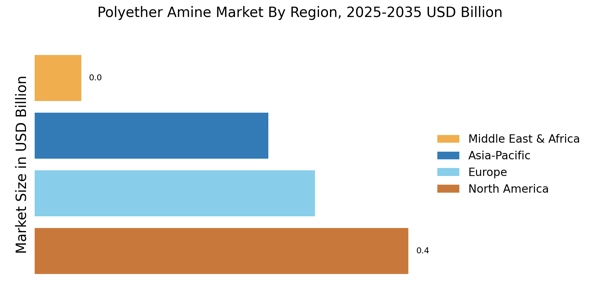
North America is witnessing robust growth in the Polyether Amine Market, driven by increasing demand from the automotive and aerospace sectors. The region holds approximately 40% of the global market share, making it the largest market. Regulatory support for sustainable materials and innovations in manufacturing processes are key catalysts for this growth. The rising trend towards lightweight materials is further propelling demand for polyether amines in various applications. The United States is the leading country in this region, hosting major players such as Huntsman Corporation and DOW Chemical Company. The competitive landscape is characterized by significant investments in R&D and strategic partnerships among key players. The presence of advanced manufacturing facilities and a strong supply chain network enhances the region's market position, ensuring a steady supply of polyether amines to meet growing industrial needs.

Europe : Sustainability and Innovation Focus

Europe is emerging as a significant player in the Polyether Amine Market, driven by stringent environmental regulations and a strong focus on sustainability. The region accounts for approximately 30% of the global market share, making it the second-largest market. Regulatory frameworks promoting eco-friendly materials and innovations in chemical processes are key growth drivers. The increasing demand for polyether amines in construction and automotive applications is also contributing to market expansion. Germany and France are the leading countries in this region, with major companies like BASF SE and Evonik Industries AG playing pivotal roles. The competitive landscape is marked by a strong emphasis on research and development, with companies investing in sustainable production methods. The presence of a well-established chemical industry and collaboration among stakeholders further enhances the region's market dynamics.

Asia-Pacific : Rapid Industrialization and Growth

Asia-Pacific is experiencing rapid growth in the Polyether Amine Market, fueled by industrialization and increasing demand from various sectors, including construction and automotive. The region holds approximately 25% of the global market share, driven by countries like China and Japan. The growing focus on infrastructure development and urbanization is propelling the demand for polyether amines, supported by favorable government policies and investments in manufacturing. China is the largest market in this region, with significant contributions from companies like Mitsui Chemicals, Inc. and Kraton Corporation. The competitive landscape is characterized by a mix of local and international players, with a strong emphasis on innovation and cost-effective production methods. The presence of a large consumer base and increasing investments in R&D are further enhancing the region's market potential.

Middle East and Africa : Emerging Markets and Opportunities

The Middle East and Africa region is witnessing emerging opportunities in the Polyether Amine Market, driven by increasing industrial activities and infrastructure projects. The region holds approximately 5% of the global market share, with significant growth potential. The demand for polyether amines is being fueled by the construction and oil & gas sectors, supported by government initiatives to diversify economies and promote industrialization. Countries like South Africa and the UAE are leading the market in this region, with a growing presence of international players. The competitive landscape is evolving, with local manufacturers increasingly entering the market. The focus on sustainable practices and the development of new applications for polyether amines are expected to drive future growth, making this region an attractive market for investment.

Polyether Amine Market Regional Image

Key Players and Competitive Insights

Leading market players are investing heavily in research and development in order to expand their product lines, which will help the polyether amine market grow even more. Market participants are also undertaking various strategic activities to expand their footprint, with important market developments including new product launches, contractual agreements, mergers and acquisitions, higher investments, and collaboration with other organizations. The polyether amine industry must offer cost-effective items to expand and survive in a more competitive and rising market climate. Manufacturing locally to minimize operational costs is one of the key business tactics manufacturers use in the polyether amine industry to benefit clients and increase the market sector. The polyether amine industry has offered some of the most significant advantages in recent years. Major players in the polyether amine market, including Clariant (Switzerland), Huntsman International LLC (US), ZIBO DEXIN LIANBANG CHEMICAL INDUSTRY CO., LTD (China), Yangzhou Chenhua New Material Co., Ltd (China), Yantai Dasteck Chemicals Co., Ltd (China), BASF SE (Germany), Qingdao IRO Surfactant Co., Ltd, and WUXI ACRYL TECHNOLOGY CO., LTD (China) and others, are attempting to increase market demand by investing in research and development operations. At BASF think people are the key to long-term success, and everyone has talent. It give employees the resources, direction, and chances they need to advance and succeed in both their professional and personal lives to do this. It create chemistry by giving you the assistance required to perform at peak and achieve your goals. Clariant (Switzerland), Clariant, one of the top specialty chemical manufacturers in the world, creates value for its clients across various industries by providing creative and sustainable solutions. Our portfolio is created with the utmost precision to satisfy very specific needs. In addition, our research and development address the day's main trends. These include resource conservation, use of renewable raw materials, emission-free transportation, and energy efficiency. Care Chemicals, Adsorbents and Additives, and Catalysts are the three business units under which Clariant is organized. The company had 11148 employees as of December 31, 2022.

Key Companies in the Polyether Amine Market include

Industry Developments

February 2021: From Audax Private Equity, Huntsman International LLC purchased Gabriel Performance Products (Gabriel), a North American manufacturer of specialty additives and epoxy curing agents for the coatings, adhesives, sealants, and composite end-markets.

Future Outlook

Polyether Amine Market Future Outlook

The Polyether Amine Market is projected to grow at an 8.21% CAGR from 2025 to 2035, driven by increasing demand in coatings, adhesives, and composites.

New opportunities lie in:

  • Development of bio-based polyether amines for sustainable applications.
  • Expansion into emerging markets with tailored product offerings.
  • Investment in R&D for high-performance polyether amines in aerospace.

By 2035, the Polyether Amine Market is expected to achieve robust growth and diversification.

Market Segmentation

Polyether Amine Market Type Outlook

  • Monoamine
  • Diamine
  • Triamine
  • Others

Polyether Amine Market Application Outlook

  • Polyurea
  • Composites
  • Fuel Additives
  • Epoxy Coatings
  • Adhesives and Sealants
  • Others

Report Scope

MARKET SIZE 2024 0.96(USD Billion)
MARKET SIZE 2025 1.039(USD Billion)
MARKET SIZE 2035 2.287(USD Billion)
COMPOUND ANNUAL GROWTH RATE (CAGR) 8.21% (2025 - 2035)
REPORT COVERAGE Revenue Forecast, Competitive Landscape, Growth Factors, and Trends
BASE YEAR 2024
Market Forecast Period 2025 - 2035
Historical Data 2019 - 2024
Market Forecast Units USD Billion
Key Companies Profiled Huntsman Corporation (US), BASF SE (DE), Evonik Industries AG (DE), Air Products and Chemicals, Inc. (US), Mitsui Chemicals, Inc. (JP), Kraton Corporation (US), DOW Chemical Company (US), Hexion Inc. (US), Solvay SA (BE)
Segments Covered Type, Region
Key Market Opportunities Growing demand for eco-friendly coatings and adhesives drives innovation in the Polyether Amine Market.
Key Market Dynamics Rising demand for eco-friendly formulations drives innovation and competition in the Polyether Amine market.
Countries Covered North America, Europe, APAC, South America, MEA

FAQs

What is the projected market valuation of the Polyether Amine Market by 2035?

The Polyether Amine Market is projected to reach a valuation of 2.287 USD Billion by 2035.

What was the market valuation of the Polyether Amine Market in 2024?

In 2024, the Polyether Amine Market had a valuation of 0.96 USD Billion.

What is the expected CAGR for the Polyether Amine Market during the forecast period 2025 - 2035?

The expected CAGR for the Polyether Amine Market during the forecast period 2025 - 2035 is 8.21%.

Which companies are considered key players in the Polyether Amine Market?

Key players in the Polyether Amine Market include Huntsman Corporation, BASF SE, Evonik Industries AG, and DOW Chemical Company.

What are the main types of Polyether Amine and their market values?

The main types include Monoamine, Diamine, and Triamine, with market values of 0.915, 0.672, and 0.456 USD Billion respectively by 2035.

What applications are driving the growth of the Polyether Amine Market?

Applications such as Epoxy Coatings and Polyurea are driving growth, with projected market values of 0.688 and 0.464 USD Billion by 2035.

How does the Polyether Amine Market's growth compare across different applications?

The Epoxy Coatings segment shows the highest growth potential, with a projected value increase to 0.688 USD Billion by 2035.

What was the market value of the Diamine segment in 2024?

In 2024, the market value of the Diamine segment was 0.288 USD Billion.

What is the expected growth trend for the Others segment in the Polyether Amine Market?

The Others segment is expected to grow, with a projected market value of 0.224 USD Billion by 2035.

How do the market values of Monoamine and Triamine compare in 2035?

By 2035, the market value of Monoamine is projected to be 0.915 USD Billion, while Triamine is expected to reach 0.456 USD Billion.
Author
Author
Author Profile
Chitranshi Jaiswal LinkedIn
Team Lead - Research
Chitranshi is a Team Leader in the Chemicals & Materials (CnM) and Energy & Power (EnP) domains, with 6+ years of experience in market research. She leads and mentors teams to deliver cross-domain projects that equip clients with actionable insights and growth strategies. She is skilled in market estimation, forecasting, competitive benchmarking, and both primary & secondary research, enabling her to turn complex data into decision-ready insights. An engineer and MBA professional, she combines technical expertise with strategic acumen to solve dynamic market challenges. Chitranshi has successfully managed projects that support market entry, investment planning, and competitive positioning, while building strong client relationships. Certified in Advanced Excel & Power BI she leverages data-driven approaches to ensure accuracy, clarity, and impactful outcomes.
Leave a Comment

Research Approach

Secondary Research

The secondary research process involved comprehensive analysis of regulatory filings, peer-reviewed chemical engineering journals, industry publications, and authoritative chemical industry organizations. Key sources included the US Environmental Protection Agency (EPA), European Chemicals Agency (ECHA), American Chemical Society (ACS), Royal Society of Chemistry (RSC), German Chemical Industry Association (VCI), China Petroleum and Chemical Industry Federation (CPCIF), Japan Chemical Industry Association (JCIA), International Council of Chemical Associations (ICCA), US Energy Information Administration (EIA), International Energy Agency (IEA), OECD Chemicals and Biotechnology Statistics, UN Comtrade Database, EU Eurostat Industrial Production Database, US Census Bureau Chemical Manufacturing Surveys, and national chemical ministry reports from key markets. These sources were used to collect production capacity data, regulatory compliance frameworks, safety and handling guidelines, feedstock price trends, import/export statistics, and competitive landscape analysis for monoamine, diamine, triamine, and other polyether amine chemistries across polyurea, composites, fuel additives, epoxy coatings, adhesives and sealants, and other end-use applications.

Primary Research

Qualitative and quantitative insights were obtained by interviewing supply-side and demand-side stakeholders during the primary research process. CEOs, VPs of Manufacturing, leaders of R&D, regulatory affairs managers, and commercial directors from polyether amine manufacturers, specialty chemical producers, and epoxy curing agent OEMs comprised supply-side sources. Demand-side sources included procurement heads from coating formulators, composite manufacturers, fuel additive blenders, polyurea applicators, and adhesives and sealants compounders, as well as technical directors from automotive OEMs, construction chemical companies, and wind energy composite fabricators. The primary research validated market segmentation by molecular architecture (monoamine, diamine, triamine), confirmed product development pipelines and capacity expansion timelines, and gathered insights on formulation adoption patterns, raw material sourcing strategies, and pricing dynamics influenced by propylene oxide and ethylene oxide feedstock volatility.

Primary Respondent Breakdown:

By Designation: C-level Primaries (32%), Director Level (30%), Others (38%)

By Region: North America (32%), Europe (30%), Asia-Pacific (30%), Rest of World (8%)

Market Size Estimation

Global market valuation was derived through revenue mapping and volume analysis. The methodology included:

Identification of 40+ key manufacturers across North America, Europe, Asia-Pacific, and Latin America

Product mapping across monoamine, diamine, triamine, and other polyether amine categories

Application-level mapping across polyurea, composites, fuel additives, epoxy coatings, adhesives and sealants, and other segments

Analysis of reported and modeled annual revenues specific to polyether amine portfolios

Coverage of manufacturers representing 70–75% of global market share in 2024

Extrapolation using bottom-up (application volume × ASP by country/region) and top-down (manufacturer revenue validation) approaches to derive segment-specific valuations

Key differences from your reference: Adjusted percentages across all breakdown categories, shifted primary respondent focus from medical/aesthetic stakeholders to chemical industry supply chain and end-use formulators, and aligned sources with chemical regulatory and trade bodies rather than medical societies.

Download Free Sample

Kindly complete the form below to receive a free sample of this Report