×
Hero Background
English
Chinese
French
Japanese
Korean
German
Spanish

Polymer Nanocomposites Market Trends

ID: MRFR/CnM/10261-HCR
128 Pages
Priya Nagrale
October 2025

Polymer Nanocomposites Market Research Report Information By Type (Carbon Nanotubes, Metal Oxide, Nanofiber, Nanoclay, Graphene, and Others (Expanded graphite, Recycled paper, Wood, Recycled fibers)), By Application (Packaging, Automotive, Electronics & Semiconductor, Aerospace & Defense, Coatings, Energy, and Others (Sports, Healthcare)), and By Region (North America, Europe, Asia-Pacific, and Rest of The World) – Market Forecast Till 2035

Share:
Download PDF ×

We do not share your information with anyone. However, we may send you emails based on your report interest from time to time. You may contact us at any time to opt-out.

Polymer Nanocomposites Market Infographic
Purchase Options

Market Trends

Key Emerging Trends in the Polymer Nanocomposites Market

Nano Polymer Nanofiber is now being used more in different areas, especially in medicine, because of improvements in tiny material technology, production methods, and other technologies. It plays a big role in healthcare because it has unique properties.

In the pharmaceutical field, there are new and creative methods based on nanotechnology for delivering medicine. Electrospinning is a popular technique for this because it can hold a lot of medicine, is efficient, can deliver multiple treatments at once, is easy to use, and doesn't cost much. Using electrospun fibers as carriers for medicine in biological applications is showing promise. Electrospinning has proven to be one of the most effective, practical, and flexible ways to create tiny structured fibers over the years.

Nanofibers made with materials that break down naturally and are safe for the body are becoming more popular due to their flexibility, effectiveness, and unique physical and chemical properties, like having a porous structure and a large surface area with a very fine diameter. Electrospinning allows the properties of the scaffold material to be adjusted to fit the needs of a specific use by using different materials with various absorption times, activity levels, and mechanical qualities.

One advantage of using electrospinning devices for medical purposes, like on devices such as stents, heart valves, and bone implants, is that they offer benefits over more traditional coating methods. Developing better and more efficient ways to produce nanofibers, like electrospinning and metal bowling, can reduce costs and increase production.

Author
Priya Nagrale
Senior Research Analyst

With an experience of over five years in market research industry (Chemicals & Materials domain), I gather and analyze market data from diverse sources to produce results, which are then presented back to a client. Also, provide recommendations based on the findings. As a Senior Research Analyst, I perform quality checks (QC) for market estimations, QC for reports, and handle queries and work extensively on client customizations. Also, handle the responsibilities of client proposals, report planning, report finalization, and execution

Leave a Comment

FAQs

What is the current valuation of the Polymer Nanocomposites Market?

As of 2024, the Polymer Nanocomposites Market was valued at 12.67 USD Billion.

What is the projected market size for the Polymer Nanocomposites Market by 2035?

The market is projected to reach 89.91 USD Billion by 2035.

What is the expected CAGR for the Polymer Nanocomposites Market during the forecast period?

The expected CAGR for the Polymer Nanocomposites Market from 2025 to 2035 is 19.5%.

Which segment is anticipated to dominate the Polymer Nanocomposites Market by type?

Carbon Nanotubes are expected to dominate the market, with a projected valuation of 18.0 USD Billion by 2035.

What application segment is likely to see the highest growth in the Polymer Nanocomposites Market?

The Electronics & Semiconductor application segment is projected to grow to 16.0 USD Billion by 2035.

Who are the key players in the Polymer Nanocomposites Market?

Key players include BASF SE, DuPont de Nemours Inc, and Evonik Industries AG, among others.

Market Summary

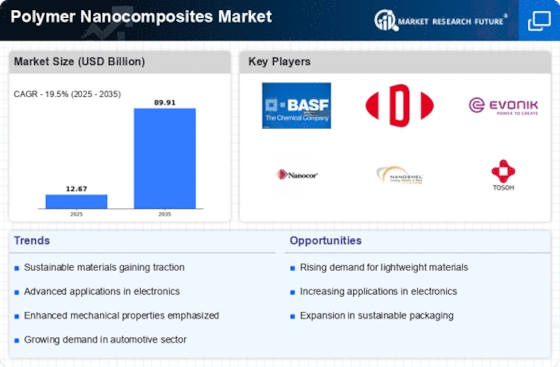
As per MRFR analysis, the Polymer Nanocomposites Market Size was estimated at 12.67 USD Billion in 2024. The Polymer Nanocomposites industry is projected to grow from 15.14 USD Billion in 2025 to 89.91 USD Billion by 2035, exhibiting a compound annual growth rate (CAGR) of 19.5 during the forecast period 2025 - 2035.

Key Market Trends & Highlights

The Polymer Nanocomposites Market is poised for substantial growth driven by sustainability and technological advancements.

  • North America remains the largest market for polymer nanocomposites, reflecting a strong demand across various industries. The Asia-Pacific region is emerging as the fastest-growing market, fueled by rapid industrialization and innovation. Carbon nanotubes dominate the market, while graphene is gaining traction as the fastest-growing segment due to its unique properties. Key drivers include the rising demand for lightweight materials and growing environmental concerns, which are shaping market dynamics.

Market Size & Forecast

2024 Market Size 12.67 (USD Billion)
2035 Market Size 89.91 (USD Billion)
CAGR (2025 - 2035) 19.5%
Largest Regional Market Share in 2024 North America

Major Players

<p>BASF SE (DE), DuPont de Nemours Inc (US), Evonik Industries AG (DE), Nanocor Inc (US), Nanoshel LLC (US), Tosoh Corporation (JP), Arkema SA (FR), Mitsubishi Chemical Corporation (JP), SABIC (SA)</p>

Market Trends

The Polymer Nanocomposites Market is currently experiencing a dynamic evolution, driven by advancements in material science and increasing demand across various industries. These nanocomposites, which integrate nanoparticles into polymer matrices, exhibit enhanced properties such as improved mechanical strength, thermal stability, and barrier performance. As industries seek to innovate and improve product performance, the adoption of polymer nanocomposites is becoming more prevalent. This trend is particularly evident in sectors such as automotive, aerospace, and electronics, where lightweight and durable materials are essential for meeting stringent performance standards. Moreover, the growing emphasis on sustainability and eco-friendly materials is influencing the Polymer Nanocomposites Market. Manufacturers are increasingly focusing on developing bio-based and recyclable nanocomposites, which align with global efforts to reduce environmental impact. This shift not only caters to consumer preferences for sustainable products but also complies with regulatory frameworks aimed at promoting greener alternatives. As a result, the market is poised for continued growth, with innovations in nanotechnology and material formulations likely to drive future developments.

Sustainability Initiatives

The Polymer Nanocomposites Market is witnessing a notable shift towards sustainable practices. Manufacturers are increasingly prioritizing eco-friendly materials, including bio-based and recyclable options. This trend aligns with global sustainability goals and consumer demand for greener products, potentially reshaping the market landscape.

Technological Advancements

Ongoing advancements in nanotechnology are significantly impacting the Polymer Nanocomposites Market. Innovations in material formulations and processing techniques are enhancing the performance characteristics of these composites, suggesting a future where applications expand across diverse industries.

Regulatory Influences

Regulatory frameworks are playing a crucial role in shaping the Polymer Nanocomposites Market. Stricter environmental regulations are prompting manufacturers to adopt safer and more sustainable practices, which may lead to the development of new standards and guidelines for nanocomposite materials.

Polymer Nanocomposites Market Market Drivers

Advancements in Nanotechnology

Technological innovations in nanotechnology are significantly influencing the Polymer Nanocomposites Market. The development of new fabrication techniques and the ability to manipulate materials at the nanoscale have led to enhanced properties of polymer nanocomposites, such as improved thermal stability and mechanical strength. These advancements are not only expanding the application range of polymer nanocomposites but also attracting investments from various sectors. For instance, the electronics industry is increasingly utilizing these materials for their lightweight and conductive properties, which could lead to a market growth of around 7% in the coming years. As research continues to evolve, the Polymer Nanocomposites Market is poised for further expansion.

Growing Environmental Concerns

The Polymer Nanocomposites Market is being propelled by increasing environmental concerns and the push for sustainable materials. As industries face mounting pressure to reduce their carbon footprints, the demand for eco-friendly alternatives is rising. Polymer nanocomposites, which can be derived from renewable resources, offer a promising solution. The market for biodegradable nanocomposites is expected to grow at a compound annual growth rate of 6% over the next five years. This shift towards sustainability is likely to encourage manufacturers to invest in research and development, thereby enhancing the Polymer Nanocomposites Market's growth trajectory. The integration of sustainable practices is becoming a key differentiator in competitive markets.

Rising Demand for Lightweight Materials

The Polymer Nanocomposites Market is experiencing a notable surge in demand for lightweight materials, particularly in the automotive and aerospace sectors. As manufacturers strive to enhance fuel efficiency and reduce emissions, the incorporation of polymer nanocomposites offers a viable solution. These materials provide superior strength-to-weight ratios, which are essential for modern engineering applications. According to recent estimates, the automotive sector alone is projected to witness a growth rate of approximately 5% annually, driven by the need for lightweight components. This trend is likely to propel the Polymer Nanocomposites Market forward, as companies increasingly adopt these advanced materials to meet stringent regulatory standards and consumer expectations for sustainability.

Regulatory Support for Advanced Materials

Regulatory frameworks are increasingly favoring the use of advanced materials, which is beneficial for the Polymer Nanocomposites Market. Governments are implementing policies that encourage the adoption of innovative materials that meet safety and environmental standards. This regulatory support is particularly evident in sectors such as automotive and construction, where compliance with stringent regulations is paramount. The Polymer Nanocomposites Market stands to gain from these initiatives, as manufacturers seek to align their products with regulatory requirements. As a result, the market is expected to see a growth rate of approximately 5% over the next few years, driven by the need for compliance and innovation.

Expanding Applications in Various Industries

The versatility of polymer nanocomposites is driving their adoption across a multitude of industries, thereby influencing the Polymer Nanocomposites Market. From packaging to construction, the unique properties of these materials enable their use in applications that require enhanced durability and performance. For example, the packaging industry is increasingly utilizing polymer nanocomposites to improve barrier properties, which is projected to grow by 4% annually. Additionally, the construction sector is leveraging these materials for their insulating properties, which could lead to energy savings. This broadening application spectrum is likely to sustain the growth momentum of the Polymer Nanocomposites Market in the foreseeable future.


Market Segment Insights

By Type: Carbon Nanotubes (Largest) vs. Graphene (Fastest-Growing)

<p>In the Polymer Nanocomposites Market, <a href="https://www.marketresearchfuture.com/reports/carbon-nanotube-market-4397">Carbon Nanotubes</a> hold the largest market share, recognized for their unparalleled strength-to-weight ratio and superior electrical and thermal conductivity. These attributes make them ideal for various applications, from advanced composites to electronics. Meanwhile, Graphene is emerging as a fast-growing segment, captivating interest for its remarkable mechanical properties and flexibility, making it suitable for innovative applications in energy storage, sensors, and more. The growth trends within this segment are driven by the increasing demand for lightweight and high-strength materials across industries such as automotive, aerospace, and electronics. Technological advancements in the processing and formulation of these nanocomposites are facilitating their incorporation into mainstream applications. Additionally, the rising focus on sustainability and eco-friendly materials is further propelling the adoption of Graphene, establishing it as a key player in the market's evolving landscape.</p>

<p>Nanofiber (Dominant) vs. Nanoclay (Emerging)</p>

<p>In the Polymer Nanocomposites Market, Nanofiber is recognized as a dominant segment due to its exceptional surface area and porosity, which enhance mechanical properties significantly. This versatility allows Nanofiber to cater to diverse applications, including filtration, reinforcement, and <a href="https://www.marketresearchfuture.com/reports/biomedical-textiles-market-6079">biomedical</a> uses. Conversely, Nanoclay is identified as an emerging segment, gaining traction for its capability to improve barrier properties and thermal stability in polymer matrices while being a cost-effective solution. The integration of Nanoclay into various applications, particularly in packaging and automotive sectors, is fostering its growth. Both segments illustrate unique strengths in addressing industry demands while offering potential for innovation.</p>

By Application: Packaging (Largest) vs. Automotive (Fastest-Growing)

<p>The Polymer Nanocomposites Market exhibits a diverse application landscape, with significant contributions from sectors like Packaging, Automotive, and Electronics &amp; Semiconductor. Among these, the Packaging segment leads the market, benefiting from the rising demand for lightweight, durable, and sustainable materials. On the other hand, sectors such as Aerospace &amp; Defense and Energy, while smaller in market share, are increasingly integrating nanocomposites for their superior properties, reflecting a shift towards innovative applications across various industries.</p>

<p>Packaging: Dominant vs. Automotive: Emerging</p>

<p>The Packaging segment is currently the dominant force in the Polymer Nanocomposites Market, primarily driven by the need for sustainable and efficient packaging solutions. This segment leverages nanocomposite materials to enhance barrier properties, improve mechanical strength, and reduce weight, making products more appealing to environmentally conscious consumers. Conversely, the Automotive segment, marked as emerging, is gaining traction due to escalating electric vehicle production and reinforcement of safety standards, leading to increased use of lightweight and high-performance materials. This shift not only improves fuel efficiency but also enhances vehicle performance, positioning automotive applications as a rapidly evolving frontier in the Polymer Nanocomposites Market domain.</p>

Get more detailed insights about Polymer Nanocomposites Market Research Report—Global Forecast till 2035

Regional Insights

North America : Innovation and Demand Surge

North America is the largest market for polymer nanocomposites, holding approximately 40% of the global share. The region's growth is driven by increasing demand in automotive, aerospace, and electronics sectors, alongside stringent regulations promoting lightweight materials. The presence of major players like DuPont and BASF further fuels innovation and market expansion. The United States dominates the North American market, supported by advanced research facilities and a robust manufacturing base. Canada also contributes significantly, focusing on sustainable materials. The competitive landscape is characterized by collaborations and mergers among key players, enhancing product offerings and market reach.

Europe : Sustainability and Innovation Focus

Europe is the second-largest market for polymer nanocomposites, accounting for around 30% of the global market share. The region's growth is propelled by stringent environmental regulations and a strong emphasis on sustainability. Countries like Germany and France are leading the charge, with initiatives aimed at reducing carbon footprints and enhancing material efficiency. Germany stands out as a key player, with significant investments in R&D for advanced materials. France and the UK also play vital roles, fostering innovation through government-backed programs. The competitive landscape is marked by collaborations among industry leaders like Evonik and Arkema, driving advancements in nanocomposite technologies.

Asia-Pacific : Rapid Growth and Adoption

Asia-Pacific is witnessing rapid growth in the polymer nanocomposites market, holding approximately 25% of the global share. The region's expansion is driven by increasing industrialization, urbanization, and demand for advanced materials in sectors like construction and electronics. Countries such as China and Japan are at the forefront, supported by favorable government policies and investments in technology. China is the largest market in the region, with significant contributions from local manufacturers and a growing focus on innovation. Japan follows closely, emphasizing high-quality production and advanced research. The competitive landscape features key players like Mitsubishi Chemical and Tosoh, enhancing the region's market dynamics through strategic partnerships and technological advancements.

Middle East and Africa : Emerging Market with Potential

The Middle East and Africa represent a nascent but promising market for polymer nanocomposites, holding about 5% of the global share. The region's growth is driven by increasing investments in infrastructure and a rising demand for advanced materials in construction and automotive sectors. Countries like South Africa and the UAE are leading the way, supported by government initiatives aimed at diversifying economies. South Africa is emerging as a key player, with a focus on sustainable development and innovation in materials. The UAE is also making strides, investing in research and development. The competitive landscape is characterized by collaborations among local and international firms, enhancing market penetration and product offerings.

Key Players and Competitive Insights

The Polymer Nanocomposites Market is currently characterized by a dynamic competitive landscape, driven by increasing demand for lightweight materials with enhanced properties across various industries, including automotive, aerospace, and electronics. Key players such as BASF SE (Germany), DuPont de Nemours Inc (US), and Evonik Industries AG (Germany) are strategically positioned to leverage their extensive research and development capabilities. These companies focus on innovation and sustainability, which are pivotal in shaping their operational strategies. For instance, BASF SE (Germany) emphasizes its commitment to sustainable solutions, while DuPont de Nemours Inc (US) is actively pursuing partnerships to enhance its product offerings in nanocomposites, thereby influencing the competitive environment significantly.

In terms of business tactics, companies are increasingly localizing manufacturing to reduce lead times and optimize supply chains. The market structure appears moderately fragmented, with several players vying for market share. However, the collective influence of major companies like SABIC (Saudi Arabia) and Arkema SA (France) is notable, as they engage in strategic collaborations and technological advancements that enhance their competitive positioning.

In August 2025, Evonik Industries AG (Germany) announced the launch of a new line of polymer nanocomposites designed specifically for the automotive sector, which is expected to improve fuel efficiency and reduce emissions. This strategic move not only aligns with global sustainability goals but also positions Evonik as a leader in providing innovative solutions tailored to industry needs. The introduction of these products could potentially reshape market dynamics by setting new performance benchmarks.

In September 2025, DuPont de Nemours Inc (US) expanded its partnership with a leading automotive manufacturer to co-develop advanced nanocomposite materials aimed at enhancing vehicle performance and safety. This collaboration underscores DuPont's strategy to integrate cutting-edge technology into its product development, thereby reinforcing its market presence and responding to the growing demand for high-performance materials in the automotive industry.

Moreover, in July 2025, BASF SE (Germany) unveiled a new initiative focused on the circular economy, which includes the development of biodegradable nanocomposites. This initiative not only reflects BASF's commitment to sustainability but also positions the company to capitalize on the increasing regulatory pressures for environmentally friendly materials. Such strategic actions are likely to enhance BASF's competitive edge in a market that is progressively leaning towards sustainable practices.

As of October 2025, the competitive trends in the Polymer Nanocomposites Market are increasingly defined by digitalization, sustainability, and the integration of artificial intelligence in product development. Strategic alliances are becoming more prevalent, as companies recognize the need to collaborate to innovate effectively. Looking ahead, it appears that competitive differentiation will evolve from traditional price-based competition to a focus on innovation, technological advancements, and supply chain reliability, which are likely to be the cornerstones of success in this rapidly changing market.

Key Companies in the Polymer Nanocomposites Market market include

Industry Developments

May 2023 According to the India Brand Equity Foundation (IBEF), the country's food processing industry is anticipated to generate US$ 535 billion by 2025–2026. In contrast, the Indian government has approved spending USD 15.25 million on 28 food processing projects, which would assist to cut down on food waste and raise consumer demand for recyclable packaging and biodegradable materials.

Future Outlook

Polymer Nanocomposites Market Future Outlook

<p>The Polymer Nanocomposites Market is projected to grow at a 19.5% CAGR from 2024 to 2035, driven by advancements in material science, increasing demand in automotive, and electronics sectors.</p>

New opportunities lie in:

  • <p>Development of eco-friendly polymer nanocomposites for sustainable packaging solutions.</p>
  • <p>Integration of nanocomposites in smart textiles for enhanced functionality.</p>
  • <p>Expansion into emerging markets with tailored product offerings for local industries.</p>

<p>By 2035, the Polymer Nanocomposites Market is expected to achieve substantial growth and innovation.</p>

Market Segmentation

Polymer Nanocomposites Market Type Outlook

  • Carbon Nanotubes
  • Metal Oxide
  • Nanofiber
  • Nanoclay
  • Graphene
  • Others (Expanded graphite
  • Recycled paper
  • Wood
  • Recycled fibers)

Polymer Nanocomposites Market Application Outlook

  • Packaging
  • Automotive
  • Electronics & Semiconductor
  • Aerospace & Defense
  • Coatings
  • Energy
  • Others (Sports
  • Healthcare)

Report Scope

MARKET SIZE 2024 12.67(USD Billion)
MARKET SIZE 2025 15.14(USD Billion)
MARKET SIZE 2035 89.91(USD Billion)
COMPOUND ANNUAL GROWTH RATE (CAGR) 19.5% (2024 - 2035)
REPORT COVERAGE Revenue Forecast, Competitive Landscape, Growth Factors, and Trends
BASE YEAR 2024
Market Forecast Period 2025 - 2035
Historical Data 2019 - 2024
Market Forecast Units USD Billion
Key Companies Profiled Market analysis in progress
Segments Covered Market segmentation analysis in progress
Key Market Opportunities Advancements in sustainable materials drive growth in the Polymer Nanocomposites Market.
Key Market Dynamics Rising demand for lightweight materials drives innovation and competition in the Polymer Nanocomposites Market.
Countries Covered North America, Europe, APAC, South America, MEA

FAQs

What is the current valuation of the Polymer Nanocomposites Market?

As of 2024, the Polymer Nanocomposites Market was valued at 12.67 USD Billion.

What is the projected market size for the Polymer Nanocomposites Market by 2035?

The market is projected to reach 89.91 USD Billion by 2035.

What is the expected CAGR for the Polymer Nanocomposites Market during the forecast period?

The expected CAGR for the Polymer Nanocomposites Market from 2025 to 2035 is 19.5%.

Which segment is anticipated to dominate the Polymer Nanocomposites Market by type?

Carbon Nanotubes are expected to dominate the market, with a projected valuation of 18.0 USD Billion by 2035.

What application segment is likely to see the highest growth in the Polymer Nanocomposites Market?

The Electronics &amp; Semiconductor application segment is projected to grow to 16.0 USD Billion by 2035.

Who are the key players in the Polymer Nanocomposites Market?

Key players include BASF SE, DuPont de Nemours Inc, and Evonik Industries AG, among others.

  1. SECTION I: EXECUTIVE SUMMARY AND KEY HIGHLIGHTS
    1. EXECUTIVE SUMMARY
      1. Market Overview
      2. Key Findings
      3. Market Segmentation
      4. Competitive Landscape
      5. Challenges and Opportunities
      6. Future Outlook 2
  2. SECTION II: SCOPING, METHODOLOGY AND MARKET STRUCTURE
    1. MARKET INTRODUCTION
      1. Definition
      2. Scope of the study
    2. RESEARCH METHODOLOGY
      1. Overview
      2. Data Mining
      3. Secondary Research
      4. Primary Research
      5. Forecasting Model
      6. Market Size Estimation
      7. Data Triangulation
      8. Validation 3
  3. SECTION III: QUALITATIVE ANALYSIS
    1. MARKET DYNAMICS
      1. Overview
      2. Drivers
      3. Restraints
      4. Opportunities
    2. MARKET FACTOR ANALYSIS
      1. Value chain Analysis
      2. Porter's Five Forces Analysis
      3. COVID-19 Impact Analysis
  4. SECTION IV: QUANTITATIVE ANALYSIS
    1. Chemicals and Materials, BY Type (USD Billion)
      1. Carbon Nanotubes
      2. Metal Oxide
      3. Nanofiber
      4. Nanoclay
      5. Graphene
      6. Others (Expanded graphite, Recycled paper, Wood, Recycled fibers)
    2. Chemicals and Materials, BY Application (USD Billion)
      1. Packaging
      2. Automotive
      3. Electronics & Semiconductor
      4. Aerospace & Defense
      5. Coatings
      6. Energy
      7. Others (Sports, Healthcare)
    3. Chemicals and Materials, BY Region (USD Billion)
      1. North America
      2. Europe
      3. APAC
      4. South America
      5. MEA
  5. SECTION V: COMPETITIVE ANALYSIS
    1. Competitive Landscape
      1. Overview
      2. Competitive Analysis
      3. Market share Analysis
      4. Major Growth Strategy in the Chemicals and Materials
      5. Competitive Benchmarking
      6. Leading Players in Terms of Number of Developments in the Chemicals and Materials
      7. Key developments and growth strategies
      8. Major Players Financial Matrix
    2. Company Profiles
      1. BASF SE (DE)
      2. DuPont de Nemours Inc (US)
      3. Evonik Industries AG (DE)
      4. Nanocor Inc (US)
      5. Nanoshel LLC (US)
      6. Tosoh Corporation (JP)
      7. Arkema SA (FR)
      8. Mitsubishi Chemical Corporation (JP)
      9. SABIC (SA)
    3. Appendix
      1. References
      2. Related Reports 6 LIST OF FIGURES
    4. MARKET SYNOPSIS
    5. NORTH AMERICA MARKET ANALYSIS
    6. US MARKET ANALYSIS BY TYPE
    7. US MARKET ANALYSIS BY APPLICATION
    8. CANADA MARKET ANALYSIS BY TYPE
    9. CANADA MARKET ANALYSIS BY APPLICATION
    10. EUROPE MARKET ANALYSIS
    11. GERMANY MARKET ANALYSIS BY TYPE
    12. GERMANY MARKET ANALYSIS BY APPLICATION
    13. UK MARKET ANALYSIS BY TYPE
    14. UK MARKET ANALYSIS BY APPLICATION
    15. FRANCE MARKET ANALYSIS BY TYPE
    16. FRANCE MARKET ANALYSIS BY APPLICATION
    17. RUSSIA MARKET ANALYSIS BY TYPE
    18. RUSSIA MARKET ANALYSIS BY APPLICATION
    19. ITALY MARKET ANALYSIS BY TYPE
    20. ITALY MARKET ANALYSIS BY APPLICATION
    21. SPAIN MARKET ANALYSIS BY TYPE
    22. SPAIN MARKET ANALYSIS BY APPLICATION
    23. REST OF EUROPE MARKET ANALYSIS BY TYPE
    24. REST OF EUROPE MARKET ANALYSIS BY APPLICATION
    25. APAC MARKET ANALYSIS
    26. CHINA MARKET ANALYSIS BY TYPE
    27. CHINA MARKET ANALYSIS BY APPLICATION
    28. INDIA MARKET ANALYSIS BY TYPE
    29. INDIA MARKET ANALYSIS BY APPLICATION
    30. JAPAN MARKET ANALYSIS BY TYPE
    31. JAPAN MARKET ANALYSIS BY APPLICATION
    32. SOUTH KOREA MARKET ANALYSIS BY TYPE
    33. SOUTH KOREA MARKET ANALYSIS BY APPLICATION
    34. MALAYSIA MARKET ANALYSIS BY TYPE
    35. MALAYSIA MARKET ANALYSIS BY APPLICATION
    36. THAILAND MARKET ANALYSIS BY TYPE
    37. THAILAND MARKET ANALYSIS BY APPLICATION
    38. INDONESIA MARKET ANALYSIS BY TYPE
    39. INDONESIA MARKET ANALYSIS BY APPLICATION
    40. REST OF APAC MARKET ANALYSIS BY TYPE
    41. REST OF APAC MARKET ANALYSIS BY APPLICATION
    42. SOUTH AMERICA MARKET ANALYSIS
    43. BRAZIL MARKET ANALYSIS BY TYPE
    44. BRAZIL MARKET ANALYSIS BY APPLICATION
    45. MEXICO MARKET ANALYSIS BY TYPE
    46. MEXICO MARKET ANALYSIS BY APPLICATION
    47. ARGENTINA MARKET ANALYSIS BY TYPE
    48. ARGENTINA MARKET ANALYSIS BY APPLICATION
    49. REST OF SOUTH AMERICA MARKET ANALYSIS BY TYPE
    50. REST OF SOUTH AMERICA MARKET ANALYSIS BY APPLICATION
    51. MEA MARKET ANALYSIS
    52. GCC COUNTRIES MARKET ANALYSIS BY TYPE
    53. GCC COUNTRIES MARKET ANALYSIS BY APPLICATION
    54. SOUTH AFRICA MARKET ANALYSIS BY TYPE
    55. SOUTH AFRICA MARKET ANALYSIS BY APPLICATION
    56. REST OF MEA MARKET ANALYSIS BY TYPE
    57. REST OF MEA MARKET ANALYSIS BY APPLICATION
    58. KEY BUYING CRITERIA OF CHEMICALS AND MATERIALS
    59. RESEARCH PROCESS OF MRFR
    60. DRO ANALYSIS OF CHEMICALS AND MATERIALS
    61. DRIVERS IMPACT ANALYSIS: CHEMICALS AND MATERIALS
    62. RESTRAINTS IMPACT ANALYSIS: CHEMICALS AND MATERIALS
    63. SUPPLY / VALUE CHAIN: CHEMICALS AND MATERIALS
    64. CHEMICALS AND MATERIALS, BY TYPE, 2024 (% SHARE)
    65. CHEMICALS AND MATERIALS, BY TYPE, 2024 TO 2035 (USD Billion)
    66. CHEMICALS AND MATERIALS, BY APPLICATION, 2024 (% SHARE)
    67. CHEMICALS AND MATERIALS, BY APPLICATION, 2024 TO 2035 (USD Billion)
    68. BENCHMARKING OF MAJOR COMPETITORS 7 LIST OF TABLES
    69. LIST OF ASSUMPTIONS
    70. North America MARKET SIZE ESTIMATES; FORECAST
      1. BY TYPE, 2025-2035 (USD Billion)
      2. BY APPLICATION, 2025-2035 (USD Billion)
    71. US MARKET SIZE ESTIMATES; FORECAST
      1. BY TYPE, 2025-2035 (USD Billion)
      2. BY APPLICATION, 2025-2035 (USD Billion)
    72. Canada MARKET SIZE ESTIMATES; FORECAST
      1. BY TYPE, 2025-2035 (USD Billion)
      2. BY APPLICATION, 2025-2035 (USD Billion)
    73. Europe MARKET SIZE ESTIMATES; FORECAST
      1. BY TYPE, 2025-2035 (USD Billion)
      2. BY APPLICATION, 2025-2035 (USD Billion)
    74. Germany MARKET SIZE ESTIMATES; FORECAST
      1. BY TYPE, 2025-2035 (USD Billion)
      2. BY APPLICATION, 2025-2035 (USD Billion)
    75. UK MARKET SIZE ESTIMATES; FORECAST
      1. BY TYPE, 2025-2035 (USD Billion)
      2. BY APPLICATION, 2025-2035 (USD Billion)
    76. France MARKET SIZE ESTIMATES; FORECAST
      1. BY TYPE, 2025-2035 (USD Billion)
      2. BY APPLICATION, 2025-2035 (USD Billion)
    77. Russia MARKET SIZE ESTIMATES; FORECAST
      1. BY TYPE, 2025-2035 (USD Billion)
      2. BY APPLICATION, 2025-2035 (USD Billion)
    78. Italy MARKET SIZE ESTIMATES; FORECAST
      1. BY TYPE, 2025-2035 (USD Billion)
      2. BY APPLICATION, 2025-2035 (USD Billion)
    79. Spain MARKET SIZE ESTIMATES; FORECAST
      1. BY TYPE, 2025-2035 (USD Billion)
      2. BY APPLICATION, 2025-2035 (USD Billion)
    80. Rest of Europe MARKET SIZE ESTIMATES; FORECAST
      1. BY TYPE, 2025-2035 (USD Billion)
      2. BY APPLICATION, 2025-2035 (USD Billion)
    81. APAC MARKET SIZE ESTIMATES; FORECAST
      1. BY TYPE, 2025-2035 (USD Billion)
      2. BY APPLICATION, 2025-2035 (USD Billion)
    82. China MARKET SIZE ESTIMATES; FORECAST
      1. BY TYPE, 2025-2035 (USD Billion)
      2. BY APPLICATION, 2025-2035 (USD Billion)
    83. India MARKET SIZE ESTIMATES; FORECAST
      1. BY TYPE, 2025-2035 (USD Billion)
      2. BY APPLICATION, 2025-2035 (USD Billion)
    84. Japan MARKET SIZE ESTIMATES; FORECAST
      1. BY TYPE, 2025-2035 (USD Billion)
      2. BY APPLICATION, 2025-2035 (USD Billion)
    85. South Korea MARKET SIZE ESTIMATES; FORECAST
      1. BY TYPE, 2025-2035 (USD Billion)
      2. BY APPLICATION, 2025-2035 (USD Billion)
    86. Malaysia MARKET SIZE ESTIMATES; FORECAST
      1. BY TYPE, 2025-2035 (USD Billion)
      2. BY APPLICATION, 2025-2035 (USD Billion)
    87. Thailand MARKET SIZE ESTIMATES; FORECAST
      1. BY TYPE, 2025-2035 (USD Billion)
      2. BY APPLICATION, 2025-2035 (USD Billion)
    88. Indonesia MARKET SIZE ESTIMATES; FORECAST
      1. BY TYPE, 2025-2035 (USD Billion)
      2. BY APPLICATION, 2025-2035 (USD Billion)
    89. Rest of APAC MARKET SIZE ESTIMATES; FORECAST
      1. BY TYPE, 2025-2035 (USD Billion)
      2. BY APPLICATION, 2025-2035 (USD Billion)
    90. South America MARKET SIZE ESTIMATES; FORECAST
      1. BY TYPE, 2025-2035 (USD Billion)
      2. BY APPLICATION, 2025-2035 (USD Billion)
    91. Brazil MARKET SIZE ESTIMATES; FORECAST
      1. BY TYPE, 2025-2035 (USD Billion)
      2. BY APPLICATION, 2025-2035 (USD Billion)
    92. Mexico MARKET SIZE ESTIMATES; FORECAST
      1. BY TYPE, 2025-2035 (USD Billion)
      2. BY APPLICATION, 2025-2035 (USD Billion)
    93. Argentina MARKET SIZE ESTIMATES; FORECAST
      1. BY TYPE, 2025-2035 (USD Billion)
      2. BY APPLICATION, 2025-2035 (USD Billion)
    94. Rest of South America MARKET SIZE ESTIMATES; FORECAST
      1. BY TYPE, 2025-2035 (USD Billion)
      2. BY APPLICATION, 2025-2035 (USD Billion)
    95. MEA MARKET SIZE ESTIMATES; FORECAST
      1. BY TYPE, 2025-2035 (USD Billion)
      2. BY APPLICATION, 2025-2035 (USD Billion)
    96. GCC Countries MARKET SIZE ESTIMATES; FORECAST
      1. BY TYPE, 2025-2035 (USD Billion)
      2. BY APPLICATION, 2025-2035 (USD Billion)
    97. South Africa MARKET SIZE ESTIMATES; FORECAST
      1. BY TYPE, 2025-2035 (USD Billion)
      2. BY APPLICATION, 2025-2035 (USD Billion)
    98. Rest of MEA MARKET SIZE ESTIMATES; FORECAST
      1. BY TYPE, 2025-2035 (USD Billion)
      2. BY APPLICATION, 2025-2035 (USD Billion)
    99. PRODUCT LAUNCH/PRODUCT DEVELOPMENT/APPROVAL
    100. ACQUISITION/PARTNERSHIP

Polymer Nanocomposites Market Segmentation

Polymer Nanocomposites Type Outlook (USD Billion, 2018-2032)

  • Carbon Nanotubes
  • Metal Oxide
  • Nanofiber
  • Nanoclay
  • Graphene
  • Others (Expanded graphite, Recycled paper, Wood, Recycled fibers)

Polymer Nanocomposites Application Outlook (USD Billion, 2018-2032)

  • Packaging
  • Automotive
  • Electronics & Semiconductor
  • Aerospace & Defense
  • Coatings
  • Energy
  • Others (Sports, Healthcare)

Polymer Nanocomposites Regional Outlook (USD Billion, 2018-2032)

  • North America Outlook (USD Billion, 2018-2032)

    • Polymer Nanocomposites by Type
      • Carbon Nanotubes
      • Metal Oxide
      • Nanofiber
      • Nanoclay
      • Graphene
      • Others (Expanded graphite, Recycled paper, Wood, Recycled fibers)
    • Polymer Nanocomposites by Application
      • Packaging
      • Automotive
      • Electronics & Semiconductor
      • Aerospace & Defense
      • Coatings
      • Energy
      • Others (Sports, Healthcare)
    • US Outlook (USD Billion, 2018-2032)

    • Polymer Nanocomposites by Type
      • Carbon Nanotubes
      • Metal Oxide
      • Nanofiber
      • Nanoclay
      • Graphene
      • Others (Expanded graphite, Recycled paper, Wood, Recycled fibers)
    • Polymer Nanocomposites by Application
      • Packaging
      • Automotive
      • Electronics & Semiconductor
      • Aerospace & Defense
      • Coatings
      • Energy
      • Others (Sports, Healthcare)
    • Canada Outlook (USD Billion, 2018-2032)

    • Polymer Nanocomposites by Type
      • Carbon Nanotubes
      • Metal Oxide
      • Nanofiber
      • Nanoclay
      • Graphene
      • Others (Expanded graphite, Recycled paper, Wood, Recycled fibers)
    • Polymer Nanocomposites by Application
      • Packaging
      • Automotive
      • Electronics & Semiconductor
      • Aerospace & Defense
      • Coatings
      • Energy
      • Others (Sports, Healthcare)
  • Europe Outlook (USD Billion, 2018-2032)

    • Polymer Nanocomposites by Type
      • Carbon Nanotubes
      • Metal Oxide
      • Nanofiber
      • Nanoclay
      • Graphene
      • Others (Expanded graphite, Recycled paper, Wood, Recycled fibers)
    • Polymer Nanocomposites by Application
      • Packaging
      • Automotive
      • Electronics & Semiconductor
      • Aerospace & Defense
      • Coatings
      • Energy
      • Others (Sports, Healthcare)
    • Germany Outlook (USD Billion, 2018-2032)

    • Polymer Nanocomposites by Type
      • Carbon Nanotubes
      • Metal Oxide
      • Nanofiber
      • Nanoclay
      • Graphene
      • Others (Expanded graphite, Recycled paper, Wood, Recycled fibers)
    • Polymer Nanocomposites by Application
      • Packaging
      • Automotive
      • Electronics & Semiconductor
      • Aerospace & Defense
      • Coatings
      • Energy
      • Others (Sports, Healthcare)
    • France Outlook (USD Billion, 2018-2032)

    • Polymer Nanocomposites by Type
      • Carbon Nanotubes
      • Metal Oxide
      • Nanofiber
      • Nanoclay
      • Graphene
      • Others (Expanded graphite, Recycled paper, Wood, Recycled fibers)
    • Polymer Nanocomposites by Application
      • Packaging
      • Automotive
      • Electronics & Semiconductor
      • Aerospace & Defense
      • Coatings
      • Energy
      • Others (Sports, Healthcare)
    • UK Outlook (USD Billion, 2018-2032)

    • Polymer Nanocomposites by Type
      • Carbon Nanotubes
      • Metal Oxide
      • Nanofiber
      • Nanoclay
      • Graphene
      • Others (Expanded graphite, Recycled paper, Wood, Recycled fibers)
    • Polymer Nanocomposites by Application
      • Packaging
      • Automotive
      • Electronics & Semiconductor
      • Aerospace & Defense
      • Coatings
      • Energy
      • Others (Sports, Healthcare)
    • Italy Outlook (USD Billion, 2018-2032)

    • Polymer Nanocomposites by Type
      • Carbon Nanotubes
      • Metal Oxide
      • Nanofiber
      • Nanoclay
      • Graphene
      • Others (Expanded graphite, Recycled paper, Wood, Recycled fibers)
    • Polymer Nanocomposites by Application
      • Packaging
      • Automotive
      • Electronics & Semiconductor
      • Aerospace & Defense
      • Coatings
      • Energy
      • Others (Sports, Healthcare)
    • Spain Outlook (USD Billion, 2018-2032)

    • Polymer Nanocomposites by Type
      • Carbon Nanotubes
      • Metal Oxide
      • Nanofiber
      • Nanoclay
      • Graphene
      • Others (Expanded graphite, Recycled paper, Wood, Recycled fibers)
    • Polymer Nanocomposites by Application
      • Packaging
      • Automotive
      • Electronics & Semiconductor
      • Aerospace & Defense
      • Coatings
      • Energy
      • Others (Sports, Healthcare)
    • Rest Of Europe Outlook (USD Billion, 2018-2032)

    • Polymer Nanocomposites by Type
      • Carbon Nanotubes
      • Metal Oxide
      • Nanofiber
      • Nanoclay
      • Graphene
      • Others (Expanded graphite, Recycled paper, Wood, Recycled fibers)
    • Polymer Nanocomposites by Application
      • Packaging
      • Automotive
      • Electronics & Semiconductor
      • Aerospace & Defense
      • Coatings
      • Energy
      • Others (Sports, Healthcare)
  • Asia-Pacific Outlook (USD Billion, 2018-2032)

    • Polymer Nanocomposites by Type
      • Carbon Nanotubes
      • Metal Oxide
      • Nanofiber
      • Nanoclay
      • Graphene
      • Others (Expanded graphite, Recycled paper, Wood, Recycled fibers)
    • Polymer Nanocomposites by Application
      • Packaging
      • Automotive
      • Electronics & Semiconductor
      • Aerospace & Defense
      • Coatings
      • Energy
      • Others (Sports, Healthcare)
    • China Outlook (USD Billion, 2018-2032)

    • Polymer Nanocomposites by Type
      • Carbon Nanotubes
      • Metal Oxide
      • Nanofiber
      • Nanoclay
      • Graphene
      • Others (Expanded graphite, Recycled paper, Wood, Recycled fibers)
    • Polymer Nanocomposites by Application
      • Packaging
      • Automotive
      • Electronics & Semiconductor
      • Aerospace & Defense
      • Coatings
      • Energy
      • Others (Sports, Healthcare)
    • Japan Outlook (USD Billion, 2018-2032)

    • Polymer Nanocomposites by Type
      • Carbon Nanotubes
      • Metal Oxide
      • Nanofiber
      • Nanoclay
      • Graphene
      • Others (Expanded graphite, Recycled paper, Wood, Recycled fibers)
    • Polymer Nanocomposites by Application
      • Packaging
      • Automotive
      • Electronics & Semiconductor
      • Aerospace & Defense
      • Coatings
      • Energy
      • Others (Sports, Healthcare)
    • India Outlook (USD Billion, 2018-2032)

    • Polymer Nanocomposites by Type
      • Carbon Nanotubes
      • Metal Oxide
      • Nanofiber
      • Nanoclay
      • Graphene
      • Others (Expanded graphite, Recycled paper, Wood, Recycled fibers)
    • Polymer Nanocomposites by Application
      • Packaging
      • Automotive
      • Electronics & Semiconductor
      • Aerospace & Defense
      • Coatings
      • Energy
      • Others (Sports, Healthcare)
    • Australia Outlook (USD Billion, 2018-2032)

    • Polymer Nanocomposites by Type
      • Carbon Nanotubes
      • Metal Oxide
      • Nanofiber
      • Nanoclay
      • Graphene
      • Others (Expanded graphite, Recycled paper, Wood, Recycled fibers)
    • Polymer Nanocomposites by Application
      • Packaging
      • Automotive
      • Electronics & Semiconductor
      • Aerospace & Defense
      • Coatings
      • Energy
      • Others (Sports, Healthcare)
    • Rest of Asia-Pacific Outlook (USD Billion, 2018-2032)

    • Polymer Nanocomposites by Type
      • Carbon Nanotubes
      • Metal Oxide
      • Nanofiber
      • Nanoclay
      • Graphene
      • Others (Expanded graphite, Recycled paper, Wood, Recycled fibers)
    • Polymer Nanocomposites by Application
      • Packaging
      • Automotive
      • Electronics & Semiconductor
      • Aerospace & Defense
      • Coatings
      • Energy
      • Others (Sports, Healthcare)
  • Rest of the World Outlook (USD Billion, 2018-2032)

    • Polymer Nanocomposites by Type
      • Carbon Nanotubes
      • Metal Oxide
      • Nanofiber
      • Nanoclay
      • Graphene
      • Others (Expanded graphite, Recycled paper, Wood, Recycled fibers)
    • Polymer Nanocomposites by Application
      • Packaging
      • Automotive
      • Electronics & Semiconductor
      • Aerospace & Defense
      • Coatings
      • Energy
      • Others (Sports, Healthcare)
    • Middle East Outlook (USD Billion, 2018-2032)

    • Polymer Nanocomposites by Type
      • Carbon Nanotubes
      • Metal Oxide
      • Nanofiber
      • Nanoclay
      • Graphene
      • Others (Expanded graphite, Recycled paper, Wood, Recycled fibers)
    • Polymer Nanocomposites by Application
      • Packaging
      • Automotive
      • Electronics & Semiconductor
      • Aerospace & Defense
      • Coatings
      • Energy
      • Others (Sports, Healthcare)
    • Africa Outlook (USD Billion, 2018-2032)

    • Polymer Nanocomposites by Type
      • Carbon Nanotubes
      • Metal Oxide
      • Nanofiber
      • Nanoclay
      • Graphene
      • Others (Expanded graphite, Recycled paper, Wood, Recycled fibers)
    • Polymer Nanocomposites by Application
      • Packaging
      • Automotive
      • Electronics & Semiconductor
      • Aerospace & Defense
      • Coatings
      • Energy
      • Others (Sports, Healthcare)
    • Latin America Outlook (USD Billion, 2018-2032)

    • Polymer Nanocomposites by Type
      • Carbon Nanotubes
      • Metal Oxide
      • Nanofiber
      • Nanoclay
      • Graphene
      • Others (Expanded graphite, Recycled paper, Wood, Recycled fibers)
    • Polymer Nanocomposites by Application
      • Packaging
      • Automotive
      • Electronics & Semiconductor
      • Aerospace & Defense
      • Coatings
      • Energy
      • Others (Sports, Healthcare)


Infographic

Free Sample Request

Kindly complete the form below to receive a free sample of this Report

Get Free Sample

Customer Strories

Compare Licence

×
Features License Type
Single User Multiuser License Enterprise User
Price $4,950 $5,950 $7,250
Maximum User Access Limit 1 User Upto 10 Users Unrestricted Access Throughout the Organization
Free Customization
Direct Access to Analyst
Deliverable Format
Platform Access
Discount on Next Purchase 10% 15% 15%
Printable Versions