Download Free Sample
Kindly complete the form below to receive a free sample of this Report
Portable Spectrometer Market Size, Share and Research Report By Type (NIR, FTIR, Portable Spectrometer and Others), Application (Life Sciences, Material Chemistry, Food and Agriculture, Environmental Testing, Forensics, Nanotechnology, Drug Discovery and Others) And Region (North America, Europe, Asia-Pacific, And Rest Of The World) –Industry Forecast Till 2035
As per Market Research Future analysis, the Portable Spectrometer Market Size was estimated at 1.45 USD Billion in 2024. The Portable Spectrometer industry is projected to grow from USD 1.58 Billion in 2025 to USD 3.724 Billion by 2035, exhibiting a compound annual growth rate (CAGR) of 8.95% during the forecast period 2025 - 2035
The Portable Spectrometer Market is experiencing robust growth driven by technological advancements and increasing demand for on-site testing.
| 2024 Market Size | 1.45 (USD Billion) |
| 2035 Market Size | 3.724 (USD Billion) |
| CAGR (2025 - 2035) | 8.95% |
The Portable Spectrometer Market is currently experiencing a notable evolution, driven by advancements in technology and increasing demand across various sectors. The integration of portable spectrometers into fields such as environmental monitoring, pharmaceuticals, and food safety is becoming more prevalent. This trend suggests a growing recognition of the importance of real-time analysis and on-site testing, which enhances decision-making processes. Furthermore, the portability aspect of these devices allows for greater flexibility and accessibility, making them indispensable tools in both laboratory and field settings. In addition, the Portable Spectrometer Market appears to be influenced by the rising emphasis on sustainability and regulatory compliance. Industries are increasingly adopting these instruments to ensure product quality and safety, aligning with global standards. The ongoing development of user-friendly interfaces and enhanced data processing capabilities indicates a shift towards more sophisticated yet accessible solutions. As the market continues to expand, it is likely that innovations will further enhance the functionality and application of portable spectrometers, catering to a diverse range of user needs and preferences.
Recent innovations in sensor technology and data analysis algorithms are enhancing the capabilities of portable spectrometers. These advancements enable more accurate measurements and faster data processing, which are crucial for applications in various industries.
There is a growing trend towards on-site testing in sectors such as agriculture and environmental monitoring. This shift is driven by the need for immediate results and the ability to make informed decisions without the delay of sending samples to laboratories.
As industries face stricter regulations regarding product quality and safety, the demand for portable spectrometers is likely to rise. These devices assist companies in meeting compliance standards by providing reliable and timely analysis.
The Portable Spectrometer Market is significantly influenced by the growing emphasis on regulatory compliance across various sectors. Industries such as food and beverage, pharmaceuticals, and environmental monitoring are subject to stringent regulations that necessitate accurate and timely testing of products. Portable spectrometers provide a practical solution for ensuring compliance with these regulations, enabling companies to conduct necessary tests on-site. This trend is particularly evident in the food industry, where portable spectrometers are used to verify the authenticity and safety of products. As regulatory frameworks continue to evolve, the demand for portable spectrometers is likely to increase, contributing to a robust market growth trajectory.
The Portable Spectrometer Market is witnessing a notable increase in demand for on-site testing solutions across various sectors. Industries such as agriculture, pharmaceuticals, and environmental science are increasingly adopting portable spectrometers to conduct immediate analyses without the need for laboratory facilities. This shift is primarily driven by the need for rapid decision-making and quality control. For example, in agriculture, farmers utilize portable spectrometers to assess soil and crop health, leading to improved yield and resource management. The convenience and efficiency of on-site testing are expected to propel market growth, with estimates suggesting a market size expansion to over 1 billion USD by 2026.
The Portable Spectrometer Market is experiencing a surge in technological advancements that enhance the capabilities and functionalities of portable spectrometers. Innovations such as miniaturization, improved sensor technology, and advanced data processing algorithms are making these devices more efficient and user-friendly. For instance, the integration of smartphone technology with portable spectrometers allows for real-time data analysis and remote monitoring. This trend is likely to attract a broader user base, including industries such as pharmaceuticals, food safety, and environmental monitoring. As a result, the market is projected to grow at a compound annual growth rate of approximately 8% over the next five years, driven by these technological improvements.
The Portable Spectrometer Market is benefiting from a heightened awareness of environmental monitoring and sustainability practices. As concerns regarding pollution and environmental degradation grow, industries are increasingly adopting portable spectrometers to monitor air and water quality. These devices enable real-time analysis of pollutants, facilitating timely interventions and compliance with environmental regulations. The market is expected to see a significant uptick in demand from environmental agencies and organizations focused on sustainability. This trend is likely to drive innovation and investment in portable spectrometer technology, potentially leading to a market valuation exceeding 1.5 billion USD by 2027.
The Portable Spectrometer Market is experiencing a boost due to the expansion of research and development activities across various fields. Academic institutions and research organizations are increasingly utilizing portable spectrometers for field studies and experimental research. This trend is particularly prominent in the fields of chemistry, biology, and materials science, where portable spectrometers facilitate in-situ measurements and data collection. The growing emphasis on interdisciplinary research is likely to further fuel the demand for these devices, as researchers seek versatile tools that can adapt to various applications. Consequently, the market is projected to grow steadily, with an anticipated increase in R&D funding and collaborations.
The Portable Spectrometer Market showcases a diverse range of technologies, with the Near-Infrared (NIR) segment leading in market share. NIR spectrometers are widely adopted across numerous applications due to their effectiveness in analyzing moisture, fat, and protein content in various samples. Following NIR, the Fourier Transform Infrared (FTIR) spectrometers are gaining traction, driven by advancements in technology that allow for more portable and user-friendly devices, increasing their appeal across different sectors.
Technology: NIR (Dominant) vs. FTIR (Emerging)
NIR spectrometers dominate the Portable Spectrometer Market due to their versatility and reliability, making them essential tools in agriculture, food quality control, and pharmaceutical industries. They offer rapid analysis and do not require extensive sample preparation, enhancing workflow efficiency. In contrast, FTIR spectrometers are emerging as a significant player, benefiting from their superior capability to provide detailed molecular information. This makes them ideal for applications in material science and chemical analyses. The trend towards miniaturization and enhanced portability is further propelling the adoption of FTIR devices, as users seek more adaptable solutions in field and laboratory settings.
In the Portable Spectrometer Market, the application segment is significantly driven by life sciences, which hold the largest share. This segment includes applications in pharmaceutical analysis, clinical diagnostics, and biotechnology, reflecting a comprehensive reliance on precision analysis for critical health decisions. The dominance of life sciences is paramount, as it not only entertains the largest market segment but also illustrates full integration into ongoing advancements in medical research and development. Conversely, forensics is emerging as the fastest-growing application area within the portable spectrometer market. The heightened emphasis on safety and security has intensified the demand for portable spectrometers in criminal investigations and evidence analysis. As forensic technology progresses, the ability of portable spectrometers to offer quick and reliable results enhances their role in crime scene investigations, ultimately paving the path for substantial growth in this application area.
Life Sciences (Dominant) vs. Forensics (Emerging)
The life sciences application in the Portable Spectrometer Market stands as the dominant force, characterized by its wide use in clinical diagnostics, research and pharmaceutical development. This segment thrives due to the necessity of precise analytical instruments that can deliver accurate results swiftly in critical healthcare settings. In comparison, the forensics application emerges as a key player, buoyed by increasing requirements for rapid analysis of evidence and materials in law enforcement. As forensic science continues to innovate, portable spectrometers become invaluable tools that enhance investigation efficiency and reliability, significantly contributing to the market's expansion.

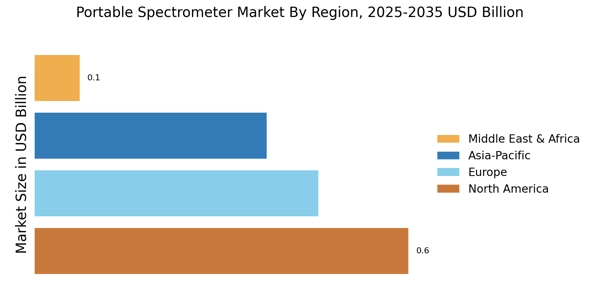
North America is the largest market for portable spectrometers, holding approximately 40% of the global market share. The region's growth is driven by increasing demand in environmental monitoring, pharmaceuticals, and food safety applications. Regulatory support from agencies like the EPA and FDA further catalyzes market expansion, ensuring compliance and safety standards are met. The rising trend of portable devices in laboratories and field applications is also a significant driver of growth. The United States dominates the North American market, with key players such as Thermo Fisher Scientific, Agilent Technologies, and PerkinElmer leading the competitive landscape. Canada follows as the second-largest market, benefiting from advancements in research and development. The presence of established companies and ongoing innovations in spectrometer technology contribute to a robust competitive environment, fostering continuous improvements and new product launches.
Europe is a significant player in the portable spectrometer market, accounting for approximately 30% of the global share. The region's growth is propelled by stringent regulations in environmental monitoring and food safety, which necessitate advanced analytical tools. The European Union's commitment to sustainability and safety standards drives demand for portable spectrometers, particularly in industries like pharmaceuticals and agriculture. The increasing focus on research and development also supports market expansion. Germany and the United Kingdom are the leading countries in this region, with a strong presence of key players such as Bruker and Analytik Jena. The competitive landscape is characterized by innovation and collaboration among companies, research institutions, and regulatory bodies. The European market is witnessing a surge in demand for portable devices, driven by advancements in technology and the need for real-time analysis in various applications.
Asia-Pacific is rapidly emerging as a key market for portable spectrometers, holding approximately 25% of the global market share. The region's growth is driven by increasing industrialization, rising environmental concerns, and a growing focus on quality control in manufacturing. Countries like China and India are investing heavily in research and development, which is expected to further boost demand for portable spectrometers. Government initiatives aimed at enhancing technological capabilities also play a crucial role in market expansion. China is the largest market in the Asia-Pacific region, followed by Japan and India. The competitive landscape is marked by the presence of both local and international players, including Horiba and JASCO. The increasing adoption of portable spectrometers in various sectors, such as pharmaceuticals, food and beverage, and environmental monitoring, is driving innovation and product development, making the region a focal point for market growth.
The Middle East and Africa region is gradually emerging in the portable spectrometer market, accounting for approximately 5% of the global share. The growth is primarily driven by increasing investments in infrastructure and technology, particularly in the oil and gas sector, where portable spectrometers are essential for quality control and environmental monitoring. Additionally, rising awareness of safety standards and regulations is fostering demand for advanced analytical tools in various industries. Countries like South Africa and the UAE are leading the market in this region, with a growing number of local and international players entering the landscape. The competitive environment is characterized by partnerships and collaborations aimed at enhancing technological capabilities. As the region continues to develop, the demand for portable spectrometers is expected to rise, presenting significant growth opportunities for manufacturers and suppliers.
The Portable Spectrometer Market is currently characterized by a dynamic competitive landscape, driven by technological advancements and increasing demand across various sectors, including pharmaceuticals, environmental monitoring, and food safety. Key players such as Thermo Fisher Scientific (US), Agilent Technologies (US), and Horiba (JP) are strategically positioned to leverage innovation and expand their market presence. For instance, Thermo Fisher Scientific (US) focuses on enhancing its product portfolio through continuous research and development, while Agilent Technologies (US) emphasizes partnerships to bolster its technological capabilities. These strategies collectively contribute to a competitive environment that is increasingly reliant on cutting-edge technology and customer-centric solutions.
In terms of business tactics, companies are localizing manufacturing and optimizing supply chains to enhance operational efficiency. The Portable Spectrometer Market appears moderately fragmented, with several key players exerting influence over market dynamics. This fragmentation allows for a diverse range of products and services, catering to various customer needs. The collective actions of these companies indicate a trend towards collaboration and strategic partnerships, which may further shape the market structure.
In August 2025, Horiba (JP) announced the launch of a new portable spectrometer designed specifically for environmental applications. This product aims to provide real-time analysis of air and water quality, reflecting the company's commitment to sustainability and environmental monitoring. The introduction of this innovative solution is likely to enhance Horiba's competitive edge in the growing market for environmental testing, aligning with global trends towards sustainability.
In September 2025, Agilent Technologies (US) expanded its collaboration with a leading biotechnology firm to develop advanced spectroscopic solutions for drug discovery. This partnership underscores Agilent's strategic focus on integrating cutting-edge technology into its offerings, potentially positioning the company as a leader in the pharmaceutical sector. The collaboration may also facilitate the development of more efficient and accurate analytical methods, thereby enhancing Agilent's market share.
In October 2025, Thermo Fisher Scientific (US) unveiled a new line of portable spectrometers equipped with AI-driven analytics capabilities. This strategic move not only reflects the growing trend of digitalization in the industry but also positions Thermo Fisher at the forefront of innovation. The integration of AI into spectroscopic analysis could significantly improve data accuracy and operational efficiency, thereby attracting a broader customer base.
As of October 2025, the competitive trends in the Portable Spectrometer Market are increasingly defined by digitalization, sustainability, and the integration of artificial intelligence. Strategic alliances among key players are shaping the landscape, fostering innovation and enhancing product offerings. Looking ahead, it is anticipated that competitive differentiation will evolve, with a shift from price-based competition to a focus on technological innovation, reliability in supply chains, and sustainable practices. This evolution suggests that companies that prioritize these aspects will likely gain a competitive advantage in the market.




May 2022: In addition to being a tried-and-true technology that is being used in a portable format and sophisticated data analysis, TrinamiX GmbH announced the development of their new application for mobile NIR - Near-Infrared Spectroscopy Solutions that are related to recycling and plastic sorting.
July 2022: Portable Raman Spectroscopy System by Renishaw was introduced in 2019. Because it employs flexible fiber optics for dependable, in-depth remote analysis, a spectrometer with internal lasers is a Virsa Raman Analyzer System feature.
February 2022: Konica Minolta Sensing Americas Inc. created new portable spectrometers, the CM-26d and CM-25d, with the highest color measurement accuracy. The site produces a variety of parts for various industries using the next-generation spectra meter. It's utilized in sectors like interior and exterior automotive parts for smartphones and tablets.
The Portable Spectrometer Market is projected to grow at an 8.95% CAGR from 2024 to 2035, driven by advancements in technology, increasing demand for field analysis, and regulatory requirements.
New opportunities lie in:
By 2035, the Portable Spectrometer Market is expected to achieve substantial growth and innovation.
| MARKET SIZE 2024 | 1.45(USD Billion) |
| MARKET SIZE 2025 | 1.58(USD Billion) |
| MARKET SIZE 2035 | 3.724(USD Billion) |
| COMPOUND ANNUAL GROWTH RATE (CAGR) | 8.95% (2024 - 2035) |
| REPORT COVERAGE | Revenue Forecast, Competitive Landscape, Growth Factors, and Trends |
| BASE YEAR | 2024 |
| Market Forecast Period | 2025 - 2035 |
| Historical Data | 2019 - 2024 |
| Market Forecast Units | USD Billion |
| Key Companies Profiled | Market analysis in progress |
| Segments Covered | Market segmentation analysis in progress |
| Key Market Opportunities | Integration of advanced sensors enhances accuracy and expands applications in the Portable Spectrometer Market. |
| Key Market Dynamics | Rising demand for portable spectrometers driven by advancements in technology and increasing applications across various industries. |
| Countries Covered | North America, Europe, APAC, South America, MEA |
The Portable Spectrometer Market is projected to reach approximately 3.724 USD Billion by 2035.
In 2024, the Portable Spectrometer Market was valued at 1.45 USD Billion.
The expected CAGR for the Portable Spectrometer Market during the forecast period 2025 - 2035 is 8.95%.
Key players in the Portable Spectrometer Market include Thermo Fisher Scientific, Agilent Technologies, PerkinElmer, and Horiba.
The main types include NIR, valued at 1.1 USD Billion, FTIR at 0.85 USD Billion, and Raman Spectrometers at 0.6 USD Billion.
Applications range from Life Sciences at 0.65 USD Billion to Environmental Testing at 0.8 USD Billion, indicating diverse usage.
The Food and Agriculture application segment is projected to reach a valuation of 0.4 USD Billion by 2035.
The Environmental Testing segment is expected to grow to 0.8 USD Billion, highlighting its importance in regulatory compliance.
The Portable Spectrometer Market's growth, with a projected CAGR of 8.95%, suggests a robust expansion compared to other analytical instruments.
The Nanotechnology application segment is anticipated to grow to 0.55 USD Billion, indicating its increasing relevance in advanced research.



Kindly complete the form below to receive a free sample of this Report

“This is really good guys. Excellent work on a tight deadline. I will continue to use you going forward and recommend you to others. Nice job”


“Thanks. It’s been a pleasure working with you, please use me as reference with any other Intel employees.”


“Thanks for sending the report it gives us a good global view of the Betaïne market.”


“Thank you, this will be very helpful for OQS.”


“We found the report very insightful! we found your research firm very helpful. I'm sending this email to secure our future business.”


“I am very pleased with how market segments have been defined in a relevant way for my purposes (such as "Portable Freezers & refrigerators" and "last-mile"). In general the report is well structured. Thanks very much for your efforts.”


“I have been reading the first document or the study, ,the Global HVAC and FP market report 2021 till 2026. Must say, good info! I have not gone in depth at all parts, but got a good indication of the data inside!”


“We got the report in time, we really thank you for your support in this process. I also thank to all of your team as they did a great job.”


“The Automotive 48V ECU Components Procurement Intelligence Study” was a complex project, but the Market Research Future (MRFR) team handled it with quality, agility, and customer-centricity. They delivered all requested data on time and within the agreed scope. The team, including Shubhendra Anand and Rahul Gotadki, was always readily available to clarify questions and swiftly implement necessary adjustments, driving the project to a successful conclusion within a very demanding timeframe.
I would also like to specifically commend Akshay Agarwal for his responsiveness and support at every stage—from our initial inquiry on May 6th through to final delivery on June 18th. His dedication made the entire process seamless.”



