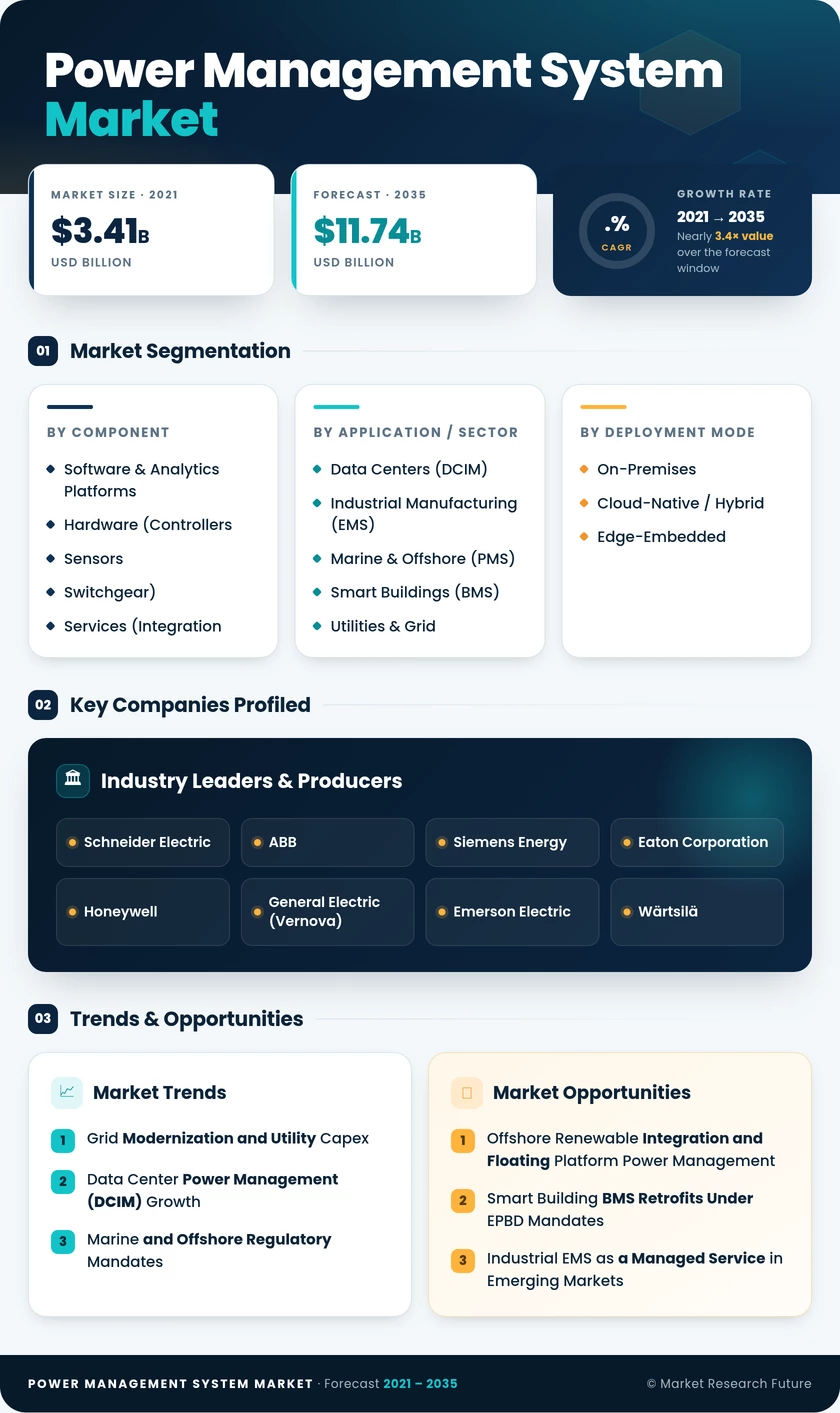
Segmentation Quick Reference
| Dimension | Sub-Segments | Dominant Segment | Fastest Growing Segment |
| By Component | Power Management System Market & Analytics Platforms; Hardware (Controllers, Sensors, Switchgear); Services (Integration, Managed, Maintenance) | Power Management System Market & Analytics Platforms (41% share) | Cloud-Native Power Management System Market (CAGR ~13.1%) |
| By Application / Sector | Data Centers (DCIM); Industrial Manufacturing (EMS); Marine & Offshore (PMS); Smart Buildings (BMS); Utilities & Grid | Data Centers / DCIM (largest USD revenue) | Data Centers / DCIM (13.8% CAGR) |
| By Deployment Mode | On-Premises; Cloud-Native / Hybrid; Edge-Embedded | On-Premises (USD 2.59B, 2025) | Cloud-Native / Hybrid |
| By Region | North America; Europe; Asia-Pacific; Middle East & Africa; South America | North America (34% share) | Asia-Pacific (12.8% CAGR) |
Market Segmentation Overview
By Component
| Sub-Segment | Key Trend |
| Power Management System Market & Analytics Platforms | AI-driven demand forecasting, ESG reporting integration and SaaS pricing models replacing perpetual licenses |
| Hardware (Controllers, Sensors, Switchgear) | Intelligent switchgear with embedded PLC replacing passive hardware; solid-state designs for offshore environments |
| Services (Integration, Managed, Maintenance) | Managed service contracts growing in APAC and MEA; remote monitoring reducing on-site engineer dependency |
Power Management System Market increasingly dominates the value stack in the Power Management System Market. Buyers are allocating more of their budgets to analytics platforms and integration services and less to commodity hardware, reflecting the broader OT software-ization trend across industrial markets. Vendors with proprietary software ecosystems—rather than generic SCADA resellers—are capturing structurally higher margins and stickier customer relationships.
By Application / Sector
| Sub-Segment | Key Trend |
| Data Centers (DCIM) | GPU cluster power density driving real-time load orchestration; renewable energy matching at the rack level |
| Industrial Manufacturing (EMS) | ISO 50001 certification mandates demand response monetization via utility programs |
| Marine & Offshore (PMS) | IMO EEXI/CII compliance; multi-fuel power management for LNG/ammonia vessels |
| Smart Buildings (BMS) | EPBD recast compliance deadline (2027); Scope 2 reporting integration |
| Utilities & Grid | FERC Order 2222 DER aggregation; AI-enabled load shedding automation at the substation level |
The application landscape of the Power Management System Market is diversifying rapidly. While data center power management (DCIM) leads in growth rate, the utilities segment remains the largest single revenue pool by deployed asset value, given the scale of grid infrastructure. Marine and offshore power management is the segment with the steepest regulatory-compliance tailwind over the 2025–2028 window, as IMO CII rating tightening forces accelerated PMS investment decisions across global shipping fleets.
By Deployment Mode
| Sub-Segment | Key Trend |
| On-Premises | Persistent demand from regulated utilities, offshore platforms, cybersecurity and data residency requirements |
| Cloud-Native / Hybrid | SaaS economics winning in BMS and industrial SME segments; hybrid architectures bridging OT/IT gap |
| Edge-Embedded | Critical for marine vessels and remote industrial sites; growing integration of edge AI inference |
Deployment mode is an increasingly strategic decision for buyers—not merely a technical one. Utilities and offshore operators typically default to on-premises architectures for compliance and latency reasons. Corporate real estate and industrial SMEs are migrating toward cloud-native and hybrid models driven by operating cost preferences. Edge-embedded deployment is the most specialized sub-segment, dominated by marine PMS and remote mining applications, where network connectivity constraints make cloud dependency operationally unacceptable.