×
Request Free Sample ×

Kindly complete the form below to receive a free sample of this Report

* Please use a valid business email

Leading companies partner with us for data-driven Insights

clients tt-cursor
Hero Background

Power Tool Battery Market

ID: MRFR/EnP/8974-HCR
111 Pages
Pradeep Nandi
October 2025

Power Tool Battery Market Research Report Information By Type (Nickel-cadmium, Nickel-Metal Hydride, Lithium-ion), By Tools (Drills, Saws, Lawn Mower, Impact Wrench, Others), By Application (Residential, Commercial, Industrial) And By Region (North America, Europe, Asia-Pacific, And Rest Of The World) –Market Forecast Till 2035

Share:
Download PDF ×

We do not share your information with anyone. However, we may send you emails based on your report interest from time to time. You may contact us at any time to opt-out.

Power Tool Battery Market Infographic
Purchase Options

Power Tool Battery Market Summary

As per MRFR analysis, the Power Tool Battery Market Size was estimated at 3291.51 USD Million in 2024. The Power Tool Battery industry is projected to grow from 3607.57 USD Million in 2025 to 9024.02 USD Million by 2035, exhibiting a compound annual growth rate (CAGR) of 9.6 during the forecast period 2025 - 2035.

Key Market Trends & Highlights

The Power Tool Battery Market is experiencing robust growth driven by technological advancements and increasing demand for cordless solutions.

  • Advancements in lithium-ion technology are enhancing battery performance and longevity, appealing to both professional and DIY users.
  • Sustainability initiatives are gaining traction, with manufacturers focusing on eco-friendly materials and recycling programs.
  • The integration of smart features in power tool batteries is becoming prevalent, particularly in the construction and automotive segments.
  • Rising demand for cordless tools and growth in construction activities are key drivers propelling the market forward, especially in North America and Asia-Pacific.

Market Size & Forecast

2024 Market Size 3291.51 (USD Million)
2035 Market Size 9024.02 (USD Million)
CAGR (2025 - 2035) 9.6%

Major Players

DeWalt (US), Makita (JP), Bosch (DE), Milwaukee (US), Ryobi (JP), Black & Decker (US), Hitachi (JP), Festool (DE), Hilti (LI)

Power Tool Battery Market Trends

The Power Tool Battery Market is currently experiencing a transformative phase characterized by rapid advancements in battery technology and increasing demand for efficient power solutions. As industries evolve, the need for high-performance batteries that offer longer run times and faster charging capabilities becomes paramount. This shift is driven by the growing popularity of cordless power tools, which provide enhanced mobility and convenience for users. Furthermore, the emphasis on sustainability is prompting manufacturers to explore eco-friendly materials and recycling initiatives, thereby aligning with global environmental goals. In addition, the competitive landscape of the Power Tool Battery Market is intensifying, with numerous players striving to innovate and differentiate their offerings. Companies are investing in research and development to create batteries that not only meet the performance expectations of consumers but also adhere to safety standards. The integration of smart technology into battery systems is also gaining traction, allowing for better monitoring and management of battery health. Overall, the Power Tool Battery Market appears poised for continued growth, driven by technological advancements and shifting consumer preferences.

Advancements in Lithium-Ion Technology

The Power Tool Battery Market is witnessing significant improvements in lithium-ion technology, which enhances energy density and reduces charging times. This trend indicates a shift towards batteries that can sustain longer usage periods while maintaining lightweight characteristics, appealing to both professional and DIY users.

Sustainability Initiatives

There is a growing focus on sustainability within the Power Tool Battery Market, as manufacturers increasingly prioritize eco-friendly materials and recycling processes. This trend suggests a commitment to reducing environmental impact, which may resonate with environmentally conscious consumers.

Integration of Smart Features

The incorporation of smart technology into power tool batteries is becoming more prevalent. This trend indicates a move towards batteries equipped with monitoring systems that provide real-time data on performance and health, potentially enhancing user experience and safety.

Power Tool Battery Market Drivers

Growing Demand for Cordless Tools

The increasing preference for cordless power tools among professionals and DIY enthusiasts drives the Global Power Tool Battery Market Industry. Cordless tools offer enhanced mobility and convenience, which are essential for various applications in construction, woodworking, and automotive sectors. As of 2024, the market is valued at 3.29 USD Billion, reflecting a robust demand for efficient battery solutions. This trend is expected to continue as more users seek tools that provide flexibility without compromising performance. The shift towards cordless technology indicates a significant transformation in user preferences, further propelling the market forward.

Market Segment Insights

By Application: Construction (Largest) vs. Automotive (Fastest-Growing)

The power tool battery market's application segment reveals a diverse distribution, with the construction sector holding the largest share. This can be attributed to the continuous demand for reliable and efficient power tools for building and infrastructure projects. Other noteworthy applications include automotive, manufacturing, gardening, and home improvement, each contributing to the market's growth but at varying levels. The automotive segment, while smaller, showcases significant potential for expansion due to increasing automation and electric vehicle production. As we analyze the growth trends, the construction sector remains driven by investments in infrastructure and commercial projects. In contrast, the automotive sector is poised for rapid growth, fueled by advancements in battery technology and a heightened focus on sustainability. Gardening and home improvement applications are also gaining traction as consumers seek more efficient tools for DIY projects, further diversifying the market landscape.

Construction (Dominant) vs. Automotive (Emerging)

The construction sector stands as the dominant player in the power tool battery market, driven by extensive usage in various construction activities such as framing, plumbing, and electrical work. This segment benefits from strong demand for cordless tools, which offer flexibility and convenience on job sites. On the other hand, the automotive sector is emerging as a key area of growth, propelled by the shift towards electric vehicles and the increasing need for power tools in manufacturing and repairing automotive components. As battery technology evolves, automotive applications are expected to witness enhancements in performance and efficiency, marking a notable shift in market dynamics.

By End Use: Professional (Largest) vs. DIY (Fastest-Growing)

In the Power Tool Battery Market, the 'End Use' segment is predominantly driven by the Professional sector, which holds the largest market share. Professionals utilize power tools extensively for construction, renovations, and various industrial applications, leading to a higher demand for robust and reliable battery solutions. Meanwhile, the DIY segment is emerging rapidly, capturing attention from casual users who seek efficient and user-friendly power tools for home projects, thus highlighting a significant shift towards consumer-driven battery applications.

Professional (Dominant) vs. DIY (Emerging)

The Professional segment stands as the dominant player in the Power Tool Battery Market, characterized by a demand for high-performance batteries suited for rigorous use in various industries. Professionals often prioritize durability, longer run times, and fast charging capabilities to maintain productivity. On the other hand, the DIY segment is classified as an emerging area, driven by a growing number of home improvement enthusiasts who favor convenience and accessibility. This segment is characterized by a desire for lightweight, easy-to-handle tools that offer sufficient power for less intensive tasks. The rise in online tutorials and home improvement projects encourages growth within the DIY market, indicating a trend towards more versatile battery solutions.

By Battery Type: Lithium Ion (Largest) vs. Nickel Cadmium (Fastest-Growing)

The Power Tool Battery Market exhibits a diverse landscape dominated by Lithium Ion batteries, which have garnered the highest market share due to their high energy density, longevity, and lower weight. In contrast, Nickel Cadmium batteries, while traditionally significant, are seeing a resurgence due to their cost-effectiveness and robust performance in various environmental conditions. The balance between these battery types significantly shapes the dynamics of market competition. Growth trends indicate a strong shift towards Lithium Ion batteries, fueled by advancements in technology and increasing consumer demand for portable power tools. Moreover, Nickel Cadmium's emerging growth is driven by its application in budget-friendly power solutions, highlighting a trend of duality in market preferences. As sustainability concerns rise, manufacturers are also exploring hybrid solutions to maximize performance while minimizing environmental impact.

Lithium Ion (Dominant) vs. Nickel Cadmium (Emerging)

Lithium Ion batteries dominate the Power Tool Battery Market due to their unmatched energy efficiency and lightweight design, making them the preferred choice for both professionals and DIY enthusiasts. Their ability to provide extended runtimes in compact formats aligns perfectly with modern user demands, leading to their widespread adoption. Conversely, Nickel Cadmium batteries, known for their durability and cost-effectiveness, represent an emerging segment that caters to users seeking reliable performance in harsh conditions. While they are being overshadowed by Lithium Ion in terms of popularity, their potential for niche applications ensures they remain relevant. As the market evolves, both segments will coexist, with Lithium Ion leading the charge in innovations while Nickel Cadmium carves out a space by appealing to budget-conscious consumers.

By Voltage Rating: High Voltage (Largest) vs. Medium Voltage (Fastest-Growing)

In the Power Tool Battery Market, the voltage rating segment is primarily divided into three categories: Low Voltage, Medium Voltage, and High Voltage. Each category captures a different market share, with High Voltage batteries leading due to their extensive application in heavy-duty power tools. Medium Voltage batteries follow closely as they rapidly gain traction among DIY enthusiasts and professionals looking for a balance of power and efficiency. Low Voltage batteries, while useful for lighter applications, occupy the smallest share in the market.

High Voltage (Dominant) vs. Medium Voltage (Emerging)

High Voltage batteries are characterized by their ability to deliver immense power, making them essential for demanding applications in construction and industrial sectors. These batteries are preferred in scenarios where high torque and extended runtime are critical. Meanwhile, Medium Voltage batteries represent a growing preference for users who desire a compromise between power and portability. The emergence of this segment is driven by an increasing demand for versatile tools that cater to both professionals and hobbyists, positioning Medium Voltage as a strong contender in the evolving power tool landscape.

Get more detailed insights about Power Tool Battery Market

Regional Insights

North America : Market Leader in Power Tools

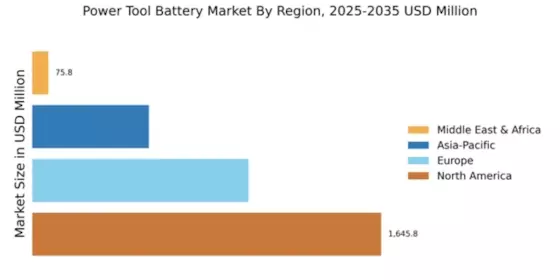
North America continues to lead the power tool battery market, holding a significant share of 1645.76 million in 2024. The growth is driven by increasing demand for cordless tools, advancements in battery technology, and a robust construction sector. Regulatory support for energy-efficient products further fuels this trend, as consumers and businesses seek sustainable solutions. The region's focus on innovation and quality standards also plays a crucial role in market expansion. The competitive landscape in North America is characterized by the presence of major players such as DeWalt, Milwaukee, and Black & Decker. These companies are investing heavily in R&D to enhance battery performance and longevity. The U.S. market is particularly strong, with a growing preference for lithium-ion batteries, which offer superior efficiency and reduced charging times. This competitive environment fosters innovation, ensuring that North America remains at the forefront of the power tool battery market.

Europe : Emerging Market with Growth Potential

Europe's power tool battery market is valued at 1020.0 million, reflecting a growing trend towards cordless tools and sustainable energy solutions. The region benefits from stringent regulations promoting energy efficiency and environmental sustainability, which drive demand for advanced battery technologies. The increasing adoption of electric vehicles and renewable energy sources also contributes to market growth, as consumers seek versatile and efficient power solutions. Leading countries in Europe include Germany, France, and the UK, where companies like Bosch and Hilti are prominent. The competitive landscape is marked by innovation, with a focus on developing high-capacity, lightweight batteries. European manufacturers are also collaborating with tech firms to integrate smart technologies into their products, enhancing user experience and efficiency. This dynamic environment positions Europe as a key player in The Power Tool Battery.

Asia-Pacific : Rapid Growth in Emerging Markets

The Asia-Pacific power tool battery market, valued at 550.0 million, is experiencing rapid growth driven by urbanization, industrialization, and a rising DIY culture. Countries like China and Japan are leading this growth, supported by increasing investments in construction and manufacturing sectors. The demand for efficient and portable power tools is on the rise, with consumers favoring cordless options for their convenience and flexibility. Regulatory initiatives promoting energy efficiency further enhance market prospects. China stands out as a major player in the region, with companies like Makita and Hitachi leading the charge. The competitive landscape is evolving, with local manufacturers emerging to meet the growing demand. The presence of established brands alongside new entrants fosters a dynamic market environment, encouraging innovation and competitive pricing. As the region continues to develop, the power tool battery market is expected to expand significantly, driven by both consumer and industrial demand.

Middle East and Africa : Untapped Market Opportunities

The Middle East and Africa power tool battery market, valued at 75.75 million, presents significant growth potential due to increasing construction activities and infrastructure development. The region is witnessing a shift towards cordless power tools, driven by the need for efficiency and mobility in various sectors. Regulatory frameworks are gradually evolving to support energy-efficient products, which is expected to further stimulate market growth in the coming years. Countries like South Africa and the UAE are emerging as key markets, with a growing number of construction projects and investments in renewable energy. The competitive landscape is characterized by a mix of local and international players, including established brands and new entrants. As the region continues to develop, the demand for advanced power tool batteries is anticipated to rise, creating opportunities for innovation and market expansion.

Key Players and Competitive Insights

The Power Tool Battery Market is currently characterized by a dynamic competitive landscape, driven by technological advancements and increasing demand for efficient power solutions. Major players such as DeWalt (US), Makita (JP), and Bosch (DE) are strategically positioned to leverage innovation and sustainability in their operations. DeWalt (US) focuses on enhancing battery performance through advanced lithium-ion technology, while Makita (JP) emphasizes eco-friendly manufacturing processes. Bosch (DE) is investing in smart battery solutions that integrate IoT capabilities, reflecting a broader trend towards digital transformation in the industry. Collectively, these strategies not only enhance product offerings but also intensify competition, as companies vie for market share in an increasingly tech-driven environment.

Key business tactics within the Power Tool Battery Market include localizing manufacturing and optimizing supply chains to enhance efficiency and reduce costs. The market structure appears moderately fragmented, with several key players exerting significant influence. This fragmentation allows for niche players to emerge, yet the collective strength of established companies like Milwaukee (US) and Ryobi (JP) shapes the competitive dynamics. Milwaukee (US) has been particularly aggressive in expanding its product line, which may indicate a strategy to capture a larger share of the market by appealing to diverse consumer needs.

In November 2025, Milwaukee (US) announced the launch of a new line of high-capacity batteries designed for heavy-duty applications. This strategic move is likely to enhance their competitive edge by catering to professional users who require longer-lasting power solutions. The introduction of these batteries not only reinforces Milwaukee's commitment to innovation but also positions the company favorably against competitors who may not yet offer similar high-capacity options.

In October 2025, Bosch (DE) unveiled a partnership with a leading tech firm to develop smart battery management systems. This collaboration is indicative of Bosch's strategy to integrate AI and IoT technologies into their products, potentially revolutionizing how users interact with power tools. By focusing on smart technology, Bosch aims to differentiate itself in a crowded market, appealing to tech-savvy consumers and professionals alike.

In September 2025, Makita (JP) expanded its manufacturing capabilities in Southeast Asia, a move that appears to be aimed at reducing production costs and improving supply chain resilience. This expansion not only enhances Makita's operational efficiency but also positions the company to better serve the growing demand in emerging markets. Such strategic localization efforts may provide a competitive advantage as global supply chains continue to face challenges.

As of December 2025, current trends in the Power Tool Battery Market are increasingly defined by digitalization, sustainability, and the integration of AI technologies. Strategic alliances among key players are shaping the landscape, fostering innovation and collaboration. The competitive differentiation is likely to evolve from traditional price-based competition towards a focus on technological advancements and supply chain reliability. Companies that prioritize innovation and sustainability may find themselves better positioned to thrive in this rapidly changing environment.

Key Companies in the Power Tool Battery Market market include

Industry Developments

October 2021: DEWALT, a Stanley Black & Decker brand known for its expertise in Jobsite Solutions, recently unveiled the worldwide release of the DEWALT POWERSTACK 20V MAX Compact Battery. This cutting-edge battery technology represents a significant leap forward in performance for DEWALT's range of cordless power tools. With its launch, DEWALT ushers in a new era of advanced capabilities, providing professionals with enhanced performance and efficiency on the job. The introduction of the DEWALT POWERSTACK 20V MAX Compact Battery demonstrates the brand's ongoing commitment to delivering top-quality tools and solutions that empower professionals to confidently tackle demanding tasks.

March 2021:Lowe's Companies Inc. and Chevron announced the exclusive launch of FLEX, a line of cutting-edge, cordless power tools. The first FLEX tools, accessories, batteries, and chargers will be available on the company website and nationwide stores.

Future Outlook

Power Tool Battery Market Future Outlook

The Power Tool Battery Market is projected to grow at a 9.6% CAGR from 2024 to 2035, driven by technological advancements, increasing demand for cordless tools, and sustainability initiatives.

New opportunities lie in:

  • Development of high-capacity lithium-ion batteries for extended tool usage.
  • Integration of smart technology for battery monitoring and management.
  • Expansion into emerging markets with tailored product offerings.

By 2035, the market is expected to achieve robust growth, positioning itself as a leader in the power tool industry.

Market Segmentation

Power Tool Battery Market End Use Outlook

  • Professional
  • DIY
  • Industrial
  • Commercial

Power Tool Battery Market Application Outlook

  • Construction
  • Automotive
  • Manufacturing
  • Gardening
  • Home Improvement

Power Tool Battery Market Battery Type Outlook

  • Lithium Ion
  • Nickel Cadmium
  • Nickel Metal Hydride
  • Lead Acid

Power Tool Battery Market Voltage Rating Outlook

  • Low Voltage
  • Medium Voltage
  • High Voltage

Report Scope

MARKET SIZE 20243291.51(USD Million)
MARKET SIZE 20253607.57(USD Million)
MARKET SIZE 20359024.02(USD Million)
COMPOUND ANNUAL GROWTH RATE (CAGR)9.6% (2024 - 2035)
REPORT COVERAGERevenue Forecast, Competitive Landscape, Growth Factors, and Trends
BASE YEAR2024
Market Forecast Period2025 - 2035
Historical Data2019 - 2024
Market Forecast UnitsUSD Million
Key Companies ProfiledDeWalt (US), Makita (JP), Bosch (DE), Milwaukee (US), Ryobi (JP), Black & Decker (US), Hitachi (JP), Festool (DE), Hilti (LI)
Segments CoveredApplication, End Use, Battery Type, Voltage Rating
Key Market OpportunitiesAdvancements in lithium-ion technology enhance performance and sustainability in the Power Tool Battery Market.
Key Market DynamicsTechnological advancements in battery efficiency drive competitive dynamics in the power tool battery market.
Countries CoveredNorth America, Europe, APAC, South America, MEA

Market Highlights

Author
Pradeep Nandi
Senior Research Analyst

I have a bachelor's degree in mechanical engineering and an MBA. I have more than two years of expertise in the retail, food, and beverage, chemical, and material industries, and hence have developed a sound cross-domain expertise. A firm believer in lifelong learning and sharing of knowledge. Having a proclivity for hatching ideas and trying to absorb as much information as possible in a short amount of time. Introducing corporates to the data and insight, which enables them to move from probability to possibility, has been my key areas of interest. 

Leave a Comment

FAQs

How much is the Power Tool Battery market?

The Power Tool Battery market size was valued at USD 2.5 Billion in 2022.

What is the growth rate of the Power Tool Battery market?

The market is expected to experience a Compound Annual Growth Rate (CAGR) of 9.60% from 2025 to 2034.

Which Region witnessed the largest market share in the Power Tool Battery market?

North America had the largest share of the market

Who are the major players in the Power Tool Battery market?

The major players in the market are Battery Xpress, BYD Co.Ltd., A-one Moli Energy Corp., Hitachi Ltd., Ryobi Ltd., Samsung SDI, Techtronic Industries Co., Ltd., Makita Corporation, LG Chem Ltd., and Sony Corporation.

Which type led the Power Tool Battery market?

The Lithium-ion Power Tool Battery category dominated the market in 2022.

Which Application witnessed the largest market share in the Power Tool Battery market?

The Industrial had the largest share of the market.

Download Free Sample

Kindly complete the form below to receive a free sample of this Report

Compare Licence

×
Features License Type
Single User Multiuser License Enterprise User
Price $4,950 $5,950 $7,250
Maximum User Access Limit 1 User Upto 10 Users Unrestricted Access Throughout the Organization
Free Customization
Direct Access to Analyst
Deliverable Format
Platform Access
Discount on Next Purchase 10% 15% 15%
Printable Versions