×
Request Free Sample ×

Kindly complete the form below to receive a free sample of this Report

* Please use a valid business email

Leading companies partner with us for data-driven Insights

clients tt-cursor
Hero Background

Power Transmission Lines Towers Market

ID: MRFR/EnP/22164-HCR
100 Pages
Snehal Singh
October 2025

Power Transmission Lines And Towers Market Research Report By Voltage Level (Low voltage (below 1 kV), Medium voltage (1-33 kV), High voltage (greater than 33 kV)), By Tower Type (Self-supporting Towers, Guyed Towers, Monopole Towers, Suspension Towers), By Conductor Type (Bare Overhead Conductors, Insulated Overhead Conductors, Underground Cables), By Application (New Infrastructure, Replacement and Upgrading of Existing Lines, Renewable Energy Integration) and By Regional (North America, Europe, South America, Asia Pacific, Middle East and... read more

Share:
Download PDF ×

We do not share your information with anyone. However, we may send you emails based on your report interest from time to time. You may contact us at any time to opt-out.

Power Transmission Lines Towers Market Infographic
Purchase Options

Power Transmission Lines Towers Market Summary

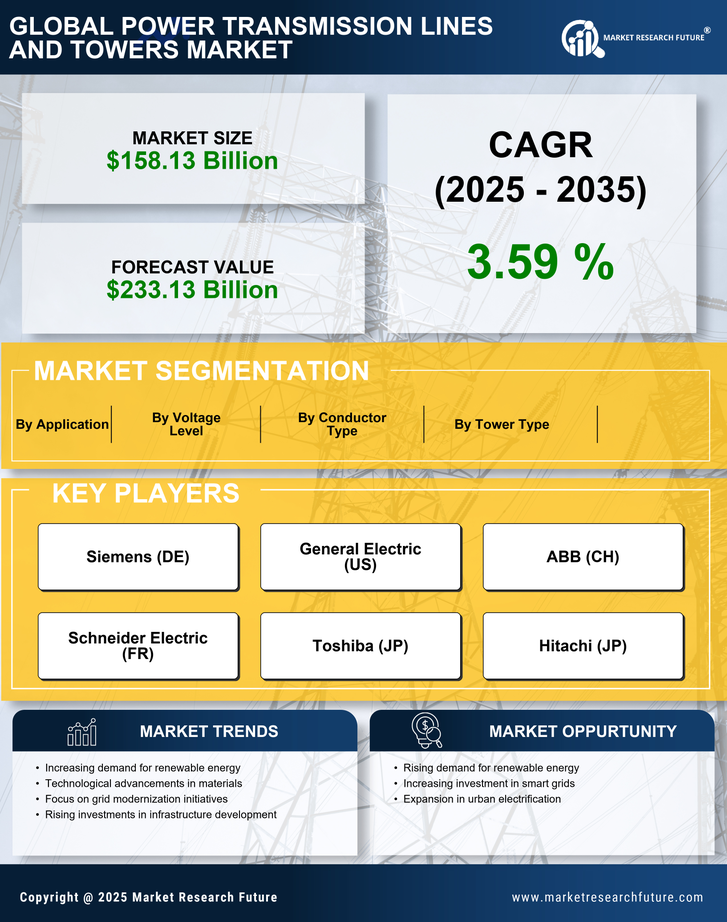
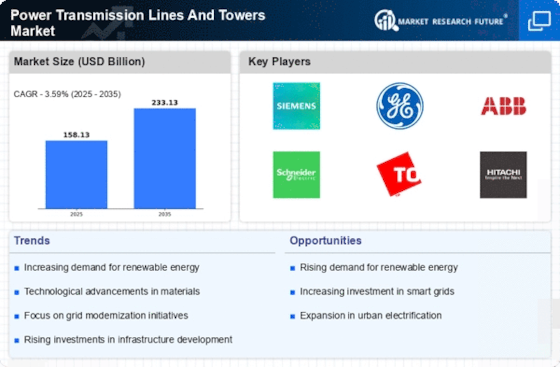
As per MRFR analysis, the Power Transmission Lines And Towers Market was estimated at 158.13 USD Billion in 2024. The Power Transmission Lines And Towers industry is projected to grow from 163.8 USD Billion in 2025 to 233.13 USD Billion by 2035, exhibiting a compound annual growth rate (CAGR) of 3.59 during the forecast period 2025 - 2035.

Key Market Trends & Highlights

The Power Transmission Lines and Towers Market is poised for substantial growth driven by technological advancements and increasing demand for renewable energy.

  • Technological advancements in transmission systems are reshaping the landscape of power distribution.
  • Sustainability and environmental considerations are becoming central to infrastructure development strategies in North America.
  • The high voltage segment remains the largest, while the medium voltage segment is experiencing rapid growth in the Asia-Pacific region.
  • Rising demand for renewable energy integration and government policies are key drivers propelling market expansion.

Market Size & Forecast

2024 Market Size 158.13 (USD Billion)
2035 Market Size 233.13 (USD Billion)
CAGR (2025 - 2035) 3.59%

Major Players

Siemens (DE), General Electric (US), ABB (CH), Schneider Electric (FR), Toshiba (JP), Hitachi (JP), Nexans (FR), Prysmian Group (IT), Southwire (US)

Power Transmission Lines Towers Market Trends

The Power Transmission Lines And Towers Market is currently experiencing a transformative phase, driven by the increasing demand for reliable electricity supply and the need for modernization of existing infrastructure. As urbanization accelerates and populations grow, the pressure on energy systems intensifies, prompting investments in new transmission lines and towers. This market is characterized by a shift towards more efficient technologies, including smart grid solutions that enhance the management of electricity distribution. Furthermore, the integration of renewable energy sources into the grid necessitates the development of robust transmission networks to accommodate fluctuating power generation. In addition to technological advancements, regulatory frameworks are evolving to support sustainable energy practices. Governments are implementing policies that encourage the adoption of environmentally friendly materials and construction methods in the Power Transmission Lines And Towers Market. This trend reflects a broader commitment to reducing carbon footprints and promoting energy efficiency. As stakeholders navigate these changes, collaboration among utility companies, manufacturers, and regulatory bodies becomes increasingly vital. The future landscape of this market appears poised for growth, with innovations likely to play a crucial role in shaping its trajectory.

Technological Advancements in Transmission Systems

The Power Transmission Lines And Towers Market is witnessing a surge in technological innovations aimed at enhancing efficiency and reliability. Smart grid technologies are being integrated to optimize electricity distribution, allowing for real-time monitoring and management of power flow. This shift not only improves operational efficiency but also supports the incorporation of renewable energy sources, which require adaptable infrastructure.

Sustainability and Environmental Considerations

There is a growing emphasis on sustainability within the Power Transmission Lines And Towers Market. Regulatory bodies are increasingly mandating the use of eco-friendly materials and construction practices. This trend reflects a commitment to reducing environmental impact and promoting energy efficiency, aligning with global efforts to combat climate change.

Increased Investment in Infrastructure Development

Investment in infrastructure development is a prominent trend in the Power Transmission Lines And Towers Market. As demand for electricity rises, stakeholders are channeling resources into expanding and modernizing transmission networks. This focus on infrastructure not only addresses current energy needs but also prepares for future growth, ensuring a reliable power supply.

Power Transmission Lines Towers Market Drivers

Urbanization and Population Growth

Urbanization and population growth are significant factors influencing the Power Transmission Lines And Towers Market. As urban areas expand, the demand for electricity surges, necessitating the development of new transmission infrastructure to meet the needs of growing populations. Recent projections indicate that urban populations are expected to increase by over 2 billion by 2050, leading to heightened pressure on existing power systems. This demographic shift compels utilities and energy providers to invest in the expansion and modernization of transmission lines and towers to ensure reliable electricity supply. Consequently, the Power Transmission Lines And Towers Market is likely to witness increased activity as stakeholders respond to the challenges posed by urbanization and strive to enhance grid resilience.

Investment in Smart Grid Technologies

Investment in smart grid technologies is emerging as a pivotal driver for the Power Transmission Lines And Towers Market. Smart grids enable enhanced communication and automation within the power transmission network, leading to improved efficiency and reliability. The integration of advanced metering infrastructure and real-time data analytics allows for better demand response and load management. Recent estimates suggest that the smart grid market could reach approximately 400 billion USD by 2027, reflecting a growing recognition of its importance in modern energy systems. As utilities and energy providers increasingly adopt these technologies, the Power Transmission Lines And Towers Market is poised for growth, driven by the need for more resilient and adaptive power transmission solutions.

Government Policies and Regulatory Frameworks

Government policies and regulatory frameworks play a crucial role in shaping the Power Transmission Lines And Towers Market. Many governments are implementing supportive policies aimed at modernizing energy infrastructure and promoting the use of clean energy. For instance, incentives for renewable energy projects and funding for grid upgrades are becoming more prevalent. In some regions, regulatory bodies are mandating the development of new transmission lines to accommodate the increasing demand for electricity. This regulatory push is expected to drive investments in the Power Transmission Lines And Towers Market, as stakeholders align their strategies with governmental objectives. The establishment of clear guidelines and frameworks can facilitate smoother project approvals and enhance investor confidence, further stimulating market growth.

Rising Demand for Renewable Energy Integration

The transition towards renewable energy sources is a significant driver for the Power Transmission Lines And Towers Market. As countries strive to meet their renewable energy targets, the need for robust transmission infrastructure becomes increasingly critical. Wind and solar energy, which are often located in remote areas, require extensive transmission networks to deliver electricity to urban centers. Recent statistics suggest that renewable energy sources accounted for over 30% of total electricity generation in several regions, necessitating upgrades and expansions in transmission lines and towers. This growing demand for renewable energy integration not only supports the decarbonization efforts but also propels investments in the Power Transmission Lines And Towers Market, as stakeholders seek to enhance grid connectivity and reliability.

Technological Innovations in Power Transmission

The Power Transmission Lines And Towers Market is experiencing a surge in technological innovations that enhance efficiency and reliability. Advanced materials, such as high-temperature superconductors, are being integrated into transmission systems, allowing for reduced energy losses and increased capacity. Furthermore, the implementation of smart grid technologies facilitates real-time monitoring and management of power flows, which is crucial for optimizing performance. According to recent data, investments in smart grid technologies are projected to reach approximately 100 billion USD by 2026, indicating a robust growth trajectory. These innovations not only improve the operational efficiency of power transmission but also contribute to the overall sustainability of energy systems, making them a pivotal driver in the Power Transmission Lines And Towers Market.

Market Segment Insights

By Voltage Level: High Voltage (Largest) vs. Medium Voltage (Fastest-Growing)

In the Power Transmission Lines and Towers Market, the voltage level segment showcases a distinct distribution of market share among low, medium, and high voltage categories. High voltage systems, defined as those exceeding 33 kV, constitute the largest share, reflecting their critical role in long-distance power transmission. Medium voltage systems, ranging from 1 to 33 kV, are significant but represent a smaller portion of the market. Low voltage systems, which operate below 1 kV, are crucial for local distribution but hold the least market share in this segment.

Medium Voltage (Dominant) vs. Low Voltage (Emerging)

Medium voltage systems serve as a dominant force in the market, primarily utilized for distributing power across urban and suburban areas to meet escalating energy demands. These systems are essential for connecting high voltage lines to local distribution grids, thereby enhancing network reliability. On the other hand, low voltage systems are emerging as crucial components in residential and small commercial applications, catering to the growing need for decentralized power generation and smart grid technologies. As electricity consumption rises and urban areas expand, the low voltage segment is expected to grow, focusing on innovative solutions such as renewable energy integration and energy-efficient technologies.

By Tower Type: Self-supporting Towers (Largest) vs. Guyed Towers (Fastest-Growing)

In the Power Transmission Lines and Towers Market, the segment consists of various tower types that cater to different operational needs. Self-supporting towers hold the largest market share due to their robust design and versatility, making them suitable for high-voltage applications. Guyed towers, on the other hand, are increasingly gaining traction, particularly in areas where cost-effectiveness and lightweight structures are paramount, providing a significant competitive advantage in specific projects. The growth trends within this segment are being driven by increased demand for renewable energy sources and the need for upgraded infrastructure. Guyed towers, viewed as the emerging segment, are favored for their efficient use of materials and lower installation costs. Self-supporting towers will continue to lead, fueled by advances in material technology that enhance durability and longevity, ensuring they remain relevant in a rapidly evolving market landscape.

Self-supporting Towers (Dominant) vs. Guyed Towers (Emerging)

Self-supporting towers stand as the dominant choice in the Power Transmission Lines and Towers Market due to their structural integrity and ability to support heavy loads. Their design offers flexibility in various terrains and conditions, making them ideal for high-voltage applications. This tower type has extensive usage in urban areas where availability of space and aesthetic considerations are vital. On the other hand, guyed towers emerge as a cost-effective alternative, especially where the land is not a limiting factor. They utilize tensioned cables to stabilize the structure, allowing for greater heights with less material. This makes them increasingly attractive for new projects, particularly in rural and less densely populated regions, thus diversifying their market appeal.

By Conductor Type: Bare Overhead Conductors (Largest) vs. Underground Cables (Fastest-Growing)

In the Power Transmission Lines and Towers Market, Bare Overhead Conductors hold the largest market share due to their widespread use and established infrastructure. These conductors are favored for overhead transmission applications due to their low cost and ease of installation. Insulated Overhead Conductors follow, offering enhanced safety and reliability, especially in urban areas. Meanwhile, Underground Cables are gaining traction, particularly in regions focusing on aesthetic and environmental considerations, reflecting a shift towards less visible and more durable solutions.

Insulated Overhead Conductors (Dominant) vs. Underground Cables (Emerging)

Insulated Overhead Conductors are becoming increasingly dominant in the market, known for their ability to reduce transmission losses and improve system reliability. These conductors are especially valuable in densely populated or sensitive areas where safety is paramount. On the other hand, Underground Cables are emerging rapidly, propelled by the growing demand for minimal environmental impact and urban development projects. While they typically incur higher installation costs, their advantages in aesthetics and reduced risk of outages during extreme weather are driving their adoption. Together, these segments illustrate a dynamic shift in the power transmission landscape, responding to technological and regulatory changes.

By Application: New Infrastructure (Largest) vs. Replacement and Upgrading of Existing Lines (Fastest-Growing)

The Power Transmission Lines and Towers Market is witnessing a significant distribution among its application segments. New Infrastructure holds the largest share as investments in expanding power grids are prioritized globally, driven by rising energy demands and urbanization. Conversely, the Replacement and Upgrading of Existing Lines is rapidly gaining traction as aging infrastructure necessitates modernization to enhance efficiency and reliability, marking it as the fastest-growing segment in the market.

Infrastructure: New Infrastructure (Dominant) vs. Replacement and Upgrading of Existing Lines (Emerging)

The New Infrastructure segment is characterized by large-scale investments in the development of new power transmission lines and towers, enabling efficient electricity distribution in growing urban areas. This segment is pivotal for ensuring access to electricity in underserved regions. On the other hand, the Replacement and Upgrading of Existing Lines focuses on enhancing the efficiency and safety of aging infrastructure, driven by technological advancements and regulatory requirements. This emerging segment is increasingly recognized for its role in integrating smart grid technologies and improving overall system reliability, positioning it as critical for future energy resilience.

Get more detailed insights about Power Transmission Lines Towers Market

Regional Insights

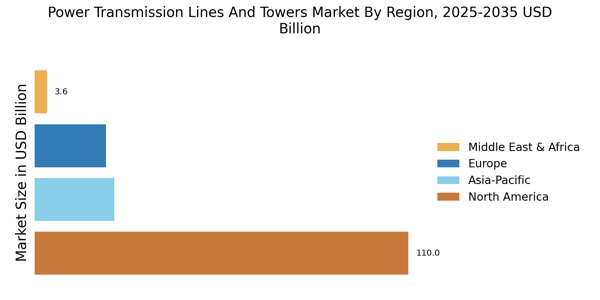
The regional segmentation of the Power Transmission Lines And Towers Market offers valuable insights into the industry's geographical distribution and growth patterns. North America, Europe, APAC, South America, and MEA are the key regions analyzed in this market report. In 2023, North America held the largest market share, accounting for around 35% of the Power Transmission Lines And Towers Market revenue. The region's robust infrastructure development, increasing energy demand, and growing renewable energy adoption drive this growth.

Europe is expected to follow closely, with a significant share of over 28% in 2023, owing to its focus on grid modernization and integration of renewable energy sources. APAC, driven by rapid industrialization and urbanization in emerging economies like India and China, is projected to witness steady growth, reaching a market size of nearly 25% by 2024. South America and MEA, while having smaller market shares, present growth opportunities due to increasing investment in infrastructure and energy projects.

Power Transmission Lines Towers Market Regional Image

Key Players and Competitive Insights

Major players in the Power Transmission Lines And Towers Market industry are constantly innovating and developing new technologies to gain an edge over their competitors. This has led to the development of new and improved products, such as high-voltage direct current (HVDC) transmission lines and towers. HVDC transmission lines can transmit electricity over long distances with minimal losses, making them an ideal solution for connecting remote areas to the grid. Leading Power Transmission Lines And Towers Market players are also investing in smart grid technologies, such as real-time monitoring and control systems. 

These technologies can help to improve the efficiency and reliability of the power grid and reduce costs. The Power Transmission Lines And Towers Market is expected to continue to grow over the next few years, driven by increasing demand for electricity and the need to upgrade and expand the existing power grid. One of the leading competitors in the Power Transmission Lines And Towers Market industry is ABB. ABB is a global leader in power and automation technologies and offers a wide range of products and services for the transmission and distribution of electricity.

ABB's power transmission and distribution products include high-voltage cables, transformers, switchgear, and substations. 

The company also provides engineering, procurement, and construction services for power transmission and distribution projects. Another major competitor in the Power Transmission Lines And Towers Market is Siemens. Siemens is a global leader in electrical engineering and electronics and offers a wide range of products and services for the power industry. Siemens' power transmission and distribution products include transformers, switchgear, substations, and power cables. The company also provides engineering, procurement, and construction services for power transmission and distribution projects.

Key Companies in the Power Transmission Lines Towers Market market include

Industry Developments

The Power Transmission Lines And Towers Market is anticipated to grow from USD 147.35 billion in 2023 to USD 202.51 billion by 2032, at a CAGR of 3.59%. The market growth is driven by increasing demand for electricity, expanding power grids, and rising investments in renewable energy. 

Technological advancements, such as the development of high-voltage direct current (HVDC) transmission systems and overhead conductors with reduced environmental impact, are also contributing to market growth. Key market players include Siemens, ABB, and Prysmian Group, who are focusing on expanding their global reach and investing in research and development. 

Recent news in the market includes the launch of a new generation of ultra-high voltage (UHV) transmission towers by a leading manufacturer, designed to handle higher power capacities and improve efficiency. Additionally, governments in emerging economies are prioritizing grid infrastructure development, creating growth opportunities for transmission line and tower suppliers.

Future Outlook

Power Transmission Lines Towers Market Future Outlook

The Power Transmission Lines and Towers Market is projected to grow at a 3.59% CAGR from 2024 to 2035, driven by increasing energy demand and infrastructure investments.

New opportunities lie in:

  • Investment in smart grid technologies to enhance efficiency.
  • Development of eco-friendly transmission materials for sustainability.
  • Expansion into emerging markets with underdeveloped power infrastructure.

By 2035, the market is expected to be robust, reflecting substantial growth and innovation.

Market Segmentation

Power Transmission Lines Towers Market Tower Type Outlook

  • Self-supporting Towers
  • Guyed Towers
  • Monopole Towers
  • Suspension Towers

Power Transmission Lines Towers Market Application Outlook

  • New Infrastructure
  • Replacement and Upgrading of Existing Lines
  • Renewable Energy Integration

Power Transmission Lines Towers Market Voltage Level Outlook

  • Low voltage (below 1 kV)
  • Medium voltage (1-33 kV)
  • High voltage (greater than 33 kV)

Power Transmission Lines Towers Market Conductor Type Outlook

  • Bare Overhead Conductors
  • Insulated Overhead Conductors
  • Underground Cables

Report Scope

MARKET SIZE 2024158.13(USD Billion)
MARKET SIZE 2025163.8(USD Billion)
MARKET SIZE 2035233.13(USD Billion)
COMPOUND ANNUAL GROWTH RATE (CAGR)3.59% (2024 - 2035)
REPORT COVERAGERevenue Forecast, Competitive Landscape, Growth Factors, and Trends
BASE YEAR2024
Market Forecast Period2025 - 2035
Historical Data2019 - 2024
Market Forecast UnitsUSD Billion
Key Companies ProfiledMarket analysis in progress
Segments CoveredMarket segmentation analysis in progress
Key Market OpportunitiesIntegration of smart grid technologies enhances efficiency in the Power Transmission Lines And Towers Market.
Key Market DynamicsRising demand for renewable energy sources drives innovation in power transmission lines and towers technology.
Countries CoveredNorth America, Europe, APAC, South America, MEA

Leave a Comment

FAQs

What is the projected market valuation for the Power Transmission Lines and Towers Market in 2035?

The projected market valuation for the Power Transmission Lines and Towers Market in 2035 is 233.13 USD Billion.

What was the overall market valuation for the Power Transmission Lines and Towers Market in 2024?

The overall market valuation for the Power Transmission Lines and Towers Market in 2024 was 158.13 USD Billion.

What is the expected CAGR for the Power Transmission Lines and Towers Market during the forecast period 2025 - 2035?

The expected CAGR for the Power Transmission Lines and Towers Market during the forecast period 2025 - 2035 is 3.59%.

Which companies are considered key players in the Power Transmission Lines and Towers Market?

Key players in the Power Transmission Lines and Towers Market include Siemens, General Electric, ABB, Schneider Electric, Toshiba, Hitachi, Nexans, Prysmian Group, and Southwire.

What are the projected valuations for the different voltage level segments in the Power Transmission Lines and Towers Market?

The projected valuations for voltage level segments are 30.0 to 45.0 USD Billion for low voltage, 50.0 to 75.0 USD Billion for medium voltage, and 78.13 to 113.13 USD Billion for high voltage.

How do the valuations for different tower types compare in the Power Transmission Lines and Towers Market?

The valuations for tower types range from 20.0 to 30.0 USD Billion for monopole towers, 25.0 to 35.0 USD Billion for guyed towers, 30.0 to 45.0 USD Billion for self-supporting towers, and 83.13 to 123.13 USD Billion for suspension towers.

What are the projected valuations for conductor types in the Power Transmission Lines and Towers Market?

The projected valuations for conductor types are 50.0 to 75.0 USD Billion for bare overhead conductors, 40.0 to 60.0 USD Billion for insulated overhead conductors, and 68.13 to 98.13 USD Billion for underground cables.

What applications are driving growth in the Power Transmission Lines and Towers Market?

The applications driving growth include new infrastructure, projected at 50.0 to 80.0 USD Billion, replacement and upgrading of existing lines at 60.0 to 90.0 USD Billion, and renewable energy integration at 48.13 to 63.13 USD Billion.

How does the market for Power Transmission Lines and Towers appear to be evolving?

The market for Power Transmission Lines and Towers appears to be evolving positively, with a projected increase in valuation from 158.13 USD Billion in 2024 to 233.13 USD Billion by 2035.

What factors might influence the growth of the Power Transmission Lines and Towers Market in the coming years?

Factors influencing growth may include advancements in technology, increased demand for renewable energy integration, and the need for infrastructure upgrades.

Download Free Sample

Kindly complete the form below to receive a free sample of this Report

Compare Licence

×
Features License Type
Single User Multiuser License Enterprise User
Price $4,950 $5,950 $7,250
Maximum User Access Limit 1 User Upto 10 Users Unrestricted Access Throughout the Organization
Free Customization
Direct Access to Analyst
Deliverable Format
Platform Access
Discount on Next Purchase 10% 15% 15%
Printable Versions