Download Free Sample
Kindly complete the form below to receive a free sample of this Report
Precision Agriculture Equipment Maintenance Market Research Report: Size, Share, Trend Analysis By End User Outlook (Farmers, Agricultural Cooperatives, Government Agencies, Research Institutions, Agribusinesses) By Technology Outlook (Telematics, Automation, Data Analytics, Remote Sensing, Drones) By Application Outlook (Crop Monitoring, Soil Management, Yield Prediction, Irrigation Management, Pest Control) By Equipment Type Outlook (Tractors, Harvesters, Sprayers, Seeders, Plows) By Maintenance Type Outlook (Preventive Maintenance, Corrective Maintenance, Predictive Maintenance, Routine Maintenance, Emergency Maintenance) By Region (North America, Europe, APAC, South America, MEA) – Growth Outlook & Industry Forecast To 2035
As per MRFR analysis, the Precision Agriculture Equipment Maintenance Market was estimated at 5.2 USD Billion in 2024. The Precision Agriculture Equipment Maintenance industry is projected to grow from 5.41 USD Billion in 2025 to 8.1 USD Billion by 2035, exhibiting a compound annual growth rate (CAGR) of 4.11% during the forecast period 2025 - 2035.
The Precision Agriculture Equipment Maintenance Market is experiencing a transformative shift towards advanced technologies and sustainable practices.
| 2024 Market Size | 5.2 (USD Billion) |
| 2035 Market Size | 8.1 (USD Billion) |
| CAGR (2025 - 2035) | 4.11% |
John Deere (US), AG Leader Technology (US), Trimble (US), CNH Industrial (GB), BASF (DE), Yara International (NO), Raven Industries (US), Topcon Positioning Systems (JP), Deere & Company (US)
Our Impact
Enabled $4.3B Revenue Impact for Fortune 500 and Leading Multinationals
Partnering with 2000+ Global Organizations Each Year
30K+ Citations by Top-Tier Firms in the Industry
The Precision Agriculture Equipment Maintenance Market is currently experiencing a transformative phase, driven by advancements in technology and an increasing emphasis on sustainable farming practices. As agricultural operations become more reliant on sophisticated machinery, the need for regular maintenance and timely repairs has escalated. This trend is further fueled by the growing awareness among farmers regarding the importance of equipment efficiency and longevity. Consequently, service providers are adapting their offerings to meet the evolving demands of the sector, ensuring that equipment remains operational and effective in the field. Moreover, the integration of data analytics and IoT technologies into agricultural machinery is reshaping maintenance strategies. Predictive maintenance, which utilizes real-time data to anticipate equipment failures, is gaining traction. This proactive approach not only minimizes downtime but also optimizes resource allocation. As the Precision Agriculture Equipment Maintenance Market continues to evolve, stakeholders are likely to explore innovative solutions that enhance productivity while reducing environmental impact. The focus on precision farming is expected to drive further developments in maintenance practices, ensuring that equipment is not only maintained but also upgraded to meet future agricultural challenges.
The Precision Agriculture Equipment Maintenance Market is witnessing a notable shift towards predictive maintenance strategies. By leveraging data analytics and IoT technologies, stakeholders can anticipate equipment failures before they occur. This proactive approach minimizes downtime and enhances operational efficiency, allowing farmers to focus on productivity.
There is a growing emphasis on sustainability within the Precision Agriculture Equipment Maintenance Market. Service providers are increasingly adopting eco-friendly practices, such as using biodegradable lubricants and recycling parts. This trend reflects a broader commitment to reducing the environmental footprint of agricultural operations.
The integration of advanced technologies, such as artificial intelligence and machine learning, is transforming maintenance practices in the Precision Agriculture Equipment Maintenance Market. These technologies enable more accurate diagnostics and tailored maintenance schedules, ultimately improving equipment performance and longevity.
Regulatory compliance is increasingly influencing the Precision Agriculture Equipment Maintenance Market. Governments and agricultural bodies are implementing stringent regulations regarding equipment safety and environmental impact. These regulations necessitate regular maintenance and inspections to ensure compliance, thereby driving demand for maintenance services. For instance, adherence to safety standards can prevent costly fines and enhance the reputation of agricultural businesses. As the regulatory landscape evolves, the need for specialized maintenance services that align with these standards is expected to grow, positioning the Precision Agriculture Equipment Maintenance Market for sustained expansion.
The emphasis on equipment efficiency is a key driver in the Precision Agriculture Equipment Maintenance Market. As agricultural operations strive to maximize productivity, the efficiency of machinery becomes critical. Regular maintenance ensures that equipment operates at peak performance, reducing downtime and enhancing overall productivity. Data indicates that well-maintained equipment can lead to a 20% increase in operational efficiency. This focus on efficiency not only reduces costs but also contributes to sustainable farming practices. Consequently, the demand for maintenance services tailored to precision agriculture equipment is likely to rise, further propelling the Precision Agriculture Equipment Maintenance Market.
The growing awareness of sustainable agricultural practices is a significant driver in the Precision Agriculture Equipment Maintenance Market. Farmers are increasingly recognizing the importance of maintaining equipment to reduce waste and enhance resource efficiency. Sustainable maintenance practices not only prolong the lifespan of machinery but also contribute to environmental conservation. Data suggests that sustainable practices can lead to a 30% reduction in resource consumption. As the agricultural sector shifts towards sustainability, the demand for maintenance services that align with these practices is expected to rise, further fueling the growth of the Precision Agriculture Equipment Maintenance Market.
The Precision Agriculture Equipment Maintenance Market is experiencing a surge in demand due to the increasing adoption of precision agriculture practices. Farmers are increasingly utilizing advanced technologies such as GPS, IoT, and data analytics to enhance crop yields and optimize resource usage. This trend necessitates regular maintenance of precision agriculture equipment to ensure optimal performance and longevity. According to recent data, the precision agriculture market is projected to grow significantly, leading to a corresponding increase in the maintenance sector. As farmers invest in sophisticated machinery, the need for specialized maintenance services becomes paramount, driving growth in the Precision Agriculture Equipment Maintenance Market.
Technological advancements are reshaping the Precision Agriculture Equipment Maintenance Market. Innovations such as remote monitoring, predictive analytics, and automated maintenance solutions are becoming increasingly prevalent. These technologies enable farmers to anticipate equipment failures and schedule maintenance proactively, thereby minimizing downtime and repair costs. The integration of such technologies is projected to enhance the efficiency of maintenance operations significantly. As farmers seek to leverage these advancements, the demand for sophisticated maintenance solutions tailored to precision agriculture equipment is likely to increase, driving growth in the Precision Agriculture Equipment Maintenance Market.
The Precision Agriculture Equipment Maintenance Market exhibits a varied distribution across its application segments. Crop Monitoring leads as the largest segment, commanding significant market share due to rising demands for enhanced data-driven farming practices. In contrast, Pest Control, while smaller in share, showcases rapid growth as producers increasingly turn to precision solutions for pest management. Other segments, such as Soil Management and Yield Prediction, also contribute to the overall dynamics of this sector, reflecting the multifaceted needs of modern agriculture.
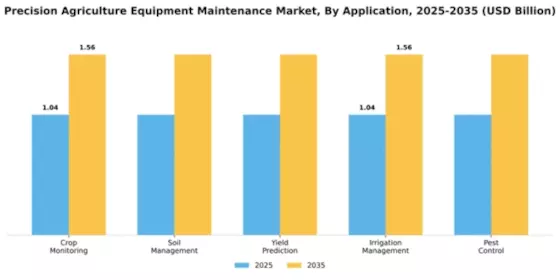
Crop Monitoring (Dominant) vs. Pest Control (Emerging)
Crop Monitoring remains the dominant force in the Precision Agriculture Equipment Maintenance Market, driven by the necessity for real-time monitoring and assessment of crop health and conditions. It incorporates advanced technologies, such as drones and sensors, to collect data, allowing farmers to make informed decisions. On the other hand, Pest Control is emerging as a critical segment, fueled by the increasing prevalence of pest-related challenges and the demand for efficacious management solutions. This segment leverages innovative pest detection tools and integrated pest management practices, positioning itself as a vital area for growth as more farmers seek sustainable options to protect their yields.
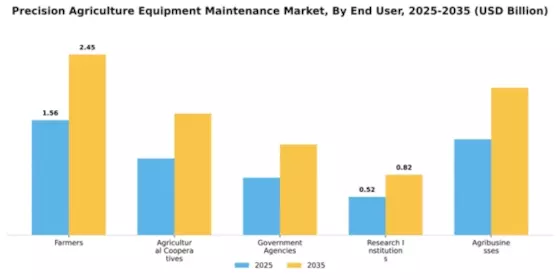
In the Precision Agriculture Equipment Maintenance Market, various equipment types serve crucial roles in optimizing farming efficiency. Currently, tractors hold the largest share among the equipment types, reflecting their vital role in the agricultural process. This segment is closely followed by harvesters, which are not far behind in terms of market share, but their rapid adoption signifies a growing reliance on advanced harvesting technologies.
Tractors (Dominant) vs. Harvesters (Emerging)
Tractors remain the dominant force in the equipment type segment of the Precision Agriculture Equipment Maintenance Market. Their versatility and essential function in tilling, planting, and transporting agricultural goods underscore their market stature. Meanwhile, harvesters are emerging as a significant segment due to technological advancements that enhance efficiency and reduce labor costs. As precision agriculture technologies develop, harvester maintenance requirements increase, driving a parallel rise in demand for maintenance services. Both segments exhibit distinct characteristics, with tractors providing foundational support and harvesters highlighting innovation in productivity.
The Precision Agriculture Equipment Maintenance Market is segmented into five primary maintenance types: Preventive, Corrective, Predictive, Routine, and Emergency Maintenance. Preventive maintenance holds the largest share within this market, as farmers and agricultural operators prioritize minimizing equipment failures and maximizing operational efficiency. Corrective and Emergency maintenance also play vital roles, but they are often reactive approaches compared to the proactive strategies employed through preventive maintenance. Routine and Predictive maintenance have been gaining traction, with Predictive maintenance emerging as a crucial strategy leveraging data analytics and IoT technology to forecast potential equipment failures.
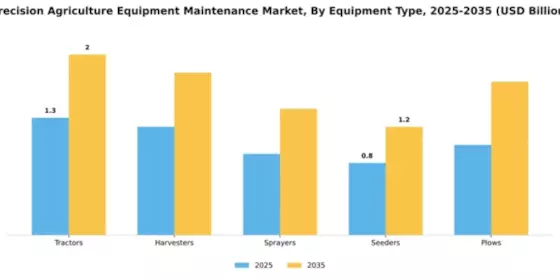
Preventive Maintenance (Dominant) vs. Predictive Maintenance (Emerging)
Preventive Maintenance is characterized by scheduled servicing and inspections, which ensure equipment operates reliably and efficiently, ultimately leading to reduced downtime and repair costs. This type of maintenance is favored for its systematic approach and is considered the dominant strategy in the Precision Agriculture Equipment Maintenance Market. Conversely, Predictive Maintenance, while currently an emerging trend, is rapidly gaining popularity as agricultural technology evolves. This strategy employs advanced tools like IoT sensors and data analytics to anticipate equipment failures before they occur, enabling more targeted interventions. As farmers increasingly adopt precision farming technologies, the shift toward Predictive Maintenance signifies a notable evolution in maintenance strategies within the sector.
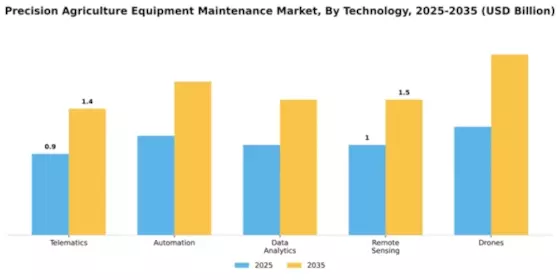
In the Precision Agriculture Equipment Maintenance Market, the technology segment is led by telematics, which significantly contributes to enhancing operational efficiency and equipment performance tracking. The market share distribution reveals that telematics occupies a substantial position due to its ability to offer real-time data, ensuring timely maintenance interventions and reducing downtime. Following closely are automation and data analytics, which are also gaining traction as farmers increasingly adopt smart solutions for managing their agricultural assets.
Technology: Telematics (Dominant) vs. Drones (Emerging)
Telematics stands out as the dominant technology in precision agriculture maintenance, leveraging IoT and connectivity to provide crucial insights into equipment performance and maintenance needs. It enables farmers to monitor their machinery remotely, ensuring optimal uptime and efficiency. On the other hand, drones represent an emerging technology with rapidly growing interest for their ability to provide aerial surveillance and precise crop monitoring. They facilitate data collection for crop health and can assist in maintenance by identifying areas requiring attention. As the precision agriculture landscape evolves, drones are expected to play a pivotal role, offering innovative solutions for improved farm management.
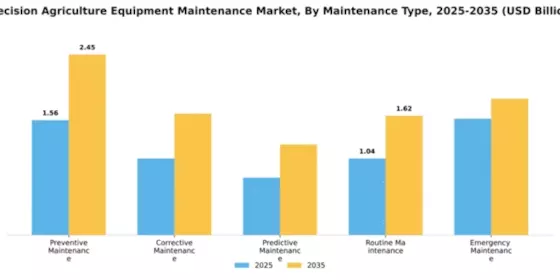
In the Precision Agriculture Equipment Maintenance Market, farmers represent the largest segment, reflecting their critical role in the agricultural supply chain. This segment constitutes a significant share as farmers increasingly seek advanced equipment maintenance solutions to enhance productivity and efficiency. Agricultural cooperatives and agribusinesses also play vital roles, but they follow in terms of share. Government agencies and research institutions are notable contributors, focusing on improving agricultural practices and sustainability standards.
Farmers (Dominant) vs. Agribusinesses (Emerging)
Farmers dominate the Precision Agriculture Equipment Maintenance Market due to their significant investment in maintenance services and technologies aimed at optimizing their operational efficiency. They rely heavily on cutting-edge equipment and best maintenance practices to increase yield and reduce downtime. In contrast, agribusinesses represent an emerging segment, adapting swiftly to technological advancements. Their role is increasingly vital in collaborating with farmers and leveraging data analytics for preventive maintenance, thus driving growth. The dynamic between dominant farmers and emerging agribusinesses shapes the future landscape of precision agriculture, emphasizing a trend toward integrated solutions and cooperation.
Get more detailed insights about Precision Agriculture Equipment Maintenance Market Request Free Sample
North America is poised to maintain its leadership in the Precision Agriculture Equipment Maintenance Market, holding a significant market share of 2.6 in 2024. The region's growth is driven by advanced agricultural technologies, increasing adoption of precision farming practices, and supportive government policies aimed at enhancing agricultural productivity. Regulatory frameworks promoting sustainable farming practices further catalyze demand for maintenance services in this sector. The competitive landscape in North America is robust, featuring key players such as John Deere, Trimble, and Raven Industries. The U.S. stands out as the leading country, with a strong emphasis on innovation and technology integration in agriculture. The presence of established companies and ongoing investments in R&D contribute to a dynamic market environment, ensuring that North America remains at the forefront of precision agriculture advancements.
Europe's Precision Agriculture Equipment Maintenance Market is gaining traction, with a market size of 1.5 in 2024. The region is experiencing growth driven by increasing awareness of sustainable farming practices and the need for efficient resource management. Regulatory initiatives, such as the EU's Common Agricultural Policy, are encouraging farmers to adopt precision agriculture technologies, thereby boosting demand for maintenance services in this sector. Leading countries in Europe include Germany, France, and the Netherlands, where agricultural innovation is prioritized. The competitive landscape features key players like BASF and CNH Industrial, who are investing in advanced technologies to enhance service offerings. The presence of these companies, coupled with favorable regulations, positions Europe as a promising market for precision agriculture maintenance services.
The Asia-Pacific region is witnessing a rapid transformation in its Precision Agriculture Equipment Maintenance Market, with a market size of 1.0 in 2024. This growth is fueled by increasing investments in agricultural technology and a rising demand for food security. Governments are implementing policies to support precision farming, which is driving the need for maintenance services to ensure optimal equipment performance and longevity. Countries like China, India, and Japan are leading the charge in adopting precision agriculture technologies. The competitive landscape is evolving, with companies such as Topcon Positioning Systems and Yara International making significant inroads. The region's diverse agricultural landscape and growing emphasis on technology adoption present substantial opportunities for market expansion in precision agriculture maintenance services.
The Middle East and Africa region is at the nascent stage of developing its Precision Agriculture Equipment Maintenance Market, currently valued at 0.1 in 2024. The growth potential is significant, driven by increasing agricultural investments and a growing recognition of the importance of precision farming. Governments are beginning to implement policies that support agricultural modernization, which is expected to catalyze demand for maintenance services in the coming years. Leading countries in this region include South Africa and Kenya, where agricultural innovation is gaining momentum. The competitive landscape is still developing, with opportunities for both local and international players to establish a foothold. As the region continues to embrace technology in agriculture, the demand for precision agriculture maintenance services is anticipated to grow substantially.
The Precision Agriculture Equipment Maintenance Market is currently characterized by a dynamic competitive landscape, driven by technological advancements and an increasing emphasis on sustainable farming practices. Key players such as John Deere (US), Trimble (US), and BASF (DE) are strategically positioned to leverage innovation and digital transformation to enhance their service offerings. John Deere (US) focuses on integrating advanced data analytics into its maintenance services, while Trimble (US) emphasizes precision technology to optimize equipment performance. BASF (DE), on the other hand, is enhancing its portfolio through strategic partnerships aimed at improving crop protection and maintenance solutions. Collectively, these strategies not only bolster their market presence but also shape a competitive environment that prioritizes efficiency and sustainability.In terms of business tactics, companies are increasingly localizing manufacturing and optimizing supply chains to enhance responsiveness to market demands. The market structure appears moderately fragmented, with several players vying for market share. However, the influence of major companies like John Deere (US) and Trimble (US) is substantial, as they set benchmarks for innovation and service quality that smaller firms often strive to emulate.In November John Deere (US) announced a partnership with a leading AI firm to develop predictive maintenance solutions that utilize machine learning algorithms. This strategic move is likely to enhance the reliability of agricultural equipment, thereby reducing downtime and maintenance costs for farmers. Such innovations could position John Deere (US) as a frontrunner in the market, as predictive analytics becomes increasingly vital in precision agriculture.In October Trimble (US) launched a new suite of software tools designed to streamline equipment maintenance processes. This initiative reflects a growing trend towards digitalization in the sector, enabling farmers to monitor equipment health in real-time. The introduction of these tools may significantly improve operational efficiency, allowing farmers to make informed decisions regarding maintenance schedules and resource allocation.In September BASF (DE) expanded its service offerings by integrating IoT technology into its maintenance solutions. This integration allows for real-time monitoring of equipment performance and environmental conditions, which is crucial for optimizing agricultural practices. By adopting IoT, BASF (DE) not only enhances its service capabilities but also aligns with the broader industry trend towards smart farming solutions.As of December the competitive trends in the Precision Agriculture Equipment Maintenance Market are increasingly defined by digitalization, sustainability, and the integration of AI technologies. Strategic alliances among key players are shaping the landscape, fostering innovation and enhancing service delivery. The shift from price-based competition to a focus on technological advancement and supply chain reliability is evident, suggesting that future competitive differentiation will hinge on the ability to innovate and adapt to evolving market demands.






The Precision Agriculture Equipment Maintenance Market is projected to grow at a 4.11% CAGR from 2025 to 2035, driven by technological advancements and increasing demand for efficiency.
New opportunities lie in:
By 2035, the market is expected to be robust, driven by innovation and strategic partnerships.
| MARKET SIZE 2024 | 5.2(USD Billion) |
| MARKET SIZE 2025 | 5.41(USD Billion) |
| MARKET SIZE 2035 | 8.1(USD Billion) |
| COMPOUND ANNUAL GROWTH RATE (CAGR) | 4.11% (2025 - 2035) |
| REPORT COVERAGE | Revenue Forecast, Competitive Landscape, Growth Factors, and Trends |
| BASE YEAR | 2024 |
| Market Forecast Period | 2025 - 2035 |
| Historical Data | 2019 - 2024 |
| Market Forecast Units | USD Billion |
| Key Companies Profiled | John Deere (US), AG Leader Technology (US), Trimble (US), CNH Industrial (GB), BASF (DE), Yara International (NO), Raven Industries (US), Topcon Positioning Systems (JP), Deere & Company (US) |
| Segments Covered | Application, Equipment Type, Maintenance Type, Technology, End User |
| Key Market Opportunities | Integration of IoT and AI technologies enhances predictive maintenance in the Precision Agriculture Equipment Maintenance Market. |
| Key Market Dynamics | Rising demand for advanced maintenance solutions driven by technological innovations and evolving agricultural practices. |
| Countries Covered | North America, Europe, APAC, South America, MEA |
The market valuation reached 5.2 USD Billion in 2024.
The market is expected to grow to 8.1 USD Billion by 2035.
The market is anticipated to experience a CAGR of 4.11% from 2025 to 2035.
Key players include John Deere, AG Leader Technology, Trimble, CNH Industrial, BASF, Yara International, Raven Industries, Topcon Positioning Systems, and Deere & Company.
The primary applications include Crop Monitoring, Soil Management, Yield Prediction, Irrigation Management, and Pest Control, each valued at 1.04 to 1.56 USD Billion.
The equipment type segment includes Tractors valued at 1.3 to 2.0 USD Billion, Harvesters at 1.2 to 1.8 USD Billion, and Sprayers at 0.9 to 1.4 USD Billion.
The market segments by maintenance type include Preventive Maintenance valued at 1.56 to 2.45 USD Billion and Corrective Maintenance at 1.04 to 1.65 USD Billion.
Technologies such as Telematics, Automation, Data Analytics, Remote Sensing, and Drones are projected to drive growth, with Drones valued at 1.2 to 2.0 USD Billion.
End users include Farmers valued at 1.56 to 2.45 USD Billion, Agricultural Cooperatives at 1.04 to 1.65 USD Billion, and Agribusinesses at 1.3 to 2.0 USD Billion.
Trends suggest a growing emphasis on predictive and preventive maintenance, with predictive maintenance projected to reach 0.78 to 1.23 USD Billion by 2035.


Kindly complete the form below to receive a free sample of this Report

“This is really good guys. Excellent work on a tight deadline. I will continue to use you going forward and recommend you to others. Nice job”


“Thanks. It’s been a pleasure working with you, please use me as reference with any other Intel employees.”


“Thanks for sending the report it gives us a good global view of the Betaïne market.”


“Thank you, this will be very helpful for OQS.”


“We found the report very insightful! we found your research firm very helpful. I'm sending this email to secure our future business.”


“I am very pleased with how market segments have been defined in a relevant way for my purposes (such as "Portable Freezers & refrigerators" and "last-mile"). In general the report is well structured. Thanks very much for your efforts.”


“I have been reading the first document or the study, ,the Global HVAC and FP market report 2021 till 2026. Must say, good info! I have not gone in depth at all parts, but got a good indication of the data inside!”


“We got the report in time, we really thank you for your support in this process. I also thank to all of your team as they did a great job.”


“The Automotive 48V ECU Components Procurement Intelligence Study” was a complex project, but the Market Research Future (MRFR) team handled it with quality, agility, and customer-centricity. They delivered all requested data on time and within the agreed scope. The team, including Shubhendra Anand and Rahul Gotadki, was always readily available to clarify questions and swiftly implement necessary adjustments, driving the project to a successful conclusion within a very demanding timeframe.
I would also like to specifically commend Akshay Agarwal for his responsiveness and support at every stage—from our initial inquiry on May 6th through to final delivery on June 18th. His dedication made the entire process seamless.”



