×
Request Free Sample ×

Kindly complete the form below to receive a free sample of this Report

Leading companies partner with us for data-driven Insights

clients tt-cursor
Hero Background

Precision Gearbox Market

ID: MRFR/EnP/21919-HCR
128 Pages
Priya Nagrale
October 2025

Precision Gearbox Market Research Report By Product Type (Cylindrical Gearbox, Planetary Gearbox, Servo Gearbox, Right Angle Gearbox, Helical Gearbox), By Application (Robotics, Medical Devices, Aerospace & Defense, Industrial Automation, Packaging Machinery), By Output Torque (Less than 50 Nm, 50 to 200 Nm, 200 to 500 Nm, 500 to 1000 Nm, Over 1000 Nm), By Precision Level (Low Precision (Grade 6), Medium Precision (Grade 5), High Precision (Grade 4), Ultra Precision (Grade 3)), By Material (Steel, Aluminum, Stainless Steel, Plastic) and ... read more

Share:
Download PDF ×

We do not share your information with anyone. However, we may send you emails based on your report interest from time to time. You may contact us at any time to opt-out.

Precision Gearbox Market Infographic
Purchase Options

Precision Gearbox Market Summary

As per MRFR analysis, the Precision Gearbox Market Size was estimated at 7.545 USD Billion in 2024. The Precision Gearbox industry is projected to grow from 7.954 USD Billion in 2025 to 13.48 USD Billion by 2035, exhibiting a compound annual growth rate (CAGR) of 5.42 during the forecast period 2025 - 2035.

Key Market Trends & Highlights

The Precision Gearbox Market is experiencing robust growth driven by technological advancements and increasing automation.

  • North America remains the largest market for precision gearboxes, driven by its advanced manufacturing sector.
  • The Asia-Pacific region is the fastest-growing market, fueled by rapid industrialization and technological adoption.
  • Planetary gearboxes dominate the market, while servo gearboxes are emerging as the fastest-growing segment due to their precision and efficiency.
  • Rising demand in robotics and the growth of electric vehicles are key drivers propelling the market forward.

Market Size & Forecast

2024 Market Size 7.545 (USD Billion)
2035 Market Size 13.48 (USD Billion)
CAGR (2025 - 2035) 5.42%

Major Players

Harmonic Drive (JP), Nidec Shimpo (JP), Neugart GmbH (DE), Wittenstein SE (DE), Brevini Power Transmission (IT), Sumitomo Drive Technologies (JP), Gleason Corporation (US), Kollmorgen (US), Parker Hannifin (US), Sew Eurodrive (DE)

Precision Gearbox Market Trends

The Precision Gearbox Market is currently experiencing a notable evolution, driven by advancements in technology and increasing demand across various sectors. Industries such as robotics, aerospace, and automotive are increasingly relying on precision gearboxes for their efficiency and reliability. This market appears to be characterized by a shift towards miniaturization and enhanced performance, as manufacturers strive to meet the rigorous demands of modern applications. Furthermore, the integration of smart technologies into gear systems suggests a trend towards automation and improved operational efficiency, which could redefine traditional manufacturing processes. In addition, sustainability concerns are influencing the Precision Gearbox Market, as companies seek to develop eco-friendly solutions. The emphasis on reducing energy consumption and minimizing waste is prompting innovations in design and materials. As a result, the market landscape is likely to witness a growing presence of lightweight and durable materials that enhance performance while adhering to environmental standards. Overall, the Precision Gearbox Market is poised for growth, with emerging technologies and sustainability initiatives shaping its future trajectory.

Technological Advancements

The Precision Gearbox Market is witnessing rapid technological advancements that enhance performance and efficiency. Innovations in materials and design are leading to lighter, more durable gearboxes that can withstand higher loads and operate at greater speeds. This trend is particularly evident in sectors such as robotics and aerospace, where precision and reliability are paramount.

Automation Integration

There is a noticeable trend towards the integration of automation technologies within the Precision Gearbox Market. As industries increasingly adopt smart manufacturing practices, gearboxes are being designed to work seamlessly with automated systems. This integration not only improves operational efficiency but also allows for real-time monitoring and predictive maintenance.

Sustainability Initiatives

Sustainability is becoming a central focus in the Precision Gearbox Market, as manufacturers strive to create eco-friendly products. The push for reduced energy consumption and waste is driving innovations in gearbox design, leading to the use of sustainable materials and processes. This trend reflects a broader commitment to environmental responsibility within the industry.

Precision Gearbox Market Drivers

Rising Demand in Robotics

The Precision Gearbox Market is experiencing a notable surge in demand due to the increasing adoption of robotics across various sectors. Robotics applications, particularly in manufacturing and logistics, require high precision and reliability, which precision gearboxes provide. According to recent data, the robotics market is projected to grow at a compound annual growth rate of over 25% in the coming years. This growth is likely to drive the demand for precision gearboxes, as they are essential components that enhance the performance and efficiency of robotic systems. As industries seek to automate processes and improve productivity, the Precision Gearbox Market is poised to benefit significantly from this trend.

Growth in Electric Vehicles

The Precision Gearbox Market is witnessing a substantial boost from the burgeoning electric vehicle (EV) sector. As the automotive industry shifts towards electrification, the need for efficient power transmission systems becomes paramount. Precision gearboxes play a critical role in optimizing the performance of electric drivetrains, ensuring smooth operation and energy efficiency. Recent statistics indicate that the electric vehicle market is expected to expand at a rate of approximately 30% annually. This rapid growth in EV adoption is likely to create a robust demand for precision gearboxes, as manufacturers seek to enhance vehicle performance and reduce energy consumption. Consequently, the Precision Gearbox Market stands to gain from this transformative shift in the automotive landscape.

Expansion of Renewable Energy Sector

The Precision Gearbox Market is benefiting from the expansion of the renewable energy sector, particularly in wind and solar energy applications. Precision gearboxes are integral to the operation of wind turbines, where they facilitate the conversion of low-speed turbine rotation into high-speed generator rotation. As the world increasingly invests in renewable energy sources, the demand for precision gearboxes in this sector is expected to rise. Recent reports suggest that the renewable energy market is projected to grow at a compound annual growth rate of around 20%. This growth is likely to drive innovation and investment in precision gearbox technology, further solidifying the position of the Precision Gearbox Market in the energy landscape.

Increased Focus on Industrial Automation

The Precision Gearbox Market is experiencing growth due to the heightened focus on industrial automation across various manufacturing sectors. As companies strive to enhance operational efficiency and reduce labor costs, the integration of automated systems becomes essential. Precision gearboxes are crucial in these automated systems, providing the necessary torque and speed control for various applications. Data indicates that the industrial automation market is expected to grow at a rate of approximately 15% annually. This trend suggests a sustained demand for precision gearboxes, as manufacturers seek reliable and efficient solutions to meet the challenges of modern production environments. The Precision Gearbox Market is likely to thrive in this context.

Technological Innovations in Gearbox Design

The Precision Gearbox Market is being propelled by ongoing technological innovations in gearbox design and manufacturing processes. Advances in materials science, computer-aided design, and manufacturing techniques are enabling the development of more efficient and compact precision gearboxes. These innovations not only enhance performance but also reduce production costs, making precision gearboxes more accessible to a wider range of industries. Recent trends indicate that the market for advanced gearbox technologies is expected to grow significantly, with a projected increase of around 10% annually. This growth reflects the industry's commitment to improving product offerings and meeting the evolving needs of customers. As a result, the Precision Gearbox Market is likely to see continued advancements and increased competitiveness.
Market Segment Insights

By Type: Planetary Gearbox (Largest) vs. Servo Gearbox (Fastest-Growing)

The precision gearbox market has diverse segments, among which the Planetary Gearbox holds the largest share. Its popularity stems from its high efficiency, compact design, and ability to deliver significant torque. On the other hand, the Servo Gearbox, recognized for its precision and responsiveness in motion control applications, is rapidly gaining traction as manufacturers seek improved automation. Both segments reflect unique strengths that cater to varying industry needs. As industries evolve toward smarter and more automated solutions, the demand for Servo Gearboxes is anticipated to surge, making it the fastest-growing segment in the Precision Gearbox Market. This growth is driven by the increasing adoption of robotics and automated machinery across various sectors, such as manufacturing, aerospace, and automotive. Furthermore, advancements in technology and the need for precision in motion control are propelling the adoption rates of Servo Gearboxes as companies realign their operations to meet modern demands.

Planetary Gearbox (Dominant) vs. Servo Gearbox (Emerging)

The Planetary Gearbox is celebrated for its compact structure and exceptional distribution of force, making it the dominant choice in many applications, particularly in robotics and heavy machinery. Its multi-planet gear system enables higher efficiency and greater torque output, positioning it as a staple in the Precision Gearbox Market. In contrast, the Servo Gearbox is emerging as a pivotal player, especially in sectors that emphasize precision and control, such as robotics and CNC equipment. This gear type is designed to handle rapid changes in load and direction with high accuracy, catering to the growing demand for automated solutions. As technology progresses, the Servo Gearbox's capabilities are expected to further enhance its position, making it a significant contender in the marketplace.

By Application: Robotics (Largest) vs. Medical Devices (Fastest-Growing)

In the Precision Gearbox Market, the application segments reveal that robotics holds the largest share, benefiting from increased automation across industries. Following closely, medical devices exhibit strong potential, identified as the fastest-growing segment due to innovation in healthcare technology and rising demand for precision and reliability. The growth trends within these segments highlight the increasing reliance on automation and robotics in various sectors, including manufacturing and healthcare. Drivers for growth include advancements in technology, rising labor costs, and a heightened focus on efficiency and precision in product development and patient care. Additionally, the aerospace defense, industrial automation, and packaging machinery segments are considerable contributors, though they are overshadowed by the leading segments in terms of market potential.

Robotics (Dominant) vs. Medical Devices (Emerging)

The robotics segment in the Precision Gearbox Market is characterized by its substantial demand driven by automation initiatives across multiple industries. With a focus on high performance and reliability, robotics applications are crucial in manufacturing processes, logistics, and even service industries. On the other hand, medical devices represent an emerging market segment, where the demand is rapidly accelerating due to technological advancements in healthcare. The emphasis on robotic-assisted surgeries and diagnostic equipment is fueling growth, positioning medical devices as a vital area for investment. While robotics is a dominant player with established applications, medical devices are rapidly carving out their space as new technologies develop and innovative solutions are introduced.

By Output Torque: 200 to 500 Nm (Largest) vs. 50 to 200 Nm (Fastest-Growing)

The Precision Gearbox Market exhibits varied distribution across the output torque segments. The range of 200 to 500 Nm holds the largest market share, reflecting its widespread application in industrial machinery where torque requirements are moderate to high. On the other hand, the 50 to 200 Nm segment is gaining traction rapidly, often utilized in robotics and automation, indicating a shift in preference towards lighter and more flexible gearboxes in modern machinery.

200 to 500 Nm (Dominant) vs. 50 to 200 Nm (Emerging)

The 200 to 500 Nm output torque segment in the Precision Gearbox Market is characterized by its robust demand across industries such as manufacturing, automotive, and renewable energy. This segment is favored for its balance of performance and efficiency, catering to applications that require a dependable power transmission. Conversely, the 50 to 200 Nm segment is emerging rapidly, primarily driven by advancements in automation technology and the increasing need for compact gear solutions. This segment appeals particularly to sectors focusing on robotics where space and weight constraints are critical.

By Precision Level: High Precision (Largest) vs. Ultra Precision (Fastest-Growing)

The Precision Gearbox Market showcases a varied distribution in precision levels, with High Precision (Grade 4) leading the way as the most significant segment in terms of market share. This dominance is attributed to its extensive applications in high-performance machinery and automation, where accuracy is paramount. Following closely, Ultra Precision (Grade 3) is gaining traction among industries demanding even finer tolerances, making it a noteworthy competitor in the landscape. Analyzing growth trends, the Ultra Precision segment is currently the fastest-growing, propelled by advancements in technology and increasing demand for high accuracy in sectors such as aerospace, robotics, and medical devices. The push for efficiency in production processes further underscores the transition towards ultra-precision solutions as industries seek to enhance performance without compromising on durability. This trend indicates that as consumer expectations rise, the Precision Gearbox Market will continue to evolve with a focus on high precision solutions.

High Precision (Dominant) vs. Ultra Precision (Emerging)

High Precision (Grade 4) gearboxes are widely recognized as the dominant segment within the Precision Gearbox Market, distinguished by their ability to deliver superior accuracy and reliability in demanding applications such as CNC machinery and automotive systems. These gearboxes are engineered for precision-driven tasks and are celebrated for their operational longevity, making them a preferred choice among manufacturers. On the other hand, Ultra Precision (Grade 3) gearboxes represent the emerging frontier in this market, targeted at niche applications requiring extreme precision levels. While still gaining visibility, their advanced features position them favorably among industries focused on cutting-edge technology, such as semiconductor fabrication and precision robotics. This dual dynamic between the high precision and ultra-precision segments highlights both established reliability and future innovation in precision gear technology.

By Material: Steel (Largest) vs. Aluminum (Fastest-Growing)

In the Precision Gearbox Market, the distribution of materials reveals that steel stands out as the largest segment, renowned for its robustness and durability. Aluminum, while comparatively smaller in market share, is rapidly growing due to its lightweight properties and increasing applications in industries where weight reduction is essential, such as aerospace and automotive. Stainless steel and plastic are also notable, fulfilling niche requirements but not capturing the same level of market prominence as steel and aluminum.

Steel (Dominant) vs. Aluminum (Emerging)

Steel remains the dominant material in the Precision Gearbox Market, favored for its high strength, resistance to wear, and structural integrity, making it ideal for heavy-duty applications. Aluminum, on the other hand, is emerging as a popular choice for its lightweight nature and excellent corrosion resistance, making it suitable for innovative designs and efficiency-focused applications. The shift towards lightweight materials is expected to drive more innovations in gearbox design, positioning aluminum as a material of choice in sectors prioritizing energy efficiency and performance. Stainless steel caters to specialized needs with superior corrosion resistance, while plastic finds its niche in lightweight, cost-sensitive applications.

Get more detailed insights about Precision Gearbox Market

Regional Insights

North America : Innovation and Demand Surge

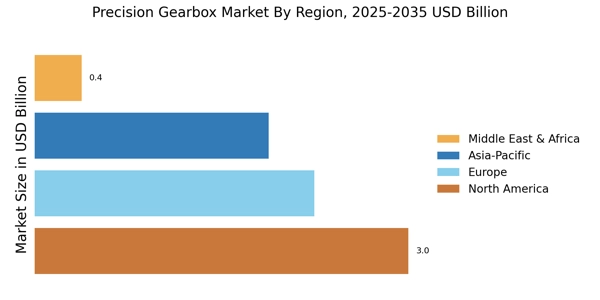
North America is the largest market for precision gearboxes, holding approximately 40% of the global market share. The region's growth is driven by advancements in automation, robotics, and aerospace technologies, alongside increasing demand for high-precision machinery. Regulatory support for manufacturing and innovation further catalyzes market expansion, with initiatives aimed at enhancing production efficiency and sustainability. The United States is the dominant player in this region, hosting key manufacturers such as Gleason Corporation, Kollmorgen, and Parker Hannifin. Canada also contributes significantly, focusing on sectors like automotive and aerospace. The competitive landscape is characterized by a mix of established companies and emerging players, all striving to innovate and meet the growing demand for precision engineering solutions.

Europe : Strong Manufacturing Backbone

Europe stands as a significant player in the precision gearbox market, accounting for around 30% of the global share. The region benefits from a strong manufacturing base, particularly in Germany and Italy, where industries such as automotive and industrial machinery drive demand. Regulatory frameworks promoting energy efficiency and sustainability are also pivotal, encouraging investments in advanced gearbox technologies. Germany leads the market, with companies like Neugart GmbH and Wittenstein SE at the forefront. Italy and France follow closely, contributing to a competitive landscape rich in innovation. The presence of major players and a focus on R&D ensure that Europe remains a key hub for precision gearbox development, catering to diverse industrial applications.

Asia-Pacific : Emerging Market Potential

Asia-Pacific is rapidly emerging as a powerhouse in the precision gearbox market, holding approximately 25% of the global share. The region's growth is fueled by increasing industrialization, particularly in countries like China and India, where manufacturing and automation are on the rise. Government initiatives aimed at boosting local production and reducing reliance on imports are also significant drivers of market expansion. China is the largest market in this region, with a strong presence of local manufacturers and international players like Harmonic Drive and Nidec Shimpo. India is also witnessing substantial growth, supported by investments in infrastructure and technology. The competitive landscape is evolving, with both established companies and startups vying for market share, leading to innovation and improved product offerings.

Middle East and Africa : Resource-Rich Opportunities

The Middle East and Africa region is gradually developing its precision gearbox market, currently holding about 5% of the global share. The growth is primarily driven by increasing investments in infrastructure and industrial projects, particularly in the Gulf Cooperation Council (GCC) countries. Regulatory frameworks are evolving to support manufacturing and attract foreign investment, which is crucial for market development. Countries like the UAE and South Africa are leading the charge, with a focus on sectors such as oil and gas, mining, and construction. The competitive landscape is still emerging, with a mix of local and international players. As the region continues to invest in industrial capabilities, the demand for precision gearboxes is expected to rise significantly, presenting opportunities for growth.

Precision Gearbox Market Regional Image

Key Players and Competitive Insights

The key industry players in the precision gearbox market are focusing on gaining a competitive edge through various approaches; some of the methods include investment in research and development, in-depth studies, increasing product portfolios, and making deliberate affiliations. The Leading actors in the precision gearbox market are majorly determined by their efforts to develop creativity and responsive product delivery. 

The market is mainly driven by significant development directed towards efficiency increase, precision delivery, long-lasting products, and reduced robust noise-related problems. The Precision Gearbox Market Competitive Landscape presents both established and entrants in stiff competition with both sides and strategies into operation. Some of the common strategies are based on product differentiation, cost legacy, and geographical expansion.

Harmonic Drive Systems, a notable member of the Precision Gearbox Market, is recognized for its manufacture of high accuracy, low backlash, and compact gearbox to a specified variety, including robotics, medical equipment, and aerospace. The manufacturer has made his main critical sales point precision delivery, innovations, and reliance on customer satisfaction. 

The key product types are planetary gearboxes, harmonic gearboxes, and cycloidal gearboxes. They offer high torque capacities and precisions at small sizes, which are the true performance indicators of a reliable gearbox producer. The key markets for Harmonic Drive Systems are located in Japan, Europe, and the United States.

Wittgenstein is another notable contributor to the Precision Gearbox Market. The German Established company has a special interest in high-performing gearboxes and systems with critical gearboxes, including planetary gearboxes, helical, and worm. It is deeply studied because of its competence in innovative designs and production expertise. The products are mainly used in machine tools, robotics, and automation. Their products are critical for their high precision and efficiency-approved delivery systems. Wittenstein’s manufacturing facilities are spread across Germany, the United States, and China.

Key Companies in the Precision Gearbox Market market include

Industry Developments

The Precision Gearbox Market is projected to reach USD 10.9 billion by 2032, exhibiting a CAGR of 5.4% during the forecast period (2025-2034). Increasing demand for precision gearboxes in robotics, automation, and industrial machinery is driving market growth. Additionally, rising investments in renewable energy and aerospace applications are expected to contribute to market expansion. For instance, in March 2023, Harmonic Drive Systems announced the launch of a new precision gearbox series specifically designed for wind turbine applications. Furthermore, government initiatives promoting smart manufacturing and Industry 4.0 are creating favorable conditions for market growth.

However, factors such as supply chain disruptions and raw material price fluctuations pose challenges to market expansion.

Future Outlook

Precision Gearbox Market Future Outlook

The Precision Gearbox Market is projected to grow at a 5.42% CAGR from 2024 to 2035, driven by advancements in automation, increasing demand for precision machinery, and the rise of electric vehicles.

New opportunities lie in:

  • Development of smart precision gearboxes with IoT integration
  • Expansion into renewable energy sectors with specialized gear solutions
  • Partnerships with robotics firms for customized gearbox applications

By 2035, the Precision Gearbox Market is expected to achieve robust growth and innovation.

Market Segmentation

Precision Gearbox Market Type Outlook

  • Cylindrical Gearbox
  • Planetary Gearbox
  • Servo Gearbox
  • Right Angle Gearbox
  • Helical Gearbox

Precision Gearbox Market Material Outlook

  • Steel
  • Aluminum
  • Stainless Steel
  • Plastic

Precision Gearbox Market Application Outlook

  • Robotics
  • Medical Devices
  • Aerospace Defense
  • Industrial Automation
  • Packaging Machinery

Precision Gearbox Market Output Torque Outlook

  • Less than 50 Nm
  • 50 to 200 Nm
  • 200 to 500 Nm
  • 500 to 1000 Nm
  • Over 1000 Nm

Precision Gearbox Market Precision Level Outlook

  • Low Precision (Grade 6)
  • Medium Precision (Grade 5)
  • High Precision (Grade 4)
  • Ultra Precision (Grade 3)

Report Scope

MARKET SIZE 20247.545(USD Billion)
MARKET SIZE 20257.954(USD Billion)
MARKET SIZE 203513.48(USD Billion)
COMPOUND ANNUAL GROWTH RATE (CAGR)5.42% (2024 - 2035)
REPORT COVERAGERevenue Forecast, Competitive Landscape, Growth Factors, and Trends
BASE YEAR2024
Market Forecast Period2025 - 2035
Historical Data2019 - 2024
Market Forecast UnitsUSD Billion
Key Companies ProfiledMarket analysis in progress
Segments CoveredMarket segmentation analysis in progress
Key Market OpportunitiesIntegration of advanced automation technologies enhances efficiency in the Precision Gearbox Market.
Key Market DynamicsTechnological advancements drive demand for precision gearboxes in automation and robotics across various industries.
Countries CoveredNorth America, Europe, APAC, South America, MEA

Leave a Comment

FAQs

What is the current valuation of the Precision Gearbox Market as of 2024?

The Precision Gearbox Market was valued at 7.545 USD Billion in 2024.

What is the projected market size for the Precision Gearbox Market by 2035?

The market is projected to reach 13.48 USD Billion by 2035.

What is the expected CAGR for the Precision Gearbox Market during the forecast period 2025 - 2035?

The expected CAGR for the Precision Gearbox Market during 2025 - 2035 is 5.42%.

Which type of gearbox segment is expected to show the highest growth in the market?

The Planetary Gearbox segment is projected to grow from 2.0 to 3.5 USD Billion.

What are the key applications driving the Precision Gearbox Market?

Key applications include Industrial Automation, which is expected to grow from 2.5 to 4.5 USD Billion.

Which material segment is anticipated to have the largest market share?

The Steel material segment is expected to dominate, growing from 2.5 to 4.5 USD Billion.

Who are the leading players in the Precision Gearbox Market?

Key players include Harmonic Drive, Nidec Shimpo, and Neugart GmbH, among others.

What is the expected growth for the Servo Gearbox segment by 2035?

The Servo Gearbox segment is projected to grow from 1.2 to 2.0 USD Billion.

How does the output torque segment '50 to 200 Nm' perform in the market?

The '50 to 200 Nm' output torque segment is expected to grow from 2.0 to 3.5 USD Billion.

What precision level segment is likely to see the most growth in the Precision Gearbox Market?

The High Precision (Grade 4) segment is anticipated to grow from 2.5 to 4.0 USD Billion.

Download Free Sample

Kindly complete the form below to receive a free sample of this Report

Compare Licence

×
Features License Type
Single User Multiuser License Enterprise User
Price $4,950 $5,950 $7,250
Maximum User Access Limit 1 User Upto 10 Users Unrestricted Access Throughout the Organization
Free Customization
Direct Access to Analyst
Deliverable Format
Platform Access
Discount on Next Purchase 10% 15% 15%
Printable Versions