Primer Market
Primer Market Summary
As per Market Research Future analysis, the Primer Market Size was estimated at 13.99 USD Billion in 2024. The Primer industry is projected to grow from 14.7 USD Billion in 2025 to 24.08 USD Billion by 2035, exhibiting a compound annual growth rate (CAGR) of 5.06% during the forecast period 2025 - 2035
Key Market Trends & Highlights
The Primer Market is currently experiencing a shift towards sustainability and technological innovation.
- The market is witnessing a pronounced focus on sustainability, with eco-friendly products gaining traction.
- Technological advancements are driving innovation in primer formulations, enhancing performance and application.
- The DIY market is expanding, particularly in North America, as consumers increasingly engage in home improvement projects.
- Rising demand for eco-friendly products and growth in the construction sector are key drivers propelling the market forward.
Market Size & Forecast
| 2024 Market Size | 13.99 (USD Billion) |
| 2035 Market Size | 24.08 (USD Billion) |
| CAGR (2025 - 2035) | 5.06% |
Major Players
PPG Industries (US), Sherwin-Williams (US), AkzoNobel (NL), BASF (DE), RPM International (US), Nippon Paint Holdings (JP), Kansai Paint (JP), Asian Paints (IN), Valspar (US)
Primer Market Trends
The Primer Market is currently experiencing a dynamic evolution, driven by various factors that influence consumer preferences and technological advancements. The increasing demand for high-quality surface preparation products is evident, as industries seek to enhance the durability and finish of their applications. Additionally, the growing awareness of environmental sustainability is prompting manufacturers to innovate and develop eco-friendly formulations. This shift not only caters to consumer preferences but also aligns with regulatory standards aimed at reducing environmental impact. Furthermore, the rise of DIY culture and home improvement projects is contributing to a surge in demand for primers among individual consumers, indicating a broader market reach beyond traditional industrial applications. In the present landscape, the Primer Market appears poised for continued growth, with emerging trends suggesting a diversification of product offerings. Companies are likely to invest in research and development to create specialized primers that cater to specific materials and applications. This trend may lead to increased competition among manufacturers, as they strive to differentiate their products in a crowded marketplace. Overall, the Primer Market reflects a complex interplay of consumer behavior, technological innovation, and regulatory influences, shaping its trajectory in the coming years.
Sustainability Focus
The emphasis on eco-friendly products is becoming increasingly prominent within the Primer Market. Manufacturers are exploring sustainable materials and formulations that minimize environmental impact, appealing to a growing segment of environmentally conscious consumers.
Technological Advancements
Innovations in formulation technology are driving the development of high-performance primers. These advancements enhance adhesion, drying times, and overall durability, allowing for more efficient application processes across various industries.
DIY Market Expansion
The rise of the do-it-yourself trend is significantly influencing the Primer Market. As more individuals engage in home improvement projects, the demand for user-friendly primers is increasing, prompting brands to tailor their offerings to meet this new consumer base.
Primer Market Drivers
Regulatory Changes and Standards
The Primer Market is increasingly influenced by regulatory changes and evolving standards concerning product safety and environmental impact. Governments and regulatory bodies are implementing stricter guidelines regarding the use of volatile organic compounds (VOCs) in primers, prompting manufacturers to reformulate their products. This shift is not only aimed at ensuring consumer safety but also at reducing environmental harm. Market data indicates that compliance with these regulations has led to a 10% increase in the production of low-VOC primers. As regulations continue to evolve, manufacturers in the Primer Market must adapt to these changes, which could drive innovation and lead to the development of safer, more sustainable products.
Growth of the Construction Sector
The Primer Market is closely linked to the growth of the construction sector, which is currently witnessing a robust expansion. As urbanization accelerates and infrastructure projects increase, the demand for high-quality primers is expected to rise correspondingly. Market analysis indicates that the construction industry has seen a growth rate of approximately 8% annually, which directly influences the primer market. This growth is driven by both residential and commercial projects, leading to an increased need for primers that ensure optimal surface preparation and finish. Consequently, the expansion of the construction sector serves as a vital driver for the Primer Market, fostering opportunities for manufacturers to cater to this burgeoning demand.
Rising Demand for Eco-Friendly Products
The Primer Market is experiencing a notable shift towards eco-friendly products, driven by increasing consumer awareness regarding environmental sustainability. As consumers become more conscious of their ecological footprint, they are actively seeking primers that are free from harmful chemicals and made from sustainable materials. This trend is reflected in market data, which indicates that the demand for eco-friendly primers has surged by approximately 25% over the past year. Manufacturers are responding by innovating and developing products that align with these values, thereby enhancing their market position. The growing emphasis on sustainability is likely to continue influencing purchasing decisions, making it a critical driver in the Primer Market.
Technological Innovations in Formulation
Technological advancements in formulation are significantly impacting the Primer Market. Innovations such as the development of water-based primers and advanced polymer technologies are enhancing product performance and application ease. These innovations not only improve adhesion and durability but also reduce drying times, which is appealing to both professional and DIY users. Market data suggests that the introduction of these advanced formulations has contributed to a 15% increase in sales within the industry. As manufacturers continue to invest in research and development, the potential for new product offerings remains high, indicating that technological innovation will be a key driver in shaping the future of the Primer Market.
Increase in DIY Home Improvement Projects
The Primer Market is benefiting from a significant increase in DIY home improvement projects, as more individuals take on renovation tasks themselves. This trend is fueled by a growing interest in home aesthetics and personal expression, leading to a surge in primer sales. Market data reveals that the DIY segment has expanded by approximately 20% in recent years, with primers being a fundamental component of many home improvement projects. As consumers seek to enhance their living spaces, the demand for user-friendly and effective primers is likely to continue rising. This shift towards DIY culture presents a substantial opportunity for the Primer Market, as manufacturers can tailor products to meet the needs of this expanding consumer base.
Market Segment Insights
By Material: Epoxy Resins (Largest) vs. Dispersants (Fastest-Growing)
The Primer Market is characterized by a diverse material composition, with the Epoxy Resins segment taking the lead due to its superior adhesion properties and wide applicability in various surfaces. Dispersants have emerged as a significant component as well, enabling improved dispersion of pigments and fillers, driving their increasing share in the market. Biocides and Others segments, while important, are comparatively smaller due to their niche applications. Recent trends indicate a growing preference for eco-friendly and durable primer materials driving the expansion of the Epoxy Resins segment. The demand for Dispersants is fueled by the need for better paint formulations that enhance stability and performance. As regulations become stricter, the market is likely to see further innovation in these material categories, resulting in shifts in market dynamics and growth opportunities.
Epoxy Resins (Dominant) vs. Dispersants (Emerging)
Epoxy Resins are currently the dominant material in the Primer Market, known for their excellent adhesion, durability, and resistance to various environmental factors. They are widely used in both industrial and consumer products, making them a preferred choice for high-performance applications. On the other hand, Dispersants, while still emerging, are rapidly gaining traction due to their role in enhancing the effectiveness of paint formulations. They help to achieve uniformity and stability in primer applications, especially in water-based and high-solid coatings. As manufacturers focus on improving product quality, the demand for both these materials is expected to rise, highlighting their respective positions in the evolving market landscape.
By Applications: Concrete (Largest) vs. Metal (Fastest-Growing)
In the Primer Market, the applications segment is diverse, with Concrete representing the largest share due to its extensive use in construction and infrastructure projects. Its established presence has enabled stability and growth. Other materials like Wood, Plastic, and Metal are also significant, with varying shares that reflect their specialized applications. While Wood is favored for its sustainability in various applications, Plastic continues to find use in lightweight designs, while Metal is gaining ground in high-performance applications.
Concrete: Dominant vs. Metal: Emerging
Concrete has long been the dominant application in the Primer Market, favored for its strength, longevity, and versatility, making it a staple in construction projects globally. However, Metal is emerging rapidly as a strong contender, driven by advancements in material technology and a growing demand for durability and resistance to environmental factors. As industries push for greater efficiency and performance, Metal's appeal in high-tech applications strengthens, indicating a shift in preference that could reshape the market landscape. Together, these materials illustrate the evolving nature of the Primer Market.
By End-Use Industry: Automotive (Largest) vs. Marine (Fastest-Growing)
In the primer market, the automotive segment dominates with the largest share of spending. This sector's significant consumption of primers supports its leading role, driven by the automotive industry's ongoing innovations and growth. The marine segment, while smaller in comparison, is rapidly gaining traction as a pivotal player, attributed to increasing recreational boating activities and marine infrastructure developments. The building and construction segment follows closely behind, influenced by rising constructions and renovations, whereas the other industries cumulatively represent a diverse yet minor part of the market.
Automotive (Dominant) vs. Marine (Emerging)
The automotive primer segment remains dominant due to the continuous advancements in vehicle manufacturing technologies and increasing demands for high-performance coatings. Automotive primers are tailored for durability and adherence, ensuring that vehicles withstand various environmental challenges. In contrast, the marine primer segment is emerging quickly, driven by innovative formulations designed to combat the corrosive marine environment. The rise in leisure boating and commercial shipping activities has propelled this segment forward. As the marine industry seeks more efficient and protective solutions, the shift towards high-quality primers becomes evident, promising significant growth opportunities.
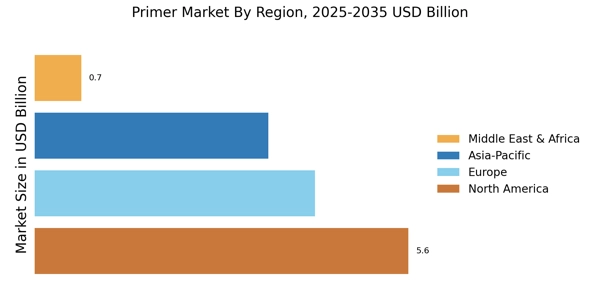
Regional Insights
North America : Market Leader in Innovation
North America is the largest market for primers, holding approximately 40% of the global market share. The region's growth is driven by increasing construction activities, stringent environmental regulations, and a rising focus on sustainable products. The demand for high-performance primers is also on the rise, fueled by advancements in technology and materials. Regulatory catalysts, such as the EPA's initiatives for low-VOC products, further enhance market growth. The United States dominates the North American primer market, accounting for a significant portion of the demand. Key players like PPG Industries, Sherwin-Williams, and RPM International are leading the competitive landscape, focusing on innovation and sustainability. The presence of these major companies ensures a robust supply chain and a variety of product offerings, catering to diverse consumer needs.
Europe : Sustainable Practices Drive Growth
Europe is the second-largest market for primers, holding around 30% of the global market share. The region's growth is significantly influenced by stringent environmental regulations and a strong push towards sustainable construction practices. The European Union's Green Deal and various national initiatives promote the use of eco-friendly materials, which is driving demand for low-VOC and water-based primers. This regulatory environment is expected to propel market growth in the coming years. Leading countries in the European primer market include Germany, France, and the UK, with Germany being the largest contributor. Major players like AkzoNobel and BASF are at the forefront, focusing on innovation and sustainability. The competitive landscape is characterized by a mix of established companies and emerging players, all striving to meet the increasing demand for environmentally friendly products.
Asia-Pacific : Emerging Markets on the Rise
Asia-Pacific is witnessing rapid growth in the primer market, accounting for approximately 25% of the global market share. The region's growth is driven by urbanization, increasing disposable incomes, and a booming construction industry. Countries like China and India are leading this growth, with significant investments in infrastructure and housing projects. Additionally, government initiatives aimed at promoting sustainable construction practices are further boosting demand for primers in the region. China is the largest market in Asia-Pacific, followed by India, where the demand for high-quality primers is increasing. Key players such as Nippon Paint Holdings and Kansai Paint are expanding their product lines to cater to the growing consumer base. The competitive landscape is becoming increasingly dynamic, with both local and international companies vying for market share, focusing on innovation and customer-centric solutions.

Middle East and Africa : Resource-Rich Market Potential
The Middle East and Africa region is emerging as a significant player in the primer market, holding about 5% of the global market share. The growth is primarily driven by large-scale infrastructure projects and a rising demand for residential and commercial buildings. Countries like the UAE and South Africa are leading the charge, with government initiatives aimed at boosting construction activities. The region's potential is further enhanced by increasing foreign investments in the construction sector. In the Middle East, the UAE is the largest market, while South Africa leads in Africa. The competitive landscape features both local and international players, with companies focusing on high-performance and eco-friendly products. Key players are adapting to regional demands, ensuring a diverse range of offerings to meet the needs of various construction projects.
Key Players and Competitive Insights
Key Companies in the Primer Market include
Industry Developments
May 2022: PPG Industries, Inc. announced the launch of PPG ENVIROCRON's portfolio of Primeron primer powders designed to provide superior corrosion resistance to metal substrates, including steel, hot dip galvanized steel, metallic steel and aluminum.
January 2022: BASF SE expands the production capacity of automotive finishing coatings at its coatings plant in Jiangmen, Guangdong Province, southern China. Our portfolio of automotive topcoats includes fillers, primers, basecoats, colorants, clearcoats, topcoats, hardeners, thinners, quick driers and mixers.
Future Outlook
Primer Market Future Outlook
The Primer Market is projected to grow at a 5.06% CAGR from 2025 to 2035, driven by technological advancements, increasing demand for high-performance coatings, and sustainability initiatives.
New opportunities lie in:
- Expansion into eco-friendly primer formulations
- Development of smart primers with self-healing properties
- Investment in automated application technologies for efficiency
By 2035, the Primer Market is expected to achieve robust growth, positioning itself as a leader in innovative coating solutions.
Market Segmentation
Primer Market Material Outlook
- Dispersants
- Epoxy Resins
- Biocides
- Others
Primer Market Applications Outlook
- Concrete
- Wood
- Metal
- Plastic
Primer Market End-Use Industry Outlook
- Automotive
- Marine
- Building & Construction
- Others
Report Scope
| MARKET SIZE 2024 | 13.99(USD Billion) |
| MARKET SIZE 2025 | 14.7(USD Billion) |
| MARKET SIZE 2035 | 24.08(USD Billion) |
| COMPOUND ANNUAL GROWTH RATE (CAGR) | 5.06% (2025 - 2035) |
| REPORT COVERAGE | Revenue Forecast, Competitive Landscape, Growth Factors, and Trends |
| BASE YEAR | 2024 |
| Market Forecast Period | 2025 - 2035 |
| Historical Data | 2019 - 2024 |
| Market Forecast Units | USD Billion |
| Key Companies Profiled | PPG Industries (US), Sherwin-Williams (US), AkzoNobel (NL), BASF (DE), RPM International (US), Nippon Paint Holdings (JP), Kansai Paint (JP), Asian Paints (IN), Valspar (US) |
| Segments Covered | Material, Applications, End-Use Industry, Region |
| Key Market Opportunities | Growing demand for eco-friendly primers driven by sustainability trends and regulatory changes. |
| Key Market Dynamics | Rising demand for eco-friendly primers drives innovation and competition among manufacturers in the primer market. |
| Countries Covered | North America, Europe, APAC, South America, MEA |
Market Highlights
FAQs
What is the current valuation of the Primer Market as of 2024?
The Primer Market was valued at 13.99 USD Billion in 2024.
What is the projected market size for the Primer Market in 2035?
The Primer Market is projected to reach 24.08 USD Billion by 2035.
What is the expected CAGR for the Primer Market during the forecast period 2025 - 2035?
The expected CAGR for the Primer Market during 2025 - 2035 is 5.06%.
Which companies are considered key players in the Primer Market?
Key players in the Primer Market include PPG Industries, Sherwin-Williams, AkzoNobel, BASF, RPM International, Nippon Paint Holdings, Kansai Paint, Asian Paints, and Valspar.
What are the main material segments in the Primer Market and their valuations?
The main material segments include Dispersants valued at 2.8 to 5.0 USD Billion, Epoxy Resins at 4.0 to 7.0 USD Billion, Biocides at 3.0 to 5.5 USD Billion, and Others at 4.19 to 6.58 USD Billion.
How do the application segments of the Primer Market perform?
Application segments include Concrete valued at 3.5 to 6.0 USD Billion, Wood at 2.5 to 4.5 USD Billion, Metal at 4.0 to 7.0 USD Billion, and Plastic at 3.99 to 6.58 USD Billion.
What end-use industries are driving growth in the Primer Market?
What trends are influencing the growth of the Primer Market?
How does the Primer Market's growth compare across different segments?
What factors could impact the future of the Primer Market?
Research Approach
Secondary Research
The secondary research process involved comprehensive analysis of regulatory databases, industry publications, chemical manufacturing reports, and authoritative standards organizations. Key sources included the US Environmental Protection Agency (EPA), European Chemicals Agency (ECHA), Occupational Safety and Health Administration (OSHA), National Institute of Standards and Technology (NIST), American Society for Testing and Materials (ASTM International), American Coatings Association (ACA), European Coatings Association (ECA), Federation of Societies for Coatings Technology (FSCT), US Census Bureau Construction Statistics, Eurostat Construction and Industrial Production Database, China National Coatings Industry Association, Japan Paint Manufacturers Association (JPMA), India Paint Association, US Department of Commerce Bureau of Industry and Security, International Maritime Organization (IMO) Coatings Guidelines, and automotive industry standards from SAE International.
These sources were employed to gather formulation data, regulatory compliance standards (VOC emissions, REACH regulations), production volume statistics, raw material pricing trends, and end-use industry consumption patterns for dispersants, epoxy resins, biocides, and specialty primer formulations.
Primary Research
Qualitative and quantitative insights were obtained by interviewing supply-side and demand-side stakeholders during the primary research process. The supply-side sources consisted of CEOs, VPs of Manufacturing, R&D leaders, and regulatory affairs managers from primer manufacturers, raw material suppliers, and chemical distributors. Demand-side sources included procurement directors from automotive OEMs, marine coating applicators, construction project managers, timber processing facility operators, and industrial maintenance engineers from prominent end-use sectors. Market segmentation was validated across material categories, product development pipelines were confirmed, and insights on formulation substitution trends, sustainability mandates, and regional pricing dynamics were gathered through primary research.
Primary Respondent Breakdown:
By Designation: C-level Primaries (28%), Director Level (32%), Others (40%)
By Region: North America (32%), Europe (30%), Asia-Pacific (33%), Rest of World (5%)
Market Size Estimation
Production volume analysis and revenue mapping throughout the value chain were employed to determine global market valuation. The methodology comprised the following:
The identification of over 50 significant manufacturers in North America, Europe, Asia-Pacific, and Latin America who specialize in primer formulations
Product mapping for epoxy resin-based, dispersant-enhanced, biocide-containing, and other specialty primer categories
Examination of primer product portfolios' annual revenues, as reported and modeled
Manufacturers that account for 75-80% of the global market share in 2024 are included in the coverage.
For automotive, marine, building & construction, and industrial applications, segment-specific valuations are derived through extrapolation using bottom-up (end-use industry consumption volume × ASP by region/material type) and top-down (manufacturer revenue validation) approaches.
Kindly complete the form below to receive a free sample of this Report
Customer Stories
“This is really good guys. Excellent work on a tight deadline. I will continue to use you going forward and recommend you to others. Nice job”
“Thanks. It’s been a pleasure working with you, please use me as reference with any other Intel employees.”
“Thanks for sending the report it gives us a good global view of the Betaïne market.”
“Thank you, this will be very helpful for OQS.”
“We found the report very insightful! we found your research firm very helpful. I'm sending this email to secure our future business.”
“I am very pleased with how market segments have been defined in a relevant way for my purposes (such as "Portable Freezers & refrigerators" and "last-mile"). In general the report is well structured. Thanks very much for your efforts.”
“I have been reading the first document or the study, ,the Global HVAC and FP market report 2021 till 2026. Must say, good info! I have not gone in depth at all parts, but got a good indication of the data inside!”
“We got the report in time, we really thank you for your support in this process. I also thank to all of your team as they did a great job.”