Process Orchestration Market (2026 - 2035)

Process Orchestration Market Size, Share and Research Report: By Function (Marketing Human Resource Management, Finance and Accounting), Component (Solution, Service), Deployment Type (Cloud), Organization Size (SMEs, Large Enterprise) Industrial Vertical (BFSI) - Global Forecast till 2035
ID: MRFR/ICT/5490-HCR
100 Pages
Ankit Gupta
Last Updated: July 20, 2026
Process Orchestration Market
Market Size
Forecast Period2026-2035
CAGR (2026-2035)12.8%
2025 Market SizeUSD 7.20 Billion
2035 Market SizeUSD 24.00 Billion
Key Players
Microsoft
IBM
ServiceNow
SAP
Appian
Pegasystems
Opportunities
  • AI-Native Process Mining and Orchestration Convergence
  • Orchestration-as-a-Service for Emerging Markets
  • Industry-Specific Orchestration Templates

Process Orchestration Market Summary

The global Process Orchestration Market reached an estimated USD 7.20 billion in 2025 and is projected to grow from USD 8.12 billion in 2026 to USD 24.00 billion by 2035, registering a CAGR of 12.8% during the forecast period (2026–2035). Two forces are propelling this trajectory: the accelerating enterprise shift toward end-to-end digital operations and rising regulatory pressure for auditability in financial services and healthcare. 's 2024 survey indicated that 68% of enterprises planned to increase orchestration spending by at least 15% annually through 2027 [1], while the European Commission's Digital Decade 2030 targets have earmarked EUR 3.2 billion for cross-border digital process standardization [2].

Legacy siloed systems — standalone RPA bots, manual handoff queues, and script-based integrations — are giving way to unified orchestration platforms that combine low-code design, real-time process intelligence, and API-first connectivity. estimated that enterprises lost USD 4.1 trillion in productivity globally in 2024 due to process fragmentation [3], a figure that underscores the urgency behind platform-level orchestration adoption. Cloud-native architectures now account for roughly 65% of new deployments, displacing on-premises middleware stacks that once dominated the Process Orchestration Market landscape.

North America commands approximately 38% of global revenue, driven by early cloud adoption and a mature SaaS ecosystem. Asia-Pacific is the fastest-growing region with a projected CAGR of 15.2%, fueled by rapid digitization in India, China, and Southeast Asia. Europe holds the second-largest share at 27%, anchored by GDPR-driven compliance orchestration requirements. As generative AI reshapes how organizations design and optimize workflows, the Process Orchestration Market is poised for a sustained expansion cycle through 2035.


Key Report Takeaways

• By Component

  • Solutions (software platforms) dominate the Process Orchestration Market with approximately 62% revenue share in 2025, reflecting enterprise preference for integrated suites over point tools.
  • Services (consulting, integration, managed services) are the fastest-growing component segment at a CAGR of 14.3%, as organizations seek implementation expertise.

• By Deployment Mode

  • Cloud-based deployment leads the Process Orchestration Market, valued at USD 4.68 billion in 2025.
  • On-premises deployment retains relevance in defense and banking, holding a 35% share.

• By End-User Industry

  • BFSI accounts for the largest industry share at 22% of the Process Orchestration Market, driven by compliance and trade-processing needs.
  • Healthcare is expanding at a CAGR of 15.8%, the fastest among verticals.

• By Region

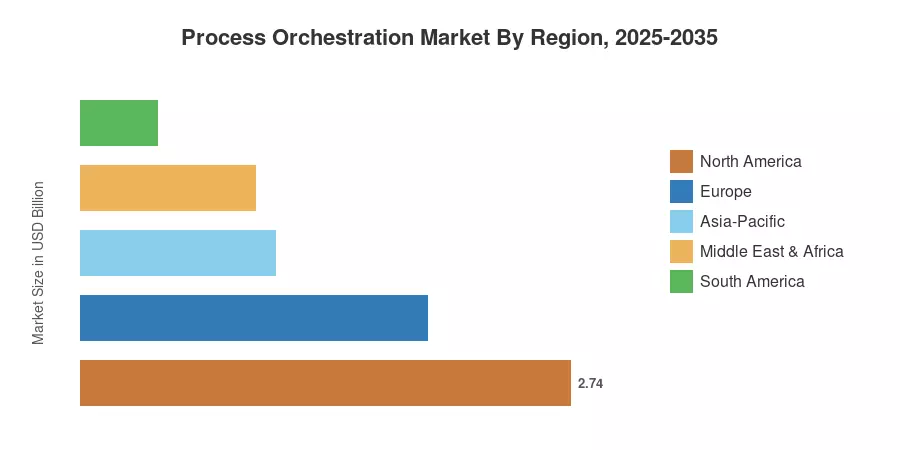
  • North America generated USD 2.74 billion in 2025 revenue.
  • Asia-Pacific records the highest regional CAGR of 15.2% through 2035.
  • Europe holds 27% of the global Process Orchestration Market share.


Process Orchestration Market Size and Forecast (2021–2035)

Market Research Future employs a triangulated approach combining top-down revenue analysis, bottom-up vendor-level aggregation, and demand-side enterprise survey validation. Historical figures (2021–2024) reflect reported vendor revenues and verified third-party estimates; forecast values (2026–2035) are derived using the 12.8% CAGR applied consistently from the 2025 base year.
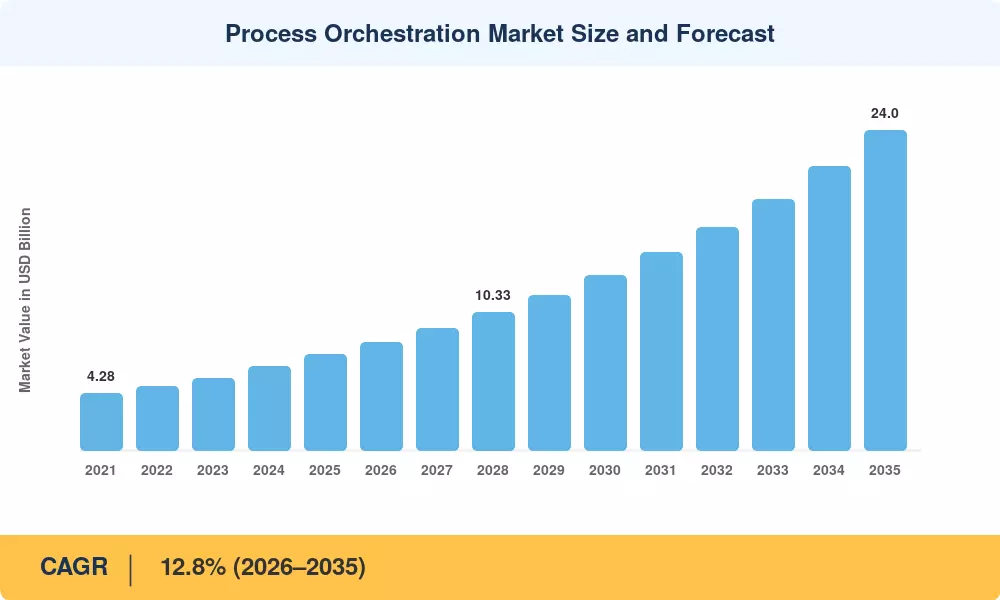
Process Orchestration Market Size and Forecast
Our Impact
Enabled $4.3B Revenue Impact for Fortune 500 and Leading Multinationals
Partnering with 2000+ Global Organizations Each Year
30K+ Citations by Top-Tier Firms in the Industry

Driver Impact Analysis

Driver ~% Impact on CAGR Geographic Relevance Impact Timeline
Digital transformation mandates ~22% Global Short-term (≤2 yr)
Generative AI integration into orchestration ~20% North America, Europe Medium-term (2–4 yr)
Regulatory compliance complexity ~16% Europe, North America Long-term (≥4 yr)
Cloud-native architecture adoption ~15% Global Short-term (≤2 yr)
Hyperautomation convergence ~12% Asia-Pacific, North America Medium-term (2–4 yr)
Supply chain resilience initiatives ~9% Asia-Pacific, Europe Medium-term (2–4 yr)
API economy expansion ~6% Global Long-term (≥4 yr)


Digital Transformation Mandates

Orchestration investments are increasingly being connected to operational KPIs by enterprise boards across the globe. Companies with advanced orchestration capabilities report far higher process throughput and lower operating cost ratios than their peers who rely on fragmented, manual automation, according to industry surveys. Additionally, the public sector is adopting enterprise-grade automation and orchestration tools more widely as a result of U.S. federal agencies updating their customer experience (CX) procedures under directives like E.O. 14058.


Generative AI Integration

By enabling self-optimizing workflows, intelligent exception routing, and natural-language process design, generative AI is revolutionizing the process orchestration industry. The time needed to create and implement business processes has been greatly decreased by Microsoft's Copilot Studio, which is connected with Power Automate. As businesses transition to autonomous operations, market analysts predict that by 2028, AI-augmented orchestration will account for a growing portion of new platform licenses.


Regulatory Compliance Complexity

The EU's Digital Operational Resilience Act (DORA), effective January 2025, requires financial institutions to demonstrate end-to-end process traceability — a requirement that effectively mandates orchestration-grade tooling. estimated that DORA compliance alone will drive EUR 1.8 billion in orchestration-related investment across European banks and insurers through 2028 [2]. Similar dynamics are emerging in U.S. healthcare under CMS interoperability rules [13].

Cloud-Native Architecture Adoption

Kubernetes-based orchestration engines are replacing monolithic BPM servers. A 2024 CNCF survey found that 78% of production orchestration deployments now run on containerized infrastructure, up from 52% in 2022 [4]. This shift lowers deployment costs by approximately 28% and accelerates time-to-value from months to weeks, making orchestration accessible to mid-market enterprises for the first time.


Restraints Impact Analysis

The restraint impact percentages below are directional estimates of headwinds that temper growth. They do not subtract directly from the CAGR but represent friction factors identified through expert interviews and enterprise demand surveys.

Restraint ~% Negative Impact Geographic Relevance Impact Timeline
Integration complexity with legacy systems ~25% Global Long-term (≥4 yr)
Data privacy and sovereignty concerns ~22% Europe, Asia-Pacific Medium-term (2–4 yr)
Talent shortage in process engineering ~20% Global Short-term (≤2 yr)
Vendor lock-in risks ~18% North America, Europe Medium-term (2–4 yr)
High total cost of ownership for SMEs ~15% South America, MEA Long-term (≥4 yr)


Integration Complexity with Legacy Systems

Many big businesses still run vast legacy estates with outdated API endpoints that are based on mainframes and proprietary middleware. A substantial majority of orchestration projects have budget overruns as a result of unanticipated integration challenges, according to industry studies, especially in highly regulated sectors like government and financial services. Since updating decades-old core systems is frequently less feasible than developing intricate, middleware-heavy integration layers, these "brownfield" settings continue to be the main source of friction.


Data Privacy and Sovereignty Concerns

Strict data residency requirements make cross-border process orchestration more difficult. Organizations must make sure that process metadata, which frequently contains sensitive operational or personal data, complies with jurisdictional borders under laws like China's PIPL and the GDPR. Compared to global, unified orchestration models, this necessity causes many multinational firms to embrace fragmented, regionalized cloud architectures, which raise infrastructure costs and delay deployment timetables.


Talent Shortage in Process Engineering

The World Economic Forum identified process design and orchestration architecture as one of the top-ten skill gaps in digital transformation for 2025 [16]. Enterprises report average vacancy periods of 6–9 months for senior orchestration architects, with salary premiums of 25–35% above comparable IT roles. This scarcity constrains implementation velocity across the Process Orchestration Market.


Process Orchestration Market Opportunities

AI-Native Process Mining and Orchestration Convergence

Process mining and orchestration platforms work together to produce a closed-loop system that continuously finds, evaluates, and executes processes. Leaders like Celonis and Camunda are forming more and more technology agreements, which enable businesses to incorporate real-time process intelligence into operational workflows. With the larger business process orchestration market expected to reach roughly $22.8 billion by 2030, this convergence is a significant growth driver.


Orchestration-as-a-Service for Emerging Markets

In quickly modernizing economies like India, Brazil, and Southeast Asia, entrance hurdles for SMEs are being lowered by consumption-based orchestration models, which are billed per process execution rather than per seat. The digital infrastructure required to scale these orchestration services to the mid-market is provided by India's Digital India program, which has effectively connected over 97% of Gram Panchayats and increased the digital economy to considerably contribute to GDP.


Industry-Specific Orchestration Templates

Enterprise users' time-to-value is being decreased by vertical-specific pre-built templates for insurance underwriting, trade finance, and healthcare claims. By integrating AI and automation into crucial processes, platforms like Appian continue to concentrate on financial services and government procurement, enabling businesses to modernize outdated systems without the hassles of conventional "rip-and-replace" tactics.


Process Data Monetization and Benchmarking

Businesses are using past execution data more and more to establish operational standards. The need for embedded process intelligence has increased since the global market for digital transformation is expected to reach $1.8 trillion by 2031. By assisting clients in visualizing performance in comparison to industry standards, orchestration suppliers who offer native benchmarking dashboards are effectively boosting platform "stickiness".


Sustainability and ESG Process Compliance

ESG reporting mandates — including the EU's Corporate Sustainability Reporting Directive (CSRD) — require traceable, auditable process chains for carbon accounting, supply chain due diligence, and emissions tracking. Orchestration platforms that embed ESG workflows tap into a compliance-driven demand layer valued at approximately USD 900 million by 2028 [22].


Process Orchestration Market Future Outlook

Autonomous Process Operations

Industry analysts predict that by 2030, a sizable portion of big businesses will switch to autonomous process operations, where orchestration platforms use AI agents to self-discover, self-design, and self-optimize workflows with little to no human supervision. This change transforms orchestration from a productivity tool into a strategic "autonomous operations layer," expanding its application beyond IT to include supply chain, finance, and human resources.


Platform Ecosystem Economics

Platform ecosystems, where companies provide marketplaces for pre-built connectors, process templates, and AI agents, are the focal point of the process orchestration market's consolidation. Partner ecosystem revenue has emerged as a crucial performance indicator, indicating that ecosystem-driven value—rather than license income alone—will determine competitive positioning over the next ten years, as shown by industry leaders like ServiceNow.


Composable Enterprise Architecture

Orchestration is essential for coordinating loosely linked services in the "composable enterprise" model, which replaces monolithic systems with modular, bundled business functions. Orchestration is increasingly seen as the "connective tissue" necessary for managing these intricate, modular IT infrastructures, with the market for process orchestration software expected to reach over $15.22 billion by 2030.


Sustainability-Linked Orchestration

Carbon-aware process routing — where orchestration engines select execution paths based on energy cost and emissions data — is emerging as a differentiator. The Science Based Targets initiative (SBTi) now requires Scope 3 supply chain traceability [22], which demands orchestration-grade visibility. By 2035, sustainability compliance is expected to influence 20% of orchestration purchasing decisions across the Process Orchestration Market.


Process Orchestration Market Segmentation

By Component

Segment Key Metric Primary Demand Driver
Solutions (Software) 62% market share (2025) Platform consolidation demand
Services CAGR 14.3% Implementation complexity, managed services growth


Solutions encompass orchestration platforms, process intelligence modules, and integration middleware. The Process Orchestration Market's solutions segment benefits from enterprises consolidating multiple point tools — RPA, iPaaS, BPM — into unified orchestration suites. Vendors like Microsoft, IBM, and SAP are embedding orchestration natively into their cloud ecosystems, driving platform-level lock-in.

Services are growing faster as enterprises realize that technology acquisition without skilled implementation yields poor returns. Consulting and systems integration account for roughly 55% of services revenue, while managed orchestration services represent the fastest-growing sub-segment as organizations seek to outsource day-to-day process operations.

By Deployment Mode

Segment Key Metric Primary Demand Driver
Cloud USD 4.68 B (2025) Scalability, lower upfront costs, remote access
On-Premises CAGR 8.4% Data sovereignty, regulated industries


Cloud deployment dominates the Process Orchestration Market, accounting for 65% of revenue. Multi-cloud and hybrid architectures are increasingly common as enterprises balance performance, compliance, and cost optimization. On-premises deployment persists in defense, intelligence, and certain banking environments where data cannot leave organizational boundaries, though its growth rate lags the overall market.

By Organization Size

Segment Key Metric Primary Demand Driver
Large Enterprises 58% market share (2025) Complex multi-system environments
SMEs CAGR 15.6% Low-code platform accessibility


Large enterprises generate the majority of Process Orchestration Market revenue due to the complexity and scale of their process landscapes. However, SMEs are the fastest-growing segment as low-code/no-code orchestration platforms reduce the technical barrier to entry. Platforms like Nintex and Kissflow specifically target the mid-market with consumption-based pricing and pre-built templates.

By End-User Industry

Segment Key Metric Primary Demand Driver
BFSI 22% market share (2025) Regulatory compliance, trade processing
IT & Telecom USD 1.30 B (2025) Service delivery automation
Healthcare CAGR 15.8% Claims processing, patient pathway orchestration
Manufacturing CAGR 14.2% Supply chain coordination, Industry 4.0
Retail & E-commerce USD 0.86 B (2025) Omnichannel order orchestration


BFSI remains the largest vertical in the Process Orchestration Market, with regulatory mandates like DORA and Basel III.1 operational resilience requirements compelling investment. Healthcare is the fastest-growing vertical, driven by payer-provider interoperability mandates from CMS and the need to orchestrate complex patient care pathways across fragmented health systems [13].


Regional Market Share Analysis

Region Key Metric Primary Investment Themes
North America 38% market share (2025) Cloud-first mandates, AI integration, federal IT modernization
Europe USD 1.94 B (2025) DORA/GDPR compliance, Industry 4.0, digital sovereignty
Asia-Pacific CAGR 15.2% (2026–2035) SME digitization, government platforms, manufacturing automation
South America USD 0.43 B (2025) Banking digitization, open finance regulation
Middle East & Africa CAGR 13.6% (2026–2035) Vision 2030 programs, oil & gas diversification
Total USD 7.20 B (2025)

The Process Orchestration Market exhibits distinct regional dynamics shaped by digital maturity, regulatory environments, and enterprise IT spending patterns.


North America

Country Key Metric Key Driver
United States 78% of regional share Federal IT modernization, hyperscaler ecosystem
Canada CAGR 13.1% Financial services orchestration, bilingual compliance
Mexico USD 0.09 B (2025) Nearshoring-driven manufacturing digitization


The United States dominates the North American Process Orchestration Market, with large-scale federal programs such as the Technology Modernization Fund (TMF) allocating USD 1.2 billion to agency-wide process digitization through 2026 [11]. Hyperscalers — AWS, Microsoft Azure, and Google Cloud — have embedded orchestration primitives into their platforms, lowering entry barriers. Canada's financial regulatory framework (OSFI Guideline B-13) is accelerating orchestration adoption among the Big Five banks for operational resilience.

Europe

Country Key Metric Key Driver
Germany 24% of regional share Industry 4.0 manufacturing orchestration
United Kingdom CAGR 13.4% Open banking, fintech integration
France USD 0.29 B (2025) Public sector digital transformation


Europe's Process Orchestration Market growth is tightly linked to regulatory compliance. DORA mandates have driven a 40% increase in orchestration RFPs from European banks since Q1 2024 [2]. Germany's manufacturing sector is layering orchestration on top of existing Industry 4.0 IoT investments to coordinate cross-plant production workflows. The UK's post-Brexit regulatory divergence has created unique demand for compliance orchestration engines that can manage dual regulatory frameworks simultaneously.

Asia-Pacific

Country Key Metric Key Driver
China 34% of regional share Smart manufacturing, government digital services
India CAGR 17.1% Digital India, UPI ecosystem expansion
Japan USD 0.22 B (2025) Legacy modernization, labor shortage mitigation
South Korea CAGR 14.8% Digital New Deal investments
Australia USD 0.12 B (2025) Financial services compliance


Asia-Pacific represents the most dynamic growth corridor in the Process Orchestration Market. India's Unified Payments Interface processed 14.6 billion transactions in December 2024 alone [19], requiring orchestration infrastructure at scale. China's State Council directive on intelligent manufacturing is mandating orchestrated production lines across 5,000 factories by 2027. Japan's acute labor shortage — workforce projected to shrink by 6.4 million by 2035 — is pushing enterprises toward automated process coordination at an unprecedented pace.

South America

Country Key Metric Key Driver
Brazil 62% of regional share Open finance (Pix), banking digitization
Argentina CAGR 12.4% Fintech growth, regulatory modernization


Brazil's central bank-driven open finance framework and Pix instant payment infrastructure have created orchestration demand across the financial sector. The Process Orchestration Market in South America is still nascent but accelerating as telecommunications and retail enterprises adopt cloud platforms to compete with digital-native challengers.

Middle East & Africa

Country Key Metric Key Driver
UAE 38% of regional share Smart government initiatives
Saudi Arabia CAGR 14.9% Vision 2030 digital transformation
South Africa USD 0.04 B (2025) Financial services modernization


Saudi Arabia's Vision 2030 has allocated SAR 6.4 billion to government digital infrastructure, with orchestration platforms central to the NEOM smart city project and public service delivery [23]. The UAE's Strategy for Artificial Intelligence 2031 complements this with mandates for AI-augmented government processes. Africa's Process Orchestration Market remains early-stage but is emerging through mobile-first banking orchestration in Kenya, Nigeria, and South Africa.


Process Orchestration Market By Region, 2025-2035

Competitive Benchmarking

The Process Orchestration Market exhibits moderate concentration, with an estimated HHI of approximately 850 and the top five players commanding roughly 38–42% of global revenue. The landscape is evolving from legacy BPM vendors toward cloud-native platform players, with significant M&A activity reshaping competitive positions.

Company Est. Revenue Share Range Key Offerings Strategic Positioning
Microsoft ~9–12% Power Automate, Logic Apps, Copilot Studio Ecosystem integration across Azure/M365
IBM ~7–10% Cloud Pak for Automation, watsonx Orchestrate AI-augmented enterprise orchestration
ServiceNow ~6–9% Flow Designer, Integration Hub IT/enterprise service orchestration
SAP ~5–8% SAP Build Process Automation, Signavio ERP-integrated process orchestration
Appian ~4–6% Appian Connected Automation Low-code process orchestration
Pegasystems ~4–6% Pega Infinity, Process Fabric Case-centric decisioning and orchestration
Camunda ~3–5% Camunda 8, Zeebe engine Open-source, developer-focused orchestration
Nintex ~2–4% Nintex Process Platform Mid-market process automation
Oracle ~2–4% Oracle Integration Cloud, Process Cloud Cloud ERP-adjacent orchestration
Salesforce ~2–3% Flow, MuleSoft Composer CRM-centric process automation


Recent News & Developments


  • European Commission (January 2025): DORA entered into force, mandating end-to-end ICT risk and process resilience frameworks for 22,000+ financial entities, directly expanding the Process Orchestration Market addressable base in Europe [2].
  • In an effort to streamline governance and broaden the scope of cross-function automation, ServiceNow introduced AI Agent Orchestrator in January 2025 to manage multi-agent environments.
  • In order to provide unified front-office experiences and faster productivity benefits, ServiceNow integrated Microsoft 365 Copilot into Now Assist in February 2025.


Process Orchestration Market Report Scope

Parameter Detail
Market Scope Global Process Orchestration Market covering solutions, services, deployment modes, organization sizes, and end-user industries
Study Period 2021–2035
CAGR 12.8% (2026–2035)
Market Size (2025) USD 7.20 Billion
Market Size (2035) USD 24.00 Billion
Fastest Growing Segment Healthcare (by end-user); Services (by component)
Companies Profiled Microsoft, IBM, ServiceNow, SAP, Appian, Pegasystems, Camunda, Nintex, Oracle, Salesforce
Valuation Currency USD (Billion)


FAQs

How should enterprises evaluate orchestration vendor lock-in risk before committing to a platform?
Prioritize vendors supporting open standards like BPMN 2.0, OpenAPI, and CloudEvents, which allow process portability across platforms. Contractual data export guarantees and multi-cloud deployment options reduce switching costs significantly [17].
What is the typical ROI timeline for a mid-market orchestration deployment?
Most mid-market deployments achieve positive ROI within 9–14 months, driven by labor reallocation and error reduction. Pilot-to-production timelines average 12 weeks on low-code platforms [14].
How does process orchestration differ from robotic process automation in practical deployment?
RPA automates individual repetitive tasks, while orchestration coordinates end-to-end workflows spanning multiple systems, people, and decisions. Orchestration platforms typically manage RPA bots as components within broader process flows [5].
What cybersecurity considerations are unique to orchestration platforms?
Orchestration platforms hold credentials for dozens of connected systems, making them high-value targets. Zero-trust architecture, encrypted credential vaults, and runtime anomaly detection are essential safeguards [15].
Which pricing model delivers the best value for organizations with variable process volumes?
Consumption-based pricing (per-execution or per-transaction) outperforms seat-based licensing for organizations with seasonal or unpredictable workloads. It aligns cost directly with realized business value [18].
How are orchestration platforms adapting to support citizen developers alongside professional IT teams?
Leading platforms now offer dual interfaces: visual low-code designers for business users and code-first environments for developers. Governance layers ensure citizen-built processes meet security and compliance standards [12].
What role does process orchestration play in multi-cloud and hybrid infrastructure strategies?
Orchestration acts as the abstraction layer that routes process execution across cloud providers based on cost, latency, and compliance rules. This prevents cloud-vendor dependency while optimizing workload placement [4].    
Author
Author
Author Profile
Ankit Gupta LinkedIn
Team Lead - Research
Ankit Gupta is a seasoned market intelligence and strategic research professional with over six plus years of experience in the ICT and Semiconductor industries. With academic roots in Telecom, Marketing, and Electronics, he blends technical insight with business strategy. Ankit has led 200+ projects, including work for Fortune 500 clients like Microsoft and Rio Tinto, covering market sizing, tech forecasting, and go-to-market strategies. Known for bridging engineering and enterprise decision-making, his insights support growth, innovation, and investment planning across diverse technology markets.

Research Approach

Research Methodology on Process Orchestration Market

1. Introduction

This research methodology focuses on understanding the core fundamentals of the research study conducted by Market Research Future (MRFR) on the global process orchestration market. The objectives of the report are to gain an in-depth analysis and insights into the process orchestration market, outline the key factors influencing its dynamics, and elucidate the opportunities, threats, trends and positioning in the global market along with the market forecasts from 2023 to 2030.

2. Research Approach

The research for this report has been conducted using a variety of approaches that includes primary and secondary research. Relevant industry journals and reports from industry associations have been used to study the processes and dynamics of the market. Primary market research was conducted to present an initial assessment of the industry's issues, dynamics, and challenges. The primary research involved telephonic interviews with industry stakeholders and industry participants. The interviews were conducted with product vendors, investors, customers, and experts.

The secondary research focuses on an in-depth analysis of industry publications, government publications, financial reports and industry databases. The analysis conducted for this report is based on both qualitative and quantitative factors. Market sizing was derived from primary sources, statistical data from secondary sources, and proprietary data from the Market Research Future (MRFF) database.

3. Market Selection

The market selection process has been used to identify the target market segment. The selection of the market was performed by analyzing the demand and supply of different market segments. The selection of the target market segment was done through interviews with industry stakeholders and customer surveys. The interviews were conducted with various stakeholders in the process orchestration market, such as product vendors, investors, customers, and experts. The customer surveys were aimed at obtaining their opinions on various aspects of the process orchestration market.

4. Data Collection

Data collection is one of the most important components of the research methodology used in this report. As a part of this research methodology, primary and secondary sources of data were used. Primary sources of data used in the report included interviews with industry stakeholders, such as product vendors, investors, customers, and experts. The interviews were conducted using telephonic interviews. Secondary sources used in the report include industry publications, government publications, and proprietary data from the Market Research Future (MRFR) database.

5. Market Segmentation

The market segmentation process included dividing the global market into four segments. These segments are application, enterprise size, deployment and regions (North America, Europe, Asia-Pacific, Middle East and Africa and Latin America). The application segment consists of Process Operations, Process Design and Automation, Process Analytics and Compliance Management. The enterprise size segment consists of Small and Medium-sized Enterprises (SMEs) and Large Enterprises. The deployment segments are cloud-based and on-premises.

6. Data Analysis

The analysis conducted for this report is based on both qualitative and quantitative factors. Market sizing was derived from primary sources, statistical data from secondary sources, and proprietary data from the Market Research Future (MRFR) database. The research methodology used in this report is designed to evaluate the key segments and drivers of the global process orchestration market. An in-depth analysis of the trends, drivers, restraints, and opportunities prevailing in the market was conducted. This included an in-depth analysis of the competitive landscape, market dynamics, and key strategies adopted by the industry players.

7. Report Outcomes

The report aims at providing an in-depth analysis of the process orchestration market and the growth prospects for the years 2023 to 2030. The report provides the market sizing and forecast based on the application, enterprise size, deployment and regions. It also provides a comprehensive overview of the factors driving the global process orchestration market, such as the market dynamics, industry trends and developments, and segmentation by applications. The report also offers insights into the various strategies adopted by the leading players in the global process orchestration market. Finally, the report provides a comprehensive overview of the industry's structure, ecosystem and regulatory framework.

Download Free Sample

Kindly complete the form below to receive a free sample of this Report

Download PDF ×

We do not share your information with anyone. However, we may send you emails based on your report interest from time to time. You may contact us at any time to opt-out.
















