×
Request Free Sample ×

Kindly complete the form below to receive a free sample of this Report

* Please use a valid business email

Leading companies partner with us for data-driven Insights

clients tt-cursor
Hero Background

Programmable Microcontroller Market

ID: MRFR/SEM/20593-CR
128 Pages
Aarti Dhapte
June 2024

Programmable Microcontroller Market Research Report Information By Type (8-Bit Microcontrollers, 16-Bit Microcontroller, 32-Bit Microcontroller, 64-Bit Microcontrollers, and Others.), By Connector Type (peripheral interface microcontroller (PIC), AVR Microcontroller, ARM Microcontroller, Mixed Signal Processor (MSP) Microcontroller, Robotic Control Microcontroller, and others.), By Application (robotics, industrial automation, safety & security devices, home automation devices, electronic measurement instruments, and others) –Industry Fo... read more

Share:
Download PDF ×

We do not share your information with anyone. However, we may send you emails based on your report interest from time to time. You may contact us at any time to opt-out.

Programmable Microcontroller Market Infographic
Purchase Options

Programmable Microcontroller Market Summary

As per MRFR analysis, the Programmable Microcontroller Market Size was estimated at 9124.6 USD Million in 2024. The Programmable Microcontroller industry is projected to grow from 10239.65 in 2025 to 32433.74 by 2035, exhibiting a compound annual growth rate (CAGR) of 12.22 during the forecast period 2025 - 2035.

Key Market Trends & Highlights

The Programmable Microcontroller Market is experiencing robust growth driven by technological advancements and increasing demand across various sectors.

  • The rise of IoT integration is transforming the programmable microcontroller landscape, particularly in North America.
  • Energy efficiency remains a focal point, as manufacturers strive to meet regulatory standards and consumer expectations in the Asia-Pacific region.
  • Advancements in automation are propelling the automotive segment, which is currently the fastest-growing area within the market.
  • The surge in consumer electronics demand and the expansion of automotive applications are key drivers fueling market growth.

Market Size & Forecast

2024 Market Size 9124.6 (USD Million)
2035 Market Size 32433.74 (USD Million)
CAGR (2025 - 2035) 12.22%

Major Players

Microchip Technology (US), Texas Instruments (US), NXP Semiconductors (NL), STMicroelectronics (FR), Infineon Technologies (DE), Analog Devices (US), Renesas Electronics (JP), Cypress Semiconductor (US), Silicon Labs (US)

Programmable Microcontroller Market Trends

The Programmable Microcontroller Market is currently experiencing a dynamic evolution, driven by advancements in technology and increasing demand for automation across various sectors. As industries strive for greater efficiency and precision, the integration of programmable microcontrollers into devices and systems has become more prevalent. This trend is particularly evident in sectors such as automotive, consumer electronics, and industrial automation, where the need for smart, connected solutions is paramount. Furthermore, the rise of the Internet of Things (IoT) has catalyzed the adoption of these microcontrollers, enabling seamless communication and control in a multitude of applications. In addition to technological advancements, the Programmable Microcontroller Market is influenced by the growing emphasis on energy efficiency and sustainability. Manufacturers are increasingly focusing on developing low-power microcontrollers that not only meet performance requirements but also contribute to reducing overall energy consumption. This shift aligns with global efforts to promote environmentally friendly practices. As the market continues to expand, it appears poised for further growth, with innovations in design and functionality likely to shape its future landscape. The interplay of these factors suggests a robust trajectory for the Programmable Microcontroller Market in the coming years.

Rise of IoT Integration

The integration of programmable microcontrollers with IoT technology is becoming increasingly prevalent. This trend facilitates enhanced connectivity and data exchange between devices, allowing for smarter and more efficient systems. As industries adopt IoT solutions, the demand for microcontrollers that can support these applications is likely to grow.

Focus on Energy Efficiency

There is a noticeable shift towards energy-efficient programmable microcontrollers. Manufacturers are prioritizing the development of low-power solutions that not only meet performance standards but also contribute to sustainability goals. This focus on energy efficiency is expected to drive innovation and attract environmentally conscious consumers.

Advancements in Automation

The Programmable Microcontroller Market is witnessing significant advancements in automation technologies. As industries seek to optimize processes and reduce human intervention, the demand for programmable microcontrollers that enable automation is likely to increase. This trend is particularly relevant in manufacturing and logistics sectors.

Programmable Microcontroller Market Drivers

Increased Focus on Automation

The global shift towards automation across various sectors, including manufacturing and agriculture, is a significant driver of the Global Programmable Microcontroller Market Industry. Automation technologies rely heavily on programmable microcontrollers to facilitate real-time data processing and control systems. For instance, automated assembly lines and precision farming equipment utilize microcontrollers to enhance operational efficiency and reduce labor costs. This growing emphasis on automation is expected to propel market growth, as industries seek to optimize processes and improve productivity. The anticipated market expansion further highlights the importance of microcontrollers in supporting automation initiatives.

Rising Demand for IoT Devices

The proliferation of Internet of Things (IoT) devices is a primary driver of the Global Programmable Microcontroller Market Industry. As industries increasingly adopt IoT solutions, the need for efficient and versatile microcontrollers becomes paramount. For instance, smart home devices, wearables, and industrial automation systems rely heavily on programmable microcontrollers for functionality. This trend is expected to contribute to the market's growth, with projections indicating a market value of 9.12 USD Billion in 2024. The integration of microcontrollers in these devices enhances connectivity and data processing capabilities, thereby driving demand in the global market.

Advancements in Embedded Systems

Technological advancements in embedded systems significantly influence the Global Programmable Microcontroller Market Industry. The evolution of microcontroller architecture has led to enhanced performance, reduced power consumption, and increased integration capabilities. For example, newer microcontrollers now incorporate advanced features such as built-in wireless connectivity and improved processing power, making them suitable for a wider range of applications. This trend is likely to accelerate market growth, as industries seek to leverage these advancements for innovative product development. The anticipated market growth trajectory suggests a potential increase to 36.2 USD Billion by 2035, reflecting the importance of embedded systems in driving demand.

Growth in Automotive Electronics

The automotive sector's increasing reliance on electronic systems is a crucial driver for the Global Programmable Microcontroller Market Industry. With the rise of electric vehicles and advanced driver-assistance systems (ADAS), programmable microcontrollers play a vital role in managing various functions, from engine control to infotainment systems. As automotive manufacturers strive to enhance vehicle safety and efficiency, the demand for sophisticated microcontrollers is expected to surge. This trend aligns with the broader market growth, with projections indicating a compound annual growth rate (CAGR) of 13.35% from 2025 to 2035, underscoring the automotive industry's pivotal role in shaping the microcontroller landscape.

Emerging Applications in Healthcare

The healthcare sector's increasing adoption of advanced medical devices is a notable driver for the Global Programmable Microcontroller Market Industry. Programmable microcontrollers are integral to the functionality of devices such as patient monitoring systems, diagnostic equipment, and wearable health trackers. These applications require precise control and data processing capabilities, which microcontrollers provide. As the demand for innovative healthcare solutions continues to rise, the market for programmable microcontrollers is expected to expand significantly. This trend reflects a broader commitment to enhancing patient care and outcomes through technology, further solidifying the role of microcontrollers in the healthcare landscape.

Market Segment Insights

By Application: Consumer Electronics (Largest) vs. Automotive (Fastest-Growing)

The Programmable Microcontroller Market shows a diversified share among its application segments, with Consumer Electronics occupying the largest share due to widespread adoption in devices like smartphones, tablets, and smart appliances. Automotive follows closely, driven by the increasing integration of advanced technologies in vehicles, including autonomous driving features and advanced driver-assistance systems (ADAS). Other segments, such as Industrial Automation and Healthcare, also contribute significantly but remain smaller in comparison.

Consumer Electronics: Dominant vs. Automotive: Emerging

Consumer Electronics represents a dominant force in the Programmable Microcontroller Market, leveraging the rapid technological advancements in smart devices and the Internet of Things (IoT). This segment thrives on innovation, with manufacturers continuously pushing the envelope to create more efficient, compact, and feature-rich microcontrollers. Conversely, the Automotive segment, identified as emerging, is witnessing accelerated growth fueled by the trends toward electric vehicles and smart automotive technologies. The increasing demand for connectivity, safety features, and infotainment systems in modern vehicles is driving this growth, positioning automotive microcontrollers as a critical contributor to the future of mobility.

By End Use: Embedded Systems (Largest) vs. Internet of Things (Fastest-Growing)

In the Programmable Microcontroller Market, Embedded Systems hold the largest share, driven by their extensive applications across diverse industries such as automotive, consumer electronics, and industrial automation. In contrast, sectors like the Internet of Things are rapidly gaining traction, competing for market space as they represent an innovative evolution of embedded technologies that integrate connectivity and data sharing capabilities.

Smart Home Devices: Established vs. Wearable Technology: Emerging

Smart Home Devices represent an established segment within the Programmable Microcontroller Market, characterized by their integration into everyday household functions. These devices, including smart speakers, thermostats, and security systems, have been widely adopted due to their convenience and energy efficiency. Conversely, Wearable Technology emerges as a dynamic segment fueled by increasing consumer preferences for health monitoring, fitness tracking, and personal safety. Innovations in both hardware and software are accelerating growth in wearable technology, creating a competitive landscape where adaptability and user experience are paramount.

By Technology: Digital Microcontrollers (Largest) vs. Hybrid Microcontrollers (Fastest-Growing)

In the Programmable Microcontroller Market, Digital Microcontrollers dominate with a significant share due to their extensive application in consumer electronics, automotive systems, and industrial automation. Their ability to handle complex tasks enhances their appeal, ensuring they capture the largest segment of the market. In contrast, Hybrid Microcontrollers, which combine the capabilities of analog and digital technologies, are rapidly gaining traction among specific applications, including IoT devices and smart systems, thereby showing substantial potential for growth.

Technology: Digital Microcontrollers (Dominant) vs. Hybrid Microcontrollers (Emerging)

Digital Microcontrollers are characterized by their high processing power, efficient memory usage, and versatility in programming, making them essential for various high-performance applications. They dominate the market thanks to widespread adoption across diverse sectors. On the other hand, Hybrid Microcontrollers represent a blend of analog and digital technologies, enabling them to efficiently interface with a range of sensors and actuators. This unique capability positions them as an emerging solution in the market, catering to the increasing demand for integrated systems, especially in smart devices and automation. The synergy between both technologies is redefining programmable solutions in the industry.

By Architecture: Von Neumann Architecture (Largest) vs. RISC Architecture (Fastest-Growing)

In the current Programmable Microcontroller Market, the Von Neumann architecture dominates the landscape, offering a unified memory structure that is advantageous for a variety of applications. This architecture’s widespread adoption is attributed to its simplicity and programming efficiency, leading to a substantial market share compared to other segments. On the other hand, RISC architecture, characterized by its reduced instruction set, is emerging rapidly, making strides as developers seek to enhance performance in power-sensitive applications.

Architecture: Von Neumann (Dominant) vs. RISC (Emerging)

The Von Neumann architecture stands out as the dominant player in the Programmable Microcontroller Market, characterized by its single memory space for both instructions and data, which simplifies system design and programming. This architecture supports a plethora of applications, providing flexibility and ease of use to developers. In contrast, RISC architecture is gaining traction as an emerging force, emphasizing efficiency and performance through a minimalistic instruction set. Ideal for applications requiring high-speed processing and low power consumption, RISC is increasingly favored in embedded systems and advanced computational tasks, leveraging its architectural efficiency to drive growth in the market.

By Connectivity: Wi-Fi Connectivity (Largest) vs. Bluetooth Connectivity (Fastest-Growing)

In the Programmable Microcontroller Market, the connectivity segment showcases a diverse range of options, including Wired, Wireless, Bluetooth, Wi-Fi, and Zigbee connectivity. Wi-Fi connectivity leads the market, holding the largest share, owing to its widespread adoption across consumer electronics and IoT applications. This dominance is reinforced by the increasing demand for high-speed internet and connected devices. On the other hand, Bluetooth connectivity, while smaller in share, is experiencing rapid growth due to the rising popularity of smart devices and wearables. Its efficient power consumption and simplicity in connecting devices contribute to its expanding market presence. The growth dynamics within the connectivity segment are driven by advancements in technology and the increasing adoption of IoT devices. Wireless connectivity options are particularly benefiting from the burgeoning demand for remote control and automation features in various applications, such as smart homes and industrial automation. As manufacturers continue to innovate and improve power efficiency, the transition towards wireless solutions is expected to accelerate. This shift is fostering a competitive landscape where Bluetooth and Zigbee connectivity are rapidly gaining traction, appealing to markets focused on low-power consumption and enhanced connectivity solutions.

Connectivity: Wi-Fi (Dominant) vs. Bluetooth (Emerging)

Wi-Fi connectivity stands out as the dominant force in the Programmable Microcontroller Market due to its ability to support high data throughput and its widespread use in consumer electronics, smart home devices, and commercial applications. Its extensive range and reliability make it ideal for applications requiring consistent and high-speed internet access. Conversely, Bluetooth connectivity is emerging as a significant player, particularly in the realm of wearable technology and smart devices. Its low power requirements and ease of pairing between devices have raised its profile, making it a preferred choice for applications where energy efficiency is paramount. As both connectivity types evolve, their market positions continue to influence the overall dynamics of the programmable microcontroller landscape.

Get more detailed insights about Programmable Microcontroller Market

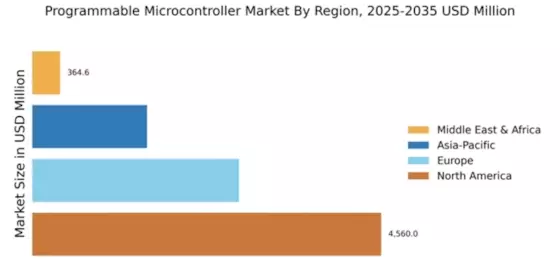
Regional Insights

North America : Market Leader in Innovation

North America continues to lead the programmable microcontroller market, holding a significant share of 4560.0. The region's growth is driven by robust demand in sectors such as automotive, consumer electronics, and industrial automation. Regulatory support for innovation and technology adoption further catalyzes market expansion, with initiatives aimed at enhancing semiconductor manufacturing and R&D. The United States stands out as the primary market, hosting key players like Microchip Technology, Texas Instruments, and Analog Devices. The competitive landscape is characterized by continuous innovation and strategic partnerships, ensuring that North America remains at the forefront of microcontroller technology. The presence of advanced manufacturing facilities and a skilled workforce further solidifies its market position.

Europe : Emerging Hub for Technology

Europe's programmable microcontroller market is projected to reach 2700.0, fueled by increasing demand across automotive, healthcare, and industrial sectors. The region benefits from stringent regulations promoting energy efficiency and sustainability, which drive innovation in microcontroller applications. Initiatives like the European Green Deal further enhance market prospects by encouraging the adoption of smart technologies. Leading countries such as Germany, France, and the Netherlands are pivotal in this growth, with a strong presence of companies like NXP Semiconductors and STMicroelectronics. The competitive landscape is marked by collaborations between tech firms and research institutions, fostering innovation and ensuring that Europe remains a key player in The Programmable Microcontroller. "The European semiconductor industry is crucial for our digital and green transition," European Commission. European Commission.

Asia-Pacific : Rapidly Growing Market

The Asia-Pacific region is witnessing rapid growth in the programmable microcontroller market, projected to reach 1500.0. This growth is driven by increasing demand for consumer electronics, IoT devices, and automotive applications. Countries are investing heavily in technology infrastructure and innovation, supported by government initiatives aimed at enhancing semiconductor production capabilities. China, Japan, and South Korea are leading the charge, with significant contributions from companies like Renesas Electronics and Cypress Semiconductor. The competitive landscape is evolving, with local players emerging alongside established global firms, creating a dynamic environment that fosters innovation and market expansion. The region's focus on smart manufacturing and automation further propels its market potential.

Middle East and Africa : Emerging Market Potential

The Middle East and Africa region is gradually emerging in the programmable microcontroller market, with a projected size of 364.6. The growth is primarily driven by increasing investments in technology and infrastructure, particularly in sectors like telecommunications and automotive. Governments are implementing policies to support local manufacturing and technology adoption, which are crucial for market development. Countries like South Africa and the UAE are at the forefront, with initiatives aimed at enhancing technological capabilities. The competitive landscape is characterized by a mix of local and international players, creating opportunities for growth and collaboration. As the region continues to develop its technological ecosystem, the demand for programmable microcontrollers is expected to rise significantly. "The Middle East is poised for a technological transformation," World Economic Forum.

Key Players and Competitive Insights

The Programmable Microcontroller Market is currently characterized by a dynamic competitive landscape, driven by rapid technological advancements and increasing demand across various sectors, including automotive, consumer electronics, and industrial automation. Key players such as Microchip Technology (US), Texas Instruments (US), and NXP Semiconductors (NL) are strategically positioned to leverage their extensive product portfolios and innovative capabilities. Microchip Technology (US) focuses on enhancing its microcontroller offerings through continuous innovation and strategic acquisitions, while Texas Instruments (US) emphasizes its commitment to research and development, aiming to maintain its competitive edge in the market. NXP Semiconductors (NL) is actively pursuing partnerships to expand its reach in the automotive sector, thereby shaping the competitive environment through collaborative efforts.

In terms of business tactics, companies are increasingly localizing manufacturing and optimizing supply chains to enhance operational efficiency and reduce costs. The market structure appears moderately fragmented, with several key players exerting considerable influence. This fragmentation allows for a diverse range of products and solutions, catering to the varying needs of end-users. The collective strategies of these companies contribute to a competitive atmosphere where innovation and responsiveness to market demands are paramount.

In November 2025, Microchip Technology (US) announced the launch of its latest microcontroller series, which integrates advanced security features aimed at the IoT market. This strategic move is significant as it positions the company to capitalize on the growing demand for secure IoT solutions, thereby enhancing its market share and reinforcing its reputation as a leader in microcontroller technology. Similarly, in October 2025, Texas Instruments (US) unveiled a new line of energy-efficient microcontrollers designed for battery-operated devices. This initiative not only reflects the company's commitment to sustainability but also addresses the increasing consumer demand for energy-efficient solutions, potentially attracting a broader customer base.

In September 2025, NXP Semiconductors (NL) entered into a strategic partnership with a leading automotive manufacturer to develop next-generation microcontrollers tailored for electric vehicles. This collaboration is likely to enhance NXP's position in the rapidly evolving automotive sector, where the demand for advanced microcontroller solutions is surging. Such partnerships are indicative of a broader trend where companies are aligning their strategies with industry needs, thereby fostering innovation and growth.

As of December 2025, the competitive trends within the Programmable Microcontroller Market are increasingly defined by digitalization, sustainability, and the integration of artificial intelligence (AI). Strategic alliances are playing a crucial role in shaping the current landscape, enabling companies to pool resources and expertise to drive innovation. Looking ahead, it is anticipated that competitive differentiation will evolve, with a pronounced shift from price-based competition to a focus on innovation, technological advancements, and supply chain reliability. This evolution underscores the importance of adaptability and forward-thinking strategies in navigating the complexities of the market.

Key Companies in the Programmable Microcontroller Market market include

Industry Developments

    • In November 2023, NXP Semiconductors has introduced the S32K39 series of automotive microcontrollers (MCUs) for modern electrification applications, optimized for electric vehicle (EV) control. The MCUs offer high-speed and high-resolution control for increased power and include networking, security, and functional safety capabilities beyond traditional automotive MCUs.
    • In March 2024, STMicroelectronics has released a ultra-low-power STM32 microcontroller, the STM32WL3, designed for industrial, medical, smart metering, and consumer applications.

Future Outlook

Programmable Microcontroller Market Future Outlook

The Programmable Microcontroller Market is projected to grow at a 12.22% CAGR from 2024 to 2035, driven by advancements in IoT, automation, and smart technologies.

New opportunities lie in:

  • Development of IoT-enabled smart home devices
  • Expansion into automotive microcontroller applications
  • Integration of AI capabilities in microcontroller designs

By 2035, the market is expected to be robust, reflecting substantial growth and innovation.

Market Segmentation

Programmable Microcontroller Market End Use Outlook

  • Embedded Systems
  • Robotics
  • Smart Home Devices
  • Wearable Technology
  • Internet of Things

Programmable Microcontroller Market Technology Outlook

  • Analog Microcontrollers
  • Digital Microcontrollers
  • Hybrid Microcontrollers
  • Microcontroller Units
  • System on Chip

Programmable Microcontroller Market Application Outlook

  • Consumer Electronics
  • Automotive
  • Industrial Automation
  • Healthcare
  • Telecommunications

Programmable Microcontroller Market Architecture Outlook

  • Harvard Architecture
  • Von Neumann Architecture
  • RISC Architecture
  • CISC Architecture
  • Embedded Architecture

Programmable Microcontroller Market Connectivity Outlook

  • Wired Connectivity
  • Wireless Connectivity
  • Bluetooth Connectivity
  • Wi-Fi Connectivity
  • Zigbee Connectivity

Report Scope

MARKET SIZE 20249124.6(USD Million)
MARKET SIZE 202510239.65(USD Million)
MARKET SIZE 203532433.74(USD Million)
COMPOUND ANNUAL GROWTH RATE (CAGR)12.22% (2024 - 2035)
REPORT COVERAGERevenue Forecast, Competitive Landscape, Growth Factors, and Trends
BASE YEAR2024
Market Forecast Period2025 - 2035
Historical Data2019 - 2024
Market Forecast UnitsUSD Million
Key Companies ProfiledMicrochip Technology (US), Texas Instruments (US), NXP Semiconductors (NL), STMicroelectronics (FR), Infineon Technologies (DE), Analog Devices (US), Renesas Electronics (JP), Cypress Semiconductor (US), Silicon Labs (US)
Segments CoveredApplication, End Use, Technology, Architecture, Connectivity
Key Market OpportunitiesIntegration of artificial intelligence in programmable microcontrollers enhances automation and efficiency across various industries.
Key Market DynamicsRising demand for automation drives innovation and competition in the programmable microcontroller market.
Countries CoveredNorth America, Europe, APAC, South America, MEA

Leave a Comment

FAQs

How much is the Programmable Microcontroller market?

The Programmable Microcontroller Market size is expected to be valued at USD 9124.60 billion in 2024.

What is the growth rate of the Programmable Microcontroller market?

The global market is projected to grow at a CAGR of 12.22% during the forecast period, 2025 to 2035.

Which region held the largest market share in the Programmable Microcontroller market?

Aisa Pacific had the largest share of the global market.

Who are the key players in the Programmable Microcontroller market?

The key players in the market Texas Instruments, Microchip Technology Inc., Polou Robotics and Electronics, STMicroelectronics, NXP Semiconductors, Renesas Electronics, SEGGER Microcontroller Systems, ELENCE, Promik Trusted Solution, BPM Microsystems, Data I/O Corporation, Arduino, and N-iX LTD.

Which Type led the Programmable Microcontroller market?

64-Bit Microcontroller dominated the market in 2023.

Download Free Sample

Kindly complete the form below to receive a free sample of this Report

Compare Licence

×
Features License Type
Single User Multiuser License Enterprise User
Price $4,950 $5,950 $7,250
Maximum User Access Limit 1 User Upto 10 Users Unrestricted Access Throughout the Organization
Free Customization
Direct Access to Analyst
Deliverable Format
Platform Access
Discount on Next Purchase 10% 15% 15%
Printable Versions