Protective Relay Market (2026 - 2035)

Protective Relay Market Research Report By Technology (Digital / Numerical Relays, Solid-State Relays, Electromechanical Relays), By Application (Transmission Line Protection, Feeder Protection, Transformer Protection, Motor Protection, Others (Bus, Capacitor Bank, Generator)), By End User (Electric Utilities, Industrial (Oil & Gas, Mining, Manufacturing), Transportation (Rail, Metro), Commercial & Data Centers) and By Regional (North America, Europe, South America, Asia Pacific, Middle East and Africa) - Industry Forecast to 2035
ID: MRFR/EnP/0413-CR
155 Pages
Chitranshi Jaiswal
Last Updated: August 05, 2026
Protective Relay Market
Market Size
Forecast Period2026-2035
CAGR (2026-2035)6.8%
2025 Market SizeUSD 3.52 Billion
2035 Market SizeUSD 6.80 Billion
Key Players
Siemens
Hitachi Energy
GE Vernova
Schweitzer Engineering Laboratories
Schneider Electric
Toshiba
Opportunities
  • Digital Substation-as-a-Service Models
  • Battery Energy Storage System Protection
  • Emerging Market Electrification

Protective Relay Market Summary

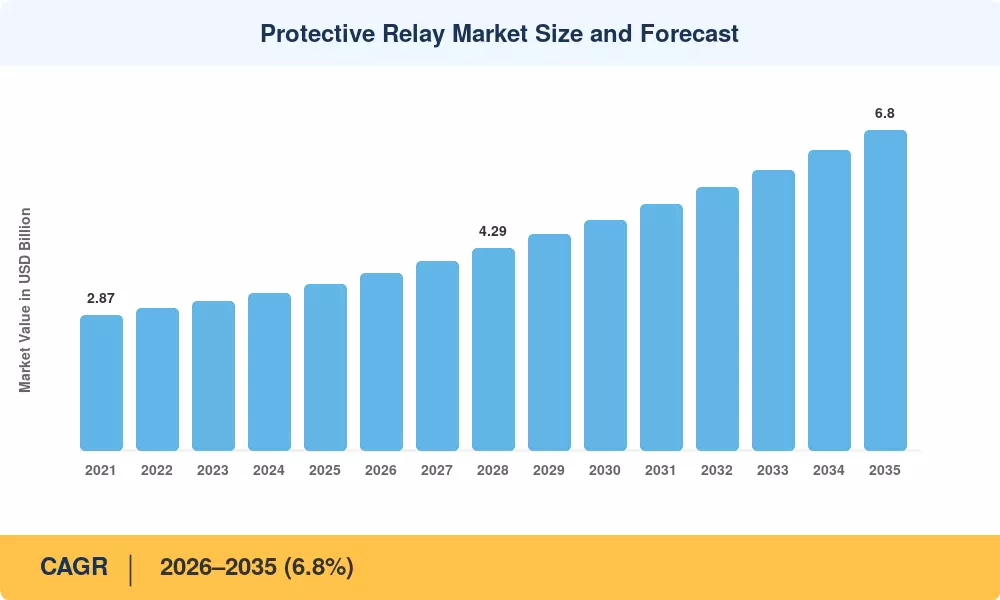
The global Protective Relay Market reached an estimated USD 3.52 billion in 2025 and is projected to grow from USD 3.76 billion in 2026 to USD 6.80 billion by 2035, advancing at a CAGR of 6.8% during the 2026–2035 forecast period. This expansion is rooted in two powerful catalysts: aging transmission and distribution infrastructure in developed economies requiring urgent replacement, and a surge of renewable energy integration across the developing world that demands smarter grid protection architectures. The U.S. Department of Energy's Grid Resilience and Innovation Partnerships (GRIP) program alone allocated over USD 10.5 billion in federal grants for grid modernization between 2022 and 2026, channeling significant demand toward next-generation protection devices [1].

A technology transformation is well underway within the Protective Relay Market. Electromechanical relays — workhorses of mid-twentieth-century grids — are being retired in favor of microprocessor-based numerical relays capable of adaptive protection, event recording, and communication over standardized protocols. Utilities worldwide are investing in substation automation platforms that consolidate protection, control, and monitoring into intelligent electronic devices. The European Union's TEN-E regulation, revised in 2022, mandates cross-border grid reinforcement projects worth an estimated EUR 5.8 billion through 2030, creating sustained demand for advanced protection equipment [2].

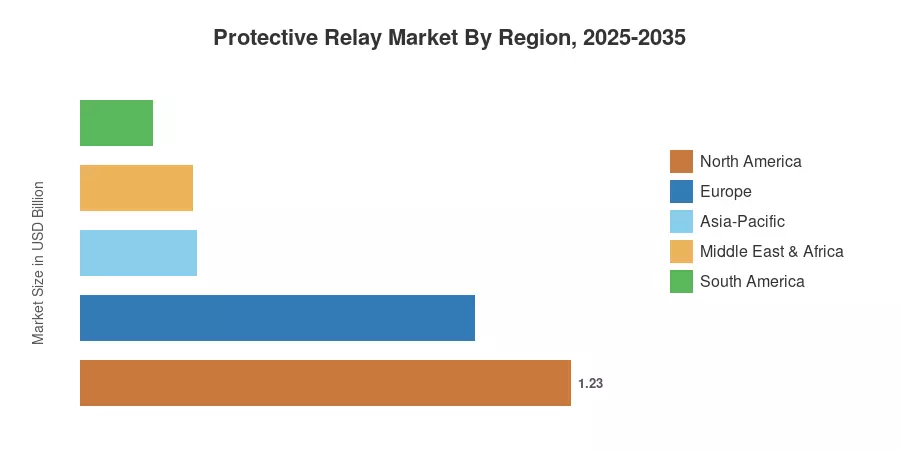
North America holds the dominant share of the Protective Relay Market at approximately 35% of global revenue, driven by NERC reliability standards and an installed base of over 650,000 substations in the United States and Canada. Asia-Pacific is the fastest-growing region with an expected CAGR of 8.2%, led by India's USD 43 billion Revamped Distribution Sector Scheme and China's State Grid modernization investments. Europe accounts for roughly 28% of global revenue, anchored by offshore wind interconnection and smart grid programs. The next decade will reshape protection relay architectures as decentralized generation, battery storage, and bidirectional power flows challenge traditional protection philosophies [3].


Key Report Takeaways

• By Technology

  • Digital/numerical relays command roughly 62% of the Protective Relay Market by value, reflecting the global shift toward microprocessor-based protection platforms with integrated communication.
  • Electromechanical relays continue to hold a legacy installed base but are declining at approximately –2.1% annually as utilities prioritize retrofit and replacement programs.
  • Solid-state relays occupy a transitional niche, growing at a CAGR of 4.3% as mid-tier utilities in developing markets upgrade incrementally.

• By Application

  • Transmission line protection represents the single largest application within the Protective Relay Market, valued at approximately USD 1.10 billion in 2025.
  • Feeder protection is expanding at a CAGR of 7.5%, driven by distribution automation and distributed energy resource interconnection requirements.

• By Region

  • North America leads the Protective Relay Market with a 35% revenue share, underpinned by FERC Order 881 compliance and wildfire mitigation investments.
  • Asia-Pacific is expected to grow at 8.2% CAGR through 2035, fueled by electrification programs in India, Southeast Asia, and China.
  • Europe holds approximately 28% of global revenue, driven by REPowerEU grid investment targets.


Protective Relay Market Size and Forecast (2021–2035)

Market Research Future constructed the baseline market size using a triangulated approach combining top-down analysis of utility capital expenditure allocations for substation equipment, bottom-up aggregation of major relay vendor shipment data, and cross-validation against publicly filed tariff schedules and procurement databases from national grid operators across 45 countries.
Protective Relay Market Size and Forecast
Our Impact
Enabled $4.3B Revenue Impact for Fortune 500 and Leading Multinationals
Partnering with 2000+ Global Organizations Each Year
30K+ Citations by Top-Tier Firms in the Industry

Driver Impact Analysis

Driver ~% Impact on CAGR Geographic Relevance Impact Timeline
Grid modernization and aging infrastructure replacement +1.8% North America, Europe Long-term (≥4 yr)
Renewable energy integration and DER interconnection +1.5% Global Medium-term (2–4 yr)
Substation automation and digital transformation +1.2% Global Medium-term (2–4 yr)
Regulatory reliability mandates (NERC, ENTSO-E) +0.9% North America, Europe Short-term (≤2 yr)
Electrification in emerging economies +0.8% Asia-Pacific, Africa Long-term (≥4 yr)
Cybersecurity requirements for critical infrastructure +0.4% North America, Europe Medium-term (2–4 yr)
Offshore wind and HVDC transmission expansion +0.3% Europe, Asia-Pacific Long-term (≥4 yr)


Grid Modernization and Aging Infrastructure Replacement

In its 2021 Report Card, the American Society of Civil Engineers gave the country's energy infrastructure a C–, noting an average transmission asset age of more than 40 years [1]. By 2024, about 70% of power transformers and related protective equipment in the United States alone had outlived their intended service life. This need for replacement is not limited to North America. EUR 5.8 billion was set aside for cross-border interconnection projects that call for updated relay protection systems at each node under the EU's updated Trans-European Networks for Energy legislation. The Protective Relay Market will experience a multiplier impact far into the 2030s as each substation update usually entails replacing 15–30 electromechanical relays with digital equivalents [2].


Renewable Energy Integration

Wind and solar capacity additions reached 510 GW worldwide in 2023 and are expected to exceed 700 GW yearly by 2030 [7]. Protection methods that take into consideration low fault current contributions, bidirectional power flows, and rapid voltage variations are necessary for every renewable generator connections point; conventional protection devices are unable to handle these problems. Numerical protection relays are specifically required for each new 220 kV and 400 kV substation connected to renewable energy zones under India's USD 1.5 billion Green Energy Corridor program. By directing demand toward adaptive and setting-less relay platforms, this driver is changing the protective relay market [8].


Substation Automation and Digital Transformation

Utilities are consolidating discrete protection, control, and monitoring functions into integrated substation automation systems that communicate via process-bus architectures. This transition compresses replacement cycles: a utility deploying a fully digital substation replaces not just relays but also conventional instrument transformers with merging units. Enel's Global Digital Grid program committed EUR 2.3 billion to digitalizing 600 substations across Italy, Spain, and Latin America between 2022 and 2026 [9]. These large-scale digitalization contracts create demand volumes that favor incumbents with end-to-end protection and automation portfolios, reinforcing market concentration within the Protective Relay Market.

Regulatory Reliability Mandates

NERC's Critical Infrastructure Protection (CIP) standards, particularly CIP-014 on physical security and CIP-013 on supply chain risk management, compel North American utilities to upgrade or replace legacy relays that lack audit logging and secure communication capabilities [15]. In Europe, ENTSO-E's Network Code on Requirements for Generators imposes fault-ride-through and reactive power control obligations that only numerical relays can satisfy. Non-compliance penalties can reach USD 1 million per day under FERC enforcement, creating a regulatory floor beneath demand within the Protective Relay Market [15].


Restraints Impact Analysis

The restraint impacts below are directional estimates of downward pressure on the forecast CAGR. They are not directly subtracted from driver impacts; real-world conditions produce complex interactions between growth catalysts and headwinds.

Restraint ~% Impact on CAGR Geographic Relevance Impact Timeline
High cost of digital relay migration –0.7% Emerging economies Long-term (≥4 yr)
Skilled workforce shortages in relay engineering –0.5% Global Medium-term (2–4 yr)
Interoperability challenges across vendor platforms –0.4% Global Medium-term (2–4 yr)
Supply chain concentration for relay-grade semiconductors –0.3% Global Short-term (≤2 yr)
Long procurement cycles in public utilities –0.2% South America, Africa Long-term (≥4 yr)


High Cost of Digital Relay Migration

According to the benchmarking studies, a complete substation protection upgrade that includes 20–25 numerical relays, communication switches, GPS clocks, and engineering services can cost USD 1.2–1.8 million per bay [16]. This capital intensity poses a major obstacle for small and mid-sized utilities in Southeast Asia and Sub-Saharan Africa. The Protective Relay Market's organic growth is slowed by many people delaying improvements until equipment breakdown necessitates replacement. This obstacle is somewhat mitigated by multilateral finance arrangements from the World Bank and Asian Development Bank, however disbursement schedules frequently take three to five years [13].


Skilled Workforce Shortages

Engineers skilled in digital communications, setting synchronization across intricate network topologies, and cybersecurity hardening are required for modern numerical relays. Even as task complexity rises, the U.S. Bureau of Labor Statistics predicts a 6% decrease in power plant operators and relay technicians until 2032 [17]. In South Asia and Africa, where university protection engineering programs are still scarce, this skills shortage is especially severe. The shortfall is somewhat filled by vendor training programs offered by major OEMs, but throughput cannot keep up with the expected expansion of installed bases throughout the Protective Relay Market.


Interoperability Challenges

Despite standardization efforts, real-world deployments frequently encounter interoperability failures when mixing relay products from different manufacturers within a single substation. Engineering rework to resolve protocol mismatches can add 10–15% to project costs and delay commissioning by several months [9]. These friction costs discourage some utilities from pursuing best-of-breed procurement strategies, limiting competitive dynamics within the Protective Relay Market.


Protective Relay Market Opportunities

Digital Substation-as-a-Service Models

Cloud-connected relay platforms open the door for subscription-based protection monitoring and analytics. Vendors that bundle relay hardware with remote diagnostics, firmware management, and protection performance dashboards can capture recurring revenue streams valued at 15–20% of initial hardware cost annually. Early movers like Hitachi Energy's Lumada APM platform are piloting these models with North American cooperatives.

Battery Energy Storage System Protection

Grid-scale battery storage deployments are expected to reach 680 GW globally by 2035, according to BloombergNEF [12]. Each battery installation requires specialized protection relays that address unique fault characteristics including rapid DC fault currents, arc flash risks, and bidirectional inverter power flows. This emerging application creates an addressable opportunity estimated at USD 480 million within the Protective Relay Market by 2035.

Emerging Market Electrification

Sub-Saharan Africa's electrification rate remains below 50%, and the African Development Bank's Desert to Power initiative targets 10 GW of solar capacity across the Sahel by 2030 [13]. Every transmission corridor and distribution feeder built to deliver this power requires protective relays. Vendors willing to offer ruggedized, simplified relay products tailored for tropical environments and limited technical support infrastructure can capture first-mover advantage in these high-growth markets.

Cybersecurity-Integrated Relay Platforms

FERC Order 887 and the EU's NIS2 directive elevate cybersecurity requirements for operational technology, including protection relays. Vendors embedding hardware security modules, encrypted communications, and zero-trust authentication directly into relay firmware can command 20–30% price premiums while satisfying compliance mandates. This opportunity reshapes competitive positioning within the Protective Relay Market as cybersecurity capability becomes a procurement prerequisite rather than an optional feature.

Data Monetization through Relay Analytics

Modern numerical relays capture high-resolution waveform data, event sequences, and equipment health metrics at every protection operation. Aggregating this data across fleet portfolios enables predictive maintenance, asset health indexing, and insurance risk modeling — services that extend the relay vendor's value proposition beyond hardware sales. Utilities managing 500+ substations have reported 12–18% reductions in unplanned outage costs after deploying relay analytics platforms.


Protective Relay Market Future Outlook

AI-Driven Adaptive Protection

Artificial intelligence is moving from the control center into the relay itself. Edge-deployed machine learning algorithms will enable relays to dynamically adjust protection settings based on real-time network topology, load conditions, and weather forecasts — eliminating the need for manual relay coordination studies after each network reconfiguration. The U.S. DOE's Advanced Grid Research program allocated USD 75 million in 2024 for AI-enabled grid protection pilot projects [14]. By 2030, AI-augmented relays could reduce false trip rates by 30–40%, substantially improving grid reliability and reshaping vendor competition within the Protective Relay Market.

Platform Consolidation and Software-Defined Protection

Hardware relay margins are compressing as component costs decline. Vendors are shifting value capture toward software platforms that manage relay fleets, automate settings deployment, and aggregate operational data. This platform economics model favors vendors with large installed bases and strong software engineering capabilities. The Protective Relay Market will increasingly resemble enterprise software markets, with annual recurring revenue from relay management platforms supplementing one-time hardware sales. Hitachi Energy, Siemens, and GE Vernova have each announced platform strategies targeting 25–35% software revenue mix by 2030 [9].

Electrification Supercycle and Grid Expansion

The IEA's World Energy Outlook 2023 projects global electricity demand growing 75% by 2050, driven by electric vehicles, data centers, heat pumps, and industrial electrification [7]. Each incremental terawatt-hour of demand requires transmission and distribution capacity — and protection relays at every switching and interconnection point. This electrification supercycle creates a structural demand floor beneath the Protective Relay Market that is largely independent of technology-cycle timing. Emerging economies will account for over 60% of net new grid infrastructure investment through 2035, tilting geographic demand toward Asia-Pacific, Africa, and the Middle East.

ESG Reporting and Grid Resilience Metrics

Investor pressure on utilities to quantify and improve grid resilience is creating new demand signals for the Protective Relay Market. SAIDI and SAIFI metrics are entering ESG disclosure frameworks, including the Sustainability Accounting Standards Board (SASB) Electric Utilities standard [15]. Utilities that demonstrate protection system investments as resilience enablers can access green bonds and sustainability-linked loans at favorable rates. This financial mechanism turns relay procurement from an operational expense into a strategic capital allocation decision, accelerating upgrade timelines.


Protective Relay Market Segmentation

By Technology

Segment Key Metric Primary Demand Driver
Digital / Numerical Relays 62% market share (2025) Substation automation, adaptive protection
Solid-State Relays 4.3% CAGR Cost-effective mid-tier upgrades
Electromechanical Relays USD 0.48 billion (2025) Legacy replacement, niche industrial applications


Digital and numerical relays dominate the Protective Relay Market because they integrate protection, control, metering, and communication functions within a single hardware platform. These devices support standardized communication protocols, enabling utilities to build fully interoperable substation automation systems. The installed base of numerical relays exceeded 12 million units globally by 2024, and their average service life of 15–20 years creates a predictable replacement demand pipeline extending through the 2040s.

Electromechanical relays continue to serve niche roles in heavy industrial plants and legacy distribution networks where simplicity and independence from power supply are valued. Their declining share within the Protective Relay Market reflects a structural technology transition rather than any immediate obsolescence — many installations still maintain electromechanical backup protection alongside primary numerical systems.

By Application

Segment Key Metric Primary Demand Driver
Transmission Line Protection USD 1.10 billion (2025) HVAC/HVDC corridor expansion
Feeder Protection 7.5% CAGR Distribution automation, DER interconnection
Transformer Protection 22% market share (2025) Critical asset protection, condition monitoring
Motor Protection 3.8% CAGR Industrial electrification, process safety
Others (Bus, Capacitor Bank, Generator) USD 0.31 billion (2025) Renewable plant protection, industrial power


Transmission line protection represents the largest revenue pool within the Protective Relay Market, driven by ongoing construction of long-distance HVAC and HVDC corridors connecting remote renewable generation zones to urban load centers. Each new 500 kV line requires distance protection relays at both terminals, plus backup and breaker-failure protection — typically six to eight relay panels per terminal.

Feeder protection is the fastest-growing application, propelled by the proliferation of distributed energy resources that transform passive distribution networks into active, bidirectional systems. Traditional overcurrent relays are insufficient for networks with significant embedded generation, driving demand for directional and adaptive feeder protection platforms.

By End User

Segment Key Metric Primary Demand Driver
Electric Utilities 68% market share (2025) Grid modernization, regulatory mandates
Industrial (Oil & Gas, Mining, Manufacturing) USD 0.62 billion (2025) Process safety, arc flash compliance
Transportation (Rail, Metro) 8.1% CAGR Electrified transit expansion
Commercial & Data Centers 7.4% CAGR Critical facility redundancy, uptime SLAs


Electric utilities are the primary buyers in the Protective Relay Market, accounting for approximately two-thirds of global revenue. Their purchasing decisions are shaped by regulatory compliance timelines, rate case approvals, and long-term capital planning cycles. Utility procurement typically follows competitive tender processes with qualification periods of 12–18 months, creating high switching costs that benefit incumbent vendors.

Industrial end users represent the second-largest demand segment. Oil and gas facilities, mining operations, and large manufacturing plants operate complex medium-voltage power systems that require motor protection, feeder protection, and busbar protection relays. The NFPA 70E arc flash safety standard and IEC 61439 low-voltage switchgear standards increasingly drive relay upgrades in these environments.


Regional Market Share Analysis

Region Key Metric Primary Investment Themes
North America 35% revenue share (2025) Grid hardening, wildfire mitigation, NERC CIP compliance
Europe 28% revenue share (2025) Offshore wind interconnection, REPowerEU, digital substations
Asia-Pacific 8.2% CAGR (2026–2035) Rural electrification, renewable integration, smart cities
South America USD 0.18 billion (2025) Hydropower modernization, distribution loss reduction
Middle East & Africa 7.9% CAGR (2026–2035) New grid construction, solar corridor development
Total USD 3.52 billion (2025)

The Protective Relay Market exhibits distinct regional demand patterns shaped by infrastructure maturity, regulatory frameworks, and investment cycles. North America and Europe together account for over 63% of global revenue, reflecting their dense substation networks and stringent reliability mandates. Asia-Pacific's rapid growth trajectory is narrowing that gap as massive electrification and grid modernization programs reach execution phase.


North America

Country Key Metric Key Driver
United States 78% of regional revenue GRIP funding, FERC reliability orders
Canada 15% of regional revenue Interprovincial transmission expansion
Mexico 7.1% CAGR CFE grid modernization, nearshoring industrial load


The U.S. dominates the North American Protective Relay Market through a combination of federal investment programs and mandatory reliability standards. FERC Order 881 on ambient-adjusted line ratings requires upgraded relay settings and often hardware replacement across thousands of transmission lines. Canada's federal government committed CAD 1.5 billion to interprovincial clean power corridors in Budget 2024, directly supporting relay procurement for new HVDC converter stations [1].

Europe

Country Key Metric Key Driver
Germany 24% of regional revenue Energiewende, offshore wind grid connection
United Kingdom 6.9% CAGR RIIO-T2 price control investments
France 19% of regional revenue Nuclear fleet life extension, RTE network upgrades
Rest of Europe USD 0.34 billion (2025) Cross-border interconnector projects


Europe's Protective Relay Market is shaped by the twin imperatives of decarbonization and energy security following the 2022 energy crisis. Germany's Federal Network Agency approved EUR 3.2 billion in offshore grid connection investments for 2024–2028, each requiring advanced protection systems at onshore landing points. The U.K.'s RIIO-T2 framework allocates GBP 16.7 billion to National Grid ESO and Scottish Power Transmission for network reinforcement over 2021–2026, directly funding relay replacement programs at aging substations [2].

Asia-Pacific

Country Key Metric Key Driver
China 38% of regional revenue State Grid and CSG substation programs
India 9.4% CAGR RDSS, Green Energy Corridor Phase II
Japan 17% of regional revenue Grid resilience after natural disasters
Rest of Asia-Pacific 8.6% CAGR ASEAN electrification, Australia ISP


Asia-Pacific represents the fastest-growing segment of the Protective Relay Market. China's State Grid Corporation commissioned over 3,200 new 110 kV-and-above substations in 2023 alone, each requiring full protection relay suites. India's RDSS program, with a total outlay of INR 3.03 lakh crore (USD 43 billion), mandates smart metering and distribution automation that pull relay demand downstream to the 33 kV and 11 kV levels. Japan's post-earthquake grid resilience investments continue to support premium relay procurement [8].

South America

Country Key Metric Key Driver
Brazil 58% of regional revenue ANEEL concession upgrades, Amazon electrification
Chile 7.3% CAGR Renewable energy integration in Atacama corridor
Rest of South America USD 0.05 billion (2025) Hydropower relay retrofits


Brazil's ANEEL regulatory cycle for 2024–2028 mandates reliability improvements across concession holders, stimulating relay replacement at aging hydropower facilities and urban distribution substations. Chile's copper mining sector is investing in dedicated power infrastructure with high-reliability protection requirements to serve remote mine-site loads [16].

Middle East & Africa

Country Key Metric Key Driver
Saudi Arabia 34% of regional revenue NEOM, Vision 2030 grid expansion
UAE 6.8% CAGR Smart grid deployment, nuclear interconnection
South Africa 28% of regional revenue Eskom grid stabilization, renewable IPPs
Rest of MEA 8.5% CAGR Desert to Power, East Africa interconnectors


Saudi Arabia's NEOM project and broader Vision 2030 infrastructure program require entirely new transmission and distribution networks, representing a greenfield opportunity for the Protective Relay Market. South Africa's Eskom is replacing failing protection equipment across its overstressed grid, while the African Development Bank's Desert to Power initiative creates relay demand along new solar-to-load transmission corridors stretching across the Sahel region [13].


Protective Relay Market By Region, 2025-2035

Competitive Benchmarking

The Protective Relay Market is moderately concentrated, with an estimated Herfindahl-Hirschman Index of approximately 1,400–1,600. The top five vendors collectively hold an estimated 55–62% of global revenue, reflecting the high barriers to entry created by utility qualification processes, installed-base relationships, and the engineering intensity of protection relay design. The market exhibits oligopolistic dynamics at the high-voltage transmission tier but is more fragmented in distribution-class and industrial protection segments.

Company Est. Revenue Share Range Key Offerings for Protective Relay Market Strategic Positioning
Siemens (SIPROTEC) ~12–16% SIPROTEC 5, digital substation solutions Full-spectrum automation, strong European base
Hitachi Energy (formerly ABB) ~11–15% Relion REL and REB series IEC 61850 leadership, global utility installed base
GE Vernova (GE Grid Solutions) ~9–13% Multilin series (B90, D60, T60) North American market strength, FACTS integration
Schweitzer Engineering Laboratories (SEL) ~8–11% SEL-421, SEL-751, SEL-487 Engineer-centric approach, U.S. utility loyalty
Schneider Electric ~5–8% Easergy MiCOM, Easergy P3/P5 Distribution-class focus, integrated MV solutions
Toshiba ~3–5% GRE/GRT series Japanese and Asian market presence
ZIV (part of CSG) ~2–4% Protection and control IEDs Strong in Iberian and Latin American markets
NR Electric ~2–4% PCS-9000 series Chinese domestic market leader, Belt and Road
Basler Electric ~1–3% BE1 series, transformer protection Industrial niche, U.S. manufacturing base
Beckwith Electric ~1–2% M-3430, M-7679 Capacitor bank and DER protection specialist


Recent News & Developments

  • Siemens (March 2025): Launched SIPROTEC 5 Series 3 with embedded edge analytics for predictive protection, targeting utilities managing more than 200 substations. The release supports containerized application deployment on the relay hardware [9].


  • Schweitzer Engineering Laboratories (July 2024): Released the SEL-422-5 with enhanced traveling-wave fault location and time-domain protection algorithms, targeting EHV transmission applications [15].
  • FERC (June 2024): Issued a Notice of Proposed Rulemaking requiring utilities to implement inverter-based resource ride-through protection within 36 months, directly impacting relay settings and hardware across thousands of interconnection points [15].
  • Schneider Electric (April 2024): Partnered with a West African development bank to supply Easergy relays for 1,200 km of new 132 kV transmission lines across Ghana and Côte d'Ivoire [13].
  • India's Central Electricity Authority (February 2024): Mandated adoption of advanced numerical protection relays with communication capability at all 220 kV substations, replacing existing electromechanical devices by December 2028 [8].
  • NR Electric (December 2023): Won a USD 42 million protection system contract for Pakistan's Matiari–Lahore HVDC corridor expansion under the China-Pakistan Economic Corridor program [8].


Protective Relay Market Report Scope

Parameter Detail
Market Scope Global Protective Relay Market (hardware, software, services)
Study Period 2021–2035
CAGR Window 2026–2035 (6.8%)
Base Year 2025
Historical Period 2021–2024
Market Size (2025) USD 3.52 Billion
Market Size (2035) USD 6.80 Billion
Fastest Growing Segment Feeder Protection (by application); Asia-Pacific (by region)
Companies Profiled 10 (Siemens, Hitachi Energy, GE Vernova, SEL, Schneider Electric, Toshiba, ZIV, NR Electric, Basler Electric, Beckwith Electric)
Valuation Currency USD (constant 2025 dollars)


FAQs

How does the shift from AC to HVDC transmission affect relay procurement strategies?
HVDC protection requires specialized relays with sub-5ms operating times and traveling-wave detection algorithms that most AC relay platforms cannot support. Utilities building HVDC corridors must budget for dedicated HVDC protection systems from vendors like Hitachi Energy, Siemens, or NR Electric, typically at 2–3× the per-terminal cost of equivalent AC protection [10].
What is the typical return on investment for upgrading from electromechanical to numerical relays?
Utilities report 18–24 month payback periods driven by reduced false trips, eliminated routine testing labor, and avoided outage penalties. EPRI case studies show that numerical relay upgrades decrease protection misoperations by 40–55%, directly translating to avoided SAIDI penalties [11].
How do wildfire mitigation mandates influence relay purchasing in the western United States?
California's SB 901 and CPUC rules require utilities to deploy fast-trip relay settings and enhanced fault detection on circuits traversing high fire-threat zones. This has accelerated relay replacement on over 25,000 circuit-miles of distribution lines since 2019 [15].
What role do merging units play in reducing total protection system costs?
Merging units digitize analog current and voltage signals at the switchyard level, eliminating copper control cables and enabling smaller relay panels. Studies from CIGRE Working Group B5.53 estimate 20–30% reduction in total substation wiring costs when process-bus architecture is adopted [9].
How should industrial facilities evaluate relay vendors differently from utility buyers?
Industrial buyers should prioritize arc flash protection capability, motor starting compatibility, and vendor responsiveness for low-volume spares. Unlike utilities, industrial plants rarely qualify three or more relay vendors, making long-term service support and firmware update commitments critical selection factors [17].
What cybersecurity certifications should buyers require for protection relays in critical infrastructure?
Buyers should require IEC 62351 compliance for communication security and NERC CIP-005 alignment for electronic access controls. Relays supporting role-based access, encrypted configuration files, and secure firmware signing reduce audit exposure and insurance premiums [14].
How does distributed energy resource growth change relay coordination complexity?
Each new DER interconnection introduces a fault current source that alters coordination margins across upstream and downstream protective devices. Utilities with DER penetration above 30% of feeder capacity typically require adaptive relay platforms or centralized protection management systems to maintain coordination [11].    
Author
Author
Author Profile
Chitranshi Jaiswal LinkedIn
Team Lead - Research
Chitranshi is a Team Leader in the Chemicals & Materials (CnM) and Energy & Power (EnP) domains, with 6+ years of experience in market research. She leads and mentors teams to deliver cross-domain projects that equip clients with actionable insights and growth strategies. She is skilled in market estimation, forecasting, competitive benchmarking, and both primary & secondary research, enabling her to turn complex data into decision-ready insights. An engineer and MBA professional, she combines technical expertise with strategic acumen to solve dynamic market challenges. Chitranshi has successfully managed projects that support market entry, investment planning, and competitive positioning, while building strong client relationships. Certified in Advanced Excel & Power BI she leverages data-driven approaches to ensure accuracy, clarity, and impactful outcomes.

Research Approach


Secondary Research

The secondary research process involved comprehensive analysis of energy regulatory databases, electrical engineering standards, utility sector publications, and power systems technical literature. Key sources included the Institute of Electrical and Electronics Engineers (IEEE), International Electrotechnical Commission (IEC), American National Standards Institute (ANSI), North American Electric Reliability Corporation (NERC), US Federal Energy Regulatory Commission (FERC), European Network of Transmission System Operators for Electricity (ENTSO-E), US Department of Energy (DOE), International Energy Agency (IEA), US Energy Information Administration (EIA), Central Electricity Authority (CEA) of India, China Electricity Council (CEC), International Council on Large Electric Systems (CIGRE), Electric Power Research Institute (EPRI), and national utility regulatory commission reports from key markets. These sources were used to collect grid modernization investment data, protective relay standards compliance, substation automation trends, voltage-level specific adoption rates, and market landscape analysis for electromechanical, static/microprocessor-based, and numerical/digital protective relay technologies.


Primary Research

To gather both qualitative and quantitative insights, supply-side and demand-side stakeholders were interviewed during the primary research phase. CEOs, VPs of business development, product line managers for protection and control systems, and regulatory compliance heads from makers of protective relays, switchgear OEMs, and substation automation solution providers were examples of supply-side sources. Chief protection engineers, substation managers, transmission and distribution utilities' grid modernization directors, electrical maintenance managers from heavy industrial facilities (oil and gas, mining, steel), and EPC contractors with expertise in power infrastructure were among the demand-side suppliers. Primary research confirmed digital relay adoption timescales, validated market segmentation across voltage levels (high, medium, and low), and collected information on utility-scale versus industrial applications' procurement cycles, protection scheme preferences, and IEC 61850 implementation trends.

Primary Respondent Breakdown:

By Designation: C-level Primaries (30%), Director Level (32%), Others (38%)

By Region: North America (32%), Europe (30%), Asia-Pacific (28%), Rest of World (10%)


Market Size Estimation

Global market valuation was derived through revenue mapping and unit shipment analysis. The methodology included:

Identification of 50+ key manufacturers across North America, Europe, Asia-Pacific, and the Middle East & Africa, encompassing major relay specialists and diversified electrical equipment conglomerates

Product mapping across electromechanical relays, static/microprocessor-based relays, and numerical/digital relays with communication capabilities (IEC 61850, DNP3, Modbus)

Segment analysis by voltage rating (low voltage [<1kV], medium voltage [1kV-33kV], high voltage [>33kV]) and application (transmission lines, transformers, motors, generators, busbars, feeders)

Analysis of reported and modeled annual revenues specific to protective relay and protection & control portfolios

Coverage of manufacturers representing 75-80% of global market share in 2024

Extrapolation using bottom-up (unit shipments × ASP by country/region and voltage class) and top-down (manufacturer revenue validation) approaches to derive segment-specific valuations, incorporating grid investment forecasts and retrofit cycle analysis for legacy electromechanical replacement trends

Download Free Sample

Kindly complete the form below to receive a free sample of this Report

Download PDF ×

We do not share your information with anyone. However, we may send you emails based on your report interest from time to time. You may contact us at any time to opt-out.