Automotive Relay Market (2026 - 2035)

Automotive Relay Market Size, Share & Growth Analysis Report By Type (PCB Relays, Plug-in Relays, High-voltage Relays, Protective Relays, Signal Relays, Time Relays), By Application Type (Powertrain Systems, Safety Systems, Convenience Systems, Lighting Systems), By Ampere Rating (5A–15A, 16A–35A, 36A & Above), By Vehicle Type (Passenger Cars, Commercial Vehicles), By Electric Vehicle Relay Type (Main Relay, Pre-charge Relay, Normal Relay, Others) and By Regional (North America, Europe, South America, Asia Pacific, Middle East and Africa) – Industry Growth & Forecast to 2035
ID: MRFR/AT/3893-HCR
100 Pages
Triveni Bhoyar, Swapnil Palwe
Last Updated: July 10, 2026
Automotive Relay Market
Market Size
Forecast Period2026-2035
CAGR (2026-2035)6.1%
2025 Market SizeUSD 15.25 Billion
2035 Market SizeUSD 27.58 Billion
Key Players
TE Connectivity
Panasonic Industry
Omron Corporation
Robert Bosch GmbH
Denso Corporation
FORVIA Hella
Opportunities
  • 800 V Battery Architecture Transition
  • Aftermarket Relay Replacement in Aging Vehicle Fleets
  • Emerging-Market Vehicle Production Expansion

Automotive Relay Market Summary

The Automotive Relay Market was valued at USD 15.25 billion in 2025 and is projected to grow from USD 16.18 Billion in 2026 to USD 27.58 billion by 2035, registering a CAGR of 6.1% during the forecast period (2026–2035). Two forces are reshaping demand simultaneously: the global electrification mandate — with over 40 countries committing to zero-emission vehicle targets by 2035 [1] — and the rapid proliferation of advanced driver-assistance systems (ADAS) required under the EU General Safety Regulation and NHTSA rulemaking in the United States [2]. Together, these regulatory catalysts are expanding the per-vehicle relay content from an average of 20 units in conventional cars to upwards of 40 in battery-electric platforms.

A pronounced technology shift is underway within the Automotive Relay Market. Electromechanical relays that once dominated powertrain switching are steadily yielding ground to high-voltage relay architectures designed for 400 V and 800 V EV battery systems. OEMs committed roughly USD 515 billion in announced EV-related capital expenditure between 2022 and 2030 [3], and every new electric platform requires pre-charge relays, main contactors, and auxiliary power relays absent from legacy ICE vehicles. This investment wave has triggered a parallel expansion of relay test and validation infrastructure across Tier-1 suppliers.

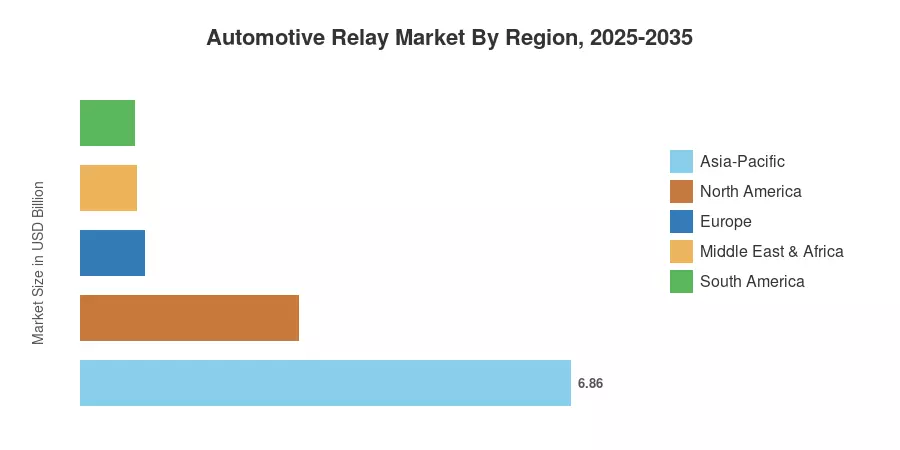
Asia-Pacific commands the largest share of the Automotive Relay Market at approximately 45% of global revenue, anchored by China's dominance in both vehicle production and EV adoption. The region also posts the fastest CAGR at 6.8%, propelled by India's Production-Linked Incentive scheme for automotive electronics and Japan's established relay manufacturing base. Europe holds the second-largest regional share at roughly 25%, driven by the EU's stringent CO₂ fleet-emission standards. The decade ahead will be defined by voltage architecture transitions and the integration of intelligent relay management into vehicle software platforms.

Key Report Takeaways

• By Type

  • PCB relays account for the largest type-level share within the Automotive Relay Market, exceeding 28% of 2025 revenue, driven by their compact form factor for body-electronics modules.
  • High-voltage relays represent the fastest-growing type segment with a projected CAGR of 8.4% through 2035, tied directly to EV battery-pack switching requirements.

• By Application

  • Powertrain systems constitute the highest-value application in the Automotive Relay Market, reflecting the relay-intensive nature of engine/motor management and transmission control.
  • Safety systems are expanding rapidly as ADAS mandates increase the electronic actuator count per vehicle across all major regulatory regions.

• By Region

  • Asia-Pacific leads the Automotive Relay Market with a 45% revenue share, supported by annual vehicle production exceeding 50 million units in the region.
  • North America contributes roughly 20% of global value, with growth anchored by the Inflation Reduction Act's EV manufacturing incentives.
  • Europe's Automotive Relay Market is projected to grow at a 5.9% CAGR, underpinned by Euro 7 emission standards and the 2035 ICE phase-out timeline.

Market Size and Forecast (2021–2035)

Market Research Future employs a bottom-up revenue model combining Tier-1 supplier shipment data, OEM procurement disclosures, and trade-flow analysis. Historical estimates (2021–2024) are cross-referenced with customs-level import/export databases, while forecast projections (2026–2035) integrate IEA global EV outlook scenarios and regional production schedules.
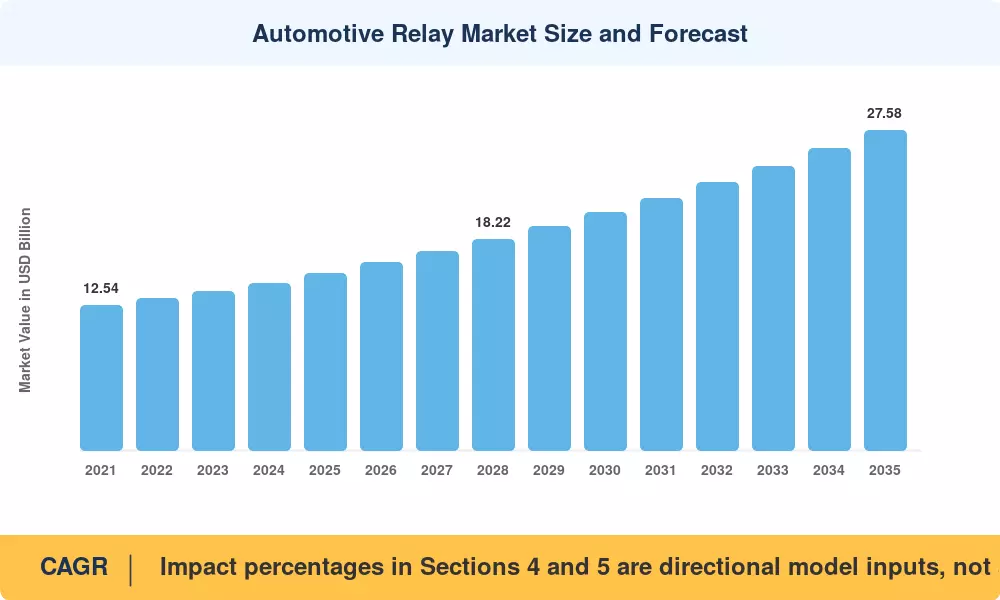
Automotive Relay Market Size and Forecast
Our Impact
Enabled $4.3B Revenue Impact for Fortune 500 and Leading Multinationals
Partnering with 2000+ Global Organizations Each Year
30K+ Citations by Top-Tier Firms in the Industry

Driver Impact Analysis

Driver ~% Impact on CAGR Geographic Relevance Impact Timeline
EV production ramp-up and 800 V architecture adoption ~22% Global Medium-term (2–4 yr)
ADAS and safety-system mandates ~20% EU, US, Japan Short-term (≤2 yr)
Rising per-vehicle electronic content ~18% Global Long-term (≥4 yr)
Infotainment and connected-vehicle proliferation ~14% North America, Asia-Pacific Medium-term
Government emission regulations (Euro 7, CAFE) ~12% EU, US Short-term
Commercial-vehicle electrification programs ~8% China, EU Medium-term
Aftermarket replacement cycle acceleration ~6% Global Long-term


EV Production Ramp-Up and High-Voltage Architecture

Battery-electric vehicles require a fundamentally different relay architecture than ICE platforms. A typical BEV uses a main contactor rated at 250 A or above, a pre-charge relay, and multiple auxiliary high-voltage relays for thermal management and DC-DC conversion. Global EV sales surpassed 14 million units in 2023 and are expected to reach 40 million by 2030, according to the IEA's Global EV Outlook [3]. Each incremental million EVs adds roughly USD 120 million in high-voltage relay demand to the Automotive Relay Market.

ADAS and Safety-System Mandates

Intelligent speed assistance, improved emergency braking, sleepiness recognition, and lane-keeping assistance are all required by the EU General Safety Regulation, which goes into force for all new cars in July 2024 [2]. Relay-controlled actuator networks are the foundation of each of these systems. Parallel demand is created in the US by the NHTSA's planned automatic emergency braking regulations and rear-visibility rule. Regardless of consumer choice cycles, these regulatory floors ensure baseline retail consumption growth.


Rising Per-Vehicle Electronic Content

The average electronic content per vehicle has grown from approximately USD 350 in 2015 to over USD 600 in 2024, driven by domain-controller architectures and zonal wiring harness designs [4]. Relays remain essential as the switching interface between low-voltage control signals and high-current loads across HVAC, seat adjustment, window lift, and mirror actuators. As vehicle platforms consolidate ECUs, the relay count per module actually increases to handle multiplexed load paths.

Infotainment and Connectivity Demand

Connected vehicles equipped with 5G telematics, over-the-air update modules, and multi-display infotainment require stable power distribution managed through relay switching circuits [5]. The global connected-car installed base is projected to exceed 500 million units by 2030, creating sustained aftermarket and OEM-fit relay demand within the Automotive Relay Market.

Restraints Impact Analysis

Restraint ~% Impact on CAGR Geographic Relevance Impact Timeline
Semiconductor-integrated smart switches are displacing relays –0.6% Global Long-term (≥4 yr)
Supply-chain disruptions for silver-alloy contact materials –0.4% Global Short-term (≤2 yr)
Price pressure from Chinese low-cost relay manufacturers –0.3% Asia-Pacific, South America Medium-term
Vehicle production slowdowns in key markets –0.3% EU, North America Short-term
Weight-reduction engineering limiting relay count –0.2% Global Long-term


Semiconductor-Based Smart Switches

In body-control modules, low-current electromechanical relays are gradually being replaced by intelligent semiconductor switches (MOSFETs, solid-state power controllers). Automotive-grade smart high-side switches with a 40 A rating have been introduced by Infineon and STMicroelectronics [9]. Relay volume in the 5 A–15 A segment may eventually decline due to ongoing die-shrink and cost reduction, even if these devices are currently unable to meet the high-current loads handled by plug-in or high-voltage relays.


Silver-Alloy Contact Material Constraints

Automotive relay contacts depend on silver-cadmium-oxide and silver-tin-oxide alloys. Silver price volatility — the metal traded between USD 22 and USD 32 per troy ounce across 2023–2024 — directly impacts relay manufacturing margins [10]. The EU's REACH restrictions on cadmium compounds add reformulation costs for European relay producers within the Automotive Relay Market.

Pricing Pressure from Low-Cost Producers

Chinese relay manufacturers such as Hongfa Technology and Sanyou have expanded capacity aggressively, offering PCB relays at price points 20–30% below Japanese and European incumbents [11]. This margin compression limits R&D reinvestment for higher-end relay development and reshapes competitive dynamics in the price-sensitive ASEAN and South American vehicle assembly markets.

Automotive Relay Market Opportunities

800 V Battery Architecture Transition

The migration from 400 V to 800 V EV platforms — led by Hyundai E-GMP, Porsche PPE, and GM Ultium — demands relays with higher arc-suppression capability and wider creepage distances. Suppliers that qualify 800 V-rated contactors early will capture premium ASPs of USD 15–25 per unit versus USD 5–8 for conventional relays.

Aftermarket Relay Replacement in Aging Vehicle Fleets

The average age of vehicles on U.S. roads reached 12.6 years in 2024. Aging electrical systems drive relay failure rates upward, creating a steady aftermarket channel for the Automotive Relay Market worth an estimated USD 2.1 billion globally. Distributors offering relay diagnostic kits bundled with replacement units can capture incremental margin.

Emerging-Market Vehicle Production Expansion

India's automotive production is forecast to reach 7 million units annually by 2030, supported by the PLI scheme allocating INR 259 billion for automotive and auto-component manufacturing [15]. Southeast Asian assembly hubs in Thailand, Indonesia, and Vietnam present greenfield relay supply opportunities as Japanese and Korean OEMs localize EV production.

Predictive Relay Health Monitoring

Integration of current-sensing ICs with relay modules enables condition-based maintenance in fleet vehicles. This data-monetization model allows relay suppliers to offer monitoring-as-a-service contracts to commercial fleet operators, shifting revenue from one-time component sales to recurring subscriptions.

Commercial-Vehicle Electrification

Relay topologies larger than 500 A are needed for charging-inlet switching and battery disconnect in electric buses and medium-duty trucks. The Automotive Relay Market has a high-growth adjacent vertical in China, the EU, and India through municipal electric-bus procurement schemes.


Automotive Relay Market Future Outlook

Electrification Supercycle and Voltage Architecture Evolution

The transition from 400 V to 800 V and eventually 1,200 V battery architectures will redefine relay specifications through the next decade. The IEA projects global EV stock will exceed 250 million vehicles by 2035 under stated policies [3]. Each voltage-class upgrade demands relays with tighter arc-management, higher creepage-distance ratings, and ceramic insulation — pushing ASPs upward even as unit volumes grow. The Automotive Relay Market will see a structural mix shift toward premium high-voltage products.

Autonomous Driving and Software-Defined Vehicles

As Level 3 and Level 4 autonomous functions move from pilot programs to series production, redundant power-distribution architectures become non-negotiable. Dual-relay safety paths for steering, braking, and perception-system power will roughly double the relay content in autonomous-capable vehicles. McKinsey estimates the software-defined vehicle market will reach USD 640 billion by 2030 [19], and relay suppliers that integrate CAN/LIN communication into their modules will capture design wins in zonal controller platforms.

ESG and Sustainability-Driven Product Redesign

Relay manufacturers are being pressured by environmental reporting standards, such as the EU Corporate Sustainability Reporting Directive, to measure and lower Scope 3 emissions in their automotive supply chains [20]. This increases the need for recyclable housing polymers, lead-free solder processes, and contact materials devoid of cadmium. OEM sourcing decisions in the automotive relay market will give preference to suppliers who have demonstrated low-carbon manufacture.


Smart Grid Integration and Vehicle-to-Grid Relays

Bidirectional charging standards (ISO 15118-20) enable vehicle-to-grid energy flows that require additional relay switching capacity on the vehicle side [21]. As V2G programs scale — the U.S. DOE has funded over USD 60 Million in V2G pilot projects — a new relay sub-category (bidirectional DC contactors rated for 10,000+ switching cycles) will emerge, adding an incremental revenue layer to the Automotive Relay Market through 2035.

Automotive Relay Market Segmentation

By Type

Segment Key Metric Primary Demand Driver
PCB Relays ~28% share (2025) Body-electronics integration, compact design
Plug-in Relays USD 2.90 Billion (2025) Legacy powertrain and HVAC switching
High-voltage Relays CAGR of 8.4% BEV battery-pack main contactors
Protective Relays ~10% share (2025) Overcurrent and thermal fault protection
Signal Relays CAGR of 5.3% Sensor-network signal routing
Time Relays USD 0.58 Billion (2025) Delayed-start accessory circuits


PCB relays command the broadest application base in the Automotive Relay Market, embedded across body-control modules, wiper systems, and seat-adjustment circuits. Their low profile and surface-mount compatibility align with the industry's push toward integrated electronic assemblies. High-voltage relays, while representing a smaller absolute share today, are the clear growth story — every BEV requires at least two high-voltage contactors for the main battery circuit, and 800 V platforms push the requirement to three or four per vehicle. Tier-1 suppliers, including TE Connectivity, Panasonic, and Omron, have each introduced next-generation high-voltage relay product lines targeting 500 A continuous ratings.

By Application Type

Segment Key Metric Primary Demand Driver
Powertrain Systems ~34% share (2025) Engine/motor management relay clusters
Safety Systems CAGR of 7.1% ADAS actuator and airbag control
Convenience Systems USD 2.59 Billion (2025) Power windows, mirrors, and seat adjusters
Lighting Systems ~14% share (2025) LED driver switching, adaptive headlamps


Powertrain systems represent the single largest application category in the Automotive Relay Market, covering starter relays in ICE vehicles and main contactors plus pre-charge relays in EVs. Safety systems are gaining share rapidly as regulatory mandates expand the electronic actuator footprint per vehicle, from ABS pump relays to autonomous emergency braking power-management circuits.

By Ampere Rating

Segment Key Metric Primary Demand Driver
5A–15A ~40% share (2025) Signal and low-current body electronics
16A–35A CAGR of 6.4% Mid-current HVAC and window motors
36A & Above USD 3.36 Billion (2025) High-current powertrain and EV contactors


The 5A–15A rating band dominates on a unit-volume basis but carries the lowest ASP. The 36A-and-above segment delivers the highest revenue contribution per unit, driven by EV main contactors and heavy-duty commercial-vehicle relays. Growth in this high-ampere band closely tracks the electrification trajectory of the Automotive Relay Market.

By Vehicle Type

Segment Key Metric Primary Demand Driver
Passenger Cars ~78% share (2025) Volume-driven relay consumption
Commercial Vehicles CAGR of 6.8% Fleet electrification, higher per-vehicle relay content


By Electric Vehicle Relay Type

Segment Key Metric Primary Demand Driver
Main Relay ~38% of EV relay revenue Battery-pack disconnect function
Pre-charge Relay CAGR of 9.2% Inrush-current protection for inverters
Normal Relay USD 0.72 Billion (2025) Auxiliary 12 V circuit switching in EVs
Others ~8% of EV relay revenue Charging-inlet, V2G, thermal management


Pre-charge relays are the fastest-growing EV relay subtype within the Automotive Relay Market, essential for limiting capacitor inrush current before the main contactor closes. As battery capacities push beyond 100 kWh in premium EVs, pre-charge relay specifications tighten, favoring suppliers with advanced contact-welding detection and hermetically sealed housings.

Regional Market Share Analysis

Region Key Metric Primary Investment Themes
Asia-Pacific ~45% revenue share (2025) EV production scale, localization mandates
Europe CAGR of 5.9% (2026–2035) Euro 7, 2035 ICE phase-out, ADAS compliance
North America USD 3.05 Billion (2025) IRA incentives, pickup/SUV electrification
South America ~5% revenue share CKD assembly growth, aftermarket demand
Middle East & Africa CAGR of 5.1% (2026–2035) Saudi Vision 2030, South Africa auto hubs
Total USD 15.25 Billion (2025)

The Automotive Relay Market exhibits strong regional concentration in Asia-Pacific, reflecting the region's dominance in both vehicle assembly and EV adoption. Europe and North America follow as mature, regulation-driven markets with high relay content per vehicle.


North America

Country Key Metric Key Driver
United States ~72% of regional share EV tax credits under IRA Section 30D
Canada CAGR of 6.3% ZEV mandate in Quebec and British Columbia
Mexico USD 0.27 Billion (2025) Nearshoring of Tier-1 relay assembly


The United States dominates North America's Automotive Relay Market, driven by the Inflation Reduction Act's consumer and manufacturing incentives that have catalyzed over USD 120 billion in announced EV and battery facility investments since 2022 [16]. Mexico's role as a cost-competitive Tier-1 manufacturing hub is expanding as relay producers establish maquiladora operations to serve both domestic assembly and U.S. cross-border supply chains.

Europe

Country Key Metric Key Driver
Germany ~30% of regional share Premium OEM relay content (BMW, Mercedes, VW)
United Kingdom CAGR of 5.7% 2035 petrol/diesel ban driving EV relay demand
France USD 0.41 Billion (2025) Renault and Stellantis EV platform ramps
Italy ~9% of regional share Stellantis Mirafiori EV production
Spain CAGR of 5.5% SEAT/CUPRA EV assembly in Martorell
Nordic Countries ~7% of regional share High BEV penetration (Norway >80% new-car share)
Russia USD 0.14 Billion (2025) Limited by sanctions, domestic substitution efforts
Rest of Europe CAGR of 5.3% Eastern EU auto-component sourcing


Germany anchors Europe's position in the Automotive Relay Market through its concentration of premium OEMs and Tier-1 suppliers, with Bosch, Continental, and Hella maintaining relay R&D centers in the country. The EU's Fit for 55 package and the 2035 combustion-engine phase-out timeline ensure sustained demand growth for high-voltage EV relays across the continent [6].

Asia-Pacific

Country Key Metric Key Driver
China ~52% of regional share World's largest EV market, domestic relay champions
India CAGR of 7.6% PLI scheme, rising domestic vehicle production
Japan USD 1.10 Billion (2025) Panasonic, Omron — established relay manufacturing
South Korea ~10% of regional share Hyundai/Kia EV platforms, 800 V architecture
ASEAN CAGR of 7.2% Thailand EV incentives, Indonesia nickel-linked EV plans
Rest of Asia-Pacific ~4% of regional share Australia EV transition, emerging CKD markets


China's role in the Automotive Relay Market extends beyond vehicle production volume; the country hosts major relay manufacturers, including Hongfa Technology and Sanyou, which together supply a significant share of global PCB and plug-in relays [11]. India's trajectory stands out as the fastest-growing country-level opportunity, with domestic vehicle output projected to nearly double by 2035 under the PLI framework [15].

South America

Country Key Metric Key Driver
Brazil ~62% of regional share Flex-fuel fleet electrification, local assembly
Argentina CAGR of 5.4% Lithium resources supporting the EV ecosystem
Rest of South America USD 0.14 Billion (2025) CKD assembly, aftermarket relay imports


Brazil leads South America's Automotive Relay Market through its established automotive assembly base, producing over 2.3 million vehicles annually. The government's Rota 2030 program provides fiscal incentives for manufacturers investing in energy-efficient technologies, creating pull-through demand for upgraded relay systems in hybrid and flex-fuel platforms [17].

Middle East & Africa

Country Key Metric Key Driver
Saudi Arabia ~33% of regional share Vision 2030 EV localization targets
UAE CAGR of 5.8% Dubai Green Mobility Strategy
South Africa USD 0.16 Billion (2025) Automotive Investment Scheme, CKD relay supply
Egypt ~12% of regional share Expanding domestic assembly (El Nasr Automotive)
Rest of MEA CAGR of 4.7% Limited but growing aftermarket demand


Saudi Arabia's ambition to localize 50% of vehicle value by 2030 under Vision 2030 is attracting relay component investments from global suppliers, establishing JVs with local industrial groups [18]. South Africa's well-established automotive corridor — anchored by BMW, Toyota, and Ford assembly plants — sustains steady relay demand within the broader Automotive Relay Market for the region.

Automotive Relay Market By Region, 2025-2035

Competitive Benchmarking

The Automotive Relay Market exhibits moderately high concentration, with an estimated HHI of approximately 1,100, and the top five players commanding a combined revenue share in the range of 48–55%. Japanese and European incumbents lead on technology and OEM qualification, while Chinese manufacturers compete aggressively on price and scale. Strategic activity centers on high-voltage relay development, capacity expansion in Asia, and M&A to consolidate niche technology portfolios.

Company Est. Revenue Share Range Key Offerings for the Automotive Relay Market Strategic Positioning
TE Connectivity ~10–13% High-voltage EV contactors, PCB relays, signal relays Global footprint, strong Tier-1 OEM relationships
Panasonic Industry ~9–12% Compact PCB relays, EV main contactors, HV relay modules Vertically integrated, emphasis on miniaturization
Omron Corporation ~8–11% Automotive micro-relays, HV DC relays, safety relays R&D-driven, broad sensing-and-relay ecosystem
Robert Bosch GmbH ~7–10% Integrated relay modules, powertrain relays Systems-level integration with ECU platforms
Denso Corporation ~6–9% Thermal-management relays, powertrain contactors Tight Toyota supply-chain alignment
FORVIA Hella ~4–6% Lighting relays, body-electronic relay modules European premium OEM tier, lighting specialist
Fujitsu Component ~3–5% Signal relays, telecom-grade automotive relays Precision miniature relay technology
Hongfa Technology ~5–7% Low-cost PCB relays, plug-in relays, EV relays Chinese cost leader, rapidly expanding global sales
Song Chuan Precision ~2–4% General-purpose automotive relays, power relays Taiwan-based, price-competitive for Tier-2 supply
American Zettler (Ametek) ~2–3% Miniature relays, HVAC relays, power relays Niche focuses on climate-control applications


Recent News & Developments

  • TE Connectivity (March 2025): Launched a 900 V-rated hermetically sealed EV contactor targeting 800 V battery platforms, with initial design wins at two European OEMs [22].
  • Panasonic Industry (January 2025): Opened a dedicated high-voltage relay production line at its Kasai, Japan, facility, adding 15 million units of annual capacity to serve the Automotive Relay Market [23].
  • Omron Corporation (October 2024): Announced a joint development agreement with a major German OEM for next-generation redundant safety relays designed for Level 3 autonomous vehicles [24].
  • Hongfa Technology (July 2024): Completed construction of a new relay manufacturing campus in Xiamen, China, doubling its annual output to 2.5 billion units across automotive and industrial segments [11].
  • European Commission (July 2024): Enforced the EU General Safety Regulation for all new vehicles, mandating ADAS features that increase per-vehicle relay demand by an estimated 15–20% [2].
  • NHTSA (September 2023): Proposed a rule requiring automatic emergency braking on all new light vehicles by 2029, expanding relay-controlled actuator content in the U.S. fleet [2].
  • Denso Corporation (June 2023): Secured a USD 180 million supply contract for thermal-management relays supporting Toyota's next-generation BEV platform [25].

Automotive Relay Market Report Scope

Parameter Detail
Market Scope Global Automotive Relay Market covering OEM-fit and aftermarket channels
Study Period 2021–2035
CAGR 6.1% (2026–2035)
Market Size — Base Year (2025) USD 15.25 Billion
Market Size — Forecast Endpoint (2035) USD 27.58 Billion
Fastest Growing Segment High-voltage Relays (by Type); Pre-charge Relay (by EV Relay Type)
Companies Profiled 10 (TE Connectivity, Panasonic, Omron, Bosch, Denso, FORVIA Hella, Fujitsu, Hongfa, Song Chuan, American Zettler)
Valuation Currency USD Billion
CAGR Driver Disclaimer Impact percentages in Sections 4 and 5 are directional model inputs, not additive components of the stated CAGR


FAQs

What relay qualification standards should procurement teams require from suppliers?
Look for AEC-Q200 qualification (passive components) and IATF 16949 certification on the supplier's relay manufacturing site. These ensure the relay meets automotive-grade thermal cycling, vibration, and endurance thresholds [13].
How does the shift to zonal vehicle architecture affect relay selection?
Zonal architectures consolidate wiring into fewer high-current nodes, increasing the ampere rating needed per relay position. Buyers should specify relays rated 20–30% above nominal load to accommodate multiplexed switching demands [4].
What is the typical lifespan difference between electromechanical and solid-state alternatives in automotive applications?
Electromechanical relays typically last 100,000–300,000 switching cycles, while solid-state alternatives exceed one million cycles due to the absence of mechanical wear. The trade-off is higher heat generation in solid-state devices [9].
Which raw material price fluctuations most affect relay costs?
Silver and copper dominate relay contact and coil costs, respectively. A 10% rise in silver spot prices can increase relay unit cost by 3–5%, making commodity hedging essential for volume buyers [10].
Are there relay-specific cybersecurity considerations for connected vehicles?
Relay control signals routed through CAN bus networks are vulnerable to spoofing attacks that could trigger unintended load switching. Suppliers now embed authentication protocols in relay driver ICs to mitigate this risk [19].
How do extreme-temperature environments affect relay performance in commercial EVs?
High-voltage EV relays in commercial applications must sustain operation from –40°C to +125°C. Hermetically sealed gas-filled housings prevent contact oxidation and arc degradation under these thermal extremes [22].
What role do relays play in vehicle-to-grid bidirectional charging systems?
V2G systems require dedicated bidirectional DC contactors rated for high cycle counts to manage energy flow reversal between the battery and grid. This represents an emerging relay category beyond standard EV relay architectures [21].    
Author
Author
Author Profile
Triveni Bhoyar LinkedIn
Senior Research Analyst
Triveni Bhoyar has over 5 years of experience in the market research industry, specializing in the Automotive and Aerospace & Defense sectors. She has contributed to 200+ reports, including numerous custom projects for leading global companies, delivering solutions to complex business challenges. Renowned for her ability to generate valuable insights, Triveni excels in addressing unique market dynamics with precision and depth. Her expertise spans market sizing, competitive intelligence, and trend analysis, enabling clients to craft data-driven growth strategies. With strong analytical rigor and a client-centric approach, she plays a pivotal role in driving impactful, strategic decision-making.
Co-Author
Co-Author Profile
Swapnil Palwe LinkedIn
Team Lead - Research
With a technical background as Bachelor's in Mechanical Engineering, with MBA in Operations Management , Swapnil has 6+ years of experience in market research, consulting and analytics with the tasks of data mining, analysis, and project execution. He is the POC for our clients, for their consulting projects running under the Automotive/A&D domain. Swapnil has worked on major projects in verticals such as Aerospace & Defense, Automotive and many other domain projects. He has worked on projects for fortune 500 companies' syndicate and consulting projects along with several government projects.

Research Approach


Secondary Research

The secondary research process involved comprehensive analysis of regulatory databases, automotive engineering publications, technical standards, and authoritative industry organizations. Key sources included the National Highway Traffic Safety Administration (NHTSA), U.S. Department of Transportation (DOT), Environmental Protection Agency (EPA), European Automobile Manufacturers Association (ACEA), Society of Automotive Engineers (SAE International), International Organization of Motor Vehicle Manufacturers (OICA), Automotive Industry Action Group (AIAG), International Electrotechnical Commission (IEC), IEEE Xplore Digital Library, Organisation for Economic Co-operation and Development (OECD) Transport Statistics, IEA Global EV Outlook, China Association of Automobile Manufacturers (CAAM), Japan Automobile Manufacturers Association (JAMA), German Association of the Automotive Industry (VDA), and national motor vehicle registries from key markets.

Data on vehicle production, certifications for safety standards, trends in electrification adoption, and supply chain analysis for PCB relays, high-voltage relays, and plug-in relay technologies were gathered from various sources. This information was applicable to both conventional and electric vehicle platforms.


Primary Research

To gather both qualitative and quantitative information, the primary research process involved interviewing players from both the supply and demand sides. CEOs, VPs of engineering, chiefs of product development, and regulatory compliance officers from automotive relay and component suppliers were among the supply-side sources. The demand side included procurement directors from Tier 1 automotive suppliers, electrical system architects from OEMs, research and development chiefs from electric vehicle divisions, and fleet management technology purchasers. The suppliers included Bosch, Denso, and Continental. The OEMs included Ford, Volkswagen, Toyota, and BYD. Through primary research, we were able to confirm the integration timescales of EV platforms, validate the segmentation of relays across different types of loads, and gain insights into the adoption of solid-state relays, thermal management requirements, and pricing dynamics in the supply chain.

Primary Respondent Breakdown:

By Designation: C-level Primaries (32%), Director Level (31%), Others (37%)

By Region: North America (32%), Europe (30%), Asia-Pacific (28%), Rest of World (10%)


Market Size Estimation

Global market valuation was derived through revenue mapping and vehicle production volume analysis. The methodology included:

Identification of 50+ key relay manufacturers across North America, Europe, Asia-Pacific, and Latin America

Product mapping across PCB relays, plug-in relays, high-voltage relays, protective relays, and time-delay relay categories

Analysis of reported and modeled annual revenues specific to automotive relay portfolios, including EV-specific high-voltage variants

Coverage of manufacturers representing 75-80% of global market share in 2024

Extrapolation using bottom-up (vehicle production volume × average relay count per vehicle × ASP by region) and top-down (manufacturer revenue validation and TAM/SAM/SOM analysis) approaches to derive segment-specific valuations for internal combustion engine vehicles, hybrid electric vehicles, and battery electric vehicle relay requirements

Download Free Sample

Kindly complete the form below to receive a free sample of this Report

Download PDF ×

We do not share your information with anyone. However, we may send you emails based on your report interest from time to time. You may contact us at any time to opt-out.
















