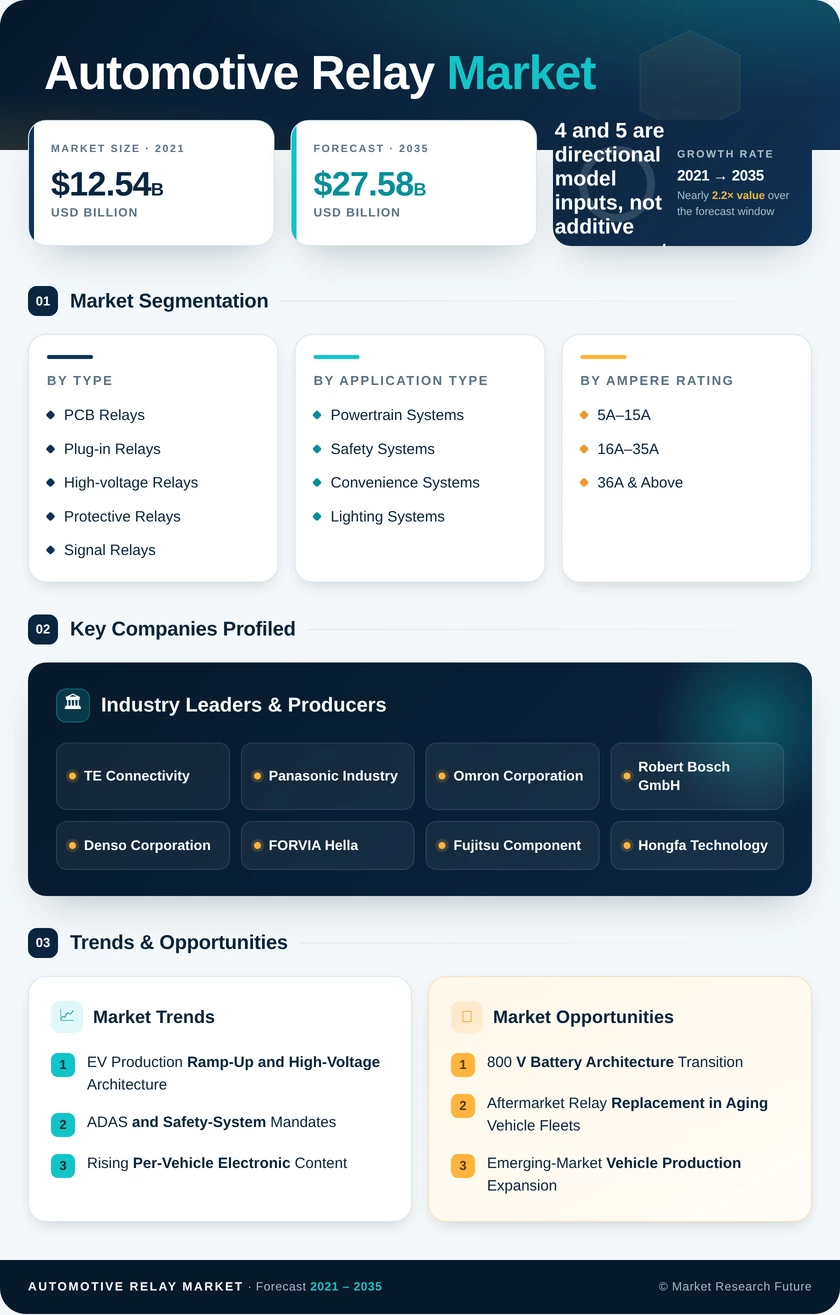
Segmentation Quick Reference
| Dimension | Sub-Segments | Dominant Segment | Fastest Growing Segment |
| By Type | PCB Relays, Plug-in Relays, High-voltage Relays, Protective Relays, Signal Relays, Time Relays | PCB Relays | High-voltage Relays |
| By Application Type | Powertrain Systems, Safety Systems, Convenience Systems, Lighting Systems | Powertrain Systems | Safety Systems |
| By Ampere Rating | 5A–15A, 16A–35A, 36A & Above | 5A–15A | 36A & Above |
| By Vehicle Type | Passenger Cars, Commercial Vehicles | Passenger Cars | Commercial Vehicles |
| By Electric Vehicle Relay Type | Main Relay, Pre-charge Relay, Normal Relay, Others | Main Relay | Pre-charge Relay |
Market Segmentation Overview
By Type
| Sub-Segment | Key Trend |
| PCB Relays | Surface-mount integration into compact body-control module PCBs |
| Plug-in Relays | Steady demand in legacy powertrain and HVAC applications |
| High-voltage Relays | Rapid growth driven by 400 V / 800 V BEV battery switching |
| Protective Relays | Increasing specification rigor for overcurrent and thermal protection |
| Signal Relays | Expanding sensor-network routing in ADAS-equipped vehicles |
| Time Relays | Niche application in delayed-start accessory and timer circuits |
PCB relays remain the volume backbone of automotive relay consumption, while high-voltage relays capture the highest growth trajectory as the global fleet electrifies. The technology gap between these segments is widening, with high-voltage products commanding 3–4× the ASP of standard PCB relays.
By Application Type
| Sub-Segment | Key Trend |
| Powertrain Systems | EV main contactors and pre-charge relays replacing legacy starter relays |
| Safety Systems | ADAS mandate compliance expanding actuator relay count per vehicle |
| Convenience Systems | Power-seat, window, and mirror relay demand tracking vehicle feature content |
| Lighting Systems | LED and adaptive headlamp driver switching are growing with premium trims |
Powertrain and safety applications together account for over half of global relay revenue. The shift toward EVs is restructuring powertrain relay demand from simple starter circuits to complex multi-relay high-voltage networks.
By Ampere Rating
| Sub-Segment | Key Trend |
| 5A–15A | Dominant unit volume; low ASP; body-electronics focus |
| 16A–35A | Mid-range growth from HVAC blower and window-motor switching |
| 36A & Above | Highest revenue per unit: EV contactors and heavy-duty applications |
The 36A-and-above segment benefits from the electrification tailwind, as EV main contactors require sustained current ratings well beyond conventional automotive relay ranges.
By Vehicle Type
| Sub-Segment | Key Trend |
| Passenger Cars | Volume-driven demand; rising electronic content per model year |
| Commercial Vehicles | Higher per-vehicle relay content; fleet electrification programs are accelerating |
Passenger cars generate the majority of relay unit shipments, but commercial vehicles deliver disproportionately high revenue per platform due to redundant power-distribution requirements and harsher operating environments.
By Electric Vehicle Relay Type
| Sub-Segment | Key Trend |
| Main Relay | Core battery-disconnect function; essential in every BEV and PHEV |
| Pre-charge Relay | Fastest growth; critical for inrush-current protection in high-capacity packs |
| Normal Relay | Auxiliary 12 V subsystem switching within EV platforms |
| Others | Emerging V2G, charging-inlet, and thermal-management relay applications |
The EV relay sub-segment is the most dynamic dimension of the market, with pre-charge relays expected to see the steepest demand curve as battery pack capacities grow and 800 V architectures proliferate through 2035.