Protein Stability Analysis Market Summary
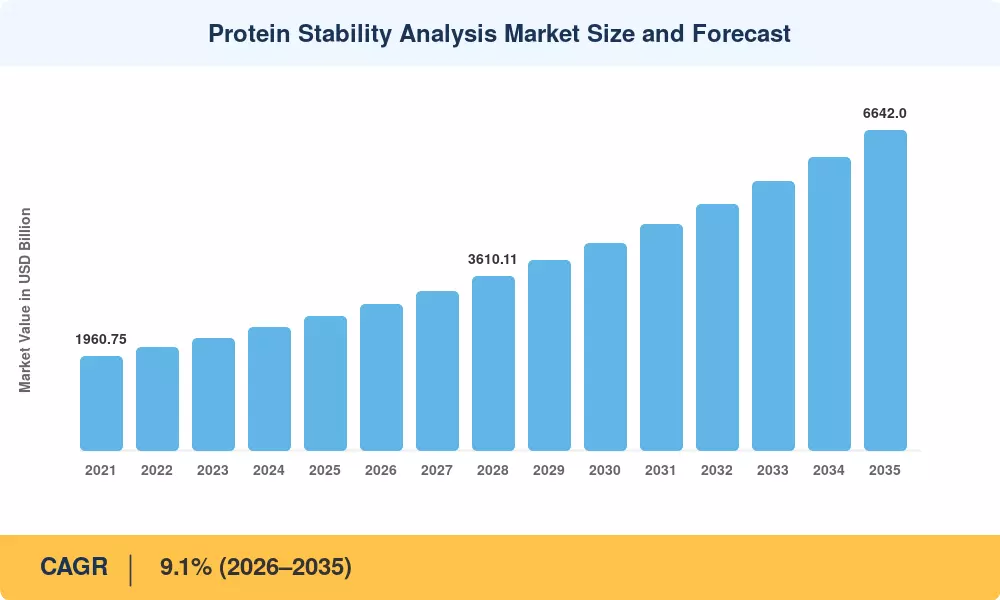
The Global Protein Stability Analysis Market size was valued at USD 2,780 Million in 2025, and the market is projected to grow from USD 3,033 Million in 2026 to USD 6,642 Million by 2035, registering a CAGR of 9.1% during the forecast period 2026–2035. Two forces are accelerating demand: the global biologics pipeline — which exceeded 8,000 active molecules in late 2024 according to the Biotechnology Innovation Organization [2] — and tightening regulatory expectations from the FDA and EMA around forced degradation and comparability studies for biosimilars. The protein stability analysis market sits at the intersection of drug safety and commercial viability, making it indispensable for any company pursuing biologic or biosimilar approvals.
A generational shift in analytical technology is reshaping how sponsors characterize protein therapeutics. Legacy batch-mode calorimetry and manual aggregation counting are giving way to high-throughput, multiplexed platforms that combine differential scanning fluorimetry, dynamic light scattering, and automated imaging in a single run. Biopharmaceutical R&D spending surpassed USD 260 billion globally in 2024 [3], and a growing share of that budget flows directly into formulation screening tools that shorten candidate selection from months to weeks.
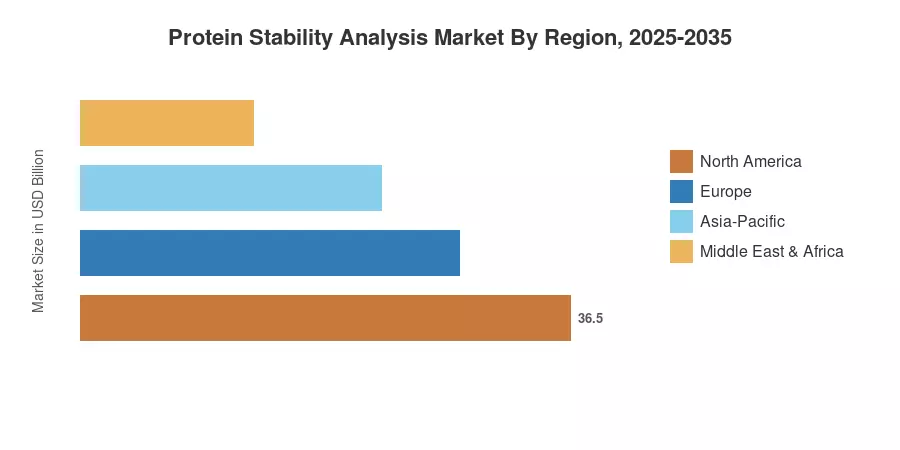
North America commands roughly 38% of the protein stability analysis market, driven by the concentration of top-20 pharma headquarters and NIH-funded academic proteomics centers. Asia-Pacific is the fastest-growing region with an estimated CAGR of 11.2%, propelled by contract research organization (CRO) expansion in China and India. Europe holds the second-largest share at approximately 28%, anchored by EMA biosimilar guidance that mandates rigorous stability comparability data. As biologics move toward personalized dosing and subcutaneous self-administration formats, demand for stability characterization will only intensify through 2035.
Key Report Takeaways — Protein Stability Analysis Market
By Product Type
- Instruments accounted for roughly 44% of the protein stability analysis market in 2025, reflecting capital investment in next-generation calorimeters and light-scattering platforms.
- Reagents & consumables are projected to register a CAGR of 10.3% through 2035, driven by recurring purchase cycles in high-throughput screening labs.
- Software & services generated approximately USD 530 million in 2025 as cloud-based data analytics gained traction among CROs.
By Application
- Biopharmaceutical development represents the dominant application segment, contributing an estimated 52% share of the protein stability analysis market.
- Quality control applications are expected to grow at a CAGR of 9.8% as post-approval lifecycle management programs expand.
By Region
- North America held the largest share of the protein stability analysis market in 2025 at approximately 38%.
- Asia-Pacific is forecast to register the highest CAGR of 11.2%, supported by rapid CRO infrastructure build-out.
- Europe contributed an estimated USD 778 million in 2025, reinforced by the EU's progressive biosimilar regulatory framework.
Protein Stability Analysis Market Size and Forecast (2021–2035)
Market sizing integrates bottom-up revenue analysis from instrument OEMs, reagent suppliers, and service providers with top-down cross-referencing against pharmaceutical R&D expenditure ratios and regulatory filing volumes. Historical figures (2021–2024) draw on company annual reports and trade association data; forecast values (2026–2035) apply a 9.1% CAGR validated against therapeutic pipeline growth rates and capital equipment replacement cycles[3].