×
Request Free Sample ×

Kindly complete the form below to receive a free sample of this Report

* Please use a valid business email

Leading companies partner with us for data-driven Insights

clients tt-cursor
Hero Background

Public Safety Analytics Market

ID: MRFR/ICT/5233-HCR
100 Pages
Shubham Munde
February 2026

Public Safety Analytics Market Research Report Information By Component (Solution, Services), By Analytics Type (Predictive, Prescriptive, Descriptive), By Deployment Type (On-Premise, Cloud), By Application (Pattern Recognition, Incident Detection, Person of Interest Screening, Surveillance), And By Region (North America, Europe, Asia-Pacific, And Rest Of The World) –Market Forecast Till 2035.

Share:
Download PDF ×

We do not share your information with anyone. However, we may send you emails based on your report interest from time to time. You may contact us at any time to opt-out.

Public Safety Analytics Market Infographic
Purchase Options

Public Safety Analytics Market Summary

As per Market Research Future analysis, the Public Safety Analytics Market Size was estimated at 8.29 USD Billion in 2024. The Public Safety Analytics industry is projected to grow from 9.482 USD Billion in 2025 to 36.35 USD Billion by 2035, exhibiting a compound annual growth rate (CAGR) of 14.38% during the forecast period 2025 - 2035

Key Market Trends & Highlights

The Public Safety Analytics Market is experiencing robust growth driven by technological advancements and increasing demand for real-time data solutions.

  • The integration of Artificial Intelligence is transforming public safety analytics, enhancing predictive capabilities.
  • North America remains the largest market, while the Asia-Pacific region is emerging as the fastest-growing area for public safety solutions.
  • Solutions dominate the market, yet services are rapidly gaining traction as organizations seek comprehensive support.
  • Rising crime rates and government initiatives are key drivers propelling the demand for advanced public safety analytics.

Market Size & Forecast

2024 Market Size 8.29 (USD Billion)
2035 Market Size 36.35 (USD Billion)
CAGR (2025 - 2035) 14.38%

Major Players

Palantir Technologies (US), IBM (US), Microsoft (US), SAS Institute (US), Oracle (US), Esri (US), Motorola Solutions (US), Verisk Analytics (US), Tyler Technologies (US), Axon Enterprise (US)

Our Impact
Enabled $4.3B Revenue Impact for Fortune 500 and Leading Multinationals
Partnering with 2000+ Global Organizations Each Year
30K+ Citations by Top-Tier Firms in the Industry

Public Safety Analytics Market Trends

The Public Safety Analytics Market is currently experiencing a transformative phase, driven by advancements in technology and an increasing emphasis on data-driven decision-making. Organizations across various sectors are recognizing the value of analytics in enhancing public safety measures. This market encompasses a wide range of applications, including crime prediction, emergency response optimization, and resource allocation. As stakeholders seek to improve operational efficiency and effectiveness, the integration of artificial intelligence and machine learning into public safety strategies appears to be gaining traction. Furthermore, the growing demand for real-time data analysis is likely to shape the future landscape of this market, as agencies strive to respond swiftly to emerging threats and challenges.

In addition to technological advancements, regulatory frameworks and public expectations are evolving, which may further influence the Public Safety Analytics Market. Governments and law enforcement agencies are increasingly held accountable for their actions, necessitating transparency and accountability in their operations. This shift could lead to a greater reliance on analytics to provide insights into performance metrics and community engagement. As the market continues to develop, collaboration among various stakeholders, including technology providers, government entities, and community organizations, is essential to foster innovation and ensure that public safety analytics effectively address the needs of society.

Integration of Artificial Intelligence

The incorporation of artificial intelligence into public safety analytics is becoming more prevalent. This trend suggests that agencies are leveraging AI to enhance predictive capabilities, enabling them to anticipate incidents and allocate resources more effectively. AI-driven tools may facilitate improved decision-making processes, ultimately leading to safer communities.

Emphasis on Real-Time Data

There is a growing focus on the utilization of real-time data within the Public Safety Analytics Market. This trend indicates that organizations are prioritizing immediate access to information, which can significantly enhance response times during emergencies. The ability to analyze data as events unfold may prove crucial in mitigating risks and ensuring public safety.

Collaboration Among Stakeholders

The trend of collaboration among various stakeholders is gaining momentum in the Public Safety Analytics Market. This suggests that partnerships between technology providers, government agencies, and community organizations are essential for fostering innovation. Such collaborations may lead to the development of comprehensive solutions that address the multifaceted challenges of public safety.

Public Safety Analytics Market Drivers

Rising Crime Rates

The increasing incidence of crime across various regions appears to be a primary driver for the Public Safety Analytics Market. As urbanization continues to rise, cities face challenges related to crime management and prevention. According to recent statistics, certain metropolitan areas have reported a surge in violent crimes, prompting law enforcement agencies to seek advanced analytical tools. These tools enable the identification of crime hotspots and predictive policing, thereby enhancing resource allocation. The demand for effective crime analysis solutions is likely to escalate, as public safety remains a critical concern for governments and communities alike. Consequently, the Public Safety Analytics Market is expected to witness substantial growth as agencies invest in technologies that facilitate data-driven decision-making.

Technological Advancements

Technological innovations are significantly shaping the Public Safety Analytics Market. The advent of sophisticated data analytics tools, machine learning algorithms, and cloud computing has transformed how public safety agencies operate. These technologies allow for the processing of vast amounts of data in real-time, enabling quicker responses to incidents. For instance, the integration of Internet of Things (IoT) devices in surveillance systems has enhanced situational awareness for law enforcement. As agencies increasingly adopt these technologies, the market is projected to expand, with estimates suggesting a compound annual growth rate of over 20% in the coming years. This trend indicates a robust demand for advanced analytics solutions that can improve public safety outcomes.

Government Initiatives and Funding

Government initiatives aimed at enhancing public safety are driving the Public Safety Analytics Market. Various countries have recognized the need for improved safety measures and are allocating substantial budgets to support these initiatives. For example, recent government reports indicate that funding for public safety technology has increased by approximately 15% in the last fiscal year. This financial support is often directed towards the acquisition of analytics tools that assist in crime prevention and emergency response. As governments prioritize public safety, the demand for analytics solutions is likely to grow, fostering innovation and competition within the market. The Public Safety Analytics Market stands to benefit from these investments, as agencies seek to leverage data for more effective safety strategies.

Integration of Smart City Initiatives

The rise of smart city initiatives is a notable driver for the Public Safety Analytics Market. As cities strive to become more efficient and sustainable, the integration of technology into urban planning has become paramount. Smart city projects often incorporate advanced analytics to monitor public safety, traffic management, and emergency response systems. For instance, cities utilizing smart surveillance systems can analyze data to predict and prevent potential incidents. This integration not only enhances public safety but also optimizes resource allocation. The trend towards smart cities indicates a growing market for analytics solutions, as municipalities invest in technologies that support their safety objectives. The Public Safety Analytics Market is likely to thrive as these initiatives gain traction.

Public Awareness and Community Engagement

The growing awareness of public safety issues among citizens is influencing the Public Safety Analytics Market. Communities are increasingly demanding transparency and accountability from law enforcement agencies, which in turn drives the need for data analytics. Public engagement initiatives often require agencies to provide insights into crime trends and safety measures, necessitating the use of analytics tools. As citizens become more involved in safety discussions, the expectation for data-driven approaches to crime prevention rises. This trend suggests that the Public Safety Analytics Market will continue to evolve, as agencies seek to meet community expectations through enhanced data sharing and analytics capabilities.

Market Segment Insights

Public Safety Analytics Market Component Insights

The global public safety analytics market segmentation, based on components, includes solutions and services. Public safety analytics solutions typically consist of software platforms and applications that use data analytics, artificial intelligence, and machine learning techniques to analyze various data sources, such as video feeds, social media, sensor data, and emergency call data, to support law enforcement, emergency response teams, and other public safety agencies in their operations and decision-making processes.

On the other hand, services in the public safety analytics market may include consulting, implementation, integration, training, and support services offered by vendors to assist their customers in adopting and using the analytics solutions effectively.

Public Safety Analytics Market Analytical Type Insights

Based on analytical type, the global public safety analytics market segment includes predictive, prescriptive, and descriptive. The predictive segment in the market for public safety analytics is anticipated to grow at the fastest rate during the forecast period as a result of factors such as the rising adoption of machine learning and deep learning technologies across a variety of industries, the rising use of predictive analytics in armed forces, the growing vulnerability to cyberattacks, and other similar factors.

Researchers from the University of Chicago stated in 2022 that an AI algorithm could anticipate upcoming crimes with a week's notice and roughly 90% accuracy. Additionally, it noted that while fewer arrests were made in the city's less fortunate regions due to crime, more were made there. It was estimated using arrest data from regions with different socioeconomic levels.

Public Safety Analytics Market Deployment Type Insights

Based on deployment type, the global public safety analytics market segmentation includes on-premises and cloud. Cloud category offer greater scalability and flexibility than traditional on-premises deployments. Public safety agencies can easily scale up or down their computing resources based on their needs, ensuring efficient utilization of resources. Cloud solutions typically follow a subscription-based pricing model, allowing organizations to pay for the resources they use. This can be more cost-effective for many public safety agencies, especially smaller ones, as it reduces the upfront capital expenses associated with on-premises infrastructure.

Public Safety Analytics Market Application Insights

Based on application, the global public safety analytics market segmentation includes pattern recognition, incident detection, person of interest screening, and surveillance. It is anticipated that the person of interest screening segment will propel market expansion. The person of interest screening tool aids law enforcement and government organizations in finding the offender in criminal investigations. This application is used in various public facilities, including airports, railway stations, and institutional and governmental buildings.

Figure 2: Global Public Safety Analytics Market, by Service, 2022 & 2032 (USD Billion)

Get more detailed insights about Public Safety Analytics Market

Regional Insights

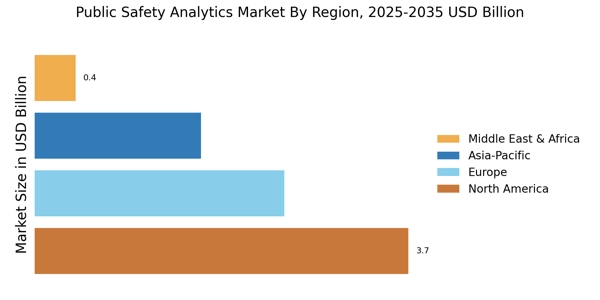
North America : Market Leader in Analytics

North America is the largest market for public safety analytics, holding approximately 45% of the global share. The region's growth is driven by increasing investments in smart city initiatives, rising crime rates, and the need for data-driven decision-making. Regulatory support from government agencies further catalyzes market expansion, as they emphasize the importance of public safety technologies in urban planning and emergency response. The United States is the leading country in this sector, with major players like Palantir Technologies, IBM, and Microsoft dominating the landscape. The competitive environment is characterized by continuous innovation and partnerships among technology firms and law enforcement agencies. Canada also plays a significant role, contributing to the market with its focus on public safety and community engagement initiatives.

Europe : Emerging Market Dynamics

Europe is witnessing a significant rise in the public safety analytics market, accounting for about 30% of the global share. The growth is fueled by stringent regulations on public safety and data protection, alongside increasing demand for integrated safety solutions. Countries are investing in advanced analytics to enhance emergency response and crime prevention strategies, supported by EU initiatives promoting smart technologies in urban areas. Leading countries in this region include the United Kingdom, Germany, and France, where local governments are actively collaborating with technology providers. Key players like IBM and Esri are establishing a strong presence, focusing on tailored solutions for law enforcement and public safety agencies. The competitive landscape is evolving, with startups also entering the market, driven by innovation and the need for customized analytics solutions.

Asia-Pacific : Rapid Growth and Adoption

Asia-Pacific is rapidly emerging as a significant player in the public safety analytics market, holding approximately 20% of the global share. The region's growth is driven by urbanization, increasing crime rates, and government initiatives aimed at enhancing public safety through technology. Countries are increasingly adopting analytics solutions to improve emergency response times and resource allocation, supported by favorable regulatory frameworks promoting smart city projects. China, India, and Japan are the leading countries in this market, with substantial investments in public safety technologies. The competitive landscape features both established players and new entrants, focusing on innovative solutions tailored to local needs. Companies like Motorola Solutions and Oracle are expanding their footprint, collaborating with governments to implement advanced analytics for public safety.

Middle East and Africa : Growing Focus on Safety

The Middle East and Africa region is gradually developing its public safety analytics market, currently holding about 5% of the global share. The growth is driven by increasing urbanization, rising security concerns, and government initiatives aimed at enhancing public safety. Countries are beginning to recognize the value of data analytics in crime prevention and emergency management, supported by investments in technology infrastructure and smart city initiatives. Leading countries in this region include the United Arab Emirates and South Africa, where governments are actively seeking partnerships with technology providers. The competitive landscape is characterized by a mix of local and international players, with companies like Verisk Analytics and Tyler Technologies making strides in the market. As awareness of public safety analytics grows, more organizations are expected to enter this space, driving further innovation and development.

Public Safety Analytics Market Regional Image

Key Players and Competitive Insights

Leading market players are investing heavily in research and development to expand their product lines, which will help the public safety analytics market, grow even more. Market participants are also engaging in various strategic measures to grow their businesses, and global footprint, with important market developments including contractual agreements, new product launches, mergers and acquisitions, higher investments, and collaboration with other organizations. The public safety analytics industry must offer cost-effective items to expand and survive in a more competitive and rising market climate. Manufacturing locally to minimize operational costs is one of the key business tactics manufacturers use in the public safety analytics industry to benefit clients and increase the market sector. In recent years, the public safety analytics industry has offered some of the most significant advantages to medicine. Major players in the public safety analytics market, including Hexagon, IBM, Cisco, NEC, SAP, Esri, SAS, Nice Systems, Splunk, Virent Systems, Hitachi Vantara, and Haystax, are attempting to increase market demand by investing in research and development operations. Cisco offers a range of video surveillance solutions that enable capturing, analyzing, and managing video data from various sources, including IP cameras and video analytics tools. These solutions help in real-time monitoring, incident detection, and investigation. For instance, in June 2022, A worldwide, cloud-delivered, integrated platform was introduced by Cisco to ensure security resilience in a future of hybrid multi-cloud computing. Using analytical techniques, it will link and defend businesses of all sizes from possible cyberattacks. The Security Cloud will provide a single experience for securely connecting people, devices, apps, and data everywhere. Motorola's CommandCentral Analytics platform is designed to help public safety agencies make sense of large volumes of data and turn it into actionable insights. It provides advanced analytics capabilities to help agencies identify patterns, trends, and anomalies, facilitating smarter resource allocation and improved response times. For instance, in April 2022, A public safety cyber threat information sharing and analysis organization (ISAO) has been established by Motorola Solutions. The Cybersecurity and Infrastructure Security Agency (CISA) has recognized the Public Safety Threat Alliance ISAO. It focuses on Motorola's everlasting dedication to public safety agencies and the communities they serve.

Key Companies in the Public Safety Analytics Market include

Industry Developments

October 2022: Oracle Public Safety Services was introduced to provide emergency response workers with situational awareness and real-time data to assist decision-making. The platform will include touch-talk-listen tablet applications for vehicle communication and coordination, cloud-based law enforcement records and jail management systems, a computer-aided dispatch command center for emergency call management and dispatch, wearable computer communications and camera systems for officers, real-time video communication tools, and wearable computer communications and camera systems for firefighters.

Future Outlook

Public Safety Analytics Market Future Outlook

The Public Safety Analytics Market is projected to grow at a 14.38% CAGR from 2025 to 2035, driven by advancements in technology, increasing data utilization, and heightened public safety concerns.

New opportunities lie in:

  • Integration of AI-driven predictive policing tools
  • Development of real-time emergency response platforms
  • Expansion of data analytics services for community safety initiatives

By 2035, the market is expected to be robust, driven by innovative solutions and strategic partnerships.

Market Segmentation

Public Safety Analytics Market Component Outlook

  • Solutions

  • Services

Public Safety Analytics Market Application Outlook

  • Pattern Recognition

  • Incident Detection

  • Person of Interest Screening

  • Surveillance

Public Safety Analytics Market Analytical Type Outlook

  • Predictive

  • Prescriptive

  • Descriptive

Public Safety Analytics Market Deployment Type Outlook

  • On-Premise

  • Cloud

Report Scope

MARKET SIZE 2024 8.29(USD Billion)
MARKET SIZE 2025 9.482(USD Billion)
MARKET SIZE 2035 36.35(USD Billion)
COMPOUND ANNUAL GROWTH RATE (CAGR) 14.38% (2025 - 2035)
REPORT COVERAGE Revenue Forecast, Competitive Landscape, Growth Factors, and Trends
BASE YEAR 2024
Market Forecast Period 2025 - 2035
Historical Data 2019 - 2024
Market Forecast Units USD Billion
Key Companies Profiled Palantir Technologies (US), IBM (US), Microsoft (US), SAS Institute (US), Oracle (US), Esri (US), Motorola Solutions (US), Verisk Analytics (US), Tyler Technologies (US), Axon Enterprise (US)
Segments Covered Component, Analytics Type, Deployment Type, Application, Region
Key Market Opportunities Integration of artificial intelligence enhances predictive capabilities in the Public Safety Analytics Market.
Key Market Dynamics Rising demand for data-driven decision-making enhances competition among public safety analytics providers.
Countries Covered North America, Europe, APAC, South America, MEA

Market Highlights

Author
Shubham Munde
Research Analyst Level II

With a technical background in information technology & semiconductors, Shubham has 4.5+ years of experience in market research and analytics with the tasks of data mining, analysis, and project execution. He is the POC for our clients, for their consulting projects running under the ICT/Semiconductor domain. Shubham holds a Bachelor’s in Information and Technology and a Master of Business Administration (MBA). Shubham has executed over 150 research projects for our clients under the brand name Market Research Future in the last 2 years. His core skill is building the research respondent relation for gathering the primary information from industry and market estimation for niche markets. He is having expertise in conducting secondary & primary research, market estimations, market projections, competitive analysis, analysing current market trends and market dynamics, deep-dive analysis on market scenarios, consumer behaviour, technological impact analysis, consulting, analytics, etc. He has worked on fortune 500 companies' syndicate and consulting projects along with several government projects. He has worked on the projects of top tech brands such as IBM, Google, Microsoft, AWS, Meta, Oracle, Cisco Systems, Samsung, Accenture, VMware, Schneider Electric, Dell, HP, Ericsson, and so many others. He has worked on Metaverse, Web 3.0, Zero-Trust security, cyber-security, blockchain, quantum computing, robotics, 5G technology, High-Performance computing, data centers, AI, automation, IT equipment, sensors, semiconductors, consumer electronics and so many tech domain projects.

Leave a Comment

FAQs

What is the current valuation of the Public Safety Analytics Market?

The Public Safety Analytics Market was valued at 8.29 USD Billion in 2024.

What is the projected market size for the Public Safety Analytics Market by 2035?

The market is projected to reach 36.35 USD Billion by 2035.

What is the expected CAGR for the Public Safety Analytics Market during the forecast period?

The expected CAGR for the Public Safety Analytics Market from 2025 to 2035 is 14.38%.

Which companies are considered key players in the Public Safety Analytics Market?

Key players include Palantir Technologies, IBM, Microsoft, SAS Institute, Oracle, Esri, Motorola Solutions, Verisk Analytics, Tyler Technologies, and Axon Enterprise.

What are the main components of the Public Safety Analytics Market?

The main components are Solutions, valued at 21.0 USD Billion, and Services, valued at 15.35 USD Billion.

How is the Public Safety Analytics Market segmented by analytical type?

The market is segmented into Predictive, Prescriptive, and Descriptive analytics, with respective valuations of 14.73 USD Billion, 10.93 USD Billion, and 10.69 USD Billion.

Research Approach

Secondary Research

The secondary research process involved comprehensive analysis of government security databases, peer-reviewed criminal justice journals, emergency management publications, and authoritative public safety organizations. Key sources included the U.S. Department of Homeland Security (DHS), Federal Bureau of Investigation (FBI) Uniform Crime Reporting (UCR) Program, Bureau of Justice Statistics (BJS), National Institute of Standards and Technology (NIST), Cybersecurity and Infrastructure Security Agency (CISA), Federal Emergency Management Agency (FEMA), Department of Justice (DOJ) Office of Justice Programs, Europol European Serious and Organised Crime Threat Assessment (SOCTA), Interpol Global Crime Trend Reports, FirstNet Authority, National Criminal Justice Reference Service (NCJRS), National Institute of Justice (NIJ) Journal, Association of Public-Safety Communications Officials (APCO) International, International Association of Chiefs of Police (IACP) Center for Officer Safety and Wellness, National Sheriffs' Association (NSA) Technology Center, OECD Public Governance Reviews, and national interior ministry reports from key markets.

The following sources were employed to gather crime statistics and incident data, federal grant allocation figures, regulatory compliance mandates for smart city surveillance, real-time crime center adoption rates, and technology landscape analysis for predictive policing software, video analytics platforms, emergency response systems, and computer-aided dispatch (CAD) technologies.

Primary Research

Qualitative and quantitative insights were obtained by interviewing supply-side and demand-side stakeholders during the primary research process. The supply-side sources consisted of CEOs, VPs of Solution Architecture, government affairs chiefs, and public sector sales directors from analytics software vendors, security technology OEMs, and system integrators that serve law enforcement agencies. Police chiefs and sheriffs, emergency management directors, heads of intelligence-led policing divisions, and procurement leads from municipal police departments, federal homeland security agencies, smart city initiatives, and public safety answering points (PSAPs) comprised of demand-side sources. Primary research has confirmed the implementation timelines for AI-driven surveillance and gunshot detection systems, validated market segmentation across solution types (predictive, prescriptive, descriptive analytics), and gathered insights on federal funding cycles, cloud migration strategies for CJIS compliance, and inter-agency data sharing dynamics.

Primary Respondent Breakdown:

By Designation: C-level Primaries (30%), Director Level (35%), Others (35%)

By Region: North America (38%), Europe (25%), Asia-Pacific (28%), Rest of World (9%)

Market Size Estimation

Government contract value mapping and public safety IT expenditure analysis were employed to determine global market valuation. The methodology comprised the following:

Solution mapping across predictive policing analytics, video content analysis, emergency dispatch optimization, crime data management platforms, and situational awareness dashboards Identification of 50+ key technology vendors and service providers in North America, Europe, Asia-Pacific, and the Middle East

Examination of annual revenues that are reported and modeled with respect to public safety analytics software, professional services, and managed service offerings

Coverage of vendors and system integrators that account for 72-78% of the global market share in 2024

Segment-specific valuations for law enforcement, emergency management, critical infrastructure protection, and border security applications are derived through extrapolation using bottom-up (agency-level IT budget allocations × analytics software spend penetration by country) and top-down (vendor revenue validation against federal/state security budgets) approach.

Download Free Sample

Kindly complete the form below to receive a free sample of this Report

Compare Licence

×
Features License Type
Single User Multiuser License Enterprise User
Price $4,950 $5,950 $7,250
Maximum User Access Limit 1 User Upto 10 Users Unrestricted Access Throughout the Organization
Free Customization
Direct Access to Analyst
Deliverable Format
Platform Access
Discount on Next Purchase 10% 15% 15%
Printable Versions