×
Request Free Sample ×

Kindly complete the form below to receive a free sample of this Report

* Please use a valid business email

Leading companies partner with us for data-driven Insights

clients tt-cursor
Hero Background

PVC Elastomer Market

ID: MRFR/CnM/18555-HCR
128 Pages
Swapnil Palwe
October 2025

PVC Elastomer Market Research Report Information By Type (Thermoset Elastomer and Thermoplastic Elastomer), By Application (Industrial, Transportation, Medical, and Others), And By Region (North America, Europe, Asia-Pacific, And Rest Of The World) –Market Forecast Till 2035

Share:
Download PDF ×

We do not share your information with anyone. However, we may send you emails based on your report interest from time to time. You may contact us at any time to opt-out.

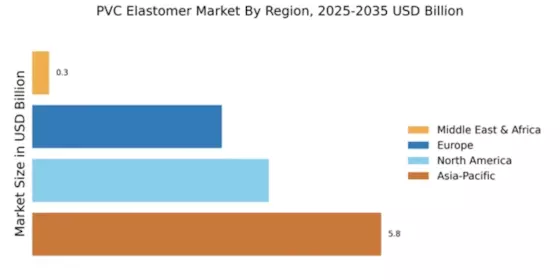
PVC Elastomer Market Infographic
Purchase Options

PVC Elastomer Market Summary

As per MRFR analysis, the PVC Elastomer Market Size was estimated at 13.16 USD Billion in 2024. The PVC Elastomer industry is projected to grow from 13.78 USD Billion in 2025 to 21.83 USD Billion by 2035, exhibiting a compound annual growth rate (CAGR) of 4.71 during the forecast period 2025 - 2035.

Key Market Trends & Highlights

The PVC elastomer market is poised for robust growth driven by sustainability and technological advancements.

  • North America remains the largest market for PVC elastomers, driven by strong demand in the automotive sector.
  • Asia-Pacific is emerging as the fastest-growing region, fueled by increasing construction activities and urbanization.
  • The automotive segment continues to dominate, while the medical devices segment is experiencing rapid growth due to rising healthcare needs.
  • Key market drivers include the rising demand in the automotive sector and the increasing focus on healthcare applications.

Market Size & Forecast

2024 Market Size 13.16 (USD Billion)
2035 Market Size 21.83 (USD Billion)
CAGR (2025 - 2035) 4.71%

Major Players

Kraton (US), LG Chem (KR), Mitsubishi Chemical (JP), BASF (DE), Solvay (BE), SABIC (SA), Dow (US), Kuraray (JP), Hexpol (SE)

PVC Elastomer Market Trends

The PVC Elastomer Market is currently experiencing a dynamic phase characterized by evolving consumer preferences and technological advancements. This sector, known for its versatility and adaptability, is witnessing increased demand across various applications, including automotive, construction, and consumer goods. The material's unique properties, such as flexibility, durability, and resistance to environmental factors, contribute to its growing popularity. As industries seek sustainable alternatives, the PVC Elastomer Market appears poised for expansion, driven by innovations in formulation and processing techniques. Moreover, the market landscape is influenced by regulatory frameworks that promote eco-friendly materials. Manufacturers are increasingly focusing on developing products that align with sustainability goals, which may enhance their competitive edge. The integration of advanced technologies in production processes is likely to improve efficiency and reduce waste, further supporting market growth. As the PVC Elastomer Market evolves, stakeholders must remain vigilant to emerging trends and shifts in consumer behavior, ensuring they adapt to the changing landscape effectively.

Sustainability Initiatives

The PVC Elastomer Market is witnessing a notable shift towards sustainability, as manufacturers increasingly prioritize eco-friendly practices. This trend encompasses the development of recyclable and biodegradable materials, which align with global environmental goals. Companies are investing in research to create formulations that minimize environmental impact, potentially enhancing their market position.

Technological Advancements

Innovations in processing technologies are transforming the PVC Elastomer Market. Enhanced production methods are enabling manufacturers to improve product quality and performance. These advancements may lead to the introduction of new applications, expanding the market's reach across various sectors, including automotive and construction.

Customization and Versatility

The demand for customized solutions is rising within the PVC Elastomer Market. Clients are increasingly seeking tailored products that meet specific performance criteria. This trend highlights the material's inherent versatility, allowing it to be adapted for diverse applications, which could drive further growth in the sector.

PVC Elastomer Market Drivers

Growing Demand in Automotive Sector

The Global PVC Elastomer Market Industry experiences a notable surge in demand driven by the automotive sector. As manufacturers increasingly seek lightweight and durable materials for vehicle components, PVC elastomers offer an attractive solution due to their excellent mechanical properties and resistance to environmental factors. In 2024, the market is projected to reach 3500 USD Million, with automotive applications accounting for a substantial share. This trend is likely to continue as the industry shifts towards more sustainable and efficient materials, potentially propelling the market further as electric vehicles gain traction.

Market Segment Insights

By Application: Automotive (Largest) vs. Medical (Fastest-Growing)

In the PVC elastomer market, the application segments display a varied distribution of market share, with automotive representing the largest segment. The robust demand for PVC elastomers in automotive applications is driven by their superior flexibility, durability, and resistance to environmental factors. Construction follows as a significant application area, owing to its extensive use in building materials and infrastructure. Meanwhile, consumer goods, electrical applications, and medical segments collectively contribute to the market, but with comparatively smaller shares, indicating niche demand within these sectors.

Automotive: Dominant vs. Medical: Emerging

The automotive segment remains dominant in the PVC elastomer market due to the increasing integration of advanced materials in vehicle manufacturing. PVC elastomers offer significant advantages, such as weight reduction and improved aesthetic appeal, making them a preferred choice for manufacturers. Conversely, the medical segment is emerging as a fast-growth area driven by rising healthcare demands and innovations in medical devices. PVC elastomers in healthcare applications provide excellent biocompatibility and ease of sterilization, positioning them favorably against traditional materials. This shift towards advanced materials in critical applications highlights a notable trend in the market.

By End Use: Automotive Components (Largest) vs. Medical Devices (Fastest-Growing)

The PVC elastomer market showcases a diverse range of applications within the 'End Use' segment, particularly highlighting automotive components, building materials, household products, medical devices, and electrical insulation. Automotive components currently dominate the market, significantly due to the extensive utilization of PVC elastomers within various automotive interior and exterior parts. In contrast, medical devices, while smaller in share, are emerging as a pivotal segment, driven by the growing healthcare demands and technological innovations that favor the adoption of advanced materials in the medical field.

Automotive Components: Dominant vs. Medical Devices: Emerging

Automotive components are recognized as the dominant player in the PVC elastomer market, primarily due to the high performance, durability, and flexibility of PVC materials in applications ranging from dashboards to seals. This segment benefits from a strong automotive industry that values lightweight materials for fuel efficiency and longevity. On the other hand, medical devices represent an emerging opportunity, fueled by rising global health concerns and advancements in medical technologies. The need for biocompatible and sterile materials in medical applications drives the growth of PVC elastomers in this sector, showcasing their potential in producing safe, reliable healthcare solutions.

By Type: Thermoplastic Elastomer (Largest) vs. Thermoset Elastomer (Fastest-Growing)

In the PVC Elastomer Market, the Thermoplastic Elastomer segment commands the largest share due to its versatile applications and favorable performance characteristics. It is widely used in automotive, consumer goods, and medical sectors, which contributes to its leading position. The segment's strong market presence is supported by numerous manufacturers focusing on innovations and enhancing product performance. Conversely, the Thermoset Elastomer segment is experiencing rapid growth, driven by increasing demand in the construction and electronics industries. This segment benefits from superior thermal stability and chemical resistance, making it ideal for specialized applications. As sustainability becomes a higher priority, the transition from traditional materials to thermoset elastomers is expected to accelerate, further boosting its market share in the coming years.

Blends and Alloys (Dominant) vs. Compounds (Emerging)

The Blends and Alloys segment stands out as a dominant force in the PVC Elastomer Market, combining various materials to offer enhanced properties such as improved flexibility, toughness, and resistance to environmental factors. This segment serves diverse industries including automotive and footwear, which require materials that can withstand challenging conditions. Manufacturers focus on developing advanced blends that meet stringent performance criteria, thereby reinforcing this segment's strong market stance. On the other hand, the Compounds segment is considered emerging, showcasing a growing interest from manufacturers looking to customize formulations for specific applications. Compounds offer tailored properties by combining PVC with other polymers, thus increasing their utility in specialized applications such as medical devices and specialized seals. The increasing trend towards customization at the production level is expected to bolster the compound segment's market presence as it caters to niche demands.

By Processing Method: Injection Molding (Largest) vs. Extrusion (Fastest-Growing)

In the PVC Elastomer Market, the processing method segments display varying market share distributions. Injection Molding emerges as the largest segment, leveraging its advantages in precision and efficiency. Following closely is Extrusion, which, although it holds a smaller market share, is recognized for its versatility and rapid production capabilities, making it an essential process in the manufacturing of PVC elastomers. Both methods play significant roles in meeting diverse customer demands across various applications. The growth trends in the PVC Elastomer processing method segment are driven by increasing demand for lightweight and durable materials in the automotive, construction, and consumer goods sectors. Extrusion is touted as the fastest-growing segment due to its suitability for high-throughput manufacturing and the rising trend towards sustainability in production processes, which aligns with consumer preferences for eco-friendly materials.

Injection Molding (Dominant) vs. Blow Molding (Emerging)

Injection Molding is the dominant processing method within the PVC Elastomer market, known for its high efficiency and precision in producing complex parts. This method allows for rapid production cycles and is particularly favored in industries requiring detailed designs and stringent quality control, such as automotive and medical devices. In contrast, Blow Molding is an emerging method gaining traction for its capability to produce hollow shapes at lower costs. It is increasingly used in packaging applications due to its economic advantages and the growing trend towards lightweight products. As both methods evolve, their applications are likely to expand, catering to the shifting requirements of manufacturers seeking innovative solutions.

By Form: Granules (Largest) vs. Film (Fastest-Growing)

In the PVC Elastomer Market, the 'Form' segment showcases significant diversity in its composition. Granules hold the largest market share, favored for their ease of processing and versatility in various applications. Following granules, the film segment is notable for its increasing adoption, driven by the growing demand in packaging and automotive sectors. The powder and sheet forms also contribute to the market, appealing to specific applications but lagging in comparison to granules and film.

Granules (Dominant) vs. Film (Emerging)

Granules are the dominant form in the PVC elastomer market, widely recognized for their exceptional processing capabilities and compatibility with a variety of manufacturing processes. They cater to diverse applications, from automotive parts to consumer goods. On the other hand, the film segment is emerging rapidly, benefiting from advancements in thin-film technologies and increasing usage in sustainable packaging solutions. This transition is characterized by growing efforts to reduce material usage and enhance product performance. As industries lean towards lightweight and flexible solutions, the film segment's growth is expected to outpace traditional forms like powder and sheet, marking it as a significant trend in the PVC elastomer market.

Get more detailed insights about PVC Elastomer Market

Regional Insights

North America : Established Market with Growth Potential

The North American PVC elastomer market, valued at $3.95 billion, is driven by increasing demand in automotive and construction sectors. Regulatory support for sustainable materials and innovations in manufacturing processes are key growth catalysts. The region is witnessing a shift towards eco-friendly alternatives, enhancing market dynamics. Leading countries like the US and Canada dominate the market, with major players such as Dow and Kraton establishing a strong presence. The competitive landscape is characterized by strategic partnerships and technological advancements, ensuring a robust supply chain and product innovation.

Europe : Innovation and Sustainability Focus

Europe's PVC elastomer market, valued at €3.15 billion, is characterized by a strong emphasis on sustainability and innovation. Regulatory frameworks, such as the EU's Green Deal, are driving demand for eco-friendly materials. The region is adapting to changing consumer preferences, leading to increased investments in R&D and sustainable practices. Germany, France, and the UK are leading countries in this market, with key players like BASF and Solvay at the forefront. The competitive landscape is marked by collaborations and technological advancements, positioning Europe as a leader in sustainable PVC elastomer solutions.

Asia-Pacific : Rapid Growth and Market Leadership

Asia-Pacific holds the largest market share in the PVC elastomer sector, valued at $5.8 billion. The region's growth is fueled by rising industrialization, urbanization, and demand from automotive and consumer goods sectors. Regulatory support for infrastructure development and environmental standards is further propelling market expansion. China, Japan, and South Korea are the leading countries, with major players like LG Chem and Mitsubishi Chemical driving innovation. The competitive landscape is dynamic, with a focus on product differentiation and strategic alliances, ensuring a robust market presence in the region.

Middle East and Africa : Emerging Market with Growth Opportunities

The Middle East and Africa PVC elastomer market, valued at $0.26 billion, is in its nascent stages but shows significant growth potential. Factors such as increasing construction activities and rising demand for automotive components are driving market interest. Regulatory initiatives aimed at enhancing industrial capabilities are also contributing to market growth. Countries like South Africa and Saudi Arabia are emerging as key players in this market. The competitive landscape is evolving, with local and international companies exploring opportunities to establish a foothold, supported by investments in infrastructure and technology.

Key Players and Competitive Insights

The PVC elastomer market exhibits a dynamic competitive landscape characterized by innovation and strategic maneuvering among key players. Major companies such as Kraton (US), LG Chem (KR), and BASF (DE) are actively shaping the market through various strategies. Kraton (US) focuses on sustainability and product innovation, aiming to enhance its portfolio with eco-friendly elastomers. Meanwhile, LG Chem (KR) emphasizes regional expansion and technological advancements, positioning itself as a leader in high-performance materials. BASF (DE) adopts a multifaceted approach, integrating digital transformation into its operations to optimize production efficiency and customer engagement. Collectively, these strategies contribute to a competitive environment that prioritizes innovation and sustainability.

Key business tactics within the PVC elastomer market include localizing manufacturing and optimizing supply chains to enhance responsiveness to regional demands. The market structure appears moderately fragmented, with several players vying for market share. However, the influence of major companies is substantial, as they leverage their resources and expertise to set industry standards and drive growth.

In November 2025, Kraton (US) announced the launch of a new line of bio-based PVC elastomers, which underscores its commitment to sustainability and innovation. This strategic move not only enhances its product offerings but also aligns with the growing demand for environmentally friendly materials. The introduction of these bio-based products is likely to strengthen Kraton's market position and appeal to eco-conscious consumers.

In October 2025, LG Chem (KR) revealed plans to invest $200 million in expanding its production capacity for PVC elastomers in Southeast Asia. This investment is indicative of LG Chem's strategy to capitalize on the growing demand in emerging markets. By increasing its production capabilities, the company aims to enhance its competitive edge and meet the rising needs of various industries, including automotive and construction.

In September 2025, BASF (DE) entered into a strategic partnership with a leading technology firm to develop AI-driven solutions for optimizing PVC elastomer production processes. This collaboration is expected to enhance operational efficiency and reduce costs, positioning BASF at the forefront of technological advancements in the industry. The integration of AI into production processes may also lead to improved product quality and faster time-to-market.

As of December 2025, current trends in the PVC elastomer market are increasingly defined by digitalization, sustainability, and the integration of advanced technologies. Strategic alliances among key players are shaping the competitive landscape, fostering innovation and collaboration. Looking ahead, it is anticipated that competitive differentiation will evolve, shifting from traditional price-based competition to a focus on innovation, technology, and supply chain reliability. Companies that successfully navigate these trends are likely to secure a competitive advantage in the evolving market.

Key Companies in the PVC Elastomer Market market include

Industry Developments

April 2022: Dupont Liveo pharma tubing, a thermoplastic elastomer tubing designed for the biopharmaceutical industry, was introduced by DowDuPont Inc. A variety of extruded pharmaceutical tubing based on TPE technology was added with the product launch.

May 2021: The thermoplastic elastomer (TPE) range of Avient, a developer of specialized and sustainable material solutions, has expanded with the inclusion of three patented formulations that are enhanced with antibacterial additives. These additives, which have undergone testing in compliance with ASTM G21-15 and JIS Z2801 standards, protect molded plastic parts by preventing fungal and mold growth and suppressing bacterial growth to a minimum of 99.9%. The product is looking for uses in consumer electronics, grips for personal hygiene products, and automobile applications like (HVAC) heating, ventilation, and air conditioning seals and cup holder mats.

Future Outlook

PVC Elastomer Market Future Outlook

The PVC elastomer market is projected to grow at a 4.71% CAGR from 2024 to 2035, driven by increasing demand in automotive, construction, and consumer goods sectors.

New opportunities lie in:

  • Development of bio-based PVC elastomers for sustainable applications.
  • Expansion into emerging markets with tailored product offerings.
  • Investment in advanced manufacturing technologies to enhance production efficiency.

By 2035, the PVC elastomer market is expected to solidify its position as a key player in various industries.

Market Segmentation

PVC Elastomer Market Form Outlook

  • Granules
  • Powder
  • Sheet
  • Film

PVC Elastomer Market Type Outlook

  • Thermoplastic Elastomer
  • Thermoset Elastomer
  • Blends and Alloys
  • Compounds

PVC Elastomer Market End Use Outlook

  • Automotive Components
  • Building Materials
  • Household Products
  • Medical Devices
  • Electrical Insulation

PVC Elastomer Market Application Outlook

  • Automotive
  • Construction
  • Consumer Goods
  • Medical
  • Electrical

PVC Elastomer Market Processing Method Outlook

  • Injection Molding
  • Extrusion
  • Blow Molding
  • Calendering

Report Scope

MARKET SIZE 202413.16(USD Billion)
MARKET SIZE 202513.78(USD Billion)
MARKET SIZE 203521.83(USD Billion)
COMPOUND ANNUAL GROWTH RATE (CAGR)4.71% (2024 - 2035)
REPORT COVERAGERevenue Forecast, Competitive Landscape, Growth Factors, and Trends
BASE YEAR2024
Market Forecast Period2025 - 2035
Historical Data2019 - 2024
Market Forecast UnitsUSD Billion
Key Companies ProfiledKraton (US), LG Chem (KR), Mitsubishi Chemical (JP), BASF (DE), Solvay (BE), SABIC (SA), Dow (US), Kuraray (JP), Hexpol (SE)
Segments CoveredApplication, End Use, Type, Processing Method, Form
Key Market OpportunitiesGrowing demand for sustainable materials drives innovation in the PVC Elastomer Market.
Key Market DynamicsRising demand for sustainable materials drives innovation and competition in the PVC elastomer market.
Countries CoveredNorth America, Europe, APAC, South America, MEA

Leave a Comment

FAQs

How much is the PVC elastomer market?

The PVC Elastomer Market size was valued at Significant value in 2022.

What is the growth rate of the PVC elastomer market?

The global market is projected to grow at a CAGR of 5.00% during the forecast period, 2025-2035.

Which region held the largest market share in the PVC elastomer market?

North America had the largest share of the global market

Who are the key players in the PVC elastomer market?

The key players in the market are Mitsubishi Engineering-Plastics, Teknor Apex, KK Technovinyl Polymers, Axiall, Westlake Chemical, Avient, Colorite, Ineos, Asahi Kasei Corp., and others.

Which type led the PVC elastomer market?

The thermoplastic elastomer category dominated the market in 2022.

Which application had the largest market share in the PVC elastomer market?

The industrial had the largest share of the global market.

Download Free Sample

Kindly complete the form below to receive a free sample of this Report

Compare Licence

×
Features License Type
Single User Multiuser License Enterprise User
Price $4,950 $5,950 $7,250
Maximum User Access Limit 1 User Upto 10 Users Unrestricted Access Throughout the Organization
Free Customization
Direct Access to Analyst
Deliverable Format
Platform Access
Discount on Next Purchase 10% 15% 15%
Printable Versions