×
Request Free Sample ×

Kindly complete the form below to receive a free sample of this Report

* Please use a valid business email

Leading companies partner with us for data-driven Insights

clients tt-cursor
Hero Background

Rear Loader Truck Market

ID: MRFR/AT/39000-HCR
128 Pages
Sejal Akre
October 2025

Rear Loader Truck Market Research Report By Application (Waste Collection, Construction, Street Cleaning, Recycling), By Vehicle Type (Light Duty, Medium Duty, Heavy Duty), By Engine Type (Internal Combustion Engine, Electric, Hybrid), By Body Type (Open Body, Enclosed Body, Compact Body) and By Regional (North America, Europe, South America, Asia Pacific, Middle East and Africa) - Forecast to 2035

Share:
Download PDF ×

We do not share your information with anyone. However, we may send you emails based on your report interest from time to time. You may contact us at any time to opt-out.

Rear Loader Truck Market Infographic
Purchase Options

Rear Loader Truck Market Summary

As per MRFR analysis, the Rear Loader Truck Market Size was estimated at 9.932 USD Billion in 2024. The Rear Loader Truck industry is projected to grow from 10.22 USD Billion in 2025 to 13.63 USD Billion by 2035, exhibiting a compound annual growth rate (CAGR) of 2.92 during the forecast period 2025 - 2035.

Key Market Trends & Highlights

The Rear Loader Truck Market is poised for growth driven by technological advancements and sustainability initiatives.

  • North America remains the largest market for rear loader trucks, driven by robust waste management infrastructure.
  • The Asia-Pacific region is emerging as the fastest-growing market, fueled by rapid urbanization and increasing waste generation.
  • The waste collection segment continues to dominate, while the recycling segment is experiencing the fastest growth due to heightened environmental awareness.
  • Key market drivers include rising waste generation and stringent environmental regulations that are shaping industry practices.

Market Size & Forecast

2024 Market Size 9.932 (USD Billion)
2035 Market Size 13.63 (USD Billion)
CAGR (2025 - 2035) 2.92%

Major Players

Waste Management Inc (US), Republic Services Inc (US), Veolia Environnement SA (FR), SUEZ SA (FR), Caterpillar Inc (US), Mack Trucks Inc (US), Peterbilt Motors Company (US), Freightliner Trucks (US)

Rear Loader Truck Market Trends

The Rear Loader Truck Market is currently experiencing a dynamic evolution, driven by various factors that influence its growth trajectory. Increasing urbanization and the corresponding rise in waste generation necessitate efficient waste management solutions, which rear loader trucks provide. These vehicles are particularly favored for their ability to navigate narrow streets and alleys, making them ideal for urban environments. Furthermore, advancements in technology, such as the integration of smart systems and enhanced fuel efficiency, are likely to bolster the appeal of rear loader trucks among municipalities and waste management companies. As sustainability becomes a focal point, the market may also witness a shift towards electric and hybrid models, aligning with global efforts to reduce carbon footprints. In addition to technological advancements, regulatory frameworks are shaping the Rear Loader Truck Market. Governments worldwide are implementing stricter emissions standards, compelling manufacturers to innovate and adapt their offerings. This regulatory pressure could lead to a more competitive landscape, as companies strive to meet compliance while also catering to the evolving needs of consumers. The market appears poised for growth, with potential opportunities arising from the increasing demand for environmentally friendly waste management solutions. Overall, the Rear Loader Truck Market is on a path of transformation, influenced by urbanization, technological progress, and regulatory changes, which collectively shape its future landscape.

Technological Advancements

The integration of advanced technologies in rear loader trucks is becoming increasingly prevalent. Features such as GPS tracking, automated lifting systems, and real-time data analytics are enhancing operational efficiency. These innovations not only streamline waste collection processes but also improve safety and reduce operational costs.

Sustainability Initiatives

There is a growing emphasis on sustainability within the Rear Loader Truck Market. Manufacturers are exploring electric and hybrid models to align with global environmental goals. This shift towards greener alternatives reflects a broader trend in the transportation sector, where reducing emissions is becoming a priority.

Regulatory Compliance

Stricter regulations regarding emissions and waste management practices are influencing the Rear Loader Truck Market. Governments are enforcing higher standards, prompting manufacturers to innovate and adapt their products. This regulatory landscape is likely to drive competition and encourage the development of more efficient and compliant vehicles.

Rear Loader Truck Market Drivers

Increasing Urbanization

The trend of increasing urbanization appears to be a significant driver for the Rear Loader Truck Market. As more people migrate to urban areas, the demand for efficient waste management solutions intensifies. Municipalities are likely to invest in rear loader trucks to enhance their waste collection capabilities. According to recent data, urban areas are projected to grow by 1.5 billion people by 2030, necessitating improved waste management systems. This growth could lead to a substantial increase in the adoption of rear loader trucks, which are designed for high-density waste collection. The Rear Loader Truck Market may thus experience a surge in demand as cities strive to maintain cleanliness and sustainability amidst rising populations.

Rising Waste Generation

The rising volume of waste generation is a pivotal factor influencing the Rear Loader Truck Market. With global waste expected to increase by 70% by 2050, municipalities and waste management companies are compelled to enhance their collection capabilities. Rear loader trucks, known for their efficiency in handling large volumes of waste, are becoming increasingly essential. Data suggests that urban areas generate significantly more waste per capita compared to rural regions, further emphasizing the need for effective waste collection solutions. This trend is likely to drive the demand for rear loader trucks, as cities seek to implement more robust waste management strategies to cope with escalating waste production.

Environmental Regulations

The implementation of stringent environmental regulations is a crucial driver for the Rear Loader Truck Market. Governments worldwide are increasingly mandating the use of eco-friendly vehicles in waste management operations. This regulatory landscape encourages the adoption of rear loader trucks that comply with emissions standards and utilize alternative fuels. For instance, the European Union has set ambitious targets for reducing greenhouse gas emissions, which could lead to a shift towards cleaner waste collection vehicles. As a result, manufacturers are likely to focus on producing rear loader trucks that meet these regulatory requirements, thereby stimulating growth in the Rear Loader Truck Market.

Technological Innovations

Technological innovations are reshaping the Rear Loader Truck Market, as manufacturers increasingly integrate advanced features into their vehicles. Innovations such as automated loading systems, GPS tracking, and telematics are enhancing operational efficiency and safety. The market for smart waste management solutions is expected to grow, with projections indicating a compound annual growth rate of over 10% in the coming years. These advancements not only improve the performance of rear loader trucks but also reduce operational costs for waste management companies. As municipalities and private firms seek to modernize their fleets, the demand for technologically advanced rear loader trucks is likely to rise, driving growth in the Rear Loader Truck Market.

Economic Growth and Infrastructure Development

Economic growth and infrastructure development are likely to serve as key drivers for the Rear Loader Truck Market. As economies expand, there is a corresponding increase in construction activities and urban development, leading to higher waste generation. This growth necessitates efficient waste management solutions, prompting municipalities to invest in rear loader trucks. Furthermore, infrastructure projects often require enhanced waste collection services, which rear loader trucks are well-equipped to provide. The construction sector is projected to grow at a rate of 5% annually, indicating a robust demand for waste management vehicles. Consequently, the Rear Loader Truck Market may witness increased investments as economies develop and urbanize.

Market Segment Insights

By Application: Waste Collection (Largest) vs. Recycling (Fastest-Growing)

In the Rear Loader Truck Market, the application segment is distinctly characterized by its diverse functionalities, with Waste Collection leading as the largest contributor. It captures a significant share of the market due to the increasing demand for efficient waste management systems in urban and suburban environments. Close on its heels is the Recycling segment, which is rapidly gaining traction due to rising environmental consciousness and the push towards sustainable practices. These applications are pivotal in shaping the industry's landscape.

Waste Collection (Dominant) vs. Recycling (Emerging)

The Waste Collection segment stands as the dominant force within the Rear Loader Truck Market, buoyed by extensive urbanization and stringent regulations targeting effective waste disposal. These trucks are specifically engineered for efficiency, often featuring compact designs suitable for narrow city streets. In contrast, the Recycling segment is emerging with robust growth due to increasing initiatives for sustainability and resource recovery. As communities strive to improve recycling rates, specialized rear loader trucks tailored for recyclable materials are becoming essential, enhancing operational efficiency and supporting the dual goals of waste reduction and resource conservation.

By Vehicle Type: Heavy Duty (Largest) vs. Light Duty (Fastest-Growing)

The Rear Loader Truck Market showcases a diverse landscape characterized by varying vehicle types, including Light Duty, Medium Duty, and Heavy Duty trucks. Heavy Duty trucks hold the largest market share, primarily due to their extensive use in commercial and industrial applications requiring robust performance and greater hauling capacities. Conversely, Light Duty trucks, though smaller in market share, are experiencing significant growth, driven by urbanization and rising demand for efficient waste management solutions in densely populated areas. This competitive space indicates a dynamic shift in consumer preferences, with a growing inclination towards vehicles that meet specific operational needs. In terms of growth trends, the Light Duty segment is gaining traction as businesses focus on enhancing operational efficiency and reducing costs. This shift is fueled by advancements in fuel efficiency and technology, which appeal to environmentally conscious consumers. As cities expand and regulatory standards for emissions tighten, the demand for smaller, eco-friendly vehicles is expected to increase, making Light Duty trucks the fastest-growing segment in the Rear Loader Truck Market. Meanwhile, the Heavy Duty segment continues to flourish, supported by persistent demand in the commercial sector, ensuring a stable foundation for sustained growth and market dominance.

Heavy Duty (Dominant) vs. Light Duty (Emerging)

In the context of the Rear Loader Truck Market, Heavy Duty trucks epitomize strength and capability, designed to handle significant loads and endure challenging operating conditions. These vehicles are the backbone of waste management operations in large urban and industrial environments, boasting greater power and durability. On the other hand, Light Duty trucks are emerging as a popular choice for businesses focused on efficiency and flexibility in urban areas. Their compact size allows for easier maneuverability, while advancements in technology and design have enhanced their operational effectiveness. As environmental concerns become increasingly paramount, the demand for Light Duty trucks is expected to rise, presenting opportunities for innovation and adaptation within this segment.

By Engine Type: Internal Combustion Engine (Largest) vs. Electric (Fastest-Growing)

In the Rear Loader Truck Market, the Internal Combustion Engine (ICE) segment dominates, holding a significant share of the market due to its established presence and extensive infrastructure. Meanwhile, the Electric segment is rapidly gaining traction as environmental concerns and emission regulations push operators to seek cleaner alternatives. The Hybrid engine, while present, holds a smaller share but is part of the transition towards electrification in the sector, offering flexibility and efficiency in fuel consumption. The growth trends in this segment are highly influenced by technological advancements and legislative changes. As electric vehicle technology improves, the electric segment is projected to experience accelerated growth, driven by demand for zero-emission solutions. Meanwhile, ICE vehicles will continue to hold their ground due to familiarity in operations, though they may see a gradual decline as electric and hybrid options become more feasible for urban waste management applications.

Internal Combustion Engine (Dominant) vs. Electric (Emerging)

The Internal Combustion Engine segment remains the dominant force in the Rear Loader Truck Market, primarily due to its long-standing history and reliability. This engine type has a widespread maintenance network and familiarity among operators, which provides convenience and reassurance. However, the Electric segment is rapidly emerging, driven by government incentives for cleaner technologies and increasing availability of charging infrastructure. Electric vehicles are seen as ideal for urban operations where emissions regulations are stringent, making them attractive for municipalities aiming to reduce carbon footprints. Meanwhile, the Hybrid segment combines the benefits of both ICE and electric technology, offering adaptability, especially in mixed-use environments. As a result, electric and hybrid options are gradually shifting the dynamics of the market, indicating a significant transition ahead.

By Body Type: Open Body (Largest) vs. Enclosed Body (Fastest-Growing)

In the Rear Loader Truck Market, the body type segment reflects a diverse distribution in market preference. The Open Body configuration currently holds the largest market share due to its practicality and ease of dumping, making it a preferred choice for waste management in urban areas. Meanwhile, the Enclosed Body type is gaining traction, driven by increasing environmental concerns and regulatory standards that demand enclosed systems to control emissions and spillage. Compact Body types, while niche, continue to hold importance in specific urban applications where space is at a premium. The growth trends in the body type segment are largely driven by advancements in vehicle design and functionality. The Open Body type benefits from improvements in size and maneuverability, tailoring it to urban environments. On the other hand, the Enclosed Body type is emerging as a fast-growing segment, fueled by stricter environmental regulations and the need for safer waste disposal solutions. Compact Bodies are also experiencing growth as urbanization increases and there is a need for trucks that can easily navigate crowded city streets. This shift highlights the importance of adapting body types to meet the evolving needs of waste management sectors.

Open Body (Dominant) vs. Compact Body (Emerging)

The Open Body segment is characterized by its versatility and efficiency in various waste management operations. As the dominant choice for many municipalities and private waste collectors, it offers significant benefits such as ease of use and lower operational costs. This type is particularly effective for bulk waste collection, where rapid unloading is essential. On the other hand, the Compact Body has emerged as a significant player in urban waste management due to rising population densities and the need for smaller, more agile vehicles. While not as widely used as Open Bodies, Compact Bodies are engineered for maneuverability and versatility in restricted spaces, making them a growing favorite among urban waste collection services.

Get more detailed insights about Rear Loader Truck Market

Regional Insights

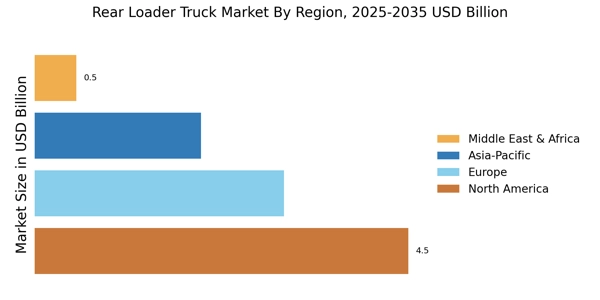
The Rear Loader Truck Market had a notable valuation in various regions, showing distinct trends and dynamics. In 2023, North America dominated the market with a valuation of 3.85 USD Billion, primarily due to robust demand from waste management services and municipal applications.

Europe followed with a significant valuation of 2.65 USD Billion as sustainability initiatives drive the need for efficient waste collection vehicles. The Asia-Pacific (APAC) region, valued at 2.0 USD Billion, showed growth potential driven by increasing urbanization and infrastructure development.

South America, with a smaller market valuation of 0.80 USD Billion, illustrated gradual growth influenced by rising environmental concerns. Lastly, the Middle East and Africa (MEA) segment, valued at 0.30 USD Billion, reflected emerging opportunities in waste management improvements.

The overall segmentation underscored diverse regional needs, market growth potential, and varying emphasis on sustainability practices, contributing to the overall expansion of the Rear Loader Truck Market revenue across these regions in the coming years.

Rear Loader Truck Market Regional Image

Key Players and Competitive Insights

The Rear Loader Truck Market is experiencing notable competitive dynamics driven by the increasing demand for efficient waste management and sanitation services. As cities expand and populations rise, the need for effective solid waste collection and transportation solutions has become more critical.

This has prompted various companies to innovate and diversify their product offerings, incorporating advanced technologies to enhance operational efficiency and reduce environmental impacts. The competition is characterized by the presence of established players as well as new entrants aiming to capture market share through strategic partnerships, mergers, and expanding service capabilities.

In this evolving landscape, companies are increasingly focusing on sustainability, leading to the development of greener alternatives to traditional rear loader trucks, ultimately improving their market position.

Clean Harbors stands out in the Rear Loader Truck Market primarily due to its extensive operational footprint and robust expertise in waste management and environmental services. The company leverages its comprehensive capabilities in waste transportation, recycling, and disposal, allowing it to effectively meet the growing demands of municipalities and industries for reliable waste removal solutions.

Clean Harbors is known for its commitment to safety and sustainability, employing advanced rear loader truck designs that optimize collection efficiency while minimizing carbon footprints.

The company's strategic investments in technology and fleet modernization further enhance its competitive edge, enabling it to offer superior services tailored to a diverse clientele. Clean Harbors maintains a strong market presence through its expansive network, which facilitates prompt and efficient service delivery.

Veolia Environnement also plays an important role in the Rear Loader Truck Market, bringing its vast experience in environmental solutions and waste management to the forefront. With a strong focus on sustainability, Veolia emphasizes the development of environmentally friendly services that align with circular economy principles.

The company integrates innovative technologies into its operations, enhancing the capabilities of its rear loader trucks for optimized waste collection and management. Veolia's commitment to reducing waste and promoting resource recovery positions it well in the marketplace, attracting customers who are increasingly mindful of ecological impacts.

Furthermore, Veolia's extensive presence across various regions provides it with the ability to tailor solutions to local needs, ensuring adaptability and resilience in a competitively evolving market.

Key Companies in the Rear Loader Truck Market market include

Industry Developments

Recent developments in the Rear Loader Truck Market include noteworthy advancements in waste management technologies and sustainability practices. Companies like Clean Harbors and Veolia Environnement are actively enhancing their fleets with eco-friendly rear loader trucks to meet increasing regulatory standards and consumer demands for greener solutions.

In current affairs, Stericycle and Waste Management are focusing on expanding their operational capacities to improve efficiency in waste collection and recycling processes. Furthermore, significant mergers and acquisitions have shaped the market landscape, with GFL Environmental acquiring regional waste service providers to bolster its service offerings, which has created a ripple effect among competitors.

The market valuation of these companies continues to grow, driven by innovations in waste processing technologies and a surge in municipal waste management projects. As organizations like Remondis and Advanced Disposal invest in state-of-the-art rear loader models, there is a noticeable shift towards automation and smart fleet management practices.

This is impacting the market positively by increasing operational efficiency while reducing overall costs and setting a new standard for waste collection strategies in urban and suburban areas.

Future Outlook

Rear Loader Truck Market Future Outlook

The Rear Loader Truck Market is projected to grow at a 2.92% CAGR from 2024 to 2035, driven by urbanization, environmental regulations, and technological advancements.

New opportunities lie in:

  • Integration of IoT for real-time fleet management solutions.
  • Development of electric rear loader trucks to meet sustainability goals.
  • Expansion into emerging markets with tailored financing options.

By 2035, the Rear Loader Truck Market is expected to be robust, reflecting steady growth and innovation.

Market Segmentation

Rear Loader Truck Market Body Type Outlook

  • Open Body
  • Enclosed Body
  • Compact Body

Rear Loader Truck Market Application Outlook

  • Waste Collection
  • Construction
  • Street Cleaning
  • Recycling

Rear Loader Truck Market Engine Type Outlook

  • Internal Combustion Engine
  • Electric
  • Hybrid

Rear Loader Truck Market Vehicle Type Outlook

  • Light Duty
  • Medium Duty
  • Heavy Duty

Report Scope

MARKET SIZE 20249.932(USD Billion)
MARKET SIZE 202510.22(USD Billion)
MARKET SIZE 203513.63(USD Billion)
COMPOUND ANNUAL GROWTH RATE (CAGR)2.92% (2024 - 2035)
REPORT COVERAGERevenue Forecast, Competitive Landscape, Growth Factors, and Trends
BASE YEAR2024
Market Forecast Period2025 - 2035
Historical Data2019 - 2024
Market Forecast UnitsUSD Billion
Key Companies ProfiledMarket analysis in progress
Segments CoveredMarket segmentation analysis in progress
Key Market OpportunitiesIntegration of advanced automation technologies enhances efficiency in the Rear Loader Truck Market.
Key Market DynamicsRising demand for efficient waste management solutions drives innovation in rear loader truck design and technology.
Countries CoveredNorth America, Europe, APAC, South America, MEA

Leave a Comment

FAQs

What is the projected market valuation for the Rear Loader Truck Market in 2035?

The projected market valuation for the Rear Loader Truck Market in 2035 is expected to reach 13.63 USD Billion.

What was the overall market valuation for the Rear Loader Truck Market in 2024?

The overall market valuation for the Rear Loader Truck Market was 9.932 USD Billion in 2024.

What is the expected CAGR for the Rear Loader Truck Market during the forecast period 2025 - 2035?

The expected CAGR for the Rear Loader Truck Market during the forecast period 2025 - 2035 is 2.92%.

Which application segment is projected to have the highest valuation in 2035?

The Waste Collection application segment is projected to reach 4.5 USD Billion by 2035.

How does the Heavy Duty vehicle type segment perform in terms of valuation?

The Heavy Duty vehicle type segment is expected to grow from 3.932 USD Billion in 2024 to 5.93 USD Billion by 2035.

What are the key players in the Rear Loader Truck Market?

Key players in the Rear Loader Truck Market include Waste Management Inc, Republic Services Inc, and Veolia Environnement SA.

What is the projected valuation for the Electric engine type segment by 2035?

The Electric engine type segment is projected to reach 4.0 USD Billion by 2035.

Which body type segment is anticipated to show the most growth by 2035?

The Compact Body segment is anticipated to grow from 3.432 USD Billion in 2024 to 5.13 USD Billion by 2035.

What was the valuation of the Recycling application segment in 2024?

The Recycling application segment was valued at 2.4 USD Billion in 2024.

How does the market for Medium Duty vehicles compare to Light Duty vehicles in 2035?

In 2035, the Medium Duty vehicle segment is expected to reach 3.2 USD Billion, while the Light Duty segment is projected to grow to 4.5 USD Billion.

Download Free Sample

Kindly complete the form below to receive a free sample of this Report

Compare Licence

×
Features License Type
Single User Multiuser License Enterprise User
Price $4,950 $5,950 $7,250
Maximum User Access Limit 1 User Upto 10 Users Unrestricted Access Throughout the Organization
Free Customization
Direct Access to Analyst
Deliverable Format
Platform Access
Discount on Next Purchase 10% 15% 15%
Printable Versions