Recombinant Vaccines Market

Key Players: Merck & Co., GlaxoSmithKline, Pfizer / BioNTech, Moderna, Sanofi, Novavax, Serum Institute of India, Takeda

Recombinant Vaccines Market

Recombinant Vaccines Market Research Report Information: By Product (Subunit Recombinant and Attenuated Recombinant Vaccines), by Disease (Cancer, Pneumococcal Disease, Hepatitis B, and DPT), and End-Users (Pediatrics, Adults, and Veterinary) - Global Forecast Till 2035
ID: MRFR/Pharma/4672-HCR
100 Pages
Rahul Gotadki, Nidhi Mandole
Last Updated: June 22, 2026

Recombinant Vaccines Market Summary

The Global Recombinant Vaccines Market size was valued at USD 19.6 Billion in 2025, and the market is projected to grow from USD 21.6 Billion in 2026 to USD 51.8 Billion by 2035, registering a CAGR of 10.2% during the forecast period 2026–2035. Two catalysts anchor that trajectory: mandatory HPV vaccination schedules now active in more than 130 countries, and sustained pandemic-preparedness allocations — including CEPI's USD 3.5 billion pledge for 100-day vaccine response capabilities — that keep manufacturing capacity utilization elevated across every major production platform [1][2].

A measurable shift away from legacy egg-based manufacturing continues to reshape the Recombinant Vaccines Market. Precision synthetic-biology workflows, single-use bioreactors, and AI-guided antigen design compress development timelines from years to months. Governments reinforced this transition with over USD 12 billion in combined Operation Warp Speed and EU HERA commitments between 2021 and 2024, catalyzing private-sector investment in mRNA, protein-subunit, and virus-like-particle platforms [3][4].

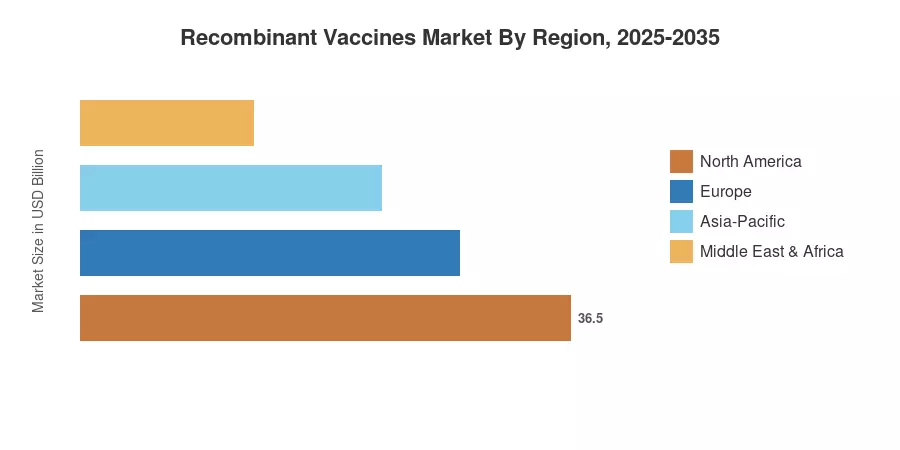
North America commanded roughly 33.2% of the Recombinant Vaccines Market in 2024, driven by deep reimbursement coverage and FDA fast-track pathways. Asia-Pacific is the fastest-growing region at a projected 10.3% CAGR through 2035, buoyed by India's and China's expanding domestic biomanufacturing capacity. Europe held the second-largest share at approximately 27%, supported by EMA harmonization of accelerated-assessment routes for novel biological products. The next decade will hinge on how quickly low- and middle-income nations scale adult catch-up programs and thermostable formulations that reduce cold-chain dependence.


Key Report Takeaways

• By Technology Type

  • Protein-subunit products captured the leading revenue share in 2024, reflecting mature supply chains for hepatitis B and HPV antigens.
  • mRNA platforms are forecast to register the fastest expansion through 2035, riding on rapid iteration advantages demonstrated during the COVID-19 pandemic.

• By Disease Indication

  • HPV vaccines represented the dominant share of the Recombinant Vaccines Market in 2024, supported by school-based mandates across OECD nations.
  • Dengue indications are accelerating at a double-digit CAGR, with Sanofi's Dengvaxia and Takeda's TAK-003 broadening endemic-market access.

• By Region

  • North America led global sales, anchored by the US CDC immunization schedule and robust payer coverage.
  • Asia-Pacific's growth outpaces all other regions in the Recombinant Vaccines Market, propelled by Gavi co-financing and local manufacturing scale-up in India, China, and Indonesia.


Market Size and Forecast (2021–2035)

Market Research Future's sizing methodology triangulates top-down revenue estimates from manufacturer disclosures, WHO procurement databases, and national immunization-program budgets against bottom-up per-dose pricing and volume models across 45 countries. Historical values (2021–2024) are validated against audited annual reports; forecast values (2026–2035) apply a calibrated 10.2% CAGR adjusted for anticipated regulatory approvals, pipeline readouts, and manufacturing capacity additions.
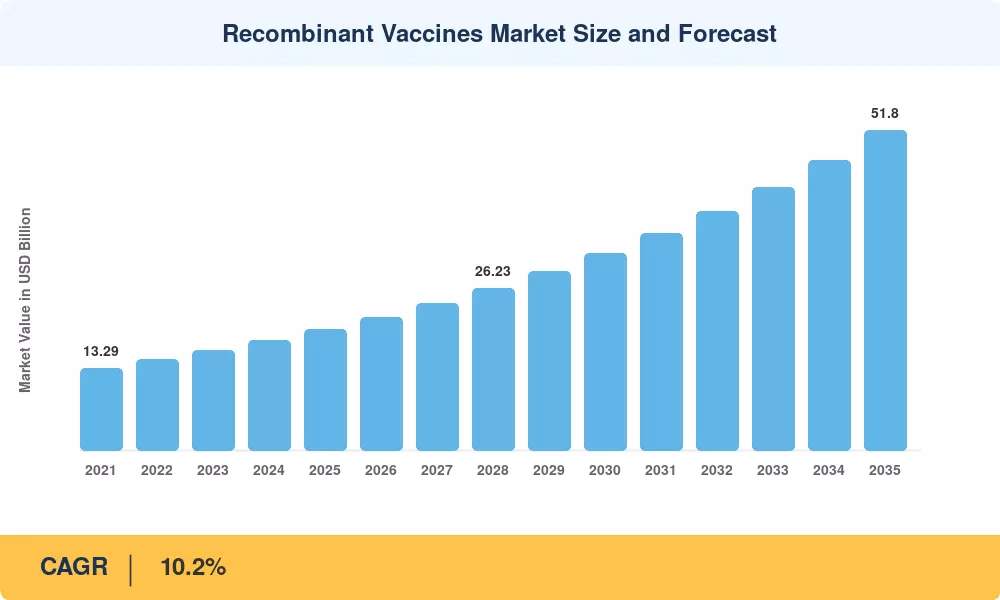
Recombinant Vaccines Market Size and Forecast
Our Impact
Enabled $4.3B Revenue Impact for Fortune 500 and Leading Multinationals
Partnering with 2000+ Global Organizations Each Year
30K+ Citations by Top-Tier Firms in the Industry

Driver Impact Analysis

Driver ~% Impact on CAGR Geographic Relevance Impact Timeline
Mandatory HPV vaccination mandates ~2.1% Global Short-term
Pandemic-preparedness funding ~1.8% North America, Europe Medium-term
mRNA platform maturation ~1.6% Global Medium-term
Thermostable formulation innovation ~1.3% Asia-Pacific, MEA Long-term
AI-guided antigen & epitope design ~1.1% North America, Europe Long-term
Single-use bioreactor cost reduction ~0.9% Global Medium-term
Gavi co-financing for LMICs ~0.8% Asia-Pacific, Africa Short-term


Mandatory HPV Vaccination Programs

Over 130 countries now include HPV vaccines in national immunization schedules, and the WHO's goal of vaccinating 90% of girls by age 15 before 2030 has unlocked multibillion-dollar procurement tenders. The United States alone expanded its HPV recommendation to adults through age 26 in 2019, driving Gardasil 9 revenues past USD 8.9 billion globally by 2024, according to the sources [1]. This policy momentum creates a predictable demand floor that supports capacity investment in the Recombinant Vaccines Market.

Pandemic-Preparedness Commitments

CEPI's five-year USD 3.5 billion strategy and the US government's Project NextGen — which allocated USD 5 billion toward next-generation COVID-19 and influenza vaccines — guarantee sustained R&D funding through at least 2027 [3][9]. These programs prioritize platform-agnostic manufacturing, directly benefiting recombinant approaches that can pivot rapidly to emerging pathogens.

mRNA and Self-Amplifying RNA Advancement

Together, Pfizer-BioNTech and Moderna showed that traditional mRNA platforms may go from sequence selection to emergency authorization in less than 11 months. Building on this enthusiasm, the regulatory clearance of Kostaive (ARCT-154) in Japan in late 2023 marked a significant milestone for self-amplifying RNA (saRNA) technology. SaRNA platforms provide strong immunogenicity at a fraction of the raw dose (e.g., 5 µg vs. 30 µg) by integrating the genetic machinery to replicate within host cells. This significantly reduces manufacturing costs per unit and relieves global cold-chain logistical pressures for the Recombinant Vaccines Market [12][14].


AI-Driven Antigen Design

Machine-learning models trained on structural virology databases can now predict immunodominant epitopes with over 85% accuracy, according to a 2024 Nature Biotechnology study [15]. These tools reduce lead-optimization cycles from 18 months to as few as four, enabling faster pivoting to novel pathogens and strengthening the overall resilience of recombinant vaccine pipelines.


Restraints Impact Analysis

Restraint ~% Drag on CAGR Geographic Relevance Impact Timeline
Cold-chain infrastructure gaps ~–1.4% Africa, South Asia Short-term
Vaccine hesitancy & misinformation ~–1.1% North America, Europe Medium-term
Regulatory divergence across markets ~–0.8% Global Medium-term
High capital costs for new platforms ~–0.7% Emerging markets Long-term
Intellectual-property disputes & TRIPS waiver uncertainty ~–0.5% Global Long-term


Cold-Chain Infrastructure Gaps

Despite advances in thermostable formulations, most approved recombinant vaccines still require 2–8°C storage. The WHO estimated in 2023 that 50% of vaccines in sub-Saharan Africa are exposed to temperature excursions during transport [16]. Until lyophilized or room-temperature-stable versions achieve broad regulatory approval, last-mile distribution will constrain uptake in the regions where the Recombinant Vaccines Market has the highest unmet need.

Vaccine Hesitancy

The WHO named vaccine hesitancy one of the top ten threats to global health. In the US, childhood HPV vaccination completion rates stalled at 62% in 2024 despite universal recommendation, and social-media-driven misinformation campaigns have complicated adult catch-up efforts across Europe [17]. This behavioral headwind delays revenue realization for new launches.

Regulatory Divergence

There are also structural limitations to harmonized expedited procedures for biological assets. Manufacturers need to carry out region-specific bridge studies and unique clinical-data extractions because the FDA's Breakthrough Therapy designation, the EMA's PRIME program, and India's CDSCO accelerated-review track all maintain separate baseline requirements. Comprehensive health policy analyses highlight the friction that global manufacturers face when navigating these disparate national dossier formatting rules. This friction prolongs international deployment timelines, delays regulatory submissions, and increases the localized administrative overhead needed to overcome rolling country-by-country approval cliffs.


Recombinant Vaccines Market Opportunities

Adult and Geriatric Catch-Up Programs

Aging populations in OECD countries present an underexploited revenue pocket. Recombinant zoster (Shingrix) and RSV vaccines demonstrate that adults aged 50+ will accept multi-dose regimens when payer coverage is adequate, and CMS's 2023 decision to cover all ACIP-recommended adult vaccines under Medicare Part D removes a major reimbursement barrier in the largest single market.

Thermostable and Needle-Free Delivery

Oral and intranasal recombinant formulations — such as Vaxart's oral tablet platform — could dismantle cold-chain barriers that currently limit penetration in sub-Saharan Africa and South Asia, opening a combined addressable population exceeding 2.5 billion.

Plant-Based Expression Platforms

Plant-based expression systems reduce the possibility of contamination by mammalian cells and achieve production economics of less than $1 per dosage. Although early corporate pioneers in molecular farming had to restructure their operations due to commercial scaling challenges, focused biotech spin-offs and specialized life sciences consortia are showing increasing interest in the underlying technological platform. By the end of the decade, this low-cost expression category could gain significant market share if existing development pipelines for plant-derived virus-like particle (VLP) vaccines for influenza and norovirus manage commercial-scale manufacturing obstacles.


Multivalent and Combination Vaccines

Combination products bundling HPV, hepatitis B, and other antigens into single-visit regimens reduce logistics costs and improve compliance. Merck's pentavalent HPV-HBV candidate, currently in Phase II, exemplifies how the Recombinant Vaccines Market can expand per-dose value while simplifying national immunization schedules.

Data Monetization Through Real-World Evidence Platforms

Post-market surveillance generates vast immunogenicity and safety datasets. Manufacturers that build cloud-based real-world evidence (RWE) platforms can monetize these data streams through licensing to regulators, payers, and academic consortia, creating recurring revenue alongside vaccine sales.


Recombinant Vaccines Market Future Outlook

AI-Accelerated Vaccine Design

Generative-biology models are compressing target-to-candidate timelines from four years to under 12 months. DeepMind's AlphaFold derivatives and Absci's generative antibody engine illustrate how computational approaches will define the next generation of recombinant antigens, with CEPI forecasting that AI-designed vaccines could halve global response time to novel pandemics by 2030 [15][3].

Platform Modularity and Rapid-Response Readiness

Modular single-use bioreactor suites — capable of switching between mRNA, subunit, and VLP production within 72 hours — will become industry standard by the early 2030s. The US BARDA has funded three such facilities at a combined USD 1.6 billion investment, and the Recombinant Vaccines Market will benefit from the resulting capacity flexibility during both pandemic and interpandemic periods [9].

Equity-Driven Expansion in Low- and Middle-Income Countries

Zero-dose children and underprivileged adult populations in 57 priority countries are the focus of the WHO's Immunization Agenda 2030. The Recombinant Vaccines Market's addressable footprint will be fundamentally expanded by Gavi's 2026–2030 replenishment cycle, which is estimated to be USD 9 billion and will direct procurement toward reasonably priced recombinant products with lax cold-chain constraints [2][16].


ESG and Sustainability in Biomanufacturing

Pharmaceutical ESG reporting standards increasingly cover Scope 3 manufacturing emissions. Recombinant platforms — particularly plant-based and cell-free systems — carry carbon footprints 40–60% lower than traditional egg-based production, according to a 2024 Nature Sustainability analysis [20]. As institutional investors screen portfolios for sustainability alignment, lower-emission manufacturing will become a competitive differentiator.


Recombinant Vaccines Market Segmentation

By Technology Type

Segment Key Metric Primary Demand Driver
Protein Subunit 46.0% share (2024) Established HPV & HBV franchises
Virus-Like Particle (VLP) USD 3.2 Billion (2025) Norovirus & malaria pipeline
mRNA 16.8% CAGR (2026–2035) Rapid-iteration pandemic response
Viral Vector USD 1.4 Billion (2025) Ebola & dengue approved products
DNA 14.2% CAGR (2026–2035) Thermostability & needle-free delivery


Protein-subunit vaccines dominate the Recombinant Vaccines Market thanks to decades of clinical validation in HPV (Gardasil, Cervarix) and hepatitis B (Engerix-B, Recombivax). These products benefit from well-characterized safety profiles, straightforward manufacturing in yeast or mammalian-cell systems, and deep payer familiarity that streamlines reimbursement negotiations.

The mRNA segment, meanwhile, leverages the infrastructure and regulatory precedents established during the COVID-19 pandemic. Pfizer-BioNTech and Moderna are extending their mRNA platforms into influenza, RSV, and combination respiratory vaccines, and the entry of self-amplifying RNA candidates promises dose-sparing economics that could reshape pricing dynamics across the Recombinant Vaccines Market in the 2030s.

By Disease Indication

Segment Key Metric Primary Demand Driver
HPV 44.2% share (2024) 130+ national mandate programs
Hepatitis B USD 3.8 Billion (2025) Birth-dose universal programs
Influenza 9.8% CAGR (2026–2035) Shift from egg-based to recombinant flu
Dengue 15.2% CAGR (2026–2035) Endemic-market expansion
COVID-19 USD 2.1 Billion (2025) Annual booster transition
Others 11.4% CAGR (2026–2035) RSV, norovirus, malaria pipeline


HPV remains the revenue backbone of the Recombinant Vaccines Market, with Merck's Gardasil 9 alone generating over USD 8.9 billion in 2024 global sales. Expansion into gender-neutral vaccination and adult catch-up cohorts continues to extend the product's commercial runway.

Dengue is the fastest-growing indication, with Takeda's TAK-003 (Qdenga) securing approvals across the EU, Brazil, Indonesia, and Thailand between 2022 and 2024. Endemic transmission in over 100 countries creates a large, underserved addressable population for the Recombinant Vaccines Market.

By Expression Platform

Segment Key Metric Primary Demand Driver
Yeast 60.5% share (2024) HBV & HPV production workhorse
Bacterial USD 1.9 Billion (2025) Low-cost antigen expression
Mammalian Cell 10.6% CAGR (2026–2035) Complex glycoprotein fidelity
Plant-Based 19.3% CAGR (2026–2035) Sub-USD 1/dose economics
Insect Cell USD 1.1 Billion (2025) Flublok & VLP production


By End User

Segment Key Metric Primary Demand Driver
Pediatric 59.1% share (2024) National childhood immunization schedules
Adolescent USD 3.4 Billion (2025) School-based HPV mandates
Adult 9.7% CAGR (2026–2035) Occupational & travel vaccination
Geriatric 11.5% CAGR (2026–2035) RSV & zoster product launches


By Route of Administration

Segment Key Metric Primary Demand Driver
Intramuscular 72.3% share (2024) Standard injection delivery
Subcutaneous USD 2.6 Billion (2025) Adjuvanted subunit formulations
Oral 17.5% CAGR (2026–2035) Needle-free compliance advantage
Intranasal 15.8% CAGR (2026–2035) Mucosal immunity induction


Regional Market Share Analysis

Region Key Metric Primary Investment Themes
North America 33.2% share (2024) HPV mandates, BARDA next-gen funding
Europe USD 5.3 Billion (2025) EMA PRIME pathway, adult booster uptake
Asia-Pacific 10.3% CAGR (2026–2035) Serum Institute scale, China self-sufficiency
South America USD 1.7 Billion (2025) PAHO revolving fund, dengue endemicity
Middle East & Africa 8.8% CAGR (2026–2035) Gavi co-financing, local fill-finish capacity
Total USD 19.6 Billion (2025)

The Recombinant Vaccines Market exhibits a geographically diversified revenue base. North America remains the largest contributor, while Asia-Pacific is outpacing all peers on a growth-rate basis, driven by domestic manufacturing scale and government procurement expansion.


North America

Country Key Metric Key Driver
US 78.4% of regional share CDC immunization schedule, Project NextGen
Canada 12.8% of regional share Provincial HPV programs
Mexico USD 0.57 Billion (2025) COFEPRIS expedited biologics review


The US dominates North America's contribution to the Recombinant Vaccines Market through comprehensive insurance coverage, aggressive CDC recommendation cycles, and the largest single-country BARDA procurement budget. Canada's publicly funded provincial vaccine programs ensure high pediatric uptake, while Mexico's growing middle class and COFEPRIS regulatory modernization are pulling incremental demand.

Europe

Country Key Metric Key Driver
Germany 22.5% of regional share SHI reimbursement for adult vaccines
UK USD 0.78 Billion (2025) JCVI expanded schedules
France 9.4% CAGR (2026–2035) Mandatory infant vaccination law
Italy 14.2% of regional share Compulsory HPV schedule
Spain USD 0.42 Billion (2025) Regional health authority procurement
Nordic Countries 8.6% of regional share High public-health compliance culture
Russia 7.3% CAGR (2026–2035) Import substitution strategy
Rest of Europe USD 0.51 Billion (2025) EU HERA pandemic-preparedness funding


Europe's share in the Recombinant Vaccines Market benefits from strong regulatory convergence under EMA centralized procedures and high societal acceptance of vaccination. France's 2018 mandatory infant vaccination law and Germany's statutory health insurance coverage for adult boosters create predictable demand floors, while the UK's JCVI continually broadens recommended schedules for HPV and influenza.

Asia-Pacific

Country Key Metric Key Driver
China 34.8% of regional share NMPA biologics fast-track, domestic mRNA push
India 11.2% CAGR (2026–2035) Serum Institute scale, UIP expansion
Japan USD 1.05 Billion (2025) PMDA approval of self-amplifying RNA
South Korea 13.6% of regional share Samsung Biologics CDMO capacity
ASEAN 10.8% CAGR (2026–2035) Dengue endemicity, UNICEF supply agreements
Rest of Asia-Pacific USD 0.31 Billion (2025) WHO prequalification pipeline growth


Asia-Pacific's rapid ascent in the Recombinant Vaccines Market is anchored by India's Serum Institute — the world's largest vaccine manufacturer by volume — and China's aggressive push toward biologics self-sufficiency under its 14th Five-Year Plan. Japan's early regulatory embrace of self-amplifying RNA platforms positions it as a technology leader, and South Korea's Samsung Biologics provides contract manufacturing capacity that serves global demand.

South America

Country Key Metric Key Driver
Brazil 58.3% of regional share Fiocruz/Bio-Manguinhos domestic production
Argentina USD 0.29 Billion (2025) mAbxience biosimilar infrastructure
Rest of South America 9.1% CAGR (2026–2035) PAHO revolving fund procurement


Brazil's Fiocruz institute anchors the Recombinant Vaccines Market in South America through technology-transfer agreements with AstraZeneca and Pfizer, enabling domestic fill-finish of globally developed antigens. The PAHO revolving fund provides pooled procurement leverage that benefits smaller Andean and Caribbean nations.

Middle East & Africa

Country Key Metric Key Driver
Saudi Arabia 28.7% of regional share Vision 2030 health-sector investment
UAE USD 0.18 Billion (2025) MoHAP expedited biologics registration
South Africa 9.5% CAGR (2026–2035) Aspen Pharmacare fill-finish hub
Egypt 15.4% of regional share EDA import-substitution incentives
Rest of MEA 8.2% CAGR (2026–2035) Gavi Advance Market Commitments


The Middle East & Africa region's growth in the Recombinant Vaccines Market hinges on local fill-finish capacity building — exemplified by South Africa's Aspen Pharmacare facility and the African Union's PAVM initiative — combined with Gavi's Advance Market Commitments that guarantee off-take for qualifying manufacturers targeting the continent's 1.4 billion population.


Recombinant Vaccines Market By Region, 2025-2035

Competitive Benchmarking

The Recombinant Vaccines Market exhibits high concentration, with the top five players accounting for an estimated 68–74% of global revenue. The Herfindahl-Hirschman Index sits in the moderately concentrated range (~1,800–2,200), reflecting Merck's and GSK's dominant HPV and HBV franchises alongside the growing mRNA duopoly of Pfizer-BioNTech and Moderna. Below the top tier, a cluster of specialized manufacturers — particularly from India and South Korea — competes on volume economics and biosimilar platforms.

Company Est. Revenue Share Range Key Offerings Strategic Positioning
Merck & Co. ~18–22% Gardasil 9 (HPV), Recombivax HB HPV franchise leader; gender-neutral expansion
GlaxoSmithKline ~14–18% Cervarix (HPV), Engerix-B (HBV), Shingrix (Zoster) Broadest recombinant portfolio across indications
Pfizer / BioNTech ~12–16% Comirnaty (COVID-19 mRNA), RSV pipeline mRNA platform scale; respiratory pipeline
Moderna ~8–12% Spikevax (COVID-19), mRNA flu candidate mRNA-only strategy; combination respiratory vaccines
Sanofi ~6–9% Dengvaxia (Dengue), Supemtek (Influenza) Recombinant flu & dengue specialist
Novavax ~3–5% Nuvaxovid (COVID-19 subunit) Protein-adjuvant platform; Matrix-M technology
Serum Institute of India ~4–6% CERVAVAC (HPV), Covovax Volume leader; Gavi supply agreements
Takeda ~2–4% Qdenga / TAK-003 (Dengue) Endemic-market dengue positioning
Dynavax Technologies ~1–3% HEPLISAV-B (HBV), CpG 1018 adjuvant Adjuvant licensing & differentiated HBV
CSL / Seqirus ~2–4% Flucelvax (Influenza), cell-culture flu Cell-culture influenza transition leader


Recent News & Developments


  • Moderna (August 2024): Received FDA approval for its updated COVID-19 mRNA booster targeting JN.1 sublineages, reinforcing annual-booster commercial viability [12].
  • Takeda (June 2024): Secured WHO prequalification for Qdenga (TAK-003), enabling Gavi procurement and opening access across 30+ endemic countries [6].
  • Novavax (March 2024): Signed a USD 1.2 billion licensing agreement with Sanofi to co-commercialize its COVID-19–influenza combination vaccine using Matrix-M adjuvant technology [5].


  • BARDA (November 2023): Awarded USD 590 million in Project NextGen contracts to support next-generation mucosal and pan-coronavirus recombinant vaccine candidates [9].
  • European Commission (September 2023): Announced EU HERA's EUR 1.3 billion allocation for pandemic-preparedness biologics manufacturing, including dedicated capacity for recombinant platforms across six member states [4].
  • Dynavax (May 2023): Reported that HEPLISAV-B captured 38% of the US adult hepatitis B vaccine market within two years of expanded commercial launch, demonstrating rapid uptake for differentiated recombinant products [22].


Recombinant Vaccines Market Report Scope

Parameter Detail
Market Scope Global Recombinant Vaccines Market — production, distribution & end-use revenue
Study Period 2021–2035
Historical Period 2021–2024
Base Year 2025
Forecast Period 2026–2035
CAGR (2026–2035) 10.2%
Market Size — 2025 USD 19.6 Billion
Market Size — 2035 USD 51.8 Billion
Fastest Growing Segment mRNA (by technology); Dengue (by indication); Plant-Based (by platform)
Companies Profiled Merck, GSK, Pfizer/BioNTech, Moderna, Sanofi, Novavax, Serum Institute, Takeda, Dynavax, CSL/Seqirus
Valuation Currency USD Billion


FAQs

How do recombinant vaccines compare with live-attenuated alternatives on safety profiles?

Recombinant products cannot revert to virulence, making them safer for immunocompromised populations. This non-replicating design also simplifies regulatory safety reviews [17].

What cold-chain investments should procurement teams prioritize for recombinant products?

Invest in passive cold-boxes validated for 2–8°C over 72-hour transport windows. Monitor thermostable pipeline candidates that may eliminate refrigeration needs within five years [16].

Which contract development organizations lead recombinant vaccine fill-finish capacity?

Samsung Biologics, Lonza, and Catalent dominate CDMO capacity for recombinant antigens. Regional alternatives include Aspen Pharmacare for African supply chains.

How does the Recombinant Vaccines Market address antigen-drift challenges in influenza?

Recombinant influenza platforms like Sanofi's Supemtek bypass egg-adaptive mutations, producing closer strain matches and improving efficacy versus egg-based alternatives [10].

What intellectual-property risks should investors evaluate in the Recombinant Vaccines Market?

TRIPS waiver extensions and compulsory licensing in India and South Africa can erode originator margins. Assess patent-cliff exposure across HPV and HBV portfolios [19].

How does the Recombinant Vaccines Market benefit from combination-vaccine strategies?

Bundling multiple antigens into single-visit regimens lifts per-dose revenue while cutting logistics costs. Merck's pentavalent HPV-HBV candidate exemplifies this approach [23].

What role do adjuvant technologies play in recombinant vaccine differentiation?

Novel adjuvants like Dynavax's CpG 1018 and Novavax's Matrix-M boost immunogenicity, enabling lower antigen doses and cost savings at scale [22].    
Author
Author
Author Profile
Rahul Gotadki LinkedIn
Research Manager
He holds an experience of about 9+ years in Market Research and Business Consulting, working under the spectrum of Life Sciences and Healthcare domains. Rahul conceptualizes and implements a scalable business strategy and provides strategic leadership to the clients. His expertise lies in market estimation, competitive intelligence, pipeline analysis, customer assessment, etc.
Co-Author
Co-Author Profile
Nidhi Mandole LinkedIn
Senior Research Analyst
She is an extremely curious individual currently working in Healthcare and Medical Devices Domain. Nidhi is comfortably versed in data centric research backed by healthcare educational background. She leverages extensive data mining and analytics tools such as Primary and Secondary Research, Statistical Analysis, Machine Learning, Data Modelling. Her key role also involves Technical Sales Support, Client Interaction and Project management within the Healthcare team. Lastly, she showcases extensive affinity towards learning new skills and remain fascinated in implementing them.

Research Approach


Secondary Research

The secondary research process involved comprehensive analysis of regulatory databases, peer-reviewed medical journals, clinical publications, biological product registrations, and authoritative public health organizations. Key sources included the US Food & Drug Administration (FDA, Center for Biologics Evaluation and Research), European Medicines Agency (EMA Committee for Medicinal Products for Human Use), World Health Organization (WHO) Immunization Data Portal and prequalification listings, US Centers for Disease Control and Prevention (CDC) Advisory Committee on Immunization Practices (ACIP), National Institutes of Health (NIH) National Institute of Allergy and Infectious Diseases (NIAID), GAVI The Vaccine Alliance market data, UNICEF immunization statistics, European Centre for Disease Prevention and Control (ECDC) Vaccine Preventable Diseases Surveillance, ClinicalTrials.gov registry for recombinant vaccine candidates, WHO International Clinical Trials Registry Platform (ICTRP), European Vaccination Information Portal (EVIP), Pan American Health Organization (PAHO) Revolving Fund data, Health Canada Biologics and Radiopharmaceuticals Directorate, UK Medicines and Healthcare products Regulatory Agency (MHRA), Australian Therapeutic Goods Administration (TGA), Japan Pharmaceuticals and Medical Devices Agency (PMDA), and national immunization program reports from key markets. These sources were used to collect vaccination coverage statistics, regulatory approval pathways for recombinant protein vaccines and vector-based platforms, clinical safety and immunogenicity studies, epidemiological burden data for target indications (HPV, hepatitis B, COVID-19 variants, influenza, RSV), manufacturing capacity utilization, and competitive landscape analysis for subunit recombinant vaccines, virus-like particles (VLPs), recombinant vector vaccines, and conjugate vaccine technologies.


Primary Research

Qualitative and quantitative insights were obtained by interviewing supply-side and demand-side stakeholders during the primary research process. Recombinant vaccine developers, biotechnology firms, and contract manufacturing organizations (CMOs) that specialize in biologics were among the supply-side sources. These sources included CEOs, VPs of Research & Development (Vaccine Sciences), global regulatory affairs heads, chief scientific officers, and commercial directors. Infectious disease specialists, immunologists, pediatricians, travel medicine specialists, hospital pharmacy directors, procurement leaders from public health agencies, ministry of health vaccination program managers, and pharmacy benefit managers comprised demand-side sources. Primary research has confirmed clinical trial timelines and regulatory submission pathways, validated market segmentation across recombinant subunit vaccines, recombinant vector platforms, and virus-like particle technologies, and gathered insights on national immunization schedule adoption patterns, tender pricing dynamics, pandemic preparedness stockpiling strategies, and cold chain distribution requirements.

Primary Respondent Breakdown:

By Designation: C-level Primaries (32%), Director Level (30%), Others (38%)

By Region: North America (32%), Europe (30%), Asia-Pacific (28%), Rest of World (10%)


Market Size Estimation

Global market valuation was derived through revenue mapping, vaccination dose analysis, and immunization program budget allocations. The methodology included:

Identification of 40+ key manufacturers and developers across North America, Europe, Asia-Pacific, and Latin America specializing in recombinant DNA technology platforms

Product mapping across recombinant subunit vaccines (hepatitis B, HPV, acellular pertussis components), recombinant vector vaccines (adenovirus-based, vaccinia-based), virus-like particles (VLPs), and recombinant conjugate vaccines

Analysis of reported and modeled annual revenues specific to recombinant vaccine portfolios, including government procurement contracts, GAVI/UNICEF tender awards, and private market sales

Coverage of manufacturers and technology licensees representing 75-80% of global market share in 2024

Extrapolation using bottom-up (forecasted dose volume × average selling price by country/region, segmented by public sector tenders vs. private pay) and top-down (manufacturer revenue validation, pipeline valuation for Phase III candidates) approaches to derive segment-specific valuations for prophylactic recombinant vaccines across viral and bacterial disease indications

Download Free Sample

Kindly complete the form below to receive a free sample of this Report

Download PDF ×

We do not share your information with anyone. However, we may send you emails based on your report interest from time to time. You may contact us at any time to opt-out.
















