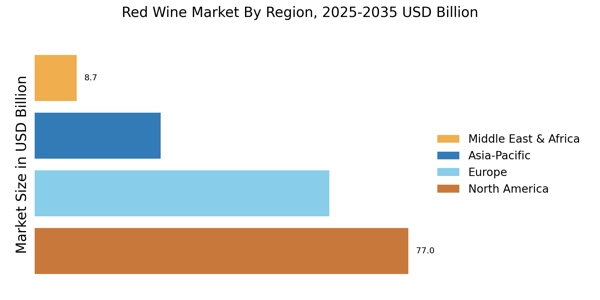
As per Market Research Future analysis, the Red Wine Market Size was estimated at 173.36 USD Billion in 2024. The Red Wine industry is projected to grow from 184.55 USD Billion in 2025 to 344.86 USD Billion by 2035, exhibiting a compound annual growth rate (CAGR) of 6.45% during the forecast period 2025 - 2035. Europe holds the largest share of the global Red Wine Market at approximately 45%, driven by centuries-old wine-producing heritage in France, Italy, and Spain, high per-capita wine consumption, and strong global demand for European-origin wines. France is the leading country within Europe, capturing approximately 18% of the global Red Wine Market share, supported by world-renowned appellations such as Bordeaux and Burgundy, a premium-positioning strategy for its wines, and strong global export demand for French red varieties including Merlot, Cabernet Sauvignon, and Pinot Noir. Still Red Wine dominates the Red Wine Market as the largest product type segment, accounting for an estimated 72% of the global market share, driven by its established position as the preferred format for everyday consumption and fine dining occasions, with broad varietal diversity appealing to consumers across all market segments.
Key Market Trends & Highlights
The Red Wine Market is currently experiencing a dynamic shift towards health-conscious consumption and innovative packaging.
- Health-conscious consumers are increasingly favoring red wine for its perceived health benefits, particularly in North America.
- E-commerce is expanding rapidly, facilitating access to a diverse range of red wines, especially in the Asia-Pacific region.
- Still red wine remains the largest segment, while sparkling red wine is witnessing the fastest growth due to changing consumer preferences.
- The growth of the market is driven by the health benefits of red wine and the rising popularity of sustainable and organic practices.
Market Size & Forecast
| 2024 Market Size | 173.36 (USD Billion) |
| 2035 Market Size | 344.86 (USD Billion) |
| CAGR (2025 - 2035) | 6.45% |
Major Players
E. & J. Gallo Winery (US), Constellation Brands (US), Pernod Ricard (FR), Treasury Wine Estates (AU), The Wine Group (US), Diageo (GB), Jackson Family Wines (US), Château Ste. Michelle (US)