Download Free Sample
Kindly complete the form below to receive a free sample of this Report
Respiratory Equipment Maintenance and Repair Services Market Research Report By Service Type (Preventive Maintenance, Repair Services, Calibration Services, Emergency Services), By Equipment Type (Ventilators, Nebulizers, CPAP Devices, Oxygen Concentrators), By Application (Home Care, Hospital, Emergency Services, Long-term Care, Portable Devices), By End Use (Healthcare Facilities, Individual Patients, Research Institutions, Emergency Medical Services) And By Region (North America, Europe, Asia-Pacific, And Rest Of The World) – Market Forecast Till 2035.
As per MRFR analysis, the Respiratory Equipment Maintenance and Repair Services Market was estimated at 7.5 USD Billion in 2024. The respiratory equipment maintenance and repair services industry is projected to grow from 7.79 USD Billion in 2025 to 11.3 USD Billion by 2035, exhibiting a compound annual growth rate (CAGR) of 3.8% during the forecast period 2025 - 2035.
The Respiratory Equipment Maintenance and Repair Services Market is poised for growth driven by technological advancements and increasing healthcare demands.
| 2024 Market Size | 7.5 (USD Billion) |
| 2035 Market Size | 11.3 (USD Billion) |
| CAGR (2025 - 2035) | 3.8% |
Philips (NL), Medtronic (US), GE Healthcare (US), ResMed (AU), Fisher & Paykel Healthcare (NZ), Becton Dickinson (US), Dragerwerk (DE), Invacare (US), AirSep Corporation (US)
Our Impact
Enabled $4.3B Revenue Impact for Fortune 500 and Leading Multinationals
Partnering with 2000+ Global Organizations Each Year
30K+ Citations by Top-Tier Firms in the Industry
The Respiratory Equipment Maintenance and Repair Services Market is currently experiencing a notable evolution, driven by the increasing demand for reliable respiratory devices across various healthcare settings. As healthcare providers prioritize patient safety and equipment reliability, the emphasis on regular maintenance and timely repairs has intensified. This trend is further fueled by advancements in technology, which necessitate specialized knowledge for effective servicing. Moreover, the growing awareness of the importance of preventive maintenance is likely to enhance the overall efficiency and longevity of respiratory equipment, thereby reducing the risk of equipment failure during critical moments. In addition, the market appears to be influenced by regulatory changes and standards that govern the operation of medical devices. Compliance with these regulations necessitates a robust maintenance and repair framework, compelling healthcare facilities to invest in professional services. Furthermore, the rise of telehealth and remote monitoring solutions may also impact the demand for maintenance services, as these technologies often require ongoing support and updates. Overall, the Respiratory Equipment Maintenance and Repair Services Market is poised for growth, driven by a combination of technological advancements, regulatory requirements, and an increasing focus on patient care quality.
The integration of advanced technologies in respiratory equipment is reshaping maintenance and repair services. Innovations such as smart sensors and IoT connectivity enable real-time monitoring, which may facilitate proactive maintenance strategies. This shift towards predictive maintenance could potentially reduce downtime and enhance the reliability of respiratory devices.
The evolving landscape of healthcare regulations is significantly impacting the Respiratory Equipment Maintenance and Repair Services Market. Stricter compliance requirements necessitate regular servicing and documentation, compelling healthcare providers to engage professional services to ensure adherence to safety standards and operational efficiency.
There is a growing recognition of the value of preventive maintenance in the healthcare sector. This trend suggests that healthcare facilities are increasingly prioritizing routine checks and servicing to prevent equipment failures. Such proactive measures are likely to enhance patient safety and optimize the performance of respiratory devices.
The increasing incidence of respiratory diseases, such as asthma and chronic obstructive pulmonary disease (COPD), drives demand for respiratory equipment maintenance and repair services. According to recent data, respiratory diseases affect millions, necessitating reliable equipment for effective management. This trend indicates a growing need for the Respiratory Equipment Maintenance and Repair Services Market, as healthcare providers seek to ensure that their equipment is functioning optimally to support patient care. The rising patient population requiring respiratory support amplifies the urgency for regular maintenance and timely repairs, thereby enhancing the market's growth potential.
There is a notable shift towards preventive healthcare, which significantly impacts the Respiratory Equipment Maintenance and Repair Services Market. Healthcare providers increasingly recognize the importance of regular maintenance to prevent equipment failures and ensure optimal patient outcomes. This proactive approach not only enhances the reliability of respiratory devices but also reduces long-term costs associated with emergency repairs. As awareness of preventive measures grows, the demand for maintenance services is likely to increase, positioning the market for sustained growth as healthcare systems prioritize preventive strategies in respiratory care.
Stringent regulatory standards and compliance requirements play a pivotal role in shaping the Respiratory Equipment Maintenance and Repair Services Market. Healthcare facilities are mandated to adhere to specific guidelines regarding equipment maintenance to ensure patient safety and quality of care. Non-compliance can result in severe penalties, prompting healthcare providers to invest in regular maintenance and repair services. This regulatory landscape fosters a robust market environment, as organizations seek to align with best practices and maintain accreditation, thereby driving demand for specialized services in the respiratory equipment sector.
Technological advancements in respiratory equipment, including the development of smart devices and telehealth solutions, significantly influence the Respiratory Equipment Maintenance and Repair Services Market. These innovations necessitate specialized maintenance and repair services to ensure optimal performance and longevity. As equipment becomes more sophisticated, the complexity of repairs increases, leading to a higher demand for skilled technicians. The market is projected to expand as healthcare facilities invest in advanced respiratory technologies, which in turn requires ongoing maintenance and support services to meet regulatory standards and patient safety requirements.
The aging population is a critical driver for the Respiratory Equipment Maintenance and Repair Services Market. As individuals age, the likelihood of developing respiratory conditions rises, leading to increased demand for respiratory equipment. Furthermore, higher healthcare expenditure among older adults translates into greater investment in maintenance and repair services to ensure that equipment remains functional and safe. This demographic shift suggests a sustained growth trajectory for the market, as healthcare providers prioritize the upkeep of respiratory devices to cater to the needs of an aging population.
The Respiratory Equipment Maintenance and Repair Services Market showcases a diverse range of applications, with Home Care leading the sector due to the increasing prevalence of chronic respiratory diseases and the rising preference for at-home healthcare solutions. Following behind are Hospital and Long-term Care segments, which also possess significant shares owing to increased hospital admissions and extended patient care needs. Portable Devices and Emergency Services, while smaller, contribute valuable growth potential thanks to their specialized functionalities in acute situations.
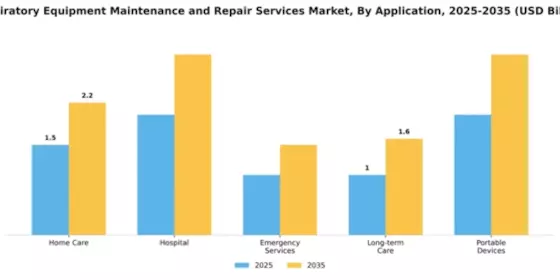
Home Care (Dominant) vs. Emergency Services (Emerging)
The Home Care segment stands out as the dominant force in the Respiratory Equipment Maintenance and Repair Services Market, offering tailored solutions for patients requiring ongoing respiratory support at home. This segment benefits from an aging population and a shift toward patient-centric care models, emphasizing independence and comfort. In contrast, the Emergency Services segment is rapidly emerging as a critical player, addressing immediate respiratory needs in acute settings. While smaller in market share, the growth of this segment is driven by advancements in technology and enhanced training for emergency personnel, enabling more effective and timely interventions in respiratory crises.
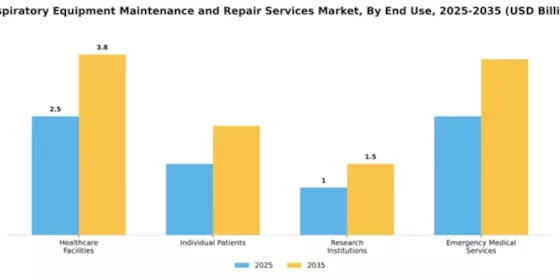
In the Respiratory Equipment Maintenance and Repair Services Market, Healthcare Facilities hold a significant leading share due to their robust infrastructure and continual demand for maintenance services. This segment encompasses hospitals, clinics, and long-term care facilities, where respiratory devices are extensively used. On the other hand, Individual Patients represent the fastest-growing segment as the rise of home healthcare solutions and increasing rates of respiratory diseases drive demand for timely maintenance and repair services within a personal context.
Healthcare Facilities (Dominant) vs. Individual Patients (Emerging)
The Healthcare Facilities segment is characterized by a steady demand for maintenance and repair services due to regulatory compliance and the need for optimal functionality of respiratory equipment in clinical settings. These facilities often have established contracts with service providers, ensuring the consistent upkeep of life-sustaining devices. In contrast, the Individual Patients segment is rapidly catching up, driven by the shift towards home healthcare and personal monitoring solutions. This segment requires tailored maintenance services that cater to the unique needs of patients using respiratory aids at home, reflecting a growing trend towards patient-centered care.
In the Respiratory Equipment Maintenance and Repair Services Market, the segment is primarily dominated by Ventilators, which command the largest market share due to their critical role in patient care, particularly in intensive care settings. Nebulizers, while smaller in overall share, are rapidly gaining traction, indicating a growing preference among patients for at-home respiratory treatments and a shift towards non-invasive solutions. Market growth in this segment is driven by factors such as the rising prevalence of respiratory diseases, including asthma and COPD, which necessitates reliable equipment for management and treatment. Additionally, technological advancements in ventilators and nebulizers are enhancing their efficiency and usability, further driving market penetration. As healthcare systems increasingly prioritize maintenance and repair services for these devices, overall demand surges, leading to a robust service market.
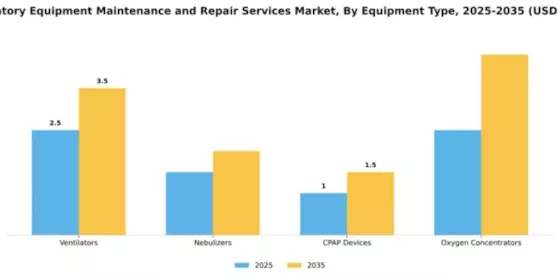
Ventilators (Dominant) vs. CPAP Devices (Emerging)
Ventilators play a crucial role in respiratory care, especially in critical environments, making them the dominant force within the Respiratory Equipment Maintenance and Repair Services Market. Their complexity requires specialized maintenance to ensure functionality and patient safety. Conversely, CPAP devices, often used for sleep apnea treatment, represent an emerging market segment with increasing adoption due to rising awareness of sleep disorders. The growth of CPAP devices is fueled by advancements in portability and user-friendliness, appealing to a broader audience. Both segments emphasize the necessity for expert maintenance services that ensure the operational efficiency and longevity of these devices, making them integral to healthcare providers' respiratory management solutions.
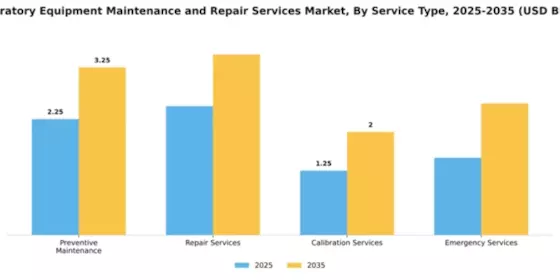
In the Respiratory Equipment Maintenance and Repair Services Market, Preventive Maintenance holds the largest share among service types, providing consistent revenue stability and ensuring the longevity of equipment. This segment is crucial as it helps healthcare facilities maintain operational efficiency and compliance with health regulations. While Preventive Maintenance is well-established, Repair Services is gaining traction, driven by an increasing number of respiratory device users requiring urgent repairs to minimize equipment downtime. Growth trends in this market segment indicate a rising demand for Repair Services due to the aging population and the prevalence of respiratory diseases. This surge is compounded by advancements in medical technology that necessitate regular tuning and calibration. Emergency Services also reflect upward trends, highlighting the market's focus on immediate response capabilities, reinforced by an increasing emphasis on patient care and equipment reliability in healthcare setups.
Preventive Maintenance (Dominant) vs. Calibration Services (Emerging)
Preventive Maintenance has established itself as a dominant force within the Respiratory Equipment Maintenance and Repair Services Market, emphasizing the necessity of regular care to prevent equipment failure and ensure patient safety. This service involves scheduled inspections, routine cleaning, and necessary adjustments that extend the lifespan of respiratory devices. In contrast, Calibration Services emerge as a significant factor in enhancing the accuracy and efficiency of these devices, especially with the growing importance of precise measurements in respiratory care. As healthcare providers prioritize quality assurance and accurate functionality, Calibration Services are rapidly becoming essential, bridging the gap between existing equipment and the evolving standards in respiratory health.
Get more detailed insights about Respiratory Equipment Maintenance and Repair Services Market Request Free Sample
North America is poised to maintain its leadership in the Respiratory Equipment Maintenance and Repair Services Market, holding a market size of $3.75B in 2025. Key growth drivers include an aging population, increasing prevalence of respiratory diseases, and advancements in technology. Regulatory support, such as Medicare reimbursements for maintenance services, further fuels demand. The region's robust healthcare infrastructure and high healthcare expenditure also contribute significantly to market growth. The competitive landscape is characterized by major players like Medtronic, GE Healthcare, and Philips, which dominate the market with innovative solutions. The U.S. is the leading country, accounting for the majority of the market share, driven by high demand for home healthcare services. The presence of established companies ensures a competitive environment, fostering continuous improvement and service quality in respiratory care.
Europe's Respiratory Equipment Maintenance and Repair Services Market is projected to reach $2.25B by 2025, driven by increasing awareness of respiratory health and supportive regulatory frameworks. The region benefits from a strong emphasis on healthcare quality and patient safety, with regulations promoting regular maintenance of respiratory devices. Countries like Germany and France are leading the charge, with significant investments in healthcare infrastructure and technology. The competitive landscape features key players such as Dragerwerk and ResMed, which are expanding their service offerings to meet growing demand. The presence of a well-established healthcare system in countries like the UK and Germany supports the market's growth. Additionally, the European Union's regulations on medical devices ensure high standards, further enhancing service quality and reliability in the respiratory equipment sector.
The Asia-Pacific region is witnessing significant growth in the Respiratory Equipment Maintenance and Repair Services Market, projected to reach $1.5B by 2025. Key drivers include rising air pollution levels, increasing respiratory diseases, and a growing elderly population. Governments are also implementing policies to improve healthcare access, which is expected to boost demand for maintenance services. Countries like China and India are at the forefront, with substantial investments in healthcare infrastructure. The competitive landscape is evolving, with local players emerging alongside established companies like Fisher & Paykel Healthcare. The region's diverse market presents both challenges and opportunities, as varying regulations and healthcare standards exist across countries. However, the increasing focus on healthcare quality and patient outcomes is driving companies to enhance their service offerings, ensuring a competitive edge in the market.
The Middle East and Africa region currently shows minimal market activity in the Respiratory Equipment Maintenance and Repair Services Market, with a size of $0.0B in 2025. Challenges such as limited healthcare infrastructure, low awareness of respiratory health, and economic constraints hinder market growth. However, there is potential for development as governments begin to recognize the importance of respiratory care, especially in light of increasing pollution and respiratory diseases. Countries like South Africa and the UAE are gradually improving their healthcare systems, which may lead to future market opportunities. The presence of international players could stimulate growth, but significant investment in local healthcare infrastructure is necessary. As awareness increases, the demand for maintenance services may rise, paving the way for a more robust market in the coming years.
The Respiratory Equipment Maintenance and Repair Services Market is characterized by a dynamic competitive landscape, driven by technological advancements and an increasing demand for high-quality respiratory care. Key players such as Philips (NL), Medtronic (US), and ResMed (AU) are strategically positioned to leverage innovation and expand their service offerings. Philips (NL) focuses on enhancing its digital health solutions, which aligns with the growing trend towards telehealth and remote monitoring. Meanwhile, Medtronic (US) emphasizes strategic partnerships to enhance its service capabilities, thereby strengthening its market presence. ResMed (AU) is actively investing in AI-driven technologies to optimize equipment maintenance, which reflects a broader industry shift towards data-driven decision-making. Collectively, these strategies contribute to a competitive environment that prioritizes technological integration and service excellence.In terms of business tactics, companies are increasingly localizing manufacturing to reduce lead times and enhance supply chain efficiency. The market appears moderately fragmented, with several players vying for market share while also collaborating through strategic alliances. This collective influence of key players fosters a competitive structure that encourages innovation and responsiveness to market demands.In November Philips (NL) announced a significant partnership with a leading telehealth provider to enhance remote monitoring capabilities for respiratory patients. This strategic move is likely to bolster Philips' service offerings, allowing for more comprehensive patient management and potentially improving patient outcomes. The partnership underscores the importance of integrating technology into service delivery, which is becoming a critical differentiator in the market.In October Medtronic (US) launched a new predictive maintenance program aimed at reducing equipment downtime for healthcare providers. This initiative is strategically important as it not only enhances customer satisfaction but also positions Medtronic as a leader in proactive service solutions. By leveraging data analytics, the company aims to anticipate maintenance needs, thereby optimizing operational efficiency for its clients.In September ResMed (AU) unveiled an innovative AI-based diagnostic tool designed to streamline the maintenance process for respiratory devices. This development is significant as it reflects ResMed's commitment to integrating cutting-edge technology into its service offerings. The tool is expected to enhance the accuracy of diagnostics, thereby improving service delivery and reinforcing ResMed's competitive edge in the market.As of December current competitive trends indicate a strong emphasis on digitalization, sustainability, and AI integration within the Respiratory Equipment Maintenance and Repair Services Market. Strategic alliances are increasingly shaping the landscape, enabling companies to pool resources and expertise. Looking ahead, competitive differentiation is likely to evolve from traditional price-based competition towards a focus on innovation, technology, and supply chain reliability. This shift suggests that companies that prioritize these elements will be better positioned to thrive in an increasingly complex market.






The Respiratory Equipment Maintenance and Repair Services Market is projected to grow at a 3.8% CAGR from 2025 to 2035, driven by technological advancements and increasing healthcare demands.
New opportunities lie in:
By 2035, the market is expected to be robust, reflecting sustained growth and innovation.
| MARKET SIZE 2024 | 7.5(USD Billion) |
| MARKET SIZE 2025 | 7.79(USD Billion) |
| MARKET SIZE 2035 | 11.3(USD Billion) |
| COMPOUND ANNUAL GROWTH RATE (CAGR) | 3.8% (2025 - 2035) |
| REPORT COVERAGE | Revenue Forecast, Competitive Landscape, Growth Factors, and Trends |
| BASE YEAR | 2024 |
| Market Forecast Period | 2025 - 2035 |
| Historical Data | 2019 - 2024 |
| Market Forecast Units | USD Billion |
| Key Companies Profiled | Philips (NL), Medtronic (US), GE Healthcare (US), ResMed (AU), Fisher & Paykel Healthcare (NZ), Becton Dickinson (US), Dragerwerk (DE), Invacare (US), AirSep Corporation (US) |
| Segments Covered | Application, End Use, Equipment Type, Service Type |
| Key Market Opportunities | Integration of advanced telehealth solutions enhances accessibility in the Respiratory Equipment Maintenance and Repair Services Market. |
| Key Market Dynamics | Rising demand for advanced respiratory devices drives growth in maintenance and repair service requirements across healthcare sectors. |
| Countries Covered | North America, Europe, APAC, South America, MEA |
The market valuation reached 7.5 USD Billion in 2024.
The market is expected to grow to 11.3 USD Billion by 2035.
The anticipated CAGR for the market is 3.8% from 2025 to 2035.
The Hospital segment is projected to grow from 2.0 USD Billion to 3.0 USD Billion.
Preventive maintenance services are expected to grow from 2.25 USD Billion to 3.25 USD Billion, while repair services are projected to increase from 2.5 USD Billion to 3.5 USD Billion.
Key players include Philips, Medtronic, GE Healthcare, ResMed, and Fisher & Paykel Healthcare.
Oxygen concentrators are projected to grow from 2.5 USD Billion to 4.3 USD Billion.
Emergency medical services are projected to increase from 2.5 USD Billion to 3.7 USD Billion.
The market for individual patients is expected to grow from 1.5 USD Billion to 2.3 USD Billion, while healthcare facilities are projected to increase from 2.5 USD Billion to 3.8 USD Billion.
Trends include advancements in technology and increasing demand for home care solutions, impacting various segments.


Kindly complete the form below to receive a free sample of this Report

“This is really good guys. Excellent work on a tight deadline. I will continue to use you going forward and recommend you to others. Nice job”


“Thanks. It’s been a pleasure working with you, please use me as reference with any other Intel employees.”


“Thanks for sending the report it gives us a good global view of the Betaïne market.”


“Thank you, this will be very helpful for OQS.”


“We found the report very insightful! we found your research firm very helpful. I'm sending this email to secure our future business.”


“I am very pleased with how market segments have been defined in a relevant way for my purposes (such as "Portable Freezers & refrigerators" and "last-mile"). In general the report is well structured. Thanks very much for your efforts.”


“I have been reading the first document or the study, ,the Global HVAC and FP market report 2021 till 2026. Must say, good info! I have not gone in depth at all parts, but got a good indication of the data inside!”


“We got the report in time, we really thank you for your support in this process. I also thank to all of your team as they did a great job.”


“The Automotive 48V ECU Components Procurement Intelligence Study” was a complex project, but the Market Research Future (MRFR) team handled it with quality, agility, and customer-centricity. They delivered all requested data on time and within the agreed scope. The team, including Shubhendra Anand and Rahul Gotadki, was always readily available to clarify questions and swiftly implement necessary adjustments, driving the project to a successful conclusion within a very demanding timeframe.
I would also like to specifically commend Akshay Agarwal for his responsiveness and support at every stage—from our initial inquiry on May 6th through to final delivery on June 18th. His dedication made the entire process seamless.”



